Effects of compocasting process parameters on microstructural characteristics and tensile properties of A356-SiCp composites
Pith reviewed 2026-05-25 05:55 UTC · model grok-4.3
The pith
Reinforcement distribution uniformity in A356-SiCp composites matters more for tensile properties than porosity level does.
A machine-rendered reading of the paper's core claim, the machinery that carries it, and where it could break.
Core claim
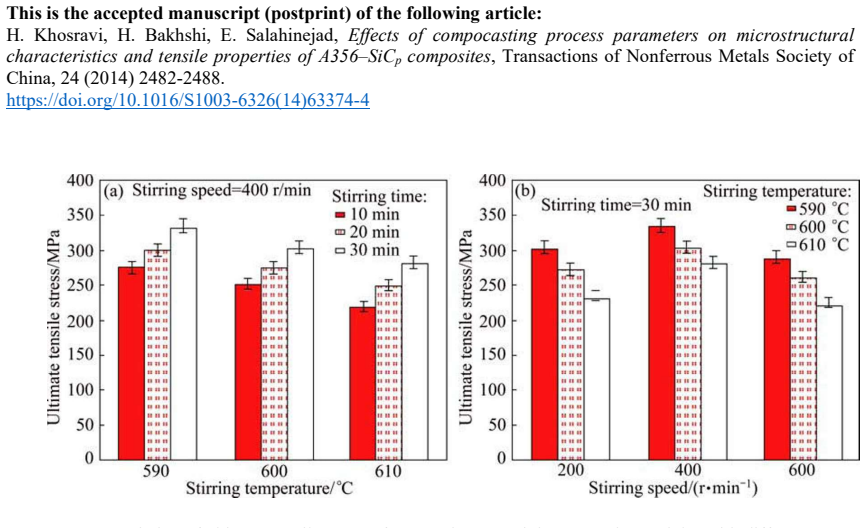
In A356-10 vol% SiCp composites made by semisolid stirring, increasing stirring time and lowering temperature improve the uniformity of SiC particle distribution while higher speeds first improve then reduce homogeneity; all three parameters raise porosity content. The tensile properties reach their maximum at 400 r/min, 590 C, and 30 min, where the benefit from uniform reinforcement distribution outweighs the negative effect of higher porosity.
What carries the argument
Semisolid stirring parameters (speed, temperature, time) that control SiC particle distribution uniformity and porosity content in the A356 matrix during compocasting.
If this is right
- Tensile properties improve most when particle distribution is made uniform even if porosity rises modestly.
- Stirring at 400 r/min, 590 C for 30 min produces the strongest samples among the tested ranges.
- Extending stirring time at lower temperature reduces clustering of SiC particles.
- Raising any of the three parameters increases porosity but this effect is secondary for strength.
- Distribution homogeneity first rises then falls as stirring speed increases.
Where Pith is reading between the lines
- Manufacturers could prioritize distribution uniformity when scaling compocasting rather than focusing solely on pore elimination.
- The same parameter ranking may guide processing of other aluminum or magnesium matrix composites with ceramic reinforcements.
- Further tests could check whether the same optimum holds when particle volume fraction or matrix alloy changes.
Load-bearing premise
Changes in measured particle distribution uniformity and porosity are the main direct reasons for the observed shifts in tensile properties.
What would settle it
Tensile strength measurements at the reported optimum parameters that fail to exceed other conditions once interface bonding quality or additional defects are separately quantified and held constant.
Figures



read the original abstract
The effects of compocasting process parameters on some structural and tensile characteristics of the A356-10% SiCp (volume fraction) composites were studied. Semisolid stirring was carried out at temperatures of 590, 600 and 610 C with stirring speeds of 200, 400 and 600 r/min for 10, 20 and 30 min. The distribution of the SiC particles within the matrix, porosity content and tensile properties of the obtained samples were examined. The structural evaluations show that by increasing the stirring time and decreasing the stirring temperature, the uniformity in the particle distribution is improved; however, by increasing the stirring speed the homogeneity firstly increases and then declines. It is also found that by increasing all of the processing parameters, the porosity content is enhanced. From the tensile characteristics viewpoint, the optimum values of the speed, temperature and time are found to be 400 r/min, 590 C and 30 min, respectively. The contribution of the reinforcement distribution uniformity prevails over that of the porosity level to the tensile properties.
Editorial analysis
A structured set of objections, weighed in public.
Referee Report
Summary. The manuscript reports an experimental parameter study on compocasting of A356 alloy with 10 vol% SiC particles. Stirring speed (200/400/600 r/min), temperature (590/600/610 °C) and time (10/20/30 min) are varied; resulting particle distribution uniformity, porosity fraction and tensile properties are characterized. The authors conclude that uniformity improves with longer time and lower temperature (non-monotonic with speed), porosity rises with all three parameters, the optimum combination is 400 r/min–590 °C–30 min, and that distribution uniformity contributes more to the observed tensile properties than porosity level does.
Significance. If the reported trends were accompanied by quantitative measurements, error analysis and controls for confounding variables, the work would supply useful process-window guidance for semisolid processing of particle-reinforced aluminum composites.
major comments (2)
- [Abstract] Abstract: the assertion that 'the contribution of the reinforcement distribution uniformity prevails over that of the porosity level to the tensile properties' is presented as a central conclusion yet rests only on simultaneous variation of three process parameters and qualitative or semi-quantitative trends; no regression analysis, partial-factorial design, or measurement of unexamined variables (interface reaction layer, matrix dendrite arm spacing, or clustering-induced stress concentrations) is described to isolate the two factors.
- [Abstract] Abstract / Results: no numerical values, error bars, standard deviations, or statistical tests are supplied for any of the reported trends in uniformity, porosity or tensile strength/elongation, preventing evaluation of whether the stated optimum is statistically distinguishable from neighboring conditions.
minor comments (1)
- [Abstract] Temperature is written as 'C' rather than '°C' throughout the abstract.
Simulated Author's Rebuttal
We thank the referee for the constructive comments. We address each major point below and indicate the revisions we will make.
read point-by-point responses
-
Referee: [Abstract] Abstract: the assertion that 'the contribution of the reinforcement distribution uniformity prevails over that of the porosity level to the tensile properties' is presented as a central conclusion yet rests only on simultaneous variation of three process parameters and qualitative or semi-quantitative trends; no regression analysis, partial-factorial design, or measurement of unexamined variables (interface reaction layer, matrix dendrite arm spacing, or clustering-induced stress concentrations) is described to isolate the two factors.
Authors: We acknowledge that the stated contribution is inferred from the observed trends across the parameter matrix rather than from a controlled isolation of variables. No regression or additional measurements of interface layers or dendrite spacing were performed. We will revise the abstract to present the finding as an observation from the experimental trends and add a brief note in the discussion on possible confounding factors. revision: partial
-
Referee: [Abstract] Abstract / Results: no numerical values, error bars, standard deviations, or statistical tests are supplied for any of the reported trends in uniformity, porosity or tensile strength/elongation, preventing evaluation of whether the stated optimum is statistically distinguishable from neighboring conditions.
Authors: The full manuscript contains figures and tables with the underlying measurements. We will incorporate explicit numerical values, standard deviations from replicate tests, and error bars into the revised results section and abstract to allow direct assessment of the optimum condition. revision: yes
Circularity Check
No circularity: purely experimental parameter study with no derivations or self-referential fits
full rationale
The manuscript is an experimental investigation that varies compocasting parameters (speed, temperature, time), measures particle distribution uniformity and porosity, and reports resulting tensile properties. No equations, models, or derivations are present that could reduce any claim to its own inputs. The statement that uniformity 'prevails' over porosity is an interpretive summary of observed trends, not a fitted quantity or self-citation chain. No self-citations, ansatzes, or uniqueness theorems are invoked. The paper is self-contained against external benchmarks as a standard process-parameter study.
Axiom & Free-Parameter Ledger
axioms (2)
- domain assumption Standard metallographic preparation and image analysis accurately quantify SiC particle distribution and porosity.
- domain assumption Tensile testing follows established procedures and specimen geometry that reflect bulk material behavior.
Reference graph
Works this paper leans on
-
[1]
ZnO: Synthesis of cast metal matrix particulate composites [J]
RAY S. ZnO: Synthesis of cast metal matrix particulate composites [J]. Journal of Materials Science, 1993, 28(1): 5397−5413
work page 1993
-
[2]
Particulate reinforced metal matrix composite—A review [J]
HOKAED E, LAVERINYA J. Particulate reinforced metal matrix composite—A review [J]. J Mater Sci, 1999, 92(1): 1−7
work page 1999
-
[3]
CHAWLA N, CHAWLA K K. Metal matrix composites [M]. New York: Springer, 2006
work page 2006
-
[4]
Composite materials: Science and engineering [M]
CHAWLA K K. Composite materials: Science and engineering [M]. 2nd ed. New York: Springer Verlag, 2001
work page 2001
-
[5]
TANG F, ANDERSON I E. GNAUPEL-HEROLD T. Pure Al matrix composites produced by vacuum hot pressing: Tensile properties and strengthening mechanisms [J]. Materials Science and Engineering A, 2004, 383: 362−373
work page 2004
-
[6]
Particle reinforced aluminum and magnesium matrix composites [J]
LLOYD D J. Particle reinforced aluminum and magnesium matrix composites [J]. International Materials Review, 1994, 39(1): 1−21
work page 1994
-
[7]
HONG S J, KIN H M, HUH D. Effect of clustering on the mechanical properties of SiC particulate- reinforced aluminum alloy 2024 metal matrix composites [J]. Materials Science and Engineering A, 2003, 347: 198−204
work page 2024
-
[9]
Wear behavior of Al−Mg−Cu-based composites containing SiC particles [J]
ADEL M H, ALRASHDAN A, MOHAMMED T. Wear behavior of Al−Mg−Cu-based composites containing SiC particles [J]. Tribology International, 2009, 42: 1230−1238
work page 2009
-
[10]
Compocasting of A356-CNT composite [J]
ABBASIPOUR B, NIROUMAND B, MONIR VAGHEFI S M. Compocasting of A356-CNT composite [J]. Transactions of Nonferrous Metals Society of China, 2010, 20(9): 1561−1566
work page 2010
-
[11]
Synthesis and characterization of 356-SiCp composites by stir casting and compocasting methods [J]
AMIRKHANLOU S, NIROUMAND B. Synthesis and characterization of 356-SiCp composites by stir casting and compocasting methods [J]. Transactions of Nonferrous Metals Society of China, 2010, 20(S3): s788−s793
work page 2010
-
[12]
ZHANG H, GENG L, GUAN L, HUANG L. Effects of SiC particle pretreatment and stirring parameters on the microstructure and mechanical properties of SiCp/Al−6.8Mg composites fabricated by semi-solid stirring technique [J]. Materials Science and Engineering A, 2010, 528: 513−518
work page 2010
-
[13]
AKHLAGHI F, LAJEVARDI A, MAGHANAKI H M. Effects of casting temperature on the microstructure and wear resistance of compocast A356/SiCp composites: A comparison between SS and SL routes [J]. Journal of Materials Processing Technology, 2004, 155−156: 1874−1880
work page 2004
-
[14]
SAJJADIS A, TORABI-PARIZI M, EZATPOURH R, SEDGHI A. Fabrication of A356 composite reinforced with micro and nano Al2O3 particles by a developed compocasting method and study of its properties [J]. Journal of Alloys and Compounds, 2012, 511: 226−231
work page 2012
-
[15]
Settling of silicon carbide particles in cast metal matrix composites [J]
OURDJINI A, CHEW K, KHOO C. Settling of silicon carbide particles in cast metal matrix composites [J]. Journal of Materials Processing Technology, 2001, 116: 72−76
work page 2001
-
[16]
Gravity and temperature effects on particle distribution in Al−Si/SiCp composites [J]
VUGT L V, FROYEN L. Gravity and temperature effects on particle distribution in Al−Si/SiCp composites [J]. Journal of Materials Processing Technology, 2000, 104: 133−144
work page 2000
-
[17]
GUPTA M, LU L, ANG S E. Effect of microstructural features on the aging behavior of Al−Cu/SiC metal matrix composites processed using casting and rheocasting routes [J]. Materials Science, 1997, 32: 1261−1267. This is the accepted manuscript (postprint) of the following article: H. Khosravi, H. Bakhshi, E. Salahinejad, Effects of compocasting process para...
-
[18]
Effect of solidification rate on spatial distribution of SiC particles in A356 alloy composites [J]
CETIN A, KALKANLI A. Effect of solidification rate on spatial distribution of SiC particles in A356 alloy composites [J]. Journal of Materials Processing Technology, 2008, 205: 1−8
work page 2008
-
[19]
Effect of extrusion temperature on the microstructure and porosity of A356−SiCp composites [J]
RAHMANI R, AKHLAGHI F. Effect of extrusion temperature on the microstructure and porosity of A356−SiCp composites [J]. Journal of Materials Processing Technology, 2007, 187−188: 433−436
work page 2007
-
[20]
GOSH P K, RAY S. Influence of process parameters on the porosity content in Al(Mg)−Al2O3 cast particulate composite produced by vortex method [J]. Journal of Material Transactions A, 2003, 47: 775−782
work page 2003
-
[21]
Porosity nucleation in metal matrix composites [J]
ILEGBUSI O J, YANG J. Porosity nucleation in metal matrix composites [J]. Metallurgical and Materials Transactions A, 2000, 31: 2069−2080
work page 2000
-
[22]
DENG X, CHAWLA N. Modeling the effect of particle clustering on the mechanical behavior of SiC particle reinforced Al matrix composites [J]. J Mater Sci, 2006, 41: 5731−5734
work page 2006
-
[23]
Effects of volume fraction of SiC particles on mechanical properties of SiC/Al composites [J]
SONG M. Effects of volume fraction of SiC particles on mechanical properties of SiC/Al composites [J]. Transactions of Nonferrous Metals Society of China, 2009, 19(6): 1400−1404
work page 2009
-
[24]
Effect of particle distribution on deformation and damage of two- phase alloys [J]
CONLON K T, WILKINSON D S. Effect of particle distribution on deformation and damage of two- phase alloys [J]. Materials Science and Engineering A, 2001, 317: 108−114
work page 2001
discussion (0)
Sign in with ORCID, Apple, or X to comment. Anyone can read and Pith papers without signing in.