GFSR: Geometric Fidelity and Spatial Refinement for Reliable Lane Detection
Pith reviewed 2026-05-25 05:03 UTC · model grok-4.3
The pith
A lane detection method calibrates classification confidence with a separate geometric fidelity measure and refines sampling points adaptively to retain better lane representations in complex scenes.
A machine-rendered reading of the paper's core claim, the machinery that carries it, and where it could break.
Core claim
The central claim is that LaneIoU-guided Confidence Calibration builds a collaborative reliability index by treating LaneIoU as soft supervision for geometric fidelity and fusing it with classification confidence, which then directs threshold filtering and NMS to favor priors that are both categorically likely and geometrically sound; at the same time, Adaptive Gated Location Refinement predicts lateral offsets for sampling points and uses a gate to control correction strength, thereby restoring inter-point correlations and increasing robustness on distant, high-curvature, and topologically complex lanes.
What carries the argument
The collaborative reliability index formed by fusing classification confidence with LaneIoU-based geometric fidelity, together with the adaptive gating mechanism inside location refinement.
If this is right
- Threshold filtering and NMS keep lane candidates that have good geometric fit even when their classification score is only moderate.
- Regression training benefits from maintained correlations among sampling points, reducing underfitting on high-curvature and distant lanes.
- The model gains adaptability to complex lane topologies without requiring changes to the base architecture.
- Perception output becomes more consistent for downstream planning modules in autonomous driving.
Where Pith is reading between the lines
- The separation of geometric fidelity from classification confidence could apply to other curve or line detection problems in vision.
- The gated refinement idea might transfer to tasks that require coordinated adjustment of multiple points, such as boundary or contour prediction.
- Adding temporal consistency across frames could further stabilize the retained lanes in video sequences.
Load-bearing premise
That LaneIoU supplies a reliable soft supervision signal for geometric fidelity whose fusion with classification confidence yields better filtering and suppression decisions than confidence alone.
What would settle it
An ablation that removes the LaneIoU component from the reliability index and shows no loss in accuracy on test sets containing many curved or distant lanes.
Figures


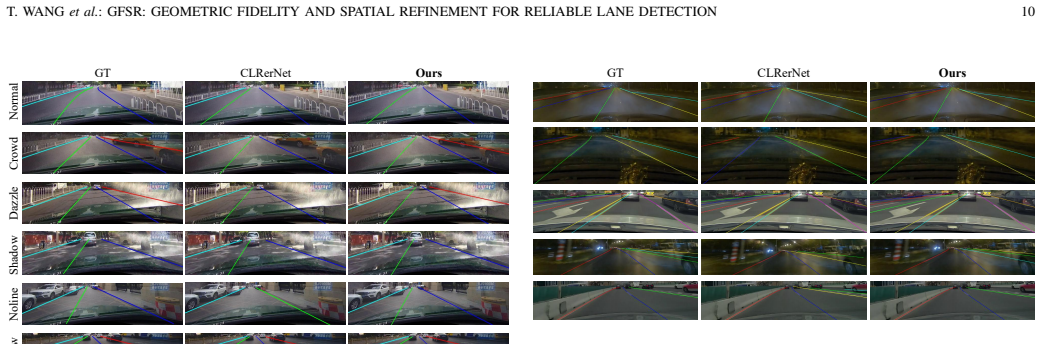


read the original abstract
Lane detection stands as a crucial perception task in autonomous driving and advanced driver assistance systems. However, existing methods still degrade in complex real scenarios due to two major limitations. First, classification confidence only characterizes the categorical existence of lane priors and has no strong correlation with geometric quality. If threshold filtering and NMS are conducted merely based on this confidence, the model tends to retain lane priors with high confidence while eliminating those with lower confidence but superior geometric representation. Secondly, the regression modules in existing methods weaken correlations among sampling points, hindering fine-grained optimization of distant, high-curvature and complex-topology lanes and causing underfitting. To address these issues, we propose Geometric Fidelity and Spatial Refinement (GFSR), a framework consisting of LaneIoU-guided Confidence Calibration (LCC) and Adaptive Gated Location Refinement (AGLR). Specifically, LCC adopts LaneIoU as soft supervision to explicitly estimate the geometric fidelity of lane priors, which is further fused with classification confidence to construct the Collaborative Reliability Index (CRI). This index guides lane prior filtering, effectively retaining those with high classification confidence and favorable geometric quality. Meanwhile, cooperating with regression heads in each refinement stage, AGLR predicts sampling point lateral offsets and adopts a gating mechanism to adaptively regulate correction magnitude, strengthen inter-point correlations and boost model adaptability as well as robustness toward complex lane scenarios. Extensive experiments on CULane and CurveLanes demonstrate that our GFSR achieves state-of-the-art performance on CULane, with F1_50 and F1_75 scores of 81.46% and 65.01%, and reaches 87.35% F1_50 on CurveLanes.
Editorial analysis
A structured set of objections, weighed in public.
Referee Report
Summary. The paper proposes GFSR, consisting of LaneIoU-guided Confidence Calibration (LCC) that fuses LaneIoU-based geometric fidelity estimates with classification confidence into a Collaborative Reliability Index (CRI) for threshold filtering and NMS, plus Adaptive Gated Location Refinement (AGLR) that predicts lateral offsets with a gating mechanism to strengthen inter-point correlations. It reports state-of-the-art F1@50 of 81.46% and F1@75 of 65.01% on CULane and 87.35% F1@50 on CurveLanes, attributing gains to better retention of geometrically high-quality lanes and improved regression on complex scenarios.
Significance. If the reported gains are shown to stem from the proposed CRI fusion and gating rather than baseline differences, the approach could meaningfully improve reliability of lane detection in autonomous driving by mitigating the known mismatch between classification confidence and geometric accuracy. Concrete F1 numbers on public benchmarks are a strength, but the absence of supporting controls limits the assessed impact.
major comments (3)
- [Abstract] Abstract / LCC description: The claim that fusing LaneIoU with classification confidence into CRI yields better filtering/NMS decisions than confidence alone is load-bearing for the SOTA attribution, yet no correlation coefficients between LaneIoU and geometric error, no ablation isolating the fusion, and no comparison of retained-lane geometric error under CRI vs. confidence-only are supplied.
- [Experiments] Experiments section: Reported F1 scores on CULane and CurveLanes are given without error bars, statistical significance tests, or explicit details on baseline re-implementations and hyper-parameters, leaving the performance claim weakly supported as noted in the soundness assessment.
- [LCC description] LCC module description: The premise that LaneIoU supplies a reliable soft supervision signal for geometric fidelity (stronger than raw confidence) is asserted without empirical verification such as scatter plots or quantitative correlation metrics against ground-truth geometric deviation.
minor comments (1)
- [Abstract] Abstract: The phrase 'reaches 87.35% F1@50 on CurveLanes' could specify the exact metric variant (e.g., whether it is also F1@75) for consistency with the CULane reporting.
Simulated Author's Rebuttal
We thank the referee for their constructive feedback on our manuscript. The comments identify key areas where additional empirical support can strengthen the presentation of our contributions. We provide point-by-point responses below and commit to revisions that address these concerns.
read point-by-point responses
-
Referee: [Abstract] Abstract / LCC description: The claim that fusing LaneIoU with classification confidence into CRI yields better filtering/NMS decisions than confidence alone is load-bearing for the SOTA attribution, yet no correlation coefficients between LaneIoU and geometric error, no ablation isolating the fusion, and no comparison of retained-lane geometric error under CRI vs. confidence-only are supplied.
Authors: We agree that these analyses are necessary to substantiate the claims regarding the CRI. In the revised version, we will incorporate correlation coefficients between LaneIoU and geometric error, an ablation study isolating the fusion component, and a comparison of geometric errors for lanes retained under CRI versus confidence-only filtering. These additions will be placed in the Experiments section. revision: yes
-
Referee: [Experiments] Experiments section: Reported F1 scores on CULane and CurveLanes are given without error bars, statistical significance tests, or explicit details on baseline re-implementations and hyper-parameters, leaving the performance claim weakly supported as noted in the soundness assessment.
Authors: We acknowledge this point. We will perform multiple runs with different seeds to report F1 scores with error bars (mean ± std). Statistical significance tests will be added where relevant. We will also expand the description of baseline re-implementations and provide complete hyper-parameter details in the revised manuscript and supplementary material. revision: yes
-
Referee: [LCC description] LCC module description: The premise that LaneIoU supplies a reliable soft supervision signal for geometric fidelity (stronger than raw confidence) is asserted without empirical verification such as scatter plots or quantitative correlation metrics against ground-truth geometric deviation.
Authors: We accept that empirical verification is warranted. The revised manuscript will include scatter plots and quantitative correlation metrics (such as Pearson's r) between LaneIoU and ground-truth geometric deviation to support the use of LaneIoU as a soft supervision signal. revision: yes
Circularity Check
No circularity; empirical claims rest on public-dataset evaluation
full rationale
The paper defines LCC using LaneIoU as soft supervision and fuses it into CRI for filtering/NMS, then reports F1 scores on CULane and CurveLanes. No equations reduce any claimed prediction or uniqueness result to a fitted quantity defined by the method itself, no self-citation chain bears the central performance claim, and no ansatz or renaming is smuggled in. The derivation chain is therefore self-contained against external benchmarks.
Axiom & Free-Parameter Ledger
free parameters (1)
- neural network parameters
axioms (1)
- domain assumption CULane and CurveLanes contain representative examples of complex real-world lane scenarios
discussion (0)
Sign in with ORCID, Apple, or X to comment. Anyone can read and Pith papers without signing in.