Probing Solar Wind Structures with Solar Energetic Particle Observations from Solar Orbiter
Pith reviewed 2026-05-25 02:51 UTC · model grok-4.3
The pith
Solar Orbiter data show solar energetic particle flux deflections marking magnetic flux tube boundaries in the solar wind.
A machine-rendered reading of the paper's core claim, the machinery that carries it, and where it could break.
Core claim
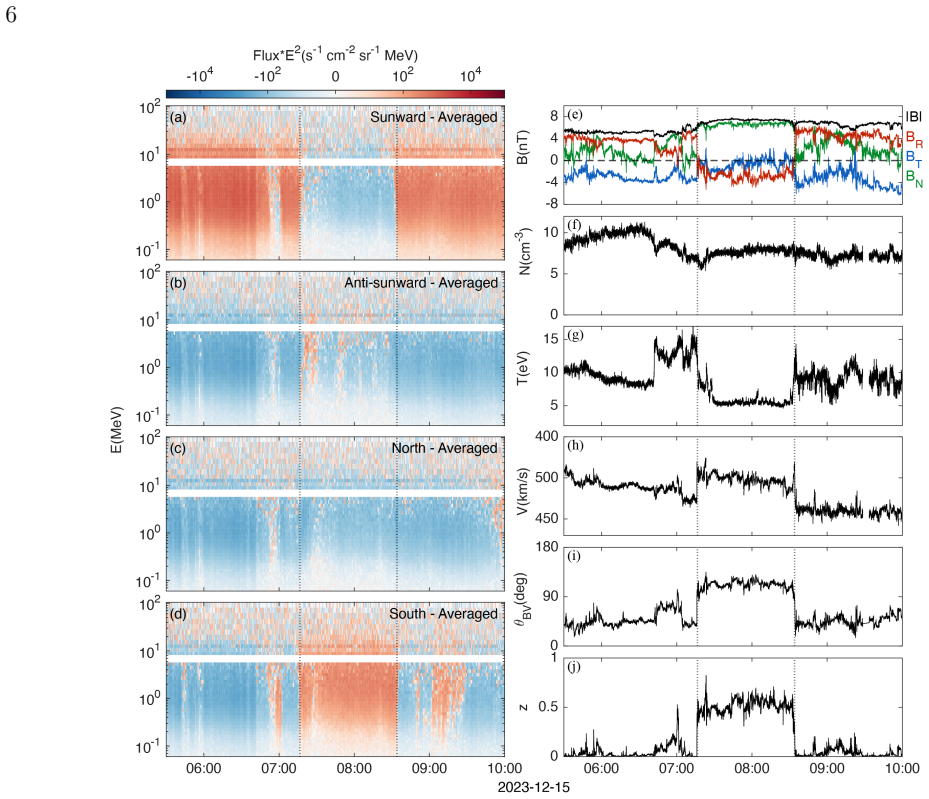
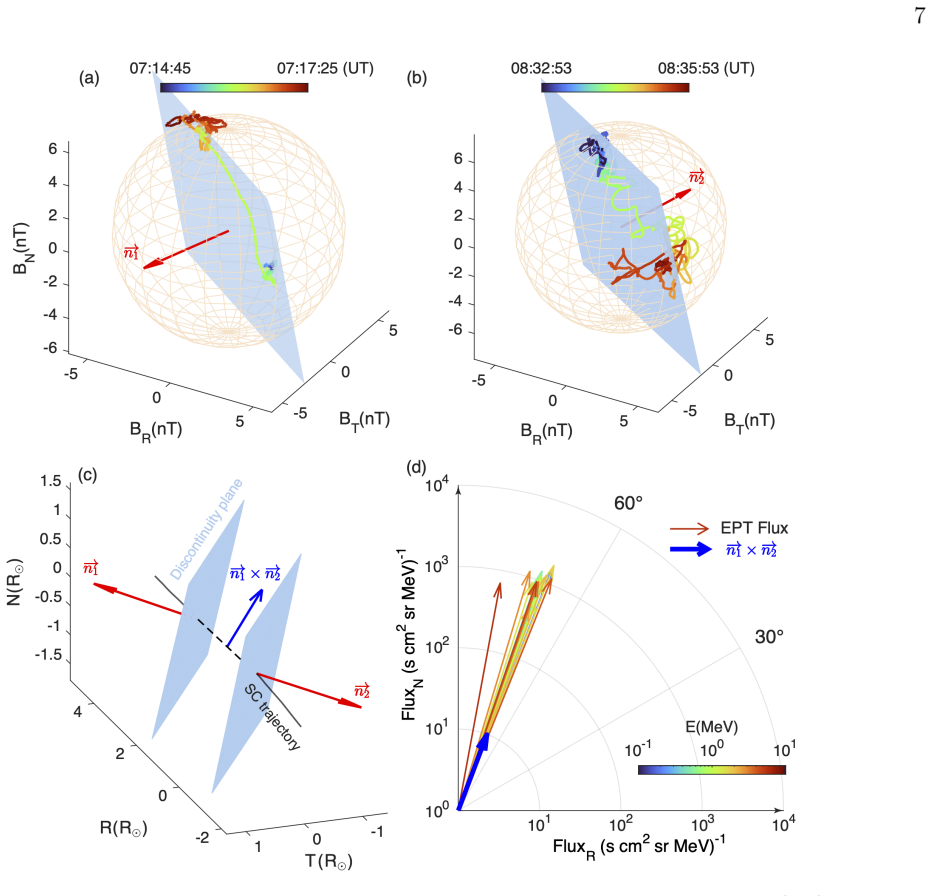
Using Solar Orbiter observations, we identify SEP flux deflections (SFDs) as sudden changes in SEP flux directions where intensities drop in one direction and increase in another without significant net change in total flux magnitude. These deflections occur dispersionlessly across energies from tens of keV to over 100 MeV, exhibit steep intensity gradients, and are typically associated with magnetic flux tubes whose boundary features are consistent with tangential discontinuities. The solar wind inside these structures exhibits distinct plasma properties, and the SEP streaming direction within SFDs aligns closely to the flux-tube axis.
What carries the argument
SEP flux deflections (SFDs), abrupt directional intensity shifts that mark crossings of magnetic flux tube boundaries with tangential discontinuities.
If this is right
- Magnetic flux tubes are a prevalent structural element of the solar wind.
- SEPs can serve as an effective diagnostic tool for probing the topology and dynamics of solar wind structures.
- Solar wind plasma inside the structures shows distinct properties from surrounding regions.
- SFDs commonly recur multiple times within a single SEP event.
- SEP streaming direction aligns closely with the flux-tube axis.
Where Pith is reading between the lines
- If SFDs reliably mark flux tube boundaries, the same signatures in data from other spacecraft could map how tube occurrence varies with distance from the Sun.
- Particle transport models that treat the interplanetary field as smoothly varying may need adjustment to incorporate discrete tube boundaries.
- Repeated SFDs within one event could be used to estimate typical tube cross-sections and their lifetimes in the inner heliosphere.
Load-bearing premise
The assumption that the observed SEP flux deflections result from crossing boundaries of magnetic flux tubes with tangential discontinuities rather than other plasma features or measurement artifacts.
What would settle it
An SFD recorded simultaneously with no measurable change in magnetic field direction, plasma density, or temperature at the expected boundary location.
Figures



read the original abstract
The propagation of solar energetic particles (SEPs) through the heliosphere is primarily guided by the interplanetary magnetic field (IMF) which is embedded in the solar wind plasma. Large-scale IMF structures can drive transient variations in SEP intensities. Using Solar Orbiter observations, we identify a distinct class of SEP variations: SEP flux deflections (SFDs), which are commonly detected in SEP events and frequently recur multiple times within a single event. SFDs are characterized by a sudden change in SEP flux directions where the intensities drop in one direction and increase in another direction, without a significant net change in total flux magnitude. These deflections occur dispersionlessly across a broad energy range-from tens of keV to over 100 MeV-and exhibit steep intensity gradients. SFDs are typically associated with magnetic flux tubes with boundary features consistent with tangential discontinuities. We further show that the solar wind inside these structures exhibits distinct plasma properties, and that the SEP streaming direction within SFDs aligns closely to the flux-tube axis. These observations suggest that magnetic flux tubes are a prevalent structural element of the solar wind, and demonstrate that SEPs can serve as an effective diagnostic tool for probing the topology and dynamics of solar wind structures.
Editorial analysis
A structured set of objections, weighed in public.
Referee Report
Summary. The manuscript reports observations from Solar Orbiter of a class of SEP intensity variations termed SEP flux deflections (SFDs). These are characterized as sudden, dispersionless changes in SEP arrival direction (with intensity dropping in one direction and rising in another) without net change in total flux, occurring across energies from tens of keV to >100 MeV. The authors associate SFDs with crossings of magnetic flux tube boundaries exhibiting tangential-discontinuity signatures, note distinct plasma properties inside the structures, and report that SEP streaming aligns with the inferred flux-tube axis. They conclude that flux tubes are a prevalent solar-wind structural element and that SEPs constitute an effective diagnostic for solar-wind topology.
Significance. If the mapping from SFDs to flux-tube boundaries is robust, the work would supply direct evidence that magnetic flux tubes are common in the solar wind and would establish SEPs as a practical remote-sensing tool for heliospheric magnetic structure, complementing in-situ magnetometer data.
major comments (2)
- [Abstract] Abstract: the central claim that SFDs arise from crossings of flux-tube boundaries that are tangential discontinuities rests on the statement that these features are 'typically associated' and exhibit 'distinct plasma properties,' yet supplies no quantitative thresholds, identification algorithm (minimum-variance analysis, Walén test, normal-component continuity), event-selection criteria, or control comparison against non-SFD intervals.
- [Abstract] Abstract: no error bars, recurrence statistics, or quantitative measures of alignment between SEP streaming and flux-tube axis are reported, so the assertion that 'SEPs can serve as an effective diagnostic tool' cannot be evaluated from the given text.
Simulated Author's Rebuttal
We thank the referee for the detailed and constructive report. We address each major comment below and will revise the manuscript to strengthen the abstract while preserving its concise nature.
read point-by-point responses
-
Referee: [Abstract] Abstract: the central claim that SFDs arise from crossings of flux-tube boundaries that are tangential discontinuities rests on the statement that these features are 'typically associated' and exhibit 'distinct plasma properties,' yet supplies no quantitative thresholds, identification algorithm (minimum-variance analysis, Walén test, normal-component continuity), event-selection criteria, or control comparison against non-SFD intervals.
Authors: The full manuscript applies minimum-variance analysis and the Walén test to identify tangential-discontinuity boundaries, requiring the normal-component of B to remain consistent with zero within uncertainties and the Walén relation to hold. Plasma parameters (density, temperature, speed) are compared statistically inside versus outside the structures, and SFD intervals are selected only when directional intensity changes occur without net flux change. A control sample of non-SFD periods is examined to confirm the association is not coincidental. We will add a brief clause to the abstract referencing these methods and the control comparison. revision: yes
-
Referee: [Abstract] Abstract: no error bars, recurrence statistics, or quantitative measures of alignment between SEP streaming and flux-tube axis are reported, so the assertion that 'SEPs can serve as an effective diagnostic tool' cannot be evaluated from the given text.
Authors: The main text quantifies recurrence (multiple SFDs per event in the majority of cases examined), reports mean alignment angles between SEP streaming and the flux-tube axis together with standard deviations, and includes error bars derived from the directional measurements. These numbers underpin the diagnostic claim. We will incorporate the key quantitative results (e.g., typical alignment angle and recurrence fraction) into the abstract. revision: yes
Circularity Check
No circularity: purely observational associations with no derivation chain or fitted predictions
full rationale
The paper presents Solar Orbiter SEP and plasma observations, identifies SFDs by their sudden directional changes without net flux change, and reports associations with flux-tube boundaries and aligned streaming. No equations, parameters fitted to subsets, self-citations as load-bearing premises, or renamings of known results appear in the provided text. The central claim is an interpretive suggestion from data patterns, not a reduction of any output to its own inputs by construction. This is the expected non-finding for an observational study.
Axiom & Free-Parameter Ledger
axioms (1)
- domain assumption The propagation of solar energetic particles through the heliosphere is primarily guided by the interplanetary magnetic field embedded in the solar wind plasma.
Reference graph
Works this paper leans on
-
[1]
2013, ApJ, 766, 2, doi: 10.1088/0004-637X/766/1/2
Arnold, L., Li, G., Li, X., & Yan, Y. 2013, ApJ, 766, 2, doi: 10.1088/0004-637X/766/1/2
-
[2]
2023, ApJ, 958, 23, doi: 10.3847/1538-4357/acf99a
Bizien, N., Dudok de Wit, T., Froment, C., et al. 2023, ApJ, 958, 23, doi: 10.3847/1538-4357/acf99a
-
[3]
Borovsky, J. E. 2008, Journal of Geophysical Research (Space Physics), 113, A08110, doi: 10.1029/2007JA012684
-
[4]
Bruno, R., Carbone, V., Veltri, P., Pietropaolo, E., & Bavassano, B. 2001, Planet. Space Sci., 49, 1201, doi: 10.1016/S0032-0633(01)00061-7
-
[5]
Chang, T., Tam, S. W. Y., & Wu, C.-C. 2004, Physics of Plasmas, 11, 1287, doi: 10.1063/1.1667496
-
[6]
2022, ApJ, 941, 23, doi: 10.3847/1538-4357/ac9f43
Chen, X., Giacalone, J., & Guo, F. 2022, ApJ, 941, 23, doi: 10.3847/1538-4357/ac9f43
-
[7]
Chollet, E. E., & Giacalone, J. 2008, ApJ, 688, 1368, doi: 10.1086/592378
-
[8]
Chollet, E. E., & Giacalone, J. 2011, ApJ, 728, 64, doi: 10.1088/0004-637X/728/1/64
-
[9]
2007, ApJ, 659, 1761, doi: 10.1086/511811
Meechai, J. 2007, ApJ, 659, 1761, doi: 10.1086/511811
-
[10]
2005, ApJL, 633, L49, doi: 10.1086/498137
Rowlands, G. 2005, ApJL, 633, L49, doi: 10.1086/498137
-
[11]
2011, Nature Physics, 7, 539, doi: 10.1038/nphys1965
Daughton, W., Roytershteyn, V., Karimabadi, H., et al. 2011, Nature Physics, 7, 539, doi: 10.1038/nphys1965
-
[12]
Rogers, B. N., & Kobayashi, S. 2006, Geophys. Res. Lett., 33, L13105, doi: 10.1029/2006GL025957 Dudok de Wit, T., Krasnoselskikh, V. V., Bale, S. D., et al. 2020, ApJS, 246, 39, doi: 10.3847/1538-4365/ab5853
-
[13]
1992, Annual Review of Fluid Mechanics, 24, 395, doi: 10.1146/annurev.fl.24.010192.002143
Farge, M. 1992, Annual Review of Fluid Mechanics, 24, 395, doi: 10.1146/annurev.fl.24.010192.002143
-
[14]
Fox, N. J., Velli, M. C., Bale, S. D., et al. 2016, Space Science Reviews, 204, 7, doi: 10.1007/s11214-015-0211-6
-
[15]
2012, The Astrophysical Journal, 761, 28, doi: 10.1088/0004-637X/761/1/28
Giacalone, J. 2012, The Astrophysical Journal, 761, 28, doi: 10.1088/0004-637X/761/1/28
-
[16]
2017, The Astrophysical Journal, 848, 123, doi: 10.3847/1538-4357/aa8df1
Giacalone, J. 2017, The Astrophysical Journal, 848, 123, doi: 10.3847/1538-4357/aa8df1
-
[17]
Giacalone, J., & Jokipii, J. R. 1999, The Astrophysical Journal, 520, 204, doi: 10.1086/307452
-
[18]
Giacalone, J., Jokipii, J. R., & Mazur, J. E. 2000, ApJL, 532, L75, doi: 10.1086/312564
-
[19]
Golub, G. H., & van Loan, C. F. 2013, Matrix computations (Johns Hopkins University Press), doi: 10.56021/9781421407944
-
[20]
Mazur, J. E. 2004, ApJ, 614, 412, doi: 10.1086/423368
-
[21]
Smith, C. W. 2005, Journal of Geophysical Research (Space Physics), 110, A01107, doi: 10.1029/2004JA010809
-
[22]
Guo, F., Jokipii, J. R., & Kota, J. 2010, ApJ, 725, 128, doi: 10.1088/0004-637X/725/1/128
-
[23]
Ho, G. C., Mason, G. M., Allen, R. C., et al. 2022, Frontiers in Astronomy and Space Sciences, 9, 939799, doi: 10.3389/fspas.2022.939799
-
[24]
S., O’Brien, H., Carrasco Blazquez, I., et al
Horbury, T. S., O’Brien, H., Carrasco Blazquez, I., et al. 2020, A&A, 642, A9, doi: 10.1051/0004-6361/201937257
-
[25]
Hu, Q., Smith, C. W., Ness, N. F., & Skoug, R. M. 2004, Journal of Geophysical Research (Space Physics), 109, A03102, doi: 10.1029/2003JA010101
-
[26]
Jokipii, J. R. 1966, The Astrophysical Journal, 146, 480, doi: 10.1086/148912
-
[27]
2017, ApJ, 851, 38, doi: 10.3847/1538-4357/aa97d7
Kong, X., Guo, F., Giacalone, J., Li, H., & Chen, Y. 2017, ApJ, 851, 38, doi: 10.3847/1538-4357/aa97d7
-
[28]
Lario, D., Kwon, R. Y., Riley, P., & Raouafi, N. E. 2017, The Astrophysical Journal, 847, 103, doi: 10.3847/1538-4357/aa89e3
-
[29]
2008, ApJL, 672, L65, doi: 10.1086/525847
Li, G. 2008, ApJL, 672, L65, doi: 10.1086/525847
-
[30]
2011, PhRvL, 106, 125001, doi: 10.1103/PhysRevLett.106.125001
Li, G., Miao, B., Hu, Q., & Qin, G. 2011, PhRvL, 106, 125001, doi: 10.1103/PhysRevLett.106.125001
-
[31]
2023, ApJ, 954, 203, doi: 10.3847/1538-4357/ace9d2
Liu, W., Kong, X., Guo, F., et al. 2023, ApJ, 954, 203, doi: 10.3847/1538-4357/ace9d2
-
[32]
Mariani, F., Bavassano, B., Villante, U., & Ness, N. F. 1973, J. Geophys. Res., 78, 8011, doi: 10.1029/JA078i034p08011
-
[33]
Zank, G. P. 2003, The Astrophysical Journal Letters, 590, L53, doi: 10.1086/376613 11
-
[34]
Mazur, J. E., Mason, G. M., Dwyer, J. R., et al. 2000, ApJL, 532, L79, doi: 10.1086/312561
-
[35]
McCracken, K. G., & Ness, N. F. 1966, J. Geophys. Res., 71, 3315, doi: 10.1029/JZ071i013p03315
-
[36]
2011, Annales Geophysicae, 29, 237, doi: 10.5194/angeo-29-237-2011 M¨ uller, D., St
Miao, B., Peng, B., & Li, G. 2011, Annales Geophysicae, 29, 237, doi: 10.5194/angeo-29-237-2011 M¨ uller, D., St. Cyr, O. C., Zouganelis, I., et al. 2020, A&A, 642, A1, doi: 10.1051/0004-6361/202038467
- [37]
-
[38]
J., Bruno, R., Livi, S., et al
Owen, C. J., Bruno, R., Livi, S., et al. 2020, A&A, 642, A16, doi: 10.1051/0004-6361/201937259
-
[39]
2008, ApJL, 682, L129, doi: 10.1086/591229
Qin, G., & Li, G. 2008, ApJL, 682, L129, doi: 10.1086/591229
-
[40]
Qin, G., Zhang, M., Dwyer, J. R., & Rassoul, H. K. 2004, ApJ, 609, 1076, doi: 10.1086/421101 Rodr´ ıguez-Pacheco, J., Wimmer-Schweingruber, R. F., Mason, G. M., et al. 2020, A&A, 642, A7, doi: 10.1051/0004-6361/201935287
-
[41]
Roelof, E. C. 1968, Canadian Journal of Physics Supplement, 46, 990, doi: 10.1139/p68-401
-
[42]
Ruffolo, D., Matthaeus, W. H., & Chuychai, P. 2003, ApJL, 597, L169, doi: 10.1086/379847
-
[43]
2012, ApJL, 747, L34, doi: 10.1088/2041-8205/747/2/L34
Chuychai, P. 2012, ApJL, 747, L34, doi: 10.1088/2041-8205/747/2/L34
-
[44]
2010, ApJL, 720, L127, doi: 10.1088/2041-8205/720/2/L127
Shalchi, A. 2010, ApJL, 720, L127, doi: 10.1088/2041-8205/720/2/L127
-
[45]
Trenchi, L., Bruno, R., D’Amicis, R., Marcucci, M. F., & Telloni, D. 2013a, Annales Geophysicae, 31, 1333, doi: 10.5194/angeo-31-1333-2013
-
[46]
2013b, ApJ, 770, 11, doi: 10.1088/0004-637X/770/1/11
Trenchi, L., Bruno, R., Telloni, D., et al. 2013b, ApJ, 770, 11, doi: 10.1088/0004-637X/770/1/11
-
[47]
1991, Annales Geophysicae, 9, 319
Tu, C.-Y., & Marsch, E. 1991, Annales Geophysicae, 9, 319
work page 1991
-
[48]
Tu, C.-Y., & Marsch, E. 1993, J. Geophys. Res., 98, 1257, doi: 10.1029/92JA01947
-
[49]
Webber, J. B. W. 2013, Measurement Science and Technology, 24, 027001, doi: 10.1088/0957-0233/24/2/027001
-
[50]
2023, ApJ, 950, 172, doi: 10.3847/1538-4357/acd1ed
Wijsen, N., Lario, D., S´ anchez-Cano, B., et al. 2023, ApJ, 950, 172, doi: 10.3847/1538-4357/acd1ed
-
[51]
2021, A&A, 656, A22, doi: 10.1051/0004-6361/202140940
Pacheco, D., et al. 2021, A&A, 656, A22, doi: 10.1051/0004-6361/202140940
-
[52]
2023, A&A, 678, A98, doi: 10.1051/0004-6361/202346319
Kollhoff, A., et al. 2023, A&A, 678, A98, doi: 10.1051/0004-6361/202346319
-
[53]
2026, A&A, 705, A98, doi: 10.1051/0004-6361/202555814
Kieokaew, R., et al. 2026, A&A, 705, A98, doi: 10.1051/0004-6361/202555814
-
[54]
F., Squire, J., Pariat, E., et al
Wyper, P. F., Squire, J., Pariat, E., et al. 2026, SSRv, 222, 43, doi: 10.1007/s11214-026-01296-5
-
[55]
Zhou, Y., Matthaeus, W. H., & Dmitruk, P. 2004, Reviews of Modern Physics, 76, 1015, doi: 10.1103/RevModPhys.76.1015
discussion (0)
Sign in with ORCID, Apple, or X to comment. Anyone can read and Pith papers without signing in.