Microbenchmarking Cloud Cryptographic Workloads for Privacy-Preserving Healthcare IoT
Pith reviewed 2026-06-30 16:26 UTC · model grok-4.3
The pith
Microbenchmarking identifies optimal configurations for cryptographic workloads in FaaS environments for healthcare IoT.
A machine-rendered reading of the paper's core claim, the machinery that carries it, and where it could break.
Core claim
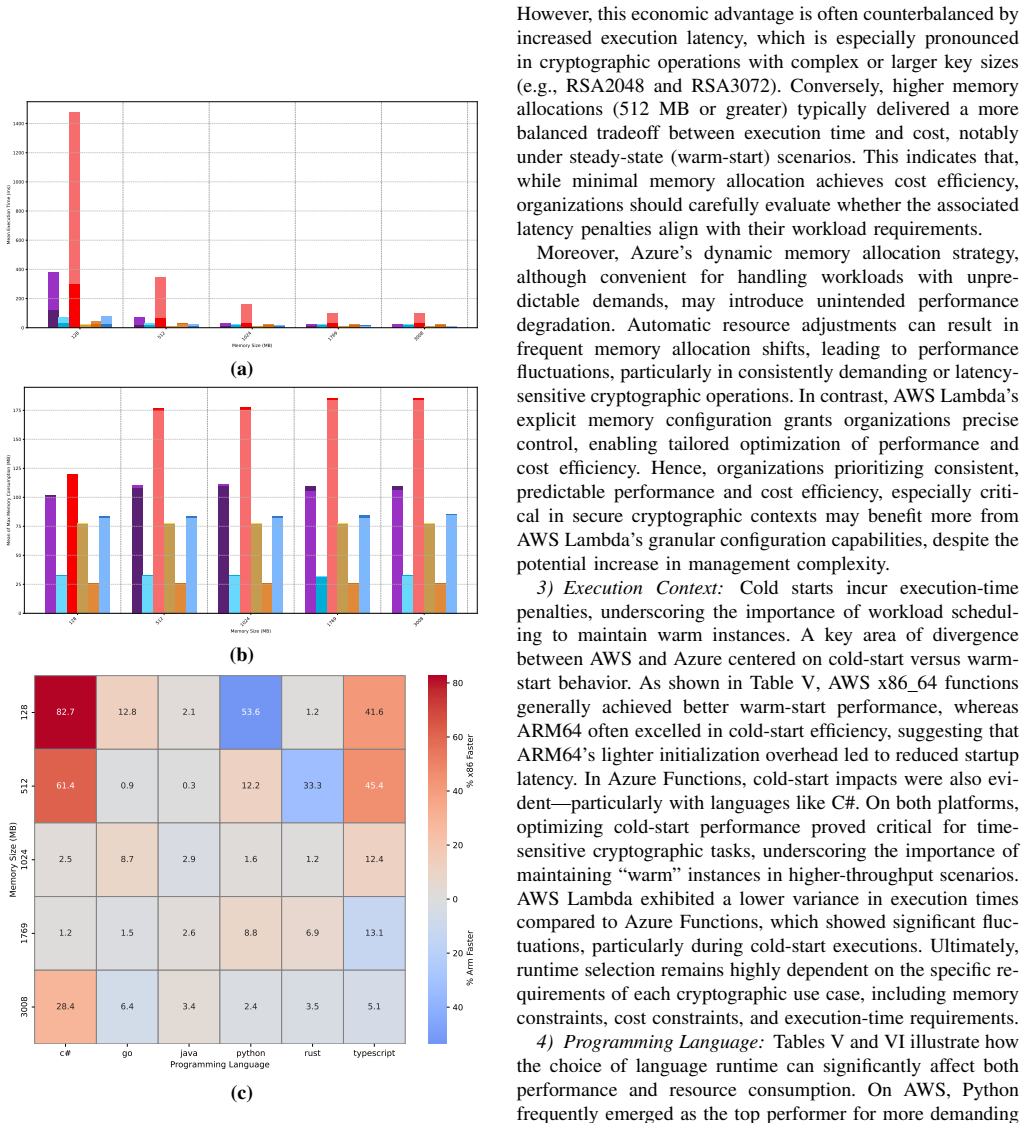
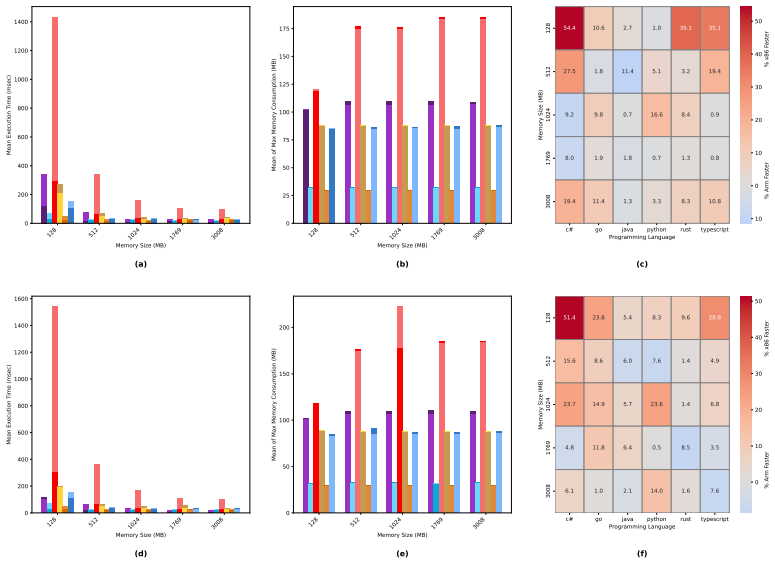
This study presents an extensive microbenchmark evaluating the performance of core cryptographic workloads including SHA HMAC generation, AES encryption and decryption, ECC signature generation and verification, and RSA encryption and decryption across FaaS integrated with KMS from AWS and Azure on EC2 instances and Azure Virtual Machines. The evaluation covers two CPU architectures, six programming languages, multiple memory configurations, and diverse instance types to capture interactions under typical cloud workload patterns. The central claim is that this analysis identifies optimal configurations that improve performance and cost efficiency while enabling secure and timely data protect
What carries the argument
The multi-dimensional microbenchmark analysis that spans cloud providers, CPU architectures, programming languages, memory allocations, and instance types to measure cryptographic operation performance.
If this is right
- Optimal configurations improve performance and cost efficiency for cryptographic workloads in FaaS environments.
- The benchmarks enable secure and timely data protection for healthcare IoT applications.
- Performance varies significantly with choices of programming language, CPU architecture, and memory allocation.
- Burst-optimized instance types capture realistic cloud workload patterns for the tested operations.
Where Pith is reading between the lines
- The same benchmarking approach could be extended to additional cloud providers or other cryptographic primitives not tested here.
- Results might guide selection of language and architecture when deploying similar security layers in non-healthcare IoT domains.
- Integration of these findings into automated configuration tools could reduce manual tuning for developers building cloud-backed IoT systems.
Load-bearing premise
The selected cryptographic workloads, FaaS platforms, programming languages, and instance types are representative of those used in real privacy-preserving healthcare IoT cloud architectures.
What would settle it
A production healthcare IoT system using one of the reported optimal configurations that shows no measurable improvement in latency or cost compared to non-optimal choices would falsify the identification of optima.
Figures



read the original abstract
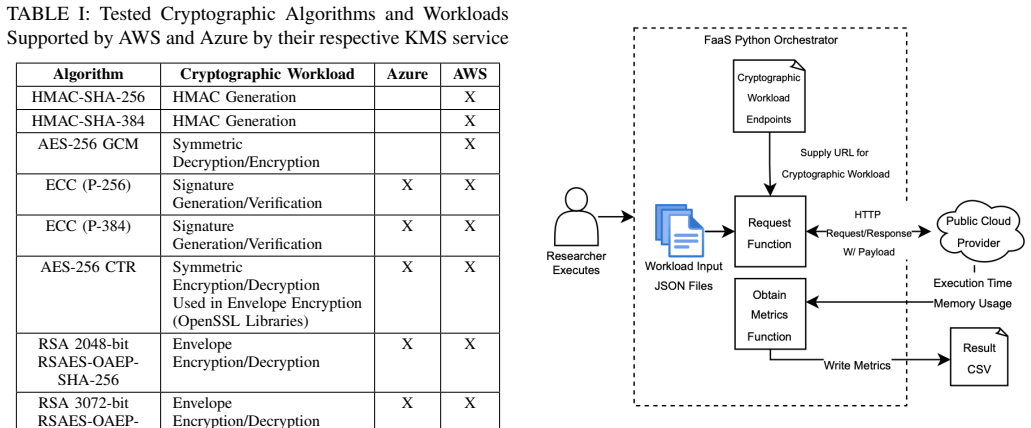
Cryptographic operations are an essential component of cloud security architectures; their comprehensive performance characterization across different cloud services, hardware architectures, and programming language implementations remains unknown. Specifically, healthcare IoT devices are highly vulnerable and frequently targeted, yet the cryptographic performance trade offs in their cloud security architectures remain poorly understood. This research presents an extensive microbenchmark study evaluating the performance of core cryptographic workloads, including SHA HMAC generation, AES encryption, decryption, Elliptic Curve Cryptography (ECC) signature generation and verification, and RSA encryption, decryption, across Function as a Service (FaaS) integrated with Key Management Services (KMS) from Amazon Web Services (AWS) and Microsoft Azure. We evaluate FaaS platforms using Elastic Compute Cloud (EC2) instances and Azure Virtual Machines, specifically using burst optimized instance types to analyze performance under typical cloud workload patterns. The benchmark encompasses a comprehensive multi dimensional analysis spanning two CPU architectures (x86 64 and Arm64), six widely adopted programming languages (Rust, Go, Python, Java, C#, and TypeScript), multiple memory allocation configurations, and diverse instance types to capture the complex interplay between these factors. This study identifies optimal configurations for cryptographic workloads in FaaS environments, improving performance and cost efficiency while enabling secure and timely data protection for healthcare IoT applications.
Editorial analysis
A structured set of objections, weighed in public.
Referee Report
Summary. The paper presents a microbenchmark study of cryptographic workloads (SHA HMAC, AES encrypt/decrypt, ECC sign/verify, RSA encrypt/decrypt) on AWS and Azure, evaluating performance across x86_64/Arm64 architectures, six languages (Rust/Go/Python/Java/C#/TypeScript), memory sizes, and burst-optimized instance types. It claims to identify optimal configurations for FaaS environments integrated with KMS to support privacy-preserving healthcare IoT.
Significance. If the platform scope were corrected, the direct empirical measurements could supply useful performance and cost data for crypto primitives in cloud healthcare settings; the work contains no derivations or invented entities that would introduce circularity.
major comments (2)
- [Abstract] Abstract: the central claim requires results to apply to FaaS (e.g., Lambda/Azure Functions), yet the text states 'We evaluate FaaS platforms using Elastic Compute Cloud (EC2) instances and Azure Virtual Machines'. EC2 and Azure VMs are IaaS, not serverless FaaS; this mismatch means the reported 'optimal configurations' do not address the stated FaaS target and undermine applicability to healthcare IoT architectures.
- [Abstract] Methods/Experimental Design (implied by abstract): no details are supplied on number of repetitions, statistical tests, variance reporting, or raw data release, preventing verification that measured differences support the optimality claims.
minor comments (1)
- [Abstract] Abstract: the phrasing 'FaaS platforms using EC2 instances' is internally contradictory and should be clarified or corrected in the title, abstract, and introduction.
Simulated Author's Rebuttal
We thank the referee for the constructive feedback on our manuscript. The comments highlight important issues of clarity in the abstract that we will address through revision.
read point-by-point responses
-
Referee: [Abstract] Abstract: the central claim requires results to apply to FaaS (e.g., Lambda/Azure Functions), yet the text states 'We evaluate FaaS platforms using Elastic Compute Cloud (EC2) instances and Azure Virtual Machines'. EC2 and Azure VMs are IaaS, not serverless FaaS; this mismatch means the reported 'optimal configurations' do not address the stated FaaS target and undermine applicability to healthcare IoT architectures.
Authors: We agree the abstract wording is imprecise and creates an unintended mismatch. The experiments use burst-optimized EC2 and Azure VM instances specifically to capture performance characteristics relevant to FaaS workloads when integrated with KMS under bursty patterns typical of IoT data flows. We will revise the abstract to describe the platform accurately as virtualized instances configured for FaaS-like burst behavior, while preserving the focus on optimal configurations for privacy-preserving healthcare IoT. This correction will align the claims with the experimental setup. revision: yes
-
Referee: [Abstract] Methods/Experimental Design (implied by abstract): no details are supplied on number of repetitions, statistical tests, variance reporting, or raw data release, preventing verification that measured differences support the optimality claims.
Authors: The abstract is intentionally concise and does not contain full methodological specifications; these are detailed in the Experimental Design and Results sections of the full manuscript, including repetition counts, statistical comparisons of performance differences, variance reporting, and data release plans. To improve accessibility, we will add a brief statement in the abstract noting the experimental rigor and directing readers to the supporting sections and data availability. revision: partial
Circularity Check
Empirical microbenchmarking study exhibits no circularity
full rationale
The paper consists entirely of direct empirical measurements of cryptographic operation latencies across languages, architectures, and instance types. No derivation chain, first-principles result, fitted model, or prediction is present; optimal configurations are simply reported from the collected data. None of the enumerated circularity patterns apply.
Axiom & Free-Parameter Ledger
Reference graph
Works this paper leans on
-
[1]
The nist definition of cloud computing,
P. Mell and T. Grance, “The nist definition of cloud computing,” National Institute of Standards and Technology, Computer Security Division, Information Technology Laboratory, Tech. Rep., 2011
2011
-
[2]
Pricing cloud iaas computing services,
N. Dimitri, “Pricing cloud iaas computing services,”Journal of Cloud Computing, vol. 9, no. 1, Dec 2020
2020
-
[3]
Optimization of resource provision- ing cost in cloud computing,
S. Chaisiri, B. Lee, and D. Niyato, “Optimization of resource provision- ing cost in cloud computing,”IEEE Transactions on Services Computing, vol. 5, pp. 164–177, Feb 2011
2011
-
[4]
Configuring aws lambda memory,
I. Amazon Web Services, “Configuring aws lambda memory,” AWS Documentation, 2025, online. Available: https://docs.aws.amazon.com/ lambda/latest/dg/configuration-memory.html. Accessed: Feb 21, 2025
2025
-
[5]
Sebs: A serverless benchmark suite for function-as-a-service comput- ing,
M. Copik, G. Kwasniewski, M. Besta, M. Podstawski, and T. Hoefler, “Sebs: A serverless benchmark suite for function-as-a-service comput- ing,” inProceedings of the 22nd International Middleware Conference, Qu´ebec City, Canada, 2021, pp. 64–78
2021
-
[6]
Estimating cloud application performance based on micro-benchmark profiling,
J. Scheuner and P. Leitner, “Estimating cloud application performance based on micro-benchmark profiling,” in2018 IEEE 11th International Conference on Cloud Computing (CLOUD), San Francisco, CA, USA, 2018, pp. 90–97
2018
-
[7]
Design of a secure encryption model (sem) for cloud data storage using hadamard transforms,
S. Srisakthi and A. P. Shanthi, “Design of a secure encryption model (sem) for cloud data storage using hadamard transforms,”Wireless Personal Communications, vol. 100, no. 4, pp. 1727–1741, 2018
2018
-
[8]
Nist special publication 800-57 part 1 revision 5 recommen- dation for key management: Part 1-general,
E. Barker, “Nist special publication 800-57 part 1 revision 5 recommen- dation for key management: Part 1-general,” NIST, Tech. Rep., May 2020
2020
-
[9]
Comparative analysis of key management service performance on aws, google cloud, and oracle cloud with performance testing,
A. Susanto, A. H. Fathulloh, Nuryasin, and A. Fitriyani, “Comparative analysis of key management service performance on aws, google cloud, and oracle cloud with performance testing,” in2023 11th International Conference on Cyber and IT Service Management (CITSM), Makassar, Indonesia, 2023, pp. 1–6
2023
-
[10]
Xfbench: A cross-cloud benchmark suite for evalu- ating faas workflow platforms,
V . Kulkarniet al., “Xfbench: A cross-cloud benchmark suite for evalu- ating faas workflow platforms,” inIEEE 24th International Symposium on Cluster, Cloud and Internet Computing (CCGrid), Philadelphia, PA, USA, 2024, pp. 543–556
2024
-
[11]
Practical cloud workloads for serverless faas,
J. Kim and K. Lee, “Practical cloud workloads for serverless faas,” in Proceedings of the ACM Symposium on Cloud Computing (SoCC ’19). New York, NY , USA: Association for Computing Machinery, 2019, p. 477
2019
-
[12]
Configuring function memory (aws lambda),
I. Amazon Web Services, “Configuring function memory (aws lambda),” AWS Documentation, Feb 21 2025, online. Available: https:// docs.aws.amazon.com/lambda/latest/dg/configuration-memory.html. Ac- cessed: March 3, 2025
2025
-
[13]
Consumption plan hosting,
M. Corporation, “Consumption plan hosting,” Microsoft Learn, Feb 21 2025, online. Available: https://learn.microsoft.com/en-us/azure/ azure-functions/consumption-plan. Accessed: March 3, 2025
2025
-
[14]
Functionbench: A suite of workloads for serverless cloud function service,
J. Kim and K. Lee, “Functionbench: A suite of workloads for serverless cloud function service,” in2019 IEEE 12th International Conference on Cloud Computing (CLOUD), Milan, Italy, 2019, pp. 502–504
2019
-
[15]
Comparing aws lambda arm vs. x86 performance, cost, and analysis,
J. Roig, D. Choudhury, J. DeMuth, and R. Singla, “Comparing aws lambda arm vs. x86 performance, cost, and analysis,” AWS Partner Network (APN), Oct 24 2023, online. Available: https://aws.amazon.com/blogs/apn/ comparing-aws-lambda-arm-vs-x86-performance-cost-and-analysis-2/. Accessed: Feb 22, 2025
2023
-
[16]
Task scheduling in cloud computing using particle swarm optimization with time varying inertia weight strategies,
X. Huang, C. Li, H. Chenet al., “Task scheduling in cloud computing using particle swarm optimization with time varying inertia weight strategies,”Cluster Computing, vol. 23, pp. 1137–1147, 2020
2020
-
[17]
Beyond microbenchmarks: The spec-rg vision for a comprehensive serverless benchmark,
E. van Eyk, J. Scheuner, S. Eismann, C. L. Abad, and A. Iosup, “Beyond microbenchmarks: The spec-rg vision for a comprehensive serverless benchmark,” ser. ICPE ’20. New York, NY , USA: Association for Computing Machinery, 2020, p. 26–31. [Online]. Available: https://doi.org/10.1145/3375555.3384381
-
[18]
Patterns in the chaos – a study of performance variation and predictability in public iaas clouds,
P. Leitner and J. Cito, “Patterns in the chaos – a study of performance variation and predictability in public iaas clouds,”ACM Transactions on Internet Technology, vol. 16, no. 3, pp. 15:1–15:23, 2016
2016
-
[19]
Software microbenchmarking in the cloud. how bad is it really?
C. Laaber, J. Scheuner, and P. Leitner, “Software microbenchmarking in the cloud. how bad is it really?”Empirical Software Engineering, vol. 24, no. 4, pp. 2469–2508, 2019
2019
-
[20]
Cloud work bench – infrastructure-as-code based cloud benchmarking,
J. Scheuner, P. Leitner, J. Cito, and H. Gall, “Cloud work bench – infrastructure-as-code based cloud benchmarking,” in2014 IEEE 6th International Conference on Cloud Computing Technology and Science, Singapore, 2014, pp. 246–253
2014
-
[21]
Automated in- frastructure as code program testing,
D. Sokolowski, D. Spielmann, and G. Salvaneschi, “Automated in- frastructure as code program testing,”IEEE Transactions on Software Engineering, vol. 50, no. 6, pp. 1585–1599, June 2024
2024
-
[22]
Cryptography on untrustworthy cloud storage for healthcare applications: A performance analysis,
L. H. Reis, M. T. De Oliveira, J. Bowden, D. Krefting, S. D. Olabarriaga, and D. M. Mattos, “Cryptography on untrustworthy cloud storage for healthcare applications: A performance analysis,” in2021 XI Brazilian Symposium on Computing Systems Engineering (SBESC). IEEE, 2021, pp. 1–8
2021
-
[23]
A new cryptog- raphy algorithm to protect cloud-based healthcare services,
M. Aledhari, A. Marhoon, A. Hamad, and F. Saeed, “A new cryptog- raphy algorithm to protect cloud-based healthcare services,” in2017 IEEE/ACM International Conference on Connected Health: Applica- tions, Systems and Engineering Technologies (CHASE). IEEE, 2017, pp. 37–43
2017
-
[24]
Hybrid workload enabled and secure healthcare monitoring sensing framework in distributed fog-cloud network,
A. Lakhan, Q.-u.-a. Mastoi, M. A. Dootio, F. Alqahtani, I. R. Alzahrani, F. Baothman, S. Y . Shah, S. A. Shah, N. Anjum, Q. H. Abbasiet al., “Hybrid workload enabled and secure healthcare monitoring sensing framework in distributed fog-cloud network,”Electronics, vol. 10, no. 16, p. 1974, 2021
1974
-
[25]
Healthfaas: Ai-based smart healthcare system for heart patients using serverless computing,
M. Golec, S. S. Gill, A. K. Parlikad, and S. Uhlig, “Healthfaas: Ai-based smart healthcare system for heart patients using serverless computing,” IEEE Internet of Things Journal, vol. 10, no. 21, pp. 18 469–18 476, 2023
2023
-
[26]
From agent failure paths to quantified residual risk: A compositional framework for resilient agentic ai,
H. Karim, S. Sitharaman, D. Gupta, and D. B. Rawat, “From agent failure paths to quantified residual risk: A compositional framework for resilient agentic ai,” 2026
2026
-
[27]
Agentic ai for continuous intelligence in future smart connected systems,
L. A. Kavuri, D. Gupta, and E. Hammad, “Agentic ai for continuous intelligence in future smart connected systems,” 2026
2026
-
[28]
Securefed: A two-phase framework for detecting malicious clients in federated learning,
L. A. Kavuriet al., “Securefed: A two-phase framework for detecting malicious clients in federated learning,” in2025 IEEE International Conference on Information Reuse and Integration and Data Science (IRI). IEEE, 2025, pp. 190–195
2025
-
[29]
Androids: Android-based intrusion detection system using federated learning,
A. K. Nairet al., “Androids: Android-based intrusion detection system using federated learning,” in2025 IEEE International Conference on Information Reuse and Integration and Data Science (IRI). IEEE, 2025, pp. 172–177
2025
-
[30]
Hierarchical federated learning based anomaly de- tection using digital twins for smart healthcare,
D. Guptaet al., “Hierarchical federated learning based anomaly de- tection using digital twins for smart healthcare,” in2021 IEEE 7th international conference on collaboration and internet computing (CIC)
-
[31]
Aws developer tools – sdks,
A. W. Services, “Aws developer tools – sdks,” AWS, online. Avail- able: https://aws.amazon.com/developer/tools/#SDKs. Accessed: Feb 22, 2025
2025
-
[32]
Microsoft azure downloads,
Microsoft, “Microsoft azure downloads,” Microsoft, online. Available: https://azure.microsoft.com/en-us/downloads/. Accessed: Feb 22, 2025
2025
-
[33]
Guide to storage encryp- tion technologies for end user devices,
K. Scarfone, M. Souppaya, and A. Orebaugh, “Guide to storage encryp- tion technologies for end user devices,” NIST, Tech. Rep. Special Pub- lication 800-111, Nov 2007, online. Available: https://nvlpubs.nist.gov/ nistpubs/Legacy/SP/nistspecialpublication800-111.pdf. Accessed: Feb 22, 2025
2007
-
[34]
Six steps toward more secure cloud computing,
F. T. Commission, “Six steps toward more secure cloud computing,” FTC Business Blog, Jun 2020, online. Avail- able: https://www.ftc.gov/business-guidance/blog/2020/06/ six-steps-toward-more-secure-cloud-computing. Accessed: Feb 22, 2025
2020
-
[35]
Choosing a kms key type,
A. W. Services, “Choosing a kms key type,” Feb 2025, on- line. Available: https://docs.aws.amazon.com/kms/latest/developerguide/ symm-asymm-choose-key-spec.html. Accessed: Feb 22, 2025
2025
-
[36]
Supported algorithms,
——, “Supported algorithms,” AWS Encryption SDK Developer Guide, Feb 20 2025, online. Available: https://docs.aws.amazon. com/encryption-sdk/latest/developer-guide/supported-algorithms.html. Accessed: Feb 22, 2025
2025
-
[37]
Hmac in aws kms,
——, “Hmac in aws kms,” AWS Key Management Service Devel- oper Guide, online. Available: https://docs.aws.amazon.com/kms/latest/ developerguide/hmac.html. Accessed: Feb 22, 2025
2025
-
[38]
Using iam policies with aws kms,
——, “Using iam policies with aws kms,” 2025, online. Available: https: //docs.aws.amazon.com/kms/latest/developerguide/iam-policies.html Accessed: March 8, 2025
2025
-
[39]
Control access to aws kms using iam roles,
——, “Control access to aws kms using iam roles,” AWS Documenta- tion, Feb 22 2025, online. Available: https://docs.aws.amazon.com/kms/ latest/developerguide/rbac.html. Accessed: Feb 22, 2025
2025
-
[40]
Key vault keys – about keys,
Microsoft, “Key vault keys – about keys,” Feb 2025, on- line. Available: https://learn.microsoft.com/en-us/azure/key-vault/keys/ about-keys-details. Accessed: Feb 22, 2025
2025
-
[41]
Azure key vault overview,
——, “Azure key vault overview,” Microsoft Azure, online. Available: https://learn.microsoft.com/en-us/azure/key-vault/general/overview. Ac- cessed: Feb 22, 2025
2025
-
[42]
Azure key vault security features,
——, “Azure key vault security features,” 2025, online. Available: https: //learn.microsoft.com/en-us/azure/key-vault/general/security-features. Accessed: March 9, 2025
2025
-
[43]
About azure key vault keys,
——, “About azure key vault keys,” 2025, online. Available: https: //learn.microsoft.com/en-us/azure/key-vault/keys/about-keys. Accessed: March 9, 2025
2025
-
[44]
Encryption at rest,
——, “Encryption at rest,” Microsoft Azure, online. Available: https://learn.microsoft.com/en-us/azure/security/fundamentals/ encryption-atrest. Accessed: Feb 22, 2025
2025
-
[45]
How to use aws kms rsa keys for offline encryption,
A. W. Services, “How to use aws kms rsa keys for offline encryption,” Aug 2023, online. Available: https://aws.amazon.com/blogs/security/ how-to-use-aws-kms-rsa-keys-for-offline-encryption/. Accessed: Feb 22, 2025
2023
-
[46]
Humble and D
J. Humble and D. Farley,Continuous Delivery: Reliable Software Releases through Build, Test, and Deployment Automation, 1st ed. Addison-Wesley Professional, 2010
2010
-
[47]
Security features of azure key vault,
Microsoft, “Security features of azure key vault,” Microsoft Learn, Feb 22 2025, online. Available: https://learn.microsoft.com/en-us/azure/ key-vault/general/security-features. Accessed: Feb 22, 2025
2025
-
[48]
Aws lambda pricing,
A. W. Services, “Aws lambda pricing,” 2025, https://aws.amazon.com/ lambda/pricing/. Accessed: March, 3, 2025
2025
-
[49]
Azure functions pricing,
M. Azure, “Azure functions pricing,” 2025, online. Available: https: //azure.microsoft.com/en-us/pricing/details/functions/. Accessed: March, 3, 2025
2025
-
[50]
Configuring aws lambda memory and storage,
I. Amazon Web Services, “Configuring aws lambda memory and storage,” AWS Documentation, 2025, online. Available: https:// docs.aws.amazon.com/lambda/latest/dg/configuration-memory.html. Ac- cessed: Feb 22, 2025
2025
-
[51]
Aws cloud development kit (cdk) documenta- tion,
A. W. Services, “Aws cloud development kit (cdk) documenta- tion,” AWS, online. Available: https://docs.aws.amazon.com/cdk/v2/ guide/home.html. Accessed: Feb 22, 2025
2025
-
[52]
Aws lambda function deployment packages,
——, “Aws lambda function deployment packages,” AWS Documen- tation, online. Available: https://docs.aws.amazon.com/lambda/latest/dg/ configuration-function-zip.html. Accessed: Feb 22, 2025
2025
-
[53]
Configuring aws lambda function urls,
——, “Configuring aws lambda function urls,” AWS, online. Avail- able: https://docs.aws.amazon.com/lambda/latest/dg/urls-configuration. html. Accessed: Feb 22, 2025
2025
-
[54]
Aws lambda environment variable encryption,
——, “Aws lambda environment variable encryption,” 2025, online. Available: https://docs.aws.amazon.com/lambda/latest/dg/ configuration-envvars-encryption.html. Accessed: March 3, 2025
2025
-
[55]
Overview of bicep,
Microsoft, “Overview of bicep,” Microsoft, online. Available: https://learn.microsoft.com/en-us/azure/azure-resource-manager/bicep/ overview?tabs=bicep. Accessed: Feb 22, 2025
2025
-
[56]
Deploy code with a zip package,
——, “Deploy code with a zip package,” Microsoft Learn, on- line. Available: https://learn.microsoft.com/en-us/azure/azure-functions/ deployment-zip-push. Accessed: Feb 23, 2025
2025
-
[57]
Azure functions scale and hosting plans,
——, “Azure functions scale and hosting plans,” Microsoft Learn, Feb 21 2024, online. Available: https://learn.microsoft.com/en-us/azure/ azure-functions/functions-scale. Accessed: Feb 25, 2025
2024
-
[58]
Azure functions consumption plan,
M. Corporation, “Azure functions consumption plan,” Microsoft Learn, 2025, online. Available: https://learn.microsoft.com/en-us/azure/ azure-functions/consumption-plan. Accessed: February 27, 2025
2025
-
[59]
How to use azure functions app settings,
Microsoft, “How to use azure functions app settings,” 2025, online. Available: https://learn.microsoft.com/en-us/azure/azure-functions/ functions-how-to-use-azure-function-app-settings?tabs=azure-portal% 2Cto-premium. Accessed: March 3, 2025
2025
-
[60]
Configure monitoring for azure functions,
——, “Configure monitoring for azure functions,” 2025, on- line. Available: https://learn.microsoft.com/en-us/azure/azure-functions/ configure-monitoring?tabs=v2. Accessed: March 9, 2025
2025
-
[61]
Operating lambda performance optimization – part 1,
A. W. Services, “Operating lambda performance optimization – part 1,” AWS, online. Available: https://aws.amazon.com/blogs/compute/ operating-lambda-performance-optimization-part-1/. Accessed: Feb 22, 2025
2025
-
[62]
Analyzing docker vulnerabilities through static and dynamic methods and enhancing iot security with aws iot core, cloudwatch, and guardduty,
V . Ajith, T. Cyriac, C. Chavda, T. K. Anum, V . Chennareddy, and K. Ali, “Analyzing docker vulnerabilities through static and dynamic methods and enhancing iot security with aws iot core, cloudwatch, and guardduty,”IoT, vol. 5, no. 3, p. 592, 2024
2024
-
[63]
Create an alarm that sends an email notification,
A. W. Services, “Create an alarm that sends an email notification,” Amazon CloudWatch Documentation, 2025, online. Available: https://docs.aws.amazon.com/AmazonCloudWatch/latest/monitoring/ AlarmThatSendsEmail.html. Accessed: Feb 22, 2025
2025
-
[64]
Aws lambda function metrics,
I. Amazon Web Services, “Aws lambda function metrics,” AWS Documentation, online. Available: https://docs.aws.amazon.com/lambda/ latest/dg/monitoring-metrics.html. Accessed: Feb 22, 2025
2025
-
[65]
Aws lambda function metrics,
——, “Aws lambda function metrics,” AWS Documentation, online. Available: https://docs.aws.amazon.com/lambda/latest/dg/ monitoring-metrics-types.html. Accessed: Feb 22, 2025
2025
-
[66]
Azure monitor metrics overview,
Microsoft, “Azure monitor metrics overview,” 2024, online. Available: https://learn.microsoft.com/en-us/azure/azure-monitor/essentials/ data-platform-metrics. Accessed: March 12, 2025
2024
-
[67]
Hmac keys in aws kms,
A. W. Services, “Hmac keys in aws kms,” 2025, online. Available: https://docs.aws.amazon.com/kms/latest/developerguide/hmac.html. Ac- cessed: March 10, 2025
2025
discussion (0)
Sign in with ORCID, Apple, or X to comment. Anyone can read and Pith papers without signing in.