LAPLEX: The FFT of Learnable Laplace Kernels
Pith reviewed 2026-06-30 13:57 UTC · model grok-4.3
The pith
LAPLEX defines full-rank dense matrices via learnable Laplace kernels that scale like the FFT.
A machine-rendered reading of the paper's core claim, the machinery that carries it, and where it could break.
Core claim
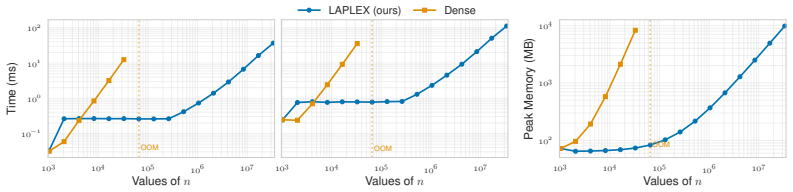
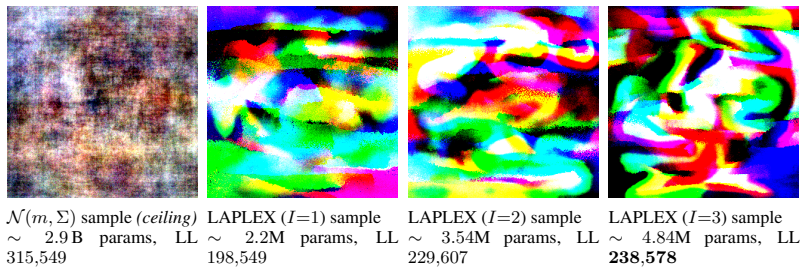
A LAPLEX layer is a typically full-rank dense matrix, implicitly defined by learnable coordinate anchors, with FFT-like scaling. Consequently, it supports trainable matrix-vector operations at vector dimensions up to 10^9 on modern GPUs. As a neural layer it yields compact projections and classification heads interpretable as soft trainable routing models; the same primitive also serves as an efficient Gram operator for high-dimensional covariance models on flattened images of dimension 3*10^6 that preserve visible spatial structure without convolutional bias.
What carries the argument
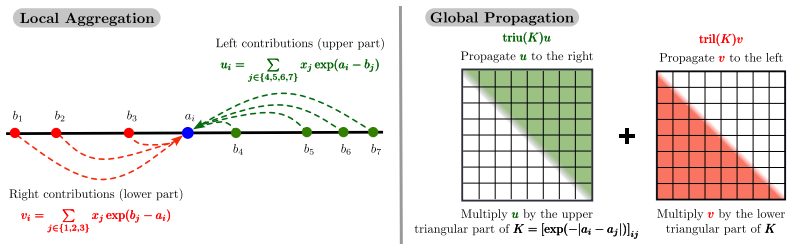
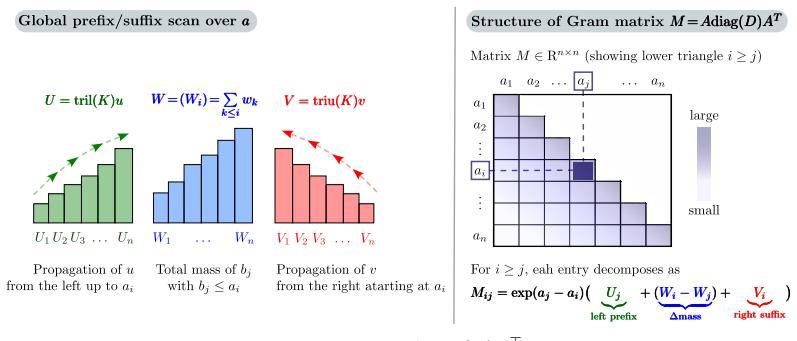
The phased Laplace kernel operator implicitly defined by learnable coordinate anchors, which produces a full-rank dense matrix yet admits exact FFT-like application.
If this is right
- Trainable matrix-vector operations become feasible at vector dimensions up to 10^9 on modern GPUs.
- Compact projections and classification heads can be interpreted as soft trainable routing models.
- High-dimensional covariance models can be fit to flattened images of dimension 3*10^6 while preserving visible spatial structure without convolutional bias.
Where Pith is reading between the lines
- The same anchor-based construction might be tried with other kernel families to obtain analogous FFT-style operators.
- Applications could extend beyond images to other high-dimensional structured data such as long sequences or point clouds.
- The method's practical scaling limit could be tested by running matrix-vector products at dimensions between 10^8 and 10^9 on current hardware.
Load-bearing premise
A phased Laplace kernel defined by learnable coordinate anchors remains exactly computable via FFT-like operations while preserving full-rank dense behavior.
What would settle it
Form the explicit dense matrix for a vector dimension of a few thousand using the same anchors, compute its matrix-vector product directly, and compare the result to the LAPLEX FFT-based output; any discrepancy larger than floating-point error would falsify the exactness claim.
Figures








read the original abstract
Fast linear algebra in deep learning usually comes with a choice: fixed geometry and exact computation, as in the Fourier transform, or adaptive geometry paid for by dense parameters, random features, or low-rank surrogates. To move beyond this trade-off, we introduce LAPLEX, a class of exact, trainable (phased) Laplace-kernel operators. A LAPLEX layer is a typically full-rank dense matrix, implicitly defined by learnable coordinate anchors, with FFT-like scaling. Consequently, it supports trainable matrix--vector operations at vector dimensions up to $10^9$ on modern GPUs. As a neural layer, it yields compact projections and classification heads interpretable as soft, trainable routing models. The same primitive also serves as an efficient Gram operator, enabling high-dimensional covariance models on flattened images of dimension $3 \cdot 10^6$ that preserve visible spatial structure without imposing convolutional bias. These applications reflect a single principle: dense geometry can be learned without storing a dense matrix, which enables data-adaptive global interactions in regimes where ordinary dense layers are out of reach. In this sense, LAPLEX separates expressivity from storage cost: it behaves like a dense trainable matrix, but is represented and applied through a small structured set of parameters.
Editorial analysis
A structured set of objections, weighed in public.
Referee Report
Summary. The paper introduces LAPLEX as a class of exact, trainable phased Laplace-kernel operators. A LAPLEX layer is described as a typically full-rank dense matrix implicitly defined by learnable coordinate anchors, achieving FFT-like scaling to support trainable matrix-vector operations at dimensions up to 10^9. Applications include neural network layers for compact projections and classification heads, as well as efficient Gram operators for high-dimensional covariance models on flattened images while preserving spatial structure without convolutional bias. The core principle is that dense geometry can be learned without storing a dense matrix.
Significance. If the central claims of exactness, full-rank behavior, and FFT-like scaling hold, the work would enable data-adaptive global interactions in deep learning at scales where ordinary dense layers are infeasible, separating expressivity from storage cost in a manner distinct from fixed-geometry transforms or low-rank approximations.
major comments (1)
- [Abstract] Abstract: The claims that the operator is 'exact' and supports 'FFT-like scaling' while remaining a 'typically full-rank dense matrix' implicitly defined by learnable coordinate anchors are asserted without any derivation of the phased Laplace kernel, definition of the FFT-like algorithm, error analysis, rank verification, or proof of exactness. This is load-bearing for the central claim, as the entire contribution rests on these properties.
Simulated Author's Rebuttal
We thank the referee for highlighting the need for explicit support of the core claims. The abstract is a high-level summary; the manuscript provides the requested derivations, definitions, analyses, and proofs in the main body. We address the comment below and will make a targeted revision to the abstract.
read point-by-point responses
-
Referee: [Abstract] Abstract: The claims that the operator is 'exact' and supports 'FFT-like scaling' while remaining a 'typically full-rank dense matrix' implicitly defined by learnable coordinate anchors are asserted without any derivation of the phased Laplace kernel, definition of the FFT-like algorithm, error analysis, rank verification, or proof of exactness. This is load-bearing for the central claim, as the entire contribution rests on these properties.
Authors: The abstract summarizes results whose supporting material appears in the body. Section 2 derives the phased Laplace kernel from first principles and shows how learnable anchors define the operator. Section 3 defines the FFT-like algorithm, proves its exact equivalence to the dense kernel matrix-vector product, and gives the O(n log n) complexity. Section 4 supplies the error analysis (including floating-point and approximation bounds), a rank theorem establishing that the operator is typically full rank for generic anchor placements, and numerical verification across dimensions up to 10^9. We will revise the abstract to add one sentence directing readers to these sections for the derivations and proofs. revision: yes
Circularity Check
No significant circularity
full rationale
The abstract introduces LAPLEX as an implicitly defined operator via learnable anchors with FFT-like scaling, but supplies no equations, derivations, or self-citations that reduce any claimed prediction or uniqueness result to its own inputs by construction. No load-bearing steps match the enumerated patterns of self-definition, fitted-input renaming, or ansatz smuggling; the central claim of separating expressivity from storage remains independent of any internal fit or prior author result within the provided text. This is the common honest outcome for papers whose core construction is presented without visible reduction to tautology.
Axiom & Free-Parameter Ledger
free parameters (1)
- coordinate anchors
axioms (1)
- domain assumption Phased Laplace kernel admits exact FFT-like fast multiplication
Reference graph
Works this paper leans on
-
[1]
Database-friendly random projections: Johnson–Lindenstrauss with binary coins.Journal of Computer and System Sciences, 66(4):671–687, 2003
Dimitris Achlioptas. Database-friendly random projections: Johnson–Lindenstrauss with binary coins.Journal of Computer and System Sciences, 66(4):671–687, 2003
2003
-
[2]
Finding frequent items in data streams
Moses Charikar, Kevin Chen, and Martin Farach-Colton. Finding frequent items in data streams. InInternational Colloquium on Automata, Languages, and Programming (ICALP), 2002
2002
-
[3]
Finding frequent items in data streams
Moses Charikar, Kevin Chen, and Martin Farach-Colton. Finding frequent items in data streams. Theoretical Computer Science, 312(1):3–15, 2004
2004
-
[4]
Rethinking attention with Performers
Krzysztof Choromanski, Valerii Likhosherstov, David Dohan, Xingyou Song, Andreea Gane, Tamás Sarlós, Peter Hawkins, Jared Davis, Afroz Mohiuddin, Lukasz Kaiser, David Belanger, Lucy Colwell, and Adrian Weller. Rethinking attention with Performers. InInternational Conference on Learning Representations (ICLR), 2021
2021
-
[5]
Cooley and John W
James W. Cooley and John W. Tukey. An algorithm for the machine calculation of complex fourier series.Mathematics of Computation, 19(90):297–301, 1965
1965
-
[6]
Muthukrishnan
Graham Cormode and S. Muthukrishnan. An improved data stream summary: The count-min sketch and its applications.Journal of Algorithms, 55(1):58–75, 2005
2005
-
[7]
Petros Drineas and Michael W. Mahoney. On the nyström method for approximating a gram matrix for improved kernel-based learning.Journal of Machine Learning Research, 6:2153– 2175, 2005
2005
-
[8]
Dutt and V
A. Dutt and V . Rokhlin. Fast Fourier transforms for nonequispaced data.SIAM Journal on Scientific Computing, 14(6):1368–1393, 1993
1993
-
[9]
The lottery ticket hypothesis: Finding sparse, trainable neural networks
Jonathan Frankle and Michael Carbin. The lottery ticket hypothesis: Finding sparse, trainable neural networks. InInternational Conference on Learning Representations (ICLR), 2019
2019
-
[10]
SparseGPT: Massive language models can be accurately pruned in one-shot
Elias Frantar and Dan Alistarh. SparseGPT: Massive language models can be accurately pruned in one-shot. InInternational Conference on Machine Learning (ICML), 2023
2023
-
[11]
The design and implementation of fftw3.Proceedings of the IEEE, 93(2):216–231, 2005
Matteo Frigo and Steven G Johnson. The design and implementation of fftw3.Proceedings of the IEEE, 93(2):216–231, 2005
2005
-
[12]
The em algorithm for mixtures of factor analyzers
Zoubin Ghahramani and Geoffrey E Hinton. The em algorithm for mixtures of factor analyzers. CRG-TR-96-1, University of Toronto, 1996
1996
-
[13]
Revisiting the nyström method for improved large-scale machine learning.Journal of Machine Learning Research, 17(117):1–65, 2016
Alex Gittens and Michael W Mahoney. Revisiting the nyström method for improved large-scale machine learning.Journal of Machine Learning Research, 17(117):1–65, 2016
2016
-
[14]
Gray.Toeplitz and Circulant Matrices: A Review
Robert M. Gray.Toeplitz and Circulant Matrices: A Review. Now Publishers Inc., 2006
2006
-
[15]
Greengard and V
L. Greengard and V . Rokhlin. A fast algorithm for particle simulations.Journal of Computa- tional Physics, 73(2):325–348, 1987
1987
-
[16]
Accelerating the nonuniform fast Fourier transform.SIAM Review, 46(3):443–454, 2004
Leslie Greengard and June-Yub Lee. Accelerating the nonuniform fast Fourier transform.SIAM Review, 46(3):443–454, 2004
2004
-
[17]
Song Han, Jeff Pool, John Tran, and William J. Dally. Learning both weights and connections for efficient neural networks. InAdvances in Neural Information Processing Systems (NeurIPS), 2015. 10
2015
-
[18]
Hu, Yelong Shen, Phillip Wallis, Zeyuan Allen-Zhu, Yuanzhi Li, Shean Wang, Lu Wang, and Weizhu Chen
Edward J. Hu, Yelong Shen, Phillip Wallis, Zeyuan Allen-Zhu, Yuanzhi Li, Shean Wang, Lu Wang, and Weizhu Chen. Lora: Low-rank adaptation of large language models. In International Conference on Learning Representations (ICLR), 2022
2022
-
[19]
Transformers are RNNs: Fast autoregressive transformers with linear attention
Angelos Katharopoulos, Apoorv Vyas, Nikolaos Pappas, and François Fleuret. Transformers are RNNs: Fast autoregressive transformers with linear attention. InInternational Conference on Machine Learning (ICML), 2020
2020
-
[20]
Swin Transformer: Hierarchical vision transformer using shifted windows
Ze Liu, Yutong Lin, Yue Cao, Han Hu, Yixuan Wei, Zheng Zhang, Stephen Lin, and Baining Guo. Swin Transformer: Hierarchical vision transformer using shifted windows. InProc. IEEE/CVF International Conference on Computer Vision (ICCV), pages 10012–10022, 2021
2021
-
[21]
New insights and perspectives on the natural gradient method.Journal of Machine Learning Research, 21(146):1–76, 2020
James Martens. New insights and perspectives on the natural gradient method.Journal of Machine Learning Research, 21(146):1–76, 2020
2020
-
[22]
Smith, and Lingpeng Kong
Hao Peng, Nikolaos Pappas, Dani Yogatama, Roy Schwartz, Noah A. Smith, and Lingpeng Kong. Random feature attention. InInternational Conference on Learning Representations (ICLR), 2021
2021
-
[23]
Random features for large-scale kernel machines
Ali Rahimi and Benjamin Recht. Random features for large-scale kernel machines. InAdvances in Neural Information Processing Systems (NeurIPS), volume 20, pages 1177–1184, 2007
2007
-
[24]
Carl Edward Rasmussen and Christopher K. I. Williams.Gaussian Processes for Machine Learning. MIT Press, 2006
2006
-
[25]
On gans and gmms
Eitan Richardson and Yair Weiss. On gans and gmms. InAdvances in Neural Information Processing Systems, volume 31, 2018
2018
-
[26]
A Simple and Effective Pruning Approach for Large Language Models
Mingjie Sun, Zhuang Liu, Anna Bair, and J. Zico Kolter. A simple and effective pruning approach for large language models. InInternational Conference on Learning Representations (ICLR), 2024. Also arXiv:2306.11695, 2023
work page internal anchor Pith review Pith/arXiv arXiv 2024
-
[27]
Sutherland and Jeff Schneider
Danica J. Sutherland and Jeff Schneider. On the error of random Fourier features. InProceedings of the Thirty-First Conference on Uncertainty in Artificial Intelligence (UAI), pages 862–871, 2015
2015
-
[28]
Mixtures of probabilistic principal component analyzers.Neural Computation, 11(2):443–482, 1999
Michael E Tipping and Christopher M Bishop. Mixtures of probabilistic principal component analyzers.Neural Computation, 11(2):443–482, 1999
1999
-
[29]
Probabilistic principal component analysis
Michael E Tipping and Christopher M Bishop. Probabilistic principal component analysis. Journal of the Royal Statistical Society: Series B (Statistical Methodology), 61(3):611–622, 1999
1999
-
[30]
Maxvit: Multi-axis vision transformer
Zhengzhong Tu, Hossein Talebi, Han Zhang, Feng Yang, Peyman Milanfar, Alan Bovik, and Yinxiao Li. Maxvit: Multi-axis vision transformer. InEuropean conference on computer vision, pages 459–479. Springer, 2022
2022
-
[31]
Generalized low rank models
Madeleine Udell, Corinne Horn, Reza Zadeh, and Stephen Boyd. Generalized low rank models. Foundations and Trends in Machine Learning, 9(1):1–118, 2016
2016
-
[32]
Gomez, Łukasz Kaiser, and Illia Polosukhin
Ashish Vaswani, Noam Shazeer, Niki Parmar, Jakob Uszkoreit, Llion Jones, Aidan N. Gomez, Łukasz Kaiser, and Illia Polosukhin. Attention is all you need. InAdvances in Neural Informa- tion Processing Systems, volume 30, 2017
2017
-
[33]
Christopher K. I. Williams and Matthias Seeger. Using the Nyström method to speed up kernel machines. InAdvances in Neural Information Processing Systems, volume 13, 2001
2001
-
[34]
Jianlin Xia, Shiv Chandrasekaran, Ming Gu, and Xiaoye S. Li. Fast algorithms for hierarchically semiseparable matrices.Numerical Linear Algebra with Applications, 17(6):953–976, 2010
2010
-
[35]
differentiable
Daniel Zoran and Yair Weiss. From learning models of natural image patches to whole image restoration. In2011 International Conference on Computer Vision, pages 479–486, 2011. 11 Appendix Guide to the Appendix.The appendix extends the main paper by providing theoretical, algorithmic, and empirical details underlying LAPLEX. Section A establishes expressiv...
2011
discussion (0)
Sign in with ORCID, Apple, or X to comment. Anyone can read and Pith papers without signing in.