Timing and Spectral Studies of PSR J2022+3842 with NICER and NuSTAR
Pith reviewed 2026-06-30 13:19 UTC · model grok-4.3
The pith
Two large glitches detected in PSR J2022+3842 with frequency jumps of 25.35 and 52.08 microHz
A machine-rendered reading of the paper's core claim, the machinery that carries it, and where it could break.
Core claim
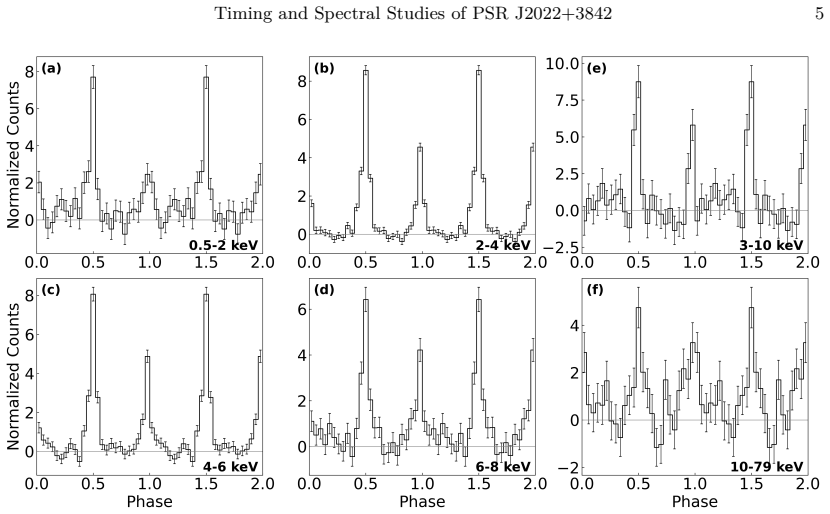
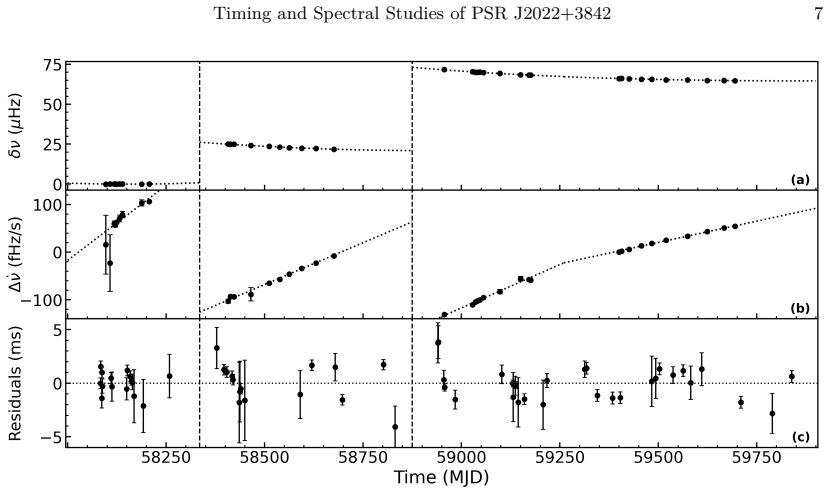
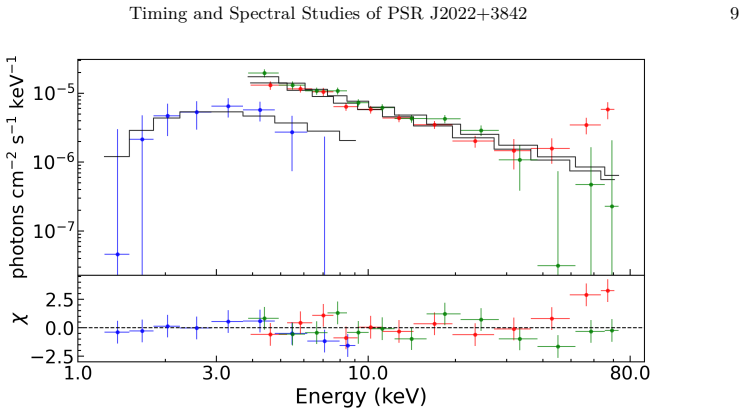
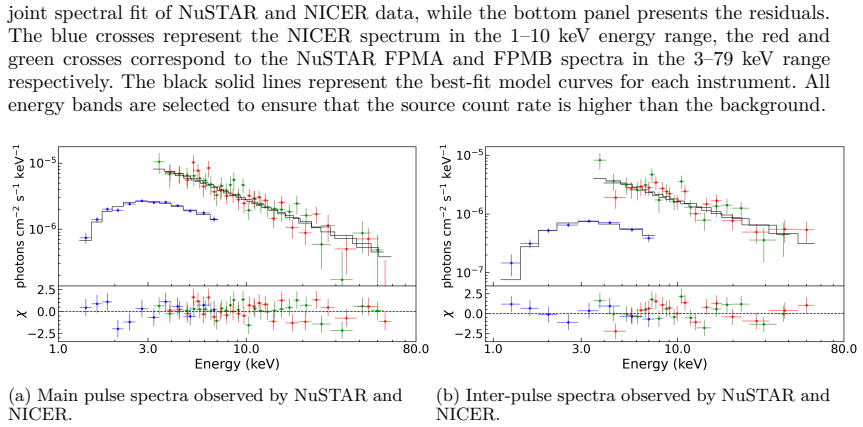
Two large glitches are identified around MJD 58335 with Δν=25.35(2)×10^{-6} Hz and MJD 58875 with Δν=52.078(6)×10^{-6} Hz. The phase-integrated X-ray spectrum (1-79 keV) has a photon index of Γ=1.22(7). The main pulse spectrum and inter-pulse spectrum are harder with Γ=1.17(4) and Γ=1.03^{+0.07}_{-0.06}. No significant variations appear in the pulse profile evolution.
What carries the argument
Identification of abrupt spin-frequency jumps as glitches together with single power-law spectral modeling of the phase-resolved X-ray emission.
If this is right
- The glitches indicate sudden angular momentum transfer events inside the neutron star.
- The power-law spectrum across phases points to dominant non-thermal magnetospheric emission.
- Harder spectra in the main pulse and inter-pulse suggest distinct acceleration sites in the magnetosphere.
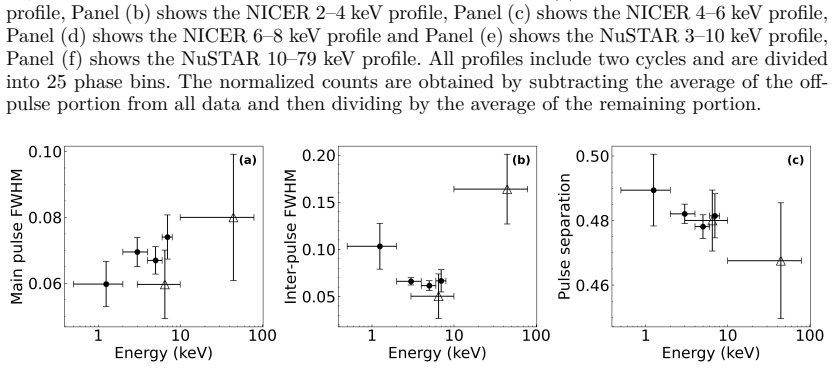
- The lack of pulse-profile evolution implies stable emission geometry over the observed baseline.
- Phase-dependent spectral indices reveal rotation-phase variations in the emission process.
Where Pith is reading between the lines
- Repeated glitches of this size could eventually constrain the superfluid component and pinning forces inside the star.
- The observed difference in spectral hardness between pulse components could be tested against geometric models of the magnetic axis and line of sight.
- Combining these X-ray timings with radio data might reveal whether the glitches are followed by the usual exponential recovery phases.
Load-bearing premise
The observed frequency jumps are discrete glitches rather than continuous timing noise or instrumental effects.
What would settle it
Continued high-precision timing observations over several additional years that either show abrupt jumps with subsequent recovery or continuous frequency wandering without discrete steps.
Figures

read the original abstract
We report on the long-term timing analysis of PSR J2022+3842 using observations from the Neutron Star Interior Composition Explorer (NICER), along with spectral properties derived from joint observations with NICER and the Nuclear Spectroscopic Telescope Array (NuSTAR). Two large glitches are identified around MJD 58335 with $\Delta\nu=25.35(2)\times10^{-6}$ Hz and MJD 58875 with $\Delta\nu=52.078(6)\times10^{-6}$ Hz. Furthermore, phase-resolved spectroscopy reveals that the X-ray emission is well described by a power-law model across different phase intervals. The phase-integrated X-ray spectrum (1-79 keV) has a photon index of $\Gamma=1.22(7)$, yielding an unabsorbed 0.5-10 keV flux of $8.9(6)\times10^{-13}$ erg cm$^{-2}$ s$^{-1}$. The main pulse spectrum (1.2-79 keV) and the inter-pulse spectrum (1-70 keV) are harder with $\Gamma=1.17(4)$ and $\Gamma=1.03^{+0.07}_{-0.06}$ separately, producing an unabsorbed 0.5-10 keV flux of $33.2(2)\times10^{-13}$ erg cm$^{-2}$ s$^{-1}$ and $29(3)\times10^{-13}$ erg cm$^{-2}$ s$^{-1}$. Investigation of the pulse profile evolution with time shows that no significant variations were observed.
Editorial analysis
A structured set of objections, weighed in public.
Referee Report
Summary. The manuscript reports long-term timing analysis of the young pulsar PSR J2022+3842 using NICER data, identifying two large glitches with Δν = 25.35(2) × 10^{-6} Hz near MJD 58335 and Δν = 52.078(6) × 10^{-6} Hz near MJD 58875. It also presents joint NICER+NuSTAR spectral analysis of the phase-integrated (1-79 keV) and phase-resolved spectra, both well described by a single power-law model with Γ = 1.22(7) for the integrated spectrum (harder indices for main-pulse and inter-pulse components), an unabsorbed 0.5-10 keV flux of 8.9(6) × 10^{-13} erg cm^{-2} s^{-1}, and no significant evolution in the pulse profile over time.
Significance. If the glitch identifications hold, the work adds two well-measured large glitches to the sample of events in young pulsars, providing additional data points for statistical studies of glitch sizes, waiting times, and recovery behavior that can constrain superfluid vortex unpinning models. The spectral results confirm non-thermal magnetospheric emission with modest phase dependence in hardness, consistent with expectations for rotation-powered pulsars, and the stable pulse profile indicates no major changes in emission geometry or viewing angle over the monitored baseline.
major comments (2)
- [Timing analysis] Timing analysis section: The central claim of two discrete glitches with the quoted Δν values requires explicit demonstration that step changes at the stated MJDs are statistically preferred over continuous timing noise, red noise, or covariance with ν̇. No details are supplied on the number of TOAs used, the rms of post-fit residuals, or quantitative model comparison (e.g., Δχ², F-test, or Bayesian odds ratio) between glitch and no-glitch timing solutions. This information is load-bearing for the headline result.
- [Spectral analysis] Spectral analysis section: The phase-integrated spectrum is stated to be well described by a single power-law with Γ = 1.22(7), yet the manuscript provides no information on data selection criteria, background subtraction procedure, alternative models tested (e.g., cutoff power-law or added blackbody), or goodness-of-fit metrics (χ²/dof or null-hypothesis probability). These omissions prevent verification that the reported photon index and fluxes are robust, especially given the differing indices found in the phase-resolved spectra.
minor comments (2)
- [Abstract] The abstract quotes precise fitted values and uncertainties but does not indicate the relevant sections or tables where the underlying TOA lists, spectral fit statistics, or data reduction steps are presented.
- [Timing results] Notation for the glitch epochs uses “around MJD 58335” and “around MJD 58875”; more precise epoch values (with uncertainties) should be stated in the timing results table or text.
Simulated Author's Rebuttal
We thank the referee for their careful and constructive review. The comments identify areas where additional methodological details will improve the clarity and verifiability of the timing and spectral results. We address each major comment below and will revise the manuscript to incorporate the requested information.
read point-by-point responses
-
Referee: [Timing analysis] Timing analysis section: The central claim of two discrete glitches with the quoted Δν values requires explicit demonstration that step changes at the stated MJDs are statistically preferred over continuous timing noise, red noise, or covariance with ν̇. No details are supplied on the number of TOAs used, the rms of post-fit residuals, or quantitative model comparison (e.g., Δχ², F-test, or Bayesian odds ratio) between glitch and no-glitch timing solutions. This information is load-bearing for the headline result.
Authors: We agree that the manuscript would benefit from additional quantitative details supporting the glitch identifications. In the revised version we will report the number of TOAs, the rms of the post-fit residuals, and explicit model-comparison statistics (Δχ² and associated probabilities) between the glitch and no-glitch solutions. These quantities were obtained during our TEMPO2 analysis but were omitted for brevity; their inclusion will demonstrate that the reported step changes are statistically preferred. revision: yes
-
Referee: [Spectral analysis] Spectral analysis section: The phase-integrated spectrum is stated to be well described by a single power-law with Γ = 1.22(7), yet the manuscript provides no information on data selection criteria, background subtraction procedure, alternative models tested (e.g., cutoff power-law or added blackbody), or goodness-of-fit metrics (χ²/dof or null-hypothesis probability). These omissions prevent verification that the reported photon index and fluxes are robust, especially given the differing indices found in the phase-resolved spectra.
Authors: We acknowledge the need for fuller methodological transparency. The revised manuscript will specify the data-selection criteria, describe the background-subtraction procedures applied to the NICER and NuSTAR data, provide the χ²/dof and null-hypothesis probabilities for the power-law fits, and report the results of testing alternative models (cutoff power-law and power-law plus blackbody). These additions will confirm that the single power-law description remains adequate and that the quoted indices and fluxes are robust. revision: yes
Circularity Check
No circularity: purely observational timing and spectral measurements
full rationale
The paper reports direct measurements of glitch amplitudes Δν at specific MJDs and fitted photon indices Γ from joint NICER/NuSTAR data. No derivation chain, predictions, or model outputs are claimed that reduce by construction to fitted inputs or self-citations. The analysis consists of standard TOA fitting and spectral modeling without invoking uniqueness theorems, ansatzes from prior self-work, or renaming of known results as new derivations. The central claims are empirical quantities extracted from observations, making the work self-contained against external data.
Axiom & Free-Parameter Ledger
free parameters (1)
- photon index Gamma
axioms (1)
- domain assumption X-ray spectra of pulsars can be adequately described by an absorbed power-law model
Reference graph
Works this paper leans on
-
[1]
@esa (Ref
\@ifclassloaded agu2001 natbib The agu2001 class already includes natbib coding, so you should not add it explicitly Type <Return> for now, but then later remove the command natbib from the document \@ifclassloaded aguplus natbib The aguplus class already includes natbib coding, so you should not add it explicitly Type <Return> for now, but then later rem...
-
[2]
@stdbsttrue NAT@ctr \@lbibitem[ NAT@ctr ] \@lbibitem[#1]#2 \@extra@b@citeb \@ifundefined br@#2\@extra@b@citeb \@namedef br@#2 \@nameuse br@#2\@extra@b@citeb \@ifundefined b@#2\@extra@b@citeb @num @parse #2 [ @natanchorstart #2\@extra@b@citeb \@biblabel @num @natanchorend] @ifcmd#1(@)(@)\@nil #2 @lbibitem\@undefined @lbibitem\@lbibitem \@lbibitem[#1]#2 @lb...
-
[3]
, " * write output.state after.block = add.period write newline
@open @close @open @close and [1] URL: #1 \@ifundefined chapter * \@mkboth \@ifundefined NAT@sectionbib * \@mkboth * \@mkboth\@gobbletwo \@ifclassloaded amsart * \@ifclassloaded amsbook * \@ifundefined bib@heading @heading NAT@ctr thebibliography [1] @ \@biblabel NAT@ctr \@bibsetup #1 NAT@ctr 0 @openbib .11em \@plus.33em \@minus.07em 4000 4000 `\.=1000 \@...
-
[4]
write newline
" write newline "" before.all 'output.state := FUNCTION format.archive archivePrefix empty "" archivePrefix ":" * if FUNCTION format.primaryClass primaryClass empty "" " [" primaryClass * "]" * if FUNCTION format.eprint eprint empty pages empty not booktitle empty not or or "" archive empty ", " * format.archive * eprint * "" ", " * format.archive * eprin...
discussion (0)
Sign in with ORCID, Apple, or X to comment. Anyone can read and Pith papers without signing in.