Recovery of directional wave spectrum from sparse data with compressed sensing
Pith reviewed 2026-06-29 23:01 UTC · model grok-4.3
The pith
Group sparsity and an energy constraint let compressed sensing recover directional wave spectra from fewer buoy measurements while keeping total energy accurate.
A machine-rendered reading of the paper's core claim, the machinery that carries it, and where it could break.
Core claim
By imposing a group sparsity constraint across channels and an energy constraint in the form of a soft lower bound, the compressed sensing framework reconstructs the directional wave spectrum from sparse multi-channel buoy data while preserving its sparse structure and avoiding energy underestimation.
What carries the argument
The group sparsity constraint that promotes physically consistent sparse representations across the three displacement channels, combined with an energy constraint as a soft lower bound enabling isotropic rescaling of the recovered spectrum.
If this is right
- The method enables compression by retaining only a subset of the original buoy measurements.
- The recovered spectrum preserves its sparse structure through the group sparsity enforcement.
- Energy bias from standard compressed sensing is corrected via the soft lower bound constraint.
- The approach maintains physical consistency across displacement channels in the reconstructed spectrum.
Where Pith is reading between the lines
- The same group sparsity and energy constraints could apply to other multi-sensor systems where signals are physically linked across channels.
- If the method scales, it could lower storage and transmission costs for long-term wave monitoring networks.
- The isotropic rescaling step might integrate with existing wave spectrum post-processing tools that expect normalized energy levels.
Load-bearing premise
The three displacement components exhibit intrinsic correlations because wave motion contributes simultaneously to all directions according to linear wave theory.
What would settle it
If spectra recovered from a retained subset of measurements show substantial deviation in directional distribution or integrated energy compared to spectra from the full measurement set, the recovery claim would be falsified.
Figures




read the original abstract
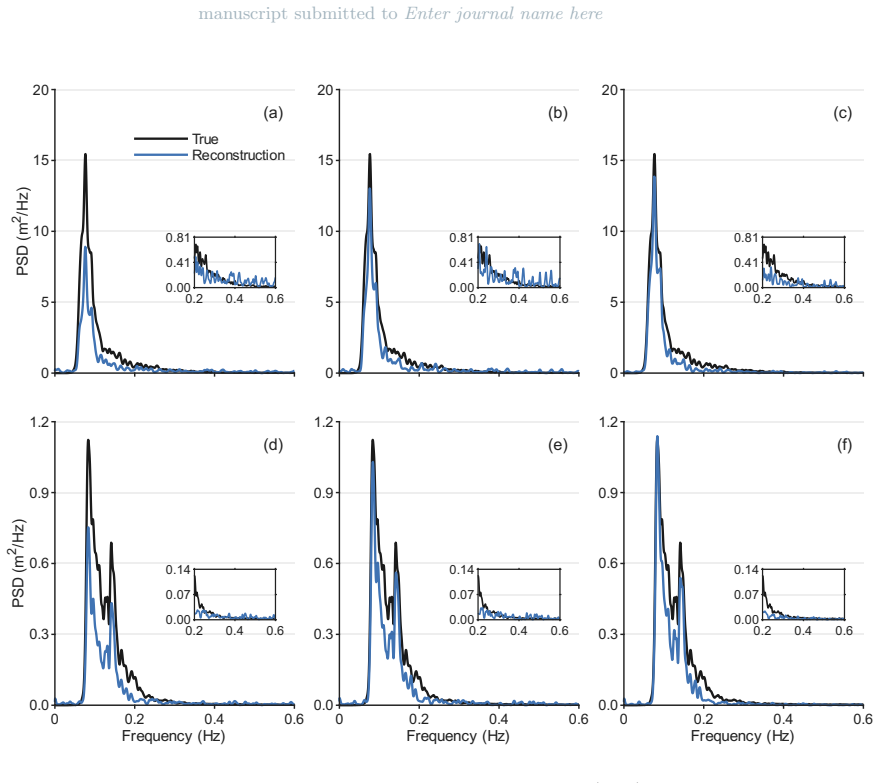
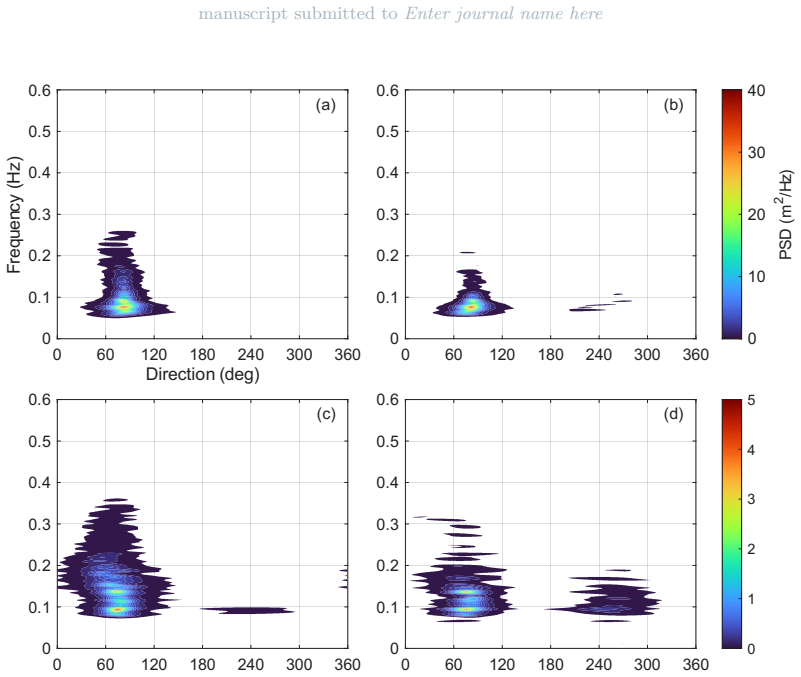
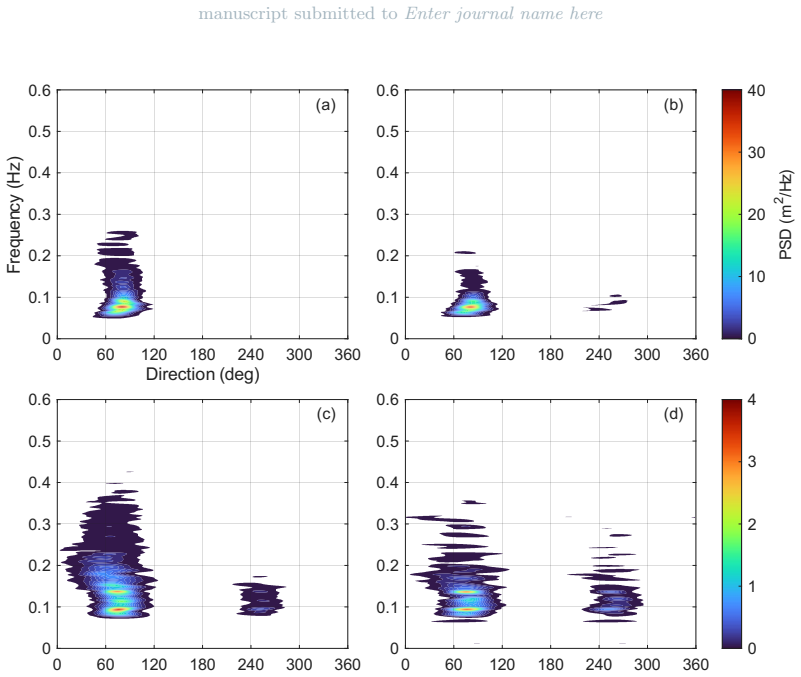
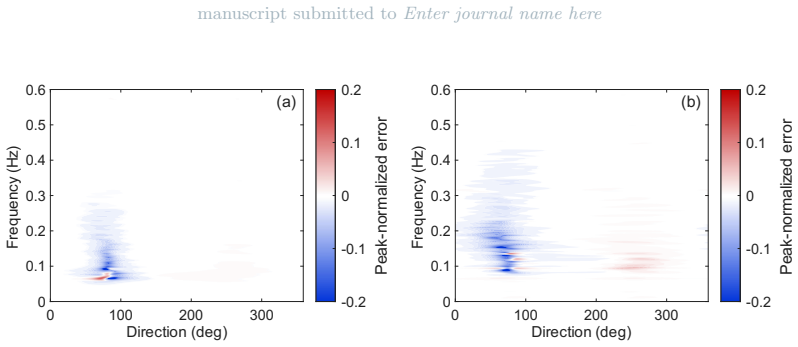
Compressed sensing provides an efficient framework for reconstructing wave signals from reduced measurements. For multi-channel buoy data, the three displacement components exhibit intrinsic correlations, as wave motion contributes simultaneously to all directions according to linear wave theory. Meanwhile, conventional compressed sensing methods based on $\ell_1$-shrinkage tend to underestimate signal energy when sparsity is not strictly satisfied, leading to biased spectral estimation. This paper introduces a group sparsity constraint to promote physically consistent sparse representations across channels. An energy constraint is proposed in the form of a soft lower bound, enabling an isotropic rescaling of the recovered spectrum while preserving its sparse structure. Considering a large volume of buoy data, we demonstrate through a series of experiments that the proposed approach enables compression by retaining a subset of original measurements.
Editorial analysis
A structured set of objections, weighed in public.
Referee Report
Summary. The manuscript proposes a compressed sensing framework for recovering directional wave spectra from sparse multi-channel buoy displacement data. It augments standard ℓ1-based recovery with a group-sparsity constraint that enforces cross-channel consistency arising from linear wave theory and adds a soft energy lower bound to counteract the known energy underestimation bias of ℓ1 shrinkage. Experiments on large volumes of buoy data are used to show that the method permits substantial measurement compression while preserving the sparse support and structure of the recovered spectrum.
Significance. If the experimental claims hold under scrutiny, the work offers a practical route to reducing data volume in directional wave monitoring while respecting the physics of linear wave motion. The explicit use of group sparsity to encode the known heave-surge-sway coupling and the soft energy correction are targeted improvements over off-the-shelf compressed sensing; both are directly relevant to oceanographic and geophysical applications where buoy arrays are costly to maintain.
major comments (2)
- [§5 (Experiments)] The central claim that the recovered spectrum remains unbiased rests on the combination of group sparsity and the soft energy lower bound; however, the manuscript does not report quantitative error metrics (bias, variance, or spectral shape error) against a dense reference or against standard ℓ1 recovery on the same data sets. Without these controls it is impossible to verify that the energy constraint actually restores the correct energy level rather than merely rescaling an already distorted support.
- [§3 (Method)] The group-sparsity formulation is described only at the level of the abstract; the precise definition of the groups (whether they are formed per frequency bin across the three channels or per time-frequency atom) and the value of the group-norm parameter are not stated. This information is load-bearing for reproducibility and for assessing whether the constraint is truly parameter-free or introduces tunable bias.
minor comments (2)
- Notation for the three displacement channels (heave, surge, sway) should be introduced once and used consistently; the abstract alternates between “components” and “channels” without a clear mapping to the linear dispersion relation.
- [§2 (Background)] The manuscript should include a brief statement of the linear wave theory dispersion relation that justifies the group-sparsity assumption, even if only as a reference to standard texts.
Simulated Author's Rebuttal
We thank the referee for their constructive comments, which help improve the clarity and rigor of the manuscript. We address each major comment below and indicate the corresponding revisions.
read point-by-point responses
-
Referee: [§5 (Experiments)] The central claim that the recovered spectrum remains unbiased rests on the combination of group sparsity and the soft energy lower bound; however, the manuscript does not report quantitative error metrics (bias, variance, or spectral shape error) against a dense reference or against standard ℓ1 recovery on the same data sets. Without these controls it is impossible to verify that the energy constraint actually restores the correct energy level rather than merely rescaling an already distorted support.
Authors: We agree that explicit quantitative error metrics are needed to substantiate the claims. In the revised manuscript we will add bias, variance, and spectral shape error (e.g., integrated squared difference) comparisons of the proposed method against both dense-reference spectra and standard ℓ1 recovery on the same buoy datasets. These will be presented in new tables and figures in §5. revision: yes
-
Referee: [§3 (Method)] The group-sparsity formulation is described only at the level of the abstract; the precise definition of the groups (whether they are formed per frequency bin across the three channels or per time-frequency atom) and the value of the group-norm parameter are not stated. This information is load-bearing for reproducibility and for assessing whether the constraint is truly parameter-free or introduces tunable bias.
Authors: The groups are defined per frequency bin, collecting the three channel coefficients (heave-surge-sway) at each frequency to enforce the linear-wave-theory coupling. The group-sparsity term employs the ℓ_{2,1} norm with its weight parameter fixed at the value obtained by cross-validation on a held-out subset of the data. Section 3 will be expanded with the exact optimization problem, group definition, and all parameter values used. revision: yes
Circularity Check
No significant circularity detected
full rationale
The derivation applies compressed sensing with group sparsity (to enforce cross-channel consistency from linear wave theory) and a soft energy lower bound (to mitigate l1 bias). These are explicit algorithmic modifications justified by standard physics and documented l1 limitations, not by redefining inputs as outputs or by self-citation chains. No equation reduces the recovered spectrum to a fitted parameter or renames a known result as a new derivation; the central compression claim remains independent of the paper's own fitted values.
Axiom & Free-Parameter Ledger
axioms (1)
- domain assumption Linear wave theory holds, so wave motion contributes simultaneously to all three displacement components creating intrinsic correlations.
Reference graph
Works this paper leans on
-
[1]
Beck, A., & Teboulle, M. (2009). A fast iterative shrinkage-thresholding algorithm for linear inverse problems.SIAM journal on imaging sciences,2(1), 183–202. Benoit, M., Frigaard, P., & Sch¨ affer, H. A. (1997).Analyzing multidirectional wave spectra: A tentative classification of available methods[Technical Report]. Benoit, M., & Goasguen, G. (1999). Co...
-
[2]
Davenport, M. A., Duarte, M. F., Eldar, Y. C., & Kutyniok, G. (2012).Introduction to compressed sensing. Dean, R. G., & Dalrymple, R. A. (1991).Water wave mechanics for engineers and scientists(Vol. 2). world scientific publishing company. Donoho, D. L. (2006). Compressed sensing.IEEE Transactions on Information The- ory,52(4), 1289–1306. doi: 10.1109/TIT...
-
[3]
general theory.Journal of Fluid Mechanics,12(4), 481–500. Holand, K., & Kalisch, H. (2024). Real-time ocean wave prediction in time do- main with autoregression and echo state networks.Frontiers in Marine Science, 11, 1486234. Holthuijsen, L. H. (2007).Waves in oceanic and coastal waters. Cambridge Univer- sity Press. doi: 10.1017/CBO9780511618536 Krogsta...
-
[4]
doi: 10.1175/1520-0485(1988)018⟨1802:MLEOOW⟩2.0.CO;2 Kuehn, J., Abadie, S., Liquet, B., & Roeber, V. (2023). A deep learning super- resolution model to speed up computations of coastal sea states.Applied Ocean Research,141, 103776. Liu, Q., Feng, X., & Tang, T. (2022). A machine learning model for wave prediction based on support vector machine.Internatio...
discussion (0)
Sign in with ORCID, Apple, or X to comment. Anyone can read and Pith papers without signing in.