SpikeReg: Energy-Efficient 3D Deformable Medical Image Registration with Spiking Neural Networks
Pith reviewed 2026-06-30 11:47 UTC · model grok-4.3
The pith
SpikeReg achieves registration accuracy comparable to its ANN teacher at 12.8 percent spike rate with 55.5 times lower projected energy.
A machine-rendered reading of the paper's core claim, the machinery that carries it, and where it could break.
Core claim
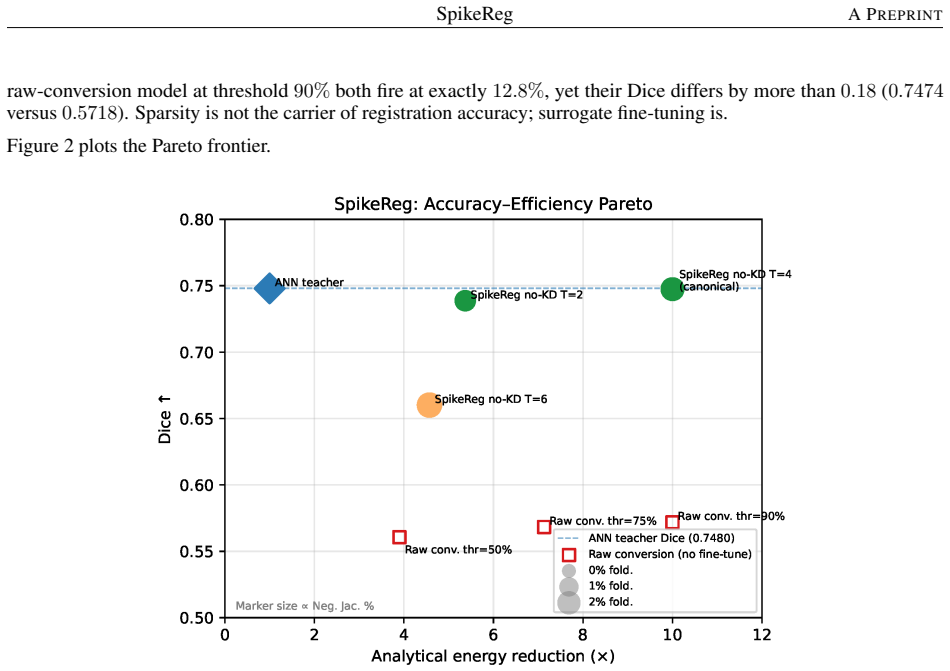
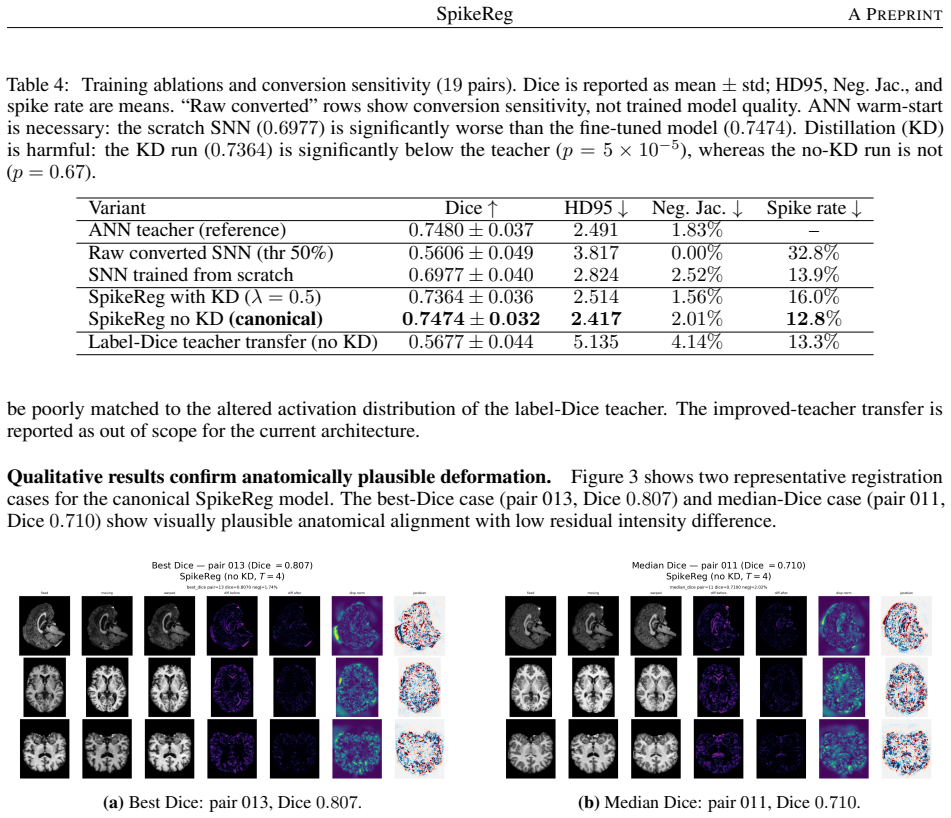
SpikeReg demonstrates that a spiking U-Net for 3D deformable medical image registration, initialized from an ANN teacher via layer-wise weight transfer and percentile-based threshold calibration and fine-tuned with a surrogate-gradient objective, attains a mean Dice score of 0.7474 with no significant difference from the teacher's 0.7480, while operating at a 12.8 percent mean spike rate that projects a 55.5-fold arithmetic-energy reduction under an event-sparse SynOps/MAC proxy.
What carries the argument
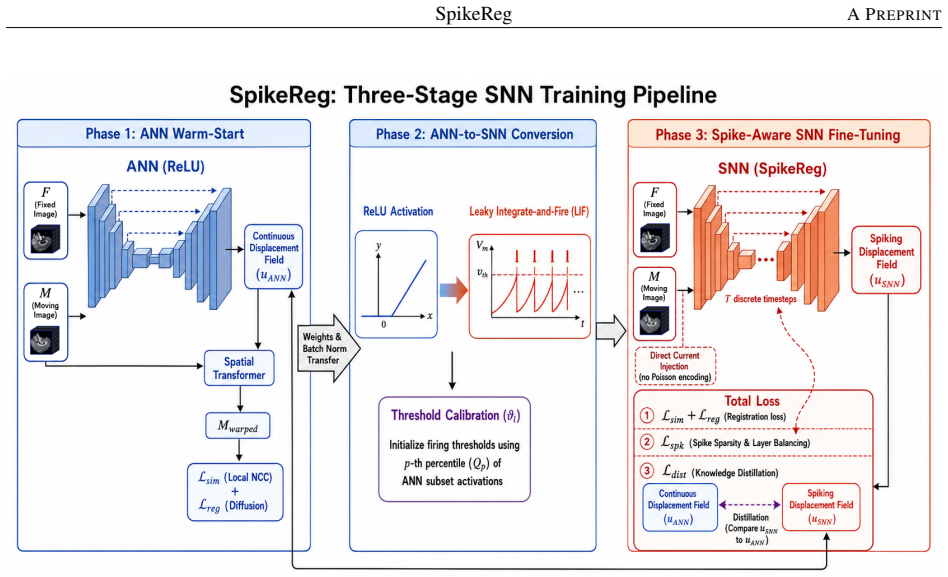
The conversion process of layer-wise weight transfer followed by activation-percentile threshold calibration, combined with surrogate-gradient fine-tuning that incorporates local cross-correlation, diffusion regularization, and spike-rate sparsity terms.
If this is right
- Dense geometric prediction can be performed under sparse event-driven computation.
- Displacement distillation from the ANN teacher hurts registration performance.
- ANN teachers trained with a label-Dice loss fail to transfer through rate-code conversion.
- A 55.5 times arithmetic-energy reduction is achievable at maintained accuracy on this task.
Where Pith is reading between the lines
- The same conversion and fine-tuning pipeline could be tested on other dense 3D medical imaging tasks such as segmentation.
- Deployment on actual neuromorphic chips might enable low-power portable registration systems.
- The reported negative findings indicate that teacher model selection and loss function matter for successful SNN transfer.
- Further reduction in spike rate through additional regularization could be explored while monitoring accuracy.
Load-bearing premise
The SynOps/MAC proxy and 12.8 percent spike-rate measurement accurately predict real arithmetic energy consumption on neuromorphic hardware.
What would settle it
Direct energy measurement of SpikeReg on physical neuromorphic hardware compared to the dense ANN baseline to check whether the observed savings reach the projected 55.5 times reduction while Dice remains above 0.74.
Figures


read the original abstract
Deformable medical image registration aligns anatomical structures across images but remains computationally dense at 3D resolution. Spiking neural networks (SNNs) offer sparse event-driven computation, yet have not been systematically studied for deformable medical image registration. We introduce SpikeReg, a spiking U-Net for 3D brain MRI registration. SpikeReg is initialized from an analog ANN registration teacher, converted by layer-wise weight transfer and activation-percentile threshold calibration, and fine-tuned with a surrogate-gradient objective combining local cross-correlation, diffusion regularization, and spike-rate sparsity. On the OASIS Learn2Reg validation split ($19$ image pairs), SpikeReg reaches Dice $0.7474 \pm 0.032$, with no significant paired Dice difference from the ANN teacher ($0.7480 \pm 0.037$, $p = 0.67$), at a $12.8\%$ mean spike rate and a $55.5\times$ projected arithmetic-energy reduction under an event-sparse SynOps/MAC proxy relative to the dense-ANN baseline. We additionally report two negative findings: displacement distillation from the ANN teacher hurts performance, and ANN teachers trained with a label-Dice loss fail to transfer through rate-code conversion. Together these results show that dense geometric prediction can be performed under sparse event-driven computation, opening a path toward neuromorphic medical image registration.
Editorial analysis
A structured set of objections, weighed in public.
Referee Report
Summary. The manuscript introduces SpikeReg, a spiking U-Net for 3D deformable registration of brain MRI. It is obtained by converting an ANN teacher via layer-wise weight transfer and activation-percentile threshold calibration, then fine-tuned with surrogate gradients on a loss combining local cross-correlation, diffusion regularization, and spike-rate sparsity. On the OASIS Learn2Reg validation split (19 image pairs), SpikeReg reports Dice 0.7474 ± 0.032 with no significant difference from the teacher (0.7480 ± 0.037, p=0.67), a 12.8% mean spike rate, and a 55.5× projected arithmetic-energy reduction under an event-sparse SynOps/MAC proxy. Two negative findings (displacement distillation hurts performance; label-Dice ANN teachers fail to transfer) are also reported.
Significance. If the energy projection holds, the work shows that dense geometric tasks such as 3D registration can be performed with sparse event-driven SNN computation while preserving accuracy, which would be relevant for energy-constrained medical imaging applications. Strengths include the direct empirical comparison to the teacher on a public dataset split, statistical testing of the Dice equivalence, and explicit reporting of negative results. The energy claim, however, rests on a proxy rather than measured hardware consumption.
major comments (2)
- [Abstract] Abstract: the 55.5× arithmetic-energy reduction is stated under an event-sparse SynOps/MAC proxy at 12.8% mean spike rate. This proxy equates synaptic operations to energy savings but does not measure actual power draw, event-routing overhead, or latency on neuromorphic silicon; no hardware-in-the-loop validation is described, so the central energy-efficiency claim remains a projection.
- [Methods] Methods (conversion and fine-tuning sections): the layer-wise activation-percentile thresholds and surrogate-gradient hyperparameters are free parameters whose calibration is performed on the OASIS split. This introduces a risk that the reported Dice equivalence and sparsity level are tuned to this particular validation set; cross-dataset or cross-task evaluation would be required to support the general claim that dense geometric prediction works under sparse event-driven computation.
minor comments (2)
- [Abstract] Abstract: the validation uses only 19 image pairs; consider adding effect-size reporting or power analysis alongside the p-value to strengthen the equivalence claim.
- [Results] Ensure the exact definition of the SynOps/MAC proxy (including any assumptions about MAC energy cost) is stated explicitly so that the 55.5× factor can be reproduced from the reported spike rate.
Simulated Author's Rebuttal
We thank the referee for the constructive feedback. We address the major comments point by point below.
read point-by-point responses
-
Referee: [Abstract] Abstract: the 55.5× arithmetic-energy reduction is stated under an event-sparse SynOps/MAC proxy at 12.8% mean spike rate. This proxy equates synaptic operations to energy savings but does not measure actual power draw, event-routing overhead, or latency on neuromorphic silicon; no hardware-in-the-loop validation is described, so the central energy-efficiency claim remains a projection.
Authors: We agree that the reported energy reduction is a projection derived from the SynOps/MAC proxy rather than direct hardware measurements. This proxy is standard in SNN literature for estimating arithmetic efficiency under sparsity. We will revise the abstract to reinforce the 'projected' qualifier and add an explicit limitations paragraph in the discussion that details the proxy assumptions, excludes routing/latency overheads, and notes the absence of neuromorphic hardware validation. This clarifies the claim without changing the numerical results. revision: yes
-
Referee: [Methods] Methods (conversion and fine-tuning sections): the layer-wise activation-percentile thresholds and surrogate-gradient hyperparameters are free parameters whose calibration is performed on the OASIS split. This introduces a risk that the reported Dice equivalence and sparsity level are tuned to this particular validation set; cross-dataset or cross-task evaluation would be required to support the general claim that dense geometric prediction works under sparse event-driven computation.
Authors: Calibration of percentile thresholds and surrogate-gradient hyperparameters was performed on the OASIS validation split to achieve the reported metrics. We acknowledge this creates a risk of dataset-specific tuning and limits strong generalizability claims. The core result remains statistical equivalence on this public benchmark together with the reported negative findings. We will add a limitations subsection discussing the calibration procedure and the need for future cross-dataset validation, but no additional datasets were evaluated in the present study. revision: partial
- Hardware-in-the-loop validation or measured power/latency on neuromorphic silicon, as no such experiments were conducted.
- Cross-dataset or cross-task evaluation beyond the OASIS Learn2Reg split, as the study was restricted to this single benchmark.
Circularity Check
No circularity: empirical comparison on public split with no self-referential derivations
full rationale
The paper reports Dice equivalence (0.7474 vs 0.7480) and a SynOps/MAC energy proxy on the OASIS validation split after ANN-to-SNN conversion and surrogate-gradient fine-tuning. No equations, fitted parameters, or self-citations are presented that reduce the claimed performance or energy ratio to quantities defined by the paper's own inputs. The central results are direct measurements against an external teacher network and dataset split; the proxy is an explicit modeling choice rather than a self-defining prediction. This is the normal case of a self-contained empirical study.
Axiom & Free-Parameter Ledger
free parameters (2)
- layer-wise activation-percentile thresholds
- surrogate-gradient hyperparameters
axioms (2)
- domain assumption Surrogate gradients provide a usable approximation for back-propagation through non-differentiable spike functions.
- domain assumption The SynOps/MAC proxy gives a faithful estimate of arithmetic energy on target neuromorphic hardware.
Reference graph
Works this paper leans on
-
[1]
doi:10.1109/TMI.2019.2897538. Adrian V . Dalca, Guha Balakrishnan, John Guttag, and Mert R. Sabuncu. Unsupervised learning of prob- abilistic diffeomorphic registration for images and surfaces.Medical Image Analysis, 57:226–236, 2019. doi:10.1016/j.media.2019.07.006. Junyu Chen, Eric C. Frey, Yufan He, William P. Segars, Ye Li, and Yong Du. TransMorph: Tr...
-
[2]
doi:10.3389/fnins.2017.00682. Peter U. Diehl, Daniel Neil, Jonathan Binas, Matthew Cook, Shih-Chii Liu, and Michael Pfeiffer. Fast-classifying, high-accuracy spiking deep networks through weight and threshold balancing. In2015 International Joint Conference on Neural Networks, pages 1–8, 2015. doi:10.1109/IJCNN.2015.7280696. Kinjal Patel, Eric Hunsberger,...
discussion (0)
Sign in with ORCID, Apple, or X to comment. Anyone can read and Pith papers without signing in.