ADMFormer: An Adaptive-Decomposition Transformer with Time-Varying Masked Spatial Attention for Traffic Forecasting
Pith reviewed 2026-06-29 21:56 UTC · model grok-4.3
The pith
ADMFormer decouples traffic time series into regular and fluctuating components using adaptive gating to improve forecasting accuracy.
A machine-rendered reading of the paper's core claim, the machinery that carries it, and where it could break.
Core claim
The central discovery is that an adaptive decomposition transformer can separate traffic signals into dominant regularities and residual fluctuations via time-node adaptive gating. A dual-branch temporal module then models global periodic dependencies in one branch and high-frequency variations in the other. Time-varying masked spatial attention sparsifies the spatial graph based on current states to preserve informative dependencies, leading to state-of-the-art results on four real-world datasets.
What carries the argument
The time-node adaptive gating mechanism for signal decomposition combined with time-varying masked spatial attention for dynamic dependency modeling.
If this is right
- Traffic series are modeled with separate handling for stable periodic regularities and event-driven fluctuations.
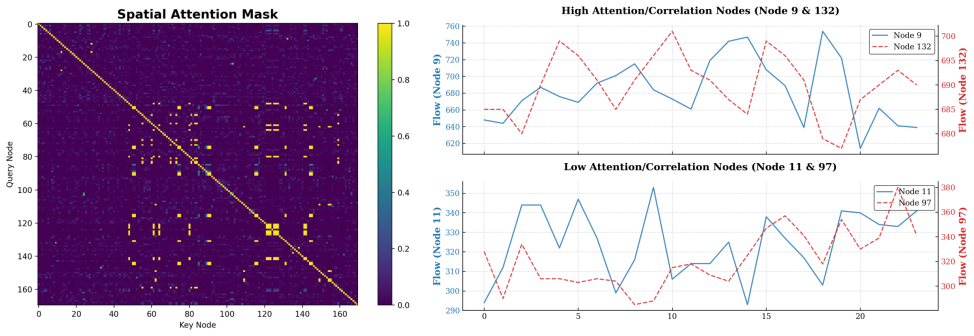
- Spatial dependencies are made dynamic and sparse to avoid redundant interactions and noise.
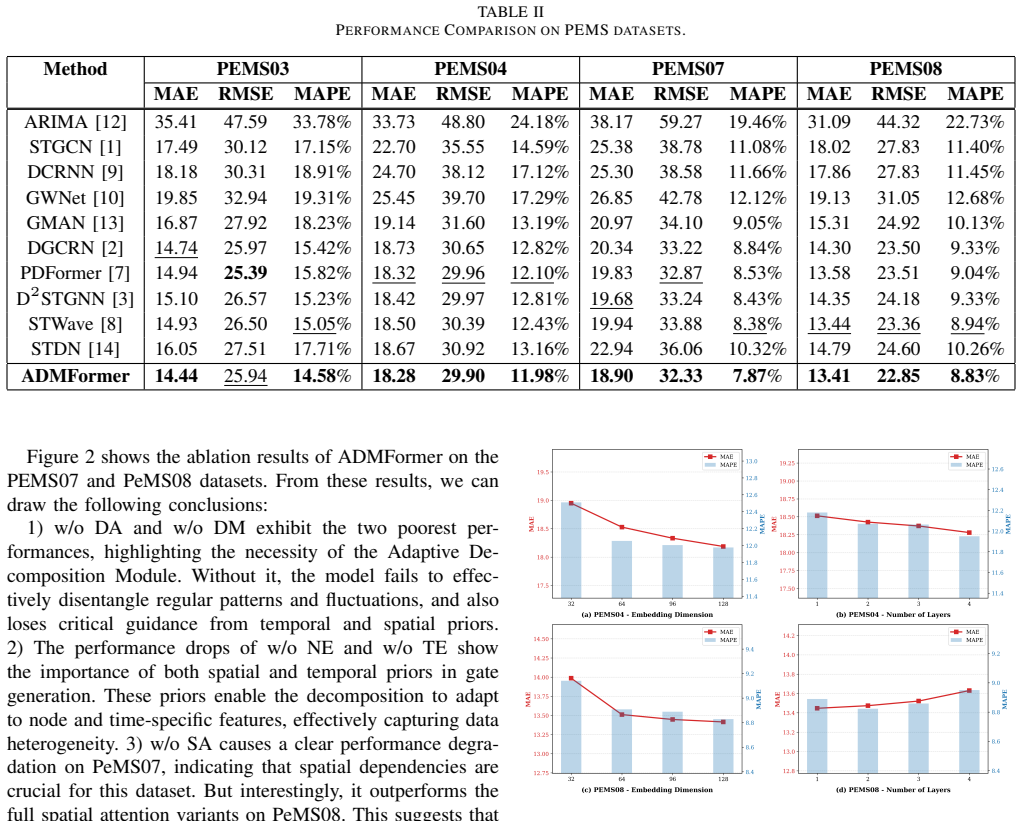
- State-of-the-art performance is achieved on four real-world traffic forecasting datasets.
- Dual-branch processing captures both global periodic and high-frequency irregular variations effectively.
Where Pith is reading between the lines
- The decomposition approach might extend to other domains with mixed regular and irregular time series such as stock prices or weather data.
- Masked attention based on real-time states could apply to other networked forecasting problems like power grid load prediction.
- Separate analysis of the decomposed components could provide new insights into what drives traffic fluctuations versus regular flows.
Load-bearing premise
The time-node adaptive gating mechanism can effectively decouple traffic signals into dominant regularities and residual fluctuations that vary across time and nodes.
What would settle it
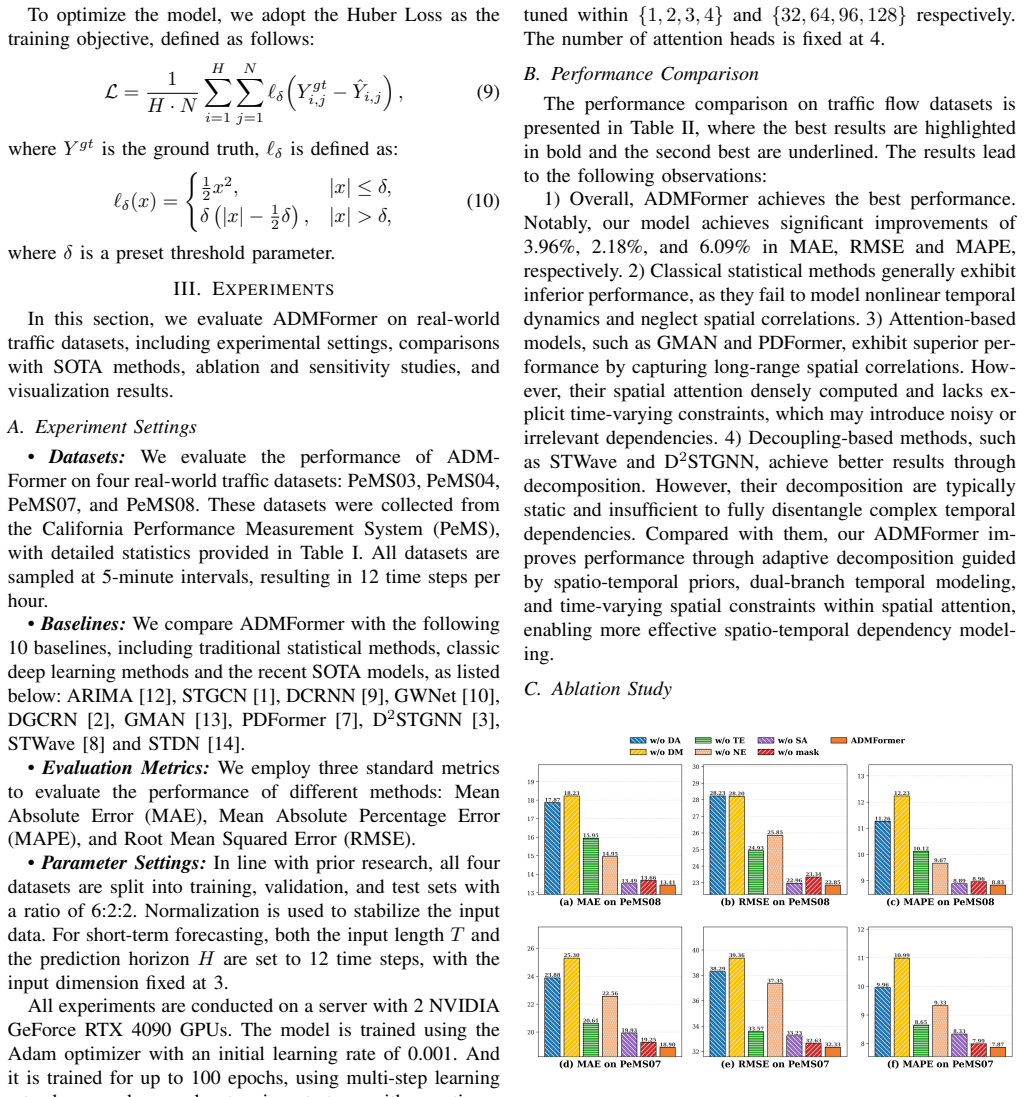
Demonstrating that ADMFormer does not outperform baseline methods on the four real-world datasets when the adaptive gating or the masked attention components are ablated.
Figures

read the original abstract
Accurate traffic forecasting is essential for intelligent transportation systems, supporting a wide range of real-world applications. However, it remains challenging due to two key factors:~(1) Traffic series contain heterogeneous temporal patterns, where stable periodic regularities coexist with event-driven fluctuations. Existing methods often treat them within a unified representation, limiting their ability to capture fine-grained temporal dynamics.~(2)Spatial dependencies among nodes are inherently dynamic and sparse, while dense all-pairs attention often introduces redundant interactions and amplifies noise. To address these issues, we propose ADMFormer, an Adaptive-Decomposition Transformer with Time-Varying Masked Spatial Attention. Specifically, ADMFormer first employs a time-node adaptive gating mechanism to decouple traffic signals into dominant regularities and residual fluctuations that vary across time and nodes. A dual-branch temporal module is then designed to separately capture global periodic dependencies and high-frequency irregular variations from these two decomposed components. Furthermore, ADMFormer introduces a time-varying masked spatial attention that sparsifies spatial interactions based on real-time traffic states, thereby effectively preserving dynamic and informative dependencies. Extensive experiments on four real-world datasets demonstrate that ADMFormer achieves state-of-the-art performance.
Editorial analysis
A structured set of objections, weighed in public.
Referee Report
Summary. The paper proposes ADMFormer, an Adaptive-Decomposition Transformer for traffic forecasting. It introduces a time-node adaptive gating mechanism to decouple traffic signals into dominant regularities and residual fluctuations varying across time and nodes, a dual-branch temporal module to separately model global periodic dependencies and high-frequency irregular variations, and time-varying masked spatial attention to sparsify dynamic spatial interactions based on real-time states. The central claim is that this architecture achieves state-of-the-art performance on four real-world datasets.
Significance. If the reported gains are reproducible and the ablations confirm the contribution of each component, the adaptive decomposition and state-dependent masking could meaningfully improve modeling of heterogeneous temporal patterns and sparse dynamic spatial dependencies in traffic data, offering a practical advance for intelligent transportation systems applications.
major comments (1)
- [Abstract] Abstract: the central SOTA claim cannot be evaluated because the provided text contains no quantitative results, dataset names, baseline comparisons, error metrics, ablation studies, or statistical significance tests; without these the performance assertion remains unverified.
minor comments (1)
- [Abstract] Abstract, paragraph 2: the phrase 'time-node adaptive gating mechanism' is introduced without even a high-level equation or pseudocode sketch, which reduces immediate clarity for readers familiar with gating mechanisms in time-series models.
Simulated Author's Rebuttal
We thank the referee for the detailed review and the observation on the abstract. We address the single major comment below.
read point-by-point responses
-
Referee: [Abstract] Abstract: the central SOTA claim cannot be evaluated because the provided text contains no quantitative results, dataset names, baseline comparisons, error metrics, ablation studies, or statistical significance tests; without these the performance assertion remains unverified.
Authors: We agree that the abstract, in its current form, presents the SOTA claim at a high level without supporting numbers, dataset names, or metrics, which prevents direct evaluation from the abstract alone. The full manuscript contains the required details in the Experiments section, including the four dataset names, baseline comparisons, MAE/RMSE/MAPE results, ablation studies, and statistical comparisons. We will revise the abstract to incorporate concise quantitative highlights (e.g., specific relative improvements and dataset references) while preserving its brevity. revision: yes
Circularity Check
No significant circularity
full rationale
The paper presents ADMFormer as an architectural proposal combining adaptive gating, dual-branch temporal modeling, and time-varying masked spatial attention to address traffic forecasting challenges. All load-bearing claims reduce to empirical SOTA results on four external datasets rather than any internal derivation, self-referential fitting, or self-citation chain. No equations are shown that equate a 'prediction' to a fitted parameter by construction, and the method is described as a direct response to the two stated challenges without importing uniqueness theorems or ansatzes from prior self-work. The argument is therefore self-contained against external benchmarks.
Axiom & Free-Parameter Ledger
Reference graph
Works this paper leans on
-
[1]
Spatio-temporal graph convolutional networks: a deep learning framework for traffic forecasting,
B. Yu, H. Yin, and Z. Zhu, “Spatio-temporal graph convolutional networks: a deep learning framework for traffic forecasting,” in Proceedings of the 27th International Joint Conference on Artificial Intelligence, 2018, pp. 3634–3640
2018
-
[2]
Dynamic graph convolutional recurrent network for traffic prediction: Benchmark and solution,
F. Li, J. Feng, H. Yan, G. Jin, F. Yang, F. Sun, D. Jin, and Y . Li, “Dynamic graph convolutional recurrent network for traffic prediction: Benchmark and solution,”ACM Transactions on Knowledge Discovery from Data, vol. 17, no. 1, pp. 1–21, 2023
2023
-
[3]
Decoupled dynamic spatial-temporal graph neural network for traffic forecasting,
Z. Shao, Z. Zhang, W. Wei, F. Wang, Y . Xu, X. Cao, and C. S. Jensen, “Decoupled dynamic spatial-temporal graph neural network for traffic forecasting,”arXiv preprint arXiv:2206.09112, 2022
-
[4]
Dmgstcn: Dynamic multigraph spatio–temporal convolution network for traffic forecasting,
Y . Qin, X. Tao, Y . Fang, H. Luo, F. Zhao, and C. Wang, “Dmgstcn: Dynamic multigraph spatio–temporal convolution network for traffic forecasting,”IEEE Internet of Things Journal, vol. 11, no. 12, pp. 22 208–22 219, 2024
2024
-
[5]
Localised adaptive spatial-temporal graph neural network,
W. Duan, X. He, Z. Zhou, L. Thiele, and H. Rao, “Localised adaptive spatial-temporal graph neural network,” inProceedings of the 29th acm sigkdd conference on knowledge discovery and data mining, 2023, pp. 448–458
2023
-
[6]
Connect- ing the dots: Multivariate time series forecasting with graph neural networks,
Z. Wu, S. Pan, G. Long, J. Jiang, X. Chang, and C. Zhang, “Connect- ing the dots: Multivariate time series forecasting with graph neural networks,” inProceedings of the 26th ACM SIGKDD international conference on knowledge discovery & data mining, 2020, pp. 753– 763
2020
-
[7]
Pdformer: Propagation delay-aware dynamic long-range transformer for traffic flow predic- tion,
J. Jiang, C. Han, W. X. Zhao, and J. Wang, “Pdformer: Propagation delay-aware dynamic long-range transformer for traffic flow predic- tion,” inProceedings of the AAAI conference on artificial intelligence, vol. 37, no. 4, 2023, pp. 4365–4373
2023
-
[8]
When spatio-temporal meet wavelets: Disentangled traffic forecasting via efficient spectral graph attention networks,
Y . Fang, Y . Qin, H. Luo, F. Zhao, B. Xu, L. Zeng, and C. Wang, “When spatio-temporal meet wavelets: Disentangled traffic forecasting via efficient spectral graph attention networks,” in2023 IEEE 39th International Conference on Data Engineering (ICDE). IEEE, 2023, pp. 517–529
2023
-
[9]
Diffusion convolutional recur- rent neural network: Data-driven traffic forecasting,
Y . Li, R. Yu, C. Shahabi, and Y . Liu, “Diffusion convolutional recur- rent neural network: Data-driven traffic forecasting,” inInternational Conference on Learning Representations, 2018
2018
-
[10]
Graph wavenet for deep spatial-temporal graph modeling,
Z. Wu, S. Pan, G. Long, J. Jiang, and C. Zhang, “Graph wavenet for deep spatial-temporal graph modeling,” inInternational Joint Conference on Artificial Intelligence 2019. Association for the Advancement of Artificial Intelligence (AAAI), 2019, pp. 1907–1913
2019
-
[11]
Duet: Dual clus- tering enhanced multivariate time series forecasting,
X. Qiu, X. Wu, Y . Lin, C. Guo, J. Hu, and B. Yang, “Duet: Dual clus- tering enhanced multivariate time series forecasting,” inProceedings of the 31st ACM SIGKDD Conference on Knowledge Discovery and Data Mining V . 1, 2025, pp. 1185–1196
2025
-
[12]
G. E. P. Box, G. M. Jenkins, G. C. Reinselet al.,Time series analysis: forecasting and control. John Wiley & Sons, 2015,arXiv:2311.10122
work page internal anchor Pith review Pith/arXiv arXiv 2015
-
[13]
Gman: A graph multi-attention network for traffic prediction,
C. Zheng, X. Fan, C. Wang, and J. Qi, “Gman: A graph multi-attention network for traffic prediction,” inProceedings of the AAAI conference on artificial intelligence, vol. 34, no. 01, 2020, pp. 1234–1241
2020
-
[14]
Revisiting spatial- temporal similarity: A deep learning framework for traffic prediction,
H. Yao, X. Tang, H. Wei, G. Zheng, and Z. Li, “Revisiting spatial- temporal similarity: A deep learning framework for traffic prediction,” inProceedings of the AAAI conference on artificial intelligence, vol. 33, no. 01, 2019, pp. 5668–5675
2019
discussion (0)
Sign in with ORCID, Apple, or X to comment. Anyone can read and Pith papers without signing in.