A Bruhat order for Latin squares and alternating sign hypermatrices
Pith reviewed 2026-06-29 21:42 UTC · model grok-4.3
The pith
Entrywise domination on corner-sum hypermatrices encodes a Bruhat order on Latin squares and alternating sign hypermatrices.
A machine-rendered reading of the paper's core claim, the machinery that carries it, and where it could break.
Core claim
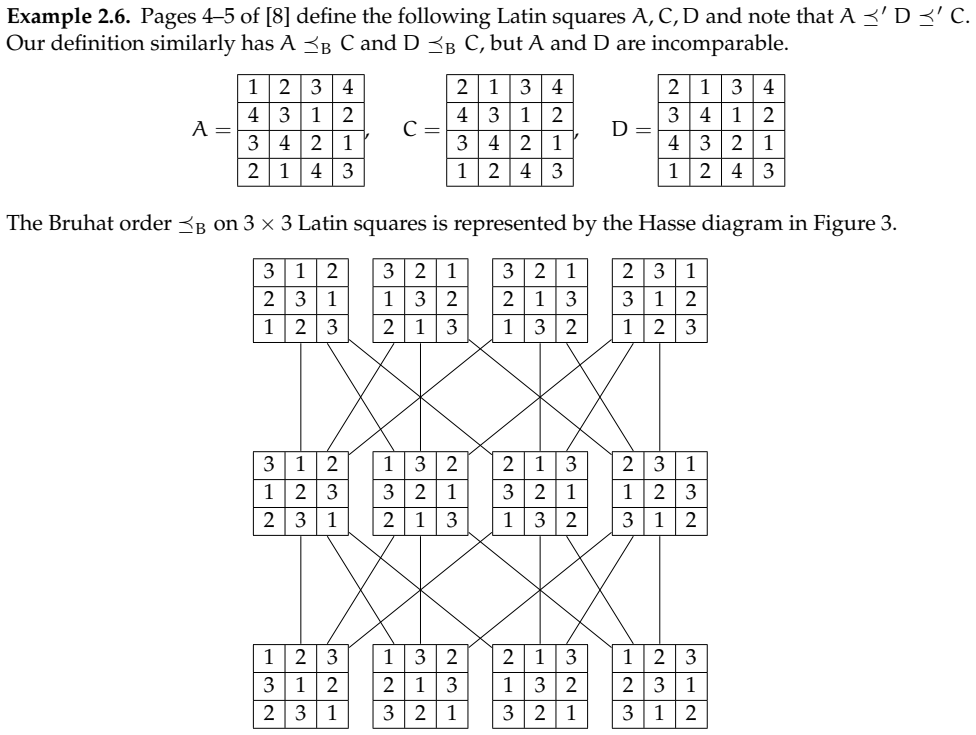
We define a Bruhat order ≼_B on Latin squares and alternating sign hypermatrices by entrywise domination on the associated corner-sum hypermatrices C_n; C_n is a distributive lattice but is not the Dedekind-MacNeille completion of the Latin-square poset, and monotone hypertriangles stand in bijection with C_n while likewise encoding the order.
What carries the argument
The corner-sum hypermatrix C_n, whose (i,j,k) entry is the sum of all entries of the input hypermatrix with indices at most (i,j,k); entrywise domination on these arrays defines the order ≼_B.
If this is right
- Covering relations in the poset of C_n admit an explicit combinatorial description.
- Rank functions on C_n generalize the known formulas for alternating sign matrices.
- Monotone hypertriangles provide an equivalent encoding of the order via entrywise domination.
- The order on alternating sign hypermatrices extends the order on Latin squares in a manner directly analogous to the two-dimensional case.
Where Pith is reading between the lines
- The failure of C_n to complete the Latin-square poset suggests that higher-dimensional Bruhat orders may require additional elements or a modified completion construction.
- The bijection with monotone hypertriangles offers a potential route to study the order through simpler triangular arrays rather than full hypermatrices.
- Rank formulas may allow enumeration or probabilistic analysis of chains in the poset of Latin squares under this order.
Load-bearing premise
The three-dimensional corner-sum construction is the correct direct analogue of the two-dimensional corner-sum matrix for encoding the Bruhat order.
What would settle it
A pair of Latin squares (or alternating sign hypermatrices) in which one entrywise-dominates the other on C_n yet the proposed Bruhat relation ≼_B fails to hold between them, or vice versa.
Figures




read the original abstract
The Bruhat order on permutation matrices extends to alternating sign matrices via corner-sum matrices, where the order is given by entrywise domination. A classical result of Lascoux and Sch\"utzenberger states that alternating sign matrices form the Dedekind-MacNeille completion of the Bruhat order on permutations. Brualdi and Dahl introduced alternating sign hypermatrices as a three-dimensional analogue of alternating sign matrices and used them to generalise Latin squares, which may be viewed as three-dimensional analogues of permutation matrices. In this paper, in analogy with the two-dimensional case, we define and study a Bruhat order $\preceq_B$ on Latin squares and alternating sign hypermatrices. We introduce the corresponding corner-sum hypermatrices $\mathcal C_n$ and prove that entrywise domination on $\mathcal C_n$ encodes this order. We show that $\mathcal C_n$ is a distributive lattice, but that, unlike in dimension two, it is not the Dedekind-MacNeille completion of the poset of Latin squares. We further characterise the covering relations for $\mathcal C_n$ and prove rank formulae generalising the classical case of alternating sign matrices. Finally, we define monotone hypertriangles, prove that they are in bijection with $\mathcal C_n$, and show that they also encode the order by entrywise domination.
Editorial analysis
A structured set of objections, weighed in public.
Referee Report
Summary. The paper extends the Bruhat order from permutation matrices and alternating sign matrices to the three-dimensional setting of Latin squares and alternating sign hypermatrices. It defines ≼_B via entrywise domination on the associated corner-sum hypermatrices C_n (in direct analogy with the 2D case), proves that this encodes the order, shows that C_n is a distributive lattice but not the Dedekind-MacNeille completion of the poset of Latin squares, characterizes covering relations and rank functions generalizing the ASM case, and establishes a bijection with monotone hypertriangles that likewise encode the order by domination.
Significance. If the stated theorems hold, the work supplies a coherent combinatorial generalization of the Bruhat order and corner-sum construction to hypermatrices, with explicit lattice-theoretic properties, covering relations, and rank formulae. The explicit demonstration that C_n is not the Dedekind-MacNeille completion (in contrast to the 2D Lascoux-Schützenberger theorem) and the bijection with monotone hypertriangles are useful distinctions and alternative models. The parameter-free, definition-driven approach and the provision of multiple equivalent encodings strengthen the contribution to poset combinatorics.
minor comments (3)
- [§3] §3, Definition 3.2: the recursive definition of the corner-sum hypermatrix C_n would be clearer if accompanied by an explicit computation for n=2 or n=3, showing how the entries are obtained from a Latin square or ASHM.
- [§5] §5, Theorem 5.4: the statement that C_n is not the Dedekind-MacNeille completion would benefit from a brief indication of the minimal missing elements or a reference to the specific pair of Latin squares whose join is absent.
- [§7] The notation for monotone hypertriangles in §7 occasionally re-uses symbols already employed for hypermatrices; a short notational table or remark distinguishing the two would improve readability.
Simulated Author's Rebuttal
We thank the referee for their positive summary and significance assessment of the manuscript, as well as for recommending minor revision. No specific major comments were provided in the report.
Circularity Check
No significant circularity; new definitions with independent proofs
full rationale
The paper defines ≼_B on Latin squares and alternating sign hypermatrices explicitly via entrywise domination on the newly introduced corner-sum hypermatrices C_n, stated as an analogy to the 2D case. It then proves independent properties including that this encodes the order, that C_n is a distributive lattice but not the Dedekind-MacNeille completion of the Latin square poset, covering relations, rank formulae, and a bijection with monotone hypertriangles. No step reduces a claimed result to a fitted parameter, self-citation chain, or definitional tautology; all central claims are new constructions followed by direct proofs without load-bearing self-references or renamings of prior results.
Axiom & Free-Parameter Ledger
axioms (2)
- standard math The Bruhat order on permutation matrices is given by entrywise domination of their corner-sum matrices (Lascoux-Schützenberger).
- domain assumption Alternating sign hypermatrices and Latin squares are the appropriate three-dimensional analogues of alternating sign matrices and permutation matrices (Brualdi-Dahl).
invented entities (2)
-
corner-sum hypermatrices C_n
no independent evidence
-
monotone hypertriangles
no independent evidence
Reference graph
Works this paper leans on
-
[1]
R. E. Behrend, V . A. Knight.Higher spin alternating sign matrices.Electronic Journal of Combina- torics,14(1), 2007
2007
-
[2]
Bj ¨orner, F
A. Bj ¨orner, F. Brenti.Combinatorics of Coxeter Groups.Graduate Texts in Mathematics, vol. 231, Springer, New York, 2005
2005
-
[3]
D. M. Bressoud.Proofs and Confirmations, The Story of the Alternating Sign Matrix Conjecture.Cam- bridge University Press, Cambridge, 1999
1999
-
[4]
Brualdi, G
R. Brualdi, G. Dahl.Alternating Sign Matrices and Hypermatrices, and a Generalization of Latin Squares.Advances in Applied Mathematics,95(10): 1016, 2018
2018
-
[5]
Brualdi, K
R. Brualdi, K. Kiernan, S. Meyer, M. Schroeder.Patterns of Alternating Sign Matrices.Linear Alge- bra and its Applications,438(10): 3967–3990, 2013
2013
-
[6]
Brualdi, M
R. Brualdi, M. Schroeder.Alternating sign matrices and their Bruhat order.Discrete Mathematics, 340: 1996–2019, 2017
1996
-
[7]
B. A. Davey and H. A. Priestley,Introduction to lattices and order.Cambridge Mathematical Text- books, Cambridge Univ. Press, Cambridge, 1990
1990
-
[8]
Fernandes, H
R. Fernandes, H. da Cruz, D. Salom ˜ao.Latin squares and their Bruhat order.Contributions to Dis- crete Mathematics,15(1), 102–120, 2020
2020
-
[9]
Kobayashi.A directed graph structure of alternating sign matrices.Linear Algebra and Its Appli- cations,519:164-190, 2017
M. Kobayashi.A directed graph structure of alternating sign matrices.Linear Algebra and Its Appli- cations,519:164-190, 2017
2017
-
[10]
Kobayashi,Weighted counting of inversions on alternating sign matrices.Order37, no
M. Kobayashi,Weighted counting of inversions on alternating sign matrices.Order37, no. 3, 461–477, 2020
2020
-
[11]
Lascoux, M.-P
A. Lascoux, M.-P . Sch ¨utzenberger.Treillis et bases des groupes de Coxeter.Electronic Journal of Combinatorics,3(2 R): 1–35, 1996
1996
-
[12]
Linial and Z
N. Linial and Z. Luria.On the vertices of thed-dimensional Birkhoff polytope.Discrete Comput. Geom.51(2014), no. 1, 161–170
2014
-
[13]
Magyar.Bruhat Order for Two Flags and a Line.Journal of Algebraic Combinatorics,21: 71–101, 2005
P . Magyar.Bruhat Order for Two Flags and a Line.Journal of Algebraic Combinatorics,21: 71–101, 2005
2005
-
[14]
O’Brien.Alternating Sign Hypermatrix Decompositions of Latin-like Squares.Advances in Ap- plied Mathematics,121, 2020
C. O’Brien.Alternating Sign Hypermatrix Decompositions of Latin-like Squares.Advances in Ap- plied Mathematics,121, 2020
2020
-
[15]
O’Brien.Weighted Projections of Alternating Sign Matrices: Latin-Like Squares and the ASM Poly- tope.Electronic Journal of Combinatorics,31(1), 2025
C. O’Brien.Weighted Projections of Alternating Sign Matrices: Latin-Like Squares and the ASM Poly- tope.Electronic Journal of Combinatorics,31(1), 2025
2025
-
[16]
O’Brien, R
C. O’Brien, R. Quinlan.Alternating sign matrices of finite multiplicative order.Linear Algebra and its Applications,651: 332–358, 2022. 33 [17]The On-Line Encyclopedia of Integer Sequences, published electronically at https://oeis.org, 2026. Sequence A144017
2022
-
[17]
Reading.Order Dimension, Strong Bruhat Order and Lattice Properties for Posets.Order,19: 73– 100, 2002
N. Reading.Order Dimension, Strong Bruhat Order and Lattice Properties for Posets.Order,19: 73– 100, 2002
2002
-
[18]
D. P . Robbins and H. Rumsey.Determinants and alternating-sign matrices.Advances in Mathemat- ics,62: 169—184, 1986
1986
-
[19]
Striker.The alternating sign matrix polytope.Electronic Journal of Combinatorics,16(1), 2009
J. Striker.The alternating sign matrix polytope.Electronic Journal of Combinatorics,16(1), 2009
2009
-
[20]
The Sage Developers,SageMath, the Sage Mathematics Software System (Version 10.7), 2025, https://www.sagemath.org
2025
-
[21]
Wanless.Cycle Switches in Latin Squares.Graphs and Combinatorics,20:545–570, 2004
I. Wanless.Cycle Switches in Latin Squares.Graphs and Combinatorics,20:545–570, 2004. 34
2004
discussion (0)
Sign in with ORCID, Apple, or X to comment. Anyone can read and Pith papers without signing in.