From Accounting to Coordination: A Virtual Water-Aware Electricity-Computation-Water Nexus Framework for Data Center Dispatch
Pith reviewed 2026-06-29 22:07 UTC · model grok-4.3
The pith
A differentiable optimization layer plus fixed-point coordination lets virtual water shape real-time power dispatch for data centers.
A machine-rendered reading of the paper's core claim, the machinery that carries it, and where it could break.
Core claim
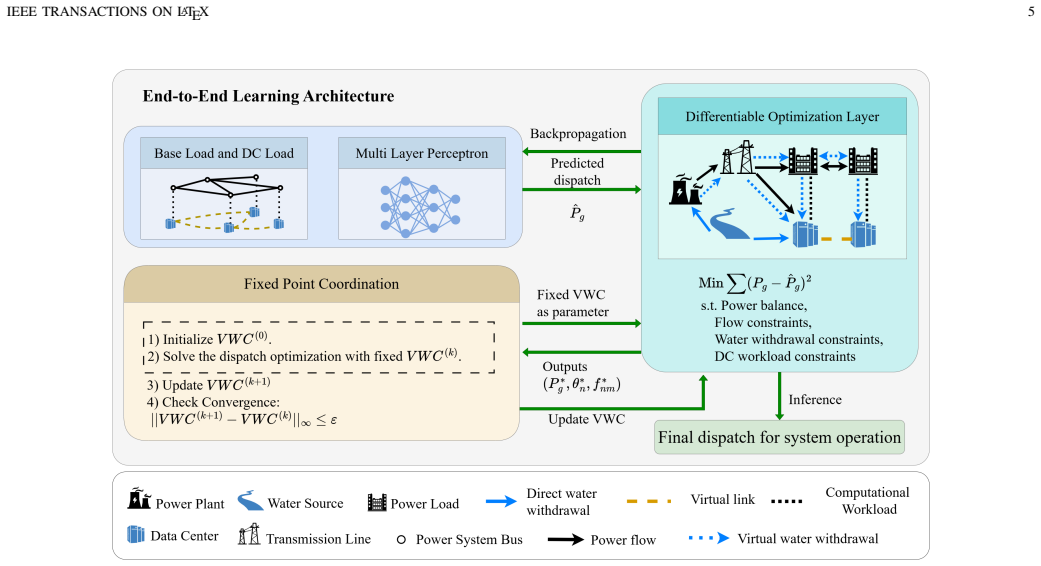
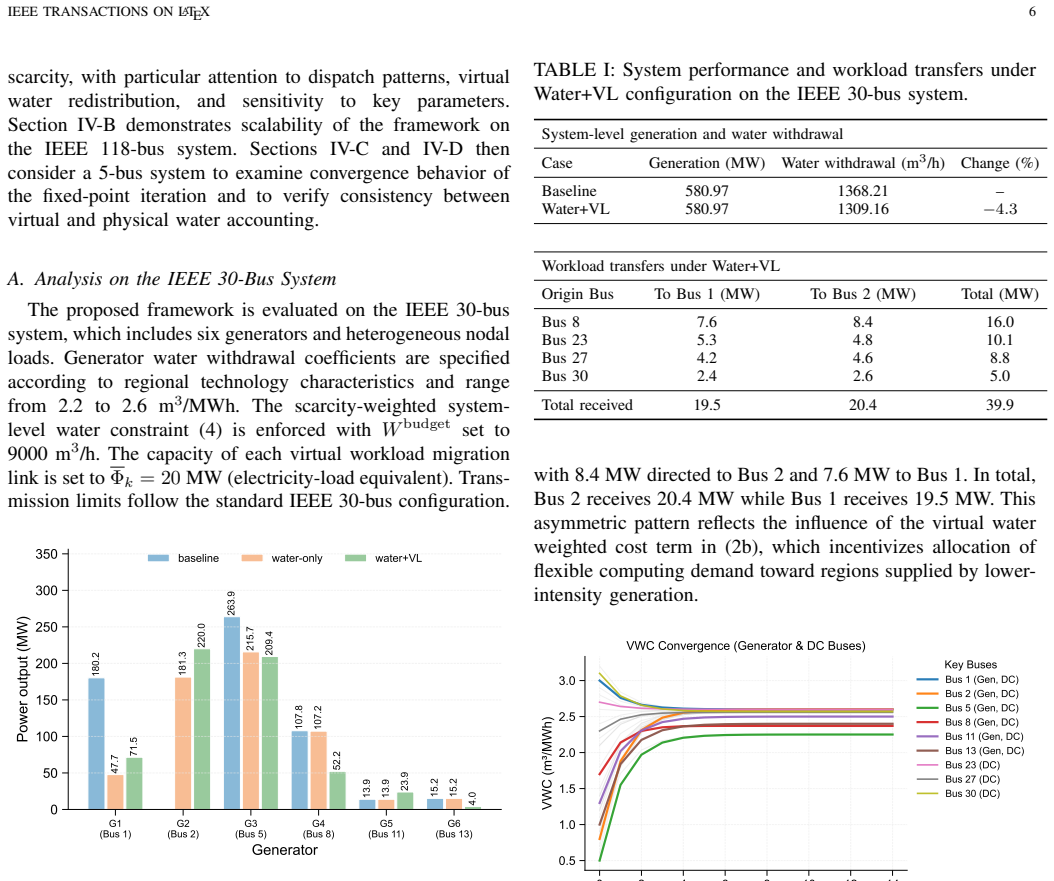
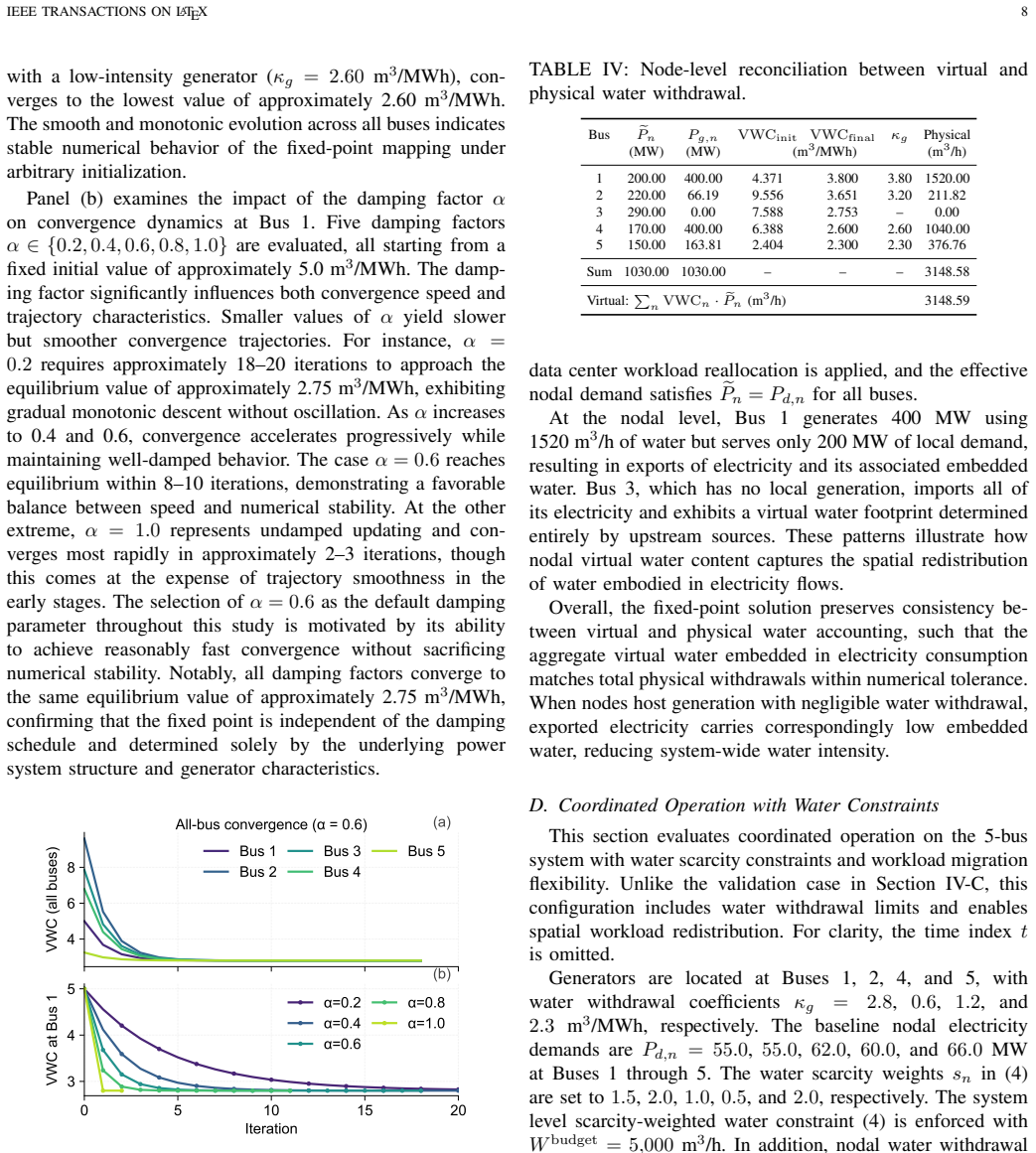
The electricity-computation-water nexus framework represents the economic dispatch problem as a differentiable optimization layer embedded in a neural architecture. Fixed-point iteration is then used to enforce exact consistency between the virtual water allocated to loads and the physical withdrawals at generation buses. On the IEEE 30-bus and 118-bus systems the procedure converges reliably and yields measurable reductions in total freshwater use when water constraints are active.
What carries the argument
Differentiable optimization layer for dispatch combined with fixed-point coordination to enforce virtual-to-physical water consistency
If this is right
- Dispatch and workload relocation decisions can be learned end-to-end while respecting both electricity and water limits.
- Virtual water becomes an internal price signal that changes with every redispatch rather than a static multiplier.
- The same layer-plus-fixed-point structure can be reused for other flow-based resources whose attribution depends on network physics.
- Under binding water constraints the framework produces lower total withdrawals than static accounting methods without violating feasibility.
Where Pith is reading between the lines
- The same architecture could be tested on real utility-scale networks where generator water-use curves are time-varying rather than constant.
- If the fixed-point step is replaced by a learned approximator, training speed might increase at the cost of occasional consistency violations.
- The method implicitly assumes that water stress can be expressed as a linear or mildly nonlinear constraint on generation; strongly nonlinear ecological limits would require a different layer design.
Load-bearing premise
Embedding the dispatch problem as a differentiable layer keeps every operational limit satisfied and the fixed-point loop reaches a numerically stable water attribution without extra network assumptions.
What would settle it
Running the same test cases on the IEEE 118-bus system and checking whether the water-balance residual after fixed-point iteration stays below machine precision while power-flow equations remain satisfied to within solver tolerance.
Figures



read the original abstract
The expansion of data centers (DCs) drives a sustained increase in electricity demand and associated water withdrawals at generation sites. These withdrawals occur at generation sites and are virtually allocated to demand based on network power flows. Consequently, the actual water footprint of a specific load varies dynamically with generation dispatch and network conditions. Existing approaches typically rely on static statistical accounting to quantify these water footprints. However, such static methods fail to capture how dispatch optimization and workload relocation dynamically affect water withdrawals. As a result, static statistical accounting approaches remain decoupled from the optimization process, rendering them incapable of guiding workload relocation or power dispatch to mitigate water stress. To address this limitation, this paper develops an operational electricity-computation-water (ECW) nexus framework that internalizes virtual water impacts directly into power system dispatch. The framework represents dispatch optimization as a differentiable optimization layer embedded within a deep learning architecture, enabling efficient end-to-end learning of coordination policies while preserving operational feasibility. Combined with fixed-point coordination, the framework enforces consistency between virtual water attribution and physical generation-side withdrawals. Case studies on the IEEE 30-bus and 118-bus test systems demonstrate reliable convergence, exact power-water consistency, and reductions of approximately 3-5% in generation-related freshwater withdrawals under water-constrained conditions.
Editorial analysis
A structured set of objections, weighed in public.
Referee Report
Summary. The paper proposes an Electricity-Computation-Water (ECW) nexus framework that embeds power system dispatch optimization as a differentiable layer inside a deep learning architecture and applies fixed-point coordination to enforce consistency between virtual water attribution (via network flows) and physical generation withdrawals. Case studies on the IEEE 30-bus and 118-bus systems are reported to show reliable convergence, exact consistency, and 3-5% reductions in freshwater withdrawals under water-constrained conditions.
Significance. If the technical claims hold, the work would provide a concrete mechanism for internalizing dynamic virtual-water impacts into operational dispatch decisions rather than relying on static post-hoc accounting. The combination of a differentiable optimization layer with fixed-point coordination, if shown to preserve feasibility and deliver exact consistency without unstated assumptions, would be a notable methodological contribution to integrated energy-water modeling.
major comments (3)
- [Methods (fixed-point coordination)] Methods section on fixed-point coordination: the claim of 'exact power-water consistency' is load-bearing for the central contribution, yet the description supplies no convergence proof, iteration bound, or analysis of potential cycling or residual mismatch arising from the sensitivity of proportional-sharing or similar power-flow tracing to dispatch changes.
- [Methods (differentiable optimization layer)] Differentiable optimization layer subsection: no explicit verification is provided that all inequality constraints of the underlying AC or DC OPF remain satisfied at the fixed point after differentiation and embedding, which directly affects the claim that operational feasibility is preserved.
- [Case studies] Case studies section (IEEE 30-bus and 118-bus results): the reported 3-5% reductions lack baseline comparisons, error bars, or sensitivity analysis to dispatch perturbations, making it impossible to assess whether the reductions are robust or artifacts of the specific water-constraint scenarios chosen.
minor comments (1)
- [Abstract] Abstract: the phrase 'reliable convergence' is used without reference to any quantitative metric (e.g., iteration count or residual threshold) that is later defined in the methods.
Simulated Author's Rebuttal
We thank the referee for the constructive and detailed comments. We address each major point below and will revise the manuscript to incorporate additional analysis and verification where needed.
read point-by-point responses
-
Referee: Methods section on fixed-point coordination: the claim of 'exact power-water consistency' is load-bearing for the central contribution, yet the description supplies no convergence proof, iteration bound, or analysis of potential cycling or residual mismatch arising from the sensitivity of proportional-sharing or similar power-flow tracing to dispatch changes.
Authors: We acknowledge the absence of a formal convergence analysis in the current manuscript. In revision we will add a dedicated subsection deriving a contraction-mapping argument under the Lipschitz continuity of the proportional-sharing tracing operator, supplying an explicit iteration bound based on the spectral radius and reporting numerical residual norms (to machine precision) across all test cases to rule out cycling. revision: yes
-
Referee: Differentiable optimization layer subsection: no explicit verification is provided that all inequality constraints of the underlying AC or DC OPF remain satisfied at the fixed point after differentiation and embedding, which directly affects the claim that operational feasibility is preserved.
Authors: The layer solves the OPF to optimality at each forward pass, so feasibility holds by construction; however, we agree an explicit check at the fixed point is warranted. We will add a verification paragraph and table in the methods section that reports the maximum violation of all inequality constraints (voltage, line flow, generation limits) at convergence for every scenario, confirming they remain below solver tolerance. revision: yes
-
Referee: Case studies section (IEEE 30-bus and 118-bus results): the reported 3-5% reductions lack baseline comparisons, error bars, or sensitivity analysis to dispatch perturbations, making it impossible to assess whether the reductions are robust or artifacts of the specific water-constraint scenarios chosen.
Authors: We will expand the case-studies section with (i) a no-ECW baseline dispatch for direct comparison, (ii) error bars obtained from 50 Monte-Carlo perturbations of water-price and load vectors, and (iii) a sensitivity sweep over water-constraint tightness levels, thereby demonstrating that the 3-5 % withdrawal reductions are robust rather than scenario-specific. revision: yes
Circularity Check
No significant circularity; consistency enforced by external fixed-point procedure rather than by construction.
full rationale
The paper's central claim of exact power-water consistency is achieved via an explicit fixed-point coordination procedure between dispatch decisions and virtual-water attribution, combined with a differentiable optimization layer. This is an algorithmic enforcement mechanism, not a self-definition or fitted parameter renamed as prediction. No load-bearing self-citations, uniqueness theorems from prior author work, or ansatzes smuggled via citation are described in the abstract or reader's summary. The case studies on IEEE test systems provide independent numerical demonstration of convergence and reductions, keeping the derivation self-contained against external benchmarks.
Axiom & Free-Parameter Ledger
axioms (2)
- domain assumption Power system dispatch optimization can be represented as a differentiable layer suitable for embedding in a deep learning architecture while preserving feasibility.
- domain assumption Fixed-point coordination can enforce exact consistency between virtual water attribution and physical generation-side withdrawals.
invented entities (1)
-
Electricity-computation-water (ECW) nexus framework
no independent evidence
Reference graph
Works this paper leans on
-
[1]
A review of the potential opportunities and challenges of the digital economy for sustainability,
A. Raihan, “A review of the potential opportunities and challenges of the digital economy for sustainability,”Innovation and Green Development, vol. 3, no. 4, p. 100174, 2024
2024
-
[2]
Eu countries’ digital transformation, economic performance, and sustainability analysis,
C. G. Bocean and A. A. V ˘arzaru, “Eu countries’ digital transformation, economic performance, and sustainability analysis,”Humanities and Social Sciences Communications, vol. 10, no. 1, pp. 1–15, 2023
2023
-
[3]
Applying large language models to power systems: Potential security threats,
J. Ruan, G. Liang, H. Zhao, G. Liu, X. Sun, J. Qiu, Z. Xu, F. Wen, and Z. Y . Dong, “Applying large language models to power systems: Potential security threats,”IEEE transactions on smart grid, vol. 15, no. 3, pp. 3333–3336, 2024
2024
-
[4]
Energy and AI,
International Energy Agency, “Energy and AI,” International Energy Agency, Paris, Tech. Rep., 2025
2025
-
[5]
Data centres will use twice as much energy by 2030 — driven by AI,
Nature Editorial, “Data centres will use twice as much energy by 2030 — driven by AI,”Nature, 2025
2030
-
[6]
Explained: Generative AI’s environmental impact,
N. Bashir, “Explained: Generative AI’s environmental impact,” MIT News, 2025
2025
-
[7]
The growing energy footprint of artificial intelligence,
A. de Vries, “The growing energy footprint of artificial intelligence,” Joule, vol. 7, no. 10, pp. 2191–2194, 2023
2023
-
[8]
Gone with the clouds: Estimating the electricity and water footprint of digital data services in europe,
J. Farfan and A. Lohrmann, “Gone with the clouds: Estimating the electricity and water footprint of digital data services in europe,”Energy Conversion and Management, vol. 290, p. 117225, 2023
2023
-
[9]
Modeling the water systems of the western us to support climate-resilient electricity system planning,
D. Yates, J. Szinai, and A. Jones, “Modeling the water systems of the western us to support climate-resilient electricity system planning,” Earth’s Future, vol. 12, no. 1, p. e2022EF003220, 2024
2024
-
[10]
Data centre water consumption,
D. Mytton, “Data centre water consumption,”npj Clean Water, vol. 4, no. 1, p. 11, 2021
2021
-
[11]
The water use of data center workloads: A review and assessment of key determinants,
N. Lei, J. Lu, A. Shehabi, and E. Masanet, “The water use of data center workloads: A review and assessment of key determinants,”Resources, Conservation and Recycling, vol. 219, p. 108310, 2025. IEEE TRANSACTIONS ON LATEX 10
2025
-
[12]
Spatially and temporally detailed water and carbon footprints of us electricity generation and use,
M. A. B. Siddik, A. Shehabi, P. Rao, and L. T. Marston, “Spatially and temporally detailed water and carbon footprints of us electricity generation and use,”Water Resources Research, vol. 60, no. 12, p. e2024WR038350, 2024
2024
-
[13]
Flexibility from networks of data centers: A market clearing formula- tion with virtual links,
W. Zhang, L. A. Roald, A. A. Chien, J. R. Birge, and V . M. Zavala, “Flexibility from networks of data centers: A market clearing formula- tion with virtual links,”Electric Power Systems Research, vol. 189, p. 106723, 2020
2020
-
[14]
Virtual water transfers of the us electric grid,
C. M. Chini, L. A. Djehdian, W. N. Lubega, and A. S. Stillwell, “Virtual water transfers of the us electric grid,”Nature Energy, vol. 3, no. 12, pp. 1115–1123, 2018
2018
-
[15]
A survey on machine learning for geo- distributed cloud data center management,
N. Hogade and S. Pasricha, “A survey on machine learning for geo- distributed cloud data center management,”IEEE Transactions on Sus- tainable Computing, vol. 8, no. 1, pp. 15–31, 2022
2022
-
[16]
Water-energy nexus management for power systems,
P. Zhao, C. Gu, Z. Cao, Q. Ai, Y . Xiang, T. Ding, X. Lu, X. Chen, and S. Li, “Water-energy nexus management for power systems,”IEEE Transactions on Power Systems, vol. 36, no. 3, pp. 2542–2554, 2020
2020
-
[17]
The changing virtual water trade network of the european electric grid,
C. M. Chini and A. S. Stillwell, “The changing virtual water trade network of the european electric grid,”Applied Energy, vol. 260, p. 114151, 2020
2020
-
[18]
Water- energy-carbon nexus in china’s intra and inter-regional trade,
P. Tian, H. Lu, H. Reinout, D. Li, K. Zhang, and Y . Yang, “Water- energy-carbon nexus in china’s intra and inter-regional trade,”Science of the Total Environment, vol. 806, p. 150666, 2022
2022
-
[19]
Categorising virtual water transfers through china’s electric power sector,
X. Liao, X. Zhao, J. W. Hall, and D. Guan, “Categorising virtual water transfers through china’s electric power sector,”Applied Energy, vol. 226, pp. 252–260, 2018
2018
-
[20]
Virtual water transfer through physical power trans- mission: Evidence from china, 2006–2022,
Y . Jin and et al., “Virtual water transfer through physical power trans- mission: Evidence from china, 2006–2022,”Energy, 2025, in press
2006
-
[21]
Categorising virtual water transfers through electricity transmission in china,
X. Liao, C. M. Chini, and A. S. Stillwell, “Categorising virtual water transfers through electricity transmission in china,”Applied Energy, vol. 210, pp. 1244–1256, 2018
2018
-
[22]
Ecological network analysis for virtual water trade in china’s electricity sector,
Y . Guo and et al., “Ecological network analysis for virtual water trade in china’s electricity sector,”Ecological Modelling, vol. 337, pp. 102–110, 2016
2016
-
[23]
Provincial virtual energy-water use and its flows within china: A multiregional input- output approach,
L. Lin, Y . D. Chen, D. Hua, Y . Liu, and M. Yan, “Provincial virtual energy-water use and its flows within china: A multiregional input- output approach,”Resources, Conservation and Recycling, vol. 151, p. 104486, 2019
2019
-
[24]
Embodiment of virtual water of power generation in the electric power system in china,
X. Zhu, R. Guo, B. Chen, J. Zhang, T. Hayat, and A. Alsaedi, “Embodiment of virtual water of power generation in the electric power system in china,”Applied Energy, vol. 151, pp. 109–115, 2015
2015
-
[25]
A node–flow model for virtual water transfers in china’s interprovincial electricity trade,
C. Zhang and et al., “A node–flow model for virtual water transfers in china’s interprovincial electricity trade,”Renewable and Sustainable Energy Reviews, vol. 73, pp. 376–388, 2017
2017
-
[26]
Optimal planning of internet data centers decarbonized by hydrogen-water-based energy systems,
J. Liu, Z. Xu, J. Wu, K. Liu, X. Sun, and X. Guan, “Optimal planning of internet data centers decarbonized by hydrogen-water-based energy systems,”IEEE Transactions on Automation Science and Engineering, vol. 20, no. 3, pp. 1577–1590, 2022
2022
-
[27]
Real- time service restoration of coupled power-water systems considering the spatio-temporal cascading failure,
H. Wan, W. Liu, Q. Shi, R. Zhu, X. Zhang, and J. Zhao, “Real- time service restoration of coupled power-water systems considering the spatio-temporal cascading failure,”IEEE Transactions on Smart Grid, 2025
2025
-
[28]
A water-energy nexus approach for the co-optimization of electric and water systems,
Z. Alnahhal, M. F. Shaaban, M. A. Hamouda, T. Majozi, and M. Al Bar- dan, “A water-energy nexus approach for the co-optimization of electric and water systems,”IEEE Access, vol. 11, pp. 28 762–28 770, 2023
2023
-
[29]
Tracking flows and network dynamics of virtual water in electricity transmission across china,
Y . Zhang, S. Hou, S. Chen, H. Long, J. Liu, and J. Wang, “Tracking flows and network dynamics of virtual water in electricity transmission across china,”Renewable and Sustainable Energy Reviews, vol. 137, p. 110475, 2021
2021
-
[30]
Virtual water and co2 emission footprints embodied in power trade: Eu-27,
L. Wang, Y . Van Fan, P. Jiang, P. S. Varbanov, and J. J. Klemeˇs, “Virtual water and co2 emission footprints embodied in power trade: Eu-27,” Energy Policy, vol. 155, p. 112348, 2021
2021
-
[31]
P. Li, X. Liu, Y . Wang, and et al., “Making ai less “thirsty”: Uncovering and addressing the secret water footprint of ai models,”arXiv preprint arXiv:2304.03271, 2023
-
[32]
Data centre energy use: Critical review of models and results,
IEA 4E Technology Collaboration Programme, “Data centre energy use: Critical review of models and results,” International Energy Agency, Tech. Rep., 2025
2025
-
[33]
Optnet: Differentiable optimization as a layer in neural networks,
B. Amos and J. Z. Kolter, “Optnet: Differentiable optimization as a layer in neural networks,” inInternational conference on machine learning. PMLR, 2017, pp. 136–145
2017
-
[34]
Joint chance-constrained unit commitment: Statistically feasible robust optimization with learning-to- optimize acceleration,
J. Liang, W. Jiang, C. Lu, and C. Wu, “Joint chance-constrained unit commitment: Statistically feasible robust optimization with learning-to- optimize acceleration,”IEEE Transactions on Power Systems, vol. 39, no. 5, pp. 6508–6521, 2024
2024
-
[35]
S. G. Krantz and H. R. Parks,The implicit function theorem: history, theory, and applications. Springer Science & Business Media, 2002
2002
-
[36]
Optimizing parameters of the lindistflow power flow approximation for distribution systems,
B. Taheri, R. K. Gupta, and D. K. Molzahn, “Optimizing parameters of the lindistflow power flow approximation for distribution systems,” IEEE Transactions on Smart Grid, pp. 1–1, 2025
2025
-
[37]
Dc3: A learning method for optimization with hard constraints,
P. L. Donti, D. Rolnick, and J. Z. Kolter, “Dc3: A learning method for optimization with hard constraints,” inInternational Conference on Learning Representations (ICLR), 2021
2021
-
[38]
Differentiable convex optimization layers,
A. Agrawal, B. Amos, S. Barratt, S. Boyd, S. Diamond, and J. Z. Kolter, “Differentiable convex optimization layers,”Advances in neural information processing systems, vol. 32, 2019
2019
-
[39]
Learning to solve optimization problems with hard linear constraints,
M. Li, S. Kolouri, and J. Mohammadi, “Learning to solve optimization problems with hard linear constraints,”IEEE Access, vol. 11, pp. 59 995– 60 004, 2023
2023
-
[40]
A time decomposition and coordination strategy for power system multi-interval operation,
F. Safdarian, O. Ciftci, and A. Kargarian, “A time decomposition and coordination strategy for power system multi-interval operation,” in2018 IEEE Power & Energy Society General Meeting (PESGM). IEEE, 2018, pp. 1–5
2018
-
[41]
Proportional sharing assumption in tracing methodology,
J. W. Bialek and P. A. Kattuman, “Proportional sharing assumption in tracing methodology,”IEE Proceedings-Generation, Transmission and Distribution, vol. 151, no. 4, pp. 526–532, 2004
2004
-
[42]
Differentiable convex optimization layers,
A. Agrawal, B. Amos, S. Barratt, S. Boyd, S. Diamond, and J. Z. Kolter, “Differentiable convex optimization layers,” inAdvances in Neural Information Processing Systems (NeurIPS), vol. 32, 2019, pp. 9558– 9570
2019
discussion (0)
Sign in with ORCID, Apple, or X to comment. Anyone can read and Pith papers without signing in.