Nonparametric Estimation via Expected Order Statistics
Pith reviewed 2026-06-29 20:33 UTC · model grok-4.3
The pith
A nonparametric estimator assigns mass 1/m to m estimated expected order statistics to produce point masses that are asymptotically less variable than raw observations.
A machine-rendered reading of the paper's core claim, the machinery that carries it, and where it could break.
Core claim
The estimator is formed by assigning mass 1/m to each of m estimated expected order statistics. Its error relative to the population version is controlled by the L1 error of the empirical distribution, and every L-functional of the estimator equals an L-functional of the empirical distribution evaluated at updated weights. The construction yields almost-sure convergence in Lp norm and Wasserstein distance as n tends to infinity (m fixed), weak convergence of the associated empirical quantile process in Lp(0,1) for p in [1, infinity) when m is fixed and for p=1,2 when both n and m diverge, and corresponding asymptotic distributions for Lp and Wasserstein functionals, together with bootstrap c
What carries the argument
The nonparametric estimator that places equal mass 1/m on m estimated expected order statistics from the sample, with the correspondence that its L-functionals match those of the empirical distribution under updated weights.
If this is right
- The estimation error of the new estimator relative to its population counterpart is bounded by the L1 error of the empirical distribution.
- Every L-functional of the estimator equals the same functional applied to the empirical distribution with updated weights.
- Almost-sure convergence holds in Lp norm and Wasserstein distance as n to infinity for fixed m.
- The associated empirical quantile process converges weakly in Lp(0,1) for all p at least 1 when m is fixed, and for p=1,2 when both n and m grow.
- Bootstrap is valid for the estimator and yields asymptotic distributions for Lp and Wasserstein distance functionals.
Where Pith is reading between the lines
- If the weight-update correspondence holds exactly, functionals that are already easy to compute on the empirical distribution become equally easy on the new estimator without additional work.
- The construction suggests a general recipe for replacing raw data points with any set of less-variable surrogates that preserve ordering or ranking properties.
- Allowing m to grow with n at a controlled rate may produce estimators whose rate of convergence improves on the usual 1/sqrt(n) while retaining the L-functional correspondence.
- The same replacement idea could be applied inside other nonparametric procedures that rely on the empirical measure, such as certain rank-based or quantile-based methods.
Load-bearing premise
That expected order statistics can be estimated nonparametrically from the sample so that the resulting point masses are asymptotically less variable than the original observations.
What would settle it
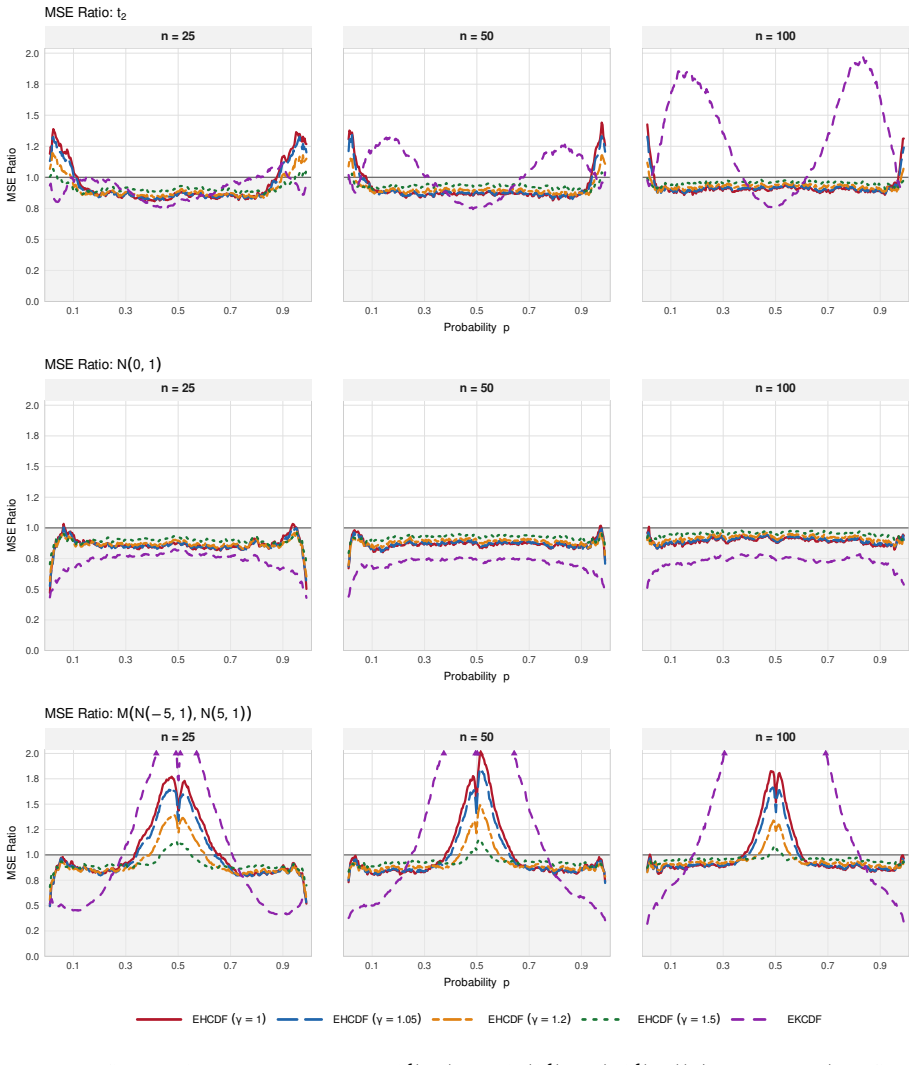
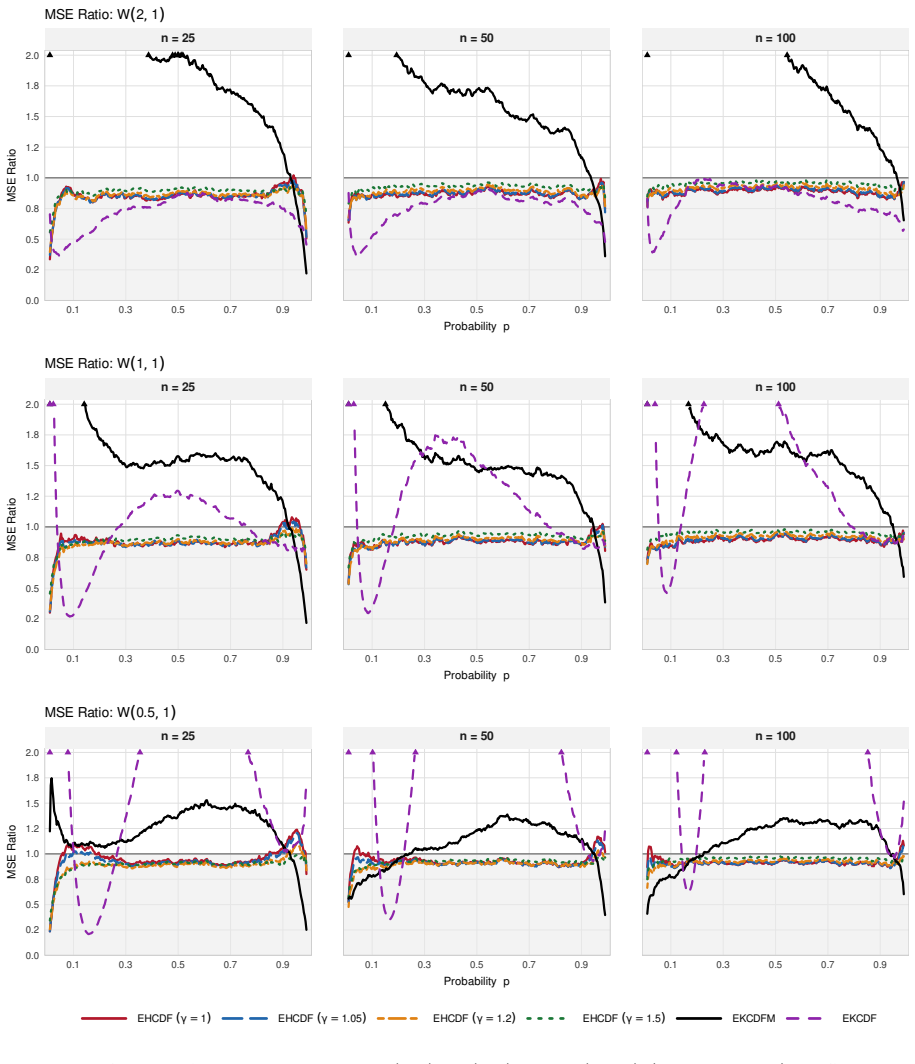
A Monte Carlo study across several distributions in which the new estimator exhibits larger integrated squared error or larger Wasserstein distance to the true distribution than the ordinary empirical distribution for large n.
Figures

read the original abstract
The empirical distribution function assigns mass $1/n$ to each of the $n$ observations in a sample. As these are highly variable, estimation error may be reduced by replacing them with estimated observations that are asymptotically less variable. Motivated by this idea, we introduce a nonparametric estimator obtained by assigning mass $1/m$ to $m$ estimated expected order statistics, with $m$ chosen arbitrarily. The estimator enjoys several finite-sample properties and yields a rich asymptotic theory. Its estimation error relative to its population counterpart is controlled by the $L^1$ error of the empirical distribution. Moreover, every $L$-functional of the new estimator corresponds to an $L$-functional of the empirical distribution with updated weights. We establish almost sure convergence in $L^p$ norm and Wasserstein distance as $n \to \infty$, and derive weak convergence of the associated empirical quantile process in $L^p(0,1)$, for $p\in[1,\infty)$ and $m$ fixed, and for $p=1,2$ as $n,m \to \infty$. These results yield asymptotic distributions for distance-based functionals, including $L^p$ and Wasserstein metrics. Bootstrap validity is also established. Simulations show that the estimator often improves on the empirical distribution and remains competitive with kernel methods, with more stable performance across different distributional settings.
Editorial analysis
A structured set of objections, weighed in public.
Referee Report
Summary. The paper introduces a nonparametric estimator that assigns mass 1/m to m estimated expected order statistics (rather than 1/n to each raw observation) and claims finite-sample properties, L1 error control by the empirical distribution's L1 error, correspondence of every L-functional to a reweighted empirical L-functional, almost-sure convergence in Lp and Wasserstein metrics, weak convergence of the quantile process in Lp(0,1) (for fixed m and for m,n→∞ under p=1,2), bootstrap validity, and competitive simulation performance versus the empirical distribution and kernel methods.
Significance. If the derivations hold, the construction supplies a distribution estimator whose error is explicitly tied to the empirical distribution and whose functionals reduce to reweighted empirical functionals; this yields a clean theoretical framework for Lp/Wasserstein asymptotics and bootstrap, which could be useful for distribution estimation when variability reduction is desired.
major comments (2)
- [Abstract] Abstract and construction: the motivating claim that the nonparametric estimates of expected order statistics are asymptotically less variable than the raw observations is load-bearing for the entire proposal, yet the abstract provides no explicit variance bounds, comparison, or verification of this reduction; without it the central motivation remains unexamined.
- [Asymptotic Theory] Asymptotics (weak convergence of quantile process): the statement for p=1,2 as n,m→∞ requires a growth condition on m relative to n to be valid, but none is indicated; this is load-bearing for the claimed limit theorems and bootstrap validity.
minor comments (1)
- [Abstract] Abstract: the simulation claim is stated without reference to the specific distributions, sample sizes, or performance metrics used; these details belong in the main text or a dedicated simulation section.
Simulated Author's Rebuttal
We thank the referee for their careful reading and constructive comments, which help clarify the presentation of our results. We address each major comment below and indicate the revisions we will make to the manuscript.
read point-by-point responses
-
Referee: [Abstract] Abstract and construction: the motivating claim that the nonparametric estimates of expected order statistics are asymptotically less variable than the raw observations is load-bearing for the entire proposal, yet the abstract provides no explicit variance bounds, comparison, or verification of this reduction; without it the central motivation remains unexamined.
Authors: We agree that the abstract would be strengthened by a more explicit reference to the variance reduction. The manuscript establishes finite-sample variance comparisons and asymptotic results showing that the estimated expected order statistics have lower variability than the raw observations (see Section 3). We will revise the abstract to include a brief statement noting this reduction and directing readers to the relevant finite-sample properties. revision: yes
-
Referee: [Asymptotic Theory] Asymptotics (weak convergence of quantile process): the statement for p=1,2 as n,m→∞ requires a growth condition on m relative to n to be valid, but none is indicated; this is load-bearing for the claimed limit theorems and bootstrap validity.
Authors: The referee correctly identifies that the weak convergence results for the quantile process as n,m → ∞ require a growth restriction on m relative to n (for example, to control the approximation error between the estimated order statistics and their population counterparts). This condition was inadvertently omitted from the theorem statements. We will add the necessary rate condition to the relevant theorems on weak convergence and bootstrap validity, ensuring the statements are complete and the proofs are updated to reflect it. revision: yes
Circularity Check
No significant circularity
full rationale
The paper defines a new estimator by reweighting m estimated expected order statistics (with masses 1/m) and then derives its finite-sample properties, L1-error control relative to the empirical distribution, L-functional reweighting, and asymptotic convergence results (Lp, Wasserstein, quantile process) directly from the properties of the empirical distribution and order statistics. No step reduces a claimed prediction or theorem to a fitted parameter or self-citation by construction; the central mapping from empirical to the new estimator is an explicit construction whose error bounds and convergences are stated as derived consequences rather than tautological renamings. The derivation chain is therefore self-contained against external benchmarks.
Axiom & Free-Parameter Ledger
axioms (1)
- domain assumption Observations are i.i.d. from an unknown distribution permitting definition and estimation of expected order statistics.
Reference graph
Works this paper leans on
-
[1]
doi: 10.1080/01621459.2013.872718. G. Geenens and C. Wang. Local-likelihood transformation kernel density estimation for positive random variables.Journal of Computational and Graphical Statistics, 27(3):620– 633,
-
[2]
doi: 10.1080/10618600.2017.1390465. W. Hoeffding. On the distribution of the expected values of the order statistics.The Annals of Mathematical Statistics, pages 93–100,
-
[3]
25 T. Nagler. A generic approach to nonparametric function estimation with mixed data. Statistics & Probability Letters, 137:326–330, 2018a. doi: 10.1016/j.spl.2018.02.030. T. Nagler. Asymptotic analysis of the jittering kernel density estimator.Mathematical Methods of Statistics, 27(3):177–196, 2018b. doi: 10.3103/S1066530718030040. T. Nagler, T. Vatter,...
discussion (0)
Sign in with ORCID, Apple, or X to comment. Anyone can read and Pith papers without signing in.