Hyperboloidal evolution for scalar scattering in Minkowski space
Pith reviewed 2026-06-29 20:45 UTC · model grok-4.3
The pith
Exact conformal matching of hyperboloidal and Penrose domains enables global scalar wave evolution from past to future null infinity without artificial boundaries.
A machine-rendered reading of the paper's core claim, the machinery that carries it, and where it could break.
Core claim
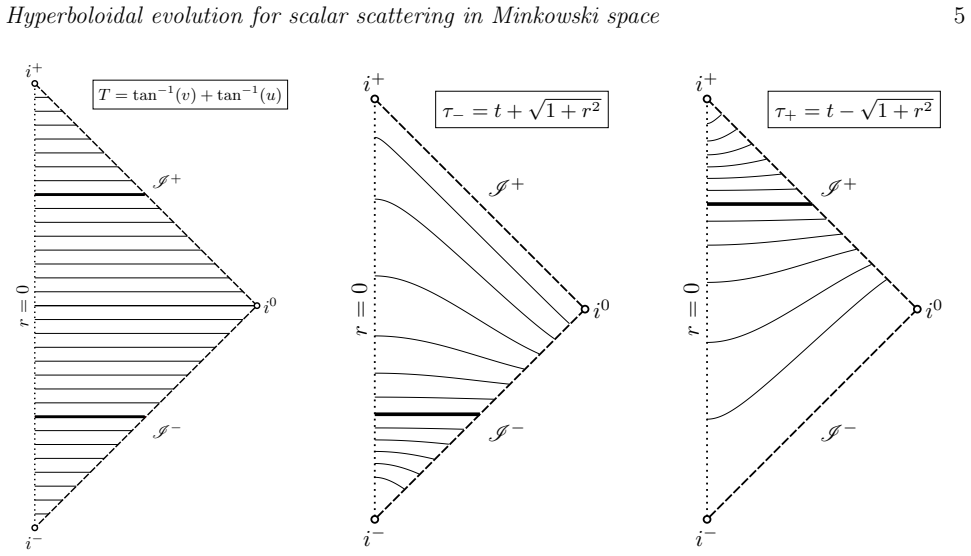
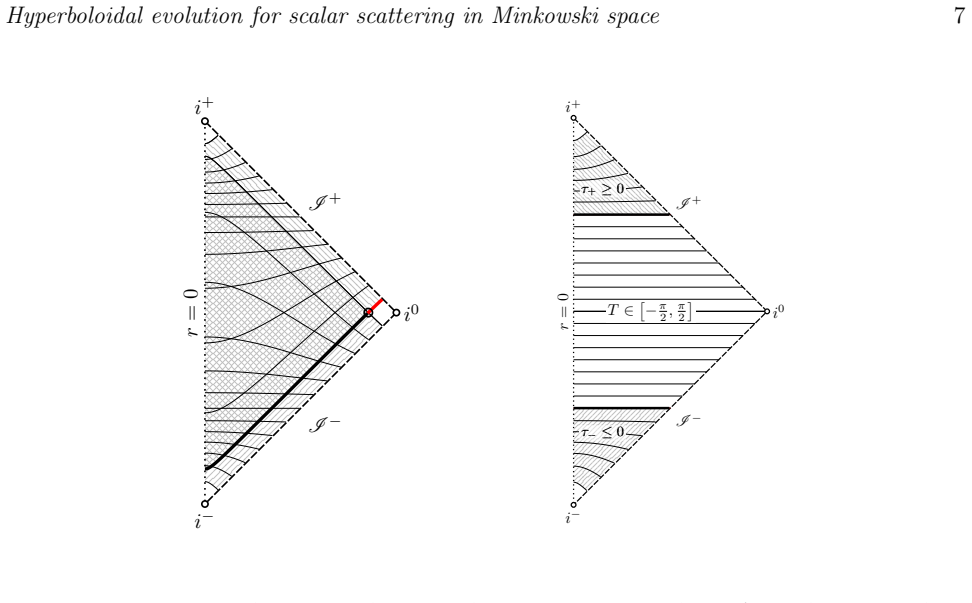
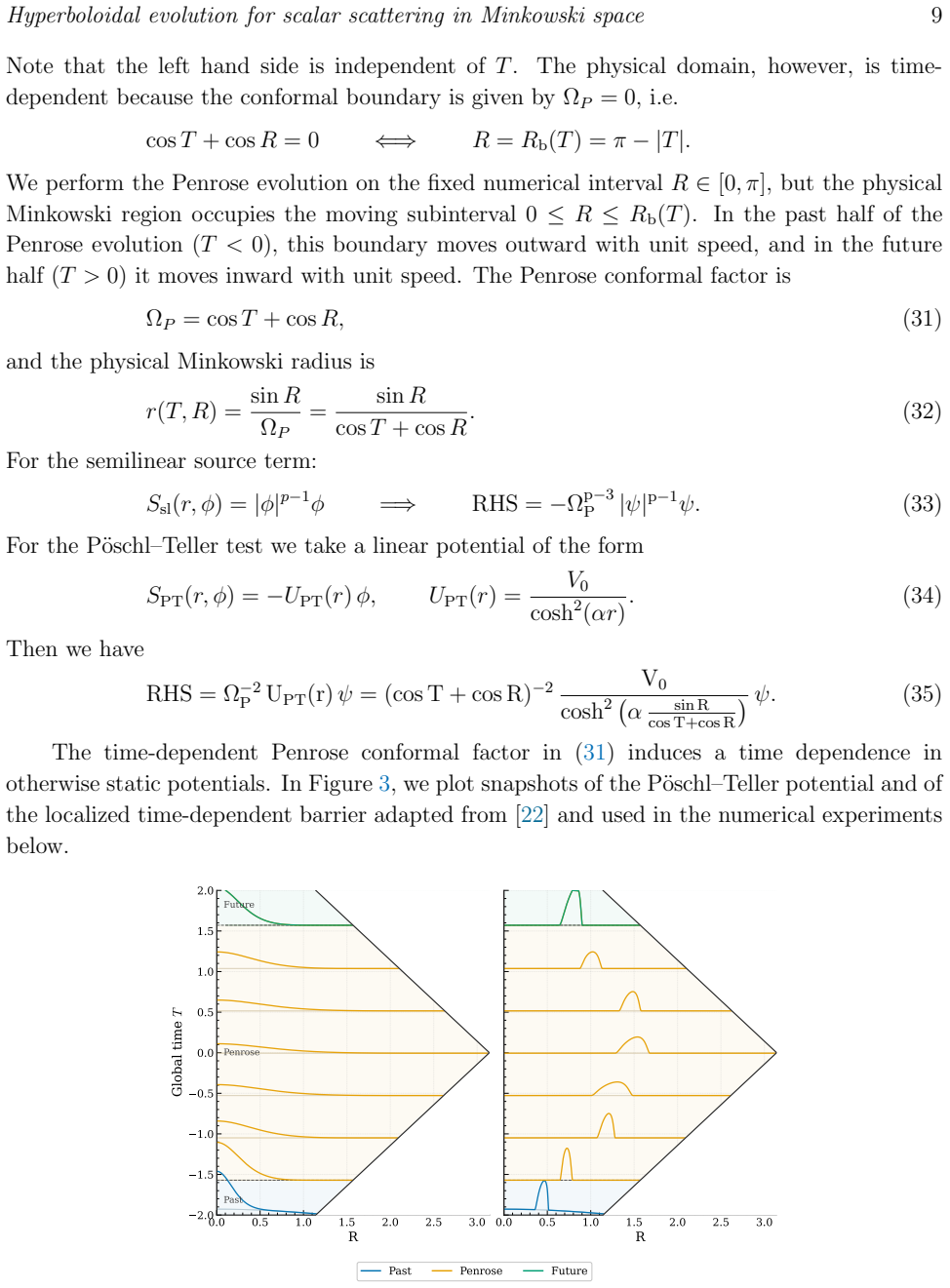
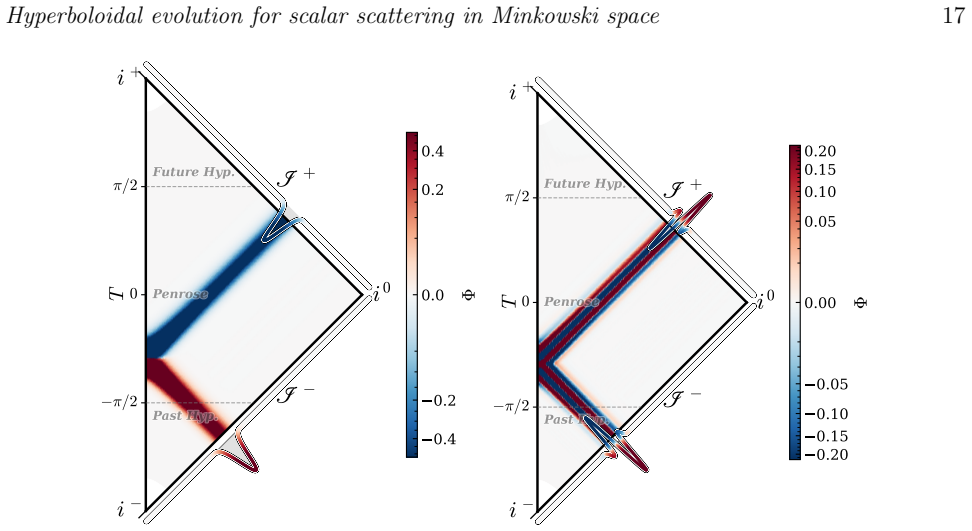
The central claim is that an exact conformal matching of a past hyperboloidal domain attached to past null infinity, a Penrose domain covering a neighborhood of spatial infinity, and a future hyperboloidal domain attached to future null infinity yields a global evolution scheme for scalar waves without artificial timelike outer boundaries and without interpolation between scri-fixing gauges.
What carries the argument
The exact conformal matching of the three compactified regions along identical conformal hypersurfaces.
If this is right
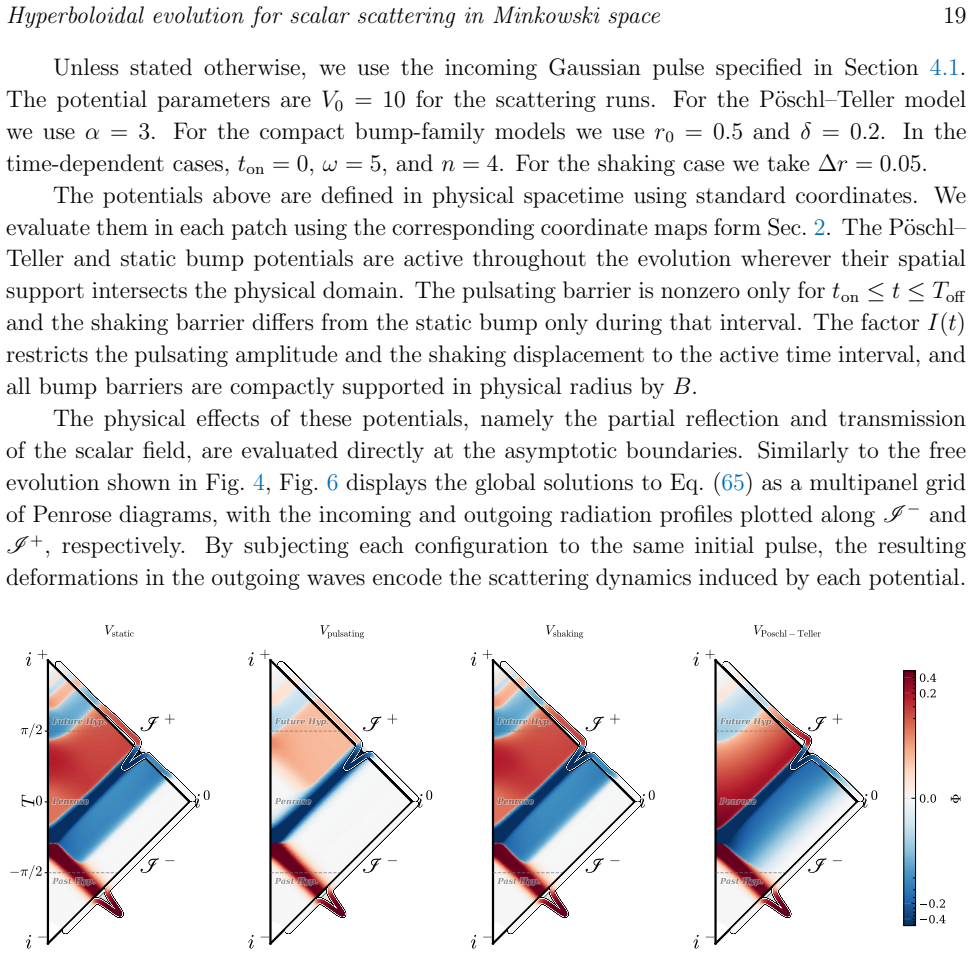
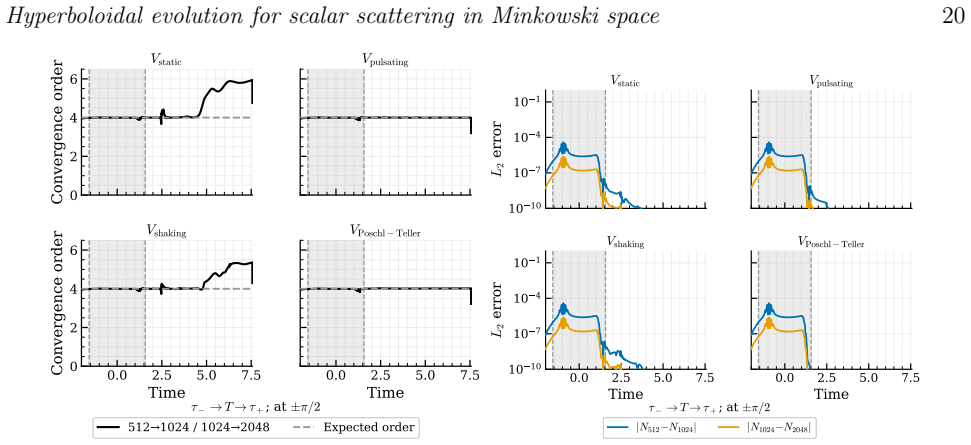
- Stable propagation occurs across the matching interfaces for free waves and linear scattering potentials.
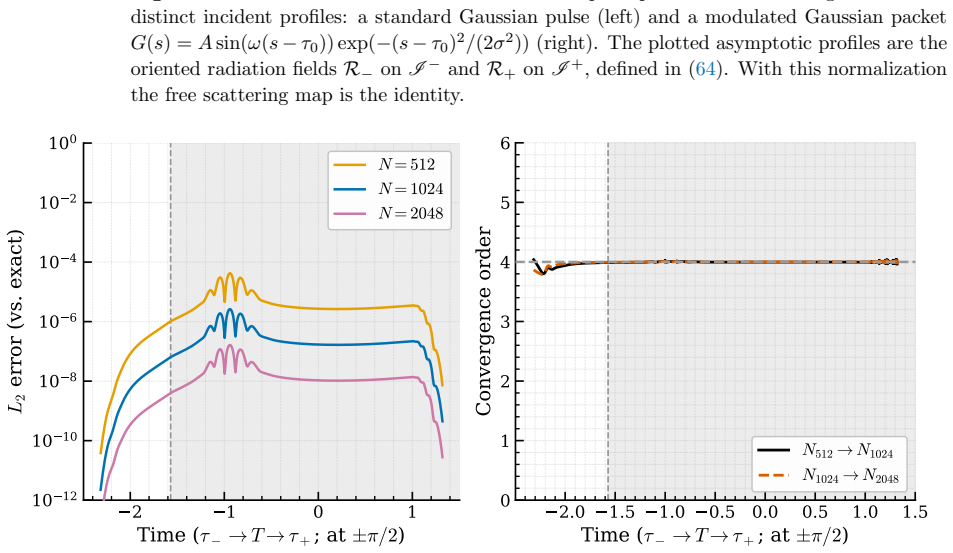
- Fourth-order convergence holds in free and linear-potential tests with direct extraction of radiation at future null infinity.
- Quintic and septic nonlinearities recover approximately fourth-order convergence and the expected late-time tail rates.
- The cubic nonlinearity yields only first-order convergence because the rescaled source remains non-vanishing near the boundaries.
Where Pith is reading between the lines
- The same matching surfaces could support longer evolutions if the boundary regularity issue for nonlinear sources is resolved.
- Avoiding artificial outer boundaries removes a common source of spurious reflections in long-time wave simulations.
- The construction supplies a template for linking different foliations across spatial infinity in other asymptotically flat settings.
- Improving the treatment of non-vanishing sources at compactified boundaries would extend the method to a wider class of nonlinear problems.
Load-bearing premise
The conformally rescaled nonlinear source term must vanish near the compactified boundaries or be treatable without loss of regularity for the matching to stay stable and high-order accurate.
What would settle it
A simulation of the cubic nonlinearity case that produces only first-order convergence instead of fourth-order, or any instability detected when crossing the matching surfaces.
Figures


read the original abstract
We develop a time-domain numerical framework for global scalar wave scattering in Minkowski spacetime. The main contribution is an exact conformal matching of three compactified regions: a past hyperboloidal domain attached to $\mathscr I^-$, a Penrose domain covering a neighborhood of spatial infinity $i^0$, and a future hyperboloidal domain attached to $\mathscr I^+$. The matching surfaces are identical conformal hypersurfaces in the adjacent charts. This yields a global evolution scheme connecting $\mathscr I^-$, the neighborhood of $i^0$, and $\mathscr I^+$ without artificial timelike outer boundaries and without interpolation between scri-fixing gauges. We implement the construction for spherically symmetric scalar waves, including free propagation, localized linear scattering potentials such as the P\"oschl--Teller potential, and semilinear wave equations with cubic, quintic, and septic nonlinearities. The numerical experiments demonstrate stable propagation across the matching interfaces, direct extraction of radiation at $\mathscr I^+$, and fourth-order convergence for the free and linear-potential tests. The quintic and septic nonlinear tests exhibit approximately fourth-order convergence and recover the expected late-time tail rates. The cubic case, by contrast, shows only first-order convergence, revealing a limitation of our treatment near compactified boundaries when the conformally rescaled nonlinear source remains non-vanishing. These results validate the conformal matching strategy for long-time simulations, while identifying the boundary regularity issues that must be addressed using a more robust treatment of spatial infinity.
Editorial analysis
A structured set of objections, weighed in public.
Referee Report
Summary. The paper claims to develop a global time-domain numerical framework for scalar wave scattering in Minkowski spacetime via an exact conformal matching of three compactified regions: a past hyperboloidal domain attached to I^-, a Penrose domain around i^0, and a future hyperboloidal domain attached to I^+. This matching on identical conformal hypersurfaces enables stable evolution connecting I^-, the neighborhood of i^0, and I^+ without artificial timelike boundaries or gauge interpolation. Tests for spherically symmetric scalars (free, linear Pöschl-Teller potential, and semilinear cubic/quintic/septic nonlinearities) demonstrate stable interface propagation, direct radiation extraction at I^+, fourth-order convergence in free/linear/quintic/septic cases, and recovery of expected late-time tails, while the cubic case yields only first-order convergence due to non-vanishing conformally rescaled source.
Significance. If the central matching construction holds, the work provides a technically novel route to boundary-free global evolutions in asymptotically flat settings, with direct access to radiation at I^+ and no need for artificial outer boundaries. The recovery of expected tail rates in the quintic and septic cases, together with fourth-order convergence where the source-regularity assumption is satisfied, constitutes a concrete strength. The explicit identification of the cubic limitation is also a positive feature, as it clarifies the scope of the current implementation.
major comments (1)
- [Numerical experiments / abstract] Numerical experiments (cubic nonlinearity test): only first-order convergence is reported, which directly follows from the non-vanishing of the conformally rescaled nonlinear source near the compactified boundaries. This is load-bearing for the claim of a high-order global scheme applicable to general semilinear equations, as the abstract itself flags the assumption failure.
minor comments (3)
- [Abstract] Abstract: verify spelling of 'P"oschl--Teller' (standard form is Pöschl-Teller) and ensure consistent math-mode rendering of symbols such as ℐ^-, ℐ^+, i^0.
- [Matching construction] The description of the three-domain matching would benefit from an explicit statement (even if brief) of the continuity conditions imposed on the rescaled field and its first derivatives at the interfaces.
- [Numerical results] Minor: the abstract states 'approximately fourth-order convergence' for quintic/septic; a table or plot caption should quantify the observed rates more precisely.
Simulated Author's Rebuttal
We thank the referee for the positive assessment and for highlighting this point. We address the major comment below.
read point-by-point responses
-
Referee: Numerical experiments (cubic nonlinearity test): only first-order convergence is reported, which directly follows from the non-vanishing of the conformally rescaled nonlinear source near the compactified boundaries. This is load-bearing for the claim of a high-order global scheme applicable to general semilinear equations, as the abstract itself flags the assumption failure.
Authors: We agree that the first-order convergence observed in the cubic case follows directly from the non-vanishing of the conformally rescaled nonlinear source near the compactified boundaries. The manuscript already states this explicitly in both the abstract and the numerical experiments section, and flags the assumption failure for the cubic nonlinearity. The framework is shown to achieve fourth-order convergence precisely when the source-regularity condition is satisfied (free evolution, linear potential, quintic, and septic cases). We do not claim a high-order scheme for arbitrary semilinear equations without this regularity; the cubic result is presented to illustrate the limitation. No revision is required. revision: no
Circularity Check
No circularity in conformal matching construction
full rationale
The paper presents a numerical framework whose central step is the explicit geometric construction of matching surfaces as identical conformal hypersurfaces across three compactified domains (past hyperboloidal, Penrose neighborhood of i^0, future hyperboloidal). This matching is defined directly from the coordinate charts and is not derived from or reduced to any fitted parameter, self-referential equation, or prior self-citation. Validation proceeds via independent numerical experiments that measure convergence orders and late-time tails against known analytic expectations; the cubic nonlinearity failure is reported as a direct consequence of the stated regularity assumption on the rescaled source term. No load-bearing step reduces by construction to its own inputs.
Axiom & Free-Parameter Ledger
axioms (1)
- standard math Minkowski spacetime admits a conformal compactification allowing hyperboloidal slices attached to I^- and I^+ together with a Penrose chart near i^0.
Reference graph
Works this paper leans on
-
[1]
Penrose R 1963Physical Review Letters1066–68
-
[2]
Series A
Penrose R 1965Proceedings of the Royal Society of London. Series A. Mathematical and Physical Sciences 284159–203
-
[3]
Friedlander F G 1980Mathematical Proceedings of the Cambridge Philosophical Society88483–515
-
[4]
Friedrich H 1981Proceedings of the Royal Society of London. A. Mathematical and Physical Sciences378 401–421
-
[5]
Baez J C, Segal I E and Zhou Z F 1990Journal of Functional Analysis93239–269
-
[6]
Mason L J and Nicolas J P 2004Journal of Hyperbolic Differential Equations1197–233
-
[7]
Bishop N T and Rezzolla L 2016Living Reviews in Relativity192 (PreprintarXiv:1606.02532)
work page internal anchor Pith review Pith/arXiv arXiv
-
[8]
Bishop N T, G´ omez R, Lehner L, Maharaj M and Winicour J 1996Physical Review D546153–6165 (PreprintarXiv:gr-qc/9705033)
work page internal anchor Pith review Pith/arXiv arXiv
-
[9]
Moxon J, Scheel M A, Teukolsky S A, Deppe N, Vu N, H´ ebert F, Kidder L E and Throwe W 2023Physical Review D107064013 Hyperboloidal evolution for scalar scattering in Minkowski space25
-
[10]
Bernuzzi S, Fontbut´ e J, Albanesi S and Zengino˘ glu A 2025Physical Review D112084036
-
[11]
Lovelace G 2009Classical and Quantum Gravity26114002
-
[12]
Pfeiffer H P and York J W 2003Physical Review D67
- [13]
-
[14]
Valiente Kroon J A and Gomes Da Silva L J 2024General Relativity and Gravitation5685
-
[15]
Friedrich H 1983Communications in Mathematical Physics91445–472
-
[16]
Frauendiener J 2004Living Reviews in Relativity71
-
[17]
Lindblad H and Schlue V 2023Journal of Hyperbolic Differential Equations20155–218
-
[18]
Lindblad H and Schlue V 2025Pure and Applied Analysis7865–926
- [19]
- [20]
- [21]
-
[22]
Duarte-Baptista P, Va˜ n´ o-Vi˜ nuales A and del R´ ıo A 2026Classical and Quantum Gravity43045009
-
[23]
Frauendiener J, Stevens C and Thwala S 2025Physical Review Letters134161401
-
[24]
Friedrich H 1998Journal of Geometry and Physics2483–163
-
[25]
Zengino˘ glu A 2008Classical and Quantum Gravity25145002
-
[26]
Zenginoglu A 2008Class. Quant. Grav.25195025 (PreprintarXiv:0808.0810)
work page internal anchor Pith review Pith/arXiv arXiv
-
[27]
Va˜ n´ o-Vi˜ nuales A, Husa S and Hilditch D 2015Class. Quant. Grav.32175010 (PreprintarXiv:1412.3827)
work page internal anchor Pith review Pith/arXiv arXiv
-
[28]
Gasperin E, Gautam S, Hilditch D and Va˜ n´ o-Vi˜ nuales A 2020Classical and Quantum Gravity37035006
-
[29]
Gautam S, Va˜ n´ o-Vi˜ nuales A, Hilditch D and Bose S 2021Physical Review D103084045
-
[30]
Peterson C, Gautam S, Va˜ n´ o-Vi˜ nuales A and Hilditch D 2024Physical Review D110124033
- [31]
- [32]
-
[33]
Kroon J A V 2023Conformal Methods in General Relativity(Cambridge University Press)
-
[34]
Carroll S M 2019Spacetime and geometry(Cambridge University Press)
- [35]
-
[36]
Zengino˘ glu A 2008Classical and Quantum Gravity25175013
-
[37]
Bizo´ n P, Rostworowski A and Zengino˘ glu A 2010Classical and Quantum Gravity27175003
-
[38]
Zengino˘ glu A 2011Journal of Computational Physics2302286–2302
-
[39]
Ripley J L, Loutrel N, Giorgi E and Pretorius F 2021Physical Review D103104018
-
[40]
Panosso Macedo R 2024Philosophical Transactions of the Royal Society A: Mathematical, Physical and Engineering Sciences382
-
[41]
Bourg P, Macedo R P, Spiers A, Leather B, Bonga B and Pound A 2025Physical Review D112044049
-
[42]
Bizo´ n P and Zengino˘ glu A 2009Nonlinearity222473
-
[43]
Donninger R and Zengino˘ glu A 2014Analysis & PDE7461–495
-
[44]
Rinne O 2025Nonlinearity38105026
-
[45]
Ferrari V and Mashhoon B 1984Physical Review D30295
-
[46]
Cardona A F and Molina C 2017Classical and Quantum Gravity34245002
-
[47]
Kroon J A V 2003Classical and Quantum Gravity20L53 Appendix A. The free solution and its conformal representations In this section we construct an explicit non-trivial spherically symmetric solution of the standard flat wave equation □ηϕ= 0,(A.1) and rewrite it as a solution of the corresponding conformal wave equations in (i) hyperboloidal coordinates (τ...
discussion (0)
Sign in with ORCID, Apple, or X to comment. Anyone can read and Pith papers without signing in.