Small-Signal Stability Manifolds in Converter-Dominated Power Systems
Pith reviewed 2026-06-29 20:11 UTC · model grok-4.3
The pith
Stability manifolds identify controller-parameter regions that keep power systems stable across multiple scenarios as inverter shares rise.
A machine-rendered reading of the paper's core claim, the machinery that carries it, and where it could break.
Core claim
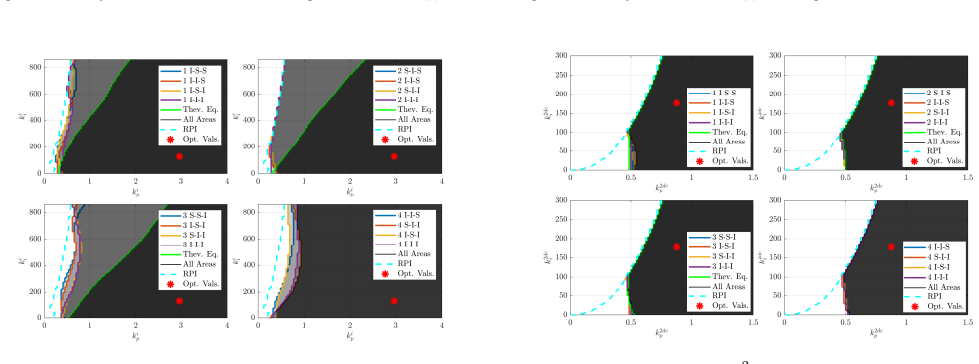
Stability manifolds are the sets of controller parameters that maintain small-signal stability across multiple operating scenarios in systems with high shares of inverter-based resources. The proposed framework approximates these manifolds through full-network linearization combined with eigenvalue analysis and adaptive sampling driven by probabilistic support vector machine classification, while surrogate optimization locates feasible initial controller tunings that meet bandwidth and phase-margin requirements. Validation on a modified Cigré European HV network benchmark across 50 scenarios with rising inverter penetration shows stability sensitivity grows with inverter share, IBR interacti
What carries the argument
Stability manifolds, defined as controller-parameter regions ensuring stability across scenarios, approximated by combining full-network linearization, eigenvalue analysis, and probabilistic support vector machine adaptive sampling.
If this is right
- Stability sensitivity grows as the share of inverters increases.
- Interactions among inverter-based resources reshape the admissible controller-parameter regions.
- Simplified equivalent-network models can overlook critical system-level stability limitations.
- The framework supports stability-oriented controller design and interconnection studies in converter-dominated systems.
Where Pith is reading between the lines
- The manifolds could support real-time parameter adjustment if updated with streaming measurements from the network.
- Interconnection studies for new inverters should use full-network models rather than equivalents once penetration exceeds moderate levels.
- The method might extend to grids containing grid-forming inverters by adjusting the linearization step to account for different control modes.
- Parameter regions identified this way could inform standardized tuning guidelines that account for multi-inverter interactions.
Load-bearing premise
Probabilistic support vector machine classification with adaptive sampling can accurately locate the true stability boundaries in high-dimensional controller-parameter space without missing unstable regions.
What would settle it
Direct eigenvalue analysis performed on a dense grid of points both inside and outside the approximated stability manifold to check whether any unstable points fall inside the manifold or stable points fall outside.
Figures


read the original abstract
This paper proposes a systematic framework to assess the small-signal stability of power systems with high shares of grid-following inverter-based resources (IBRs) under varying controller parameters and operating conditions. Stability manifolds are introduced to identify controller-parameter regions that ensure stability across multiple scenarios. Full-network linearization and eigenvalue analysis are combined with adaptive sampling based on probabilistic support vector machine classification to approximate stability boundaries efficiently, while surrogate optimization identifies feasible initial controller settings meeting bandwidth and phase-margin constraints. The approach is validated on a modified Cigr\'e European HV network benchmark with 50 operating scenarios and increasing inverter penetration. Results show that stability sensitivity grows with inverter share, interactions among IBRs reshape admissible parameter regions, and simplified equivalent-network models may overlook critical system-level limitations. The framework supports stability-oriented controller design and interconnection studies in converter-dominated systems.
Editorial analysis
A structured set of objections, weighed in public.
Referee Report
Summary. The paper proposes a framework to assess small-signal stability in power systems with high shares of grid-following IBRs by defining stability manifolds that delineate controller-parameter regions stable across multiple operating scenarios. It combines full-network linearization and eigenvalue analysis with probabilistic SVM-based adaptive sampling to approximate boundaries, uses surrogate optimization for feasible initial controller settings, and validates the approach on a modified Cigré European HV network benchmark across 50 scenarios with increasing inverter penetration. Key findings include growing stability sensitivity with IBR share, reshaping of admissible regions by IBR interactions, and limitations of simplified equivalent-network models.
Significance. If the sampling-based approximation of stability boundaries proves reliable, the work would offer a practical method for stability-oriented controller design and interconnection studies in converter-dominated systems, with the full-network analysis on a standard benchmark and multi-scenario validation providing concrete evidence of IBR interaction effects.
major comments (2)
- [Abstract / framework description] Abstract / framework description: The central claim that stability manifolds correctly identify controller-parameter regions stable across the 50 scenarios rests on the probabilistic SVM adaptive sampling not missing unstable regions. No discussion or bound is provided on the risk of false-stable labels for narrow, high-codimension unstable filaments that can arise with growing IBR interactions, which directly undermines the reported growth in stability sensitivity and the conclusion that equivalent-network models overlook system-level limits.
- [Validation section] Validation section: The results assert that stability sensitivity grows with inverter share and IBR interactions reshape admissible regions, yet the manuscript supplies no quantitative validation metrics (e.g., classifier error rates on held-out points, estimated missed-volume bounds, or comparison against exhaustive low-dimensional sampling) to confirm that the adaptive sampling has not overlooked unstable pockets.
minor comments (1)
- [Abstract] The abstract states that surrogate optimization meets bandwidth and phase-margin constraints but does not indicate how these constraints are formulated or whether they are enforced inside or outside the stability-manifold computation.
Simulated Author's Rebuttal
We thank the referee for the constructive feedback. The concerns regarding potential limitations of the adaptive sampling approach are valid, and we will strengthen the manuscript by adding quantitative validation metrics and a discussion of sampling risks in the revision.
read point-by-point responses
-
Referee: [Abstract / framework description] Abstract / framework description: The central claim that stability manifolds correctly identify controller-parameter regions stable across the 50 scenarios rests on the probabilistic SVM adaptive sampling not missing unstable regions. No discussion or bound is provided on the risk of false-stable labels for narrow, high-codimension unstable filaments that can arise with growing IBR interactions, which directly undermines the reported growth in stability sensitivity and the conclusion that equivalent-network models overlook system-level limits.
Authors: We acknowledge that the manuscript provides no explicit bounds or discussion on the risk of missing narrow, high-codimension unstable regions with the probabilistic SVM adaptive sampling. The method focuses sampling near the decision boundary, and application to the Cigré benchmark across 50 scenarios showed consistent results without evident missed instabilities. To address the concern directly, the revised manuscript will add a dedicated subsection on sampling reliability, including a discussion of limitations for high-codimension filaments and their potential impact on the reported sensitivity growth and equivalent-model conclusions. revision: yes
-
Referee: [Validation section] Validation section: The results assert that stability sensitivity grows with inverter share and IBR interactions reshape admissible regions, yet the manuscript supplies no quantitative validation metrics (e.g., classifier error rates on held-out points, estimated missed-volume bounds, or comparison against exhaustive low-dimensional sampling) to confirm that the adaptive sampling has not overlooked unstable pockets.
Authors: We agree that the absence of quantitative metrics such as classifier error rates or missed-volume estimates leaves the validation open to the critique raised. The current results rely on the adaptive sampling outcomes and observed trends across scenarios. In the revision we will incorporate classifier precision/recall on held-out points collected during sampling, plus a comparison of manifold approximations against denser sampling in selected low-dimensional parameter projections, to provide concrete evidence that unstable pockets were not overlooked. revision: yes
Circularity Check
No significant circularity; standard methods applied without reduction to inputs
full rationale
The paper's framework uses full-network linearization, eigenvalue analysis, probabilistic SVM classification, and adaptive sampling to approximate stability manifolds in controller-parameter space. These are established techniques applied to the problem of IBR-dominated systems; no step equates a claimed prediction or manifold to a fitted quantity by construction, nor relies on self-citation chains or ansatzes smuggled from prior author work. The central results (growth of sensitivity with inverter share, reshaping of regions) follow from the numerical application rather than definitional equivalence. This is the expected non-finding for a computational study using off-the-shelf classification on linearized models.
Axiom & Free-Parameter Ledger
axioms (1)
- domain assumption Small-signal stability of the system can be determined from the eigenvalues of the linearized state-space model
invented entities (1)
-
stability manifolds
no independent evidence
Reference graph
Works this paper leans on
-
[1]
Def- inition and Classification of Power System Stability – Revisited & Extended,
N. Hatziargyriou, J. Milanovic, C. Rahmann, V . Ajjarapu, C. Canizares, I. Erlich, D. Hill, I. Hiskens, I. Kamwa, B. Pal, P. Pourbeik, J. Sanchez- Gasca, A. Stankovic, T. Van Cutsem, V . Vittal, and C. V ournas, “Def- inition and Classification of Power System Stability – Revisited & Extended,”IEEE Trans. Power Syst., vol. 36, no. 4, pp. 3271–3281, 2021
2021
-
[2]
Analysis of Dynamic Properties of VSCs Connected to Weak Grids Including the Effects of Dead Time and Time Delays,
A. Rodr ´ıguez-Cabero, M. Prodanovic, and J. Rold ´an-Perez, “Analysis of Dynamic Properties of VSCs Connected to Weak Grids Including the Effects of Dead Time and Time Delays,”IEEE Trans. Sustain. Energy, vol. 10, no. 3, pp. 1066–1075, 2019
2019
-
[3]
Stability Analysis of Systems With High VSC Penetration: Where Is the Limit?
C. Collados-Rodriguez, M. Cheah-Mane, E. Prieto-Araujo, and O. Gomis-Bellmunt, “Stability Analysis of Systems With High VSC Penetration: Where Is the Limit?”IEEE Trans. Power Del., vol. 35, no. 4, pp. 2021–2031, 2020
2021
-
[4]
Impacts of Phase-Locked Loop Dynamic on the Stability of DC-Link V oltage Control in V oltage Source Converter Integrated to Weak Grid,
Y . Huang, L. Wang, S. Zhang, D. Wang, X. Deng, and G. Zhu, “Impacts of Phase-Locked Loop Dynamic on the Stability of DC-Link V oltage Control in V oltage Source Converter Integrated to Weak Grid,”IEEE Trans. Emerg. Sel. Topics Circuits Syst., vol. 12, no. 1, pp. 48–58, 2022
2022
-
[5]
Small-Signal Stability of Grid- Connected Converter System in Renewable Energy Systems with Fractional-Order Synchronous Reference Frame Phase-Locked Loop,
P. Zhang, W. Du, and H. Wang, “Small-Signal Stability of Grid- Connected Converter System in Renewable Energy Systems with Fractional-Order Synchronous Reference Frame Phase-Locked Loop,” Journal of Modern Power Systems and Clean Energy, pp. 1–12, 2024
2024
-
[6]
Factors affecting voltage stability while integrating inverter based renewable energy sources into weak power grids,
M. I. Saleem, S. Saha, L. Ang, U. Izhar, and T. K. Roy, “Factors affecting voltage stability while integrating inverter based renewable energy sources into weak power grids,”IET Generation, Transmission & Distribution, vol. 17, no. 6, pp. 1216–1231, 2023
2023
-
[7]
Stability assessment of inverter-based renewable energy sources integrated to weak grids,
M. I. Saleem, S. Saha, U. Izhar, and L. Ang, “Stability assessment of inverter-based renewable energy sources integrated to weak grids,”IET Energy Systems Integration, vol. 6, no. 4, pp. 525–544, 2024
2024
-
[8]
Reduced- Order Modeling and Transient Stability Analysis of Grid-Connected VSC in DC-Link V oltage Control Timescale,
Y . Ma, D. Zhu, J. Hu, D. Liu, X. Ji, X. Zou, and Y . Kang, “Reduced- Order Modeling and Transient Stability Analysis of Grid-Connected VSC in DC-Link V oltage Control Timescale,”IEEE Trans. Emerg. Sel. Topics Power Electron., vol. 12, no. 3, pp. 2981–2993, 2024
2024
-
[9]
Grid- forming inverters: A comparative study of different control strategies in frequency and time domains,
N. Mohammed, H. Udawatte, W. Zhou, D. J. Hill, and B. Bahrani, “Grid- forming inverters: A comparative study of different control strategies in frequency and time domains,”IEEE Open J. Ind. Electron. Soc., vol. 5, pp. 185–214, 2024
2024
-
[10]
Stability and operation limits of power systems with high penetration of power electronics,
C. Collados-Rodriguez, M. Cheah-Mane, E. Prieto-Araujo, and O. Gomis-Bellmunt, “Stability and operation limits of power systems with high penetration of power electronics,”Int. J. Electr. Power Energy Syst., vol. 138, p. 107728, 2022
2022
-
[11]
Holistic small-signal stability analysis for large-scale inverter-intensive power systems with coupled and full-order dynamics from control systems and power networks,
L. Ding, Y . Ouyang, X. Lu, J. Qin, S. Dong, A. Hoke, and J. Tan, “Holistic small-signal stability analysis for large-scale inverter-intensive power systems with coupled and full-order dynamics from control systems and power networks,”IEEE Trans. Ind. Appl., vol. 61, no. 1, pp. 1131–1147, 2025
2025
-
[12]
Understanding the role of vsc control strategies in the limits of power electronics integration in ac grids using modal analysis,
R. Mourouvin, J. C. Gonzalez-Torres, J. Dai, A. Benchaib, D. Georges, and S. Bacha, “Understanding the role of vsc control strategies in the limits of power electronics integration in ac grids using modal analysis,” Electr. Power Syst. Res., vol. 192, p. 106930, 2021
2021
-
[13]
Power system stability with a high penetration of inverter-based resources,
Y . Gu and T. C. Green, “Power system stability with a high penetration of inverter-based resources,”Proceedings of the IEEE, vol. 111, no. 7, pp. 832–853, 2023
2023
-
[14]
Revisiting small-signal modeling for analyzing fast dynamic interactions in converter-dominated power systems,
F. Kelada, J. Buire, and N. HadjSaid, “Revisiting small-signal modeling for analyzing fast dynamic interactions in converter-dominated power systems,”IEEE Trans. Power Syst., vol. 40, no. 5, pp. 3819–3832, 2025
2025
-
[15]
Efficient global optimiza- tion of expensive black-box functions,
D. R. Jones, M. Schonlau, and W. J. Welch, “Efficient global optimiza- tion of expensive black-box functions,”J. Glob. Optim, vol. 13, no. 4, pp. 455–492, 1998
1998
-
[16]
[Online]
MathWorks, Inc.,Surrogate Optimization Algorithm, 2025, accessed: 2025-05-21. [Online]. Available: https://www.mathworks.com/help/ gads/surrogateopt.html
2025
-
[17]
Benchmark Systems for Network Integration of Renewable and Distributed Energy Resources,
Cigr ´e WG C6.04, “Benchmark Systems for Network Integration of Renewable and Distributed Energy Resources,” Cigr´e, Tech. Rep., 2014
2014
-
[18]
Detailed small–signal stability analysis of the cigr ´e high–voltage net- work penetrated by grid–following inverter–based resources,
F. Conte, F. Mancilla-David, A. Sagar, C. Li, F. Silvestro, and S. Grillo, “Detailed small–signal stability analysis of the cigr ´e high–voltage net- work penetrated by grid–following inverter–based resources,” in2025 International Conference on Clean Electrical Power (ICCEP), 2025, pp. 1115–1121
2025
-
[19]
Kundur,Power System Stability and Control
P. Kundur,Power System Stability and Control. New York, NY , USA: McGraw-Hill, 1994
1994
-
[20]
P. M. Anderson and A. A. Fouad,Power System Control and Stability, 2nd ed. Piscataway, NJ, USA: IEEE Press, 2003
2003
-
[21]
IEEE Recommended Practice for Excitation System Models for Power System Stability Studies,
IEEE, “IEEE Recommended Practice for Excitation System Models for Power System Stability Studies,”IEEE Std 421.5-1992, pp. 1–56, 1992
1992
-
[22]
Machowski, J
J. Machowski, J. W. Bialek, and J. R. Bumby,Power System Dynamics: Stability and Control, 3rd ed. Hoboken, NJ, USA: Wiley, 2020
2020
-
[23]
Power System Linearizaton Tool,
SCooPS Project, “Power System Linearizaton Tool,” https://github.com/ grisamgit/SCooPS, 2026
2026
-
[24]
Yazdani and R
A. Yazdani and R. Iravani,Voltage-Sourced Converters in Power Sys- tems: Modeling, Control, and Applications. Hoboken, NJ: IEEE Press / Wiley, 2010
2010
-
[25]
A phase tracking system for three phase utility interface inverters,
S. Chung, “A phase tracking system for three phase utility interface inverters,”IEEE Trans. Power Electron., vol. 15, no. 3, pp. 431–438, 2000
2000
-
[26]
Dynamic aggregate equivalent modeling of solar parks considering irradiation levels and fault scenar- ios,
A. Mishra, A. S. Mir, and N. P. Padhy, “Dynamic aggregate equivalent modeling of solar parks considering irradiation levels and fault scenar- ios,”IEEE Trans. Ind. Appl., vol. 60, no. 5, pp. 7291–7302, 2024
2024
-
[27]
Stability Analysis of Modern Power Systems,
C. Collados-Rodr ´ıguez, “Stability Analysis of Modern Power Systems,” PhD thesis, Universitat Polit `ecnica de Catalunya (UPC), Departament d’Enginyeria El`ectrica, 2024
2024
-
[28]
P. W. Sauer and M. A. Pai,Power System Dynamics and Stability. Upper Saddle River: Prentice Hall, 1998
1998
-
[29]
[Online]
MathWorks Ltd.,Steam Turbine and Governor, 2024, accessed: 2025-05-21. [Online]. Available: https://it.mathworks.com/help/releases/ R2024b/sps/powersys/ref/steamturbineandgovernor.html
2024
-
[30]
Dynamic Models for Steam and Hydro Turbines in Power System Studies,
I. C. Report, “Dynamic Models for Steam and Hydro Turbines in Power System Studies,”IEEE Trans. Power App. Syst., vol. PAS-92, no. 6, pp. 1904–1915, 1973
1904
-
[31]
[Online]
MathWorks Ltd.,Excitation System, 2024, accessed: 2025-05-21. [Online]. Available: https://it.mathworks.com/help/releases/R2024b/sps/ powersys/ref/excitationsystem.html
2024
-
[32]
Cristianini and J
N. Cristianini and J. Shawe-Taylor,An Introduction to Support Vector Machines and Other Kernel-Based Learning Methods. Cambridge, UK: Cambridge University Press, 2000
2000
-
[33]
Teodorescu, M
R. Teodorescu, M. Liserre, and P. Rodriguez,Grid Converters for Photovoltaic and Wind Power Systems. Chichester, UK: Wiley, 2011
2011
-
[34]
Design and analysis of a current-controlled voltage- source converter with phase-locked loop,
L. Harnefors, “Design and analysis of a current-controlled voltage- source converter with phase-locked loop,”IEEE Trans. Ind. Electron., vol. 54, no. 6, pp. 3472–3480, 2007
2007
-
[35]
Yazdani and R
A. Yazdani and R. Iravani,Voltage-Sourced Converters in Power Sys- tems: Modeling, Control, and Applications. Hoboken, NJ: Wiley, 2010
2010
-
[36]
Impedance modeling and analysis of grid- connected voltage-source converters,
M. Cespedes and J. Sun, “Impedance modeling and analysis of grid- connected voltage-source converters,”IEEE Trans. Power Electron., vol. 29, no. 3, pp. 1254–1261, 2014
2014
-
[37]
Passivity- based stability assessment of grid-connected vscs,
L. Harnefors, X. Wang, A. G. Yepes, and F. Blaabjerg, “Passivity- based stability assessment of grid-connected vscs,”IEEE Trans. Power Electron., vol. 30, no. 12, pp. 6401–6408, 2015
2015
-
[38]
Design and control of an lcl- filter-based three-phase active rectifier,
M. Liserre, F. Blaabjerg, and S. Hansen, “Design and control of an lcl- filter-based three-phase active rectifier,”IEEE Trans. Ind. Appl., vol. 41, no. 5, pp. 1281–1291, 2005
2005
-
[39]
Power converters & cabinets,
GamesaElectric, “Power converters & cabinets,” 2025, accessed: 2025- 05-23. [Online]. Available: https://www.gamesaelectric.com/products/
2025
discussion (0)
Sign in with ORCID, Apple, or X to comment. Anyone can read and Pith papers without signing in.