The Environmental Costs of Surveillance Capitalism: A Case Study of Social Media Platforms
Pith reviewed 2026-06-29 19:10 UTC · model grok-4.3
The pith
Corporate overhead of X establishes a lower bound on CO2e emissions from surveillance capitalism activities that do not serve users.
A machine-rendered reading of the paper's core claim, the machinery that carries it, and where it could break.
Core claim
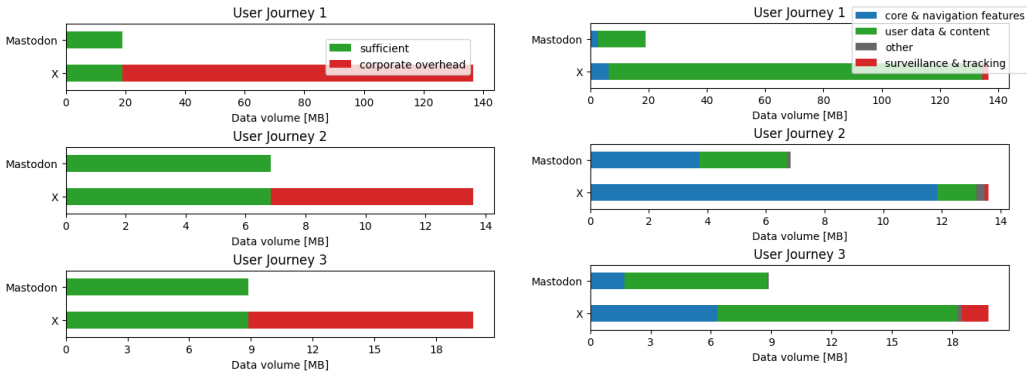
By comparing X with Mastodon, the corporate overhead of X can be isolated as excess resource consumption driven by for-profit surveillance practices and used to establish a lower bound in CO2e emissions attributable to activities that do not contribute to the user experience.
What carries the argument
Corporate overhead, the excess network traffic and resource consumption in the corporate platform beyond what is required for user experience, used as a proxy for surveillance capitalism processes.
If this is right
- The proportion of ICT carbon impact traceable to surveillance processes can be estimated through platform comparisons.
- Corporate overhead supplies a usable lower bound on emissions from non-user-experience activities in for-profit social media.
- The framework can be applied to other corporate platforms to quantify similar overhead.
- Quantifying these costs provides a basis for linking surveillance practices directly to infrastructure demands.
Where Pith is reading between the lines
- The same comparative method could be tried with other decentralized services to test whether overhead patterns hold across domains.
- If corporate overhead proves large, platform redesigns that reduce data extraction might also cut emissions without harming core functionality.
- Extending the proxy to data-center energy use rather than network traffic alone would give a fuller picture of total material costs.
Load-bearing premise
Differences in network traffic and resource consumption between X and Mastodon are caused primarily by surveillance capitalism rather than differences in scale, features, user base, or technical architecture.
What would settle it
A breakdown of actual packet-level traffic or server logs showing that the measured differences between X and Mastodon disappear once user numbers, feature sets, and architecture are matched.
Figures
read the original abstract
The business model of surveillance capitalism, premised on the extraction of behavioral data and its predictive potential for profit, relies on extensive material infrastructure. Such profit is typically driven by practices such as telemetry, user tracking, data analytics, secondary data uses, increased user engagement, and AI model training, as well as large-scale data storage systems that retain personal information for sale or reuse. This paper is motivated by the question: how much of the rising carbon impact of ICT can be attributed to this material infrastructure? Such an inquiry provides a foundation for quantifying the environmental costs of surveillance capitalism by proposing a conceptual framework and research direction that link processes of surveillance with their underlying material realities. To demonstrate the applicability of this framework, we examine the proportion of network traffic caused by surveillance capitalism processes through a comparative case study of a corporate social media platform, X/formerly Twitter, and a decentralized, non-commercial alternative, Mastodon. Our findings highlight the existence of corporate overhead: excess resource consumption driven by corporate social media practices, which is used as an initial proxy for the activities of surveillance capitalism. Our findings further demonstrate how the corporate overhead of X can be used to establish a lower bound in CO2e emissions attributable to for-profit activities that do not contribute to the user experience.
Editorial analysis
A structured set of objections, weighed in public.
Referee Report
Summary. The paper proposes a conceptual framework linking surveillance capitalism processes (telemetry, tracking, data analytics, secondary uses, AI training, and storage) to ICT carbon impacts and demonstrates it via a comparative case study of X (corporate) versus Mastodon (decentralized), defining 'corporate overhead' as excess network traffic and resource consumption used to establish a lower bound on CO2e emissions from for-profit activities that do not contribute to user experience.
Significance. If the proxy can be validated with appropriate controls, the framework offers a novel direction for attributing environmental costs to specific business models rather than generic ICT growth. The case-study approach is a reasonable starting point for operationalizing the idea, though the current execution leaves the attribution open to alternative explanations.
major comments (2)
- [Case Study] Case-study design and proxy construction: The measured differences in network traffic and resource consumption between X and Mastodon are attributed to surveillance-capitalism processes, but the comparison supplies no normalization for user-base scale (X is orders of magnitude larger), centralized versus federated topology, recommendation systems, or storage/replication strategies; without these controls the excess cannot be confidently assigned to telemetry/tracking rather than architectural or scale confounders.
- [Methods] Methods and data section: No description is given of traffic measurement methods, energy conversion factors, data exclusion rules, or statistical controls, so it is impossible to determine whether the reported corporate-overhead figures support the stated lower-bound claim on CO2e emissions.
minor comments (1)
- [Abstract] The abstract and introduction could more explicitly separate the conceptual framework from the empirical proxy demonstration to clarify what is being claimed versus illustrated.
Simulated Author's Rebuttal
We thank the referee for the detailed and constructive report. The comments correctly identify areas where the case-study design and methods documentation require strengthening to support the lower-bound claim. We address each point below and indicate planned revisions.
read point-by-point responses
-
Referee: [Case Study] Case-study design and proxy construction: The measured differences in network traffic and resource consumption between X and Mastodon are attributed to surveillance-capitalism processes, but the comparison supplies no normalization for user-base scale (X is orders of magnitude larger), centralized versus federated topology, recommendation systems, or storage/replication strategies; without these controls the excess cannot be confidently assigned to telemetry/tracking rather than architectural or scale confounders.
Authors: We agree that the current presentation does not sufficiently address potential confounders. The case study is offered as an initial demonstration of the framework, with corporate overhead defined as a conservative lower-bound proxy rather than a fully controlled causal estimate. In the revised manuscript we will add an explicit limitations subsection discussing scale, topology, recommendation systems, and replication differences, and we will qualify the attribution language accordingly. Where feasible we will incorporate available public data on user-base size for normalization; however, complete controls for all listed factors are not possible with the data sources used. revision: partial
-
Referee: [Methods] Methods and data section: No description is given of traffic measurement methods, energy conversion factors, data exclusion rules, or statistical controls, so it is impossible to determine whether the reported corporate-overhead figures support the stated lower-bound claim on CO2e emissions.
Authors: The referee is correct that the methods description is insufficient. We will expand the Methods section to detail traffic measurement procedures, the specific energy conversion factors and emission factors applied, data exclusion criteria, and any statistical handling. This expansion will directly support evaluation of the lower-bound CO2e claim. revision: yes
Circularity Check
No circularity: proxy is interpretive attribution, not definitional reduction
full rationale
The paper proposes a conceptual framework linking surveillance capitalism processes to material infrastructure and applies it via a comparative case study measuring network traffic and resource differences between X and Mastodon. Corporate overhead is introduced as an interpretive label for observed excess consumption, then used as a proxy for a lower bound on CO2e from non-user-experience activities. No equations, fitted parameters, or derivation steps are shown that would make the claimed bound equivalent to the input measurements by construction. The attribution step rests on the case-study design and assumption about causes of the delta rather than any self-referential definition or self-citation chain. The analysis is therefore self-contained; external validation of the confounders would address the assumption but does not indicate circularity in the presented chain.
Axiom & Free-Parameter Ledger
axioms (1)
- domain assumption Differences in network traffic between X and Mastodon are attributable to surveillance capitalism practices rather than platform scale or design differences
invented entities (1)
-
corporate overhead
no independent evidence
Reference graph
Works this paper leans on
-
[1]
Data Colonialism: Re- thinking Big Data’s Relation to the Contemporary Sub- ject,
N. Couldry and U. A. Mejias, “Data Colonialism: Re- thinking Big Data’s Relation to the Contemporary Sub- ject,”Television & New Media, vol. 20, no. 4, pp. 336– 349, May 2019
2019
-
[2]
Zuboff,The Age of Surveillance Capitalism: The Fight for a Human Future at the New Frontier of Power
S. Zuboff,The Age of Surveillance Capitalism: The Fight for a Human Future at the New Frontier of Power. PublicAffairs, Jan. 2019
2019
-
[3]
Data-driven digital advertising: Benefits and risks of online behavioral advertising,
S. Aiolfi, S. Bellini, and D. Pellegrini, “Data-driven digital advertising: Benefits and risks of online behavioral advertising,”International Journal of Retail & Distribu- tion Management, vol. 49, no. 7, pp. 1089–1110, May 2021
2021
-
[4]
The role of persuasion knowledge, assessment of benefit and harm, and third- person perception in coping with online behavioral ad- vertising,
C.-D. Ham and M. R. Nelson, “The role of persuasion knowledge, assessment of benefit and harm, and third- person perception in coping with online behavioral ad- vertising,”Computers in Human Behavior, vol. 62, pp. 689–702, Sep. 2016
2016
-
[5]
The Slow Violence of Surveillance Capitalism: How Online Behavioral Advertising Harms People,
Y . Wu, S. Bice, W. K. Edwards, and S. Das, “The Slow Violence of Surveillance Capitalism: How Online Behavioral Advertising Harms People,” inProceedings of the 2023 ACM Conference on Fairness, Accountability, and Transparency, ser. FAccT ’23. New York, NY , USA: Association for Computing Machinery, Jun. 2023, pp. 1826–1837
2023
-
[6]
Energy and AI,
“Energy and AI,” https://www.iea.org/reports/energy- and-ai, Apr. 2025
2025
-
[7]
The Case for Alternative Social Me- dia,
R. W. Gehl, “The Case for Alternative Social Me- dia,”Social Media + Society, vol. 1, no. 2, p. 2056305115604338, Jul. 2015
2015
-
[8]
Schneider,Governable Spaces: Democratic Design for Online Life
N. Schneider,Governable Spaces: Democratic Design for Online Life. University of California Press, 2024
2024
-
[9]
An Empirical Inquiry into Surveillance Cap- italism: Web Tracking,
N. Bonfils, “An Empirical Inquiry into Surveillance Cap- italism: Web Tracking,” Aug. 2025
2025
-
[10]
Big other: Surveillance Capitalism and the Prospects of an Information Civilization,
S. Zuboff, “Big other: Surveillance Capitalism and the Prospects of an Information Civilization,”Journal of Information Technology, vol. 30, no. 1, pp. 75–89, Mar. 2015
2015
-
[11]
Problems with surveillance capitalism and possible alternatives for IT infrastructure,
M. Landwehr, A. Borning, and V . Wulf, “Problems with surveillance capitalism and possible alternatives for IT infrastructure,”Information, Communication & Society, vol. 26, no. 1, pp. 70–85, Jan. 2023
2023
-
[12]
Elements of Zuboff’s Surveillance Capi- talism,
G. Greenleaf, “Elements of Zuboff’s Surveillance Capi- talism,” Rochester, NY , Jul. 2019
2019
-
[13]
Big Data for Big Problems-Climate Change, Water Availability, and Food Safety,
W. Armbruster and M. MacDonell, “Big Data for Big Problems-Climate Change, Water Availability, and Food Safety,” inEnviroInfo and ICT for Sustainability 2015. Atlantis Press, Sep. 2015, pp. 190–196
2015
-
[14]
Big Data GIS Analytics Towards Efficient Waste Management in Stockholm,
H. Shahrokni, B. V . der Heijde, D. Lazarevic, and N. Brandt, “Big Data GIS Analytics Towards Efficient Waste Management in Stockholm,” inICT for Sustain- ability 2014 (ICT4S-14). Atlantis Press, Aug. 2014, pp. 140–147
2014
-
[15]
Big data analytics: A survey,
C.-W. Tsai, C.-F. Lai, H.-C. Chao, and A. V . Vasilakos, “Big data analytics: A survey,”Journal of Big Data, vol. 2, no. 1, p. 21, Oct. 2015
2015
-
[16]
Data warehousing and analytics infrastructure at facebook,
A. Thusoo, Z. Shao, S. Anthony, D. Borthakur, N. Jain, J. Sen Sarma, R. Murthy, and H. Liu, “Data warehousing and analytics infrastructure at facebook,” inProceedings of the 2010 ACM SIGMOD International Conference on Management of Data, ser. SIGMOD ’10. New York, NY , USA: Association for Computing Machinery, Jun. 2010, pp. 1013–1020
2010
-
[17]
Energy-efficient Data Engineering Practices for Big Data Workloads in Cloud Infrastructure
K. Arul, “Energy-efficient Data Engineering Practices for Big Data Workloads in Cloud Infrastructure.”
-
[18]
Energy con- sumption analysis of data stream processing: A bench- marking approach,
M. Dayarathna, Y . Li, Y . Wen, and R. Fan, “Energy con- sumption analysis of data stream processing: A bench- marking approach,”Software: Practice and Experience, vol. 47, no. 10, pp. 1443–1462, 2017
2017
-
[19]
What is analytic infrastructure and why should you care?
R. L. Grossman, “What is analytic infrastructure and why should you care?”ACM SIGKDD Explorations Newsletter, vol. 11, no. 1, pp. 5–9, Nov. 2009
2009
-
[20]
Big Data Tools, Technologies, and Applications: A Survey,
Y . Arfat, S. Usman, R. Mehmood, and I. Katib, “Big Data Tools, Technologies, and Applications: A Survey,” inSmart Infrastructure and Applications: Foundations for Smarter Cities and Societies, R. Mehmood, S. See, I. Katib, and I. Chlamtac, Eds. Cham: Springer Inter- national Publishing, 2020, pp. 453–490
2020
-
[21]
Digital sufficiency: Conceptual considerations for ICTs on a finite planet,
T. Santarius, J. C. T. Bieser, V . Frick, M. H ¨ojer, M. Gossen, L. M. Hilty, E. Kern, J. Pohl, F. Rohde, and S. Lange, “Digital sufficiency: Conceptual considerations for ICTs on a finite planet,”Annals of Telecommunica- tions, vol. 78, no. 5, pp. 277–295, Jun. 2023
2023
-
[22]
ICT Sufficiency is Necessary: Results from Simulating Four Possible Futures,
G. A. Szalkowski and I. M. Windekilde, “ICT Sufficiency is Necessary: Results from Simulating Four Possible Futures,” in2024 10th International Conference on ICT for Sustainability (ICT4S), Jun. 2024, pp. 183–193
2024
-
[23]
Digital Sufficiency Behaviors to Deal with Intermittent Energy Sources in a Data Center,
J. Gatt, M. Madon, and G. Da Costa, “Digital Sufficiency Behaviors to Deal with Intermittent Energy Sources in a Data Center,” in2024 10th International Conference on ICT for Sustainability (ICT4S), Jun. 2024, pp. 53–64
2024
-
[24]
Breaking the Cornu- copian Paradigm: Towards Moderate Internet Use in Everyday Life,
K. Widdicks and D. Pargman, “Breaking the Cornu- copian Paradigm: Towards Moderate Internet Use in Everyday Life,” inProceedings of the Fifth Workshop on Computing within Limits. Lappeenranta Finland: ACM, Jun. 2019, pp. 1–8
2019
-
[25]
Understanding and Mitigating the Effects of Device and Cloud Service Design Decisions on the Environmental Footprint of Digital Infrastructure,
C. Preist, D. Schien, and E. Blevis, “Understanding and Mitigating the Effects of Device and Cloud Service Design Decisions on the Environmental Footprint of Digital Infrastructure,” inProceedings of the 2016 CHI Conference on Human Factors in Computing Systems, ser. CHI ’16. New York, NY , USA: Association for Computing Machinery, May 2016, pp. 1324–1337
2016
-
[26]
The environmental sustainability of digital content consumption,
R. Istrate, V . Tulus, R. N. Grass, L. Vanbever, W. J. Stark, and G. Guill ´en-Gos´albez, “The environmental sustainability of digital content consumption,”Nature Communications, vol. 15, no. 1, p. 3724, May 2024
2024
-
[27]
Carbon Footprint of The Most Popular Social Media Platforms,
A. Batmunkh, “Carbon Footprint of The Most Popular Social Media Platforms,”Sustainability, vol. 14, no. 4, Feb. 2022
2022
-
[28]
The Effect of Analytics Tools on Energy Consumption of Websites,
P. Puhtila, L. Kivim ¨aki, T. Heino, J.-M. M¨akel¨a, S. Rauti, and T. M¨akil¨a, “The Effect of Analytics Tools on Energy Consumption of Websites,” in2024 10th International Conference on ICT for Sustainability (ICT4S), Jun. 2024, pp. 335–345
2024
-
[29]
The Dark (Patterns) Side of UX Design,
C. M. Gray, Y . Kou, B. Battles, J. Hoggatt, and A. L. Toombs, “The Dark (Patterns) Side of UX Design,” in Proceedings of the 2018 CHI Conference on Human Factors in Computing Systems, ser. CHI ’18. New York, NY , USA: Association for Computing Machinery, Apr. 2018, pp. 1–14
2018
-
[30]
ICT for Sustainability: An Emerging Research Field,
L. M. Hilty and B. Aebischer, “ICT for Sustainability: An Emerging Research Field,” inICT Innovations for Sus- tainability, L. M. Hilty and B. Aebischer, Eds. Cham: Springer International Publishing, 2015, pp. 3–36
2015
-
[31]
Online Tracking: A 1- million-site Measurement and Analysis,
S. Englehardt and A. Narayanan, “Online Tracking: A 1- million-site Measurement and Analysis,” inProceedings of the 2016 ACM SIGSAC Conference on Computer and Communications Security. Vienna Austria: ACM, Oct. 2016, pp. 1388–1401
2016
-
[32]
Code for The Environmental Costs of Surveillance Capitalism: A Case Study of Social Media Platforms,
N. Bonfils and C. Becker, “Code for The Environmental Costs of Surveillance Capitalism: A Case Study of Social Media Platforms,” Zenodo, May 2026
2026
-
[33]
mitmproxy: A free and open source interactive HTTPS proxy,
A. Cortesi, M. Hils, T. Kriechbaumer, and contributors, “mitmproxy: A free and open source interactive HTTPS proxy,” 2010–, [Version 12.2]. [Online]. Available: https://mitmproxy.org/
2010
-
[34]
Life Cycle Assessment of Network Traffic: A Review of Challenges and Possible Solutions,
T. Billstein, A. Bj ¨orklund, T. Rydberg, T. Billstein, A. Bj ¨orklund, and T. Rydberg, “Life Cycle Assessment of Network Traffic: A Review of Challenges and Possible Solutions,”Sustainability, vol. 13, no. 20, Oct. 2021
2021
-
[35]
The Energy Intensity of the Internet: Edge and Core Networks,
D. Schien, V . C. Coroama, L. M. Hilty, and C. Preist, “The Energy Intensity of the Internet: Edge and Core Networks,” inICT Innovations for Sustainability, L. M. Hilty and B. Aebischer, Eds. Cham: Springer Interna- tional Publishing, 2015, pp. 157–170
2015
-
[36]
Does not compute: Avoid- ing pitfalls assessing the Internet’s energy and carbon impacts,
J. Koomey and E. Masanet, “Does not compute: Avoid- ing pitfalls assessing the Internet’s energy and carbon impacts,”Joule, vol. 5, no. 7, pp. 1625–1628, Jul. 2021
2021
-
[37]
Electricity 2025,
“Electricity 2025,” https://www.iea.org/reports/electricity- 2025, Feb. 2025
2025
-
[38]
Actually, X sees 500M posts per day – not 100M-200M as Musk recently said,
S. Perez, “Actually, X sees 500M posts per day – not 100M-200M as Musk recently said,” https://techcrunch.com/2023/10/04/actually-x-sees- 500m-posts-per-day-not-100m-200m-as-musk-recently- said/, Oct. 2023
2023
-
[39]
US tech firms successfully lobbied EU to keep datacentre emissions secret,
A. Niranjan, N. Schmidt, and E. Joyner, “US tech firms successfully lobbied EU to keep datacentre emissions secret,”The Guardian, Apr. 2026
2026
-
[40]
Hype, Sustainability, and the Price of the Bigger-is-Better Paradigm in AI,
G. Varoquaux, S. Luccioni, and M. Whittaker, “Hype, Sustainability, and the Price of the Bigger-is-Better Paradigm in AI,” inProceedings of the 2025 ACM Conference on Fairness, Accountability, and Transparency, ser. FAccT ’25. New York, NY , USA: Association for Computing Machinery, Jun. 2025, pp. 61–75. [Online]. Available: https://dl.acm.org/doi/10.1145...
-
[41]
Irresponsible AI: big tech’s influence on AI research and associated impacts,
A. Hern ´andez-Garc´ıa, A. V olokhova, E. Williams, and D. S. Kabakibo, “Irresponsible AI: big tech’s influence on AI research and associated impacts,” Nov
-
[42]
Available: https://openreview.net/forum? id=QwC3Q1erNe
[Online]. Available: https://openreview.net/forum? id=QwC3Q1erNe
-
[43]
Message content features and social media engagement: Evidence from the media industry,
G. Moran, L. Muzellec, and D. Johnson, “Message content features and social media engagement: Evidence from the media industry,”Journal of Product & Brand Management, vol. 29, no. 5, pp. 533–545, Oct. 2019
2019
-
[44]
Under- standing consumers’ social media engagement behaviour: An examination of the moderation effect of social media context,
D. Cao, M. Meadows, D. Wong, and S. Xia, “Under- standing consumers’ social media engagement behaviour: An examination of the moderation effect of social media context,”Journal of Business Research, vol. 122, pp. 835–846, Jan. 2021
2021
-
[45]
The environmental footprint of social media host- ing: Tinkering with mastodon,
S. Laser, A. Pasek, E. Sørensen, M. Hogan, M. Ojala, J. Fehrenbacher, M. G. Hepach, L. C ¸ elik, and K. R. Ku- mar, “The environmental footprint of social media host- ing: Tinkering with mastodon,”EASST Review, vol. 41, no. 3, pp. 41–3, 2022
2022
-
[46]
Meta-crisis computing and you: Finding agency through the Two Loops model of change,
M. Laurell Thorslund, O. Bates, E. Eriksson, D. Pargman, A. Biørn-Hansen, F. Bakhshoudeh, and A. R. Menon, “Meta-crisis computing and you: Finding agency through the Two Loops model of change,” inProceedings of the Sixth Decennial Aarhus Conference: Computing X Crisis, ser. AAR ’25. New York, NY , USA: Association for Computing Machinery, Aug. 2025, pp. 127–139
2025
-
[47]
Climate Change: What is Computing’s Responsibility? (Dagstuhl Perspec- tives Workshop 25122),
B. Knowles, V . L. Hanson, C. Becker, M. Berners-Lee, A. A. Chien, B. Combemale, V . Coroam ˘a, K. De Boss- chere, Y . Ding, A. Friday, B. Gamazaychikov, L. Hard- man, S. Hinterholzer, M. H ¨ojer, L. Kaack, L. Kuijer, A.-L. Ligozat, J. T. Muehlberg, Y . Nah, T. Olsson, A.- C. Orgerie, D. Pargman, B. Penzenstadler, T. Romanoff, E. Strubell, C. Venters, and...
2025
-
[48]
Algorithms as Social- Ecological-Technological Systems: An Environmental Justice Lens on Algorithmic Audits,
B. Rakova and R. Dobbe, “Algorithms as Social- Ecological-Technological Systems: An Environmental Justice Lens on Algorithmic Audits,” inProceedings of the 2023 ACM Conference on Fairness, Accountability, and Transparency, ser. FAccT ’23. New York, NY , USA: Association for Computing Machinery, Jun. 2023, p. 491
2023
-
[49]
Push and Pull: A Framework for Measuring Attentional Agency on Digital Platforms,
Z. Wojtowicz, S. Jain, and N. Vincent, “Push and Pull: A Framework for Measuring Attentional Agency on Digital Platforms,” inProceedings of the 2025 ACM Conference on Fairness, Accountability, and Transparency. Athens Greece: ACM, Jun. 2025, pp. 679–689
2025
discussion (0)
Sign in with ORCID, Apple, or X to comment. Anyone can read and Pith papers without signing in.