Microwave-driven Floquet-Fano interference in a ring-chord quantum dot structure for enhanced spin-caloritronic performance
Pith reviewed 2026-06-29 15:54 UTC · model grok-4.3
The pith
Microwave driving in ring-chord quantum dot devices yields ZT near 12 and ZsT near 18 by combining Floquet sidebands with Fano interference from the chord pathway.
A machine-rendered reading of the paper's core claim, the machinery that carries it, and where it could break.
Core claim
In the microwave-driven ring-chord quantum dot structure, the interplay of Floquet sidebands from photon processes and Fano interference from the chord pathway leads to enhanced thermoelectric figures of merit, specifically ZT ≈ 12 and ZsT ≈ 18 at T=0.3Γ₀, enabled by spin-polarized injection and Zeeman splitting.
What carries the argument
The Floquet-Fano interference created when microwave-driven sidebands compete with the discrete chord pathway against the ring-mediated continuum of states.
If this is right
- Microwave irradiation dynamically tunes electrical conductance, thermopower, and electronic thermal conductance through photon absorption and emission.
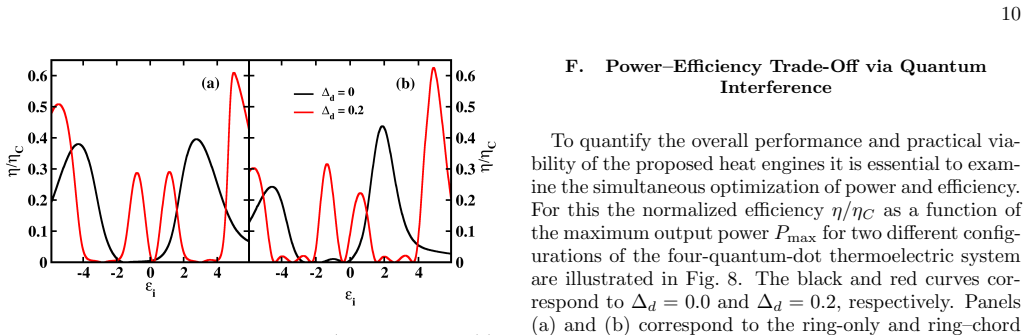
- The ring-chord geometry reaches nearly 62 percent of Carnot efficiency at an output power of 6.24 fW.
- Spin-polarized injection from the leads together with Zeeman splitting produces a robust spin-dependent Floquet-Fano response.
- The maximum spin thermoelectric figure of merit reaches ZsT approximately 18.
- Microwave engineering of Fano interference serves as a strategy for modulating spin-caloritronic behavior in multi-quantum-dot devices.
Where Pith is reading between the lines
- The same interference mechanism could be tested in other multi-dot layouts where a bridging path competes with a closed loop.
- Device integration might allow recovery of waste heat while generating spin currents if the temperature and drive parameters can be maintained.
- The linear-response assumption suggests checking whether the high ZT persists when finite bias or stronger interactions are included experimentally.
Load-bearing premise
The self-consistent Hartree treatment combined with linear-response nonequilibrium Green's function formalism remains quantitatively accurate without higher-order interactions or nonlinear effects altering the reported ZT values.
What would settle it
Fabricate the ring-chord four-dot device, apply microwave drive at the amplitudes used in the calculation, measure the charge and spin thermoelectric figures of merit at T=0.3Γ₀, and check whether they reach the stated values of 12 and 18.
Figures





read the original abstract
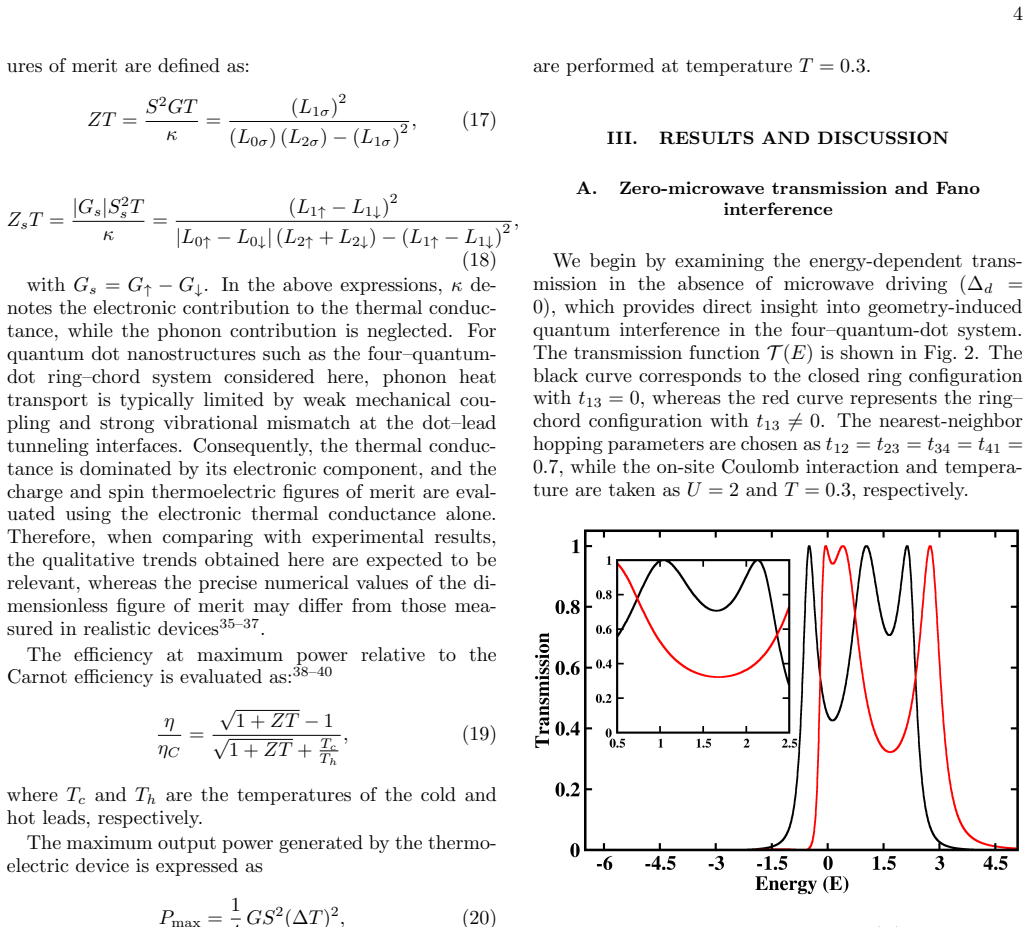
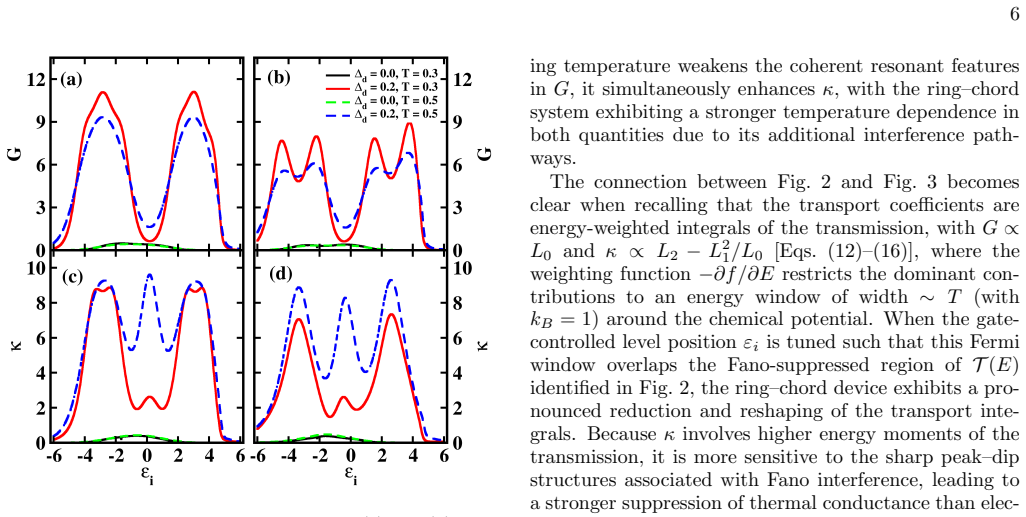
We investigate photon-assisted thermoelectric transport in four--quantum-dot nanostructures featuring ring and ring--chord geometries coupled to ferromagnetic leads. Focusing on the interplay between microwave-induced Floquet sidebands and geometry-driven Fano interference, we employ the nonequilibrium Green's function formalism combined with Floquet theory and a self-consistent Hartree treatment of electron-electron interactions within the linear response regime. The inclusion of a longitudinal interdot chord bridging the lead-coupled dots introduces a discrete interference pathway that competes with the continuum of ring-mediated states, giving rise to pronounced Fano resonances. Microwave irradiation dynamically reshapes these resonances through photon absorption and emission processes, enabling tunable control of electrical conductance, thermopower, and electronic thermal conductance. Quantitatively, at an intermediate temperature of $T=0.3\Gamma_0$ (where $\Gamma_0$ denotes the dot-lead coupling strength), the microwave-driven ring-chord geometry exhibits an exceptional thermoelectric figure of merit of ZT $\approx$ 12 and an optimal efficiency--power trade-off, reaching nearly $62\%$ of the Carnot efficiency with an output power of $6.24~\mathrm{fW}$. Crucially, the combination of spin-polarized injection from the leads and Zeeman splitting within the dots induces a robust spin-dependence within this Floquet--Fano interference. This cooperative interplay results in an enhanced spin Seebeck response and a maximum spin thermoelectric figure of merit of nearly $Z_sT \approx 18$. Our findings establish microwave-driven engineering of Fano interference as an effective strategy for modulating spin-caloritronic behavior in multi-quantum-dot devices.
Editorial analysis
A structured set of objections, weighed in public.
Referee Report
Summary. The manuscript investigates photon-assisted thermoelectric transport in four-quantum-dot ring and ring-chord geometries coupled to ferromagnetic leads. Employing the nonequilibrium Green's function formalism combined with Floquet theory and a self-consistent Hartree treatment of interactions in the linear-response regime, the authors report that microwave irradiation reshapes Fano resonances via photon-assisted processes. At T=0.3Γ₀ the ring-chord structure is claimed to achieve ZT≈12 and ZsT≈18 through the cooperative action of spin-polarized injection, Zeeman splitting, and Floquet-Fano interference, together with 62% of Carnot efficiency at 6.24 fW output power.
Significance. If the numerical results hold under the stated approximations, the work would demonstrate a concrete route for microwave tuning of interference effects to reach high spin-caloritronic figures of merit in multi-dot devices. The quantitative enhancements and the explicit spin dependence constitute a potentially useful addition to the literature on engineered thermoelectric response in quantum-dot systems.
major comments (2)
- [Abstract / numerical results] The central claims rest on the linear-response NEGF + self-consistent Hartree treatment remaining quantitatively accurate for the microwave amplitudes and interdot couplings that produce ZT≈12 and ZsT≈18. No convergence checks, error estimates, or explicit verification that photon-assisted processes stay within the linear regime are supplied, which directly affects the reliability of the reported peak values.
- [Abstract / parameter selection] The temperature T=0.3Γ₀ at which the optimal figures of merit are reported is presented without an independent justification or scan showing that this value is not tuned to maximize the quoted ZT and ZsT; this choice is load-bearing for the quantitative conclusions.
Simulated Author's Rebuttal
We thank the referee for the detailed reading and for highlighting two issues that bear directly on the quantitative claims. We address each point below and indicate the revisions we will make.
read point-by-point responses
-
Referee: [Abstract / numerical results] The central claims rest on the linear-response NEGF + self-consistent Hartree treatment remaining quantitatively accurate for the microwave amplitudes and interdot couplings that produce ZT≈12 and ZsT≈18. No convergence checks, error estimates, or explicit verification that photon-assisted processes stay within the linear regime are supplied, which directly affects the reliability of the reported peak values.
Authors: We agree that the absence of explicit convergence tests and error estimates weakens the quantitative assertions. The calculations were performed with a fixed number of Floquet replicas (N=5) and a self-consistent Hartree loop converged to 10^{-6} relative tolerance, but these details were omitted. In the revised manuscript we will add (i) a supplementary figure showing ZT and ZsT versus number of replicas for the optimal parameters, (ii) a statement confirming that the microwave amplitude used (A=0.5Γ₀) keeps the sideband weights within the regime where the linear-response thermoelectric coefficients remain valid (i.e., the induced current is linear in the small bias and temperature gradient), and (iii) a brief error estimate obtained by varying the Hartree convergence threshold. These additions will be placed in the methods section and referenced from the abstract. revision: yes
-
Referee: [Abstract / parameter selection] The temperature T=0.3Γ₀ at which the optimal figures of merit are reported is presented without an independent justification or scan showing that this value is not tuned to maximize the quoted ZT and ZsT; this choice is load-bearing for the quantitative conclusions.
Authors: The value T=0.3Γ₀ was chosen because it lies in the intermediate-temperature window where thermal broadening is comparable to both the interdot coupling and the microwave frequency, allowing the Floquet-Fano features to remain resolved. However, the manuscript indeed contains no temperature scan that would demonstrate this choice is not specially tuned. We will add a new panel (or supplementary figure) displaying ZT(T) and ZsT(T) over the range 0.1Γ₀–1.0Γ₀ for both geometries, with the reported point marked. The accompanying text will note that the peak occurs near 0.3Γ₀ but remains above 8 (ZT) and 12 (ZsT) over a finite interval, thereby providing the requested justification. revision: yes
Circularity Check
No circularity: results are numerical outputs of standard NEGF-Floquet-Hartree computation
full rationale
The paper applies the nonequilibrium Green's function formalism combined with Floquet theory and self-consistent Hartree treatment within linear response to compute conductance, thermopower, and ZT for the ring-chord geometry. The reported ZT≈12 and ZsT≈18 at T=0.3Γ₀ are direct numerical outputs for chosen parameters and microwave amplitudes; they are not obtained by re-expressing inputs, fitting a subset and renaming the fit as prediction, or invoking self-citations to force uniqueness. No self-definitional steps, ansatz smuggling, or renaming of known results appear. The derivation chain is self-contained as a computational study whose central claims remain independent of the quoted performance numbers.
Axiom & Free-Parameter Ledger
free parameters (3)
- microwave amplitude and frequency
- interdot coupling strengths and chord parameters
- temperature T = 0.3 Γ₀
axioms (2)
- domain assumption Nonequilibrium Green's function formalism combined with Floquet theory accurately captures photon-assisted transport
- domain assumption Self-consistent Hartree treatment suffices for electron-electron interactions in the linear-response regime
Reference graph
Works this paper leans on
-
[1]
Bulk nanostructured thermoelectric materials: current research and future prospects
AJl Minnich, Milfred S Dresselhaus, ZF Ren, and G Chen. Bulk nanostructured thermoelectric materials: current research and future prospects. Energy & Environmental Science , 2(5):466--479, 2009
2009
-
[2]
Molecular transport junctions: vibrational effects
Michael Galperin, Mark A Ratner, and Abraham Nitzan. Molecular transport junctions: vibrational effects. Journal of Physics: Condensed Matter , 19(10):103201, 2007
2007
-
[3]
Quantum sensing of thermoelectric power in low-dimensional materials
Mali Zhao, Dohyun Kim, Young Hee Lee, Heejun Yang, and Suyeon Cho. Quantum sensing of thermoelectric power in low-dimensional materials. Advanced Materials , 35(27):2106871, 2023
2023
-
[4]
Colloquium: Heat flow and thermoelectricity in atomic and molecular junctions
Yonatan Dubi and Massimiliano Di Ventra. Colloquium: Heat flow and thermoelectricity in atomic and molecular junctions. Reviews of Modern Physics , 83(1):131--155, 2011
2011
-
[5]
Electric and thermoelectric phenomena in a multilevel quantum dot attached to ferromagnetic electrodes
Micha Wierzbicki and Renata \'S wirkowicz. Electric and thermoelectric phenomena in a multilevel quantum dot attached to ferromagnetic electrodes. Physical Review B—Condensed Matter and Materials Physics , 82(16):165334, 2010
2010
-
[6]
Large enhancement of thermoelectric effects in a double quantum dot system due to interference and coulomb correlation phenomena
Piotr Trocha and J \'o zef Barna \'s . Large enhancement of thermoelectric effects in a double quantum dot system due to interference and coulomb correlation phenomena. Physical Review B—Condensed Matter and Materials Physics , 85(8):085408, 2012
2012
-
[7]
Thermoelectric performance of quantum dots embedded in an aharonov-bohm ring: a pauli master equation approach
Parbati Senapati and Prakash Parida. Thermoelectric performance of quantum dots embedded in an aharonov-bohm ring: a pauli master equation approach. Scientific Reports , 15(1):13232, 2025
2025
-
[8]
Quantum coherent control of nonlinear thermoelectric transport in a triple-dot aharonov-bohm heat engine
Jayasmita Behera, Salil Bedkihal, Bijay Kumar Agarwalla, and Malay Bandyopadhyay. Quantum coherent control of nonlinear thermoelectric transport in a triple-dot aharonov-bohm heat engine. Physical Review B , 108(16):165419, 2023
2023
-
[9]
Thermoelectric effect in an aharonov-bohm ring with an embedded quantum dot
Jun Zheng, Feng Chi, Xiao-Dong Lu, and Kai-Cheng Zhang. Thermoelectric effect in an aharonov-bohm ring with an embedded quantum dot. Nanoscale research letters , 7(1):157, 2012
2012
-
[10]
Thermoelectric effects in transport through quantum dots attached to ferromagnetic leads with noncollinear magnetic moments
Renata \'S wirkowicz, Micha Wierzbicki, and J \'o zef Barna \'s . Thermoelectric effects in transport through quantum dots attached to ferromagnetic leads with noncollinear magnetic moments. Physical Review B—Condensed Matter and Materials Physics , 80(19):195409, 2009
2009
-
[11]
Thermopower of a kondo spin-correlated quantum dot
R Scheibner, H Buhmann, D Reuter, MN Kiselev, and LW Molenkamp. Thermopower of a kondo spin-correlated quantum dot. Physical review letters , 95(17):176602, 2005
2005
-
[12]
Enhancement of the thermoelectric figure of merit in a quantum dot due to the coulomb blockade effect
Jie Liu, Qing-feng Sun, and XC Xie. Enhancement of the thermoelectric figure of merit in a quantum dot due to the coulomb blockade effect. Physical Review B—Condensed Matter and Materials Physics , 81(24):245323, 2010
2010
-
[13]
Thermospin effects in a quantum dot connected to ferromagnetic leads
Yonatan Dubi and Massimiliano Di Ventra. Thermospin effects in a quantum dot connected to ferromagnetic leads. Physical Review B—Condensed Matter and Materials Physics , 79(8):081302, 2009
2009
-
[14]
Enhanced thermopower under a time-dependent gate voltage
Adeline Cr \'e pieux, Fedor S imkovic, Benjamin Cambon, and Fabienne Michelini. Enhanced thermopower under a time-dependent gate voltage. Physical Review B—Condensed Matter and Materials Physics , 83(15):153417, 2011
2011
-
[15]
Microwave-mediated heat transport in a quantum dot attached to leads
Feng Chi and Yonatan Dubi. Microwave-mediated heat transport in a quantum dot attached to leads. Journal of Physics: Condensed Matter , 24(14):145301, 2012
2012
-
[16]
Thermoelectric effects in a quantum dot coupled to ferromagnetic leads and subject to microwave fields
M Bagheri Tagani and H Rahimpour Soleimani. Thermoelectric effects in a quantum dot coupled to ferromagnetic leads and subject to microwave fields. Journal of Applied Physics , 113(14), 2013
2013
-
[17]
Vahid Mosallanejad, Yu Wang, and Wenjie Dou. Floquet non-equilibrium green’s function and floquet quantum master equation for electronic transport: The role of electron--electron interactions and spin current with circular light. The Journal of Chemical Physics , 160(16), 2024
2024
-
[18]
Enhanced thermoelectric effects in a driven one-dimensional system
CX Zhang, Alessandro Braggio, Alessandro Romito, and Fabio Taddei. Enhanced thermoelectric effects in a driven one-dimensional system. arXiv preprint arXiv:2506.22329 , 2025
work page internal anchor Pith review Pith/arXiv arXiv 2025
-
[19]
Photon-mediated thermoelectric and heat currents through a resonant quantum wire-cavity system
Nzar Rauf Abdullah, Rawezh Bakr Marif, and Hunar Omar Rashid. Photon-mediated thermoelectric and heat currents through a resonant quantum wire-cavity system. Energies , 12(6):1082, 2019
2019
-
[20]
Robustness of quantized transport through edge states of finite length: Imaging current density in floquet topological versus quantum spin and anomalous hall insulators
Utkarsh Bajpai, Mark JH Ku, and Branislav K Nikoli \'c . Robustness of quantized transport through edge states of finite length: Imaging current density in floquet topological versus quantum spin and anomalous hall insulators. Physical Review Research , 2(3):033438, 2020
2020
-
[21]
Photon-assisted transport in semiconductor nanostructures
Gloria Platero and Ram \'o n Aguado. Photon-assisted transport in semiconductor nanostructures. Physics Reports , 395(1-2):1--157, 2004
2004
-
[22]
A semi-classical floquet-negf approach to model photon-assisted tunneling in quantum well devices
Nathan De Sutter, Emile Vanderstraeten, and Dries Vande Ginste. A semi-classical floquet-negf approach to model photon-assisted tunneling in quantum well devices. Journal of Computational Electronics , 23(6):1148--1161, 2024
2024
-
[23]
Spin-dependent thermoelectric properties of a hybrid ferromagnetic metal/quantum dot/topological insulator junction
Piotr Trocha. Spin-dependent thermoelectric properties of a hybrid ferromagnetic metal/quantum dot/topological insulator junction. Scientific Reports , 15(1):4904, 2025
2025
-
[24]
Effects of correlated hopping on thermoelectric response of a quantum dot strongly coupled to ferromagnetic leads
Kacper Wrze \'s niewski and Ireneusz Weymann. Effects of correlated hopping on thermoelectric response of a quantum dot strongly coupled to ferromagnetic leads. Annalen der Physik , 537(9):e00236, 2025
2025
-
[25]
A proposal for time-dependent pure-spin-current generators
YS Liu, XF Yang, F Chi, MS Si, and Y Guo. A proposal for time-dependent pure-spin-current generators. Applied Physics Letters , 101(21), 2012
2012
-
[26]
Time-dependent thermopower effect in an interacting quantum dot
M Bagheri Tagani and H Rahimpour Soleimani. Time-dependent thermopower effect in an interacting quantum dot. International Journal of Thermophysics , 35(1):136--144, 2014
2014
-
[27]
Tunneling resonances through periodically driven quantum dots
Jan Mathis Giesen, Daniel Weber, and Sebastian Eggert. Tunneling resonances through periodically driven quantum dots. arXiv preprint arXiv:2509.07539 , 2025
-
[28]
Naoto Tsuji. Floquet states. arXiv preprint arXiv:2301.12676 , 2023
-
[29]
Resonant andreev reflection in a normal-metal/quantum-dot/superconductor system with coupled majorana bound states
Su-Xin Wang, Yu-Xian Li, and Jian-Jun Liu. Resonant andreev reflection in a normal-metal/quantum-dot/superconductor system with coupled majorana bound states. Chinese Physics B , 25(3):037304, 2016
2016
-
[30]
Fano--kondo shot noise in a quantum dot embedded interferometer irradiated with microwave fields
Hong-Kang Zhao and Wei-Ke Zou. Fano--kondo shot noise in a quantum dot embedded interferometer irradiated with microwave fields. Physics Letters A , 379(4):389--395, 2015
2015
-
[31]
Time-dependent transport through a mesoscopic structure
Ned S Wingreen, Antti-Pekka Jauho, and Yigal Meir. Time-dependent transport through a mesoscopic structure. Physical Review B , 48(11):8487, 1993
1993
-
[32]
Time-dependent electron tunnelling through a quantum dot with coulomb interactions
Qing-feng Sun and Tsung-han Lin. Time-dependent electron tunnelling through a quantum dot with coulomb interactions. Journal of Physics: Condensed Matter , 9(23):4875, 1997
1997
-
[33]
Landauer formula for the current through an interacting electron region
Yigal Meir and Ned S Wingreen. Landauer formula for the current through an interacting electron region. Physical review letters , 68(16):2512, 1992
1992
-
[34]
Quantum kinetics in transport and optics of semiconductors
Hartmut Haug and Antti-Pekka Jauho. Quantum kinetics in transport and optics of semiconductors . Springer, 2008
2008
-
[35]
Thermoelectric efficiency in nanojunctions: a comparison between atomic junctions and molecular junctions
Yu-Shen Liu, Yi-Ren Chen, and Yu-Chang Chen. Thermoelectric efficiency in nanojunctions: a comparison between atomic junctions and molecular junctions. ACS nano , 3(11):3497--3504, 2009
2009
-
[36]
The influence of side-coupled quantum dots on thermoelectric effect of parallel-coupled double quantum dot system
Jiyuan Bai, Zelong He, Li Li, Suihu Dang, Yadong Li, and Weimin Sun. The influence of side-coupled quantum dots on thermoelectric effect of parallel-coupled double quantum dot system. Physica B: Condensed Matter , 545:377--382, 2018
2018
-
[37]
Influence of phonon-assisted tunneling on the linear thermoelectric transport through molecular quantum dots
A Khedri, V Meden, and TA Costi. Influence of phonon-assisted tunneling on the linear thermoelectric transport through molecular quantum dots. Physical Review B , 96(19):195156, 2017
2017
-
[38]
Most efficient quantum thermoelectric at finite power output
Robert S Whitney. Most efficient quantum thermoelectric at finite power output. Physical review letters , 112(13):130601, 2014
2014
-
[39]
Finding the quantum thermoelectric with maximal efficiency and minimal entropy production at given power output
Robert S Whitney. Finding the quantum thermoelectric with maximal efficiency and minimal entropy production at given power output. Physical Review B , 91(11):115425, 2015
2015
-
[40]
Thermoelectric efficiency at maximum power in low-dimensional systems
Natthapon Nakpathomkun, Hongqi Q Xu, and Heiner Linke. Thermoelectric efficiency at maximum power in low-dimensional systems. Physical Review B—Condensed Matter and Materials Physics , 82(23):235428, 2010
2010
-
[41]
Thermoelectric effects of molecular quantum dot junctions with strong electron phonon interactions
David M-T Kuo. Thermoelectric effects of molecular quantum dot junctions with strong electron phonon interactions. Japanese Journal of Applied Physics , 49(9R):095205, 2010
2010
-
[42]
Mott's formula for the thermopower and the wiedemann-franz law
M Jonson and GD Mahan. Mott's formula for the thermopower and the wiedemann-franz law. Physical Review B , 21(10):4223, 1980
1980
-
[43]
Large enhancement of thermoelectric effects in multiple quantum dots in a serial configuration due to coulomb interactions
Natalya A Zimbovskaya. Large enhancement of thermoelectric effects in multiple quantum dots in a serial configuration due to coulomb interactions. Journal of Physics: Condensed Matter , 34(25):255302, 2022
2022
-
[44]
Coherent control of thermoelectric performance via engineered transmission functions in multidot aharonov-bohm heat engines
Sridhar, Salil Bedkihal, and Malay Bandyopadhyay. Coherent control of thermoelectric performance via engineered transmission functions in multidot aharonov-bohm heat engines. Physical Review B , 113(8):085428, 2026
2026
-
[45]
Optimal power and efficiency of single quantum dot heat engines: Theory and experiment
Martin Josefsson, Artis Svilans, Heiner Linke, and Martin Leijnse. Optimal power and efficiency of single quantum dot heat engines: Theory and experiment. Physical Review B , 99(23):235432, 2019
2019
-
[46]
Optimization of thermoelectric systems for maximum power generation based on heat-source and heat-sink conditions
Honggu Kwon, Sungjin Park, Wonsik Song, and Woochul Kim. Optimization of thermoelectric systems for maximum power generation based on heat-source and heat-sink conditions. Journal of Applied Physics , 136(15), 2024
2024
-
[47]
Large enhancement in thermoelectric efficiency of quantum dot junctions due to increase of level degeneracy
David MT Kuo, Chih-Chieh Chen, and Yia-Chung Chang. Large enhancement in thermoelectric efficiency of quantum dot junctions due to increase of level degeneracy. Physical Review B , 95(7):075432, 2017
2017
-
[48]
Large enhancement of thermoelectric effect by majorana bound states coupled to a quantum dot
Lan Hong, Feng Chi, Zhen-Guo Fu, Yue-Fei Hou, Zhigang Wang, Ke-Man Li, Jia Liu, Haiyan Yao, and Ping Zhang. Large enhancement of thermoelectric effect by majorana bound states coupled to a quantum dot. Journal of Applied Physics , 127(12), 2020
2020
discussion (0)
Sign in with ORCID, Apple, or X to comment. Anyone can read and Pith papers without signing in.