A Dynamic Programming Framework for Discovering Count and Values of Multilevel Image Thresholding
Pith reviewed 2026-06-29 18:24 UTC · model grok-4.3
The pith
A modified minimum error thresholding criterion combined with dynamic programming can automatically determine both the number and the values of thresholds for multilevel image segmentation.
A machine-rendered reading of the paper's core claim, the machinery that carries it, and where it could break.
Core claim
By adapting the Minimum Error Thresholding criterion into a form suitable for dynamic programming, the resulting MET-DP algorithm simultaneously optimizes threshold count and threshold locations, yielding an automatic multilevel thresholding procedure that requires substantially less computation time than standard DP methods once the threshold count becomes large and that identifies suitable counts across diverse image types.
What carries the argument
The MET-DP dynamic programming recurrence that minimizes a modified Minimum Error Thresholding objective to recover both the optimal number of thresholds and their intensity values.
If this is right
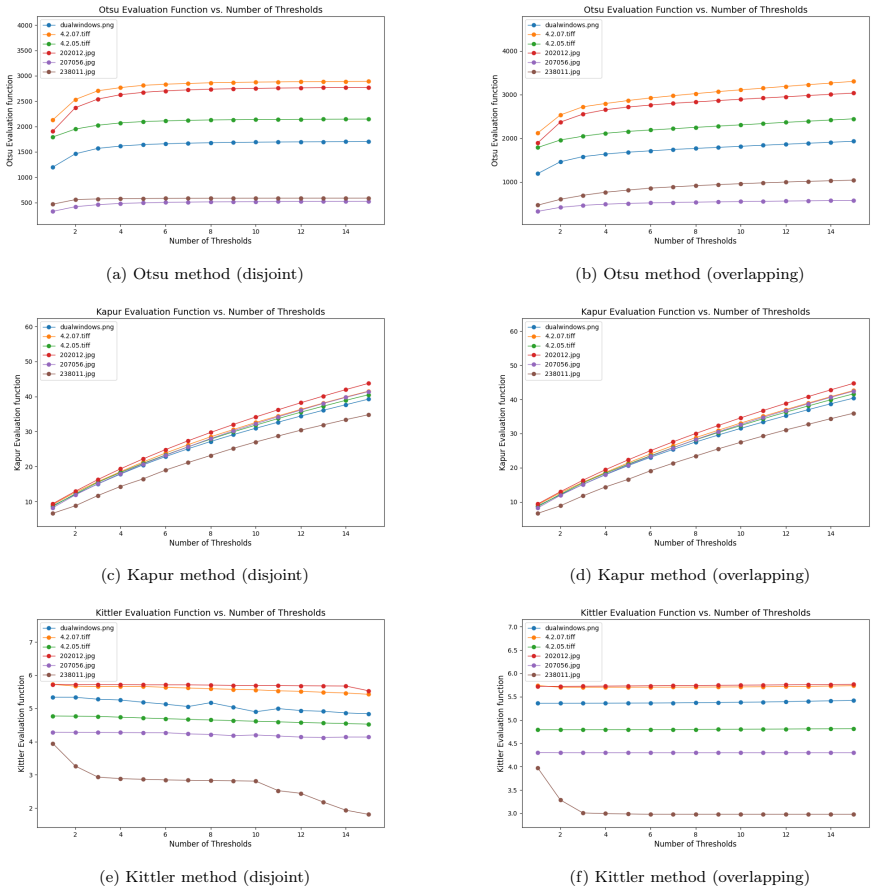
- Computation time remains lower than traditional DP thresholding once the number of thresholds increases.
- The method selects a suitable threshold count for most images across natural, satellite, and medical domains without external specification of that count.
- When the threshold count is supplied in advance, competing methods achieve higher structural similarity and peak signal-to-noise ratio than MET-DP.
- An empirical statistical analysis identifies the source of the speed advantage over conventional dynamic programming approaches.
Where Pith is reading between the lines
- The same DP structure could be paired with other thresholding criteria to produce additional automatic-count methods.
- Because runtime grows more slowly with threshold count, the technique may become practical for applications that previously avoided high-level thresholding.
- If the modified criterion proves stable across modalities, the framework could be applied to video frames or volumetric data with only minor adaptation of the cost function.
- The source code release allows direct replication and extension on new image collections.
Load-bearing premise
The modification of the Minimum Error Thresholding criterion produces a valid objective function whose minimization by dynamic programming yields both an appropriate threshold count and values that generalize beyond the tested image set.
What would settle it
Running MET-DP on a fresh collection of images where expert-annotated or ground-truth segmentations exist and finding that the automatically chosen threshold counts produce substantially lower agreement with the ground truth than counts chosen by competing automatic methods.
Figures






read the original abstract
Multilevel Image thresholding is an important preprocessing algorithm in computer vision applications nowadays. Since most common thresholding methods take the desired count of thresholds as input by the user, thresholding methods that automatically determines a suitable count of thresholds from the input image itself are advantageous. In this article, a novel thresholding method based on a dynamic programming algorithm and a modification of Minimum Error Thresholding (MET) criterion is thoroughly presented. An empirical statistical study is performed to pinpoint why this proposed method is superior. Moreover, an extended comparison between this proposed method and other state-of-the-art methods is performed on a comprehensive set of natural, satellite and medical test images. The numerical results show that the proposed MET-DP method takes much less time than traditional dynamic programming thresholding methods when the number of thresholds is high. The proposed method can detect a suitable count of thresholds for most of tested images of different types. However, traditional methods that take the count of thresholds as input produce thresholded images of higher structural similarity index measure (SSIM) and peak signal-to-noise ratio (PSNR) values than MET-DP. Source code can be found on https://w3id.org/met-dp/article1-code
Editorial analysis
A structured set of objections, weighed in public.
Referee Report
Summary. The manuscript introduces MET-DP, a dynamic programming framework that employs a modification of the Minimum Error Thresholding (MET) criterion to automatically determine both the number and the values of thresholds for multilevel image thresholding without requiring the count as user input. It presents an empirical statistical study to explain the method's advantages, followed by comparisons against state-of-the-art methods on natural, satellite, and medical images. Key claims include substantially lower runtime than traditional DP thresholding approaches when the number of thresholds is high, successful detection of suitable threshold counts for most tested images, and reproducible results via provided source code, while acknowledging that fixed-count methods achieve higher SSIM and PSNR.
Significance. If the modified MET objective remains valid under DP minimization and the empirical advantages generalize, the work provides a practical contribution to automating threshold selection in image preprocessing pipelines. The reported speed gains for large threshold counts, the automatic count detection capability, and the explicit release of source code are concrete strengths that could facilitate adoption and further testing in computer vision applications.
minor comments (3)
- The abstract states that an empirical statistical study is performed to 'pinpoint why this proposed method is superior,' but the manuscript should include a dedicated subsection (e.g., §4.2) that explicitly lists the statistical tests, sample sizes, and definitions of 'suitable count' used in that study.
- Notation for the modified MET criterion and the DP recurrence should be introduced with a clear table or pseudocode block early in the method section to improve readability for readers unfamiliar with the baseline MET formulation.
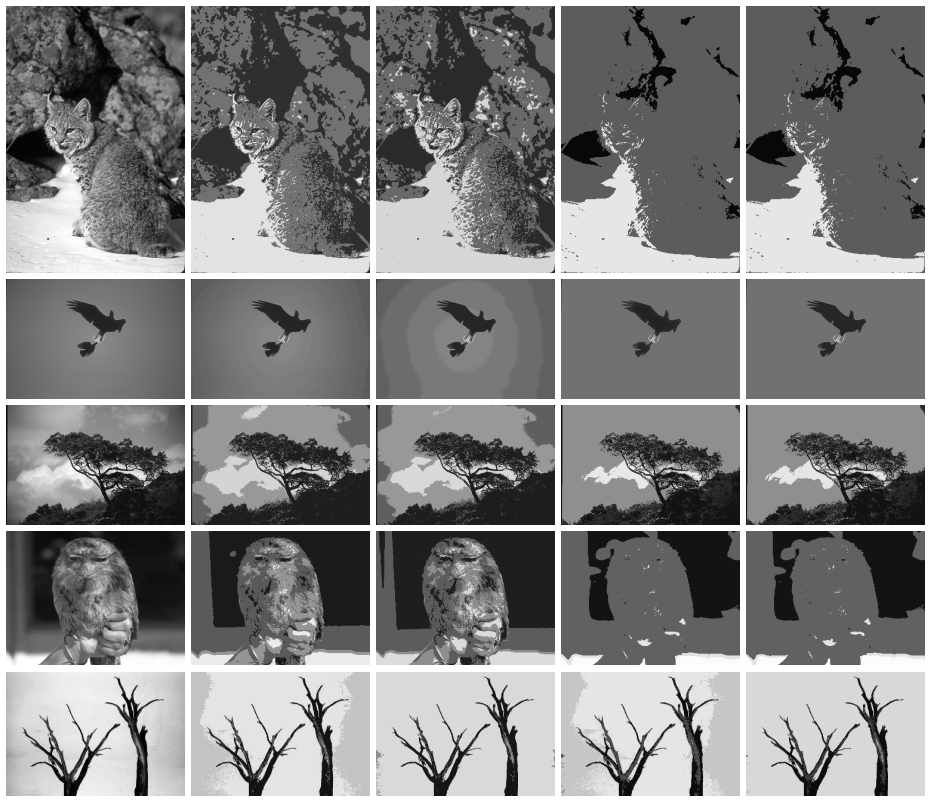
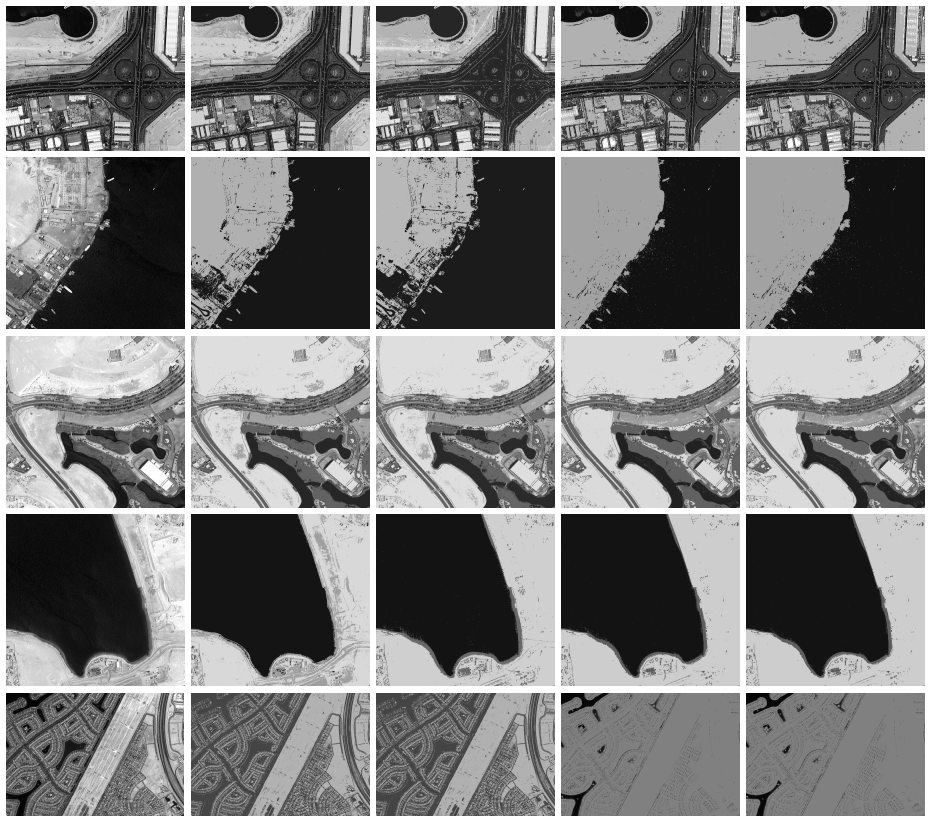
- Figure captions for the thresholded image examples would benefit from explicit mention of the automatically detected threshold count alongside the SSIM/PSNR values for direct visual comparison.
Simulated Author's Rebuttal
We thank the referee for the thorough summary and positive evaluation of our work on MET-DP. We appreciate the recognition of the runtime advantages for high threshold counts, the automatic count detection, and the release of source code. The recommendation for minor revision is noted, and we address the overall assessment below. No major comments requiring point-by-point rebuttal were specified in the report.
Circularity Check
No significant circularity detected
full rationale
The paper presents MET-DP as an algorithmic construction: dynamic programming minimization of a modified Minimum Error Thresholding criterion to jointly determine threshold count and values. No equations, recurrences, or fitting procedures are exhibited that reduce any claimed prediction or result to a parameter fitted from the target outputs themselves. The central claims rest on empirical comparisons across image sets rather than a self-referential derivation chain, and the abstract explicitly notes trade-offs in SSIM/PSNR versus fixed-k methods. This is the most common honest finding for an applied algorithmic paper whose validity is externally falsifiable via code and benchmarks.
Axiom & Free-Parameter Ledger
Reference graph
Works this paper leans on
-
[1]
write newline
" write newline "" before.all 'output.state := FUNCTION n.dashify 't := "" t empty not t #1 #1 substring "-" = t #1 #2 substring "--" = not "--" * t #2 global.max substring 't := t #1 #1 substring "-" = "-" * t #2 global.max substring 't := while if t #1 #1 substring * t #2 global.max substring 't := if while FUNCTION word.in bbl.in ":" * " " * FUNCTION f...
-
[2]
write newline
" write newline "" before.all 'output.state := FUNCTION n.dashify 't := "" t empty not t #1 #1 substring "-" = t #1 #2 substring "--" = not "--" * t #2 global.max substring 't := t #1 #1 substring "-" = "-" * t #2 global.max substring 't := while if t #1 #1 substring * t #2 global.max substring 't := if while FUNCTION word.in bbl.in ":" * " " * FUNCTION f...
-
[3]
write newline
" write newline "" before.all 'output.state := FUNCTION n.dashify 't := "" t empty not t #1 #1 substring "-" = t #1 #2 substring "--" = not "--" * t #2 global.max substring 't := t #1 #1 substring "-" = "-" * t #2 global.max substring 't := while if t #1 #1 substring * t #2 global.max substring 't := if while FUNCTION word.in bbl.in ":" * " " * FUNCTION f...
-
[4]
Leslie Lamport, : a document preparation system, Addison Wesley, Massachusetts, 2nd edition, 1994
1994
discussion (0)
Sign in with ORCID, Apple, or X to comment. Anyone can read and Pith papers without signing in.