FABSVer: Faster Training and Better Self-Verification for LLM Mathematical Reasoning
Reviewed by Pith T0 review T1 audit T2 compute T3 formal T4 kernel 2026-06-29 12:41 UTCgrok-4.3pith:7VJSBYOFrecord.jsonopen to challenge →
The pith
Fusing generation and verification into one pass lets LLMs self-check math answers more accurately while using far less training time.
A machine-rendered reading of the paper's core claim, the machinery that carries it, and where it could break.
Core claim
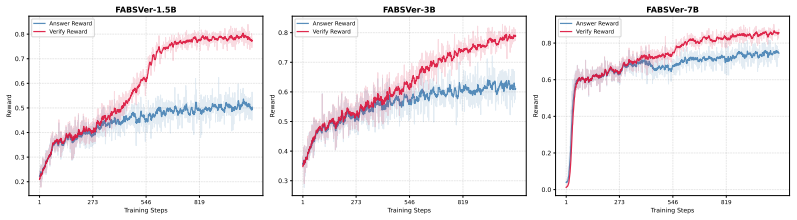
FABSVer fuses solution generation and verification into a single generation pass, which reduces training overhead while jointly optimizing both capabilities. To overcome the convergence bottleneck where reward plateaus because the policy is constrained by a fixed reference model, the method introduces Dynamic Reference Model Update (DRMU) that raises the reward ceiling and sustains growth. This produces superior self-verification and reasoning performance on math benchmarks with substantially lower training time, and analysis shows distinct learning phases plus a shrinking gap between verify and answer rewards as model size increases.
What carries the argument
Fusion of generation and verification into one generation pass, together with Dynamic Reference Model Update (DRMU) that dynamically adjusts the reference model to lift the reward ceiling.
If this is right
- Self-verification accuracy exceeds that of separate-training baselines on standard math benchmarks.
- Reasoning performance improves at three different model scales.
- Total training time drops to between 51 and 71 percent of prior methods.
- Models progress through distinct phases while acquiring self-verification skill.
- The difference between verification reward and answer reward narrows as model size grows.
Where Pith is reading between the lines
- The single-pass fusion could be tested on non-math tasks such as code generation to check whether training cost savings generalize.
- DRMU might be combined with other reinforcement-learning methods that also face reward plateaus from fixed references.
- Tracking the identified learning phases could guide when to switch training objectives or data mixtures for faster gains.
- The shrinking verify-answer gap with scale suggests larger models may need less explicit verification training.
Load-bearing premise
Training generation and verification together in one pass will improve both abilities without one degrading the other.
What would settle it
A direct comparison on a new math benchmark where the single-pass FABSVer model shows lower verification accuracy than a separately trained verifier while still using less training time.
Figures



read the original abstract
While large language models have made significant progress in mathematical reasoning, they remain unreliable at judging the correctness of their own solutions. Existing approaches that equip models with self-verification typically treat solution generation and verification as two separate tasks, leading to substantially increased training time. In this paper, we propose FABSVer, which fuses these two tasks into a single generation pass, dramatically reducing training overhead while jointly optimizing both capabilities. We further identify a convergence bottleneck both theoretically and empirically: as training progresses, the reward reaches a plateau because the policy is constrained by a fixed reference model. To overcome this, we introduce Dynamic Reference Model Update (DRMU), which raises the reward ceiling and enables sustained reward growth. Extensive experiments on math benchmarks demonstrate that FABSVer achieves superior self-verification and reasoning performance across three model scales, while requiring only 51%--71% of the training time of existing methods. Analysis further reveals distinct learning phases in how models acquire self-verification, and that the gap between verify and answer rewards shrinks noticeably as model size increases.
Editorial analysis
A structured set of objections, weighed in public.
Referee Report
Summary. The paper proposes FABSVer, which fuses LLM solution generation and self-verification into a single generation pass (rather than separate tasks) to reduce training overhead, while introducing Dynamic Reference Model Update (DRMU) to address a convergence bottleneck where rewards plateau due to a fixed reference model. Experiments on math benchmarks across three model scales claim superior self-verification and reasoning performance with only 51%-71% of the training time of prior methods, plus analysis of distinct learning phases and shrinking verify/answer reward gaps with scale.
Significance. If the empirical claims hold after addressing the fusion interference concern, the work would be significant for efficient self-verifying LLM training, as it directly targets the training-time penalty of separate verification while providing a mechanism (DRMU) to sustain reward growth. The joint optimization and phase analysis could inform future multi-task LLM fine-tuning if ablations confirm no degradation.
major comments (3)
- [Abstract and §4 (Experiments)] The central claim that fusing generation and verification into one pass jointly optimizes both without degradation (abstract) rests on an untested assumption; no ablation isolates the fusion effect from DRMU or from matched total token count, leaving open the possibility that the reported time savings come at the cost of weaker verification than a two-pass baseline.
- [§3] §3 (Method, DRMU description): the theoretical identification of the convergence bottleneck (policy constrained by fixed reference model) is load-bearing for the DRMU contribution, but the manuscript provides no derivation or formal statement showing why the fixed reference necessarily causes a plateau rather than other factors such as reward model saturation.
- [§4] Table 2 or equivalent results table: the 51%-71% training time reduction and performance gains are reported without error bars, dataset sizes, or statistical tests, so it is impossible to determine whether the superiority over baselines is robust or sensitive to post-hoc choices.
minor comments (2)
- [Abstract] The abstract refers to 'distinct learning phases' and 'shrinking verify/answer reward gaps' but does not define the phases or the gap metric, which should be clarified with a figure or equation in the main text.
- [§3] Notation for the fused sequence (solution + verification tokens) is introduced without an explicit example or tokenization diagram, making the single-pass construction harder to follow.
Simulated Author's Rebuttal
We thank the referee for the constructive feedback on our manuscript. We address each major comment point by point below, outlining the revisions we plan to incorporate.
read point-by-point responses
-
Referee: [Abstract and §4 (Experiments)] The central claim that fusing generation and verification into one pass jointly optimizes both without degradation (abstract) rests on an untested assumption; no ablation isolates the fusion effect from DRMU or from matched total token count, leaving open the possibility that the reported time savings come at the cost of weaker verification than a two-pass baseline.
Authors: We acknowledge that the manuscript lacks a dedicated ablation isolating the fusion mechanism from DRMU and controlling for total token count. While the main results compare against two-pass baselines and show improved performance at reduced training time, this does not fully rule out interference effects. In the revision, we will add an ablation study that trains variants with and without fusion under matched token budgets to directly test for degradation in verification quality. revision: yes
-
Referee: [§3] §3 (Method, DRMU description): the theoretical identification of the convergence bottleneck (policy constrained by fixed reference model) is load-bearing for the DRMU contribution, but the manuscript provides no derivation or formal statement showing why the fixed reference necessarily causes a plateau rather than other factors such as reward model saturation.
Authors: The current manuscript identifies the bottleneck through empirical reward plateau observations and links it to the fixed reference via the standard KL-constrained RL objective. However, we agree that an explicit derivation would strengthen the claim and distinguish it from reward model saturation. In the revision, we will add a short formal analysis in §3 deriving the plateau condition under a fixed reference model. revision: yes
-
Referee: [§4] Table 2 or equivalent results table: the 51%-71% training time reduction and performance gains are reported without error bars, dataset sizes, or statistical tests, so it is impossible to determine whether the superiority over baselines is robust or sensitive to post-hoc choices.
Authors: We agree that the absence of error bars, explicit dataset sizes, and statistical tests limits the ability to assess robustness. In the revised manuscript, we will report standard deviations over multiple random seeds, specify the exact training and evaluation dataset sizes, and include paired statistical significance tests for the performance differences. revision: yes
Circularity Check
No circularity: paper contains no equations, derivations, or load-bearing self-citations
full rationale
The provided abstract and description contain no mathematical derivations, equations, fitted parameters, or self-citations that could reduce claims to inputs by construction. The method (FABSVer fusion + DRMU) is presented as an empirical proposal with performance results, but no prediction is shown to equal its own training data or prior self-citation. No uniqueness theorems or ansatzes are invoked. This is the common case of a self-contained empirical paper with no derivation chain to inspect for circularity.
Axiom & Free-Parameter Ledger
Reference graph
Works this paper leans on
-
[1]
Missing final answer enclosed in \\boxed{} at the end: assign \\boxed{-1}
-
[2]
Correct response with the final answer enclosed in \\boxed{} at the end: assign \\boxed{1}
-
[3]
Is the answer correct ( Yes / No ) ? X
Incorrect response with the final answer enclosed in \\boxed at the end: assign \\boxed{- 0.5}. ### Question Begin ### {Question} ### Question End ### ### Response Begin ### {Response} ### Response End ### Briefly summarize your analysis, then clearly state your final rating value enclosed in \\boxed{} at the end. Figure 4: Verification prompt used in [Li...
2025
-
[4]
Since0≤1, we use the second expression: f(0) = 0−1 =−1
Forf(0): f(0) = 03 + 2·0−1if0>1, 0−1if0≤1. Since0≤1, we use the second expression: f(0) = 0−1 =−1
-
[5]
Since1≤1, we use the second expression: f(1) = 1−1 = 0
Forf(1): f(1) = 13 + 2·1−1if1>1, 1−1if1≤1. Since1≤1, we use the second expression: f(1) = 1−1 = 0
-
[6]
Now we sum these values: f(0) +f(1) +f(2) =−1 + 0 + 11 = 10
Forf(2): f(2) = 2 3 + 2·2−1 = 8 + 4−1 = 11. Now we sum these values: f(0) +f(1) +f(2) =−1 + 0 + 11 = 10. </think> <answer> \boxed{10} </answer> <verify> To verify the calculation, I will go back to the definitions and the rules I stated. 1.f(0) =−12.f(1) = 03.f(2) = 11 Summing them up: −1 + 0 + 11 = 10 Verifying the correctness, I get \boxed{Correct}. </v...
-
[7]
The difference between the first and second term should be equal to the difference between the third and second term: 12−(y+ 6) =y−12
-
[8]
Simplify both sides of the equation: 12−y−6 =y−12 6−y=y−12
-
[9]
Solve fory: 6 + 12 =y+y 18 = 2y y= 9 </think> <answer> The value ofyis \boxed{9}. </answer> <verify> Let’s verify the solution by checking if it maintains the same common differenced: - The difference between the first and second term withy= 9: 12−(9 + 6) = 12−15 =−3 - The difference between the second and third term withy= 9: 9−12 =−3 Since both differen...
discussion (0)
Sign in with ORCID, Apple, or X to comment. Anyone can read and Pith papers without signing in.