Learning shape resonances from the stabilization method
Pith reviewed 2026-06-29 11:42 UTC · model grok-4.3
The pith
Stabilization method identifies shape resonances through discrete energy level features and spatial localization.
A machine-rendered reading of the paper's core claim, the machinery that carries it, and where it could break.
Core claim
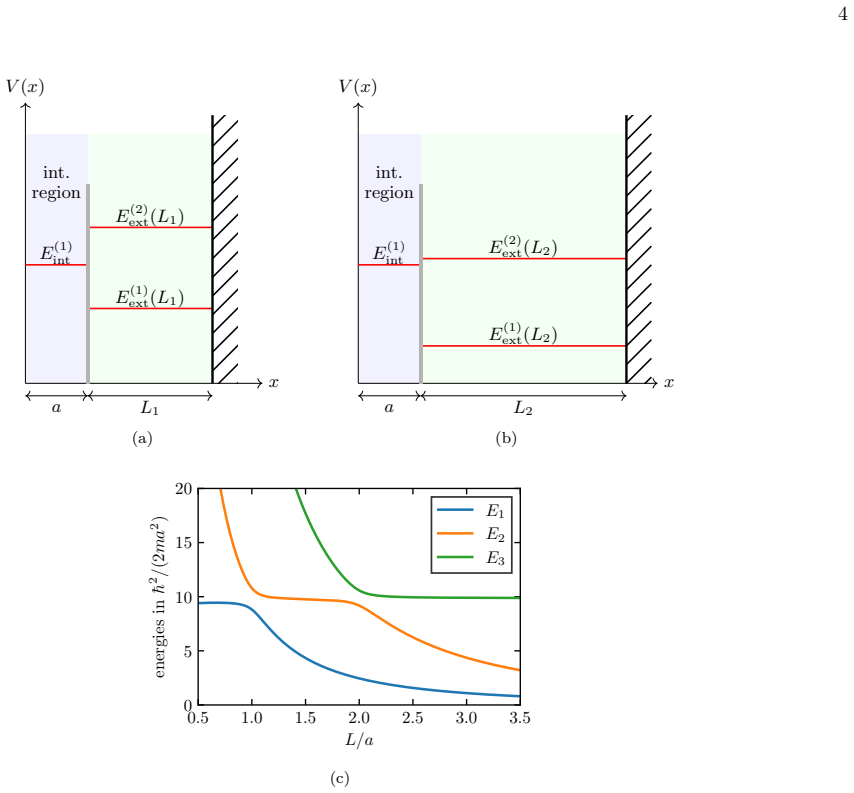
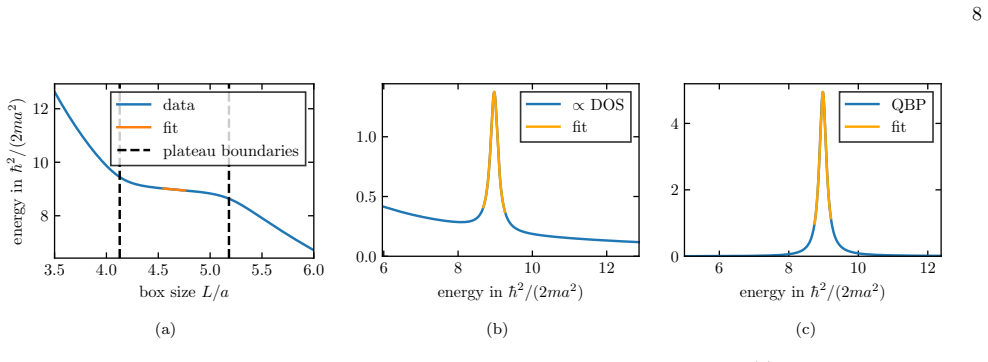
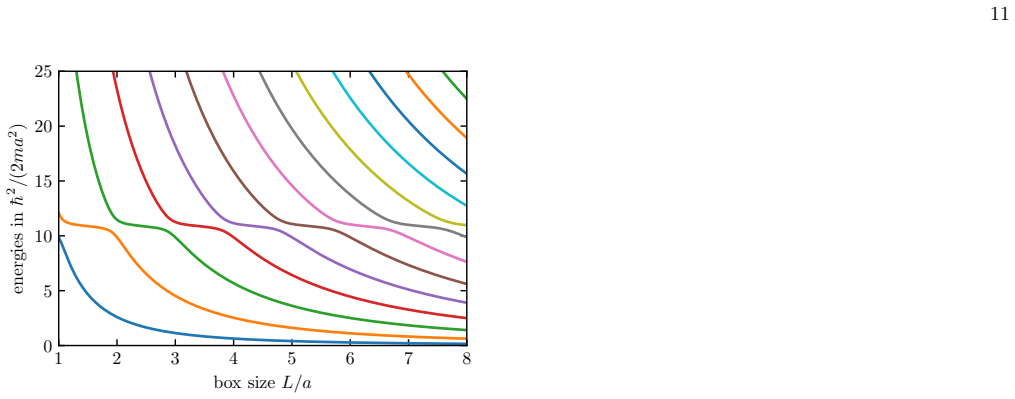
Resonances in quantum mechanics appear as characteristic features in the energy levels when the confining box size is varied in the stabilization method. These features allow extraction of resonance parameters via established fitting and a novel spatial localization analysis of the states, remaining connected to discrete quantum mechanics.
What carries the argument
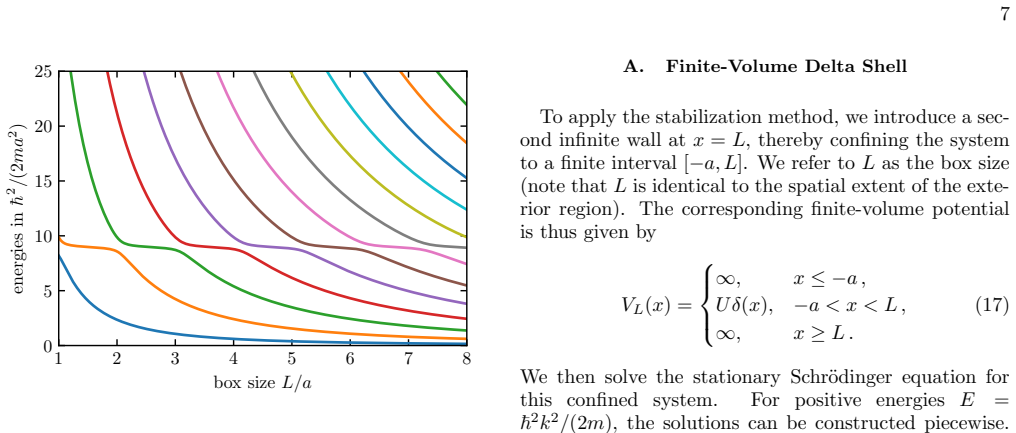
The stabilization diagram, which plots energy levels against the size of the confining box, combined with analysis of the spatial localization of the corresponding eigenstates.
If this is right
- Resonance positions and widths can be read off from how energy levels behave with box size.
- Localization patterns distinguish resonant states from non-resonant ones.
- The method applies equally to attractive and repulsive potentials.
- Parameters match those from full continuum calculations for the tested models.
Where Pith is reading between the lines
- The approach could extend to potentials without analytic solutions by using numerical diagonalization.
- Teaching quantum resonances might become simpler by starting with finite boxes before introducing continuum.
- Similar localization criteria might help in identifying resonances in many-body systems.
Load-bearing premise
The patterns seen in the finite-box calculations correspond directly to the resonance properties that would appear in an infinite-space scattering calculation.
What would settle it
Computing the resonance parameters for the delta-shell potential using both the stabilization method and an independent method like solving the time-independent Schrödinger equation with outgoing boundary conditions, and finding a mismatch in position or width.
Figures

read the original abstract
Resonances in quantum mechanics are commonly introduced as quasi-bound states embedded in the continuum, a perspective that can be conceptually challenging due to the abstract nature of continuum states. In this work, we discuss an alternative approach that avoids an explicit treatment of the continuum by formulating the problem in terms of discrete quantum states. Our discussion is based on the stabilization method, in which the system is confined to a finite region such that the continuum is replaced by a discrete energy spectrum. Resonances then appear as characteristic features in the energy levels under variation of the confining box size, providing an intuitive interpretation in terms of a two-level system while remaining closely connected to standard quantum mechanics curriculum. We review the method, derive selected results, and discuss practical strategies for extracting resonance parameters from stabilization diagrams. In addition to established fitting procedures, we introduce a novel approach based on the analysis of spatial localization of resonant states, which enables a robust identification of resonance properties. The approach is illustrated using both attractive and repulsive delta-shell potentials, which serve as simple and instructive model systems amenable to analytical treatment.
Editorial analysis
A structured set of objections, weighed in public.
Referee Report
Summary. The paper claims that the stabilization method, by confining quantum systems to finite boxes of varying size, replaces the continuum with a discrete spectrum in which resonances appear as characteristic avoided crossings or flat features in energy levels versus box size; it reviews the method, derives selected results, and introduces a novel spatial-localization analysis of the confined wave functions as an additional, robust route to extracting resonance energy and width, illustrated on exactly solvable attractive and repulsive delta-shell potentials.
Significance. If the localization diagnostic is shown to recover the correct resonance parameters, the work would supply an intuitive, discrete-state route to resonances that stays within standard undergraduate quantum mechanics and could be useful for both pedagogy and numerical practice. The choice of analytically solvable models is a clear strength that permits direct validation against continuum results.
major comments (2)
- [Results section on delta-shell potentials (attractive and repulsive cases)] The central claim that spatial localization of states in the stabilization diagram furnishes a robust, independent extraction of resonance parameters is not supported by any side-by-side comparison with the exact resonance poles obtainable from the analytic S-matrix (or phase-shift) solution for the same delta-shell potentials. Because the models admit closed-form continuum solutions, the absence of this benchmark leaves open the possibility that the observed localization features are discretization artifacts rather than faithful reporters of the true resonance energy and width.
- [Discussion of the novel localization approach] No quantitative error estimates, convergence tests with respect to box-size sampling, or direct numerical comparison between localization-derived widths and the exact imaginary parts of the resonance poles are reported, so the assertion of robustness cannot be assessed.
minor comments (2)
- Notation for the localization measure (e.g., how the spatial integral or probability is normalized) should be defined explicitly in the text or a dedicated equation.
- Figure captions for the stabilization diagrams would benefit from explicit indication of which curves correspond to the resonant versus non-resonant branches.
Simulated Author's Rebuttal
We thank the referee for the constructive comments and the positive evaluation of the work's potential utility. We address the two major comments point by point below.
read point-by-point responses
-
Referee: [Results section on delta-shell potentials (attractive and repulsive cases)] The central claim that spatial localization of states in the stabilization diagram furnishes a robust, independent extraction of resonance parameters is not supported by any side-by-side comparison with the exact resonance poles obtainable from the analytic S-matrix (or phase-shift) solution for the same delta-shell potentials. Because the models admit closed-form continuum solutions, the absence of this benchmark leaves open the possibility that the observed localization features are discretization artifacts rather than faithful reporters of the true resonance energy and width.
Authors: We agree that a direct benchmark against the exact resonance poles from the analytic S-matrix is the most rigorous way to validate the localization diagnostic. The revised manuscript will include this side-by-side comparison for both attractive and repulsive delta-shell cases, demonstrating that the resonance parameters extracted from spatial localization agree with the exact poles to within the numerical precision of the stabilization calculation. revision: yes
-
Referee: [Discussion of the novel localization approach] No quantitative error estimates, convergence tests with respect to box-size sampling, or direct numerical comparison between localization-derived widths and the exact imaginary parts of the resonance poles are reported, so the assertion of robustness cannot be assessed.
Authors: We acknowledge that the present version does not report quantitative error estimates or convergence tests. In the revision we will add (i) error estimates on the extracted resonance widths obtained from the localization analysis, (ii) convergence tests with respect to the density of box-size sampling, and (iii) explicit numerical comparisons of the localization-derived widths against the exact imaginary parts of the resonance poles. revision: yes
Circularity Check
No circularity: stabilization method and localization analysis remain independent of fitted resonance parameters
full rationale
The paper reviews the stabilization method as a discrete formulation connected to standard quantum mechanics, derives results for delta-shell potentials that admit exact analytic scattering solutions, and presents spatial localization as an additional diagnostic alongside established fitting. No step reduces a claimed prediction or resonance parameter to a fitted input by the paper's own equations, no self-citation is load-bearing for the central claim, and no ansatz or uniqueness theorem is imported from prior author work. The derivation chain is therefore self-contained against external benchmarks.
Axiom & Free-Parameter Ledger
Reference graph
Works this paper leans on
-
[1]
Learning shape resonances from the stabilization method
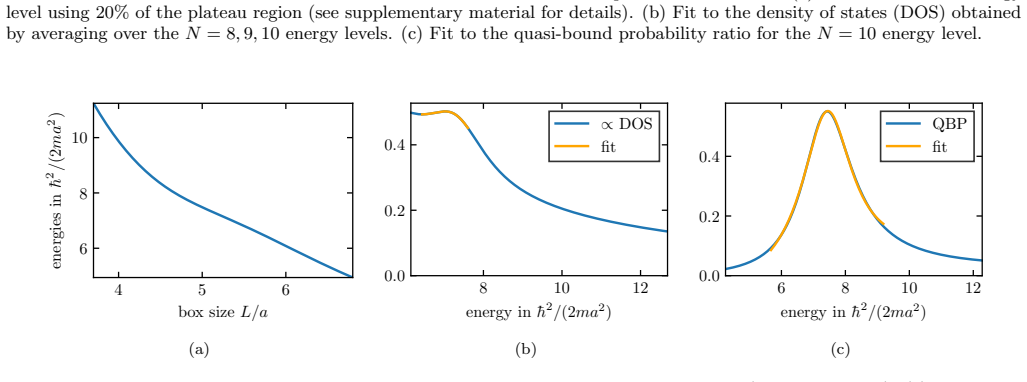
Within this framework, we present three complementary approaches for extracting resonance parameters: a direct fit to the finite-volume energy levels, an analysis based on the density of states, and a method based on calculating probabilities. To the best of our knowledge, the latter has not been previously discussed in this context. We show that this met...
work page internal anchor Pith review Pith/arXiv arXiv 2026
-
[2]
What is a resonance? And why does it matter?
Stabilized energy levels of the attractive delta-shell potential forG=−20. The first resonance is clearly visible. TABLE IV. First and second resonances of the attractive delta-shell potential for different strengthsGextracted via the stabilization method. Values from all three methods are presented. Energies and widths are given in units ofℏ 2/(2ma2). GF...
work page internal anchor Pith review Pith/arXiv arXiv doi:10.1103/physrevphyseducres.21.010102 1998
discussion (0)
Sign in with ORCID, Apple, or X to comment. Anyone can read and Pith papers without signing in.