pith. machine review for the scientific record. sign in

physics.ed-ph

Physics Education

Report of results of a research study, laboratory experience, assessment or classroom practice that represents a way to improve teaching and learning in physics. Also, report on misconceptions of students, textbook errors, and other similar information relative to promoting physics understanding.

0
physics.ed-ph 2026-05-13 2 theorems

Women lose more physics identity from B grades than men

The Gendered Cost of Lower Grades: Women's Physics Perceived Recognition and Identity Suffer Disproportionately If They Earn Less Than A Grade

Introductory physics students drop in identity when earning below an A, with women showing steeper declines through reduced perceived recogn

abstract click to expand
Perceptions of disciplinary recognition and identity can be shaped by various forms of feedback and experiences. Here we focus on the potential effects of course grades on the perceievd recognition and physics identity of students. We analyze patterns in changes in physics identity and perceived recognition from pre course to post course across three cohorts of university students enrolled in calculus-based Physics 1 (N=1,681). Students not receiving A grade, on average, showed declines in physics identity and perceived recognition. Even a B grade resulted in declines, and the declines were nonlinear across lower grades. Changes in perceived recognition fully mediated the changes in identity. Importantly, women showed significantly larger declines in identity and perceived recognition, compared to men, if they got less than A grade. The gender moderation was specifically localized to changes in perceived recognition, with no further gender effects on identity beyond the cascading effects on perceived recognition.
0
0
physics.ed-ph 2026-05-12 2 theorems

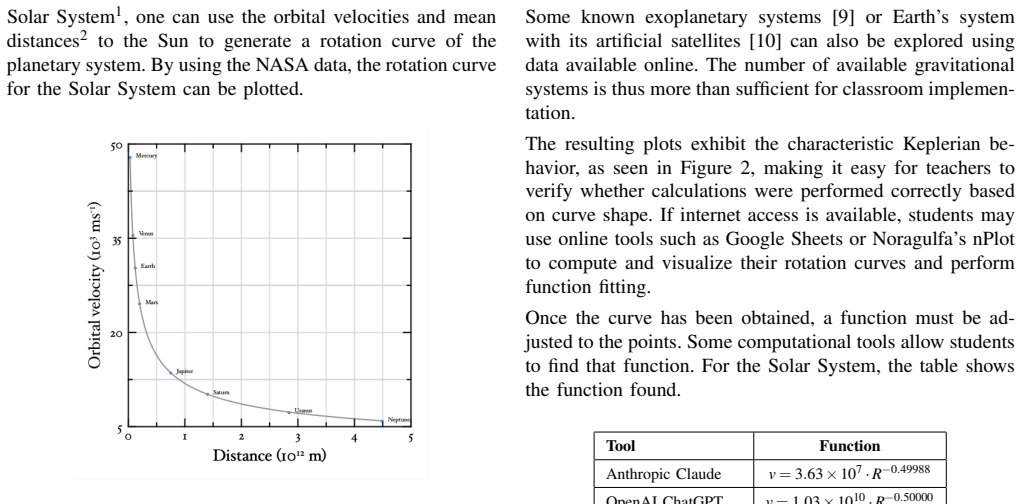
Online data lets students deduce gravity's inverse-square law

The Solar System as a lab for the Law of Universal Gravitation

Using planetary orbit records from the internet, learners recover the mathematical form of universal gravitation through direct analysis.

Figure from the paper full image
abstract click to expand
The Law of Universal Gravitation is part of middle and high school's general physics and astronomy curricula. This topic is included in the most popular physics textbooks available as a fact whose origin remains in the detailed work of Sir Isaac Newton 300 years ago. Consequently, its mathematical form is presented as an equation without any deductive process. Nevertheless, deduction of the mathematical form of this law is an opportunity to discuss how a deductive process can be performed using the data available on the Internet from reliable sources.
0
0
physics.ed-ph 2026-05-11 2 theorems

AI-powered materials discovery requires workflow-aligned AI literacy

Preparing Students for AI-Powered Materials Discovery: A Workflow-Aligned Framework for AI Literacy, Equity, and Scientific Judgment

Moving beyond tool access ties AI use to data validation and physics reasoning so students build judgment and equitable readiness.

Figure from the paper full image
abstract click to expand
Artificial intelligence (AI) is reshaping education, scientific training, and materials discovery. In materials science, AI models increasingly support property prediction, experiment prioritization, and hypothesis generation; however, the limiting factor is no longer only algorithmic capability but also whether students and educators can use AI with domain-specific scientific judgment. This workshop-informed white paper and curriculum-oriented position article argues that AI education for AI-powered materials discovery must move beyond tool access and surface-level interaction with generative AI systems toward a workflow-aligned model of AI literacy. We connect AI literacy to materials-informatics competencies: data provenance, domain-specific featurization, model validation, uncertainty quantification, physics informed reasoning, reproducibility, and experimental feedback. We also emphasize outcome-oriented equity: institutions should evaluate not only access, participation, and engagement, but also whether AI-enabled instruction produces comparable learning gains, transfer of learning, confidence calibration, defined as the alignment with students confidence and the quality or correctness of their work, persistence, and research readiness across student subgroups. The paper synthesizes relevant evidence, identifies risks for learners such as cognitive off-loading and cognitive surrender, and provides a dual-track curriculum model and implementation recommendations such as curriculum guides and an assessment plan for courses, bootcamps, workshops, and program-level reform. The central goal is to prepare students to become better scientists, not merely more efficient users of AI tools.
0
0
physics.ed-ph 2026-05-11 2 theorems

Chatbots beat students on relativity test but fail on diagrams

Performance and failure modes of AI chatbots on a novel concept inventory on relativity in classical mechanics

A new unpublished inventory reveals models make the same visual mistakes every time while students spread their errors.

Figure from the paper full image
abstract click to expand
AI chatbots are increasingly used by students as study tools in physics, raising practical questions about their reliability on conceptual tasks. Existing evaluations of large language models (LLMs) on physics concept inventories rely almost exclusively on instruments that have been publicly available for years and likely appear in model training data, making it difficult to disentangle physics competence from familiarity with the test items themselves. We address this issue by evaluating three frontier LLMs (GPT-5.2, Gemini 3 Pro, Gemini 3 Flash) on the Classical Relativity Concept Inventory (CRCI), a recently developed and validated 21-item instrument on Galilean relativity that was not publicly available at the time of testing. Each item was administered 30 times per model, and all 1890 responses were qualitatively coded along three dimensions: visual interpretation, physics reasoning, and coordination. Mean accuracy was 97% for Gemini 3 Flash, 89% for Gemini 3 Pro, and 73% for GPT-5.2, compared to 62% for the student sample (N = 267). However, all three models fail completely on a small number of items. The qualitative analysis shows that these failures stem predominantly from misinterpretations of visual content rather than from deficits in physics knowledge, and that LLM errors differ structurally from those of students: when models err, they converge on a single distractor with high consistency, whereas student errors are more broadly distributed. These findings indicate that chatbot reliability on conceptual physics is item-dependent and unpredictable, with direct implications for how concept inventories are administered.
0
0
physics.ed-ph 2026-05-11 Recognition

Consumer cameras capture radiation scintillation light

Using Consumer Cameras to Observe Scintillation Light from Radiation

Spatial patterns in the images indicate radiation energy, enabling simple classroom comparisons of radiation properties.

Figure from the paper full image
abstract click to expand
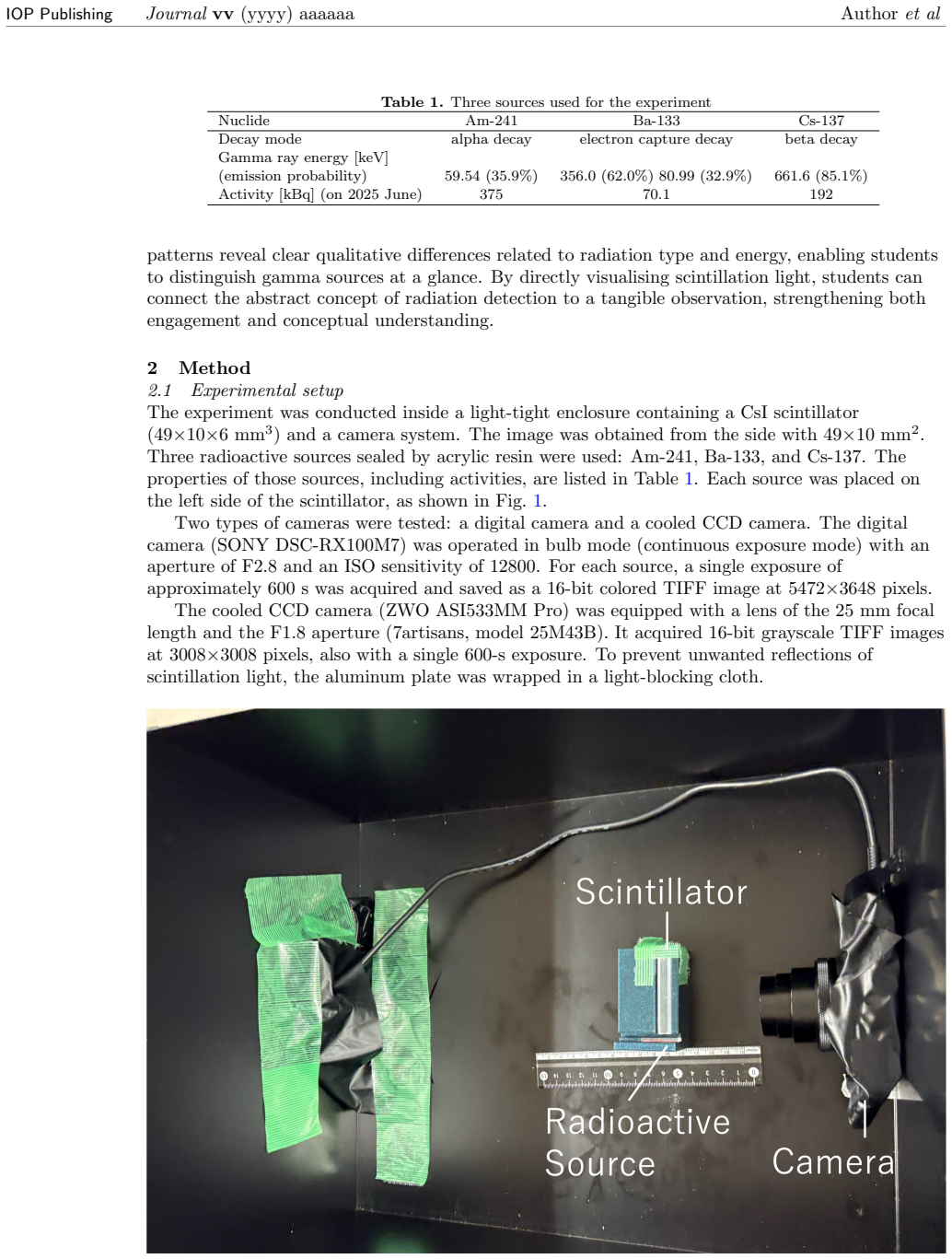
For a long time, the cloud chamber was the only educational tool available for measuring radiation. In recent years, simple radiation detectors combining scintillators with silicon photomultipliers have become increasingly common for these purposes. However, students are not able to see the scintillation light, the core process of radiation measurements with scintillators. Therefore, we explored the possibility of detecting scintillation light using two general-purpose cameras. In addition, we examined how differences in the spatial distribution relate to radiation types and energies. Scintillation light were able to be measured by a general-use camera, and their spatial distribution indicates radiation energy. This method could be utilized as an accessible imaging setup to compare radiation properties in a classroom.
0
0
physics.ed-ph 2026-05-11 Recognition

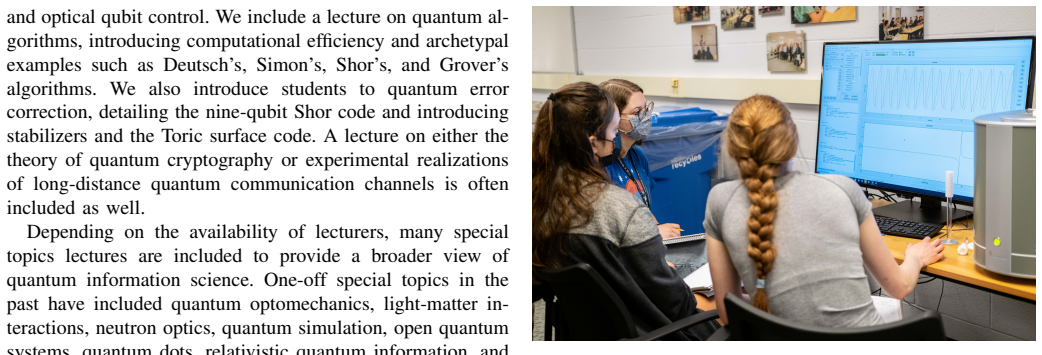
Eight recommendations shape future QISE graduate programs

Graduate Training in Quantum Information Science and Engineering: Lessons, Challenges, and a Roadmap from the NSF Research Traineeship Programs

Lessons from 18 NSF NRT awards identify tensions between depth and breadth and propose concrete steps including team models and new sensing

Figure from the paper full image
abstract click to expand
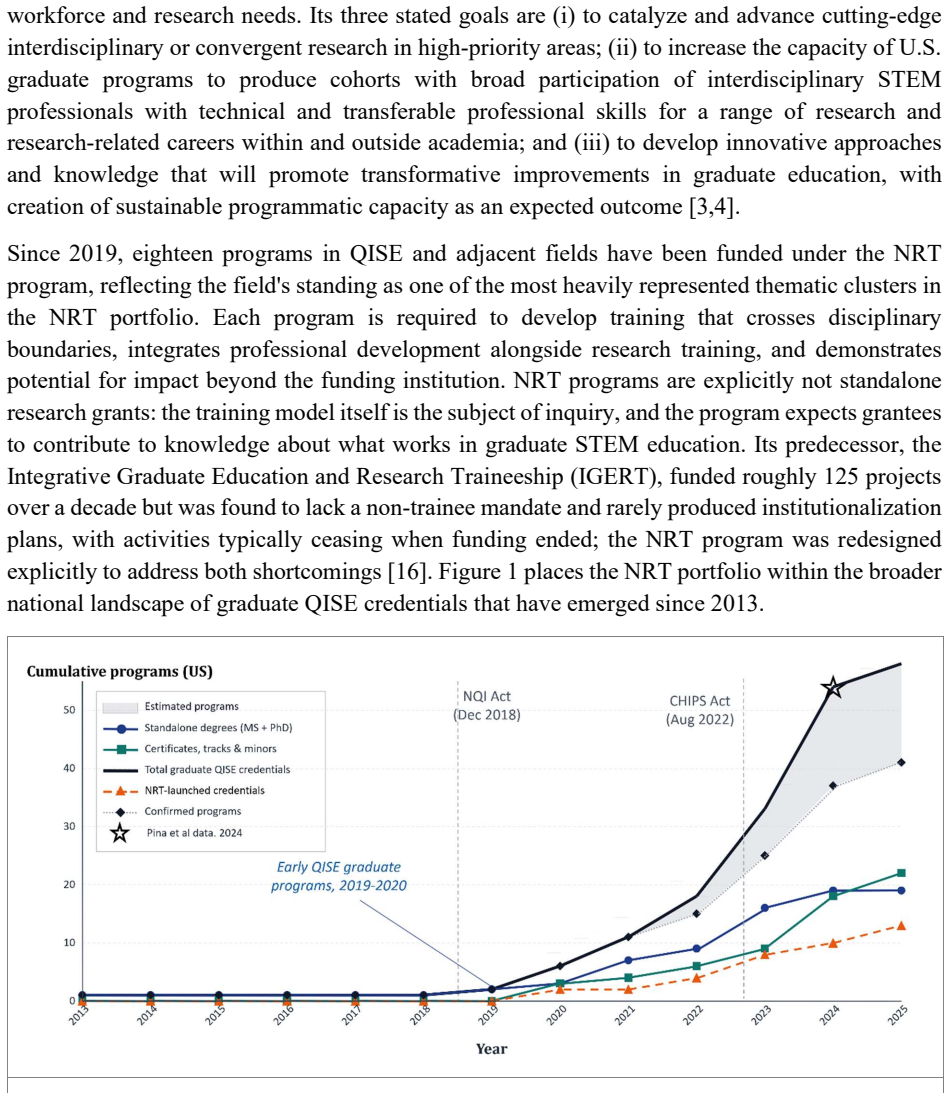
Since 2019, eighteen NSF Research Traineeship (NRT) awards in quantum information science and engineering (QISE) and adjacent fields have been funded, constituting the largest NSF-coordinated investment in graduate QISE training in the United States. Synthesizing lessons from our programs, we work through the central tensions that every QISE graduate program must negotiate: between depth in a home discipline and breadth across the field, between structured instruction and open-ended experiential and hands-on learning, and between training individual specialists and cultivating teams that collectively cover all areas of QISE. We describe the structural and pedagogical innovations the NRT programs have developed in response, assess what is working and what remains unresolved, and sketch 12 open problems the community will need to address as QISE graduate education scales beyond the well-resourced research universities where it has up till now been mainly concentrated. Eight concrete recommendations follow: (1) adopt the startup model of team-based training as an organizing philosophy; (2) invest immediately in sensing and communication curriculum development; (3) build student agency into program governance, not just activities; (4) establish structural mechanisms for industrial engagement rather than depending on goodwill; (5) design for sustainability from year one; (6) develop graduate-level textbooks spanning all three QISE pillars: computing, sensing, and communications; (7) establish shared outcome assessment instruments across programs; and (8) develop structured mechanisms for faculty professional development in QISE.
0
0
physics.ed-ph 2026-05-11 Recognition

Building cartoons teach quantum numbers via floors and rooms

From Floors to Electrons: Using a Building Analogy and Cartooning to Teach Quantum Numbers

A visual analogy lets students map everyday building layouts to electron states and rules before equations appear.

abstract click to expand
Aspects of quantum physics are no longer confined to the upper years of a physics degree. Concepts like superposition or entanglement that were once reserved for second- or third-year undergraduate courses now deserve attention earlier in a student's curriculum. Technology is changing at a pace that requires engaged citizens to understand some of the quantum basics if they are to make sense of the world. This paper offers a cartoon building analogy that teachers can use to introduce quantum numbers to their students.
0
0
physics.ed-ph 2026-05-11 Recognition

Strategies enable multi-institutional DBER data collection

Strategies for Collecting Multi-Institutional Data in Discipline-Based Education Research

Handling IRB, recruitment, standardization, and logistics turns isolated findings into results that apply across many institutions.

abstract click to expand
Multi-institutional studies are critical for advancing discipline-based education research (DBER) because they allow us to determine where and for whom research findings are applicable. Despite this benefit, such studies remain relatively rare due to the complexities of coordinating data collection across different institutions. In this paper, we describe key challenges and propose actionable strategies for implementing multi-institutional DBER studies. We focus on navigating Institutional Review Board procedures, recruiting participants from a range of institution types, standardizing data sources across institutions, and managing logistics. We also provide an applied example of these strategies from a national research project in which we collected concept inventory data, social network surveys, and classroom observations from 31 introductory physics instructors at 28 institutions in the United States.
0
0
physics.ed-ph 2026-05-08 2 theorems

Computational essays elicit broad CT in engineering students

Using Computational Physics Essays to Facilitate Engineering Students' Computational Thinking

A Python notebook capstone for modeling real physics systems shows 99 percent systems thinking proficiency and 0.75 correlation with quality

abstract click to expand
Background: As traditional coding tasks in education become increasingly vulnerable to the use of Generative AI, there is a critical need for authentic, project-based assessments that evaluate students' scientific inquiry. To address this need, we adapted the existing Computational Essay framework to create the Computational Physics Essay (CPE). Administered as a culminating capstone project, the CPE required introductory engineering students to use Python within Jupyter Notebooks to iteratively model real-world physics systems. We analyzed a random sample of CPE submissions (N = 100) using a customized 20-item rubric based on Weintrop's computational thinking (CT) taxonomy. Results: The project-based constraint successfully elicited a high variety of CT practices. Students demonstrated high proficiency in Modeling and Systems Thinking, with 99% successfully investigating complex systems as a whole. Furthermore, the use of CT practices strongly correlated (\r{ho}= 0.75) with expert ratings of the overall quality of the CPE. While some students showed expected novice weaknesses in software modularity, the CPE successfully shifted their epistemic frame toward physical sensemaking. Conclusions: Situating computation within real-world capstone projects provides a robust framework for assessing CT, bridging the gap between programming and scientific argumentation in introductory engineering students.
0
0
physics.ed-ph 2026-05-07 Recognition

Smartphone measures oil viscosity via spring damping

Determining Viscosity of a Liquid with Smartphone Sensors: A Classroom-Friendly Approach Using Damped Oscillations

Accelerometer data from damped ball oscillations in mustard oil matches literature values and video tracking.

Figure from the paper full image
abstract click to expand
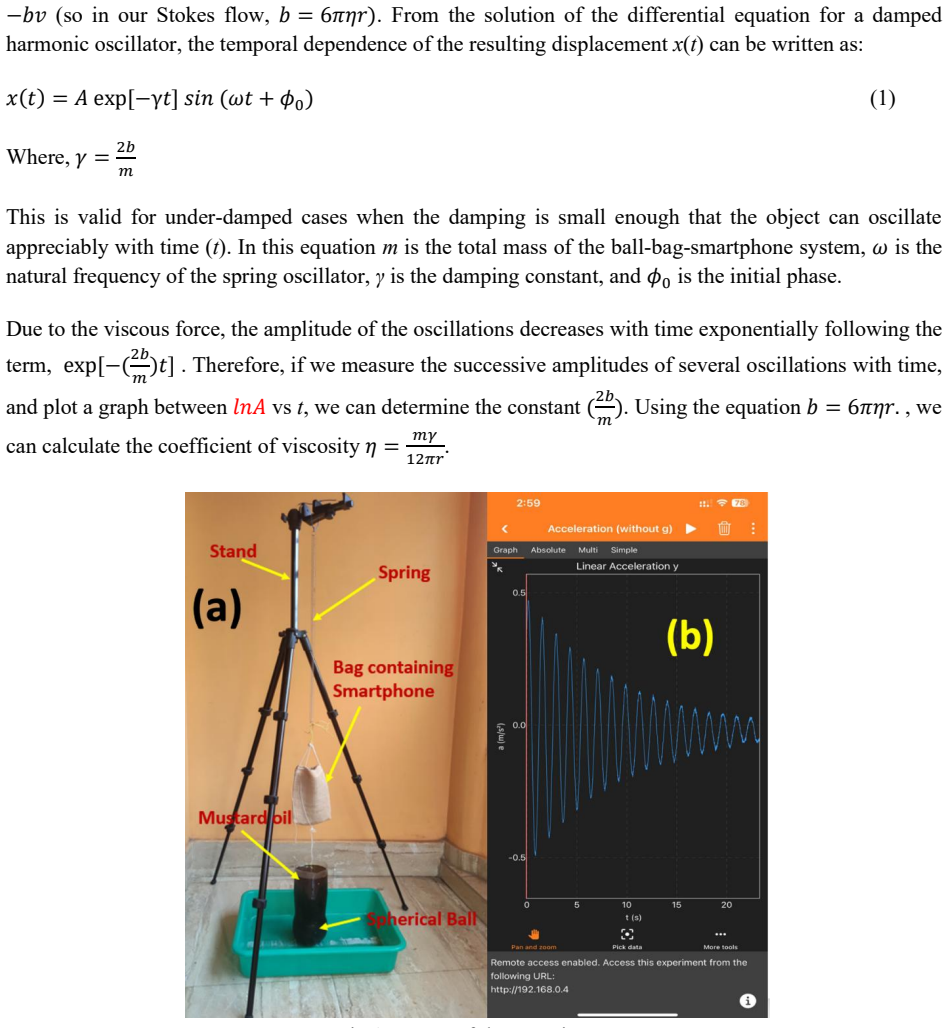
This study presents a classroom-friendly method for measuring the coefficient of viscosity of a liquid using a smartphone s accelerometer sensor. A metallic ball tied with a spring-mass system and submerged in mustard oil undergoes damped oscillations due to viscous forces. The Phyphox app is used to record the temporal variation of acceleration, from which the damping constant is calculated to determine the coefficient of viscosity of the oil. The experimentally obtained value is further validated using the Tracker app, and this value is shown to be in close agreement with the standard literature. This method provides an accurate, low-cost experiment ideal for educational settings, utilizing smartphone sensors for viscosity measurement.
0
0
physics.ed-ph 2026-05-07 Recognition

Smartphone measures density with pressure sensor

Use of smartphone as a density measuring device

Air and submerged pressure readings from the phone sensor yield density of solids.

abstract click to expand
In this paper, we have proposed a simple method of measuring the density of a solid material. We have utilized the pressure sensor of a smartphone as a pressure-measuring device. By measuring the values of pressure when a solid object is in air and also in the fully immersed condition in a non-reactive liquid, we have determined the density of the object.
0
0
physics.ed-ph 2026-05-07 Recognition

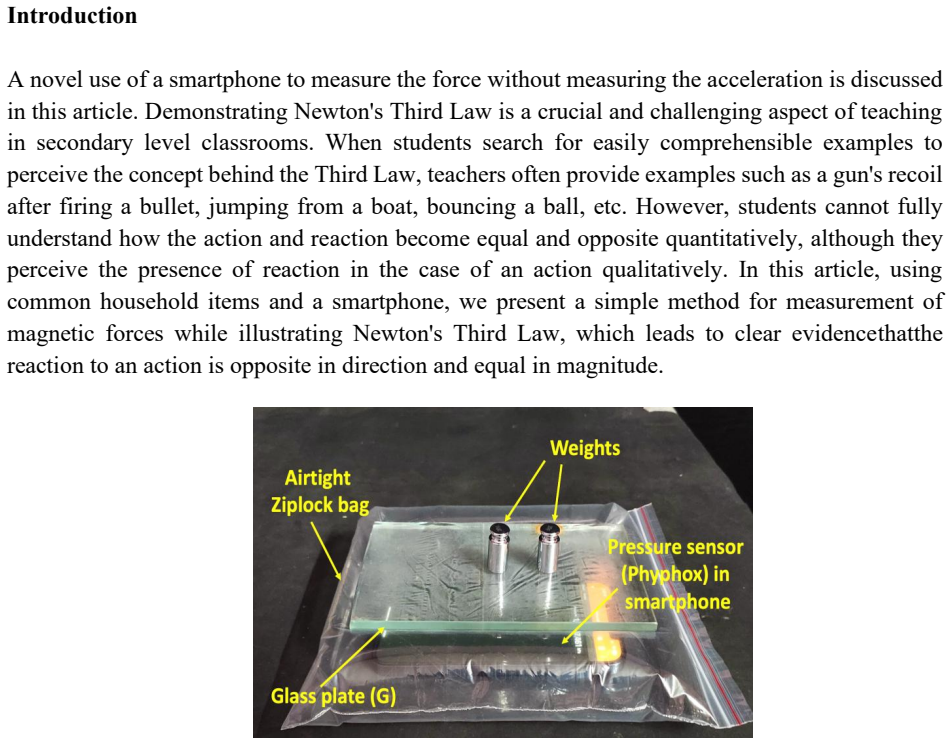
Smartphone sensor confirms magnet repulsion follows 1/r^4 law

Demonstration of magnetic dipole-dipole interaction by using smartphone pressure sensor

Inflated bag and pressure readings let students plot force data and extract dipole moments from neodymium discs.

abstract click to expand
In this paper, we present a hands-on activity designed to verify the dependence of the magnetic force between two identical N35 neodymium disc magnets on their separation distance. Utilizing a weight-measuring device incorporating a smartphone pressure sensor placed inside an inflated Ziplock bag, with a glass plate ensuring perfect contact, we measured the magnetic force with high precision. Our results confirm the established inverse fourth power relationship between magnetic force and distance. The linear plot of magnetic force versus the inverse fourth power of distance corroborates the corresponding theoretical model. From the slope of this linear plot, we have calculated the magnetic dipole moment of each magnet, providing a practical validation of theoretical predictions. This methodology also offers an effective approach for educational and experimental verification of magnetic interactions.
0
0
physics.ed-ph 2026-05-06

Dialogue fixes 82% of LLM errors on image-based physics problems

A Dialogue-Based Framework for Correcting Multimodal Errors in AI-Assisted STEM Education

A short back-and-forth conversation overcomes the accuracy drop when models must read diagrams in STEM questions.

abstract click to expand
Large Language Models (LLMs) are democratizing access to personalized tutoring; however, their effectiveness is hindered by challenges in processing multimodal content, which limits AI's potential to provide equitable, high-quality STEM support. This study evaluates LLM performance on multimodal physics problems, identifies specific failure modes through an empirical error taxonomy, and tests practical interventions designed to overcome multimodal processing limitations. We assessed three publicly available LLMs (Claude, Gemini, and ChatGPT) on multimodal physics problems from the OpenStax database and compared the results with text-only performance. An empirically derived error taxonomy was developed through pilot testing, followed by evaluation of a structured multimodal dialogue intervention. All three models achieved near-ceiling accuracy (96%) on text-only physics problems. Performance declined substantially on multimodal problems, consistent with what we term the Multimodal Interference Effect. Error analysis identified four failure modes: visual processing errors, context misinterpretation, mathematical computational errors, and hybrid errors, with visual processing errors being the most prevalent. The structured dialogue intervention corrected 82% of errors overall; visual processing errors were corrected at 100% across all models. Educators and students can implement these interventions immediately, requiring no model retraining, to improve AI tutoring reliability on image-rich STEM content, advancing equitable access to high-quality learning support.
0
0
physics.ed-ph 2026-05-06 2 theorems

Smartphone measures permeability from magnet's terminal velocity in pipe

A smartphone-based simple method for determination of the free space permeability

Sensor data and video timing turn a simple drop into a quantitative determination of the free-space constant

abstract click to expand
A simple and novel method is designed to determine the free space permeability. This value is computed from the expression of the terminal velocity of a magnet falling through a conducting pipe using the magnetic sensor of a smartphone and a video player. This method deserves its importance because of the accuracy and precision of the results.
0
0
physics.ed-ph 2026-05-06

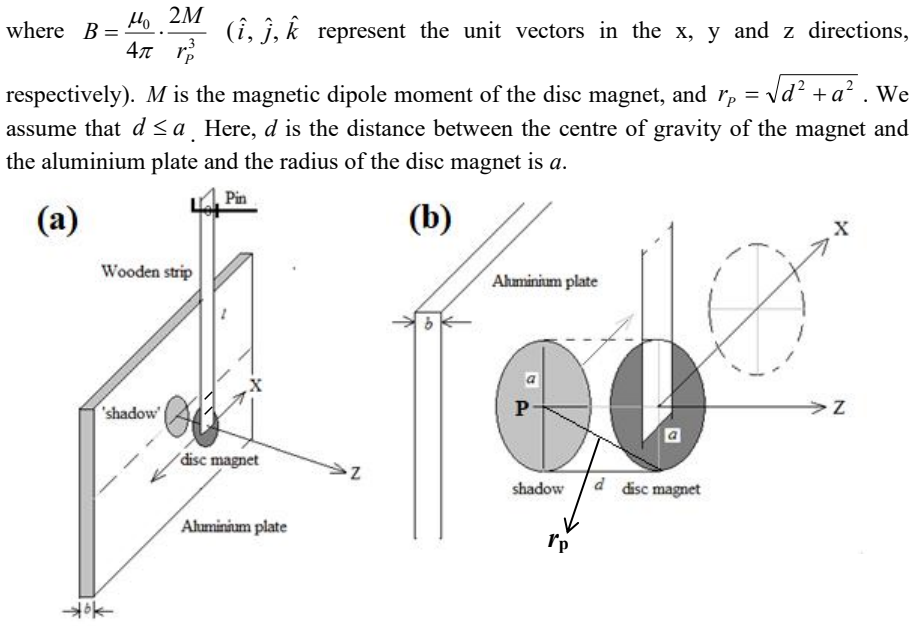
Smartphone extracts g from magnet falling in pipe

Determination of the acceleration due to gravity by studying magnet s motion through a conducting pipe

Terminal velocity and torsional oscillation data replace pendulum timing for local gravity measurement.

Figure from the paper full image
abstract click to expand
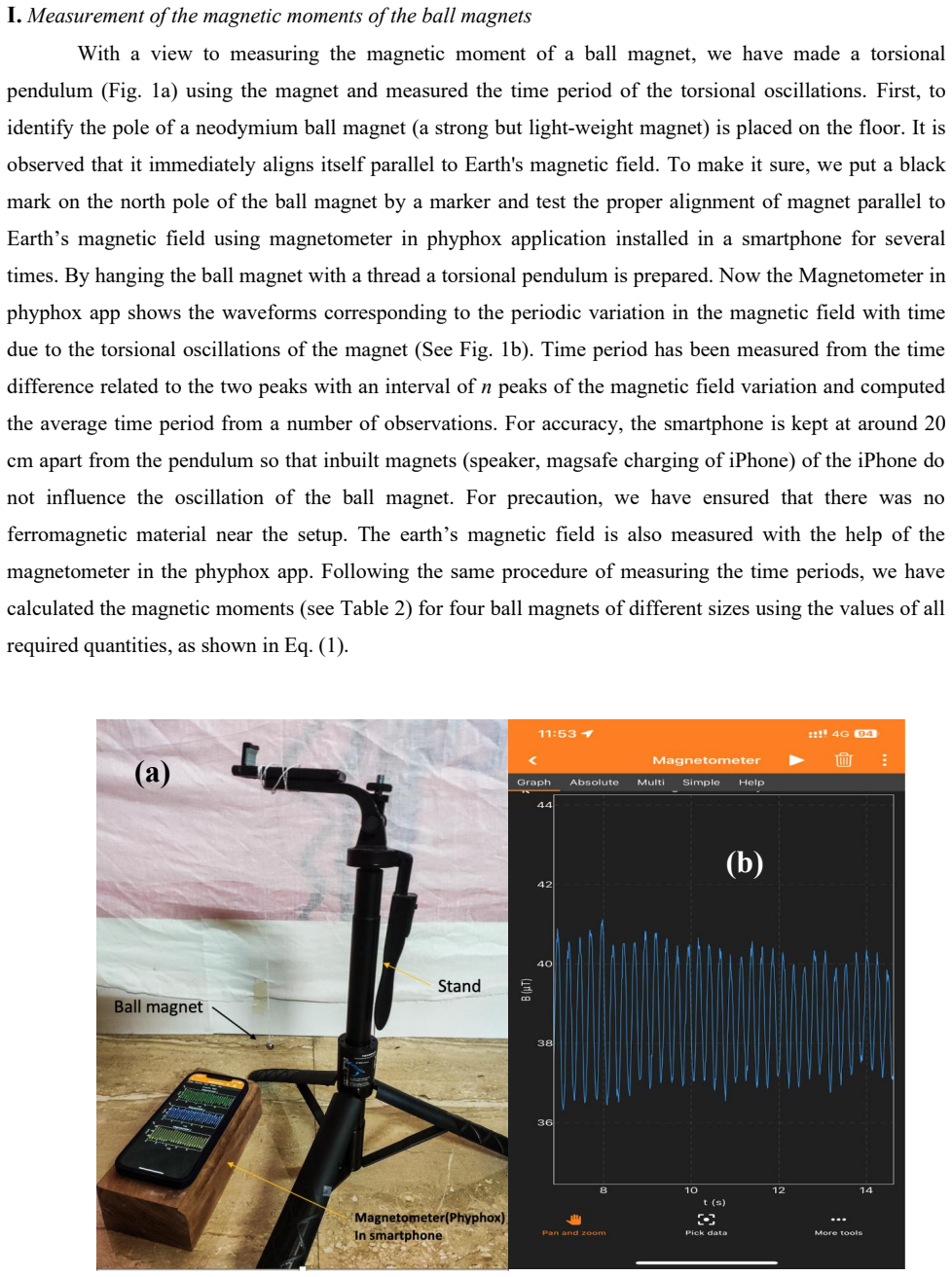
We determine the acceleration due to gravity (g) in a novel way using a magnetic sensor and video analysis technique of a smartphone. The same applications are used to measure the terminal velocity of a magnet falling through a conducting pipe and the magnetic moment of the magnet from its torsional oscillations. This experiment would appear to be intriguing, as it combines elements of magnetism, terminal velocity, and electromagnetic damping to determine g.
0
0
physics.ed-ph 2026-05-06

Magnet damps faster closer to conducting plate

Study of the effect of electromagnetic damping force on a magnet oscillating near a non-ferromagnetic conducting plate

Video tracking extracts how eddy-current drag changes with separation in a simple undergraduate setup.

Figure from the paper full image
abstract click to expand
We have designed an experiment that involves studying the effects of a conducting plate on the motion of an oscillating disc magnet. We have employed the video analysis method by Tracker software to investigate the variation of electromagnetic damping coefficient with distance between the plate and the magnet. This experiment can indeed serve as a valuable educational tool for undergraduate students, covering topics such as damped oscillation, electromagnetic damping, Lenz's law, and eddy currents.
0
0
physics.ed-ph 2026-05-05

Opinions on AI in physics compiled to seed community talks

AI and the Research-Education Environment of Physics

A discussion summary on how AI is changing research and education offers a prompt for other groups to address local issues.

Figure from the paper full image
abstract click to expand
In the current era of AI transforming the research-education environment of physics, variety of issues and concerns arise. The KITP program "Generative AI for High and Low Energy Physics'' offered a discussion session on this, and here presented is a summary of the opinions provided in the discussion. The material is formulated such that it can serve as a starting point for further discussions in readers' research community/institution/group.
0
0
physics.ed-ph 2026-05-04

Phone sensor measures magnet force to check Newton's third law

Smartphone-based measurement of magnetic force and demonstration of Newton third law of motion

Ring magnets and household items let students record equal and opposite forces with a standard smartphone.

Figure from the paper full image
abstract click to expand
A fascinating approach to teaching Newton's Third Law using readily available technology is presented in this article. Magnetic forces are measured by using a smartphone's pressure sensor, two ring magnets, and common household items. Students can measure the magnitudes of forces, gain a more tangible understanding of the law, and see how 'action' and 'reaction' are quantitatively equal and opposite.
0
0
physics.ed-ph 2026-05-04

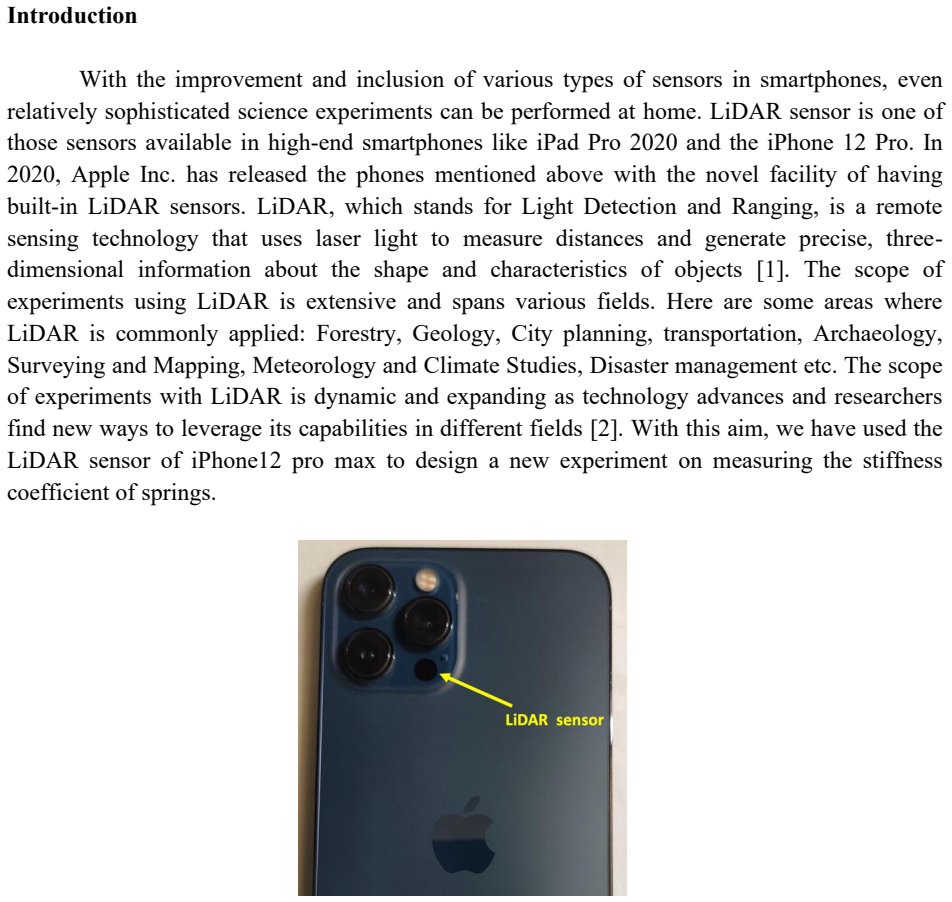
Phone LiDAR yields spring constants matching theory

LiDAR based determination of spring constant using smartphones

A heater coil and hanging mass oscillate while the smartphone sensor records periods, giving results that agree with calculated stiffness.

Figure from the paper full image
abstract click to expand
A novel use of the LiDAR sensor of a smartphone in introductory physics experiments is discussed in this article. We have determined the spring constant for various combinations of springs using the LiDAR sensor of a smartphone through the phyphox application. An electrical heater coil is used as a spring, and the period of oscillation of a vertical spring-mass system is measured using a LiDAR sensor. The experimental values of spring constants agree with the theoretical values. A high school student can perform this simple experiment in a smart way at home.
0
0
physics.ed-ph 2026-05-04

Magnet's terminal speed in pipe gives its magnetic moment

Determination of the magnetic moment of a magnet by letting it fall through a conducting pipe

Eddy-current drag creates constant velocity tracked by smartphone sound waves; matches torsion-pendulum check.

Figure from the paper full image
abstract click to expand
A novel method is proposed to determine the magnetic moment of a magnet by studying its free-falling motion inside a non-ferromagnetic and conducting pipe. The dynamics of a neodymium magnet falling inside a pipe is tracked by using sound waves of a fixed frequency generated by one smartphone and detecting acoustic resonance in the pipe simultaneously by the other. This tracking technique leads to the measurement of the terminal velocity of the falling magnet, as the interaction between the magnet and the conducting pipe creates viscosity artificially. The result obtained is verified by studying torsional oscillations of the suspended magnet and conforms to the reported value in such a low-cost setup. The experiment is designed with concepts integrating the domains of general physics, electromagnetic induction, and acoustics.
0
0
physics.ed-ph 2026-04-30

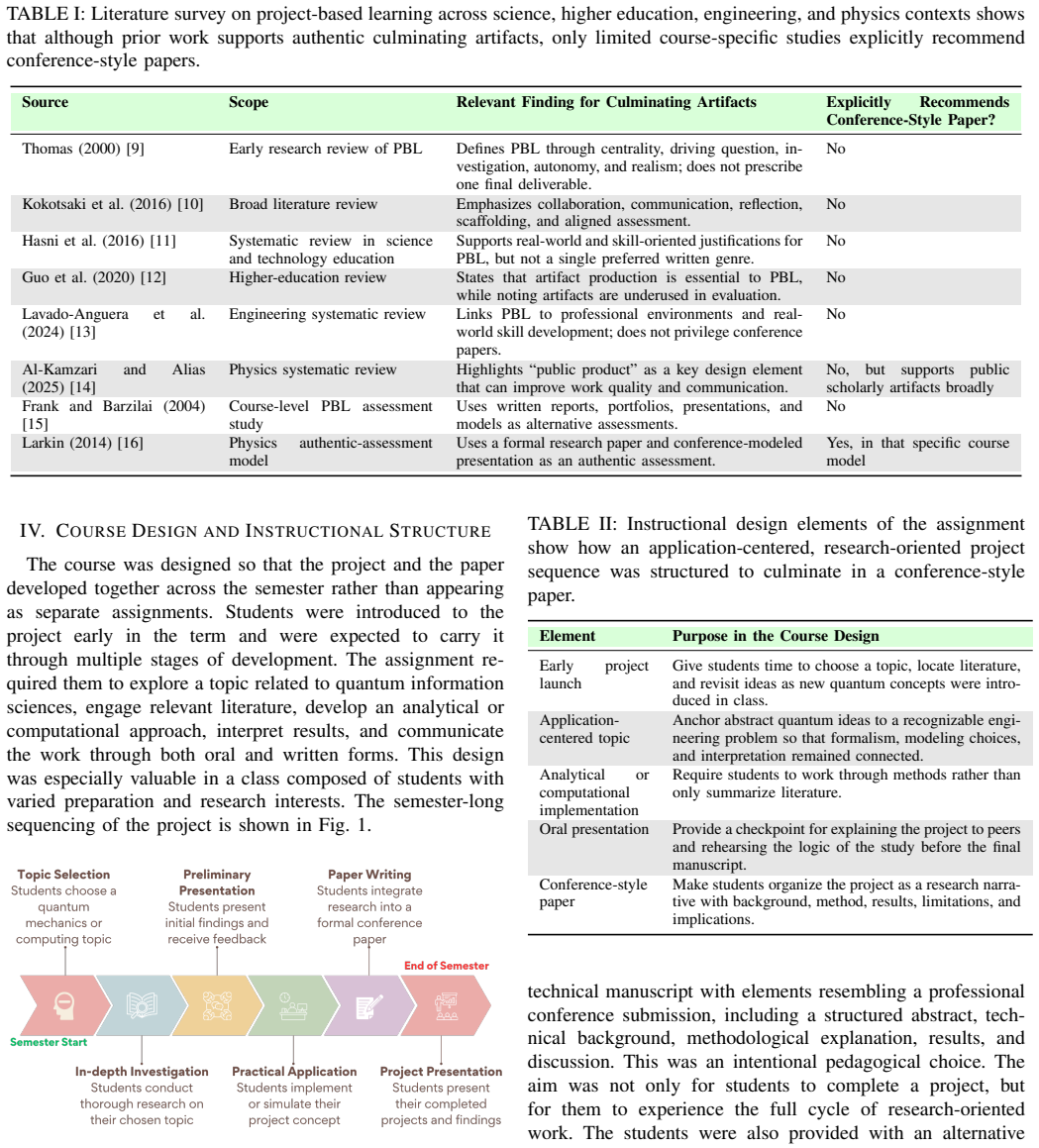
Conference-style papers extend quantum PBL value

Beyond Project-Based Learning: Conference-Style Writing as Authentic Assessment in Interdisciplinary Quantum Engineering Education

Surveys show the writing requirement builds communication and research skills on top of project engagement benefits.

Figure from the paper full image
abstract click to expand
Project-based learning is recognized as an effective approach for improving engagement and applied understanding in STEM education. In quantum engineering courses, however, the question is no longer only whether students benefit from projects but how those projects should culminate if the goal is authentic disciplinary preparation. This paper examines the educational role of a conference-style paper requirement embedded within a project-based learning implementation for an introductory quantum mechanics course for engineers. We use post-course survey responses from students in a pilot run of the course. We evaluate perceived effects on conceptual understanding, scientific communication, research readiness, and attitudes toward the writing requirement itself. The results suggest that students viewed the project as beneficial for engagement, confidence, and technical skill development, while the conference-style paper emerged as a demanding but meaningful component of the experience. We argue that once PBL has been established in quantum mechanics education, conference-style writing can serve as an extension of that model, especially for graduate students. The findings support retaining the conference-paper requirement with improved scaffolding.
0
0
physics.ed-ph 2026-04-29

Unit convention makes electrical resistance dimensionless

A Pedagogical MKS-based Electromagnetic Unit Convention with ε₀ = μ₀ = 1/c

By setting vacuum constants to 1/c, Maxwell's equations stay familiar while units simplify and c becomes explicit.

abstract click to expand
We propose a pedagogical, rationalized MKS-based convention for electromagnetic quantities designed to reduce cognitive load in undergraduate undergraduate electromagnetism. By setting vacuum constants to $\varepsilon_0 = \mu_0 = 1/c$, we preserve the familiar structure of Maxwell's equations while making the role of the speed of light explicit. In this convention, electrical units are expressed directly in terms of mechanical units (e.g.\ $[\mathrm{nuA}] = \sqrt{\mathrm{J/s}}$), effectively reducing the number of independent base units. A striking pedagogical consequence is that electrical resistance becomes dimensionless, capacitance and inductance acquire units of time, and radiation pressure reduces to $|\mathbf{E}\times \mathbf{B}|$, greatly simplifying dimensional analysis for circuits and fields. We introduce corresponding non-SI units (\textit{nu}-units), provide conversion relations to SI, and demonstrate the potential utility of this system through comparative ``before/after'' derivations of the wave equation, electromagnetic energy density, radiation pressure, and the Bohr atom. Preliminary empirical support is provided by student attitude surveys administered to $N_1 = 46$ and $N_2 = 39$ students in an undergraduate physics course, which showed a statistically significant improvement in the perceived clarity of the wave equation derivation after exposure to the nu-system ($p = 0.005$, Mann--Whitney $U$ test), and a majority preference for the dimensionless-resistance feature.
0
0
physics.ed-ph 2026-04-29

17-year quantum summer school sends alumni into research careers

USEQIP: Outcomes and experiences from 17 years of undergraduate summer schools in experimental quantum information science

Two weeks of labs plus internships have equipped hundreds of undergraduates with experimental skills and led many to continue in the field.

Figure from the paper full image
abstract click to expand
To grow the quantum information science and technology workforce, opportunities for students to gain experiential learning and build a sense of belonging in the broader community are essential. The Undergraduate School on Experimental Quantum Information Processing (USEQIP) is a two-week summer school for undergraduate students that has been held since 2009 with the goal of introducing undergraduate students from around the world to the tools of quantum information research, paired with a summer internship program. Here we report on the structure, impact, and outlook of the program, including hands-on laboratory activities refined over many iterations of the program. We highlight the career trajectories of program alumni, many of whom have made significant contributions to the quantum field.
0
0
physics.ed-ph 2026-04-28

Quantum hackathon teaches basics to underrepresented high schoolers

Bridging the Quantum Divide: A Learning-Centric Quantum Hackathon for Underrepresented Students (Extended Version)

A two-day event built with mastery learning and Quirk simulations reached its target demographics in Nova Scotia.

Figure from the paper full image
abstract click to expand
This paper describes the design and implementation of a two-day quantum hackathon for underrepresented high school students in Nova Scotia, Canada. The first day of the hackathon is spent introducing students to quantum computing through hands-on activities, whereas the second day teaches students to apply this knowledge through guided challenges. Both days are informed by the theory of mastery learning and specification grading, with the full curriculum being crafted within the Integrated Course Design framework. This requires identifying situational factors unique to our target demographics, from which we develop learning outcomes, and then work backwards to a full curriculum with educative assessments. A novel aspect of our hackathon is that all circuit simulations are performed within Quirk: a decision based on best practices in computer science education. Based on feedback from students, we conclude that our hackathon successfully introduced students to the basics of quantum computing, and was able to reach most of our target demographics.
0
0
physics.ed-ph 2026-04-28

QFT textbooks repeat six conceptual mistakes

Six textbook mistakes in quantum field theory

Corrections to widespread errors aim to stop them from propagating into research papers and student work.

Figure from the paper full image
abstract click to expand
This article discusses incorrect statements appearing in textbooks on quantum field theory (QFT); some of these mistakes also appear in the research literature. The focus is not on errors made by an individual author, but on conceptual muddledness that is widespread in introductory textbooks. We start from a bare-bones summary of QFT, meant to establish the notation. We then turn to our six paradigmatic themes, in each case quoting a specific example of the textbook mistake, a summary of material that is known to experts but is frequently mishandled in introductory works, pointers to authoritative references where the relevant concept is handled properly, as well as a concise correction that rectifies any issues. The goal of this work is to warn readers of the existence of several pitfalls and thereby stop these errors from further propagating in the literature on QFT.
0
0
physics.ed-ph 2026-04-24

DIY inertia dyno shows scooter CVT flat power curve

Building an inertia dynamometer with vocational students: a low-budget apparatus for teaching rotational dynamics

Vocational students use a steel drum and laptop mic to measure torque and power, matching expected CVT signatures.

Figure from the paper full image
abstract click to expand
We report the design, construction, and classroom use of a low-cost inertia dynamometer, built as a year-long project-based learning (PBL) activity with adult students at a Greek Evening Vocational High School (EPAL). The apparatus consists of a machined steel drum of calculated moment of inertia $I = 0.6507~\mathrm{kg\,m^2}$, mounted on a student-welded frame and instrumented with a green-laser / light-dependent resistor (LDR) optical interrupter. The analogue output is sampled at 44.1\,kHz by the microphone input of a laptop computer, which is used as an opportunistic analogue-to-digital converter; torque and power curves are then reconstructed in software from the inter-pulse intervals via $\tau = I\alpha$ and $P = \tau\omega$. The drum's moment of inertia is cross-checked by an inclined-plane rolling experiment. A wide-open-throttle test with a 50\,cc scooter reproduces the expected flat-power / falling-torque signature of a continuously variable transmission in the low-to-moderate RPM range; the LDR's millisecond-scale recovery time imposes an upper bandwidth limit that provides an unplanned but pedagogically rich lesson in sensor physics. The project integrated industrial-lathe fabrication, arc welding, analogue electronics, and numerical differentiation into a single coherent workflow. We describe the apparatus, the physics, the signal-processing pipeline (for which MATLAB and Python/Octave code are provided as supplementary material), and reflect on the pedagogical outcomes for a student population traditionally disengaged from abstract physics.
0
0
physics.ed-ph 2026-04-24

Inductive bias improves ML detection of student reasoning in talks

Locating acts of mechanistic reasoning in student team conversations with mechanistic machine learning

Probabilistic model generalizes better to unseen students and new contexts when its dynamics align with domain knowledge.

Figure from the paper full image
abstract click to expand
STEM education researchers are often interested in identifying moments of students' mechanistic reasoning for deeper analysis, but have limited capacity to search through many team conversation transcripts to find segments with a high concentration of such reasoning. We offer a solution in the form of an interpretable machine learning model that outputs time-varying probabilities that individual students are engaging in acts of mechanistic reasoning, leveraging evidence from their own utterances as well as contributions from the rest of the group. Using the toolkit of intentionally-designed probabilistic models, we introduce a specific inductive bias that steers the probabilistic dynamics toward desired, domain-aligned behavior. Experiments compare trained models with and without the inductive bias components, investigating whether their presence improves the desired model behavior on transcripts involving never-before-seen students and a novel discussion context. Our results show that the inductive bias improves generalization -- supporting the claim that interpretability is built into the model for this task rather than imposed post hoc. We conclude with practical recommendations for STEM education researchers seeking to adopt the tool and for ML researchers aiming to extend the model's design. Overall, we hope this work encourages the development of mechanistically interpretable models that are understandable and controllable for both end users and model designers in STEM education research.
0
0
physics.ed-ph 2026-04-22

New profession proposed for guiding student research

The Research Guide: From Informal Role to Profession

Informal PhD-style mentoring falls short for the hundreds of thousands doing authentic projects each year.

Figure from the paper full image
abstract click to expand
Guiding others through authentic scientific research outside of PhD programs has been practiced for decades in specialized secondary schools, undergraduate research programs, and independent settings. These practitioners work in the middle, between the classroom science teacher and the PhD advisor, guiding learners with aptitude or serious interest. Sport and music have dedicated professions for this middle position (the school-team coach and the school band director); research does not. This paper names that missing profession the Research Guide: the practitioner who develops another person's capacity to do research, from framing a question to communicating findings. Hundreds of thousands of middle and high school students already pursue authentic research each year, even more college undergraduates participate in research with a faculty member, and millions of adults engage in citizen science. In current practice, the programs that serve this middle group mostly default to a simplified version of the PhD apprenticeship model structured around one mentor with a few students at a time, without systematic training; they overwhelmingly frame research as the hypothetico-deductive cycle alone. The role calls for cognitive apprenticeship, a pedagogical approach in which an expert's tacit moves on open-ended problems are made visible and scaffolded, then faded as the learner develops, while the research outcomes themselves remain unpredictable. It spans multiple modes of inquiry (not only the hypothetico-deductive cycle) and demands a combination that no existing training program produces: pedagogy, research methodology, developmental assessment, risk and productive struggle management, domain flexibility, and community building. Together these demands warrant a dedicated profession: a named role, a training pathway, a career ladder, hiring standards, and institutional recognition.
0
0
physics.ed-ph 2026-04-20

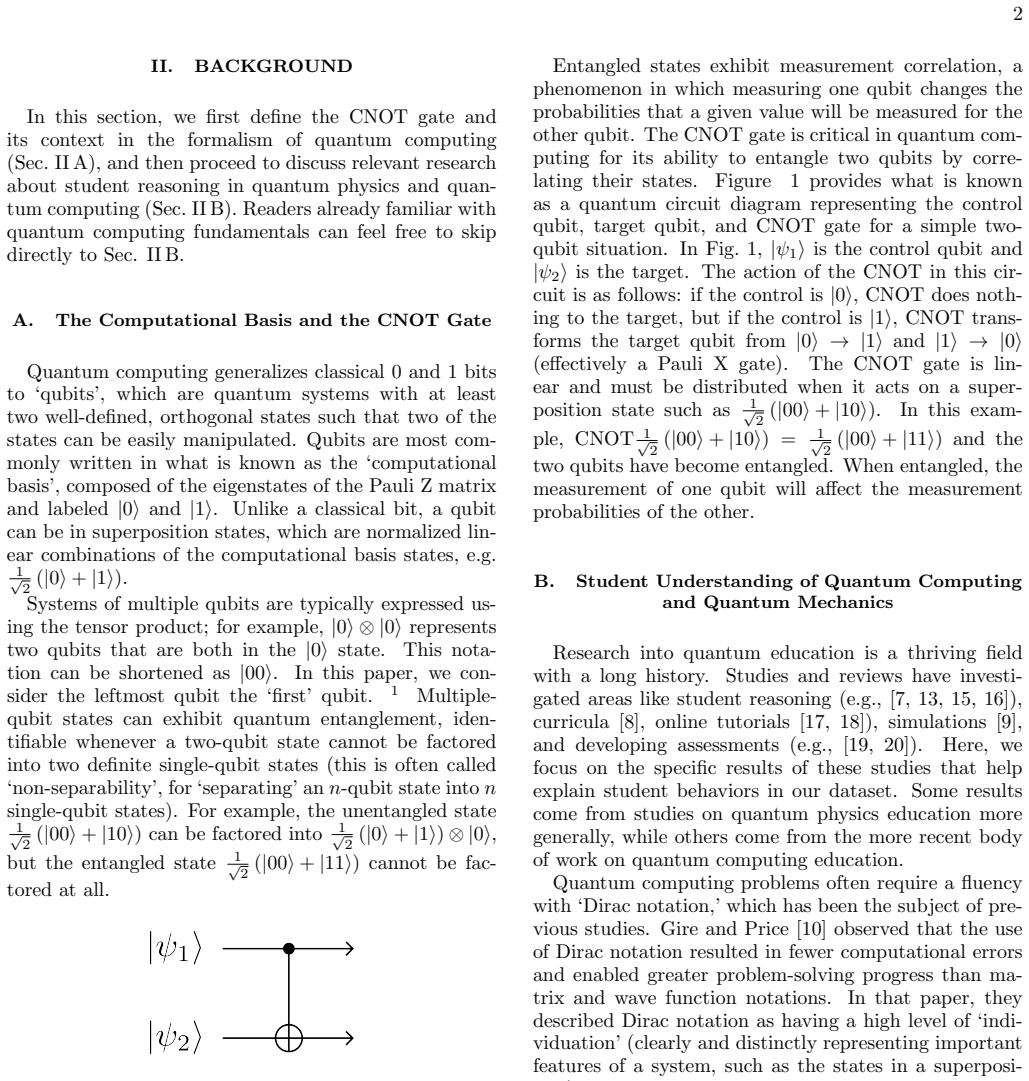
Three cognitive resources shape student use of CNOT

Can a CNOT Gate Affect the Control Qubit? Student Resources for Understanding CNOT and Entanglement

Procedural application underpins qualitative rules that sometimes produce errors with superposition and entanglement.

Figure from the paper full image
abstract click to expand
The Controlled-Not (CNOT) gate is essential to algorithms in quantum computing for its ability to entangle qubits. As such, it is important to understand how students learning quantum computing reason around the function and use of this critical quantum gate. To investigate this, we conducted think-aloud interviews in which students solved problems involving the CNOT gate to understand students' `CNOT toolbox' -- the strategies and cognitive resources students use when reasoning about the effect of the CNOT gate. We identify three cognitive resources related to the CNOT gate: (1) the procedural resource of applying CNOT to specific states, (2) a qualitative description of CNOT's effect on the target qubit given the control qubit, and (3) the idea that the control qubit is not changed when CNOT is applied to computational basis states. We find that students' use of the first resource is foundational to their understanding of the second and third, that the second and third resources can sometimes lead students to incorrect conclusions, and that students can use each of these resources separately or in tandem. We also explore how students use these resources in conjunction with Dirac notation, superposition states, and entanglement to reason both productively and unproductively about quantum computing problems.
0
0
physics.ed-ph 2026-04-15

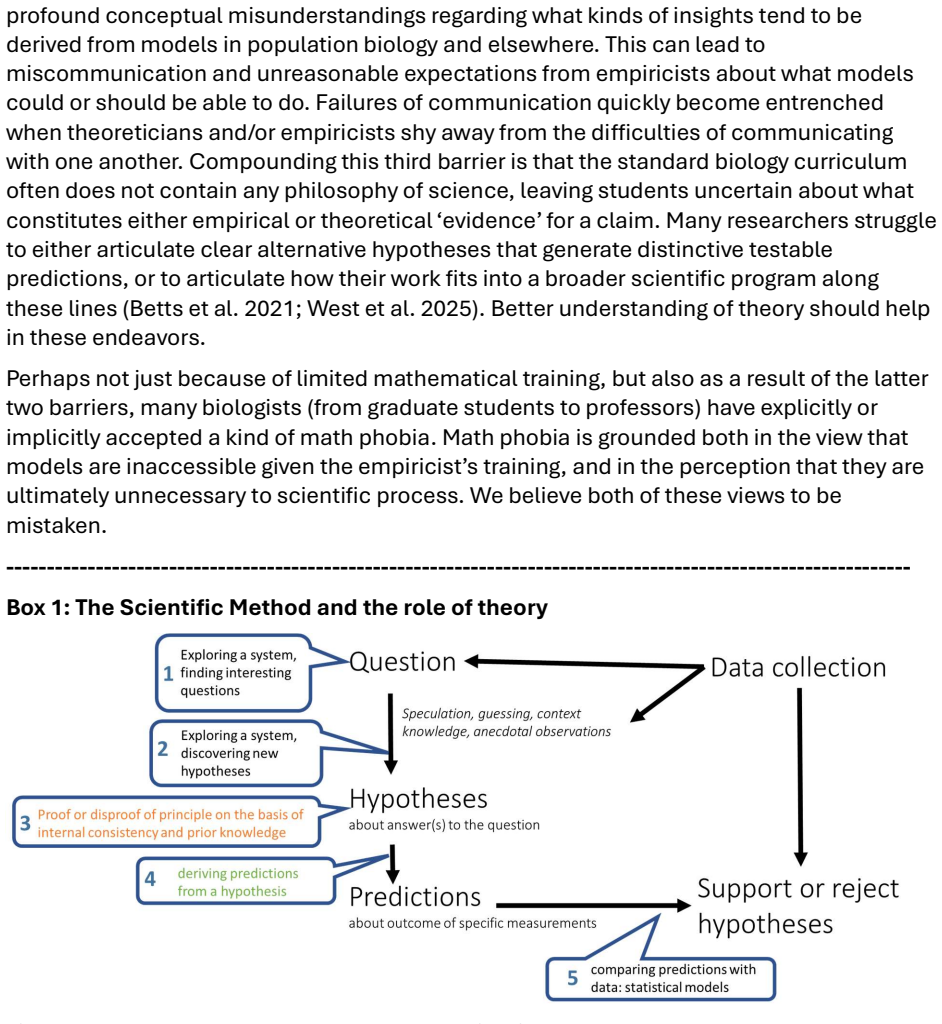
Course teaches biology students to read theory papers

What good is modeling? Introducing biology students to theory

Active methods help those with little math background grasp models, assumptions, and evidence.

Figure from the paper full image
abstract click to expand
Theory and empirical science should be in constant dialogue, but often find it hard to understand one another. Here we describe a graduate-level university course we developed to improve matters. The course was designed to help empirically-focused biology graduate students read and understand theory papers, despite little prior mathematical training. It uses several evidence-based principles of modern teaching: backwards design, active learning, and just-in-time teaching. We believe that this or similar curricular content, emphasizing the nature of evidence and the role of theory in science, will improve critical thinking and scientific progress.
0
0
physics.ed-ph 2026-04-15

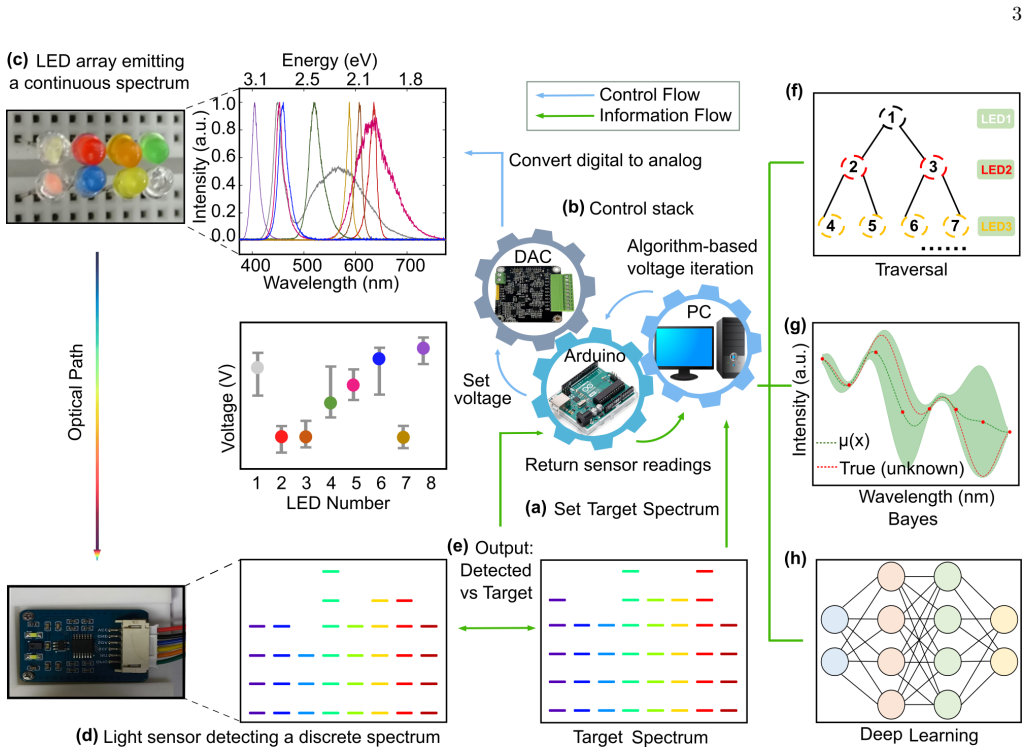
Arduino IoT rig lets students train ML on live optical data

Building an Affordable Self-Driving Lab: Practical Machine Learning Experiments for Physics Education Using Internet-of-Things

Low-cost platform generates real datasets where deep learning outperforms traversal and Bayesian methods on nonlinear patterns.

Figure from the paper full image
abstract click to expand
Machine learning (ML) is transforming modern physics research, but practical, hands-on experience with ML techniques remains limited due to cost and complexity barriers. To address this gap, we introduce an affordable, autonomous, Internet-of-Things (IoT)-enabled experimental platform designed specifically for applied physics education. Utilizing an Arduino microcontroller, a customizable multi-wavelength light emitting diode (LED) array, and photosensors, our setup generates diverse, real-time optical datasets ideal for training and evaluating foundational ML algorithms, including traversal methods, Bayesian inference, and deep learning. The platform facilitates a closed-loop, self-driving experimental workflow, encompassing automated data collection, preprocessing, model training, and validation. Through systematic performance comparisons, we demonstrate the superior ability of deep learning to capture complex nonlinear relationships compared to traversal and Bayesian methods. At approximately $60, this open-source IoT platform provides an accessible, practical pathway for students to master advanced ML concepts, promoting deeper conceptual insights and essential technical skills required for the next generation of physicists and engineers.
0
0
physics.ed-ph 2026-04-14

Two profiles capture critical thinking in physics labs

Multidimensional Profiles of Critical Thinking in Physics Labs: Latent Structure, Instructional Change, and Connections to Physics Identity

Belonging predicts higher-profile shifts while agency and self-efficacy form an asymmetric loop

Figure from the paper full image
abstract click to expand
The Physics Lab Inventory of Critical Thinking (PLIC) measures three components of students' critical thinking in physics labs: evaluating data, evaluating methods, and proposing next steps. Prior work has analyzed these components in isolation or as a composite score. In this study, we apply latent profile analysis (LPA) to the three PLIC scales using a large, multi-institutional dataset of 5,513 matched pre/post student records to identify characteristic response patterns across the three components simultaneously. At both pre- and post-instruction, a two-profile solution best fit the data. Profile composition shifted substantially over instruction, with 48.4\% of students in the lower-performing profile at pre-test transitioning to the higher-performing profile at post-test, while 43.6\% of students moved in the opposite direction. Course type was statistically associated with profile membership at both timepoints, though the effect was small (Cram\'er's $V \approx 0.10$). To examine the relationship between profile transitions and students' affective development, we estimated cross-lagged panel models (CLPMs) linking profile membership to belonging, recognition, self-efficacy, and agency. Belonging emerged as the principal upstream predictor, prospectively predicting recognition, self-efficacy, agency, and higher-knowledge profile membership. Agency and self-efficacy formed a reciprocal but asymmetric loop, with the path from agency to later self-efficacy being stronger. Recognition functioned primarily as a downstream construct over this timescale. These results provide the first person-centered, multidimensional characterization of PLIC performance and demonstrate that epistemic and identity-related constructs are interlinked in physics lab learning.
0
0
physics.ed-ph 2026-04-13

Four skill areas mark quantum jobs ready for bachelor's grads

Experimental Skills for Undergraduate Career Preparation in Quantum Information Science and Engineering

Interviews group needed abilities into instrumentation, data analysis, project design, and collaboration for entry-level QISE roles.

Figure from the paper full image
abstract click to expand
The growth of the Quantum Information Science and Engineering (QISE) industry has increased interest in how undergraduate programs prepare students for careers in this field. Prior research emphasizes the value of experiential learning as preparation for the quantum industry, but lacks specificity regarding the experimental skills needed for positions available to bachelor's degree graduates. In this study, we investigate the experimental skills associated with bachelor's-level quantum industry positions through 44 semi-structured interviews with quantum industry professionals. Guided by the American Association of Physics Teachers recommendations for the undergraduate physics laboratory curriculum, we characterize the experimental skills associated with positions described as requiring bachelor's-level preparation and thematically synthesize them into four categories: instrumentation, computation and data analysis, experimental and project design, and communication and collaboration. We further examine how these skills cluster across role types and articulate them as learning goals to provide guidance for educators interested in aligning undergraduate instruction with the needs of students wanting to pursue a career in the quantum industry. Our findings suggest the need to emphasize the discussion of hardware in QISE theory courses, expand experimental training through instructional laboratories, and intentionally integrate professional skills in undergraduate QISE education.
0
0
physics.ed-ph 2026-04-10

Instructor framing drives student gains in MoI electrostatics tutorial

Instructor Framing and Incentives Shape Physics Students' Engagement and Learning Gains from an Inquiry-Based Electrostatics Tutorial on the Method of Images

The same inquiry tutorial produced different motivation and performance levels depending on how instructors presented the task.

Figure from the paper full image
abstract click to expand
The method of images (MoI) is a valuable technique for solving certain electrostatic boundary value problems consisting of charge density near conductor(s). We developed and validated an inquiry-based tutorial on MoI to help students learn to identify the problems related to the concept. We implemented the inquiry-based tutorial accompanied by pretest and posttest, across three instructors' classes to evaluate student learning. We also conducted think-aloud interviews with advanced physics students, which helped us gain insights into their problem-solving strategies, evaluate their understanding developed through the tutorial and make necessary refinements to the MoI tutorial. The study identified common student difficulties, which were subsequently integrated into the inquiry-based tutorial as a guide to provide support to students. We found that advanced students have common difficulties related to physics concepts similar to those found in introductory physics courses. The performance difference in the pretest administered after lecture-based instruction and the posttest administered after working through the tutorial reflects students' ability to apply what they learned from the inquiry-based tutorial compared to traditional lecture. Another important and unanticipated finding reveals how instructor's framing about inquiry-based instructional tasks can have a significant impact on student motivation, engagement, and performance. Overall, this iterative multi-year design-based comparative research with mixed-method triangulation provides valuable insights on the challenges involved in such studies that educators and researchers alike can greatly benefit from.
0
0
physics.ed-ph 2026-04-08 Recognition

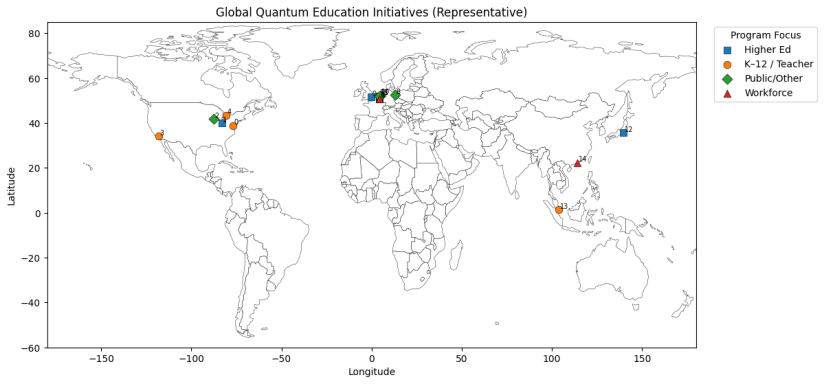
Quantum education forms ecosystem with gaps

The Quantum Education Ecosystem: A Review of Global Initiatives, Methods, and Challenges

Review of international programs identifies fragmentation and proposes non-linear model to improve access and workforce alignment.

Figure from the paper full image
abstract click to expand
Quantum information science and engineering (QISE) is advancing rapidly, creating an urgent demand for a quantum-literate, technically proficient workforce. Despite this need, quantum education initiatives remain fragmented across regions, educational levels, and instructional approaches, which constrains their scalability and overall impact. This paper offers a structured analysis of the current quantum education ecosystem by synthesizing global initiatives, pedagogical strategies, and emerging trends. Quantum education is examined through a dual framework that considers both learner progression and instructional methodology, emphasizing the evolution of educational approaches from conceptual exposure to formal reasoning and practical application. Analysis of data from international programs and academic literature reveals key challenges, including inequitable access, absence of standardized curricula, limited empirical evaluation, and discontinuities between educational stages. Quantum education is more accurately conceptualized as a non-linear ecosystem rather than a traditional pipeline, characterized by multiple entry points, feedback mechanisms, and critical transition gaps. Based on this perspective, directions are proposed for developing more coherent, inclusive, and scalable educational frameworks that align with workforce requirements and technological progress. This work presents a unified perspective on the quantum education landscape and outlines actionable strategies to enhance global quantum literacy and workforce preparedness.
0
0
physics.ed-ph 2026-04-06 Recognition

Homemade metre bridge runs electricity labs with charger and wire

A Unified and Economical Approach to Teaching Higher Secondary Electricity Experiments

Using a mobile charger, nichrome wire and basic meters, the Indigenous Metre Bridge replicates commercial tools for high school experiments.

Figure from the paper full image
abstract click to expand
In both rural and urban educational settings, science education is often hindered by limited access to lab resources and intimidating, complex instruments. This paper introduces a low-cost, homemade experimental apparatus built using a mobile charger, nichrome wire, galvanometer, and digital multimeter that enables educators to perform key higher secondary electricity experiments. The Indigenous Metre Bridge (IMB) has proven to be an intuitive, user-friendly tool that not only bridges theoretical and practical learning but also reduces student apprehension toward lab work. Its simplicity and accessibility exemplify how frugal innovation can transform physics education.
0
0
physics.ed-ph 2026-04-03 Recognition

Gudeg making shows physics concepts to students

The Physics of Gudeg: Learning the Mechanics and Thermal Properties Using Collaborative Project based Activities for the High School Physics

Jackfruit peeling, sections, boiling, and preservation link density, Young's modulus, and heat transfer to everyday cooking.

abstract click to expand
In this paper, we describe a presentation on the physics of Gudeg, a traditional food from Indonesia specifically originated in the Special District of Yogyakarta. This learning context is designed for the high school physics curricula. The physics presentation focuses on the making processes of Gudeg. Qualitative interviews with Gudeg makers were carried out by the researchers to thematize the process of making Gudeg and highlight its educational connections for the physics learning. Five extracted learning themes are how the density concept behind peeling the jackfruit skin (main Gudeg ingredient), how the relation between the Youngs modulus concept and the jackfruit sections, how the texture-torque experiment of the sweet and tasty gudeg, how the effect of boiling mechanism on the texture of the jackfruit, and how the conduction and convection of the preserved Gudeg. Using our learning strategy which is so-called Collaborative Project based Teaching, we provide simple experimentations and demonstrations of the physical concepts behind these Gudeg processes that are promising for conceptual physics learning by managing triple educational roles between teachers, students, and Gudeg practitioners. This approach can be generally adopted beyond physics to promote the excitement of traditional knowledge which can enhance pedagogical approach in educational setting.
0
0
physics.ed-ph 2026-04-03 2 theorems

Core physics courses slow grads' growth as physicists

What does it mean to think like a physicist? Insights from physics graduate students

Interviews show electives and research better support the integration of physical concepts with math than required classes do.

Figure from the paper full image
abstract click to expand
Learning to think like a physicist (LTP) is often cited as a central goal of graduate physics education, yet what this means in practice and the extent to which physics graduate education prepares students to develop LTP and view LTP as valuable to their research and teaching remain unclear. This interview-based study, conducted with seven physics graduate students at one US public research university, explores how students define thinking like a physicist and how their coursework and research experiences correlate with this development. Students emphasized that physics uniquely requires integrating physical and mathematical concepts in ways that go beyond other science disciplines. Our findings show that physics core courses, particularly electricity and magnetism, frequently emphasize mathematical techniques and content coverage at a rapid pace at the expense of deeper conceptual engagement and development of LTP. In contrast, physics elective courses and research experiences were more synergistic with and effective in fostering conceptual understanding, problem-solving skills, and identity development as physicists. Because graduate students simultaneously take core courses, conduct research and teach introductory physics, their perspectives on LTP are particularly valuable in how physics departments may consider transforming their preparation. Their voices highlight how this transformative stage of training can either support or hinder the development of physicist thinking.
0
0
physics.ed-ph 2023-08-22

Physics students trusted ChatGPT's wrong answers about half the time

Unreflected Acceptance -- Investigating the Negative Consequences of ChatGPT-Assisted Problem Solving in Physics Education

And they pasted the exercise verbatim into the chatbot ten times more often than into a search engine.

Figure from the paper full image
abstract click to expand
Large language models (LLMs) have recently gained popularity. However, the impact of their general availability through ChatGPT on sensitive areas of everyday life, such as education, remains unclear. Nevertheless, the societal impact on established educational methods is already being experienced by both students and educators. Our work focuses on higher physics education and examines problem solving strategies. In a study, students with a background in physics were assigned to solve physics exercises, with one group having access to an internet search engine (N=12) and the other group being allowed to use ChatGPT (N=27). We evaluated their performance, strategies, and interaction with the provided tools. Our results showed that nearly half of the solutions provided with the support of ChatGPT were mistakenly assumed to be correct by the students, indicating that they overly trusted ChatGPT even in their field of expertise. Likewise, in 42% of cases, students used copy & paste to query ChatGPT -- an approach only used in 4% of search engine queries -- highlighting the stark differences in interaction behavior between the groups and indicating limited reflection when using ChatGPT. In our work, we demonstrated a need to (1) guide students on how to interact with LLMs and (2) create awareness of potential shortcomings for users.
1 0

browse all of physics.ed-ph → full archive · search · sub-categories