Efficient First-Order Methods for Estimating Generalized Additive Index Models
Pith reviewed 2026-06-29 10:12 UTC · model grok-4.3
The pith
Basis expansion turns generalized additive index model estimation into a finite-dimensional problem solvable by gradient descent or variational inequality methods.
A machine-rendered reading of the paper's core claim, the machinery that carries it, and where it could break.
Core claim
By leveraging basis expansion, the semiparametric estimation task for generalized additive index models is cast as a finite-dimensional optimization problem solvable by first-order methods such as gradient descent. A variational inequality estimation algorithm extends the variational inequality framework from generalized linear models to these models, and both algorithms share a unified convergence result to a stationary point.
What carries the argument
Basis expansion that reduces the infinite-dimensional nonparametric components to a finite-dimensional optimization problem, solved simultaneously by gradient descent or variational inequality methods.
If this is right
- The algorithms achieve simultaneous rather than sequential estimation while retaining a convergence guarantee to a stationary point.
- Numerical experiments demonstrate both computational speedups and statistical gains relative to stage-wise procedures.
- The variational inequality variant offers particular advantages when the link function is non-canonical.
Where Pith is reading between the lines
- The finite-dimensional reduction may permit direct application of existing first-order optimization theory and software to a wider class of semiparametric index models.
- If the basis approximation error can be controlled explicitly, the stationary-point convergence could be strengthened to statistical consistency rates under standard smoothness assumptions on the unknown functions.
Load-bearing premise
Basis expansion can be chosen so that stationary points of the resulting finite-dimensional problem correspond to good estimators of the original semiparametric model.
What would settle it
On simulated data with known true index functions and links, the recovered estimates from these algorithms show approximation error that does not decrease as the basis dimension grows or fails to match or beat the error of classical stage-wise estimators.
Figures

read the original abstract
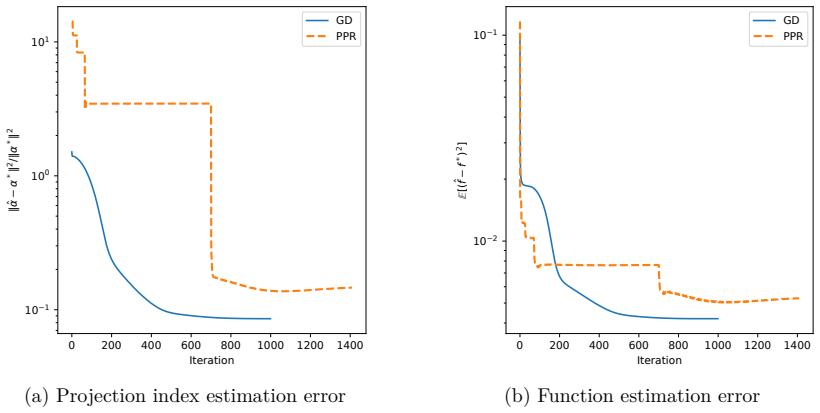
Generalized additive index models (GAIMs) offer a flexible semiparametric framework for capturing complex data relationships, balancing the interpretability of parametric models with the flexibility of nonparametric approaches. However, classical stage-wise estimation procedures for GAIMs suffer from computational inefficiencies due to their sequential nature and reliance on nonparametric smoothing. To overcome these drawbacks, we propose efficient, simultaneous estimation algorithms for GAIMs. By leveraging basis expansion, we cast the semiparametric estimation task as a finite-dimensional optimization problem solvable by first-order methods such as gradient descent (GD). Furthermore, we introduce a variational inequality (VI) estimation algorithm, extending the VI framework from generalized linear models to GAIMs. We provide a unified convergence result to a stationary point for both algorithms. Numerical experiments highlight the computational and statistical advantages of our methods over classical stage-wise procedures, and reveal the potential benefits of the VI-based approach over GD for non-canonical link functions.
Editorial analysis
A structured set of objections, weighed in public.
Referee Report
Summary. The manuscript proposes efficient simultaneous estimation algorithms for generalized additive index models (GAIMs). It uses basis expansion to reformulate the semiparametric problem as a finite-dimensional optimization task that can be solved by gradient descent and by a new variational inequality (VI) algorithm extending the GLM framework. A unified convergence guarantee to a stationary point is provided for both methods, and numerical experiments are reported to demonstrate computational and statistical advantages over classical stage-wise procedures.
Significance. If the finite-dimensional stationary points are shown to be statistically consistent for the original infinite-dimensional GAIM, the work would supply practical first-order methods that avoid sequential smoothing and could be especially useful for non-canonical links. The unified convergence result is a clear algorithmic strength.
major comments (2)
- [theoretical analysis of convergence] The convergence analysis establishes algorithmic convergence to a stationary point of the finite-dimensional objective obtained after basis expansion, but supplies no rates or bounds on the approximation error between this stationary point and a solution of the original semiparametric GAIM (see the paragraph describing the casting of the estimation task as a finite-dimensional problem and the statement of the unified convergence result). Without such control, the statistical validity of the resulting estimators for the underlying GAIM is not secured.
- [numerical experiments] The numerical experiments claim both computational and statistical advantages, yet the manuscript does not report how the number or placement of basis functions scales with sample size or provide diagnostics on the approximation quality of the basis expansion (see the numerical experiments section). This information is required to interpret whether the reported statistical gains are attributable to the proposed algorithms or to particular basis choices.
Simulated Author's Rebuttal
We thank the referee for the constructive comments, which help clarify the scope of our contributions. We address each major comment point by point below, indicating planned revisions where appropriate.
read point-by-point responses
-
Referee: [theoretical analysis of convergence] The convergence analysis establishes algorithmic convergence to a stationary point of the finite-dimensional objective obtained after basis expansion, but supplies no rates or bounds on the approximation error between this stationary point and a solution of the original semiparametric GAIM (see the paragraph describing the casting of the estimation task as a finite-dimensional problem and the statement of the unified convergence result). Without such control, the statistical validity of the resulting estimators for the underlying GAIM is not secured.
Authors: We agree that the analysis establishes convergence only for the finite-dimensional problem after basis expansion and does not supply approximation error bounds or statistical consistency rates linking the stationary point back to a solution of the original infinite-dimensional GAIM. The manuscript's primary focus is the development of simultaneous first-order methods (GD and the new VI algorithm) together with a unified algorithmic convergence guarantee in the discretized setting; this directly targets the computational drawbacks of stage-wise smoothing. Deriving explicit approximation rates would require additional assumptions on function smoothness, basis approximation properties, and possibly oracle inequalities, which lie beyond the current scope. We will add a clarifying remark in the discussion section noting this limitation and identifying it as a direction for future work. revision: partial
-
Referee: [numerical experiments] The numerical experiments claim both computational and statistical advantages, yet the manuscript does not report how the number or placement of basis functions scales with sample size or provide diagnostics on the approximation quality of the basis expansion (see the numerical experiments section). This information is required to interpret whether the reported statistical gains are attributable to the proposed algorithms or to particular basis choices.
Authors: The experiments in the current manuscript use a fixed number of basis functions (20 cubic B-splines per index component) selected via preliminary cross-validation and held constant across sample sizes. We acknowledge that omitting explicit scaling information and approximation diagnostics makes it harder to attribute gains solely to the algorithms. We will revise the numerical experiments section to report: the basis selection procedure, results from additional simulations showing how the number of basis functions grows with n, and simple diagnostics (e.g., integrated squared approximation error on simulated smooth functions). These additions will strengthen the interpretation of the reported advantages. revision: yes
Circularity Check
No circularity: algorithmic convergence derived independently of statistical consistency claim
full rationale
The paper casts GAIM estimation as a finite-dimensional optimization problem via basis expansion and derives a unified convergence result for GD and VI algorithms to a stationary point of that objective. This derivation addresses only the algorithmic behavior on the approximated problem and does not reduce by construction to any fitted parameter, self-definition, or self-citation chain. The link between stationary points of the finite-dimensional surrogate and estimators of the original infinite-dimensional semiparametric model is presented as an enabling assumption of basis expansion rather than a derived result, with no load-bearing self-citation or renaming of known patterns. The contribution remains self-contained as an algorithmic analysis backed by separate numerical experiments.
Axiom & Free-Parameter Ledger
Reference graph
Works this paper leans on
-
[1]
John Ashworth Nelder and Robert W. M. Wedderburn. Generalized linear models.Journal of the Royal Statistical Society Series A: Statistics in Society, 135(3):370–384, 1972
1972
-
[2]
McCullagh and John A
P. McCullagh and John A. Nelder.Generalized linear models, volume 37 ofMonographs on Statistics and Applied Probability. Chapman and Hall/CRC, second edition, 1989
1989
-
[3]
Number 19 in Econometric Society Monographs
Wolfgang Härdle.Applied nonparametric regression. Number 19 in Econometric Society Monographs. Cambridge University Press, 1990
1990
-
[4]
Charles J. Stone. Additive regression and other nonparametric models.The Annals of Statistics, 13(2):689–705, 1985
1985
-
[5]
Generalized additive models.Statistical Science, 1(3): 297–310, 1986
Trevor Hastie and Robert Tibshirani. Generalized additive models.Statistical Science, 1(3): 297–310, 1986
1986
-
[6]
Wood.Generalized additive models: an introduction with R
Simon N. Wood.Generalized additive models: an introduction with R. Chapman and Hall/CRC, 2017
2017
-
[7]
Simon N. Wood. Generalized additive models.Annual Review of Statistics and Its Application, 12(1):497–526, 2025
2025
-
[8]
index of condensation
Joseph B. Kruskal. Toward a practical method which helps uncover the structure of a set of multivariate observations by finding the linear transformation which optimizes a new “index of condensation”. InStatistical Computation, pages 427–440. Academic Press, 1969
1969
-
[9]
J. H. Friedman and J. W. Tukey. A projection pursuit algorithm for exploratory data analysis. IEEE Transactions on Computers, C-23(9):881–890, 1974. 12
1974
-
[10]
Friedman and Werner Stuetzle
Jerome H. Friedman and Werner Stuetzle. Projection pursuit regression.Journal of the American Statistical Association, 76(376):817–823, 1981
1981
-
[11]
Roosen and Trevor J
Charles B. Roosen and Trevor J. Hastie. Logistic response projection pursuit. Technical Report BL011214-930806-09TM, AT&T Bell Laboratories, Murray Hill, NJ, 1993
1993
-
[12]
On nonlinear functions of linear combinations
Persi Diaconis and Mehrdad Shahshahani. On nonlinear functions of linear combinations. SIAM Journal on Scientific and Statistical Computing, 5(1):175–191, 1984
1984
-
[13]
On projection pursuit regression.The Annals of Statistics, 17(2):573–588, 1989
Peter Hall. On projection pursuit regression.The Annals of Statistics, 17(2):573–588, 1989
1989
-
[14]
Estimation of a projection-pursuit type regression model.The Annals of Statistics, 19(1):142–157, 1991
Hung Chen. Estimation of a projection-pursuit type regression model.The Annals of Statistics, 19(1):142–157, 1991
1991
-
[15]
On the identifiability of additive index models.Statistica Sinica, pages 1901–1911, 2011
Ming Yuan. On the identifiability of additive index models.Statistica Sinica, pages 1901–1911, 2011
1901
-
[16]
Samworth
Yining Chen and Richard J. Samworth. Generalized additive and index models with shape constraints.Journal of the Royal Statistical Society Series B: Statistical Methodology, 78(4): 729–754, 2016
2016
-
[17]
Lingjærde and Knut Liestøl
Ole C. Lingjærde and Knut Liestøl. Generalized projection pursuit regression.SIAM Journal on Scientific Computing, 20(3):844–857, 1998
1998
-
[18]
Dimension reduction and parameter estimation for additive index models.Statistics and its Interface, 3(4):493–499, 2010
Lingyan Ruan and Ming Yuan. Dimension reduction and parameter estimation for additive index models.Statistics and its Interface, 3(4):493–499, 2010
2010
-
[19]
Tsybakov.Introduction to Nonparametric Estimation
Alexandre B. Tsybakov.Introduction to Nonparametric Estimation. Springer Series in Statistics. Springer New York, 2009
2009
-
[20]
Simon N. Wood. Fast stable restricted maximum likelihood and marginal likelihood estimation of semiparametric generalized linear models.Journal of the Royal Statistical Society Series B: Statistical Methodology, 73(1):3–36, 2011
2011
-
[21]
Juditsky and Arkadii S
Anatoli B. Juditsky and Arkadii S. Nemirovski. Signal recovery by stochastic optimization. Automation and Remote Control, 80(10):1878–1893, 2019
2019
-
[22]
Linglingzhi Zhu, Jonghyeok Lee, and Yao Xie. Beyond maximum likelihood: Variational inequality estimation for generalized linear models.arXiv preprint arXiv:2511.03087, 2025
-
[23]
Proximal alternating linearized minimization for nonconvex and nonsmooth problems.Mathematical Programming, 146(1):459–494, 2014
Jérôme Bolte, Shoham Sabach, and Marc Teboulle. Proximal alternating linearized minimization for nonconvex and nonsmooth problems.Mathematical Programming, 146(1):459–494, 2014
2014
-
[24]
Convergence of a block coordinate descent method for nondifferentiable minimiza- tion.Journal of Optimization Theory and Applications, 109(3):475–494, 2001
Paul Tseng. Convergence of a block coordinate descent method for nondifferentiable minimiza- tion.Journal of Optimization Theory and Applications, 109(3):475–494, 2001
2001
-
[25]
Iteration complexity analysis of block coordinate descent methods.Mathematical Programming, 163(1):85–114, 2017
Mingyi Hong, Xiangfeng Wang, Meisam Razaviyayn, and Zhi-Quan Luo. Iteration complexity analysis of block coordinate descent methods.Mathematical Programming, 163(1):85–114, 2017
2017
-
[26]
projection-pursuit: Projection pursuit software
Pavel Komarov. projection-pursuit: Projection pursuit software. https://github.com/ pavelkomarov/projection-pursuit, August 2024. Version 1.1. 13
2024
discussion (0)
Sign in with ORCID, Apple, or X to comment. Anyone can read and Pith papers without signing in.