RadioFormer3D: Weakly Supervised 3D Radio Map Estimation in Low-Altitude Airspace via Generative Modeling
Pith reviewed 2026-06-29 08:41 UTC · model grok-4.3
The pith
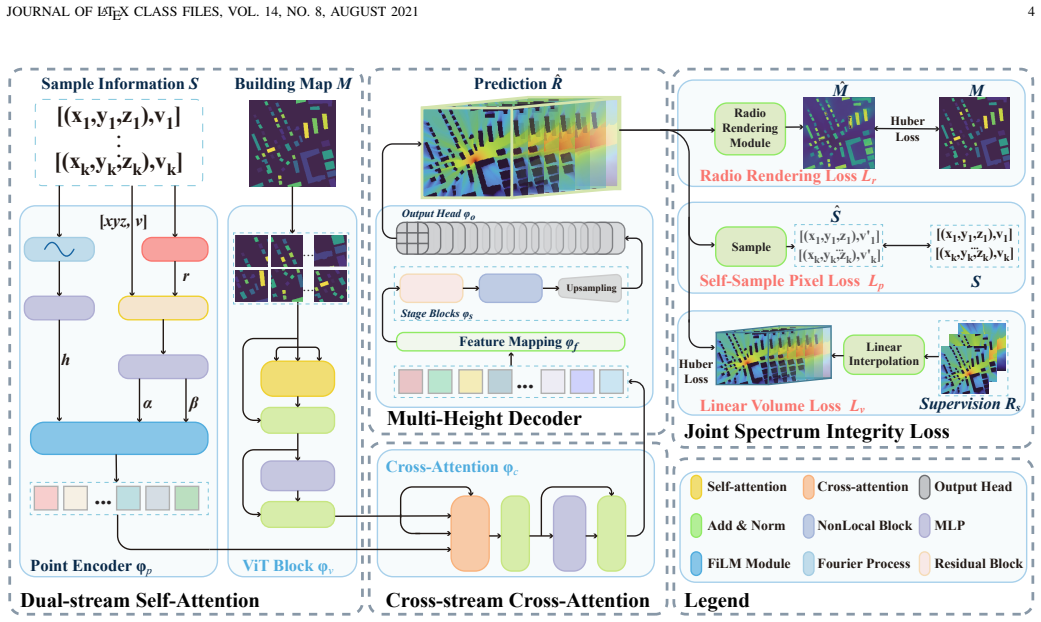
RadioFormer3D reconstructs 3D radio maps from sparse horizontal measurements by enforcing spectrum integrity across volumes, maps, and pixels.
A machine-rendered reading of the paper's core claim, the machinery that carries it, and where it could break.
Core claim
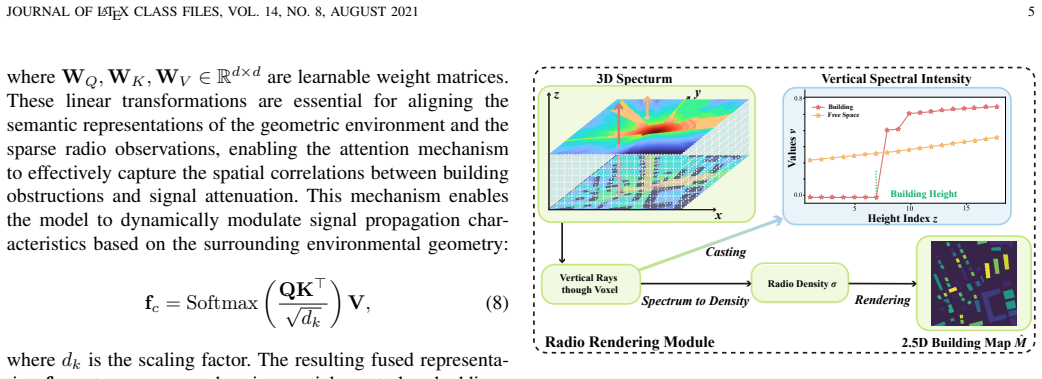
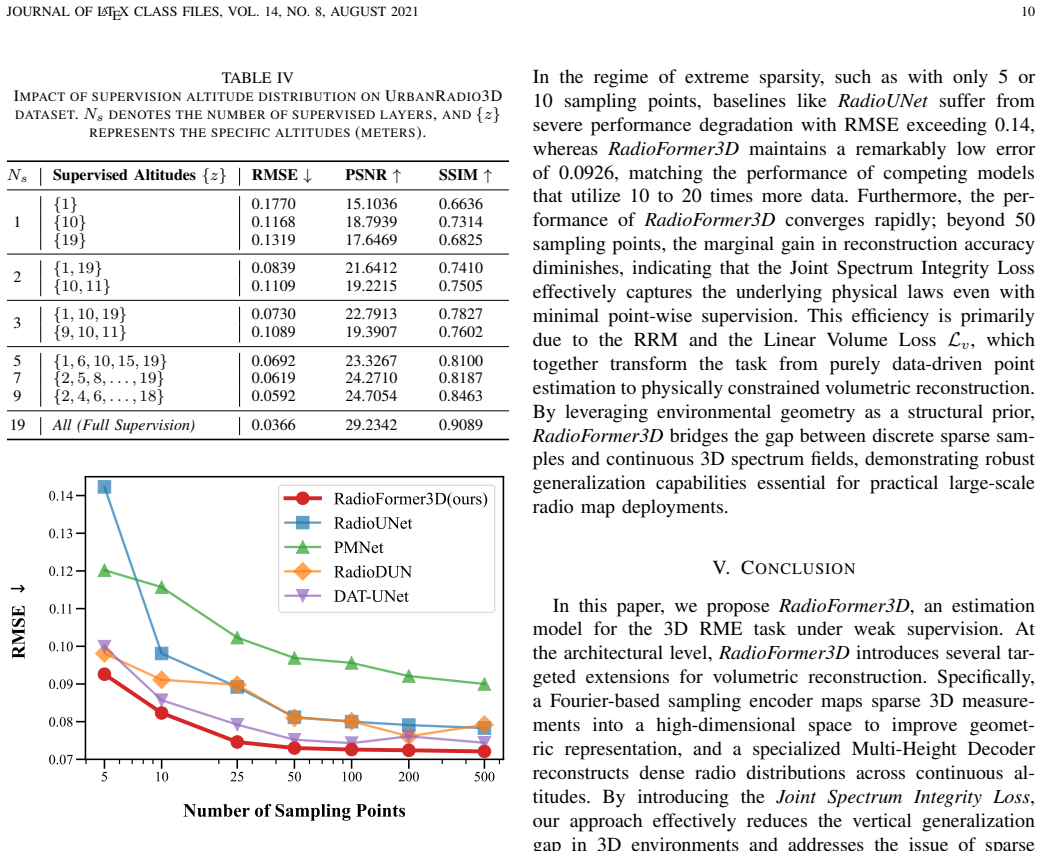
RadioFormer3D, built on the dual-stream multi-granularity fusion of RadioFormer, adds a Fourier-based sampling encoder and volumetric decoder to process sparse 3D measurements; its Joint Spectrum Integrity Loss unifies volume-level pseudo-label supervision, map-level geometry-aware radio rendering, and pixel-level localized constraints so the model can recover complex vertical structural relationships from limited horizontal data alone, yielding superior overall performance and improved reconstruction at unlabeled altitudes.
What carries the argument
The Joint Spectrum Integrity Loss, which integrates volume-level pseudo-label supervision, map-level geometry-aware radio rendering, and pixel-level localized constraints to infer vertical structure from sparse horizontal inputs.
If this is right
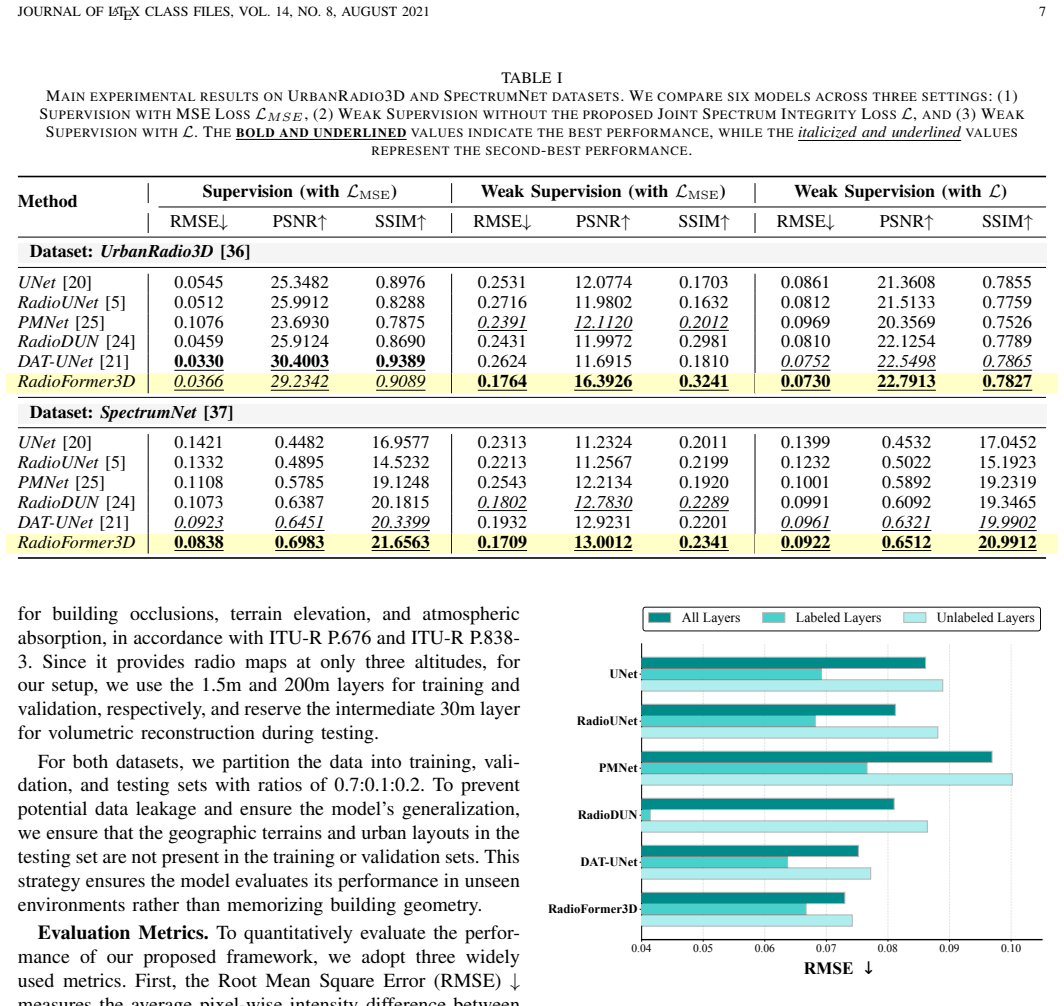
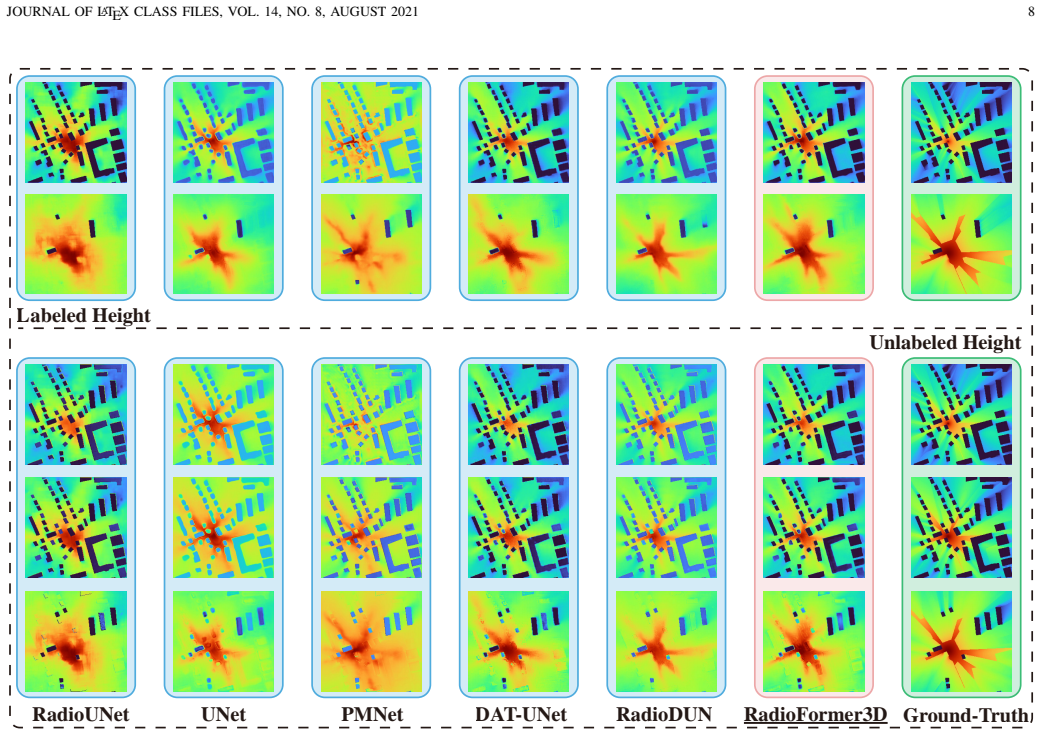
- Superior reconstruction quality at unlabeled altitudes compared with representative existing methods.
- Favorable accuracy versus inference-efficiency trade-off on multiple radio map datasets.
- Support for future 3D environment-aware wireless networks that require volumetric spectrum awareness.
- Effective use of weak supervision to handle increased spatial sparsity when extending from 2D to 3D radio mapping.
Where Pith is reading between the lines
- The loss formulation could transfer to other anisotropic volumetric tasks where dense sampling exists in only one or two axes.
- Deployment would need checks against real flight-collected data whose altitude fading statistics differ from the pseudo-label generation process.
- Larger spatial extents could reveal whether the Fourier encoder continues to scale without accuracy loss.
- The same architecture might support incremental updating when new horizontal slices become available over time.
Load-bearing premise
The assumption that the combined pseudo-label, rendering, and constraint terms can reliably recover vertical propagation patterns when only horizontal slices are directly observed.
What would settle it
A set of real continuous-altitude radio measurements in a test volume where the model's predicted signal values at the unlabeled heights deviate substantially from the measured ground truth.
Figures

read the original abstract
With the emergence of wireless applications in three-dimensional environments, such as the low-altitude airspace and 3D heterogeneous networks, radio map estimation is increasingly required to characterize signal propagation across both horizontal and vertical dimensions. However, extending radio map estimation from 2D to 3D remains challenging due to increased spatial sparsity and limited supervision across continuous altitudes. In this paper, we propose \textbf{\textit{RadioFormer3D}}, a specialized model for volumetric spectrum reconstruction under weak supervision. Building on the dual-stream, multi-granularity fusion architecture of \textit{RadioFormer}, \textit{RadioFormer3D} introduces a Fourier-based sampling encoder and a volumetric decoder to efficiently process sparse measurements in 3D space. To alleviate the lack of vertical supervision, we propose the \textbf{\textit{Joint Spectrum Integrity Loss}}, which integrates volume-level pseudo-label supervision, map-level geometry-aware radio rendering, and pixel-level localized constraints within a unified optimization scheme. This design enables the model to capture complex vertical structural relationships more effectively under sparse supervision. Extensive experiments across several radio map datasets show that \textit{RadioFormer3D} achieves superior overall performance compared to representative existing methods. In particular, it demonstrates improved reconstruction quality at unlabeled altitudes while maintaining a favorable trade-off between accuracy and inference efficiency, positioning it as a highly promising solution for future 3D environment-aware wireless networks.
Editorial analysis
A structured set of objections, weighed in public.
Referee Report
Summary. The paper proposes RadioFormer3D, extending the dual-stream RadioFormer architecture with a Fourier-based sampling encoder and volumetric decoder for weakly supervised 3D radio map estimation in low-altitude airspace. It introduces the Joint Spectrum Integrity Loss, which combines volume-level pseudo-label supervision, map-level geometry-aware radio rendering, and pixel-level localized constraints to address limited vertical supervision from sparse horizontal measurements. Experiments on multiple radio map datasets claim superior overall performance versus existing methods, with particular gains in reconstruction quality at unlabeled altitudes and a favorable accuracy-inference efficiency trade-off.
Significance. If the central claims hold, the work would advance 3D spectrum reconstruction for environment-aware wireless networks by demonstrating that a multi-term loss can recover vertical propagation structure under weak supervision. The extension of generative modeling to volumetric radio maps with explicit handling of altitude sparsity addresses a practical gap in low-altitude airspace applications. No machine-checked proofs or parameter-free derivations are present, but the emphasis on inference efficiency is a positive attribute if validated.
major comments (1)
- [Abstract] Abstract (Joint Spectrum Integrity Loss): the headline claim of improved reconstruction quality at unlabeled altitudes rests on the assertion that the three-term loss recovers complex vertical structural relationships from sparse horizontal data alone. No information is supplied on pseudo-label generation (e.g., whether derived solely from the same horizontal measurements), the explicit formulation of the geometry-aware rendering term, or any ablation isolating each component's contribution to vertical consistency. This absence makes it impossible to determine whether the loss supplies new vertical information or merely regularizes toward plausible but unverified solutions, directly undermining assessment of the central empirical result.
Simulated Author's Rebuttal
We thank the referee for their constructive feedback on the manuscript. We address the major comment point by point below.
read point-by-point responses
-
Referee: [Abstract] Abstract (Joint Spectrum Integrity Loss): the headline claim of improved reconstruction quality at unlabeled altitudes rests on the assertion that the three-term loss recovers complex vertical structural relationships from sparse horizontal data alone. No information is supplied on pseudo-label generation (e.g., whether derived solely from the same horizontal measurements), the explicit formulation of the geometry-aware rendering term, or any ablation isolating each component's contribution to vertical consistency. This absence makes it impossible to determine whether the loss supplies new vertical information or merely regularizes toward plausible but unverified solutions, directly undermining assessment of the central empirical result.
Authors: We agree that the abstract is too concise and omits key implementation details, which hinders evaluation of the central claim. The full manuscript details pseudo-label generation in Section 3.2 (derived solely from horizontal measurements via physics-informed interpolation), the geometry-aware rendering term in Equation (6) (a differentiable ray-integration approximation), and component ablations in Section 4.3/Table 4 (showing each term's isolated contribution to vertical consistency). We will revise the abstract to briefly reference these elements. The experiments demonstrate that removing any loss term degrades performance at unlabeled altitudes, supporting that the formulation recovers vertical structure rather than mere regularization. revision: yes
Circularity Check
No circularity: derivation is self-contained architectural and loss design.
full rationale
The abstract and description introduce RadioFormer3D as an extension of RadioFormer with a new Joint Spectrum Integrity Loss that combines three explicitly described terms (volume-level pseudo-label supervision, map-level geometry-aware radio rendering, pixel-level constraints). No equations, fitting procedures, or self-citations are shown that reduce any claimed prediction or result to the inputs by construction. The central claim of improved vertical reconstruction rests on the independent design of the loss terms rather than on any self-referential definition or fitted parameter renamed as output. This is the normal non-circular case for a methods paper proposing a new model and objective.
Axiom & Free-Parameter Ledger
Reference graph
Works this paper leans on
-
[1]
Blockage- resilient integrated sensing and communication in mmwave networks: Multi-view collaboration and efficient task allocation,
Y . Cui, H. Ding, Y . Ma, X. Li, H. Zhang, and Y . Fang, “Blockage- resilient integrated sensing and communication in mmwave networks: Multi-view collaboration and efficient task allocation,”IEEE Trans. Mob. Comput., 2025
2025
-
[2]
Cram ´er-rao bound analysis and beam- forming design for integrated sensing and communication with extended targets,
Y . Wang, M. Tao, and S. Sun, “Cram ´er-rao bound analysis and beam- forming design for integrated sensing and communication with extended targets,”IEEE Transactions on Wireless Communications, 2024
2024
-
[3]
A spatiotemporal approach for secure crowd- sourced radio environment map construction,
Y . Hu and R. Zhang, “A spatiotemporal approach for secure crowd- sourced radio environment map construction,”IEEE/ACM Transactions on Networking, 2020. JOURNAL OF LATEX CLASS FILES, VOL. 14, NO. 8, AUGUST 2021 11
2020
-
[4]
Wireless communications with reconfigurable intelligent surface: Path loss modeling and experimental measurement,
W. Tang, M. Z. Chen, X. Chen, J. Y . Dai, Y . Han, M. Di Renzo, Y . Zeng, S. Jin, Q. Cheng, and T. J. Cui, “Wireless communications with reconfigurable intelligent surface: Path loss modeling and experimental measurement,”IEEE Transactions on Wireless Communications, 2021
2021
-
[5]
Radiounet: Fast radio map estimation with convolutional neural networks,
R. Levie, C ¸ . Yapar, G. Kutyniok, and G. Caire, “Radiounet: Fast radio map estimation with convolutional neural networks,”IEEE Trans. Wirel. Commun., 2021
2021
-
[7]
Dataset of pathloss and toa radio maps with localization application,
C. Yapar, R. Levie, G. Kutyniok, and G. Caire, “Dataset of pathloss and toa radio maps with localization application,” 2022
2022
-
[8]
Joint trajectory and communication design for multi-uav enabled wireless networks,
Q. Wu, Y . Zeng, and R. Zhang, “Joint trajectory and communication design for multi-uav enabled wireless networks,”IEEE Transactions on Wireless Communications, 2018
2018
-
[9]
A mobility-resilient spectrum sharing framework for operating wireless uavs in the 6 ghz band,
J. Hu, S. K. Moorthy, A. Harindranath, Z. Zhang, Z. Zhao, N. Mas- tronarde, E. S. Bentley, S. Pudlewski, and Z. Guan, “A mobility-resilient spectrum sharing framework for operating wireless uavs in the 6 ghz band,”IEEE/ACM Transactions on Networking, 2023
2023
-
[10]
Sparse bayesian learning-based hierarchical construction for 3d radio environment maps incorporating channel shadowing,
J. Wang, Q. Zhu, Z. Lin, J. Chen, G. Ding, Q. Wu, G. Gu, and Q. Gao, “Sparse bayesian learning-based hierarchical construction for 3d radio environment maps incorporating channel shadowing,”IEEE Transactions on Wireless Communications, 2024
2024
-
[11]
Radio map assisted multi-uav target searching,
C. He, Y . Dong, and Z. J. Wang, “Radio map assisted multi-uav target searching,”IEEE Transactions on Wireless Communications, 2023
2023
-
[12]
Radioformer: A multiple-granularity radio map estimation transformer with 1‱spatial sampling,
Z. Fang, K. Liu, K. Chen, Q. Liu, J. Zhang, L. Song, and Y . Wang, “Radioformer: A multiple-granularity radio map estimation transformer with 1‱spatial sampling,”CoRR, 2025
2025
-
[13]
Bayesian active learning for sample efficient 5g radio map reconstruction,
K. D. Polyzos, A. Sadeghi, W. Ye, S. Sleder, K. Houssou, J. Calder, Z.-L. Zhang, and G. B. Giannakis, “Bayesian active learning for sample efficient 5g radio map reconstruction,”IEEE Transactions on Wireless Communications, 2024
2024
-
[14]
Deep completion autoencoders for radio map estimation,
Y . Teganya and D. Romero, “Deep completion autoencoders for radio map estimation,”IEEE Transactions on Wireless Communications, 2022
2022
-
[15]
A self-supervised learning-based channel estimation for irs-aided communication without ground truth,
Z. Zhang, T. Ji, H. Shi, C. Li, Y . Huang, and L. Yang, “A self-supervised learning-based channel estimation for irs-aided communication without ground truth,”IEEE Transactions on Wireless Communications, 2023
2023
-
[16]
Wide- band millimeter-wave propagation measurements and channel models for future wireless communication system design,
T. S. Rappaport, G. R. MacCartney, M. K. Samimi, and S. Sun, “Wide- band millimeter-wave propagation measurements and channel models for future wireless communication system design,”IEEE Transactions on Communications, 2015
2015
-
[17]
Ray tracing for radio propagation modeling: Principles and applications,
Z. Yun and M. F. Iskander, “Ray tracing for radio propagation modeling: Principles and applications,”IEEE Access, 2015
2015
-
[18]
A statistical basis for lognormal shadowing effects in multipath fading channels,
A. Coulson, A. Williamson, and R. Vaughan, “A statistical basis for lognormal shadowing effects in multipath fading channels,”IEEE Trans- actions on Communications, 1998
1998
-
[19]
Radio map estimation: A data-driven approach to spectrum cartography,
D. Romero and S.-J. Kim, “Radio map estimation: A data-driven approach to spectrum cartography,”IEEE Signal Processing Magazine, 2022
2022
-
[20]
U-net: Convolutional networks for biomedical image segmentation,
O. Ronneberger, P. Fischer, and T. Brox, “U-net: Convolutional networks for biomedical image segmentation,” inMedical Image Computing and Computer-Assisted Intervention - MICCAI 2015, N. Navab, J. Horneg- ger, W. M. W. III, and A. F. Frangi, Eds., 2015
2015
-
[21]
Paying deformable attention to sparse spatial observations for deep radio map estimation,
K. Liu, C. Qiu, K. Chen, Q. Zheng, L. Song, and Y . Wang, “Paying deformable attention to sparse spatial observations for deep radio map estimation,”IEEE Transactions on Cognitive Communications and Networking, 2026
2026
-
[22]
Deformable convolutional networks,
J. Dai, H. Qi, Y . Xiong, Y . Li, G. Zhang, H. Hu, and Y . Wei, “Deformable convolutional networks,” in2017 IEEE International Conference on Computer Vision (ICCV), 2017
2017
-
[23]
Deformable convnets v2: More deformable, better results,
X. Zhu, H. Hu, S. Lin, and J. Dai, “Deformable convnets v2: More deformable, better results,” in2019 IEEE/CVF Conference on Computer Vision and Pattern Recognition (CVPR), 2019
2019
-
[24]
Radiodun: A physics-inspired deep unfolding network for radio map estimation,
T. Chen, Z. Zhou, Z. Fang, W. Zou, K. Liu, K. Chen, Y . Zhang, and Y . Wang, “Radiodun: A physics-inspired deep unfolding network for radio map estimation,” 2025
2025
-
[25]
Pmnet: Robust pathloss map prediction via supervised learning,
J. Lee, O. G. Serbetci, D. P. Selvam, and A. F. Molisch, “Pmnet: Robust pathloss map prediction via supervised learning,” inIEEE Global Communications Conference, GLOBECOM 2023,, 2023, pp. 4601–4606
2023
-
[26]
Attention is all you need,
A. Vaswani, N. Shazeer, N. Parmar, J. Uszkoreit, L. Jones, A. N. Gomez, L. Kaiser, and I. Polosukhin, “Attention is all you need,” inAdvances in Neural Information Processing Systems 30: Annual Conference on Neural Information Processing Systems, NIPS 2017, I. Guyon, U. von Luxburg, S. Bengio, H. M. Wallach, R. Fergus, S. V . N. Vishwanathan, and R. Garne...
2017
-
[27]
Nerf: Representing scenes as neural radiance fields for view synthesis,
B. Mildenhall, P. P. Srinivasan, M. Tancik, J. T. Barron, R. Ramamoorthi, and R. Ng, “Nerf: Representing scenes as neural radiance fields for view synthesis,”Communications of the ACM, 2021
2021
-
[28]
3d gaussian splatting for real-time radiance field rendering
B. Kerbl, G. Kopanas, T. Leimk ¨uhler, G. Drettakiset al., “3d gaussian splatting for real-time radiance field rendering.”ACM Trans. Graph., vol. 42, no. 4, pp. 139–1, 2023
2023
-
[29]
Nerf2: Neural radio-frequency radiance fields,
X. Zhao, Z. An, Q. Pan, and L. Yang, “Nerf2: Neural radio-frequency radiance fields,” inProceedings of the 29th Annual International Con- ference on Mobile Computing and Networking, 2023
2023
-
[30]
Newrf: A deep learning framework for wireless radiation field reconstruction and channel prediction,
H. Lu, C. Vattheuer, B. Mirzasoleiman, and O. Abari, “Newrf: A deep learning framework for wireless radiation field reconstruction and channel prediction,”arXiv preprint arXiv:2403.03241, 2024
-
[31]
Neural representation for wireless radiation field reconstruction: A 3d gaussian splatting approach,
C. Wen, J. Tong, Y . Hu, Z. Lin, and J. Zhang, “Neural representation for wireless radiation field reconstruction: A 3d gaussian splatting approach,”IEEE Transactions on Wireless Communications, 2025
2025
-
[32]
An image is worth 16x16 words: Trans- formers for image recognition at scale,
A. Dosovitskiy, L. Beyer, A. Kolesnikov, D. Weissenborn, X. Zhai, T. Unterthiner, M. Dehghani, M. Minderer, G. Heigold, S. Gelly, J. Uszkoreit, and N. Houlsby, “An image is worth 16x16 words: Trans- formers for image recognition at scale,” in9th International Conference on Learning Representations, ICLR 2021, 2021
2021
-
[33]
Bracewell,The Fourier Transform and its Applications, Tokyo
R. Bracewell,The Fourier Transform and its Applications, Tokyo
-
[34]
Learning represen- tations by back-propagating errors,
D. E. Rumelhart, G. E. Hinton, and R. J. Williams, “Learning represen- tations by back-propagating errors,”Nature, 1986
1986
-
[35]
P. J. Huber,Robust Estimation of a Location Parameter, 1992
1992
-
[36]
Radiodiff-3d: A 3d× 3d radio map dataset and generative diffusion based benchmark for 6g environment-aware communication,
X. Wang, Q. Zhang, N. Cheng, J. Chen, Z. Zhang, Z. Li, S. Cui, and X. Shen, “Radiodiff-3d: A 3d× 3d radio map dataset and generative diffusion based benchmark for 6g environment-aware communication,” IEEE Transactions on Network Science and Engineering, 2026
2026
-
[37]
Generative ai on spectrumnet: An open benchmark of multiband 3- d radio maps,
S. Zhang, S. Jiang, W. Lin, Z. Fang, K. Liu, H. Zhang, and K. Chen, “Generative ai on spectrumnet: An open benchmark of multiband 3- d radio maps,”IEEE Transactions on Cognitive Communications and Networking, 2025
2025
-
[38]
Image quality assessment: from error visibility to structural similarity,
Z. Wang, A. C. Bovik, H. R. Sheikh, and E. P. Simoncelli, “Image quality assessment: from error visibility to structural similarity,”IEEE Trans. Image Process., 2004
2004
-
[39]
Radiodiff: An effective generative diffusion model for sampling-free dynamic radio map construction,
X. Wang, K. Tao, N. Cheng, Z. Yin, Z. Li, Y . Zhang, and X. Shen, “Radiodiff: An effective generative diffusion model for sampling-free dynamic radio map construction,”IEEE Transactions on Cognitive Communications and Networking, 2025
2025
-
[40]
Physics-informed diffusion model for radio environment map reconstruction from sparse measurements,
Z. Ye, Y . Shao, T. Fan, C. Zhang, F. Wu, F. Liu, W. Fan, B. Tang, and Y . Liu, “Physics-informed diffusion model for radio environment map reconstruction from sparse measurements,” in2025 30th Asia-Pacific Conference on Communications (APCC), 2025
2025
discussion (0)
Sign in with ORCID, Apple, or X to comment. Anyone can read and Pith papers without signing in.