Two-way coupling of gravity waves and wind farm wakes: a reduced-order boundary-layer model
Pith reviewed 2026-06-29 05:42 UTC · model grok-4.3
The pith
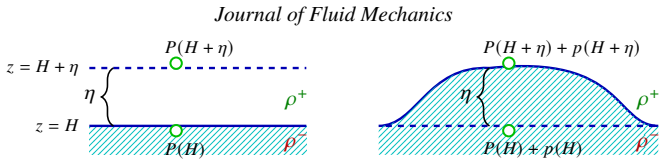
A reduced-order boundary-layer model captures two-way coupling between gravity waves and wind-farm wakes through a dynamic condition at the capping inversion.
A machine-rendered reading of the paper's core claim, the machinery that carries it, and where it could break.
Core claim
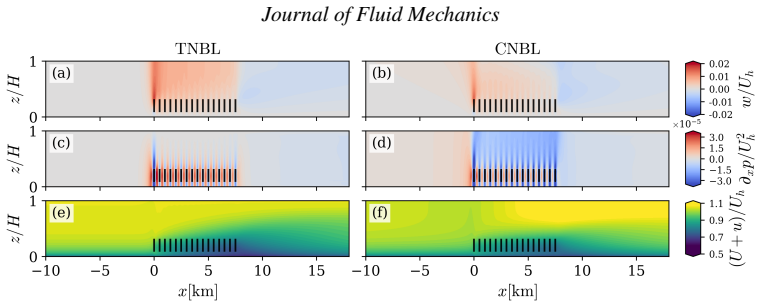
The two-way coupling between gravity waves and wind-farm wakes is represented by separate governing equations for the boundary layer and the overlying stratified free atmosphere that remain coupled through a dynamic boundary condition at the capping inversion; a mixed spectral-finite-difference discretization keeps the model efficient while preserving vertical structure, and the resulting predictions match the upstream blockage and accelerated wake recovery observed in large-eddy simulations.
What carries the argument
The dynamic boundary condition at the capping inversion that transmits the feedback of gravity waves onto the boundary-layer flow.
If this is right
- The model predicts upstream blockage induced by adverse pressure gradients from gravity waves.
- It reproduces accelerated wake recovery within and downwind of the farm driven by favourable pressure gradients.
- The framework matches both internal wind-farm flow and large-scale gravity-wave effects in LES comparisons.
- The mixed discretization retains vertical boundary-layer structure at modest computational cost.
Where Pith is reading between the lines
- Wind-farm power estimates that omit this coupling may understate losses from blockage in very large arrays.
- The same linear-coupling structure could be tested in time-dependent or weakly nonlinear regimes by relaxing the linearization.
- Integration into mesoscale weather models might improve forecasts for offshore farms where stratification is pronounced.
- Analogous reduced-order treatments could be explored for other wave-boundary-layer problems such as urban or oceanic flows.
Load-bearing premise
Linearizing the non-hydrostatic Boussinesq equations and applying simplifications appropriate to each region produces equations that remain valid when the regions are joined by the dynamic boundary condition.
What would settle it
Large-eddy simulations of a wind farm in stratified flow that show neither upstream blockage nor accelerated wake recovery under conditions where the model predicts both would falsify the coupling framework.
Figures


read the original abstract
This paper develops a reduced-order framework for modelling the two-way coupling between gravity waves and turbulent wakes in large-scale wind farms. Linearising the non-hydrostatic Boussinesq equations and introducing simplifications appropriate to the boundary layer and the overlying stratified free atmosphere yield separate governing equations for the two regions. These are coupled through a dynamic boundary condition at the capping inversion, which directly captures the feedback of gravity waves on the boundary-layer flow. A mixed spectral-finite-difference discretisation yields a computationally efficient model while retaining vertical boundary-layer structure. Comparisons with large-eddy simulations (LES) confirm the model successfully reproduces both internal wind-farm flow and large-scale gravity-wave effects. It captures the upstream blockage induced by adverse pressure gradients, as well as the accelerated wake recovery within and downwind of the farm, driven by favourable pressure gradients.
Editorial analysis
A structured set of objections, weighed in public.
Referee Report
Summary. The paper develops a reduced-order model for two-way coupling between gravity waves and wind-farm wakes. It linearizes the non-hydrostatic Boussinesq equations, applies boundary-layer and free-atmosphere simplifications to obtain separate governing equations, couples the regions via a dynamic condition at the capping inversion, discretizes with a mixed spectral-finite-difference scheme, and reports that the resulting model reproduces LES results for upstream blockage and accelerated wake recovery.
Significance. If the linearization and coupling remain valid, the framework supplies an efficient tool for capturing gravity-wave feedback on farm-scale flows that is absent from standard wake models; this would be useful for assessing blockage, recovery, and large-scale atmospheric interactions in wind-energy applications.
major comments (3)
- [Abstract, §4] Abstract and §4 (results): the claim that the model 'successfully reproduces' LES results for blockage and wake recovery is stated without quantitative error metrics (e.g., L2 norms, point-wise velocity or pressure differences, or R² values) or a stated validity range for the linearization; this prevents assessment of whether the reproduction is within acceptable engineering tolerance.
- [§2, §3] §2 (model derivation) and §3 (coupling): the statement that the linearized equations 'remain valid when coupled through the dynamic boundary condition' is asserted without an a-posteriori evaluation of the neglected nonlinear advection terms evaluated on the computed solution; for finite farm forcing this check is load-bearing for the central claim.
- [§3] §3 (discretization and boundary conditions): no discussion is provided of how the dynamic inversion condition is discretized or of any numerical tests confirming that the coupling does not re-introduce O(1) perturbations that violate the small-amplitude premise inside the farm.
minor comments (2)
- Notation for the inversion displacement and pressure jump should be defined once at first use and used consistently thereafter.
- Figure captions for the LES comparison panels should state the exact farm layout, inversion height, and stratification parameters used in each case.
Simulated Author's Rebuttal
We thank the referee for the constructive and detailed comments. We address each major comment below, indicating where revisions will be made to improve the manuscript.
read point-by-point responses
-
Referee: [Abstract, §4] Abstract and §4 (results): the claim that the model 'successfully reproduces' LES results for blockage and wake recovery is stated without quantitative error metrics (e.g., L2 norms, point-wise velocity or pressure differences, or R² values) or a stated validity range for the linearization; this prevents assessment of whether the reproduction is within acceptable engineering tolerance.
Authors: We agree that quantitative metrics are needed for a rigorous assessment. In the revised manuscript we will add L2 norms of velocity and pressure differences between the model and LES, selected point-wise comparisons, and an explicit statement of the linearization validity range based on perturbation amplitudes relative to the mean flow. These additions will clarify performance within engineering tolerances. revision: yes
-
Referee: [§2, §3] §2 (model derivation) and §3 (coupling): the statement that the linearized equations 'remain valid when coupled through the dynamic boundary condition' is asserted without an a-posteriori evaluation of the neglected nonlinear advection terms evaluated on the computed solution; for finite farm forcing this check is load-bearing for the central claim.
Authors: We acknowledge that an explicit a-posteriori check strengthens the central claim. The revised manuscript will include estimates of the neglected nonlinear advection terms evaluated on the computed solution, compared against the retained linear terms, to confirm they remain small for the farm forcings examined. revision: yes
-
Referee: [§3] §3 (discretization and boundary conditions): no discussion is provided of how the dynamic inversion condition is discretized or of any numerical tests confirming that the coupling does not re-introduce O(1) perturbations that violate the small-amplitude premise inside the farm.
Authors: We will expand the discretization section to detail the implementation of the dynamic inversion condition within the mixed spectral-finite-difference scheme. We will also add numerical tests showing that the coupled solution keeps perturbations inside the farm within the small-amplitude regime assumed by the linearization. revision: yes
Circularity Check
No circularity: derivation from linearized equations is self-contained
full rationale
The paper derives its reduced-order model directly from linearization of the non-hydrostatic Boussinesq equations plus boundary-layer simplifications, followed by coupling at the capping inversion. No equations or parameters are shown to be fitted to the target data and then re-presented as predictions; no self-citation chain is invoked to justify uniqueness or an ansatz; and the central coupling step is presented as following from the linearized governing equations rather than reducing to the inputs by construction. LES comparisons function as external validation, not as the source of the model itself.
Axiom & Free-Parameter Ledger
Reference graph
Works this paper leans on
-
[1]
& Meyers, J.2017 Boundary-layer development and gravity waves in conventionally neutral wind farms.Journal of Fluid Mechanics814, 95–130
Allaerts, D. & Meyers, J.2017 Boundary-layer development and gravity waves in conventionally neutral wind farms.Journal of Fluid Mechanics814, 95–130
2017
-
[2]
˚A., Berkesten H ¨agglund, P
Ebenhoch, R., Muro, B., Dahlberg, J. ˚A., Berkesten H ¨agglund, P. & Segalini, A.2017 A linearized numerical model of wind-farm flows.Wind Energy20(5), 859–875
2017
-
[3]
Modelling Farm-to-Farm Interaction Using a Fast Linearised Numerical Approach
Everley, Alexia, Kafiabad, Hossein A. & Bastankhah, Majid2026 Modelling farm-to-farm interaction using a fast linearised numerical approach, arXiv: 2605.04782
work page internal anchor Pith review Pith/arXiv arXiv
-
[4]
Khan, Mehtab Ahmed, Allaerts, Dries, Watson, Simon J. & Churchfield, Matthew J.2025 Investigating the relationship between simulation parameters and flow variables in simulating atmospheric gravity waves for wind energy applications.Wind Energy Science10(6), 1167–1185
2025
-
[5]
Khan, Mehtab Ahmed, Churchfield, Matthew J. & Watson, Simon J.2026 Dependence of wind- farm-induced gravity waves and wind farm performance on non-dimensional atmospheric parameters and simulation configuration.Wind Energy Science11(5), 1631–1652
2026
-
[6]
& Meyers, J.2024 A parametric large-eddy simulation study of wind-farm blockage and gravity waves in conventionally neutral boundary layers.Journal of Fluid Mechanics979, A54
Lanzilao, L. & Meyers, J.2024 A parametric large-eddy simulation study of wind-farm blockage and gravity waves in conventionally neutral boundary layers.Journal of Fluid Mechanics979, A54
2024
-
[7]
& Meneveau, Charles 2025 JHTDB-wind: a web-accessible large-eddy simulation database of a wind farm with virtual sensor querying.Wind Energy Science10(12), 2821–2840
Lemson, Gerard, Yao, Hanxun, Szalay, Alexander S., Gayme, Dennice F. & Meneveau, Charles 2025 JHTDB-wind: a web-accessible large-eddy simulation database of a wind farm with virtual sensor querying.Wind Energy Science10(12), 2821–2840. 0X0-11
2025
discussion (0)
Sign in with ORCID, Apple, or X to comment. Anyone can read and Pith papers without signing in.