JWST Predictions for z > 10 Galaxies from the Renaissance Simulations -- I: Photometry and Sizes
Pith reviewed 2026-06-29 06:19 UTC · model grok-4.3
The pith
Renaissance Simulations reproduce JWST z>10 galaxy trends at lower stellar masses.
A machine-rendered reading of the paper's core claim, the machinery that carries it, and where it could break.
Core claim
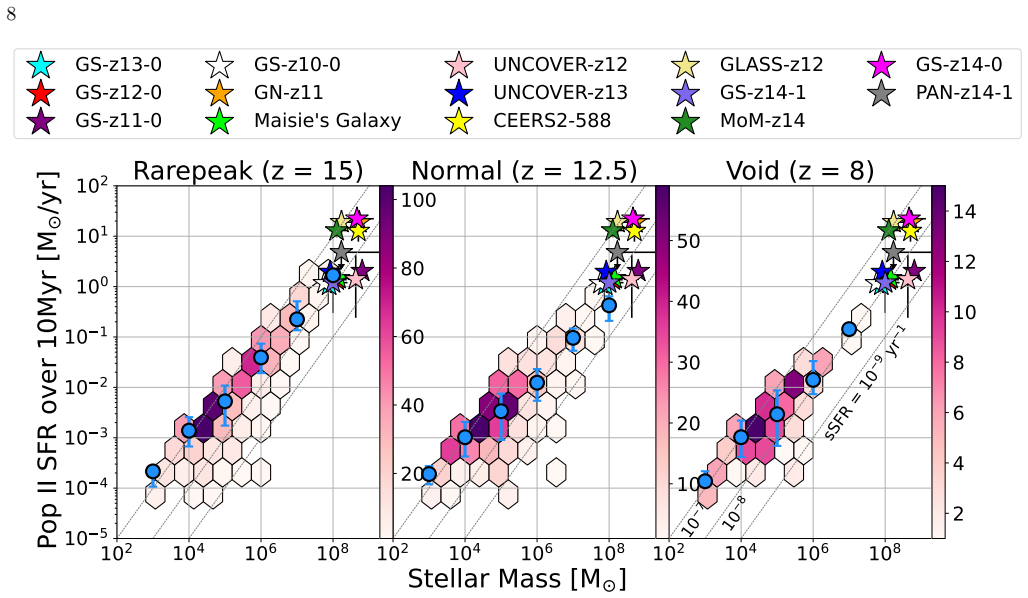
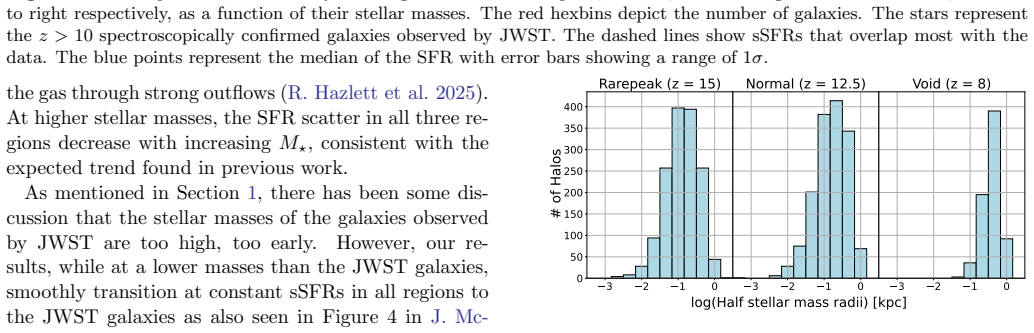
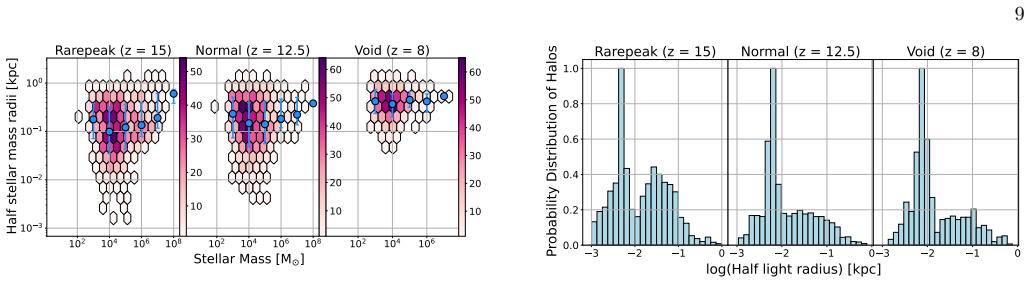
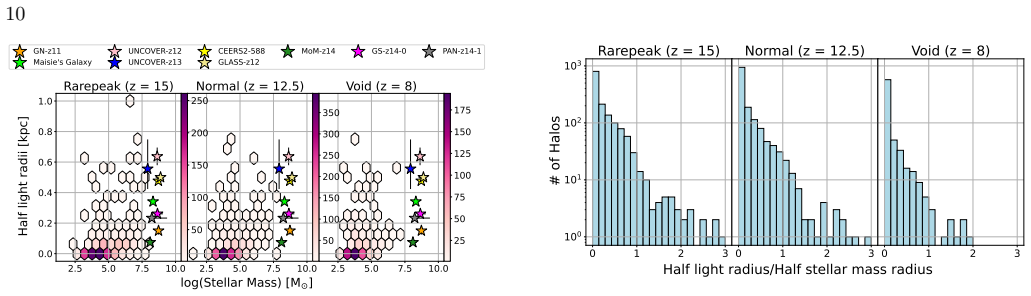
The Renaissance galaxies provide an accurate representation of the formation history of JWST's z > 10 discoveries and follow the trends observed in JWST galaxies but extended to lower masses. Stellar masses range from approximately 10^3 to 10^8 solar masses, overlapping JWST galaxies from 10^7 to 10^9 solar masses; star formation rates increase from 10^{-4} to 10 solar masses per year and overlap the lower JWST range of 1-20 solar masses per year; the galaxies are compact with half-light radii mostly 1-10 parsecs and half-stellar-mass radii around 0.1 kiloparsec; Sersic indices lie between 0 and 4; and the galaxies are bluer while transitioning into the absolute UV magnitudes of the JWST mai
What carries the argument
Mock photometry and size measurements generated from the Renaissance Simulations for galaxies at z>10, used to compare stellar mass, SFR, half-light radius, half-mass radius, Sersic index, and UV magnitude distributions against JWST observations.
If this is right
- The simulations extend the galaxy main sequence to stellar masses three orders of magnitude below current JWST detections.
- Galaxy morphology shows little change across the simulated mass range, with most objects remaining compact.
- The simulated color and magnitude trends connect directly to the observed JWST sequence, allowing the runs to fill in the faint end.
- The agreement makes the simulations a practical tool for predicting properties of still-fainter galaxies at these redshifts.
Where Pith is reading between the lines
- If the overlap holds, the simulations can be used to forecast the number density and detectability of galaxies below current JWST limits.
- The compactness prediction offers a clear target for future high-resolution imaging or lensing studies of z>10 systems.
- Any future discrepancy in size or color distributions would point to specific missing physics such as altered feedback efficiency at early times.
Load-bearing premise
The Renaissance Simulations correctly capture the dominant physical processes of star formation, feedback, metal enrichment, and cosmology that govern galaxy formation at z>10 without major missing ingredients or resolution limits that would change the reported overlaps.
What would settle it
Discovery of a large population of z>10 galaxies whose half-light radii lie systematically outside the 1-10 parsec range or whose stellar masses and SFRs fall well below the simulated lower bounds would falsify the claimed overlap.
Figures



read the original abstract
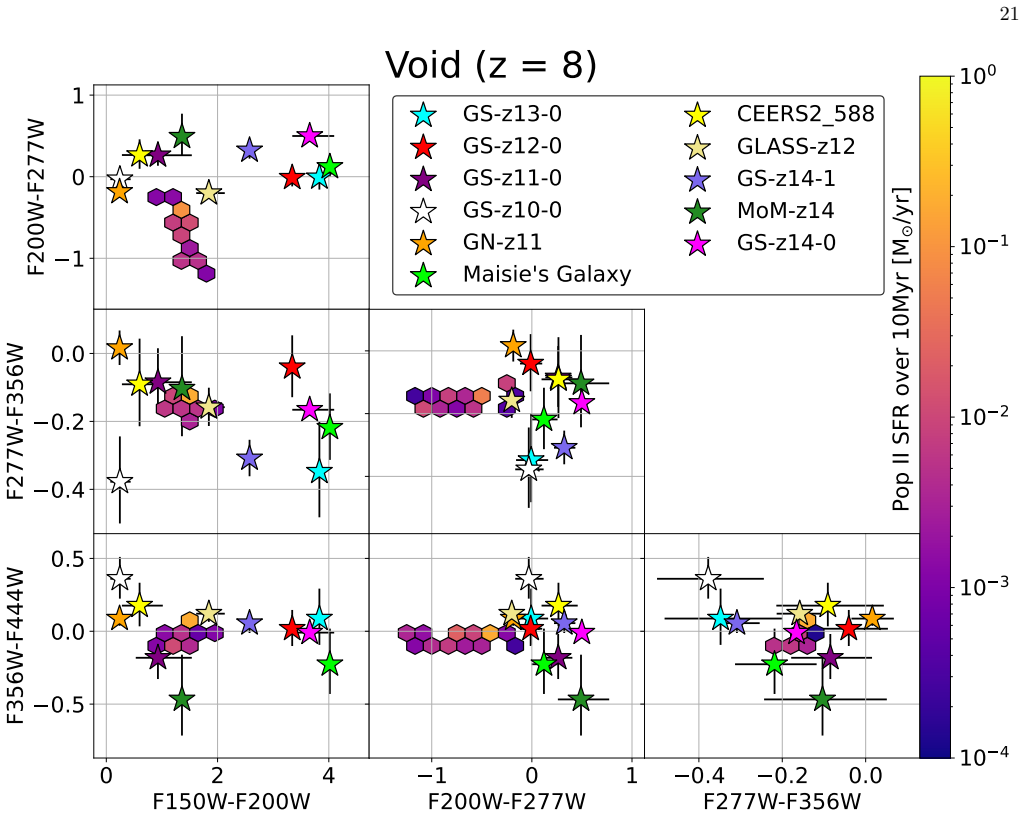
JWST has enabled new high redshift observations with 14 spectroscopically confirmed galaxies at $z > 10$ to date, leading to a need for high redshift, high resolution simulations to interpret these observations. We present the physical properties and mock observations of the galaxies in the Renaissance Simulations to add to the growing database of high redshift simulation data to guide and interpret observations. We find that they provide an accurate representation of the formation history of JWST's $z > 10$ discoveries and follow the trends observed in JWST galaxies but extended to lower masses. The stellar masses of the Renaissance galaxies range from $\approx 10^{3}$ to $10^8 M_{\odot}$ and overlap well with the $z > 10$ JWST galaxies with a stellar mass range of about $10^{7}$ to $10^9 M_{\odot}$. The simulated SFRs increase from $10^{-4}$ to $10^1 M_{\odot}yr^{-1}$, overlapping the JWST galaxies' lower SFRs in the range $1 - 20 M_{\odot}yr^{-1}$. These compact galaxies show minimal morphology change as their stellar masses increase with the majority of the half light radii between $1$ and $10$ pc and the majority of the half stellar mass radii around $0.1$ kpc; their Sersic indices vary between $0$ and $4$. The Renaissance galaxies are bluer and generally transition well into the absolute UV magnitudes of the JWST galaxies in the main sequence of galaxies. Overall, our simulations agree well with JWST's discoveries to date, making them a valuable tool in the continued effort to understand the high redshift Universe.
Editorial analysis
A structured set of objections, weighed in public.
Referee Report
Summary. The manuscript analyzes galaxies from the Renaissance Simulations at z > 10, reporting stellar masses from ~10^3 to 10^8 M⊙, SFRs from 10^{-4} to 10^1 M⊙ yr^{-1}, half-light radii mostly 1-10 pc (with half-stellar-mass radii ~0.1 kpc), Sersic indices 0-4, and blue colors with UV magnitudes that transition into the JWST range. Mock photometry is generated and compared to the 14 spectroscopically confirmed JWST z > 10 galaxies (masses ~10^7-10^9 M⊙, SFRs 1-20 M⊙ yr^{-1}). The central claim is that the simulated galaxies provide an accurate representation of JWST z > 10 formation histories, follow observed trends, and usefully extend them to lower masses.
Significance. If the resolution and subgrid physics concerns are addressed, the work supplies a valuable public database of mock photometry and sizes for interpreting JWST high-redshift observations, particularly by populating the lower-mass regime. Direct overlap comparisons and the extension of trends constitute a concrete contribution to the growing suite of high-z simulation-observation interfaces.
major comments (1)
- [Abstract; results on photometry and sizes] Abstract and results section on sizes/masses: the reported half-light radii (1-10 pc) and stellar masses down to 10^3 M⊙ are load-bearing for the claim that the simulations 'follow the trends observed in JWST galaxies but extended to lower masses' and 'provide an accurate representation.' The manuscript must explicitly state the Renaissance grid resolution, softening length, and minimum resolved mass relative to these scales; without this, it is impossible to determine whether the compact sizes and low-mass extension are physical or set by numerical floors.
minor comments (2)
- [Abstract] The abstract states 'overlap well' and 'agree well' but does not report quantitative metrics (e.g., distribution overlap statistics or selection-function-matched comparisons); adding these would strengthen the presentation without altering the central claim.
- [Methods] Mock photometry pipeline details (filter transmission, dust attenuation model, and any post-processing adjustments) should be cross-referenced to a dedicated methods subsection for reproducibility.
Simulated Author's Rebuttal
We thank the referee for their constructive feedback and recommendation for major revision. We address the single major comment below and agree to incorporate the requested numerical details to strengthen the manuscript.
read point-by-point responses
-
Referee: [Abstract; results on photometry and sizes] Abstract and results section on sizes/masses: the reported half-light radii (1-10 pc) and stellar masses down to 10^3 M⊙ are load-bearing for the claim that the simulations 'follow the trends observed in JWST galaxies but extended to lower masses' and 'provide an accurate representation.' The manuscript must explicitly state the Renaissance grid resolution, softening length, and minimum resolved mass relative to these scales; without this, it is impossible to determine whether the compact sizes and low-mass extension are physical or set by numerical floors.
Authors: We agree that explicitly stating the Renaissance Simulations' grid resolution, gravitational softening length, and minimum resolved stellar mass (relative to the reported half-light radii of 1-10 pc and stellar masses down to 10^3 M⊙) is necessary to support our claims. These parameters are documented in the original Renaissance papers (Wise et al. 2012, 2014), but were not restated in this manuscript. In the revised version, we will add a dedicated paragraph in the methods section quoting the relevant values (e.g., maximum grid resolution, softening, and the mass threshold for resolved star particles) and directly compare them to the galaxy scales reported in the results. This will demonstrate that the compact sizes and low-mass extension are resolved and physical rather than numerical artifacts, thereby reinforcing the overlap with JWST trends. revision: yes
Circularity Check
No circularity: direct comparison of independent simulation outputs to JWST observations
full rationale
The paper presents physical properties and mock observations derived from the Renaissance Simulations and compares them directly to independent JWST observational data on stellar masses, SFRs, sizes, and UV magnitudes. No equations, parameter fits, or self-citations are described that would reduce the reported overlaps or trends to quantities defined from the JWST sample itself. The agreement is an external, falsifiable comparison between simulation outputs and separate observations.
Axiom & Free-Parameter Ledger
Reference graph
Works this paper leans on
-
[1]
Adamo, A., Atek, H., Bagley, M. B., et al. 2025, Nature Astronomy, 9, 1134, doi: 10.1038/s41550-025-02624-5 Arrabal Haro, P., Dickinson, M., Finkelstein, S. L., et al. 2023, Nature, 622, 707, doi: 10.1038/s41586-023-06521-7 Astropy Collaboration, Robitaille, T. P., Tollerud, E. J., et al. 2013, A&A, 558, A33, doi: 10.1051/0004-6361/201322068 Astropy Colla...
-
[2]
Bakx, T. J. L. C., Zavala, J. A., Mitsuhashi, I., et al. 2023, MNRAS, 519, 5076, doi: 10.1093/mnras/stac3723
-
[3]
Baldwin, J. O., Nelson, E., Johnson, B. D., et al. 2024, Research Notes of the American Astronomical Society, 8, 29, doi: 10.3847/2515-5172/ad220a
-
[4]
Behroozi, P. S., Wechsler, R. H., & Wu, H.-Y. 2013, ApJ, 762, 109, doi: 10.1088/0004-637X/762/2/109
work page internal anchor Pith review doi:10.1088/0004-637x/762/2/109 2013
-
[5]
2022, MNRAS, 512, 3703, doi: 10.1093/mnras/stac648
Bird, S., Ni, Y., Di Matteo, T., et al. 2022, MNRAS, 512, 3703, doi: 10.1093/mnras/stac648
-
[6]
2023, MNRAS, 523, 1009, doi: 10.1093/mnras/stad1014
Bouwens, R., Illingworth, G., Oesch, P., et al. 2023, MNRAS, 523, 1009, doi: 10.1093/mnras/stad1014
-
[7]
2023, Nature Astronomy, 7, 731, doi: 10.1038/s41550-023-01937-7
Boylan-Kolchin, M. 2023, Nature Astronomy, 7, 731, doi: 10.1038/s41550-023-01937-7
-
[8]
2019, Journal of Open Source Software, 4, 1636, doi: 10.21105/joss.01636
Brummel-Smith, C., Bryan, G., Butsky, I., et al. 2019, Journal of Open Source Software, 4, 1636, doi: 10.21105/joss.01636
-
[9]
Bryan, G. L., Norman, M. L., O’Shea, B. W., et al. 2014, ApJS, 211, 19, doi: 10.1088/0067-0049/211/2/19 24
-
[10]
J., NIRSPEC Instrument Science Team, & JAESs Collaboration
Bunker, A. J., NIRSPEC Instrument Science Team, & JAESs Collaboration. 2020, in IAU Symposium, Vol. 352, Uncovering Early Galaxy Evolution in the ALMA and JWST Era, ed. E. da Cunha, J. Hodge, J. Afonso, L. Pentericci, & D. Sobral, 342–346, doi: 10.1017/S1743921319009463
-
[11]
Bunker, A. J., Saxena, A., Cameron, A. J., et al. 2023, A&A, 677, A88, doi: 10.1051/0004-6361/202346159
-
[12]
Byler, N., Dalcanton, J. J., Conroy, C., & Johnson, B. D. 2017, ApJ, 840, 44, doi: 10.3847/1538-4357/aa6c66
-
[13]
Calzetti, D., Kinney, A. L., & Storchi-Bergmann, T. 1994, ApJ, 429, 582, doi: 10.1086/174346
-
[14]
2024, Nature, 633, 318–322, doi: 10.1038/s41586-024-07860-9
Carniani, S., Hainline, K., D’Eugenio, F., et al. 2024, Nature, 633, 318–322, doi: 10.1038/s41586-024-07860-9
-
[15]
Conroy, C., & Gunn, J. E. 2010, ApJ, 712, 833, doi: 10.1088/0004-637X/712/2/833
work page internal anchor Pith review doi:10.1088/0004-637x/712/2/833 2010
-
[17]
Conroy, C., Gunn, J. E., & White, M. 2009b, ApJ, 699, 486, doi: 10.1088/0004-637X/699/1/486
work page internal anchor Pith review doi:10.1088/0004-637x/699/1/486
-
[18]
2023, Nature Astronomy, 7, 622, doi: 10.1038/s41550-023-01918-w
Curtis-Lake, E., Carniani, S., Cameron, A., et al. 2023, Nature Astronomy, 7, 622, doi: 10.1038/s41550-023-01918-w
-
[19]
Donnan, C. T., McLeod, D. J., Dunlop, J. S., et al. 2023, MNRAS, 518, 6011, doi: 10.1093/mnras/stac3472
-
[20]
Donnan, C. T., McLeod, D. J., McLure, R. J., et al. 2026, ApJ, 1002, 134, doi: 10.3847/1538-4357/ae5c05
-
[21]
2025, A&A, 698, A234, doi: 10.1051/0004-6361/202453267
Dottorini, D., Calabr` o, A., Pentericci, L., et al. 2025, A&A, 698, A234, doi: 10.1051/0004-6361/202453267
-
[22]
Draine, B. T. 2003, ARA&A, 41, 241, doi: 10.1146/annurev.astro.41.011802.094840
work page internal anchor Pith review Pith/arXiv arXiv doi:10.1146/annurev.astro.41.011802.094840 2003
-
[23]
J., Willott, C., Alberts, S., et al
Eisenstein, D. J., Willott, C., Alberts, S., et al. 2026, ApJS, 283, 6, doi: 10.3847/1538-4365/ae3163
-
[24]
Ferland, G. J., Porter, R. L., van Hoof, P. A. M., et al. 2013, RMxAA, 49, 137, doi: 10.48550/arXiv.1302.4485
work page internal anchor Pith review Pith/arXiv arXiv doi:10.48550/arxiv.1302.4485 2013
-
[25]
Finkelstein, S. L., Bagley, M. B., Arrabal Haro, P., et al. 2022, ApJL, 940, L55, doi: 10.3847/2041-8213/ac966e
-
[26]
Finkelstein, S. L., Bagley, M. B., Ferguson, H. C., et al. 2023, ApJL, 946, L13, doi: 10.3847/2041-8213/acade4
-
[27]
Furlanetto, S. R., & Mirocha, J. 2022, MNRAS, 511, 3895, doi: 10.1093/mnras/stac310
-
[28]
2024, MNRAS, 530, 3765, doi: 10.1093/mnras/stae839
Garaldi, E., Kannan, R., Smith, A., et al. 2024, MNRAS, 530, 3765, doi: 10.1093/mnras/stae839
-
[29]
2022, ApJ, 926, 80, doi: 10.3847/1538-4357/ac43b8
Garg, P., Narayanan, D., Byler, N., et al. 2022, ApJ, 926, 80, doi: 10.3847/1538-4357/ac43b8
-
[30]
Gelli, V., Mason, C., & Hayward, C. C. 2024, ApJ, 975, 192, doi: 10.3847/1538-4357/ad7b36
-
[31]
2020, MNRAS, 498, 4134, doi: 10.1093/mnras/staa2410
Gelli, V., Salvadori, S., Pallottini, A., & Ferrara, A. 2020, MNRAS, 498, 4134, doi: 10.1093/mnras/staa2410
-
[32]
Grogin, N. A., Kocevski, D. D., Faber, S. M., et al. 2011, ApJS, 197, 35, doi: 10.1088/0067-0049/197/2/35
-
[33]
Hainline, K. N., Johnson, B. D., Robertson, B., et al. 2024, ApJ, 964, 71, doi: 10.3847/1538-4357/ad1ee4
-
[34]
2024, ApJ, 960, 56, doi: 10.3847/1538-4357/ad0b7e
Harikane, Y., Nakajima, K., Ouchi, M., et al. 2024, ApJ, 960, 56, doi: 10.3847/1538-4357/ad0b7e
-
[35]
2023, ApJS, 265, 5, doi: 10.3847/1538-4365/acaaa9
Harikane, Y., Ouchi, M., Oguri, M., et al. 2023, ApJS, 265, 5, doi: 10.3847/1538-4365/acaaa9
-
[36]
Harvey, T., Conselice, C. J., Adams, N. J., et al. 2024, The Astrophysical Journal, 978, 89, doi: 10.3847/1538-4357/ad8c29
-
[37]
Haslbauer, M., Kroupa, P., Zonoozi, A. H., & Haghi, H. 2022, ApJL, 939, L31, doi: 10.3847/2041-8213/ac9a50
-
[38]
Hazlett, R., Kulkarni, M., Visbal, E., & Wise, J. H. 2025, ApJ, 978, 13, doi: 10.3847/1538-4357/ad919e
-
[39]
Hartmann, D. H. 2003, ApJ, 591, 288, doi: 10.1086/375341
-
[40]
Helton, J. M., Rieke, G. H., Alberts, S., et al. 2025, Nature Astronomy, 9, 729, doi: 10.1038/s41550-025-02503-z
-
[41]
Hopkins, P. F., Gurvich, A. B., Shen, X., et al. 2023, MNRAS, 525, 2241, doi: 10.1093/mnras/stad1902
-
[42]
Hunter, J. D. 2007, CSE, 9, 90, doi: 10.1109/mcse.2007.55
-
[43]
2022, MNRAS, 511, 4005, doi: 10.1093/mnras/stab3710
Kannan, R., Garaldi, E., Smith, A., et al. 2022, MNRAS, 511, 4005, doi: 10.1093/mnras/stab3710
-
[44]
2025, The Open Journal of Astrophysics, 8, 153, doi: 10.33232/001c.145804
Kannan, R., Puchwein, E., Smith, A., et al. 2025, The Open Journal of Astrophysics, 8, 153, doi: 10.33232/001c.145804
-
[45]
Katz, H., Kimm, T., Ellis, R. S., Devriendt, J., & Slyz, A. 2023a, MNRAS, 524, 351, doi: 10.1093/mnras/stad1903
-
[46]
P., Cadiou, C., Kimm, T., & Agertz, O
Katz, H., Rey, M. P., Cadiou, C., Kimm, T., & Agertz, O. 2026, The Open Journal of Astrophysics, 9, 56097, doi: 10.33232/001c.156097
-
[47]
2023, The Open Journal of Astrophysics, 6, 44, doi: 10.21105/astro.2309.03269
Katz, H., Rosdahl, J., Kimm, T., et al. 2023b, The Open Journal of Astrophysics, 6, 44, doi: 10.21105/astro.2309.03269
-
[48]
Katz, H., Rey, M. P., Cadiou, C., et al. 2025, arXiv e-prints, arXiv:2510.05201, doi: 10.48550/arXiv.2510.05201
-
[49]
W., Munshi, F., Trebitsch, M., & Tremmel, M
Keller, B. W., Munshi, F., Trebitsch, M., & Tremmel, M. 2023, The Astrophysical Journal Letters, 943, L28, doi: 10.3847/2041-8213/acb148
-
[50]
C., Jr.\ 1998, , 36, 189, doi:10.1146/annurev.astro.36.1.189
Kennicutt, Robert C., J. 1998, ARA&A, 36, 189, doi: 10.1146/annurev.astro.36.1.189
work page internal anchor Pith review doi:10.1146/annurev.astro.36.1.189 1998
-
[51]
Koekemoer, A. M., Faber, S. M., Ferguson, H. C., et al. 2011, ApJS, 197, 36, doi: 10.1088/0067-0049/197/2/36
-
[52]
2024, arXiv e-prints, arXiv:2405.04578, doi: 10.48550/arXiv.2405.04578
Kravtsov, A., & Belokurov, V. 2024, arXiv e-prints, arXiv:2405.04578, doi: 10.48550/arXiv.2405.04578
-
[53]
2025a, The Open Journal of Astrophysics, 8, 20, doi: 10.33232/001c.129991 25
LaChance, P., Croft, R., Ni, Y., et al. 2025a, The Open Journal of Astrophysics, 8, 20, doi: 10.33232/001c.129991 25
-
[54]
LaChance, P., Croft, R. A. C., Di Matteo, T., et al. 2025b, arXiv e-prints, arXiv:2505.20439, doi: 10.48550/arXiv.2505.20439
-
[55]
2022, MNRAS, 509, 595, doi: 10.1093/mnras/stab3034
Legrand, L., Hutter, A., Dayal, P., et al. 2022, MNRAS, 509, 595, doi: 10.1093/mnras/stab3034
-
[56]
McCaffrey, J., Hardin, S., Wise, J. H., & Regan, J. A. 2023, The Open Journal of Astrophysics, 6, 47, doi: 10.21105/astro.2304.13755
-
[57]
2025, MNRAS, 544, 1732, doi: 10.1093/mnras/staf1861
McClymont, W., Tacchella, S., Smith, A., et al. 2025, MNRAS, 544, 1732, doi: 10.1093/mnras/staf1861
-
[58]
Naidu, R. P., Oesch, P. A., van Dokkum, P., et al. 2022, ApJL, 940, L14, doi: 10.3847/2041-8213/ac9b22
-
[59]
A "Black Hole Star" Reveals the Remarkable Gas-Enshrouded Hearts of the Little Red Dots
Naidu, R. P., Matthee, J., Katz, H., et al. 2025, arXiv e-prints, arXiv:2503.16596, doi: 10.48550/arXiv.2503.16596
work page internal anchor Pith review Pith/arXiv arXiv doi:10.48550/arxiv.2503.16596 2025
-
[60]
Naidu, R. P., Oesch, P. A., Brammer, G., et al. 2026, The Open Journal of Astrophysics, 9, 56033, doi: 10.33232/001c.156033
-
[61]
Narayanan, D., Turk, M. J., Robitaille, T., et al. 2021, The Astrophysical Journal Supplement Series, 252, 12, doi: 10.3847/1538-4365/abc487
-
[62]
2018, MNRAS, 475, 624, doi: 10.1093/mnras/stx3040
Nelson, D., Pillepich, A., Springel, V., et al. 2018, MNRAS, 475, 624, doi: 10.1093/mnras/stx3040
work page internal anchor Pith review doi:10.1093/mnras/stx3040 2018
-
[63]
The ASTRID simulation: the evolution of supermassive black holes , volume=
Ni, Y., Di Matteo, T., Bird, S., et al. 2022, MNRAS, 513, 670, doi: 10.1093/mnras/stac351
-
[64]
A., Brammer, G., van Dokkum, P
Oesch, P. A., Brammer, G., van Dokkum, P. G., et al. 2016, ApJ, 819, 129, doi: 10.3847/0004-637X/819/2/129
-
[65]
2025, ApJ, 991, 222, doi: 10.3847/1538-4357/adfc4d
Ono, Y., Ouchi, M., Harikane, Y., et al. 2025, ApJ, 991, 222, doi: 10.3847/1538-4357/adfc4d
-
[66]
2023, ApJ, 951, 72, doi: 10.3847/1538-4357/acd44a
Ono, Y., Harikane, Y., Ouchi, M., et al. 2023, ApJ, 951, 72, doi: 10.3847/1538-4357/acd44a O’Shea, B. W., Wise, J. H., Xu, H., & Norman, M. L. 2015, ApJL, 807, L12, doi: 10.1088/2041-8205/807/1/L12
-
[67]
D., Sivaramakrishnan, A., Lajoie, C.-P., et al
Perrin, M. D., Sivaramakrishnan, A., Lajoie, C.-P., et al. 2014, in Society of Photo-Optical Instrumentation Engineers (SPIE) Conference Series, Vol. 9143, Space Telescopes and Instrumentation 2014: Optical, Infrared, and Millimeter Wave, ed. J. M. Oschmann, Jr., M. Clampin, G. G. Fazio, & H. A. MacEwen, 91433X, doi: 10.1117/12.2056689
-
[68]
2012, in Society of Photo-Optical Instrumentation Engineers (SPIE) Conference Series, Vol
Sivaramakrishnan, A. 2012, in Society of Photo-Optical Instrumentation Engineers (SPIE) Conference Series, Vol. 8442, Space Telescopes and Instrumentation 2012:
2012
-
[69]
Oschmann, Jr., 84423D, doi: 10.1117/12.925230
-
[70]
Pickering, T. E., Pontoppidan, K. M., Laidler, V. G., et al. 2016, in Observatory Operations: Strategies, Processes, and Systems VI, ed. A. B. Peck, C. R. Benn, & R. L. Seaman (SPIE), 44, doi: 10.1117/12.2231768
-
[71]
Robertson, B. E., Tacchella, S., Johnson, B. D., et al. 2023, Nature Astronomy, 7, 611, doi: 10.1038/s41550-023-01921-1
-
[72]
Robitaille, T. P. 2011, A&A, 536, A79, doi: 10.1051/0004-6361/201117150
-
[73]
2018, MNRAS, 479, 994, doi: 10.1093/mnras/sty1655
Rosdahl, J., Katz, H., Blaizot, J., et al. 2018, MNRAS, 479, 994, doi: 10.1093/mnras/sty1655
-
[74]
2002, A&A, 382, 28, doi: 10.1051/0004-6361:20011619
Schaerer, D. 2002, A&A, 382, 28, doi: 10.1051/0004-6361:20011619
-
[75]
2023, MNRAS, 525, 3254, doi: 10.1093/mnras/stad2508
Shen, X., Vogelsberger, M., Boylan-Kolchin, M., Tacchella, S., & Kannan, R. 2023, MNRAS, 525, 3254, doi: 10.1093/mnras/stad2508
-
[76]
2024, MNRAS, 534, 1433, doi: 10.1093/mnras/stae2156
Shen, X., Vogelsberger, M., Borrow, J., et al. 2024, MNRAS, 534, 1433, doi: 10.1093/mnras/stae2156
-
[77]
Smith, B. D., & Lang, M. 2019, Journal of Open Source Software, 4, 1881, doi: 10.21105/joss.01881
-
[78]
Snyder, G. F., Pe˜ na, T., Yung, L. Y. A., et al. 2023, MNRAS, 518, 6318, doi: 10.1093/mnras/stac3397
-
[79]
Sparre, M., Hayward, C. C., Feldmann, R., et al. 2017, MNRAS, 466, 88, doi: 10.1093/mnras/stw3011
-
[80]
Stanway, E. R., & Eldridge, J. J. 2023, MNRAS, 522, 4430, doi: 10.1093/mnras/stad1185
-
[81]
Stark, D. P., Topping, M. W., Endsley, R., & Tang, M. 2026, in Encyclopedia of Astrophysics, Volume 4, Vol. 4, 453–499, doi: 10.1016/B978-0-443-21439-4.00128-0
discussion (0)
Sign in with ORCID, Apple, or X to comment. Anyone can read and Pith papers without signing in.