Effects of the Symmetry energy slope on the exotic content of the neutron stars
Pith reviewed 2026-06-29 00:08 UTC · model grok-4.3
The pith
Varying the symmetry energy slope barely changes hyperon content but strongly suppresses delta resonances for large L in neutron star cores.
A machine-rendered reading of the paper's core claim, the machinery that carries it, and where it could break.
Core claim
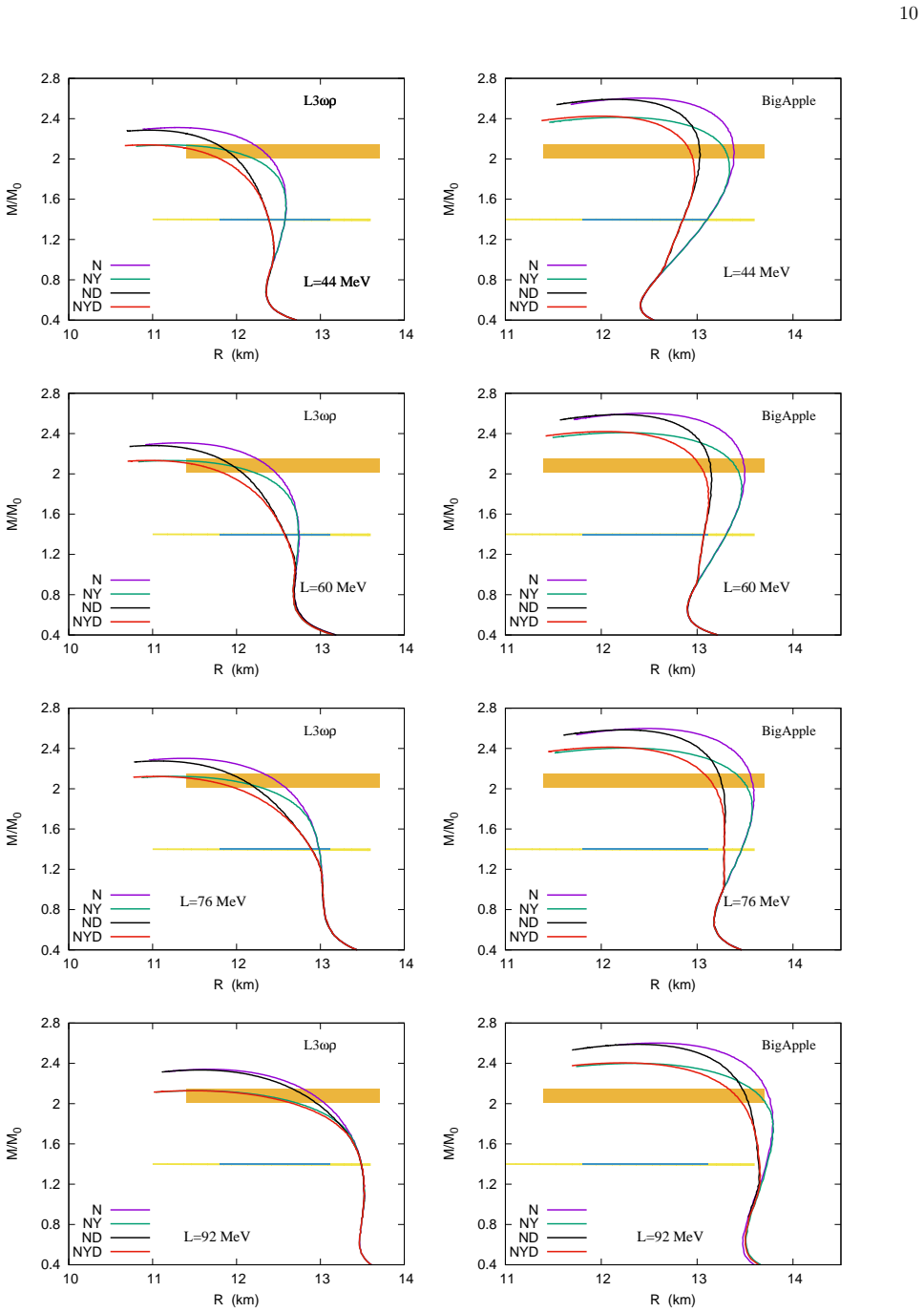
Using the L3ωρ and BigApple parametrizations with the three core compositions, the work establishes that hyperon populations change little when L varies, whereas delta resonance populations are strongly suppressed at large L values, so that the presence of exotic content is more evident for lower L than for large ones.
What carries the argument
The symmetry energy slope L, which sets the density dependence of the isovector interaction and thereby controls the relative chemical potentials that determine hyperon versus delta populations at high density.
If this is right
- Neutron stars with lower L are expected to contain more total exotic particles than those with higher L.
- Macroscopic properties such as maximum mass and radius will exhibit greater sensitivity to the choice of exotic composition when L is small.
- The two parametrizations produce qualitatively similar L-dependent trends despite quantitative differences in their equations of state.
- The suppression of deltas at high L reduces the softening of the equation of state that would otherwise occur from exotic degrees of freedom.
Where Pith is reading between the lines
- Radius measurements of neutron stars could indirectly constrain L by revealing whether delta resonances are present or absent.
- Cooling curves and gravitational-wave signals from mergers may show clearer signatures of exotics when L is low.
- Models that omit the L dependence of delta populations could misestimate the range of allowed equations of state at high density.
Load-bearing premise
The two selected parametrizations together with the three chosen core compositions adequately represent the range of possible equations of state.
What would settle it
A measured neutron-star radius or tidal deformability that requires a sizable delta population even when the inferred L is large would falsify the reported suppression trend.
Figures
read the original abstract
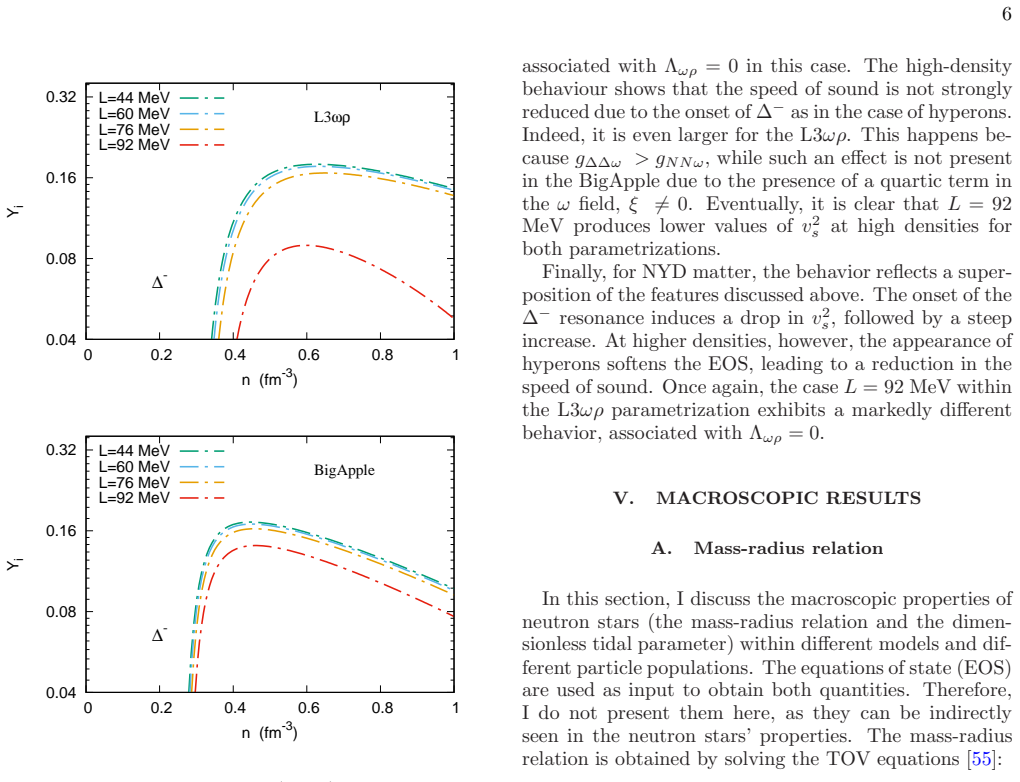
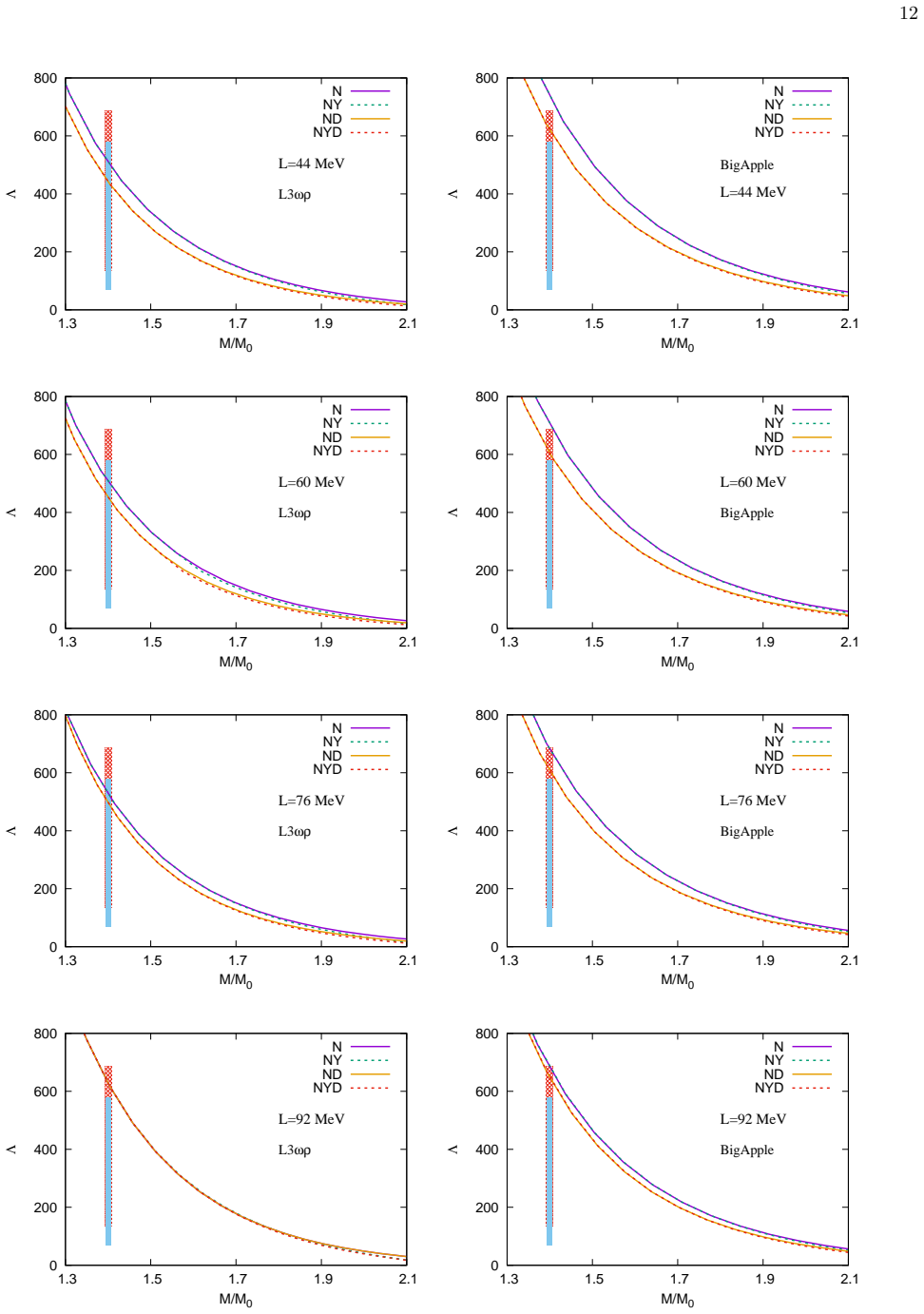
By varying the symmetry energy slope ($L$), I investigate how the exotic content within the interiors of neutron stars changes and how it affects both macroscopic and microscopic quantities. Using two different parametrizations (L3$\omega\rho$ and BigApple), and three different possibilities about the neutron star core (nucleons+hyperons, nucleons+deltas, nucleons+hyperons+deltas), I show that, for the models analyzed in this work, changing the slope barely changes the amount of hyperons, but it can strongly suppress the $\Delta$ resonances for large values of $L$. I also show that, in general, the presence of exotic content will be more evident for lower values of $L$ than for large ones. Differences and similarities between the two parametrizations are also analyzed.
Editorial analysis
A structured set of objections, weighed in public.
Referee Report
Summary. The paper studies the dependence of exotic particle populations (hyperons and Δ resonances) in neutron-star cores on the symmetry-energy slope L. It employs two relativistic mean-field parametrizations (L3ωρ and BigApple) and three core compositions (nucleons+hyperons, nucleons+Δs, nucleons+hyperons+Δs), reporting that hyperon fractions remain nearly insensitive to L while Δ populations are strongly suppressed at large L; exotic content is stated to be more visible at low L. Differences between the two parametrizations are also discussed.
Significance. Within the two chosen models the reported differential sensitivity of hyperons versus Δ resonances to L supplies concrete numerical illustrations that could help interpret how nuclear symmetry energy influences neutron-star composition. The scoped, model-specific nature of the claims limits their generality but provides clear, falsifiable trends inside the selected EOS families.
minor comments (2)
- [Abstract] Abstract and §1: the manuscript is written in first person; rephrasing to impersonal style would align with standard journal conventions.
- [Results] Results section (figures showing particle fractions vs. density): confirm that the plotted thresholds and density ranges are identical across the three compositions so that the claimed suppression of Δs at large L can be directly compared.
Simulated Author's Rebuttal
We thank the referee for the positive assessment of our manuscript and for recommending minor revision. The referee's summary correctly reflects the scope and main conclusions of the work. No specific major comments were raised in the report.
Circularity Check
No significant circularity detected
full rationale
The paper varies the externally defined symmetry energy slope L (taken from nuclear phenomenology) inside two fixed parametrizations and three core compositions, then reports numerical trends in hyperon and Δ populations. No equation reduces a reported particle fraction or macroscopic quantity to a fitted parameter defined inside the same calculation, no self-citation is invoked as a uniqueness theorem, and no ansatz is smuggled via prior work by the same author. The central claims are scoped statements about behavior inside the chosen models and therefore remain self-contained.
Axiom & Free-Parameter Ledger
free parameters (1)
- L (symmetry energy slope)
axioms (1)
- domain assumption The chosen parametrizations L3ωρ and BigApple remain valid when L is changed while other couplings are kept constant.
Reference graph
Works this paper leans on
-
[1]
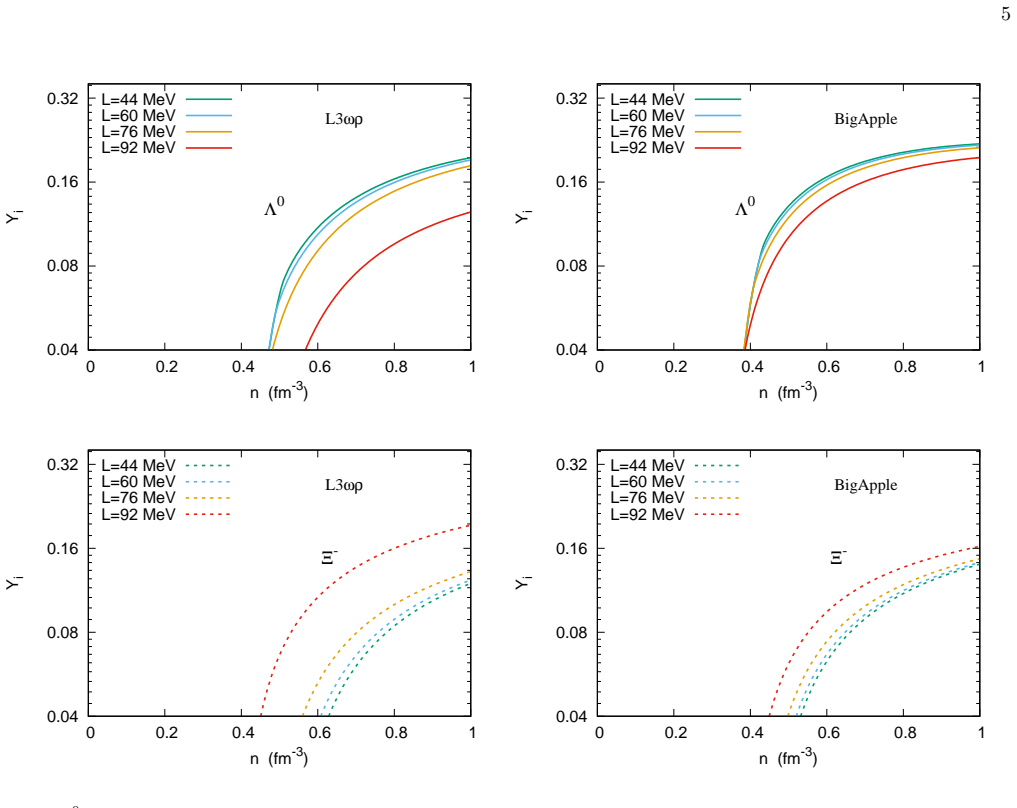
This result is exacerbated for the L = 92 MeV in the L3 ωρ , whose onset is pushed to higher densities
From a qualitative point of view, increasing the slope does not significantly change the onset of Λ 0, but it does suppress this particle at higher densities. This result is exacerbated for the L = 92 MeV in the L3 ωρ , whose onset is pushed to higher densities. The threshold of the Ξ − , on the other hand, is pulled to lower densities as we increase the s...
-
[2]
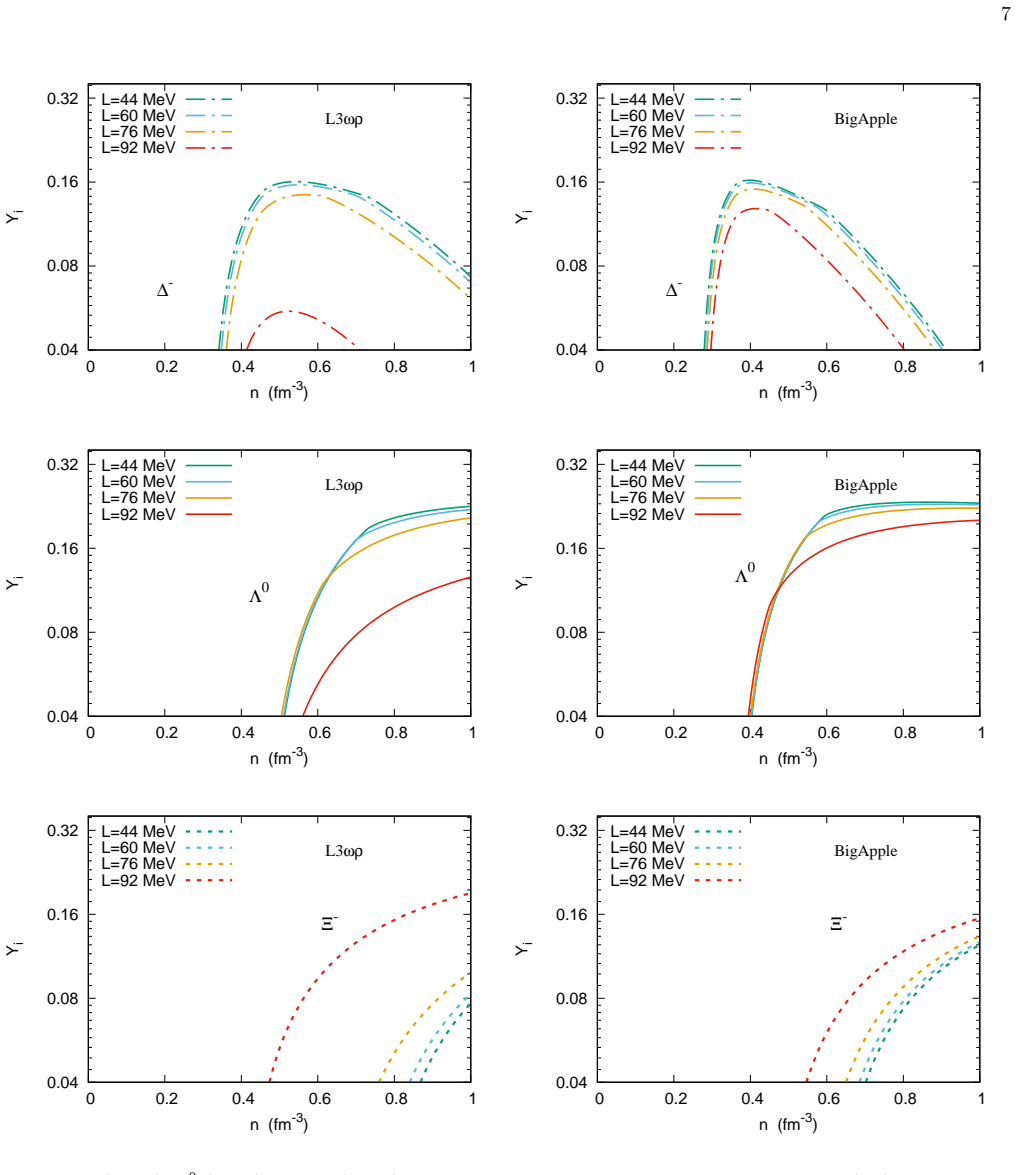
Maybe 7 0.04 0.08 0.16 0.32 0 0.2 0.4 0.6 0.8 1 ∆- L3ωρ Yi n (fm-3) L=44 MeV L=60 MeV L=76 MeV L=92 MeV 0.04 0.08 0.16 0.32 0 0.2 0.4 0.6 0.8 1 ∆- BigApple Yi n (fm-3) L=44 MeV L=60 MeV L=76 MeV L=92 MeV 0.04 0.08 0.16 0.32 0 0.2 0.4 0.6 0.8 1 Λ0 L3ωρ Yi n (fm-3) L=44 MeV L=60 MeV L=76 MeV L=92 MeV 0.04 0.08 0.16 0.32 0 0.2 0.4 0.6 0.8 1 Λ0 BigApple Yi n ...
-
[3]
07M⊙ with a radius between 11.41 km < R < 13.70 km as suggested in ref. [ 25]. Concerning the canonical 1.4 M⊙ star, two NICER teams have pointed to a limit of 13. 85 km [ 26] and 14 . 26 km [ 27]. These results were refined in ref. [ 28] to 11.80 km <R 1. 4< 13. 10 km, which implies a strong bound with an uncertainty of only 5%. A more conservative constr...
-
[4]
01M⊙ star has its radius reduced due to the onset of hyperons
40M⊙ , but a 2 . 01M⊙ star has its radius reduced due to the onset of hyperons. The lower the slope, the larger the reduction. The variations ∆ R2. 01 are larger for the L3 ωρ . • Unlike hyperons, ∆ resonances affect both the canonical 1.4M⊙ and a 2.01 M⊙ . In general, the lower the slope, the larger the value of ∆ R1. 4 and ∆ R2. 01. • ∆ ′s also affects Λ ...
2024
-
[5]
J. J. Sakurai, Modern Quantum Mechanics (Addison Wesley Longman, 1994)
1994
-
[6]
N. K. Glendenning, Compact stars: (2 ed. Edition, Springer New York, 2000)
2000
-
[7]
Bethe and M
H. Bethe and M. Johnson, Dense baryon matter calculations with realistic potentials, Nucl. Phys. A 230, 1 (1974)
1974
-
[8]
N. K. Glendenning, The hyperon composition of neutron stars, Phys. Lett. B 114, 392 (1982)
1982
-
[9]
L. L. Lopes and D. P. Menezes, On the na- ture of the mass-gap object in the gw190814 event, Astrophys. J. 936, 41 (2022)
2022
-
[10]
Sedrakian, J.-J
A. Sedrakian, J.-J. Li, and F. We- ber, Heavy baryons in compact stars, Prog. Part. Nucl. Phys. 131, 104041 (2023)
2023
-
[11]
Chorozidou and T
A. Chorozidou and T. Gaitanos, Momentum dependence of in-medium potentials: A solution to the hyperon puz- zle in neutron stars, Phys. Rev. C 109, L032801 (2024)
2024
-
[12]
Dapo, B.-J
H. Dapo, B.-J. Schaefer, and J. Wambach, Appearance of hyperons in neutron stars, Phys. Rev. C 81, 035803 (2010)
2010
-
[13]
L. L. Lopes and D. P. Menezes, Broken su(6) symmetry and massive hybrid stars, Nucl. Phys. A 1009, 122171 (2021) . 15
2021
-
[14]
H. Tong, S. Elhatisari, and U.-G. MeiBner, Hy- perneutron stars from an ab initio calculation, Astrophys. J. 982, 164 (2025)
2025
-
[15]
Mohammad Ali Looee, M
A. Mohammad Ali Looee, M. Shahrbaf, and H. R. Mosh- fegh, Hyperons in neutron stars across the observed mass range: Insights from λ n and λλ interactions within a mi- croscopic framework, Astrophys. J. 997, 26 (2026)
2026
-
[16]
Bodek and T
A. Bodek and T. Cai, Comparison of opti- cal potential for nucleons and δ resonances., Eur. Phys. J. C 80, 655 (2020)
2020
-
[17]
J. C. T. de Oliveira, S. B. Duarte, H. Rodrigues, M. Chiapparini, and M. Kyotoku, Effects of δ- baryon interaction strength on neutron stars properties, Int. J. Mod. Phys. D 16, 175 (2007)
2007
-
[18]
Kolomeitsev, K
E. Kolomeitsev, K. Maslov, and D. Voskresen- sky, Delta isobars in relativistic mean-field mod- els with σ -scaled hadron masses and couplings, Nucl. Phys. A 961, 106 (2017)
2017
-
[19]
L. L. Lopes, K. D. Marquez, and D. P. Menezes, Baryon coupling scheme in a unified su(3) and su(6) symmetry formalism, Phys. Rev. D 107, 036011 (2023)
2023
-
[20]
K. D. Marquez, D. P. Menezes, H. Pais, and C. m. c. Providˆ encia, ∆ baryons in neutron stars, Phys. Rev. C 106, 055801 (2022)
2022
-
[21]
Dutra, O
M. Dutra, O. Louren¸ co, S. S. Avancini, et al., Relativis- tic mean-field hadronic models under nuclear matter con- straints, Phys. Rev. C 90, 055203 (2014)
2014
-
[22]
Oertel, M
M. Oertel, M. Hempel, T. Kl¨ ahn, and S. Typel, Equations of state for supernovae and compact stars, Rev. Mod. Phys. 89, 015007 (2017)
2017
-
[23]
Paar et al., Neutron star structure and collective exci- tations of finite nuclei, Phys
N. Paar et al., Neutron star structure and collective exci- tations of finite nuclei, Phys. Rev. C 90, 011304 (2014)
2014
-
[24]
Lattimer and A
J. Lattimer and A. Steiner, Constraints on the symmetry energy using the mass-radius relation of neutron stars, Eur. Phys. J. A 50, 40 (2014)
2014
-
[25]
Lattimer and Y
J. Lattimer and Y. Lim, Constraining the symmetry parameters of the nuclear interaction, Astrophys. J. 771, 51 (2013)
2013
-
[26]
Estee et al., Probing the symmetry energy with the spectral pion ratio, Phys
J. Estee et al., Probing the symmetry energy with the spectral pion ratio, Phys. Rev. Lett. 126, 162701 (2020)
2020
-
[27]
Reed et al., Implications of prex-2 on the equation of state of neutron-rich matter, Phys
B. Reed et al., Implications of prex-2 on the equation of state of neutron-rich matter, Phys. Rev. Lett. 126, 172503 (2020)
2020
-
[28]
Tagami, T
S. Tagami, T. Wakasa, and M. Yahiro, Slope parameters determined from crex and prex2, Resul. Phys. 43, 106037 (2022)
2022
-
[29]
Riley et al., A NICER View of the Mas- sive Pulsar PSR J0740+6620 Informed by Ra- dio Timing and XMM-Newton Spectroscopy, Astrophys
T. Riley et al., A NICER View of the Mas- sive Pulsar PSR J0740+6620 Informed by Ra- dio Timing and XMM-Newton Spectroscopy, Astrophys. J. Lett. 918, L27 (2021)
2021
-
[30]
T. E. Riley et al., A NICER View of PSR J0030+0451: Millisecond Pulsar Parameter Estimation, Astrophys. J. Lett. 887, L21 (2019)
2019
-
[31]
Miller et al., PSR J0030+0451 Mass and Radius from N ICER Data and Implications for the Properties of Neutron Star Matter, Astrophys
M. Miller et al., PSR J0030+0451 Mass and Radius from N ICER Data and Implications for the Properties of Neutron Star Matter, Astrophys. J. Lett. 887, L24 (2019)
2019
-
[32]
Miller et al., The Radius of PSR J0740+6620 from NICER and XMM-Newton Data, Astrophys
M. Miller et al., The Radius of PSR J0740+6620 from NICER and XMM-Newton Data, Astrophys. J. Lett. 918, L28 (2021)
2021
-
[33]
Annala, T
E. Annala, T. Gorda, A. Kurkela, and A. Vuorinen, Gravitational-wave constraints on the neutron-star-matter equation of state, Phys. Rev. Lett. 120, 172703 (2018)
2018
-
[34]
Abbott et al., Gw170817: Observation of grav- itational waves from a binary neutron star inspiral, Phys
B. Abbott et al., Gw170817: Observation of grav- itational waves from a binary neutron star inspiral, Phys. Rev. Lett. 119, 161101 (2017)
2017
-
[35]
B. P. Abbott, R. Abbott, T. D. Abbott, et al., Gw170817: Measurements of neutron star radii and equation of state, Phys. Rev. Lett. 121, 161101 (2018)
2018
-
[36]
Y. Li, H. Chen, D. Wen, et al., Constraining the nuclear symmetry energy and properties of the neutron star from gw170817 by bayesian analysis, Eur. Phys. J. A 57, 31 (2021)
2021
-
[37]
Fattoyev et al., Relativistic effective interaction for nuclei, giant resonances, and neutron stars, Phys
F. Fattoyev et al., Relativistic effective interaction for nuclei, giant resonances, and neutron stars, Phys. Rev. C 82, 055803 (2010)
2010
-
[38]
Cavagnoli, D
R. Cavagnoli, D. Menezes, and C. Providencias, Neutron star properties and the symmetry energy, Phys. Rev. C 84, 065810 (2011)
2011
-
[39]
Dexheimer et al., What do we learn about vector inter- actions from gw170817?, J
V. Dexheimer et al., What do we learn about vector inter- actions from gw170817?, J. Phys. G 46, 034002 (2019)
2019
-
[40]
Kubis and M
S. Kubis and M. Kutschera, Nuclear matter in rela- tivistic mean field theory with isovector scalar meson, Phys. Lett. B 399, 191 (1997)
1997
-
[41]
B. Liu, V. Greco, V. Baran, M. Colonna, and M. Di Toro, Asymmetric nuclear matter: The role of the isovector scalar channel, Phys. Rev. C 65, 045201 (2002)
2002
-
[42]
Lopes and D
L. Lopes and D. Menezes, Effects of the symmetry energy and its slope on neutron star properties, Braz. J. Phys. 44, 774 (2014)
2014
-
[43]
L. L. Lopes et al., Imprints of the nuclear symmetry en- ergy slope in gravitational wave signals emanating from neutron stars, Phys. Rev. D 108, 083042 (2023)
2023
-
[44]
L. L. Lopes, D. P. Menezes, and M. R. Pelicer, Correlation between the symmetry energy slope and the deconfinement phase transition, Phys. Rev. C 109, 045801 (2024)
2024
-
[45]
L. L. Lopes, Role of the symmetry energy slope in neutron stars: Exploring the model dependency, Phys. Rev. C 110, 015805 (2024)
2024
-
[46]
Kl¨ ahn et al., Constraints on the high-density nuclear equation of state from the phenomenol- ogy of compact stars and heavy-ion collisions, Phys
T. Kl¨ ahn et al., Constraints on the high-density nuclear equation of state from the phenomenol- ogy of compact stars and heavy-ion collisions, Phys. Rev. C 74, 035802 (2006)
2006
-
[47]
B. D. Serot, Quantum hadrodynamics, Rep. Progr. Phys. 55, 1855 (1992)
1992
-
[48]
Miyatsu, M.-K
T. Miyatsu, M.-K. Cheoun, and K. Saito, Equation of state for neutron stars in su(3) flavor symmetry, Phys. Rev. C 88, 015802 (2013)
2013
-
[49]
L. L. Lopes, Hyperonic neutron stars: reconciliation be- tween nuclear properties and nicer and ligo/virgo results, Commun. Theor. Phys. 74, 015302 (2022)
2022
-
[50]
F. J. Fattoyev, C. J. Horowitz, J. Piekarewicz, and B. Reed, Gw190814: Impact of a 2.6 solar mass neutron star on the nucleonic equations of state, Phys. Rev. C 102, 065805 (2020)
2020
-
[51]
Boguta and A
J. Boguta and A. Bodmer, Relativistic calculation of nuclear matter and the nuclear surface, Nucl. Phys. A 292, 413 (1977)
1977
-
[52]
L. L. Lopes, A closer look at the Yukawa in- teraction from a symmetry group perspective, Prog. Theor. Exper. Phys. 2023, 113D01 (2023)
2023
-
[53]
L. L. Lopes, An undergraduate approach to the quan- tum hadrodynamics and physics of neutron stars, Universe 11, 276 (2025)
2025
-
[54]
Schaffner-Bielich and A
J. Schaffner-Bielich and A. Gal, Properties of strange hadronic matter in bulk and in finite systems, 16 Phys. Rev. C 62, 034311 (2000)
2000
-
[55]
Inoue, Hyperon forces from qcd and their applications, JPS Conf
T. Inoue, Hyperon forces from qcd and their applications, JPS Conf. Proc 26, 023018 (2019)
2019
-
[56]
Haidenbauer, Johann, MeiBner, Ulf-G., Nogga, Andreas, and Le, Hoai, Hyperon–nucleon interaction in chiral effective field theory at next-to-next-to-leading order, Eur. Phys. J. A 59, 63 (2023)
2023
-
[57]
271, 03002 (2022)
Friedman, Eliahu and Gal, Avraham, ξ-nuclear constraints from ξ− emulsion capture events, EPJ Web Conf. 271, 03002 (2022)
2022
-
[58]
Friedman and A
E. Friedman and A. Gal, Compatibility of recent ξ− nuclear bound state signals, Phys. Lett. B 868, 139728 (2025)
2025
-
[59]
J. R. Oppenheimer and G. M. Volkoff, On massive neu- tron cores, Phys. Rev. 55, 374 (1939)
1939
-
[60]
G. Baym, C. Pethick, and P. Sutherland, The ground state of matter at high densities, Astrophys. J. 170, 299 (1971)
1971
-
[61]
G. Baym, H. A. Bethe, and C. J. Pethick, Neutron star matter, Nucl.Phys. A 175, 225 (1971)
1971
-
[62]
L. L. Lopes, Decoding rotating neutron stars: Role of the symmetry energy slope, Astrophys. J. 966, 184 (2024)
2024
-
[63]
Mauviard et al., A nicer view of the 1.4 m0 edge-on pulsar psr j0614-3329, Astrophys
L. Mauviard et al., A nicer view of the 1.4 m0 edge-on pulsar psr j0614-3329, Astrophys. J. 995, 60 (2025)
2025
-
[64]
Choudhury et al., A nicer view of the near- est and brightest millisecond pulsar: Psr j0437-4715, Astrophys
D. Choudhury et al., A nicer view of the near- est and brightest millisecond pulsar: Psr j0437-4715, Astrophys. J. Lett. 971, L20 (2024)
2024
-
[65]
Hinderer, Tidal love numbers of neutron stars, Astrophys
T. Hinderer, Tidal love numbers of neutron stars, Astrophys. J. 677, 1216 (2008)
2008
-
[66]
R. W. Romani, D. Kandel, A. V. Filippenko, T. G. Brink, and W. Zheng, Psr j0952-0607: The fastest and heaviest known galactic neutron star, Astrophys. J. Lett. 934, L17 (2022)
2022
-
[67]
Tang, Y.-J
S.-P. Tang, Y.-J. Huang, and Y.-Z. Fan, Phase tran- sition and nuclear symmetry energy from neutron star observations: Constraints in light of psr j0614-3329, Phys. Rev. D 112, 083009 (2025)
2025
-
[68]
Ferreira and C
M. Ferreira and C. m. c. Providˆ encia, Learning about neutron star composition from the slope of the mass- radius diagram, Phys. Rev. D 112, 083058 (2025)
2025
-
[69]
Bauswein, A
A. Bauswein, A. Nikolaidis, G. Lioutas, H. Kochankovski, P. Char, C. Mondal, M. Oertel, L. Tolos, N. Chamel, and S. Goriely, Stellar properties indi- cating the presence of hyperons in neutron stars, Phys. Rev. Res. 8, 013253 (2026)
2026
discussion (0)
Sign in with ORCID, Apple, or X to comment. Anyone can read and Pith papers without signing in.