Sharp behavior of the free energy for the two-dimensional directed polymer model
Pith reviewed 2026-06-28 21:34 UTC · model grok-4.3
The pith
The quenched free energy of the 2D directed polymer satisfies −𝔣(β) ≍ exp(−π/σ²(β)) as β↓0.
A machine-rendered reading of the paper's core claim, the machinery that carries it, and where it could break.
Core claim
By verifying that the bounded log-energy property propagates along open paths in the percolation argument, the authors derive a lower bound on the quenched free energy 𝔣(β) that matches the exponential rate of the known upper bound, establishing the sharp equivalence −𝔣(β) ≍ exp(−π/σ²(β)) as β↓0, where σ(β)² = e^{λ(2β)−2λ(β)}−1 and λ(β) = log E[e^{β ω_{1,0}}].
What carries the argument
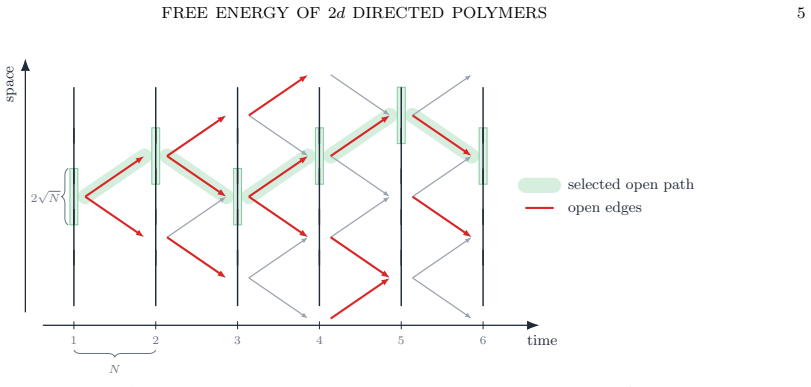
The bounded log-energy property of the polymer measures at diffusive scales, which propagates along open paths in the percolation construction.
If this is right
- The lower bound on −𝔣(β) is of the same order as the upper bound from Berger, Caravenna, and Turchi (2025).
- The free energy remains positive for every β > 0 yet decays at the precise super-exponential rate given by the variance parameter σ(β).
- The bounded log-energy property holds for the polymer measures and is preserved under the percolation construction in d=2.
- The same percolation method yields control over the partition function whenever the environment admits sufficiently many open paths.
Where Pith is reading between the lines
- The percolation-plus-log-energy technique may adapt to pinning or random-walk-in-random-environment models that share the same marginal dimension.
- Direct Monte-Carlo checks of the log-energy bound on moderate-size lattices could test whether propagation survives in finite-volume approximations.
- The result indicates that endpoint or path-measure observables might admit matching sharp asymptotics once the same regularity property is available.
Load-bearing premise
The bounded log-energy property of the polymer measures at diffusive scales propagates along open paths in the percolation construction.
What would settle it
A numerical computation of the free energy for sufficiently small β that lies outside any constant multiple of exp(−π/σ²(β)) would falsify the claimed asymptotic.
Figures
read the original abstract
We consider the directed polymer model on $\mathbb{Z}^d$, in an i.i.d.\ random environment $\omega=(\omega_{n,x})_{n\geq 0,x\in\mathbb Z^d}$, focusing on the critical dimension $d=2$. Our main contribution is to give a sharp lower bound on the free energy in the high-temperature regime. Our proof uses a percolation argument inspired by Lacoin (2010), for which we introduce a key property of bounded ``$\log$-energy'': this property quantifies the regularity of the polymer measures at diffusive scales and we show that it propagates along open paths. Writing $\mathfrak{f}(\beta)$ for the quenched free energy, and setting $\lambda(\beta):=\log \mathbb E[e^{\beta\omega_{1,0}}]$ and $\sigma(\beta)^2:=e^{\lambda(2\beta)-2\lambda(\beta)}-1$, our lower bound combined with Theorem 2.8 of Berger, Caravenna, and Turchi (2025) gives $$ -\mathfrak{f}(\beta) \asymp \exp{\Big(- \frac{\pi}{\sigma^2(\beta)}\Big)},\quad \text{ as $\beta\downarrow 0$.} $$
Editorial analysis
A structured set of objections, weighed in public.
Referee Report
Summary. The manuscript establishes a sharp lower bound on the quenched free energy ℓ(β) for the two-dimensional directed polymer model in i.i.d. random environment in the high-temperature regime. It employs a percolation argument (inspired by Lacoin 2010) that introduces a bounded 'log-energy' property quantifying regularity of the polymer measures at diffusive scales; the authors claim this property propagates along open paths. Combined with the upper bound in Theorem 2.8 of Berger, Caravenna, and Turchi (2025), the result yields the sharp equivalence -ℓ(β) ≍ exp(-π/σ^{2}(β)) as β ↓ 0, where λ(β) = log E[exp(β ω_{1,0})] and σ^{2}(β) = exp(λ(2β) - 2λ(β)) - 1.
Significance. If the propagation of the bounded log-energy property can be established with constants uniform in the percolation parameter, the result would deliver the first sharp asymptotic for the free energy in the critical dimension d=2, confirming the conjectured high-temperature behavior and providing a new analytic tool (the log-energy property) that may apply to related models with marginal regularity.
major comments (1)
- Abstract (proof strategy paragraph): the bounded log-energy property is asserted to propagate along open paths in the percolation construction, but the marginal regularity of the 2D polymer measures at diffusive scales makes it unclear whether the bound remains uniform under path concatenation or environment resampling; without explicit controls showing that the constants are independent of the percolation parameter, the exponential lower bound at scale exp(-π/σ^{2}(β)) is not yet supported.
minor comments (1)
- Abstract: the symbol ≍ is used without local definition; a parenthetical clarification that it denotes asymptotic equivalence up to multiplicative constants would improve readability.
Simulated Author's Rebuttal
We thank the referee for their careful reading and constructive comments. We address the single major comment below regarding uniformity of constants in the log-energy propagation.
read point-by-point responses
-
Referee: [—] Abstract (proof strategy paragraph): the bounded log-energy property is asserted to propagate along open paths in the percolation construction, but the marginal regularity of the 2D polymer measures at diffusive scales makes it unclear whether the bound remains uniform under path concatenation or environment resampling; without explicit controls showing that the constants are independent of the percolation parameter, the exponential lower bound at scale exp(-π/σ²(β)) is not yet supported.
Authors: We thank the referee for this observation. The propagation is proved in Section 3 (Proposition 3.2 and Lemma 3.5) via an inductive resampling argument over i.i.d. environments along open paths. The log-energy constant is shown to be independent of the percolation parameter p (for p sufficiently close to 1) because the estimates depend only on the fixed diffusive scale and on σ²(β)→0 as β↓0; concatenation produces a multiplicative factor bounded uniformly in path length by the high percolation density. We agree the abstract's proof-strategy sentence is terse on this point and will revise it (and add a short clarifying remark after Lemma 3.5) to state explicitly that all constants are uniform in the percolation parameter. This revision will be made in the next version. revision: yes
Circularity Check
Sharp asymptotic equivalence depends on self-cited upper bound from overlapping authors
specific steps
-
self citation load bearing
[Abstract]
"our lower bound combined with Theorem 2.8 of Berger, Caravenna, and Turchi (2025) gives -mathfrak f(beta) ≍ exp(-pi/sigma^2(beta)), as beta↓0."
The claimed sharp two-sided asymptotic requires the upper bound from a 2025 paper with overlapping authorship (Berger); while the new lower bound stands alone, the ≍ equivalence for the central result is load-bearing on this self-citation.
full rationale
The paper's primary contribution is an independent lower bound on the free energy derived via a new percolation argument introducing and propagating bounded log-energy. However, the central sharp claim -f(beta) ≍ exp(-pi/sigma^2(beta)) as beta↓0 is obtained only by combining this lower bound with an upper bound from Theorem 2.8 of Berger-Caravenna-Turchi (2025), a paper sharing author Berger. This matches the self-citation load-bearing pattern for the equivalence statement, while the lower bound itself retains independent content. No self-definitional reductions, fitted-input predictions, or ansatz smuggling appear in the provided derivation chain. The propagation step is presented as a new proof element without evident reduction to prior inputs by construction.
Axiom & Free-Parameter Ledger
axioms (1)
- domain assumption The random environment omega is i.i.d. with finite moments so that lambda(beta) and sigma(beta) are well-defined.
Reference graph
Works this paper leans on
-
[1]
Alberts, K
T. Alberts, K. Khanin, and J. Quastel. The intermediate disorder regime for directed polymers in dimension 1 + 1.Ann. Probab., 42(3):1212–1256, 2014
2014
-
[2]
Alexander and G
K. Alexander and G. Yıldırım. Directed polymers in a random environment with a defect line.Electron. J. Probab., 20:20 pp., 2015
2015
-
[3]
Bates and S
E. Bates and S. Chatterjee. The endpoint distribution of directed polymers.Ann. Probab., 48(2):817–871, 03 2020
2020
-
[4]
Q. Berger, F. Caravenna, and N. Turchi. Strong disorder for stochastic heat flow and 2D directed polymers. preprint arXiv:2508.02478, 2025
Pith/arXiv arXiv 2025
-
[5]
Berger and H
Q. Berger and H. Lacoin. The high-temperature behavior for the directed polymer in dimension1 + 2.Annales de l’Institut Henri Poincaré, Probabilités et Statistiques, 53(1):430–450, 2017
2017
-
[6]
Bolthausen
E. Bolthausen. A note on the diffusion of directed polymers in a random environment.Commun. Math. Phys., 123(4):529–534, 1989. FREE ENERGY OF2dDIRECTED POLYMERS 17
1989
-
[7]
Caravenna, R
F. Caravenna, R. Sun, and N. Zygouras. The Dickman subordinator, renewal theorems, and disordered systems.Electron. J. Probab., 24, 2019
2019
-
[8]
Caravenna, R
F. Caravenna, R. Sun, and N. Zygouras. On the moments of the(2 + 1)-dimensional directed polymer and stochastic heat equation in the critical window.Comm. Math. Phys., 372(2):385–440, 2019
2019
-
[9]
Caravenna, R
F. Caravenna, R. Sun, and N. Zygouras. The critical 2d Stochastic Heat Flow.Invent. Math., 233(1):325–460, 2023
2023
-
[10]
Statistical Mechanics and Stochastic PDEs
F. Caravenna, R. Sun, and N. Zygouras. The critical 2d stochastic heat flow and related models. arXiv:2412.10311, 2024, to appear in the book "Statistical Mechanics and Stochastic PDEs” in the C.I.M.E. Foundation Subseries
Pith/arXiv arXiv 2024
-
[11]
F. Caravenna, R. Sun, and N. Zygouras. From disordered systems to the Critical 2D Stochastic Heat Flow. preprint arXiv:2511.08479, 2025
arXiv 2025
-
[12]
Caravenna, R
F. Caravenna, R. Sun, and N. Zygouras. State space for the critical 2d Stochastic Heat Flow. 2026+
2026
-
[13]
Carmona and Y
P. Carmona and Y. Hu. On the partition function of a directed polymer in a Gaussian random environment. Probab. Theory Related Fields, 124(3):431–457, 2002
2002
-
[14]
Carmona and Y
P. Carmona and Y. Hu. Strong disorder implies strong localization for directed polymers in a random environment.ALEA, Lat. Am. J. Probab. Math. Stat., 2:217–229, 2006
2006
-
[15]
Comets.Directed Polymers in Random Environments, volume 2175 ofEcole d’Eté de probabilités de Saint-Flour
F. Comets.Directed Polymers in Random Environments, volume 2175 ofEcole d’Eté de probabilités de Saint-Flour. Springer International Publishing, 2017
2017
-
[16]
Comets, T
F. Comets, T. Shiga, and N. Yoshida. Directed polymers in a random environment: strong disorder and path localization.Bernoulli, 9(4):705–723, 2003
2003
-
[17]
Comets and V
F. Comets and V. Vargas. Majorizing multiplicative cascades for directed polymers in random media.ALEA, Lat. Am. J. Probab. Math. Stat., 2:267–277, 2006
2006
-
[18]
Comets and N
F. Comets and N. Yoshida. Directed polymers in random environment are diffusive at weak disorder.The Annals of Probability, 34(5):1746–1770, 2006
2006
-
[19]
R. Durrett. Oriented percolation in two dimensions.The Annals of Probability, pages 999–1040, 1984
1984
-
[20]
S. Ganguly and K. Nam. Sharp moment and upper tail asymptotics for the critical2d stochastic heat flow. preprint arXiv:2507.22029, 2025
arXiv 2025
-
[21]
Giacomin.Random Polymer Models
G. Giacomin.Random Polymer Models. Imperial College Press, World Scientific, 2007
2007
-
[22]
D. A. Huse and C. L. Henley. Pinning and roughening of domain walls in Ising systems due to random impurities.Physics Review Letters, 54:2708–2711, 1985
1985
-
[23]
N. C. Jain and W. E. Pruitt. The range of random walk.Proc. Sixth Berkeley Symp. on Math. Statist. and Probab., pages 31–50, 1972
1972
-
[24]
S. Junk and H. Lacoin. Strong disorder and very strong disorder are equivalent for directed polymers. arXiv:2402.02562, 2024
arXiv 2024
-
[25]
Junk and H
S. Junk and H. Lacoin. On the free energy of directed polymers in dimensiond≥3.in preparation, 2026
2026
-
[26]
H. Lacoin. New bounds for the free energy of directed polymer in dimension1 + 1and1 + 2.Commun. Math. Phys., 294:471–503, 2010
2010
-
[27]
H. Lacoin. The localization transition for the directed polymer in a random environment is smooth. arXiv:2505.13382, 2025
arXiv 2025
-
[28]
H. Lacoin. A short proof of diffusivity for the directed polymers in the weak disorder phase.Electronic Communications in Probability, 30:1–6, 2025
2025
-
[29]
G. F. Lawler and V. Limic.Random Walk: A Modern Introduction. Cambridge Studies in Advanced Mathematics. Cambridge University Press, 2010
2010
-
[30]
T. M. Liggett, R. H. Schonmann, and A. M. Stacey. Domination by product measures.The Annals of Probability, 25(1):71–95, 1997
1997
-
[31]
Nakashima
M. Nakashima. A remark on the bound for the free energy of directed polymers in random environment in 1+ 2 dimension.Journal of Mathematical Physics, 55(9), 2014
2014
-
[32]
Nakashima
M. Nakashima. Free energy of directed polymers in random environment in1+1-dimension at high temperature. Electron. J. Probab., 24:1–43, 2019
2019
-
[33]
Digital Library of Mathematical Functions.https://dlmf.nist.gov/, Release 1.2.6 of 2026-03-15, F
NIST. Digital Library of Mathematical Functions.https://dlmf.nist.gov/, Release 1.2.6 of 2026-03-15, F. W. J. Olver, A. B. Olde Daalhuis, D. W. Lozier, B. I. Schneider, R. F. Boisvert, C. W. Clark, B. R. Miller, B. V. Saunders, H. S. Cohl, and M. A. McClain, eds
2026
-
[34]
S. Rajeev. A condensation of interacting bosons in two dimensional space.arXiv preprint hep-th/9905120, 1999
Pith/arXiv arXiv 1999
-
[35]
Zygouras
N. Zygouras. Directed polymers in a random environment: a review of the phase transitions.Stochastic Processes and their Applications, 177:104431, 2024. Université Sorbonne Paris Nord, Laboratoire d’Analyse, Géométrie et Applications, CNRS UMR 7539, 99 A v. J-B Clément, 93430 Villetaneuse, France and Institut Universitaire de France Email address:quentin....
2024
discussion (0)
Sign in with ORCID, Apple, or X to comment. Anyone can read and Pith papers without signing in.