Positivity and log concavity of the Links--Gould polynomial of knots
Pith reviewed 2026-06-28 20:30 UTC · model grok-4.3
The pith
The Links-Gould polynomial of alternating links is positive, hole-free, and log-concave.
A machine-rendered reading of the paper's core claim, the machinery that carries it, and where it could break.
Core claim
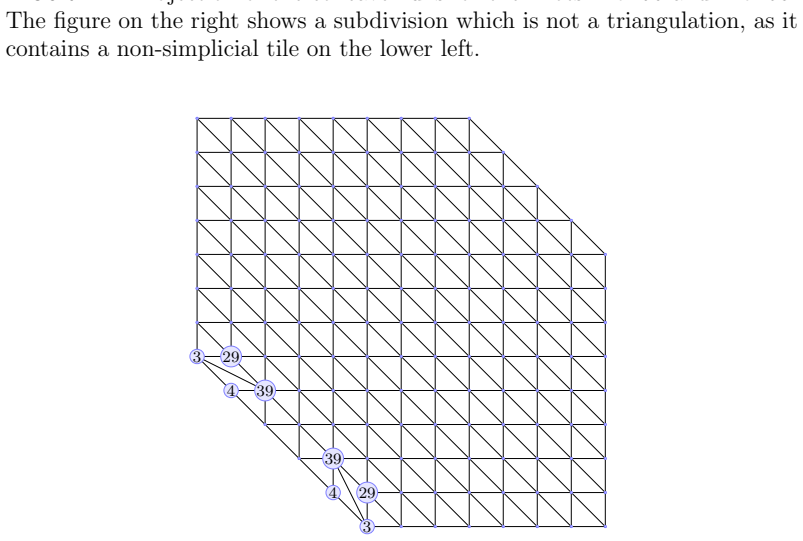
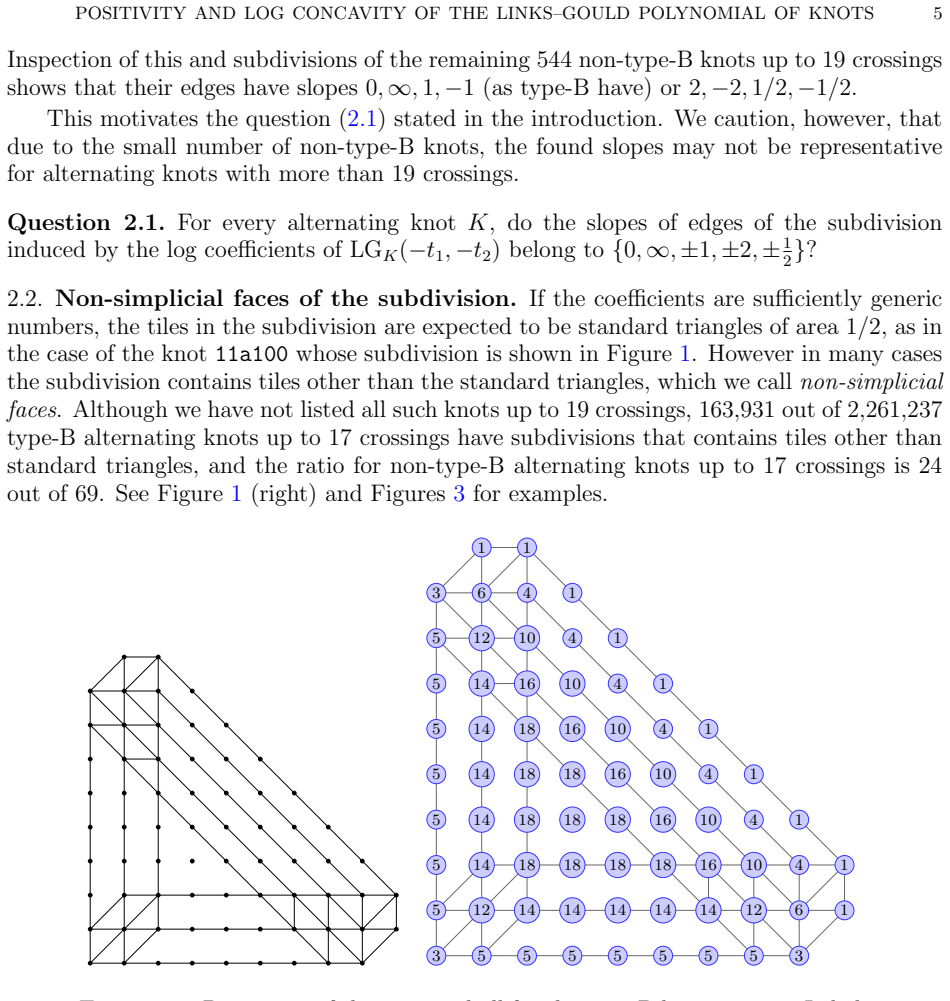
The paper formulates a conjecture asserting positivity, hole-freeness, and log-concavity for the Links-Gould polynomial of alternating links. It verifies the conjecture holds for all 51.3 million alternating knots with at most 19 crossings, with 544 of them failing a stronger type-B log-concavity condition that is characterized by the slopes of edges in the subdivision of the monomial support induced by the log coefficients.
What carries the argument
The Links-Gould polynomial, a two-variable polynomial invariant of links, carrying the properties of positivity, hole-free support, and log-concavity under the stated conjecture.
If this is right
- The conjecture applies to all alternating links, not just those with few crossings.
- The stronger type-B log-concavity holds for the vast majority of the checked knots.
- The verification provides substantial computational evidence for the conjecture.
- The property is expected to extend beyond the enumerated knots if the pattern continues.
Where Pith is reading between the lines
- If the conjecture is correct, the Links-Gould polynomial may share structural features with other knot polynomials that exhibit positivity and concavity.
- The distinction between ordinary and type-B log-concavity could point to different combinatorial interpretations of the coefficient array.
- Verification at higher crossing numbers would be a natural next test of the conjecture.
Load-bearing premise
The complete and error-free enumeration of all alternating knots with at most 19 crossings together with accurate computation of their Links-Gould polynomials for every such knot.
What would settle it
Computation of the Links-Gould polynomial for an alternating knot with 20 crossings that shows either a negative coefficient, a hole in the support, or a violation of log-concavity.
Figures

read the original abstract
Motivated by the recent work of Harper--Kohli--Song--Tahar, we formulate a positivity, hole-free, and log-concavity conjecture for the Links--Gould polynomial of alternating links and verify it for all 51.3 million alternating knots with at most 19 crossings. All but 544 of those knots satisfy a stronger type-B log-concavity condition characterized by the slopes of edges in the subdivision of the monomial support induced by the log coefficients.
Editorial analysis
A structured set of objections, weighed in public.
Referee Report
Summary. The manuscript formulates conjectures asserting positivity, absence of holes in the support, and log-concavity of the Links-Gould polynomial for alternating links. It reports an exhaustive computational verification of these properties (including a stronger type-B log-concavity condition for all but 544 cases) across all 51.3 million alternating knots with at most 19 crossings.
Significance. If the reported verification is reliable, the work supplies extensive empirical support for new conjectures on the Links-Gould invariant, potentially guiding future theoretical study of its positivity and concavity properties on alternating links. The scale of the enumeration and the distinction drawn between ordinary and type-B log-concavity constitute a concrete computational contribution that strengthens the case for the conjectures.
major comments (2)
- [Computational verification section] Computational verification section: the central claim rests on correct evaluation of the Links-Gould polynomial for every alternating knot up to 19 crossings, yet the manuscript supplies no description of the evaluation algorithm, data structures, cross-validation against known values for knots with fewer crossings, or error-detection methods. Without these, the reported verification cannot be independently assessed and remains the load-bearing element of the paper.
- [Introduction] Introduction and conjecture statement: the paper asserts that the verification covers 'all 51.3 million alternating knots,' but provides no explicit reference to the source of the knot enumeration (e.g., a standard table or generation method) or confirmation that the Links-Gould computation was performed consistently with the two-variable definition used in the literature.
minor comments (1)
- [Abstract] The abstract uses an em-dash in 'Links--Gould'; consistent hyphenation or spelling should be adopted throughout the text and references.
Simulated Author's Rebuttal
We thank the referee for their careful reading and for identifying areas where additional details would strengthen the manuscript. We address each major comment below and commit to revisions that directly respond to the concerns raised.
read point-by-point responses
-
Referee: [Computational verification section] Computational verification section: the central claim rests on correct evaluation of the Links-Gould polynomial for every alternating knot up to 19 crossings, yet the manuscript supplies no description of the evaluation algorithm, data structures, cross-validation against known values for knots with fewer crossings, or error-detection methods. Without these, the reported verification cannot be independently assessed and remains the load-bearing element of the paper.
Authors: We agree that the current manuscript lacks the necessary methodological details. In the revised version we will expand the computational verification section with a description of the evaluation algorithm, the data structures employed for the bivariate polynomials, cross-validation procedures against known values for knots with fewer crossings, and the error-detection methods used. This addition will make the verification independently assessable. revision: yes
-
Referee: [Introduction] Introduction and conjecture statement: the paper asserts that the verification covers 'all 51.3 million alternating knots,' but provides no explicit reference to the source of the knot enumeration (e.g., a standard table or generation method) or confirmation that the Links-Gould computation was performed consistently with the two-variable definition used in the literature.
Authors: We accept this observation. The revised introduction will include an explicit reference to the source of the alternating knot enumeration together with a statement confirming that the Links-Gould computations follow the standard two-variable definition appearing in the literature. revision: yes
Circularity Check
No circularity; conjecture and verification rest on independent computation
full rationale
The paper formulates a new positivity/hole-free/log-concavity conjecture for the Links-Gould polynomial of alternating links, motivated by external prior work (Harper-Kohli-Song-Tahar), and verifies it by exhaustive enumeration and evaluation on the complete set of 51.3 million alternating knots ≤19 crossings. No equations, fitted parameters, self-citations, or ansatzes are presented that reduce the conjecture or its verification to a tautology or input-by-construction. The central claim is a statement about an external invariant whose values are computed independently of the conjecture itself.
Axiom & Free-Parameter Ledger
Reference graph
Works this paper leans on
-
[1]
[BRS+25] Grigoriy Blekherman, Felipe Rinc´ on, Rainer Sinn, Cynthia Vinzant, and Josephine Yu,Moments, sums of squares, and tropicalization, J. Lond. Math. Soc. (2)112(2025), no. 4, Paper No. e70311,
2025
-
[2]
[Cro59] Richard Crowell,Genus of alternating link types, Ann. of Math. (2)69(1959), 258–275. [DLRS10] Jes´ us A. De Loera, J¨ org Rambau, and Francisco Santos,Triangulations, Algorithms and Com- putation in Mathematics, vol. 25, Springer-Verlag, Berlin, 2010, Structures for algorithms and applications. [DWIL05] David De Wit, Atsushi Ishii, and Jon Links,I...
work page internal anchor Pith review arXiv 1959
-
[3]
[GLY26] Stavros Garoufalidis, Shana Li, and Josephine Yu,Code and data for Positivity and Log Concavity of the Links–Gould Polynomial of Knots,https://doi.org/10.7910/DVN/DKJ84O,
-
[4]
[HKST] Matthew Harper, Ben-Michael Kohli, Jiebo Song, and Guillaume Tahar,On some log- concavity properties of the Alexander-Conway and Links-Gould invariants, Preprint 2025, arXiv:2509.16868. [Hog74] S.G Hoggar,Chromatic polynomials and logarithmic concavity, Journal of Combinatorial Theory, Series B16(1974), no. 3, 248–254. [Koh16] Ben-Michael Kohli,On ...
-
[5]
[KPM17] Ben-Michael Kohli and Bertrand Patureau-Mirand,Other quantum relatives of the Alexander polynomial through the Links-Gould invariants, Proc. Amer. Math. Soc.145(2017), no. 12, 5419–5433. [Lev65] Jerome Levine,A characterization of knot polynomials, Topology4(1965), 135–141. [LG92] Jon Links and Mark Gould,Two variable link polynomials from quantum...
2017
-
[6]
Korean Math
[Sto14] Alexander Stoimenow,Log-concavity and zeros of the Alexander polynomial, Bull. Korean Math. Soc.51(2014), no. 2, 539–545. [Zie95] G¨ unter M. Ziegler,Lectures on polytopes, Graduate Texts in Mathematics, vol. 152, Springer- Verlag, New York,
2014
discussion (0)
Sign in with ORCID, Apple, or X to comment. Anyone can read and Pith papers without signing in.