A scalable Ewald-free BIE framework for periodic Stokes flow via hierarchical proxy sums
Pith reviewed 2026-06-28 21:26 UTC · model grok-4.3
The pith
The periodization precomputation for periodic Stokes flow depends only on box geometry and reuses across kernels for O(N) accuracy.
A machine-rendered reading of the paper's core claim, the machinery that carries it, and where it could break.
Core claim
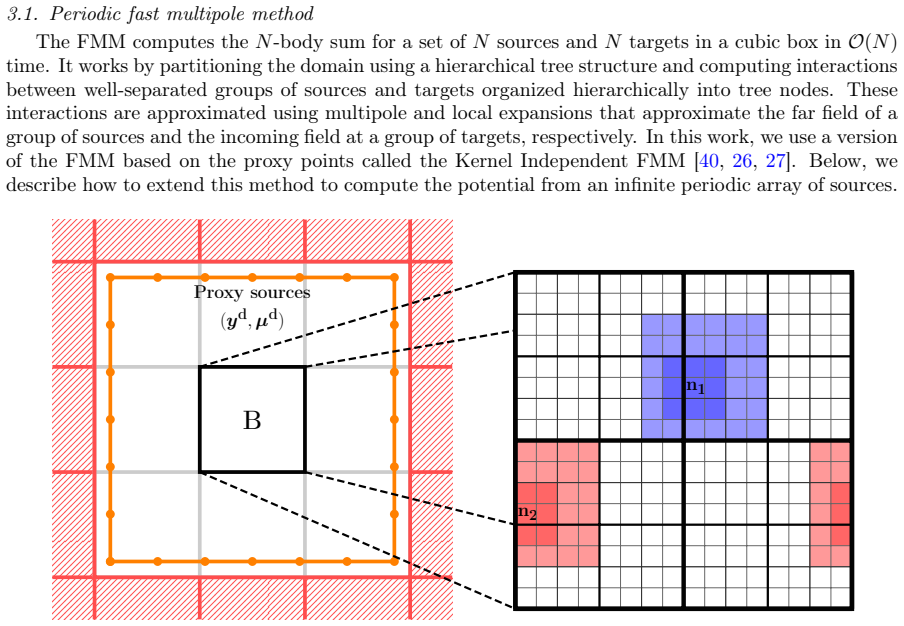
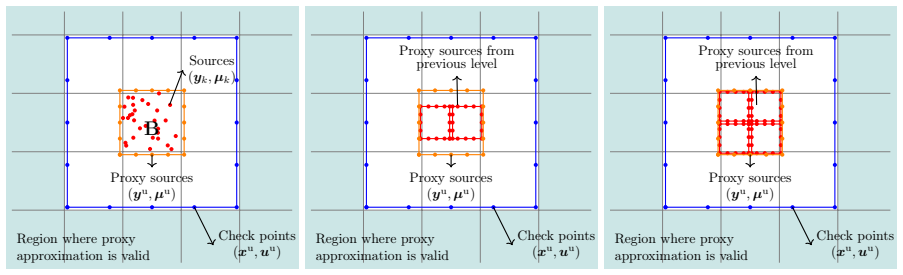
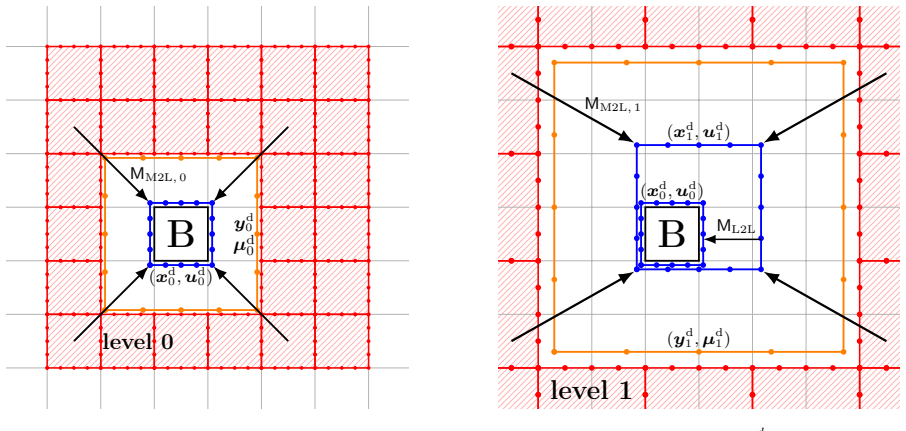
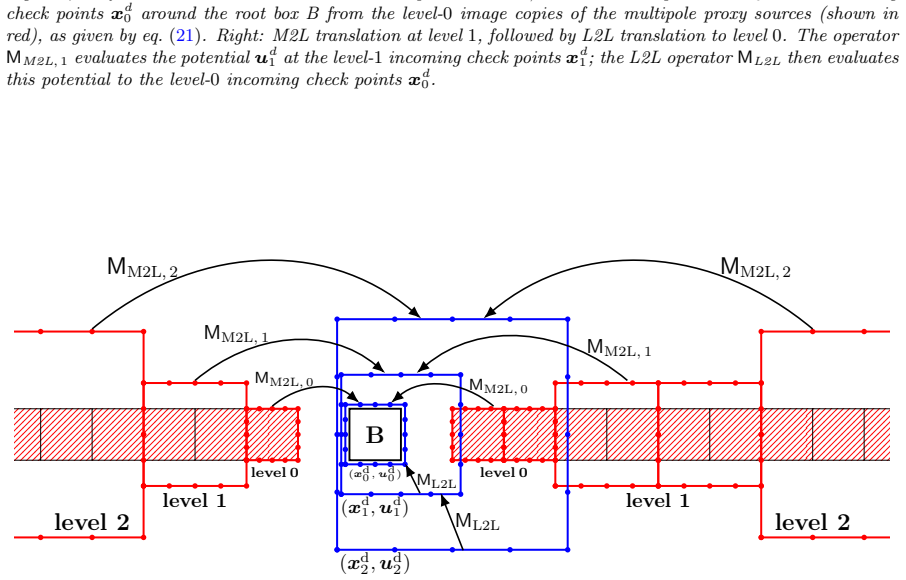
Proxy sources placed on equivalent surfaces of the kernel-independent FMM form the auxiliary basis, and contributions from far image boxes are captured by a hierarchical proxy sum made absolutely convergent by a net-force-zero compatibility condition. The resulting periodization precomputation depends only on the periodic-box geometry, independent of the kernel and of the surfaces inside the box, and is reused verbatim across the Stokeslet, stresslet, and rotlet.
What carries the argument
hierarchical proxy sum: a sum over hierarchical proxy sources on equivalent surfaces that captures periodic image contributions and is rendered convergent by the net-force-zero condition
Load-bearing premise
The net-force-zero compatibility condition is sufficient to make the hierarchical proxy sum absolutely convergent for periodic pipes, wall-bounded doubly-periodic, and triply-periodic geometries.
What would settle it
Running the hierarchical proxy sum for a configuration with nonzero net force and observing whether the sum diverges or fails to converge to the expected periodic solution would test the assumption.
Figures




read the original abstract
Particulate Stokes flow in confined, periodic geometries underlies a broad class of problems in biophysics, microfluidics, and the rheology of complex fluids. Boundary integral equation (BIE) methods are a natural tool for such problems, but existing periodization schemes rely either on periodic Green's functions, which are restrictive for complex confining geometries, or on free-space schemes that solve auxiliary proxy strengths alongside the surface densities in an extended linear system whose cost scales unfavorably in three dimensions. We present a BIE framework for three-dimensional particulate Stokes flow in periodic pipes with circular cross-sections, wall-bounded doubly-periodic, and triply-periodic geometries that uses only the free-space Green's function and avoids both Ewald summation and the extended linear system. Proxy sources placed on equivalent surfaces of the kernel-independent FMM (KIFMM) form the auxiliary basis, and contributions from far image boxes are captured by a hierarchical proxy sum made absolutely convergent by a net-force-zero compatibility condition. The resulting periodization precomputation depends only on the periodic-box geometry, independent of the kernel and of the surfaces inside the box, and is reused verbatim across the Stokeslet, stresslet, and rotlet. Combined with high-order adaptive surface discretizations, the method achieves high-order accuracy at $\mathcal{O}(N)$ cost with a single layer of image boxes in the near field. Numerical examples on dense polydisperse suspensions with thousands of particles and on flow through complex periodic channels, together with strong and weak scaling studies, demonstrate efficient performance on systems with millions of degrees of freedom on distributed-memory architectures.
Editorial analysis
A structured set of objections, weighed in public.
Referee Report
Summary. The manuscript presents a boundary integral equation framework for three-dimensional particulate Stokes flow in periodic pipes, wall-bounded doubly-periodic, and triply-periodic geometries. It employs only the free-space Green's function together with hierarchical proxy sums constructed from KIFMM-style equivalent surfaces; a net-force-zero compatibility condition is asserted to render the proxy sums absolutely convergent, enabling a kernel-independent periodization precomputation that is reused across the Stokeslet, stresslet, and rotlet and combined with high-order adaptive surface discretizations to achieve O(N) cost using only a single layer of image boxes in the near field. Numerical examples on dense polydisperse suspensions and complex channels plus scaling studies are offered in support.
Significance. If the central claims hold, the work supplies a practical route to high-order, scalable simulations of confined periodic Stokes flow that avoids both Ewald summation and the cost of extended linear systems. The kernel- and surface-independent precomputation, together with the reported strong/weak scaling to millions of degrees of freedom on distributed architectures, would constitute a genuine technical contribution to the field.
major comments (2)
- [Abstract] Abstract: the assertion that the net-force-zero compatibility condition renders the hierarchical proxy sum "absolutely convergent" (and thereby permits truncation after a single image layer) is load-bearing for the claimed high-order accuracy and kernel independence. No explicit proof, decay-rate analysis, or uniform error bound is supplied for the stresslet and rotlet (whose far-field decay differs from the Stokeslet), nor is absolute versus conditional convergence verified numerically for the three distinct geometries.
- [Numerical examples] Numerical examples section: the reported error studies and scaling plots do not isolate the truncation error incurred by the single-layer image-box approximation when the proxy sum is applied to the stresslet or rotlet; without such targeted tests the claim that geometry-dependent errors are absorbed by the precomputation cannot be assessed.
minor comments (2)
- The definition of the hierarchical proxy sum and the precise placement of equivalent surfaces would benefit from an additional schematic or pseudocode block for readers outside the KIFMM literature.
- A short table summarizing the precomputation cost (in terms of box geometry only) versus the per-solve cost would clarify the claimed separation of concerns.
Simulated Author's Rebuttal
We thank the referee for the positive evaluation of the work's potential contribution and for the detailed, constructive comments. We respond to each major comment below.
read point-by-point responses
-
Referee: [Abstract] Abstract: the assertion that the net-force-zero compatibility condition renders the hierarchical proxy sum "absolutely convergent" (and thereby permits truncation after a single image layer) is load-bearing for the claimed high-order accuracy and kernel independence. No explicit proof, decay-rate analysis, or uniform error bound is supplied for the stresslet and rotlet (whose far-field decay differs from the Stokeslet), nor is absolute versus conditional convergence verified numerically for the three distinct geometries.
Authors: We agree that the manuscript would benefit from an explicit decay-rate analysis and numerical verification to support the absolute-convergence claim for all kernels. The net-force-zero condition cancels the leading far-field term of the Stokeslet; the stresslet and rotlet possess faster natural decay, and the same compatibility condition extends the argument. We will add a dedicated subsection containing the decay-rate analysis, uniform error bounds, and numerical checks of absolute versus conditional convergence for the Stokeslet, stresslet, and rotlet across the three geometries. revision: yes
-
Referee: [Numerical examples] Numerical examples section: the reported error studies and scaling plots do not isolate the truncation error incurred by the single-layer image-box approximation when the proxy sum is applied to the stresslet or rotlet; without such targeted tests the claim that geometry-dependent errors are absorbed by the precomputation cannot be assessed.
Authors: We concur that isolating the single-layer truncation error for the stresslet and rotlet would strengthen the assessment of the precomputation. We will augment the numerical-examples section with targeted experiments that apply the proxy sum separately to each kernel, quantify the truncation error under the single-image-layer approximation, and confirm that geometry-dependent contributions remain absorbed by the precomputed corrections while high-order accuracy is retained. revision: yes
Circularity Check
No circularity: derivation relies on external KIFMM and net-force-zero condition with independent numerical validation
full rationale
The paper's central claims rest on the mathematical assertion that net-force-zero renders the hierarchical proxy sum (built from KIFMM equivalent surfaces) absolutely convergent for the listed geometries, combined with reuse of a geometry-only precomputation across kernels. No step reduces by definition or construction to its own inputs; the compatibility condition is an external assumption whose sufficiency is tested via reported scaling studies rather than assumed. No self-citations are load-bearing, no parameters are fitted then renamed as predictions, and the periodization independence is presented as a consequence of the proxy construction rather than a tautology. The derivation chain is therefore self-contained against external benchmarks.
Axiom & Free-Parameter Ledger
axioms (1)
- domain assumption Net-force-zero compatibility condition ensures absolute convergence of the hierarchical proxy sum from far image boxes.
invented entities (1)
-
Hierarchical proxy sum
no independent evidence
Forward citations
Cited by 1 Pith paper
-
Fast summation on rectangular cuboids with arbitrary periodicity in the DMK framework
DMK extended to rectangular cuboids with arbitrary periodicity via localized octree evaluations on cubical tilings and Fourier-space root-level summation with truncated kernels for reduced periodicity.
Reference graph
Works this paper leans on
-
[1]
Ludvig af Klinteberg and Anna-Karin Tornberg. Fast Ewald summation for Stokesian particle suspensions.International Journal for Numerical Methods in Fluids, 76(10):669–698, 2014. doi: 10.1002/fld.3953. 18
-
[2]
Ludvig af Klinteberg, Davoud Saffar Shamshirgar, and Anna-Karin Tornberg. Fast Ewald sum- mation for free-space Stokes potentials.Research in the Mathematical Sciences, 4(1):1, 2017. doi: 10.1186/s40687-016-0092-7
-
[3]
Ludvig af Klinteberg, Leslie Greengard, Shidong Jiang, and Anna-Karin Tornberg. Fast sum- mation of Stokes potentials using a new kernel-splitting in the DMK framework.arXiv preprint arXiv:2509.21471, 2025
arXiv 2025
-
[4]
Active turbulence.An- nual Review of Condensed Matter Physics, 13(1):143–170, 2022
Ricard Alert, Jaume Casademunt, and Jean-François Joanny. Active turbulence.An- nual Review of Condensed Matter Physics, 13(1):143–170, 2022. doi: 10.1146/ annurev-conmatphys-082321-035957
2022
-
[5]
Joar Bagge and Anna-Karin Tornberg. Fast Ewald summation for Stokes flow with arbitrary periodicity.Journal of Computational Physics, 493:112473, 2023. doi: 10.1016/j.jcp.2023.112473
-
[6]
A new integral representation for quasi-periodic scattering problems in two dimensions.BIT Numerical Mathematics, 51(1):67–90, 2011
Alex Barnett and Leslie Greengard. A new integral representation for quasi-periodic scattering problems in two dimensions.BIT Numerical Mathematics, 51(1):67–90, 2011. doi: 10.1007/ s10543-010-0297-x
2011
-
[7]
Barnett, Gary Marple, Shravan Veerapaneni, and Lin Zhao
Alex H. Barnett, Gary Marple, Shravan Veerapaneni, and Lin Zhao. A unified integral equa- tion scheme for doubly periodic Laplace and Stokes boundary value problems in two dimensions. Communications on Pure and Applied Mathematics, 71(11):2334–2380, 2018
2018
-
[8]
Alexander H. Barnett, Jeremy Magland, and Ludvig af Klinteberg. A parallel nonuniform fast Fouriertransformlibrarybasedonan“exponentialofsemicircle” kernel.SIAM Journal on Scientific Computing, 41(5):C479–C504, 2019. doi: 10.1137/18M120885X
-
[9]
Leonard Berman and Leslie Greengard
C. Leonard Berman and Leslie Greengard. A renormalization method for the evaluation of lattice sums.Journal of Mathematical Physics, 35(11):6036–6048, 1994. doi: 10.1063/1.530726
-
[10]
Min Hyung Cho and Alex H. Barnett. Robust fast direct integral equation solver for quasi-periodic scattering problems with a large number of layers.Optics Express, 23(2):1775–1799, 2015. doi: 10.1364/OE.23.001775
-
[11]
Darling and Dino Di Carlo
Eric M. Darling and Dino Di Carlo. High-throughput assessment of cellular mechani- cal properties.Annual Review of Biomedical Engineering, 17:35–62, 2015. doi: 10.1146/ annurev-bioeng-071114-040545
2015
-
[12]
X.-J. Fan, N. Phan-Thien, and R. Zheng. Completed double layer boundary element method for periodic suspensions.Zeitschrift für angewandte Mathematik und Physik, 49(2):167–193, 1998. doi: 10.1007/s000330050214
-
[13]
David R. Foss and John F. Brady. Brownian dynamics simulation of hard-sphere colloidal disper- sions.Journal of Rheology, 44(3):629–651, 2000. doi: 10.1122/1.551104
-
[14]
Jonathan B. Freund. Numerical simulation of flowing blood cells.Annual Review of Fluid Mechan- ics, 46:67–95, 2014. doi: 10.1146/annurev-fluid-010313-141349
-
[15]
A fast direct solver for quasiperiodic scattering problems
Adrianna Gillman and Alex Barnett. A fast direct solver for quasiperiodic scattering problems. Journal of Computational Physics, 248:309–322, 2013
2013
-
[16]
L. Greengard and V. Rokhlin. A fast algorithm for particle simulations.Journal of Computational Physics, 73(2):325–348, 1987. doi: 10.1016/0021-9991(87)90140-9
-
[17]
Leslie Greengard and Mary Catherine Kropinski. Integral equation methods for Stokes flow in doubly-periodic domains.Journal of Engineering Mathematics, 48(2):157–170, 2004. doi: 10.1023/ B:ENGI.0000011923.59797.92. 19
arXiv 2004
-
[18]
Hidenori Hasimoto. On the periodic fundamental solutions of the Stokes equations and their application to viscous flow past a cubic array of spheres.Journal of Fluid Mechanics, 5(3):317– 328, 1959. doi: 10.1017/S0022112059000222
-
[19]
A dual-space multilevel kernel-splitting framework for discrete and continuous convolution.Communications on Pure and Applied Mathematics, 78(5):1086–1143,
Shidong Jiang and Leslie Greengard. A dual-space multilevel kernel-splitting framework for discrete and continuous convolution.Communications on Pure and Applied Mathematics, 78(5):1086–1143,
-
[20]
doi: 10.1002/cpa.22240
-
[21]
Chao Jin, Sarah M. McFaul, Simon P. Duffy, Xiaoyan Deng, Peyman Tavassoli, Peter C. Black, and Hongshen Ma. Technologies for label-free separation of circulating tumor cells: from historical foundations to recent developments.Lab on a Chip, 14(1):32–44, 2014. doi: 10.1039/C3LC50625H
-
[22]
Dag Lindbo and Anna-Karin Tornberg. Spectrally accurate fast summation for periodic Stokes potentials.Journal of Computational Physics, 229(23):8994–9010, 2010. doi: 10.1016/j.jcp.2010. 08.026
-
[23]
Fast and spectrally accurate Ewald summation for 2- periodic electrostatic systems.The Journal of Chemical Physics, 136(16):164111, 2012
Dag Lindbo and Anna-Karin Tornberg. Fast and spectrally accurate Ewald summation for 2- periodic electrostatic systems.The Journal of Chemical Physics, 136(16):164111, 2012. doi: 10. 1063/1.4704177
2012
-
[24]
Yuxiang Liu and Alex H. Barnett. Efficient numerical solution of acoustic scattering from doubly- periodic arrays of axisymmetric objects.Journal of Computational Physics, 324:226–245, 2016. doi: 10.1016/j.jcp.2016.08.011
-
[25]
Scientific computing template library
Dhairya Malhotra. Scientific computing template library. URLhttps://sctl.readthedocs.io/ en/latest/index.html
-
[26]
Dhairya Malhotra and Alex Barnett. Efficient convergent boundary integral methods for slender bodies.Journal of Computational Physics, 503:112855, 2024. doi: 10.1016/j.jcp.2024.112855
-
[27]
Dhairya Malhotra and George Biros. PVFMM: A parallel kernel independent FMM for particle and volume potentials.Communications in Computational Physics, 18(3):808–830, 2015. doi: 10.4208/cicp.020215.150515sw
-
[28]
Algorithm 967: A distributed-memory fast multipole method for volume potentials.ACM Transactions on Mathematical Software, 43(2):1–27, 2016
Dhairya Malhotra and George Biros. Algorithm 967: A distributed-memory fast multipole method for volume potentials.ACM Transactions on Mathematical Software, 43(2):1–27, 2016. doi: 10. 1145/2898349
2016
-
[29]
Marple, Alex Barnett, Adrianna Gillman, and Shravan Veerapaneni
Gary R. Marple, Alex Barnett, Adrianna Gillman, and Shravan Veerapaneni. A fast algorithm for simulating multiphase flows through periodic geometries of arbitrary shape.SIAM Journal on Scientific Computing, 38(5):B740–B772, 2016. doi: 10.1137/15M1043066
-
[30]
Martin Maxey. Simulation methods for particulate flows and concentrated suspensions.Annual Review of Fluid Mechanics, 49:171–193, 2017. doi: 10.1146/annurev-fluid-122414-034408
-
[31]
Ehssan Nazockdast, Abtin Rahimian, Daniel Needleman, and Michael Shelley. Cytoplasmic flows as signatures for the mechanics of mitotic positioning.Molecular Biology of the Cell, 28(23): 3261–3270, 2017. doi: 10.1091/mbc.E16-02-0108
-
[32]
The physics of dense suspen- sions.Annual Review of Condensed Matter Physics, 13(1):97–117, 2022
Christopher Ness, Ryohei Seto, and Romain Mari. The physics of dense suspen- sions.Annual Review of Condensed Matter Physics, 13(1):97–117, 2022. doi: 10.1146/ annurev-conmatphys-031620-105938
2022
-
[33]
Ruqi Pei, Travis Askham, Leslie Greengard, and Shidong Jiang. A fast method for imposing periodic boundary conditions on arbitrarily-shaped lattices in two dimensions.Journal of Compu- tational Physics, 474:111792, 2023. doi: 10.1016/j.jcp.2022.111792
-
[34]
Pozrikidis.Boundary Integral and Singularity Methods for Linearized Viscous Flow
C. Pozrikidis.Boundary Integral and Singularity Methods for Linearized Viscous Flow. Cambridge University Press, Cambridge, UK, 1992. 20
1992
-
[35]
Pozrikidis
C. Pozrikidis. Computation of Stokes flow in two-dimensional periodic systems.Journal of Fluid Mechanics, 324:107–131, 1996
1996
-
[36]
David Saintillan, Eric Darve, and Eric S. G. Shaqfeh. A smooth particle-mesh Ewald algorithm for Stokes suspension simulations: The sedimentation of fibers.Physics of Fluids, 17(3):033301, 2005. doi: 10.1063/1.1862262
-
[37]
Timothy W. Secomb. Blood flow in the microcirculation.Annual Review of Fluid Mechanics, 49: 443–461, 2017. doi: 10.1146/annurev-fluid-010816-060302
-
[38]
Mu Wang and John F. Brady. Spectral Ewald acceleration of Stokesian dynamics for polydisperse suspensions.Journal of Computational Physics, 306:443–477, 2016. doi: 10.1016/j.jcp.2015.11.042
-
[39]
Wen Yan and Michael Shelley. Flexibly imposing periodicity in kernel independent FMM: A multipole-to-local operator approach.Journal of Computational Physics, 355:214–232, 2018. doi: 10.1016/j.jcp.2017.11.012
-
[40]
Wen Yan, Eduardo Corona, Dhairya Malhotra, Shravan Veerapaneni, and Michael Shelley. A scalable computational platform for particulate Stokes suspensions.Journal of Computational Physics, 416:109524, 2020. doi: 10.1016/j.jcp.2020.109524
-
[41]
Lexing Ying, George Biros, and Denis Zorin. A kernel-independent adaptive fast multipole algo- rithm in two and three dimensions.Journal of Computational Physics, 196(2):591–626, 2004. doi: 10.1016/j.jcp.2003.11.021
-
[42]
G. K. Youngren and A. Acrivos. Stokes flow past a particle of arbitrary shape: a numerical method of solution.Journal of Fluid Mechanics, 69(2):377–403, 1975. doi: 10.1017/S0022112075001486
-
[43]
A. A. Zick and G. M. Homsy. Stokes flow through periodic arrays of spheres.Journal of Fluid Mechanics, 115:13–26, 1982. doi: 10.1017/S0022112082000627. 21
discussion (0)
Sign in with ORCID, Apple, or X to comment. Anyone can read and Pith papers without signing in.