DEM: A Distilled Explanation Model for Interpretable Anomaly Detection in Physiological Sensor Networks
Pith reviewed 2026-06-28 23:16 UTC · model grok-4.3
The pith
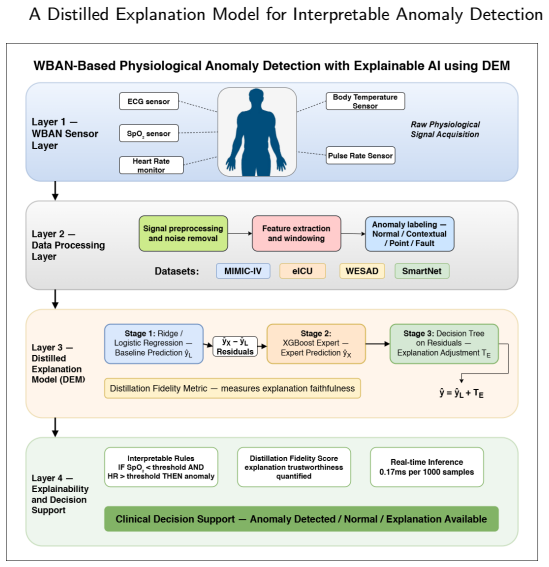
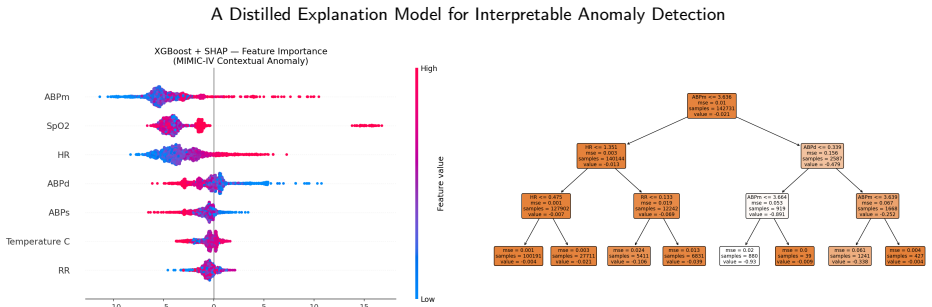
DEM distills gradient boosting into a residual decision tree so the explanation is the prediction itself for physiological anomaly detection.
A machine-rendered reading of the paper's core claim, the machinery that carries it, and where it could break.
Core claim
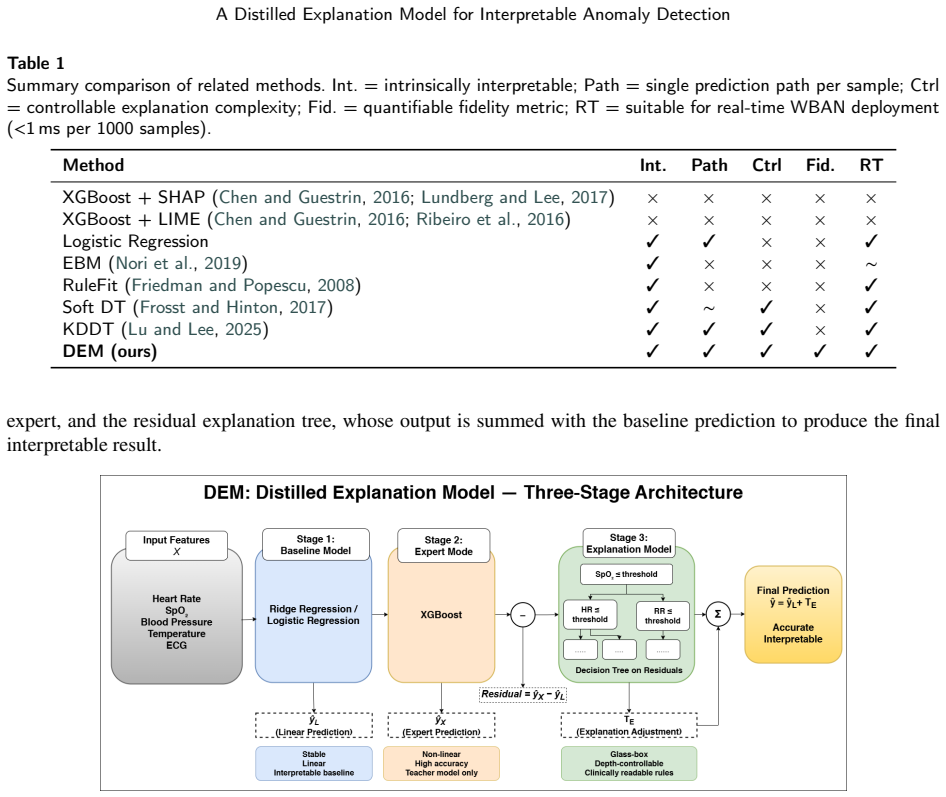
DEM is a three-stage glass-box framework that distills the non-linear knowledge of a gradient boosting expert into an interpretable decision tree operating on residuals relative to a linear baseline, so that the explanation is not an approximation but the prediction itself, while introducing a novel distillation fidelity metric.
What carries the argument
The residual decision tree that receives the nonlinear contribution distilled from the gradient boosting expert, serving simultaneously as predictor and built-in explainer.
If this is right
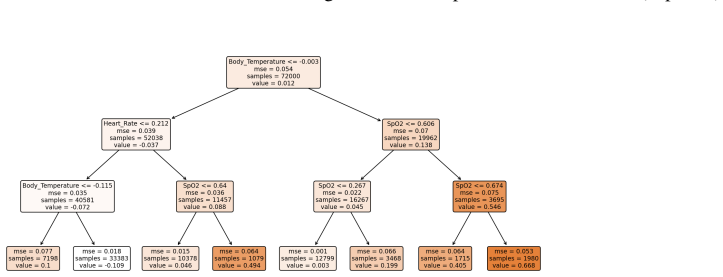
- Anomaly predictions in WBAN data become human-readable if-then rules at user-chosen depth while retaining AUCs above 0.90.
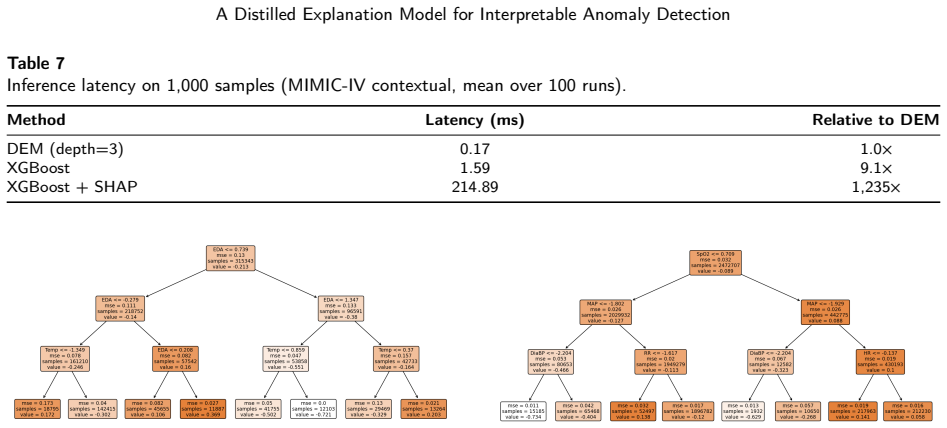
- Real-time monitoring becomes feasible because inference runs in 0.17 ms per 1000 samples.
- The fidelity metric supplies a quantitative check on whether the tree has faithfully extracted the expert's nonlinear behavior.
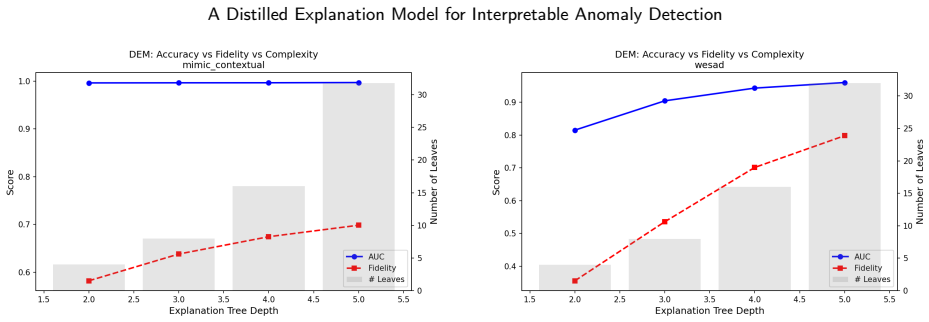
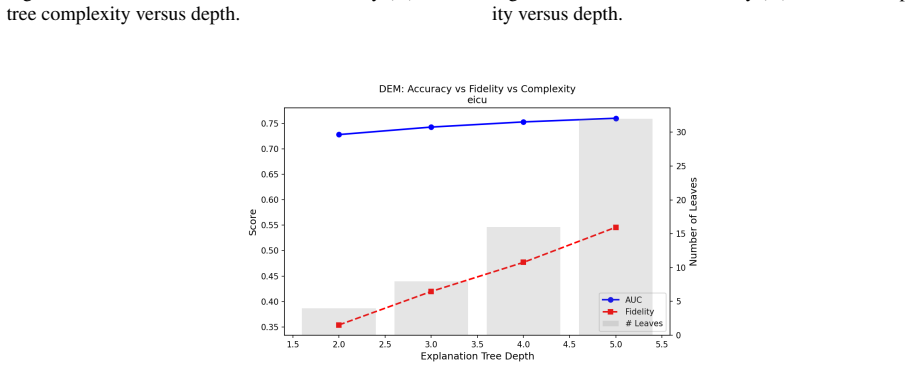
- Accuracy-interpretability trade-offs are made explicit and adjustable by changing tree depth alone.
Where Pith is reading between the lines
- The residual-distillation pattern could extend to other sensor-based tasks where linear baselines are already common, such as environmental monitoring.
- Regulatory requirements for explainable AI in healthcare might favor this built-in approach over post-hoc methods because the rules are the model output.
- If the fidelity metric proves stable across domains, it could become a standard check for any distilled interpretable model.
Load-bearing premise
That the XGBoost distillation step produces measurable performance gains over fitting a decision tree directly to residuals without the expert model.
What would settle it
A replication on the same four datasets in which a decision tree trained directly on residuals matches or exceeds DEM's AUC without any gradient boosting distillation step.
Figures
read the original abstract
Anomaly detection in physiological sensor data from Wireless Body Area Networks (WBANs) can be caused by sensor faults, network disruptions, or missing data, leading to false alarms. Hence, it demands both high predictive accuracy and clinically interpretable explanations. Existing approaches rely either on black-box models that achieve strong performance but offer no transparency, or on post-prediction explanation methods such as SHAP and LIME. In this paper, we propose the Distilled Explanation Model (DEM), a three-stage glass-box framework that distills the non-linear knowledge of a gradient boosting expert into an interpretable decision tree operating on residuals relative to a linear baseline, so that the explanation is not an approximation but the prediction itself. DEM introduces a novel distillation fidelity metric that quantifies how faithfully the explanation tree captures the expert model's non-linear contribution, providing a principled measure of explanation trustworthiness absent from prior interpretable models. Evaluated across four physiological datasets, including MIMIC-IV, WESAD, eICU, and an in-house SmartNet WBAN corpus, DEM achieves an AUC of 0.9964 on clinical contextual anomaly detection and 0.9047 on wearable stress detection while producing human-readable if-then rules at a controllable depth. Inference requires 0.17ms per 1000 samples, rendering DEM 1235x faster than SHAP-based post-hoc explanation and suitable for real-time physiological monitoring. Ablation studies confirm that the XGBoost distillation step provides measurable gains over naive residual fitting, and depth-sensitivity analysis demonstrates an explicit, user-controlled accuracy-interpretability trade-off unique to DEM among existing intrinsically interpretable models.
Editorial analysis
A structured set of objections, weighed in public.
Referee Report
Summary. The manuscript proposes DEM, a three-stage glass-box model for interpretable anomaly detection in physiological sensor data. It distills an XGBoost expert into a residual decision tree relative to a linear baseline, introduces a distillation fidelity metric, and reports high AUCs (0.9964 on clinical anomalies, 0.9047 on stress detection), 1235x speedup over SHAP, and ablation-confirmed gains from distillation across four datasets (MIMIC-IV, WESAD, eICU, SmartNet).
Significance. Should the central claims be substantiated, DEM would represent a meaningful contribution to intrinsically interpretable anomaly detection by ensuring the explanation coincides with the prediction and providing a fidelity metric for trustworthiness. The real-time suitability and user-controlled depth trade-off are notable strengths for WBAN applications. The approach builds on residual modeling but the distillation step's added value requires confirmation.
major comments (2)
- [Ablation studies] The assertion that the XGBoost distillation step provides measurable gains over naive residual fitting (as stated in the abstract) is load-bearing for the framework's novelty. However, without details on controls for hyperparameter tuning, tree depth, feature engineering, or statistical significance of the AUC deltas, this claim remains insecure and could be addressed by standard residual tree fitting.
- [Experimental evaluation] The reported performance metrics, including specific AUC values and inference times, are presented without error bars, baseline comparisons, dataset sizes, or preprocessing details. This absence makes it difficult to assess the robustness of the generalizability claim across the four named datasets.
minor comments (2)
- The abstract provides numerical claims but the full manuscript should include corresponding tables or figures with full experimental setup for reproducibility.
- [Notation] Clarify the definition and computation of the novel distillation fidelity metric with an explicit formula or algorithm.
Simulated Author's Rebuttal
We thank the referee for the constructive feedback. We address the two major comments below and will revise the manuscript to provide the requested details on ablations and experimental reporting.
read point-by-point responses
-
Referee: [Ablation studies] The assertion that the XGBoost distillation step provides measurable gains over naive residual fitting (as stated in the abstract) is load-bearing for the framework's novelty. However, without details on controls for hyperparameter tuning, tree depth, feature engineering, or statistical significance of the AUC deltas, this claim remains insecure and could be addressed by standard residual tree fitting.
Authors: We agree that the current description of the ablation studies lacks sufficient detail to fully substantiate the claim. In the revision we will expand the ablation section with explicit controls: hyperparameter grids and selection criteria for both the XGBoost expert and the residual tree, fixed tree-depth matching between DEM and the naive residual baseline, identical feature engineering pipelines, and statistical significance testing (paired t-tests across 5-fold cross-validation with reported p-values) for the reported AUC deltas. We will also clarify that the distillation procedure incorporates the novel fidelity metric during training, which is absent from standard residual fitting. revision: yes
-
Referee: [Experimental evaluation] The reported performance metrics, including specific AUC values and inference times, are presented without error bars, baseline comparisons, dataset sizes, or preprocessing details. This absence makes it difficult to assess the robustness of the generalizability claim across the four named datasets.
Authors: We acknowledge that the experimental section would benefit from greater transparency. The revised manuscript will add: (i) error bars as standard deviations over 5-fold cross-validation for all AUC and timing figures, (ii) expanded baseline tables including additional interpretable and post-hoc methods, (iii) explicit dataset sizes and class distributions for MIMIC-IV, WESAD, eICU, and SmartNet, and (iv) a dedicated preprocessing subsection detailing normalization, missing-value imputation, and train/test splits. These additions will strengthen the generalizability assessment. revision: yes
Circularity Check
No significant circularity; claims rest on external empirical evaluation
full rationale
The paper's central construction (linear baseline + residual decision tree distilled from XGBoost) is presented as an architectural design choice that makes the tree output part of the prediction by definition, but this is not offered as a derived 'prediction' or first-principles result that reduces to its inputs. Reported AUCs (0.9964, 0.9047), inference times, and ablation comparisons are measured on four independent datasets and do not reduce by construction to the novel fidelity metric or the distillation step. No self-citation chains, uniqueness theorems, or fitted parameters renamed as predictions appear in the abstract or described framework. The derivation chain is therefore self-contained against external benchmarks.
Axiom & Free-Parameter Ledger
free parameters (1)
- tree depth
axioms (1)
- domain assumption A decision tree trained on residuals can faithfully capture non-linear contributions from a gradient boosting model
invented entities (1)
-
distillation fidelity metric
no independent evidence
Reference graph
Works this paper leans on
-
[1]
author Albattah, A. , author Rassam, M.A. , year 2022 . title A correlation-based anomaly detection model for wireless body area networks using convolutional long short-term memory neural network . journal Sensors volume 22 , pages 1951 . :10.3390/s22051951
-
[2]
, author D \' az-Rodr \' guez, N
author Arrieta, A.B. , author D \' az-Rodr \' guez, N. , author Del Ser, J. , author Bennetot, A. , author Tabik, S. , author Barbado, A. , author Garc \' a, S. , author Gil-L \'o pez, S. , author Molina, D. , author Benjamins, R. , et al., year 2020 . title Explainable artificial intelligence ( XAI ): Concepts, taxonomies, opportunities and challenges to...
2020
-
[3]
, author Bose, S
author Bagadia, G. , author Bose, S. , author Hota, C. , year 2025 . title A convolutional transformer network for anomaly detection in wireless body area networks . journal IEEE Journal of Selected Areas in Sensors
2025
-
[4]
, year 2012
author Boucsein, W. , year 2012 . title Electrodermal Activity . edition 2 ed., publisher Springer , address New York
2012
-
[5]
author Buciluă, C. , author Caruana, R. , author Niculescu-Mizil, A. , year 2006 . title Model compression , in: booktitle Proceedings of the 12th ACM SIGKDD International Conference on Knowledge Discovery and Data Mining , pp. pages 535--541 . :10.1145/1150402.1150464
-
[6]
, author Gonzalez, S
author Chen, M. , author Gonzalez, S. , author Vasilakos, A. , author Cao, H. , author Leung, V.C. , year 2011 . title Body area networks: A survey . journal Mobile Networks and Applications volume 16 , pages 171--193
2011
-
[7]
, author Guestrin, C
author Chen, T. , author Guestrin, C. , year 2016 . title XGBoost : A scalable tree boosting system , in: booktitle Proceedings of the 22nd ACM SIGKDD International Conference on Knowledge Discovery and Data Mining , pp. pages 785--794
2016
-
[8]
, author Clifton, L
author Clifton, D.A. , author Clifton, L. , author Pimentel, M.A. , author Watkinson, P.J. , author Tarassenko, L. , year 2012 . title Gaussian processes for personalized e-health monitoring with wearable sensors . journal IEEE Transactions on Biomedical Engineering volume 60 , pages 193--197
2012
-
[9]
, author Popescu, B.E
author Friedman, J.H. , author Popescu, B.E. , year 2008 . title Predictive learning via rule ensembles . journal The Annals of Applied Statistics volume 2 , pages 916--954
2008
-
[10]
, author Hinton, G.E
author Frosst, N. , author Hinton, G.E. , year 2017 . title Distilling a neural network into a soft decision tree , in: booktitle Comprehensibility and Explanation in AI and ML (CEX), Workshop at AI*IA 2017
2017
-
[11]
, author Amaral, L.A
author Goldberger, A.L. , author Amaral, L.A. , author Glass, L. , author Hausdorff, J.M. , author Ivanov, P.C. , author Mark, R.G. , author Mietus, J.E. , author Moody, G.B. , author Peng, C.K. , author Stanley, H.E. , year 2000 . title PhysioBank, PhysioToolkit, and PhysioNet : Components of a new research resource for complex physiologic signals . jour...
2000
-
[12]
author Hajar, M.S. , et al., year 2025 . title Securing wireless body area networks data transmission with machine learning: A cross-tier framework for anomaly detection and intrusion prevention . journal Smart Health :10.1016/j.smhl.2025.100001
-
[13]
author Heringlake, M. , et al., year 2024 . title Explainable boosting machine approach identifies risk factors for acute renal failure . journal Journal of Clinical Medicine volume 13 , pages 3413 . :10.3390/jcm13123413
-
[14]
Distilling the Knowledge in a Neural Network
author Hinton, G. , author Vinyals, O. , author Dean, J. , year 2015 . title Distilling the knowledge in a neural network . journal arXiv preprint arXiv:1503.02531
work page internal anchor Pith review Pith/arXiv arXiv 2015
-
[15]
author Johansson, U. , author Sönströd, C. , author Löfström, T. , year 2011 . title One tree to explain them all , in: booktitle 2011 IEEE Congress of Evolutionary Computation (CEC) , pp. pages 1444--1451 . :10.1109/CEC.2011.5949785
-
[16]
, author Bulgarelli, L
author Johnson, A. , author Bulgarelli, L. , author Pollard, T. , author Gow, B. , author Moody, B. , author Horng, S. , author Celi, L.A. , author Mark, R. , year 2024 . title MIMIC-IV . howpublished https://physionet.org/content/mimiciv/3.1/
2024
-
[17]
author Johnson, A.E.W. , author Bulgarelli, L. , author Shen, L. , author Gayles, A. , author Shammout, A. , author Horng, S. , author Pollard, T.J. , author Hao, S. , author Moody, B. , author Gow, B. , author Lehman, L.w.H. , author Celi, L.A. , author Mark, R.G. , year 2023 . title MIMIC-IV , a freely accessible electronic health record dataset . journ...
-
[18]
author Ko, J. , author Lu, C. , author Srivastava, M.B. , author Stankovic, J.A. , author Terzis, A. , author Welsh, M. , year 2010 . title Wireless sensor networks for healthcare . journal Proceedings of the IEEE volume 98 , pages 1947--1960 . :10.1109/JPROC.2010.2065210
-
[19]
, author Braem, B
author Latr \'e , B. , author Braem, B. , author Moerman, I. , author Blondia, C. , author Demeester, P. , year 2011 . title A survey on wireless body area networks . journal Wireless Networks volume 17 , pages 1--18
2011
-
[20]
author Li, J. , author Li, Y. , author Xiang, X. , author Xia, S.T. , author Dong, S. , author Cai, Y. , year 2020 . title TNT : An interpretable tree-network-tree learning framework using knowledge distillation . journal Entropy volume 22 , pages 1203 . :10.3390/e22111203
-
[21]
author Lu, X. , author Lee, J.J. , year 2025 . title Knowledge distillation decision tree for unravelling black-box machine learning models . journal The New England Journal of Statistics in Data Science :10.51387/25-NEJSDS95
-
[22]
, author Lee, S.I
author Lundberg, S.M. , author Lee, S.I. , year 2017 . title A unified approach to interpreting model predictions , in: booktitle Advances in Neural Information Processing Systems
2017
-
[23]
, year 1956
author Miller, G.A. , year 1956 . title The magical number seven, plus or minus two: Some limits on our capacity for processing information . journal Psychological Review volume 63 , pages 81--97
1956
-
[24]
, author Abolhasan, M
author Movassaghi, S. , author Abolhasan, M. , author Lipman, J. , author Smith, D. , author Jamalipour, A. , year 2014 . title Wireless body area networks: A survey . journal IEEE Communications Surveys & Tutorials volume 16 , pages 1658--1686
2014
-
[25]
author Nori, H. , author Jenkins, S. , author Koch, P. , author Caruana, R. , year 2019 . title InterpretML : A unified framework for machine learning interpretability . journal arXiv preprint arXiv:1909.09223
-
[26]
author Oluwasanmi, A. , author Aftab, M.U. , author Baagyere, E. , author Qin, Z. , author Ahmad, M. , author Mazzara, M. , year 2022 . title Attention autoencoder for generative latent representational learning in anomaly detection . journal Sensors volume 22 , pages 123 . :10.3390/s22010123
-
[27]
, author Varoquaux, G
author Pedregosa, F. , author Varoquaux, G. , author Gramfort, A. , author Michel, V. , author Thirion, B. , author Grisel, O. , author Blondel, M. , author Prettenhofer, P. , author Weiss, R. , author Dubourg, V. , et al., year 2011 . title Scikit-learn: Machine learning in Python . journal Journal of Machine Learning Research volume 12 , pages 2825--2830
2011
-
[28]
author Pollard, T. , author Johnson, A. , author Raffa, J. , author Celi, L.A. , author Badawi, O. , author Mark, R. , year 2019 . title eICU Collaborative Research Database . journal PhysioNet https://doi.org/10.13026/C2WM1R, :10.13026/C2WM1R. note version 2.0
-
[29]
author Rassam, M.A. , year 2024 . title Autoencoder-based neural network model for anomaly detection in wireless body area networks . journal IoT volume 5 , pages 852--870 . :10.3390/iot5040039
-
[30]
Why should I trust you?
author Ribeiro, M.T. , author Singh, S. , author Guestrin, C. , year 2016 . title " Why should I trust you?": Explaining the predictions of any classifier , in: booktitle Proceedings of the 22nd ACM SIGKDD International Conference on Knowledge Discovery and Data Mining , pp. pages 1135--1144
2016
-
[31]
author Rudin, C. , year 2019 . title Stop explaining black box machine learning models for high stakes decisions and use interpretable models instead . journal Nature Machine Intelligence volume 1 , pages 206--215 . :10.1038/s42256-019-0048-x
-
[32]
, author Guerassimov, A
author Salem, O. , author Guerassimov, A. , author Mehaoua, A. , author Marcus, A. , author Furht, B. , year 2014 . title Anomaly detection in medical wireless sensor networks using SVM and linear regression models . journal International Journal of E-Health and Medical Communications volume 5 , pages 20--45
2014
-
[33]
author Schmidt, P. , author Reiss, A. , author D \"u richen, R. , author Marberger, C. , author Laerhoven, K.V. , year 2018 a. title Introducing wesad: A multimodal dataset for wearable stress and affect detection , in: booktitle Proceedings of the 20th ACM International Conference on Multimodal Interaction (ICMI '18) , publisher Association for Computing...
-
[34]
, author Reiss, A
author Schmidt, P. , author Reiss, A. , author D \"u richen, R. , author Marberger, C. , author Van Laerhoven, K. , year 2018 b. title Introducing WESAD , a multimodal dataset for wearable stress and affect detection , in: booktitle Proceedings of the 20th ACM International Conference on Multimodal Interaction , pp. pages 400--408
2018
-
[35]
author Siddiqui, C.R. , et al., year 2024 . title ADSBAN : Anomaly detection system for body area networks utilizing IoT and machine learning . journal Concurrency and Computation: Practice and Experience volume 36 , pages e8075 . :10.1002/cpe.8075
-
[36]
author Slack, D. , author Hilgard, S. , author Jia, E. , author Singh, S. , author Lakkaraju, H. , year 2020 . title Fooling LIME and SHAP : Adversarial attacks on post hoc explanation methods , in: booktitle Proceedings of the AAAI/ACM Conference on AI, Ethics, and Society (AIES) , pp. pages 180--186 . :10.1145/3375627.3375830
-
[37]
author Stiglic, G. , author Br\" u hl, R. , author Gundel, J. , author Gundel, L. , author Figueroa, R.L. , author Kov c evi c , T. , author Oderbolz, N. , author Stadelmann, T. , author Vogel, J. , year 2022 . title Development and validation of an interpretable 3 day intensive care unit readmission prediction model using explainable boosting machines . ...
-
[38]
author Thamaraimanalan, T. , author Ramalingam, S. , year 2025 . title Enhancing anomaly detection in WBANs using hybrid deep learning and optimization algorithms . journal Neural Computing and Applications :10.1007/s00521-025-11061-4
-
[39]
, author Guan, C
author Tjoa, E. , author Guan, C. , year 2021 . title A survey on explainable artificial intelligence ( XAI ): Toward medical XAI . journal IEEE Transactions on Neural Networks and Learning Systems volume 32 , pages 4793--4813
2021
-
[40]
author Vimbi, V. , author Shaffi, N. , author Mahmud, M. , year 2024 . title Interpreting artificial intelligence models: A systematic review on the application of LIME and SHAP in A lzheimer's disease detection . journal Brain Informatics volume 11 , pages 10 . :10.1186/s40708-024-00222-1
discussion (0)
Sign in with ORCID, Apple, or X to comment. Anyone can read and Pith papers without signing in.