The Nonparametric Kiefer-Weiss Problem
Pith reviewed 2026-06-28 20:21 UTC · model grok-4.3
The pith
The nonparametric Kiefer-Weiss problem reduces to an optimal stopping problem whose solution is recovered in the limit of unbounded randomizations and yields a two-dimensional stopping policy.
A machine-rendered reading of the paper's core claim, the machinery that carries it, and where it could break.
Core claim
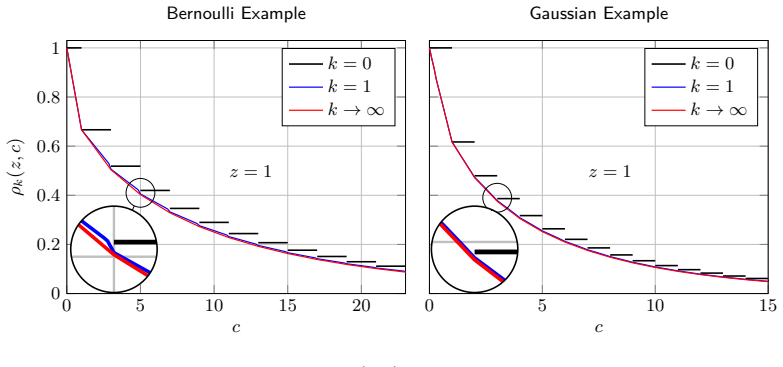
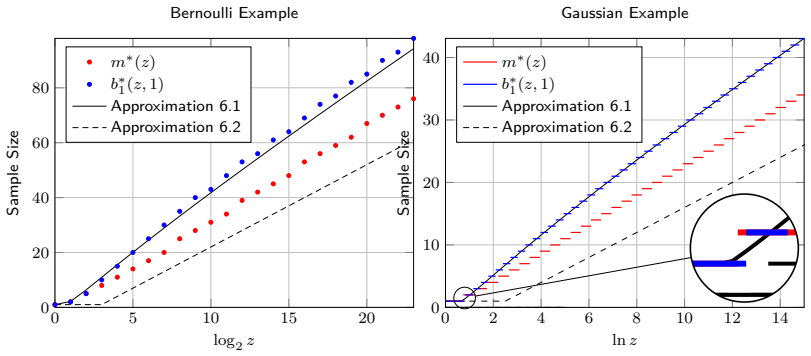
The nonparametric Kiefer-Weiss problem reduces to an optimal stopping problem. Its solution is obtained from the nonlinear Bellman equation that arises when at most k randomizations are permitted; the original problem is recovered in the limit as k tends to infinity. The optimal stopping policy is based on a two-dimensional test statistic with one component given by the likelihood ratio and the other by the expected remaining sample size. The optimal randomization rule is determined by a function that maps the likelihood ratio to an integer-valued sample size, for which two practical approximations are given.
What carries the argument
The two-dimensional test statistic that tracks the likelihood ratio together with the expected remaining sample size, and the associated randomization function mapping the likelihood ratio to a target sample size.
If this is right
- The optimal cost function satisfies a nonlinear Bellman equation.
- The stopping policy uses randomization both to increase the remaining expected sample size in some cases and to stop early in others.
- Two approximations to the randomization function can be evaluated easily for practical tests.
- The method applies to tests for shifts in Bernoulli success probability and normal distribution means.
Where Pith is reading between the lines
- The two-dimensional structure may generalize to other nonparametric sequential problems that enforce a worst-case sample size bound.
- The rate at which finite-k solutions converge to the limit could supply useful error bounds for numerical implementation.
- The explicit form of the randomization function opens the possibility of replacing the approximations with exact closed-form expressions in low-dimensional cases.
Load-bearing premise
The nonparametric Kiefer-Weiss problem can be reduced to an optimal stopping problem whose solution under a finite-randomization constraint yields the original problem in the limit as the number of allowed randomizations tends to infinity.
What would settle it
An explicit example of a probability distribution and error weights for which the proposed two-dimensional policy fails to achieve the minimal weighted error sum while satisfying the maximum expected sample size constraint would disprove the optimality of the derived policy.
Figures

read the original abstract
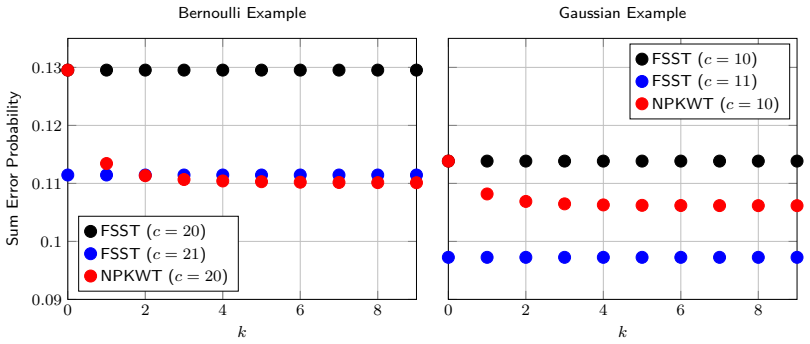
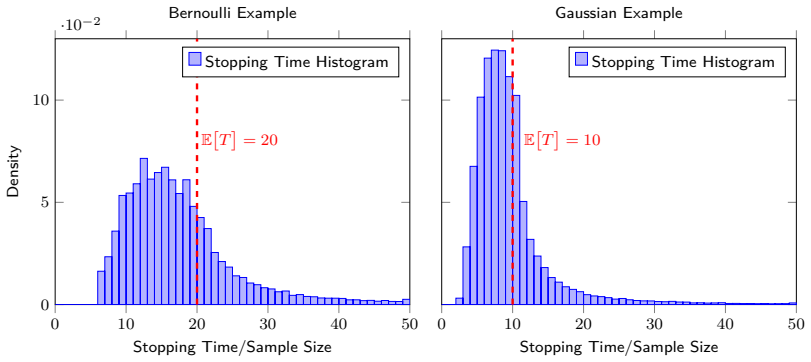
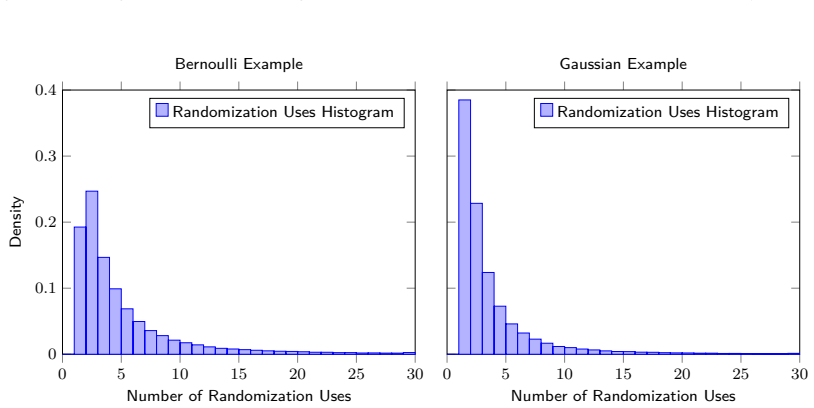
A nonparametric variant of the Kiefer-Weiss problem is proposed and solved. The objective is to minimize a weighted sum of the error probabilities of a binary sequential test subject to a constraint on its maximum expected sample size. This maximum is taken over all possible probability distributions on the given sequence space. First, it is shown that the nonparametric Kiefer-Weiss problem can be reduced to an optimal stopping problem. Then, the optimal stopping policy is derived under the assumption that at most k uses of randomization are permitted during any run of the test. The solution to the original problem is then obtained by letting k go to infinity. The optimal cost function is shown to be the solution of a nonlinear Bellman equation. The corresponding optimal stopping policy is shown to be based on a two-dimensional test statistic, with one component tracking the likelihood ratio and the other one tracking the expected remaining sample size. Critically, the stopping policy uses randomization to increase the remaining expected sample size for some runs, while stopping early for others. The optimal randomization rule is shown to be determined by a function that maps the likelihood ratio to an integer-valued sample size. Two approximations of this function are proposed that can be evaluated easily in practice. The results are illustrated with two numerical examples of nonparametric Kiefer-Weiss tests, one for a shift in the success probability of a Bernoulli distribution, and one for a shift in the mean of a normal distribution.
Editorial analysis
A structured set of objections, weighed in public.
Referee Report
Summary. The manuscript proposes a nonparametric variant of the Kiefer-Weiss problem: minimize a weighted sum of type-I and type-II error probabilities for a binary sequential test subject to a constraint on the supremum (over all distributions P) of the expected sample size. It reduces the problem to an optimal stopping problem, solves the version with at most k randomizations via a nonlinear Bellman equation, and recovers the original solution by sending k to infinity. The resulting optimal policy is characterized by a two-dimensional statistic (likelihood ratio together with expected remaining sample size); randomization is governed by a function that maps the likelihood ratio to an integer-valued sample size, for which two practical approximations are given. The results are illustrated on Bernoulli and Gaussian shift examples.
Significance. If the reduction and the k-to-infinity limit are rigorously justified, the work supplies the first explicit solution method for a nonparametric Kiefer-Weiss problem and yields implementable policies together with easily computable randomization approximations. This would constitute a substantive advance in robust sequential analysis.
major comments (2)
- [argument recovering the original problem by k→∞ (after the finite-k Bellman equation)] The central claim that the original nonparametric value is recovered by letting k→∞ after solving the finite-randomization Bellman equation rests on an unstated convergence argument. In the nonparametric setting the state space (likelihood ratio × expected remaining sample size) is typically non-compact; without an explicit uniform-integrability, tightness, or monotone-convergence justification for V_k → V (and preservation of the sup_P E_P[N] constraint), the passage to the limit may fail to yield a feasible or optimal policy for the original problem.
- [reduction to optimal stopping and derivation of the nonlinear Bellman equation] The reduction of the nonparametric Kiefer-Weiss problem to an optimal stopping problem is asserted, but the precise manner in which the supremum over all P is folded into the Bellman operator (or into the two-dimensional state process) is not shown to commute with the dynamic-programming recursion; this step is load-bearing for the claim that the finite-k solution converges to the desired nonparametric optimum.
minor comments (2)
- [numerical examples] The two numerical examples would benefit from a brief statement of the discretization or approximation scheme used to solve the Bellman equation on the continuous state space.
- [characterization of the optimal policy] Notation for the likelihood-ratio process and the expected-remaining-sample-size process should be introduced once and used consistently; currently the same symbols appear to be overloaded between the finite-k and limiting regimes.
Simulated Author's Rebuttal
We thank the referee for the careful reading and for identifying two points where the manuscript's arguments would benefit from expanded justification. We address each major comment below and will make the indicated revisions.
read point-by-point responses
-
Referee: The central claim that the original nonparametric value is recovered by letting k→∞ after solving the finite-randomization Bellman equation rests on an unstated convergence argument. In the nonparametric setting the state space (likelihood ratio × expected remaining sample size) is typically non-compact; without an explicit uniform-integrability, tightness, or monotone-convergence justification for V_k → V (and preservation of the sup_P E_P[N] constraint), the passage to the limit may fail to yield a feasible or optimal policy for the original problem.
Authors: We agree that the convergence V_k → V requires a more explicit treatment than the sketch currently given in Section 5. In the revised version we will insert a new subsection establishing monotone convergence of the finite-k value functions to the nonparametric value via the monotone convergence theorem applied to the Bellman operators. Non-compactness will be handled by a truncation argument on the likelihood-ratio coordinate together with a uniform-integrability bound derived from the fact that the worst-case expected sample size remains bounded by the constraint; preservation of the sup_P E_P[N] constraint in the limit will follow from Fatou's lemma. These additions will appear in the next revision. revision: yes
-
Referee: The reduction of the nonparametric Kiefer-Weiss problem to an optimal stopping problem is asserted, but the precise manner in which the supremum over all P is folded into the Bellman operator (or into the two-dimensional state process) is not shown to commute with the dynamic-programming recursion; this step is load-bearing for the claim that the finite-k solution converges to the desired nonparametric optimum.
Authors: The reduction is carried out in Section 3 by augmenting the state with the worst-case expected remaining sample size, so that the supremum over P is absorbed into the definition of the state process before the dynamic-programming recursion begins. The nonlinear Bellman equation is then obtained by applying the optimality principle to this augmented Markov decision process. While the manuscript indicates this construction, it does not supply a separate lemma verifying that the sup and the recursion commute. In the revision we will add such a lemma (new Lemma 3.2) that shows the value function of the reduced optimal-stopping problem satisfies the nonlinear Bellman equation without interchanging the order of sup and inf. revision: yes
Circularity Check
No significant circularity; derivation is a standard optimal-stopping reduction.
full rationale
The paper reduces the nonparametric Kiefer-Weiss problem to an optimal stopping problem whose value function satisfies a nonlinear Bellman equation, solves the finite-k randomization version explicitly, and recovers the original problem by taking k to infinity. This chain relies on dynamic programming and limiting arguments rather than any self-definitional mapping, fitted parameters renamed as predictions, or load-bearing self-citations. No equation is shown to equal its own input by construction, and the two-dimensional test statistic (likelihood ratio plus expected remaining sample size) emerges from the Bellman recursion rather than being presupposed. The derivation is therefore self-contained against external benchmarks.
Axiom & Free-Parameter Ledger
axioms (2)
- domain assumption The nonparametric Kiefer-Weiss problem reduces to an optimal stopping problem under the given max-expected-sample-size constraint.
- standard math The optimal cost function satisfies a nonlinear Bellman equation.
Reference graph
Works this paper leans on
-
[1]
A. Wald and J. Wolfowitz. “Optimum Character of the Sequential Probability Ratio Test”. In: Annals of Mathematical Statistics19.3 (1948), pp. 326–339.doi:10.1214/aoms/1177730197
-
[2]
Tartakovsky, I
A. Tartakovsky, I. Nikiforov, and M. Basseville.Sequential Analysis: Hypothesis Testing and Changepoint Detection. Boca Raton, FL, USA: Chapman and Hall/CRC, 2014.doi:10.1201/ b17279
2014
-
[3]
Some Properties of Generalized Sequential Probability Ratio Tests
J. Kiefer and L. Weiss. “Some Properties of Generalized Sequential Probability Ratio Tests”. In:Annals of Mathematical Statistics28.1 (1957), pp. 57–74.doi:10.1214/aoms/1177707037
-
[4]
On Sequential Tests which Minimize the Maximum Expected Sample Size
L. Weiss. “On Sequential Tests which Minimize the Maximum Expected Sample Size”. In: Journal of the American Statistical Association57.299 (1962), pp. 551–566.doi:10.2307/ 2282392
1962
-
[5]
On information and sufficiency,
A. Dvoretzky, J. Kiefer, and J. Wolfowitz. “Sequential Decision Problems for Processes with Continuous Time Parameter. Testing Hypotheses”. In:Annals of Mathematical Statistics24.2 (1953), pp. 254–264.doi:10.1214/aoms/1177729031
-
[6]
A Modification of the Sequential Probability Ratio Test to Reduce the Sample Size
T. W. Anderson. “A Modification of the Sequential Probability Ratio Test to Reduce the Sample Size”. In:Annals of Mathematical Statistics31.1 (1960), pp. 165–197.doi:10.1214/ aoms/1177705996
-
[7]
A Class of Stopping Rules for Testing Parametric Hypothe- ses
H. Robbins and D. Siegmund. “A Class of Stopping Rules for Testing Parametric Hypothe- ses”. In:Proc. of the Sixth Berkeley Symposium on Mathematical Statistics and Probability, Volume 4: Biology and Health. University of California Press, 1972, pp. 37–41.doi:10.1525/ 9780520422001-006
1972
-
[8]
Optimal Stopping and Sequential Tests which Minimize the Maximum Expected Sample Size
T. L. Lai. “Optimal Stopping and Sequential Tests which Minimize the Maximum Expected Sample Size”. In:Annals of Statistics1.4 (1973), pp. 659–673.doi:10.1214/aos/1176342461
-
[9]
G. Lorden. “2-SPRT’S and The Modified Kiefer-Weiss Problem of Minimizing an Expected Sample Size”. In:Annals of Statistics4.2 (1976), pp. 281–291.doi:10.1214/aos/1176343407
-
[10]
The Asymptotic Solution of the Kiefer–Weiss Problem
B. Eisenberg. “The Asymptotic Solution of the Kiefer–Weiss Problem”. In:Communications in Statistics. Part C: Sequential Analysis1.1 (1982), pp. 81–88.doi:10.1080/07474948208836005
-
[11]
M. D. Huffman. “An Efficient Approximate Solution to the Kiefer–Weiss Problem”. In:Annals of Statistics11.1 (1983), pp. 306–316.doi:10.1214/aos/1176346081
-
[12]
Asymptotic Solution of the Kiefer–Weiss Problem for Pro- cesses with Independent Increments
V. P. Dragalin and A. Novikov. “Asymptotic Solution of the Kiefer–Weiss Problem for Pro- cesses with Independent Increments”. In:Theory of Probability & Its Applications32.4 (1988), pp. 617–627.doi:10.1137/1132094
-
[13]
T. L. Lai.Asymptotic Optimality of Generalized Sequential Likelihood Ratio Tests in Some Classical Sequential Testing Problems. Tech. rep. Department of Statistics, Stanford Univer- sity, 1988.doi:10.1081/SQA-120016301
-
[14]
Sequential Procedure of Testing Composite Hypotheses with Applications to the Kiefer–Weiss Problem
I. V. Pavlov. “Sequential Procedure of Testing Composite Hypotheses with Applications to the Kiefer–Weiss Problem”. In:Theory of Probability & Its Applications35.2 (1991), pp. 280– 292.doi:10.1137/1135036
-
[15]
T. Augustin and S. P¨ ohlmann.On Robust Sequential Analysis – Kiefer–Weiss Optimal Test- ing under Interval Probability. 2001.doi:10.5282/ubm/epub.1641. 30
-
[16]
The Optimal Decision Rule in the Kiefer–Weiss Problem for a Brownian Motion
M. V. Zhitlukhin, A. A. Muravlev, and A. N. Shiryaev. “The Optimal Decision Rule in the Kiefer–Weiss Problem for a Brownian Motion”. In:Russian Mathematical Surveys68.2 (2013), pp. 389–391.doi:10.1070/RM2013v068n02ABEH004834
-
[17]
A Computational Approach to the Kiefer–Weiss Problem for Sampling from a Bernoulli Population
Andrey Novikov, Andrei Novikov, and Fahil Farkhshatov. “A Computational Approach to the Kiefer–Weiss Problem for Sampling from a Bernoulli Population”. In:Sequential Analysis 41.2 (2022), pp. 198–219.doi:10.1080/07474946.2022.2070212
-
[18]
A Computational Approach to the Kiefer–Weiss Problem for Sampling from a Bernoulli Population
Andrey Novikov and Fahil Farkhshatov. “Design and Performance Evaluation in Kiefer–Weiss Problems When Sampling from Discrete Exponential Families”. In:Sequential Analysis41.4 (2022), pp. 417–434.doi:10.1080/07474946.2022.2109673
-
[19]
Numerical Solution of Kiefer– Weiss Problems When Sampling from Continuous Exponential Families
Andrey Novikov, Andrei Novikov, and Fahil Farkhshatov. “Numerical Solution of Kiefer– Weiss Problems When Sampling from Continuous Exponential Families”. In:Sequential Anal- ysis42.2 (2023), pp. 189–209.doi:10.1080/07474946.2023.2193602
-
[20]
Michael Fauß and H. Vincent Poor. “Fading Boundaries: On a Nonparametric Variant of the Kiefer–Weiss Problem”. In:arXiv: Statistics Theory(2020).doi:10.48550/arXiv.2010. 12094
-
[21]
C. D. Aliprantis and K. C. Border.Infinite Dimensional Analysis: A Hitchhiker’s Guide. 3rd. Berlin: Springer, 2007.doi:10.1007/3-540-29587-9
-
[22]
Lehmann and George Casella.Theory of Point Estimation
Erich L. Lehmann and George Casella.Theory of Point Estimation. 2nd ed. Springer Texts in Statistics. New York: Springer, 1998.doi:10.2307/1270597
-
[23]
A. Wald.Sequential Analysis. Hoboken, NJ, USA: Wiley, 1947.doi:10.2307/2280027
-
[24]
Siegmund.Sequential Analysis
D. Siegmund.Sequential Analysis. New York City, NY, USA: Springer, 1985.doi:10.1007/ 978-1-4757-1862-1. [25]Code Repository.https://github.com/mifauss/Nonparametric_Kiefer_Weiss_Test
1985
-
[25]
G. B. Folland.Real Analysis: Modern Techniques and Their Applications. 2nd. Pure and Applied Mathematics: A Wiley Series of Texts, Monographs and Tracts. New York: Wiley, 1999
1999
-
[26]
Compactness of Stopping Times
J. R. Baxter and Rafael V. Chacon. “Compactness of Stopping Times”. In:Zeitschrift f¨ ur Wahrscheinlichkeitstheorie und Verwandte Gebiete40 (1977), pp. 169–181.doi:10.1007/ bf00736045
1977
-
[27]
On Compactness and Optimality of Stopping Times
G. A. Edgar, A. Millet, and L. Sucheston. “On Compactness and Optimality of Stopping Times”. In:Martingale Theory in Harmonic Analysis and Banach Spaces. Ed. by Jia-Arng Chao and Wojbor A. Woyczy´ nski. Berlin, Heidelberg: Springer, 1982, pp. 36–61.doi:10. 1007/bfb0096258
1982
-
[28]
J. B. Conway.A Course in Functional Analysis. Graduate Texts in Mathematics. Springer New York, 1994.doi:10.1007/978-1-4757-4383-8
-
[29]
Rudin.Real and Complex Analysis
W. Rudin.Real and Complex Analysis. Mathematics series. McGraw-Hill, 1987.doi:10 . 2307/2348852
1987
-
[30]
J. R. Munkres.Topology: A First Course. 1st. Englewood Cliffs, NJ: Prentice-Hall, 1974
1974
-
[31]
Rudin.Principles of Mathematical Analysis
W. Rudin.Principles of Mathematical Analysis. 3rd. International Series in Pure and Applied Mathematics. New York: McGraw-Hill, 1976. 31
1976
-
[32]
R. T. Rockafellar and R. J. B. Wets.Variational Analysis. Vol. 317. Grundlehren der math- ematischen Wissenschaften. Berlin, Heidelberg: Springer, 2009.doi:10.1007/978- 3- 642- 02431-3
-
[33]
R. T. Rockafellar.Convex Analysis. Princeton, NJ, USA: Princeton University Press, 1970. doi:10.1515/9781400873173
-
[34]
Feller.An Introduction to Probability Theory and Its Applications, Volume 1
W. Feller.An Introduction to Probability Theory and Its Applications, Volume 1. An Intro- duction to Probability Theory and Its Applications. Wiley, 1968.doi:10.2307/2286108. 32
discussion (0)
Sign in with ORCID, Apple, or X to comment. Anyone can read and Pith papers without signing in.