Motif-based morphology signatures for interpretable ECG screening and monitoring
Pith reviewed 2026-06-29 15:22 UTC · model grok-4.3
The pith
Representative ECG motifs serve as interpretable signatures to track and detect changes in cardiac morphology.
A machine-rendered reading of the paper's core claim, the machinery that carries it, and where it could break.
Core claim
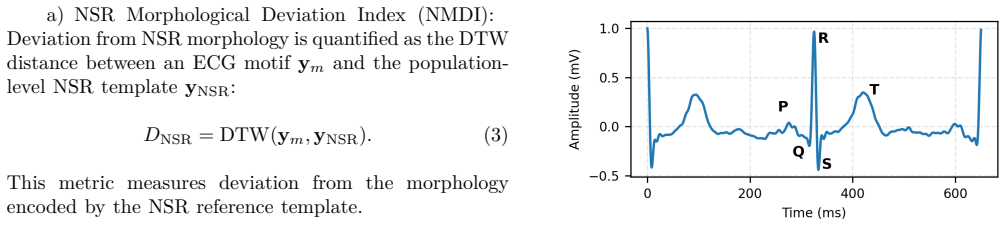
ECG motifs defined as representative cardiac cycles extracted by minimizing DTW distance within fixed windows provide interpretable signatures of morphology. Three metrics quantify deviation from normal sinus rhythm, from a personalized baseline, and motif instability. These metrics achieve statistically significant separation of normal from abnormal ECGs.
What carries the argument
ECG motifs as beat-aligned representative cycles that minimize DTW distance, used to quantify morphological drift and deviation.
If this is right
- Motif overlays and fiducial visualizations allow direct inspection of changes.
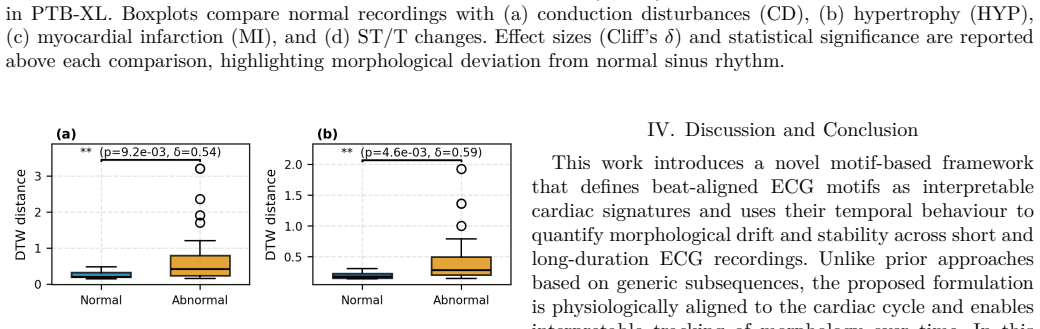
- The metrics separate normal from arrhythmic subjects in long recordings.
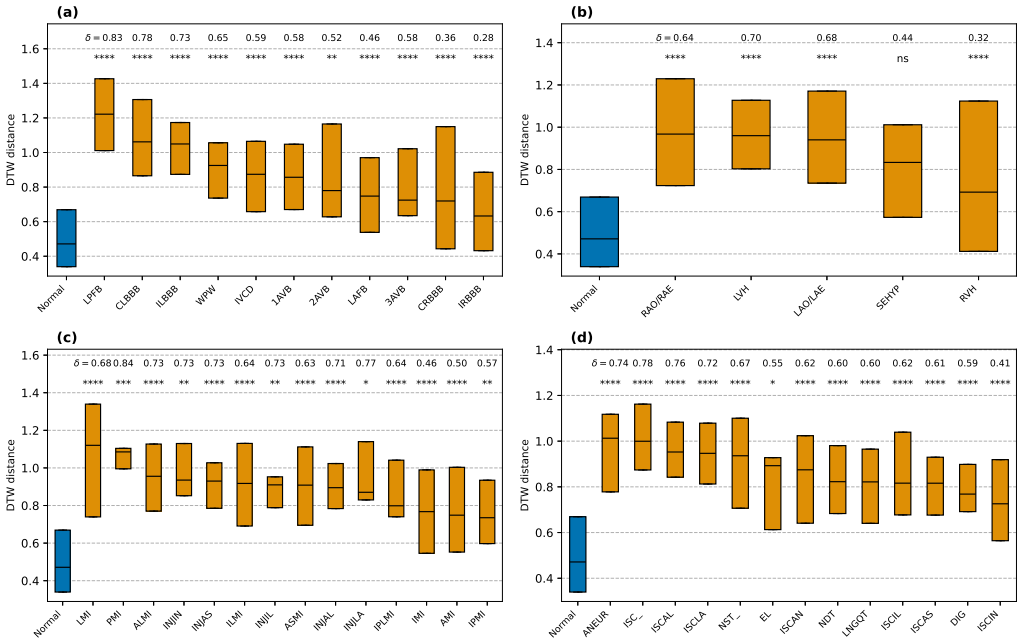
- Deviation from normal sinus rhythm distinguishes normal from abnormal ECGs across subtypes.
- Supports scalable longitudinal monitoring and early detection of morphology-driven change.
Where Pith is reading between the lines
- If the motif approach generalizes, it could enable automated alerts for progressive changes in ambulatory monitoring.
- Similar motif extraction might apply to other physiological signals for interpretable tracking.
- Combining motifs with other features could improve detection of subtle pre-clinical shifts.
Load-bearing premise
Selecting beats by minimizing DTW distance within fixed windows captures the dominant morphology without systematic bias from noise, artifacts, or non-stationary segments.
What would settle it
Failure of the drift metrics to statistically separate normal from abnormal ECGs in a held-out collection of recordings would indicate the motifs do not reliably capture morphology changes.
Figures



read the original abstract
Electrocardiography (ECG) remains central to cardiovascular screening, yet interpretation remains largely manual and episodic. Clinical practice relies on brief resting ECGs and, when required, long-duration ambulatory recordings, both generating data that require resource-intensive review. Consequently, subtle morphological changes or progressive drift preceding clinically apparent abnormalities may go unnoticed. We propose a motif-based framework that defines beat-aligned ECG motifs as interpretable cardiac signatures and quantifies morphological drift and deviation across short and long-term monitoring. Motifs are representative cardiac cycles capturing dominant morphology. We introduce three interpretable drift metrics: deviation from a normal sinus rhythm (NSR), deviation from a personalised baseline, and a motif instability index. Motifs are extracted by selecting beats that minimise Dynamic Time Warping (DTW) distance within fixed windows. We evaluate these metrics on short (PTB-XL) and long-duration (MIT-BIH Arrhythmia) ECG datasets. Interpretability is achieved through representative motif overlays and fiducial-based visualisations, enabling direct inspection of morphological changes. In MIT-BIH, the proposed metrics significantly separated predominantly normal from arrhythmic subjects (p<0.01). In PTB-XL, NSR deviation distinguished normal from abnormal ECGs across major diagnostic subtypes (p<1e-4, Cliff's delta up to 0.93). ECG motifs provide an interpretable representation of cardiac morphology, supporting scalable longitudinal monitoring and early detection of morphology-driven change.
Editorial analysis
A structured set of objections, weighed in public.
Referee Report
Summary. The paper proposes a motif-based framework for ECG analysis in which representative cardiac cycles (motifs) are extracted by selecting the beat that minimizes DTW distance inside fixed windows. Three interpretable drift metrics are defined—NSR deviation, personalized baseline deviation, and motif instability index—and evaluated on the PTB-XL and MIT-BIH datasets. The central claim is that these metrics achieve statistically significant separation of normal from abnormal ECGs (p<0.01 on MIT-BIH; p<1e-4 and Cliff’s delta up to 0.93 on PTB-XL) while supporting longitudinal monitoring through visual motif overlays.
Significance. If the motif extraction step is shown to be robust, the work would supply an interpretable, parameter-light signature for morphology-driven change that complements existing ECG pipelines. Credit is due for the use of two public benchmark datasets, explicit reporting of effect sizes (Cliff’s delta), and the focus on visual fiducial overlays rather than opaque embeddings. The approach could scale to ambulatory monitoring if the extraction bias concern is resolved.
major comments (3)
- [Abstract] Abstract (motif extraction paragraph): the statistically significant separations rest on the claim that the DTW-minimizing beat inside each fixed window faithfully represents dominant morphology. No window-length justification, no motif-count specification, no artifact-rejection rule, and no quantitative check (e.g., agreement with median beat or expert annotation) are supplied; this directly engages the load-bearing assumption that the minimization step is insensitive to noise, baseline wander, or non-stationary segments.
- [Abstract] Abstract (results paragraph): p-values are reported for multiple diagnostic subtypes on PTB-XL without any statement of multiple-comparison correction. Because the headline claim of separation across subtypes depends on these p-values, the absence of correction or pre-specified primary endpoint undermines the reported significance levels.
- [Methods] Methods (motif extraction): the two free parameters listed in the axiom ledger—window length and number of motifs per window—are not accompanied by sensitivity analysis or cross-validation. Any systematic bias introduced by these choices would propagate directly into the three drift metrics and the reported Cliff’s deltas.
minor comments (1)
- [Abstract] The abstract states that motifs are “representative cardiac cycles capturing dominant morphology” but does not define how dominance is operationalized beyond the DTW rule; a short clarifying sentence would improve readability.
Simulated Author's Rebuttal
Thank you for the constructive review and for highlighting areas where additional justification and validation would strengthen the manuscript. We address each major comment below and will revise the manuscript to incorporate the suggested improvements on parameter justification, statistical reporting, and robustness checks.
read point-by-point responses
-
Referee: [Abstract] Abstract (motif extraction paragraph): the statistically significant separations rest on the claim that the DTW-minimizing beat inside each fixed window faithfully represents dominant morphology. No window-length justification, no motif-count specification, no artifact-rejection rule, and no quantitative check (e.g., agreement with median beat or expert annotation) are supplied; this directly engages the load-bearing assumption that the minimization step is insensitive to noise, baseline wander, or non-stationary segments.
Authors: We agree that the abstract and current Methods description lack explicit justification and validation for these choices. In the revised manuscript we will expand the Methods section with: (i) rationale for the selected window length grounded in typical ECG cycle durations, (ii) specification of the motif count per window, (iii) an amplitude-based artifact rejection rule applied prior to motif extraction, and (iv) a quantitative comparison of the DTW-selected motif against the median beat (reporting mean DTW distance and visual overlays) across both datasets to demonstrate robustness to noise and non-stationarity. revision: yes
-
Referee: [Abstract] Abstract (results paragraph): p-values are reported for multiple diagnostic subtypes on PTB-XL without any statement of multiple-comparison correction. Because the headline claim of separation across subtypes depends on these p-values, the absence of correction or pre-specified primary endpoint undermines the reported significance levels.
Authors: The observation is correct. We will revise the Results and Statistical Analysis sections to apply Bonferroni correction (or an equivalent family-wise error rate control) to the reported p-values for the diagnostic subtypes on PTB-XL, present the adjusted values, and explicitly state the primary endpoint used for the headline separation claim. revision: yes
-
Referee: [Methods] Methods (motif extraction): the two free parameters listed in the axiom ledger—window length and number of motifs per window—are not accompanied by sensitivity analysis or cross-validation. Any systematic bias introduced by these choices would propagate directly into the three drift metrics and the reported Cliff’s deltas.
Authors: We acknowledge that a sensitivity analysis is missing. The revised manuscript will include a dedicated sensitivity subsection that varies window length and motif count over clinically plausible ranges, recomputes the three drift metrics and Cliff’s deltas on both datasets, and reports that the statistical separations remain stable, thereby quantifying any potential bias from parameter choice. revision: yes
Circularity Check
No significant circularity detected
full rationale
The paper extracts motifs by minimizing DTW distance (a standard external measure) within fixed windows, then defines three drift metrics directly from distances to NSR references and personalized baselines. These metrics are evaluated empirically for separation on independent datasets (PTB-XL, MIT-BIH) with reported p-values and effect sizes. No equations reduce any output metric to a fitted parameter of the input data by construction, no self-citations are invoked as load-bearing uniqueness theorems, and no ansatz or renaming is presented as a derivation. The chain from raw ECG to reported separations is self-contained against external benchmarks.
Axiom & Free-Parameter Ledger
free parameters (2)
- window length for motif extraction
- number of motifs per window
axioms (2)
- domain assumption Dynamic time warping provides a clinically meaningful distance between ECG beat shapes
- domain assumption Normal sinus rhythm template is an appropriate external reference for deviation scoring
invented entities (1)
-
motif instability index
no independent evidence
Reference graph
Works this paper leans on
-
[1]
Cardiovascular diseases,
World Health Organization, “Cardiovascular diseases,” WHO, https://www.who.int/health-topics/cardiovascular-diseases (accessed Jan. 17, 2026)
2026
-
[2]
Global burden of cardiovascular diseases: Projections from 2025 to 2050,
B. Chong, J. Jayabaskaran, S. M. Jauhari, S. P. Chan, R. Goh, M. T. W. Kueh, H. Li, Y. H. Chin, G. Kong, V. V. Anand, J.-W. Wang, M. Muthiah, V. Jain, A. Mehta, S. L. Lim, R. Foo, G. A. Figtree, S. J. Nicholls, M. A. Mamas, J. L. Januzzi, N. W. S. Chew, A. M. Richards, and M. Y. Chan, “Global burden of cardiovascular diseases: Projections from 2025 to 205...
-
[3]
F. D’Ascenzi, F. Valentini, S. Pistoresi, F. Frascaro, P. Piu, L. Cavigli, S. Valente, M. Focardi, M. Cameli, M. Bonifazi, M. Metra, and S. Mondillo, “Causes of sudden cardiac death in young athletes and non-athletes: Systematic review and meta-analysis,” Trends Cardiovasc. Med., vol. 32, no. 5, pp. 299–308, 2022, doi: 10.1016/j.tcm.2021.06.001
-
[4]
A. F. Pedroso and R. Khera, “Leveraging AI-enhanced digital health with consumer devices for scalable cardiovascular screening, prediction, and monitoring,” npj Cardiovasc. Health, vol. 2, Art. no. 34, 2025, doi: 10.1038/s44325-025-00071-9
-
[5]
ECG screening in athletes: A systematic review of sport, age, and gender variations,
A. Caramoci, A. M. Smaranda, T. S. Drăgoiu, and I. A. Bădărău, “ECG screening in athletes: A systematic review of sport, age, and gender variations,” Rev. Cardiovasc. Med., vol. 26, no. 5, Art. no. 38209, 2025, doi: 10.31083/RCM38209
-
[6]
Probabilistic discovery of time series motifs,
B. Chiu, E. Keogh, and S. Lonardi, “Probabilistic discovery of time series motifs,” in Proc. 9th ACM SIGKDD Int. Conf. Knowledge Discovery and Data Mining, Washington, DC, USA, 2003, pp. 493–498
2003
-
[7]
Discovering all frequent trends in time series,
A. Udechukwu, K. Barker, and R. Alhajj, “Discovering all frequent trends in time series,” in Proc. Winter Int. Symp. Information and Communication Technologies, 2004, pp. 1–6
2004
-
[8]
Detecting subdimensional motifs: An efficient algorithm for generalized multivariate pattern discovery,
D. Minnen, C. Isbell, I. Essa, and T. Starner, “Detecting subdimensional motifs: An efficient algorithm for generalized multivariate pattern discovery,” in Proc. 7th IEEE Int. Conf. Data Mining (ICDM), 2007, pp. 601–606
2007
-
[9]
Time series motif discovery: Dimensions and applications,
A. Mueen, “Time series motif discovery: Dimensions and applications,” Wiley Interdiscip. Rev.: Data Mining Knowl. Discov., vol. 4, no. 2, pp. 152–159, 2014
2014
-
[10]
A generic motif discovery algorithm for sequential data,
K. L. Jensen, M. P. Styczynski, I. Rigoutsos, and G. N. Stephanopoulos, “A generic motif discovery algorithm for sequential data,” Bioinformatics, vol. 22, no. 1, pp. 21–28, 2006, doi: 10.1093/bioinformatics/bti745
-
[11]
Time series motif discovery and anomaly detection based on subseries join,
Y. Lin, M. D. McCool, and A. A. Ghorbani, “Time series motif discovery and anomaly detection based on subseries join,” IAENG Int. J. Comput. Sci., vol. 37, no. 3, pp. 259–271, 2010
2010
-
[12]
Motiflets–Simple and accurate detection of motifs in time series,
P. Schäfer and U. Leser, “Motiflets–Simple and accurate detection of motifs in time series,” arXiv:2206.03735, 2022
-
[13]
Robust and accurate anomaly detection in ECG artifacts using time series motif discovery,
H. Sivaraks and C. A. Ratanamahatana, “Robust and accurate anomaly detection in ECG artifacts using time series motif discovery,” Comput. Math. Methods Med., vol. 2015, Art. no. 453214, 2015
2015
-
[14]
Arrhythmia detection in ECG signals: A novel framework for signature extraction using self-supervised motif discovery,
S. B. Ramezani, A. Amirlatifi, S. Rahimi, and M. Seale, “Arrhythmia detection in ECG signals: A novel framework for signature extraction using self-supervised motif discovery,” Authorea Preprints, 2024
2024
-
[15]
EEG-based classification in psychiatry using motif discovery,
M. Kraljevska, K. Hlaváčková-Schindler, L. Miklautz, and C. Plant, “EEG-based classification in psychiatry using motif discovery,” Neuroscience Informatics, p. 100242, 2025
2025
-
[16]
Persistence-based motif discovery in time series,
T. Germain, C. Truong, and L. Oudre, “Persistence-based motif discovery in time series,” IEEE Trans. Knowl. Data Eng., vol. 36, no. 11, pp. 6814–6827, 2024
2024
-
[17]
In-phase matrix profile: A novel method for the detection of major depressive disorder,
T. Uudeberg, J. Belikov, L. Pãeske, H. Hinrikus, I. Liiv, and M. Bachmann, “In-phase matrix profile: A novel method for the detection of major depressive disorder,” Biomed. Signal Process. Control, vol. 88, p. 105378, 2024
2024
-
[18]
DOGMA: De novo assembly of densely labelled optical DNA maps using a matrix profile approach,
A. Dvirnas, L. M. Leal-Garza, Z. Abbaspour, E. Fröbrant, K. Frykholm, M. Wrande, L. Sandegren, F. Westerlund, and T. Ambjörnsson, “DOGMA: De novo assembly of densely labelled optical DNA maps using a matrix profile approach,” PLoS One, vol. 20, no. 12, p. e0335633, 2025
2025
-
[19]
The MIT-BIH arrhythmia database,
G. B. Moody and R. G. Mark, “The MIT-BIH arrhythmia database,” IEEE Eng. Med. Biol. Mag., vol. 20, no. 3, pp. 45–50, May–June 2001
2001
-
[20]
PTB-XL, a large publicly available electrocardiography dataset,
P. Wagner, N. Strodthoff, R.-D. Bousseljot, D. Kreiseler, F. Lunze, W. Samek, and T. Schaeffter, “PTB-XL, a large publicly available electrocardiography dataset,” Sci. Data, vol. 7, Art. no. 154, 2020
2020
-
[21]
NeuroKit2: A Python toolbox for neurophysiological signal processing,
D. Makowski, T. Pham, Z. J. Lau, J. C. Brammer, F. Lespinasse, H. Pham, C. Schölzel, and S. A. Chen, “NeuroKit2: A Python toolbox for neurophysiological signal processing,” Behav. Res. Methods, vol. 53, no. 4, pp. 1689–1696, 2021, doi: 10.3758/s13428-020-01516-y
-
[22]
Matrix profile I: All pairs similarity joins for time series: A unifying view that includes motifs, discords and shapelets,
Y.-C. Yeh, Y. Zhu, L. Ulanova, N. Begum, Y. Ding, H. Dau, D. F. Silva, A. Mueen, and E. Keogh, “Matrix profile I: All pairs similarity joins for time series: A unifying view that includes motifs, discords and shapelets,” in Proc. IEEE Int. Conf. Data Mining (ICDM), 2016, pp. 1317–1322
2016
discussion (0)
Sign in with ORCID, Apple, or X to comment. Anyone can read and Pith papers without signing in.