REVIEW 1 major objections 2 minor 100 references
Subarcsecond Multi-line Observations of NH$_3$ with VLA toward the Class 0 Source IRAS 16293-2422
T0 review · 1 major / 2 minor · reviewed 2026-06-28 · grok-4.3
Pith's one-line read High-energy ammonia lines trace 200-300 K gas near the protostars in IRAS 16293-2422.
desk verdict New VLA multi-line NH3 data for IRAS 16293-2422 is the real contribution, but the shock-versus-accretion heating claims rest on a two-component LTE model whose optical-depth and non-LTE assumptions are not obviously validated. read the letter →
The pith
A machine-rendered reading of the paper's core claim, the machinery that carries it, and where it could break.
The reading
What carries the argument
Two-component rotation diagram model fitted to the intensities of the 17 NH3 lines to derive separate temperatures and column densities for warm inner and cool outer components.
What would settle it
If high-energy NH3 lines showed strong optical depth or if their locations failed to align with shock features seen in ALMA data, the attribution of heating mechanisms would not hold.
Extended reading notes
Core claim
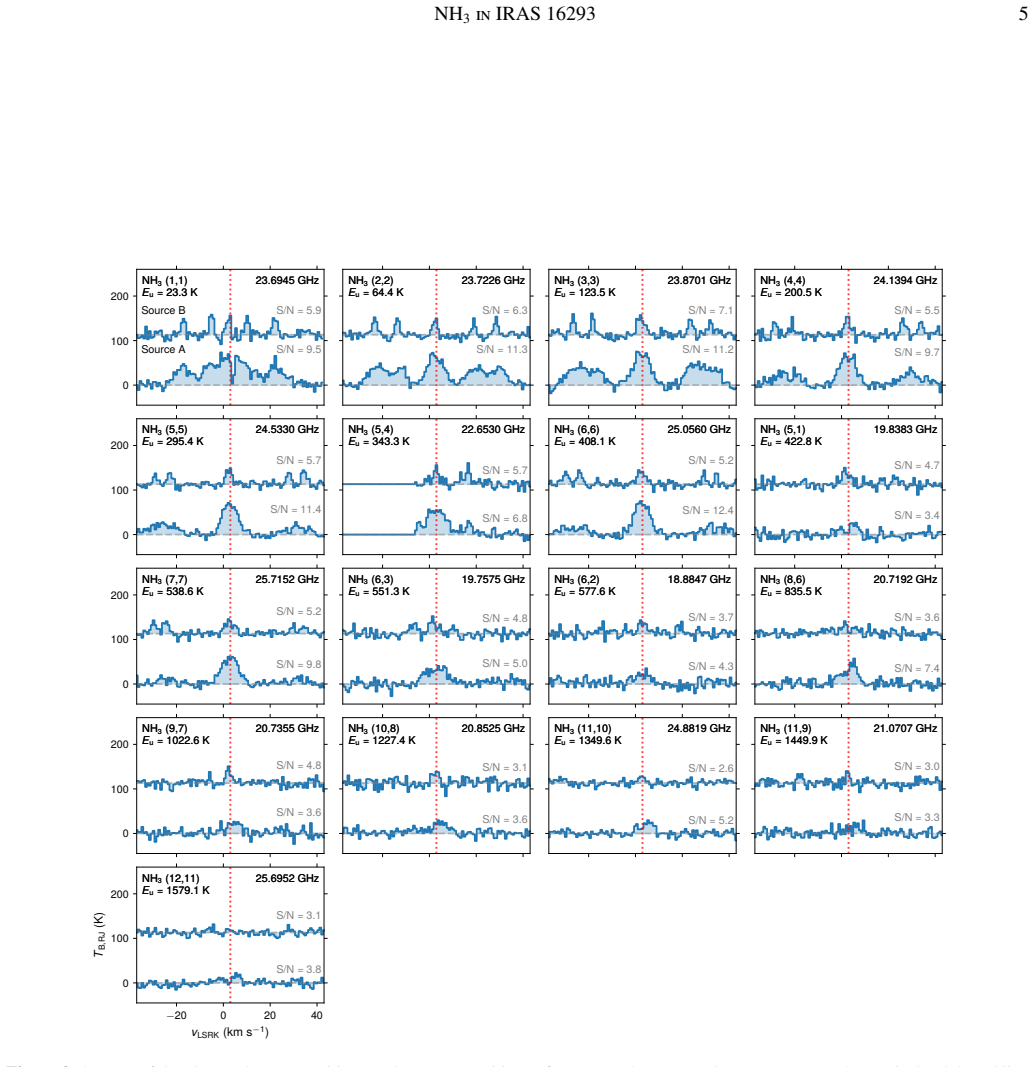
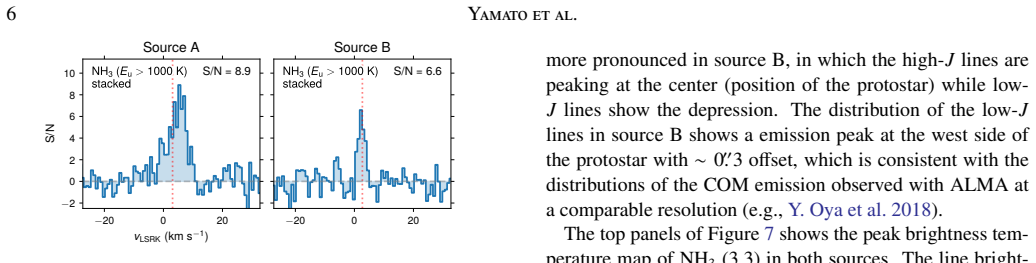
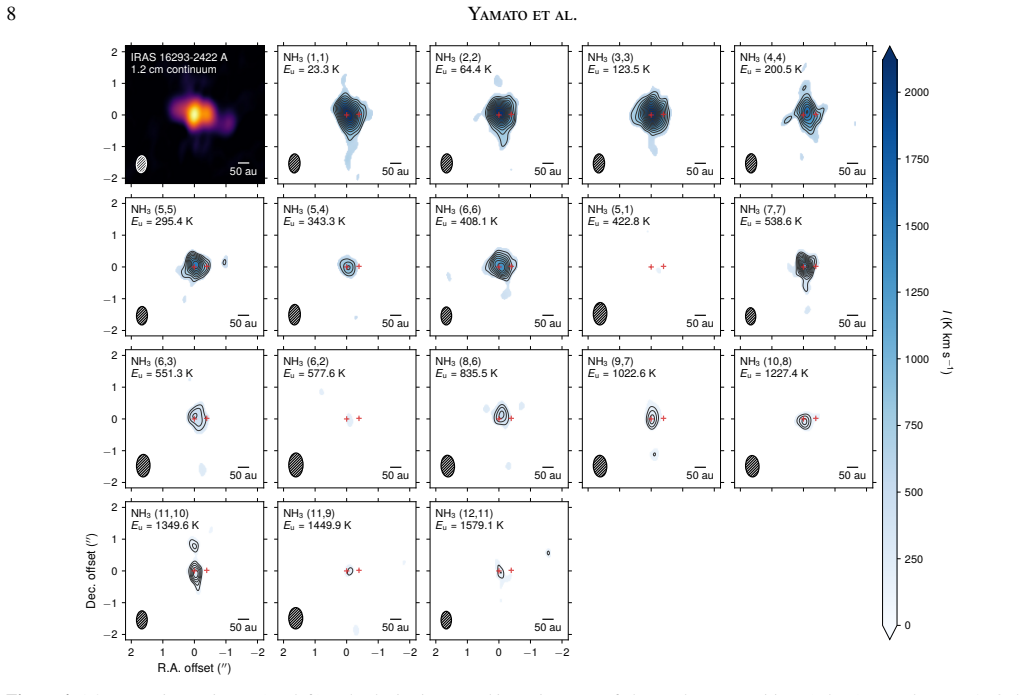
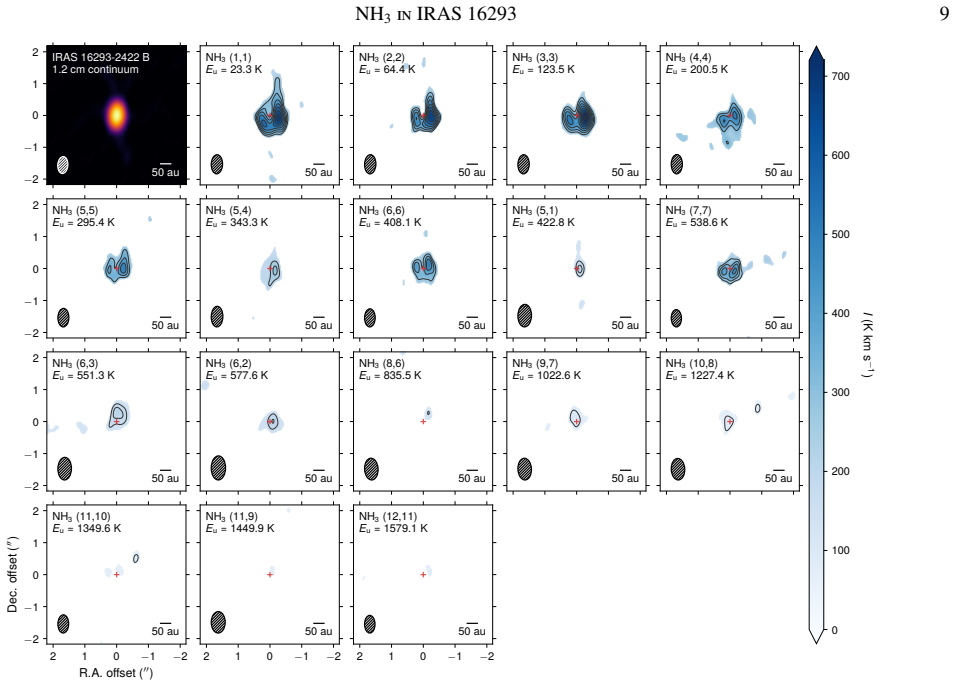
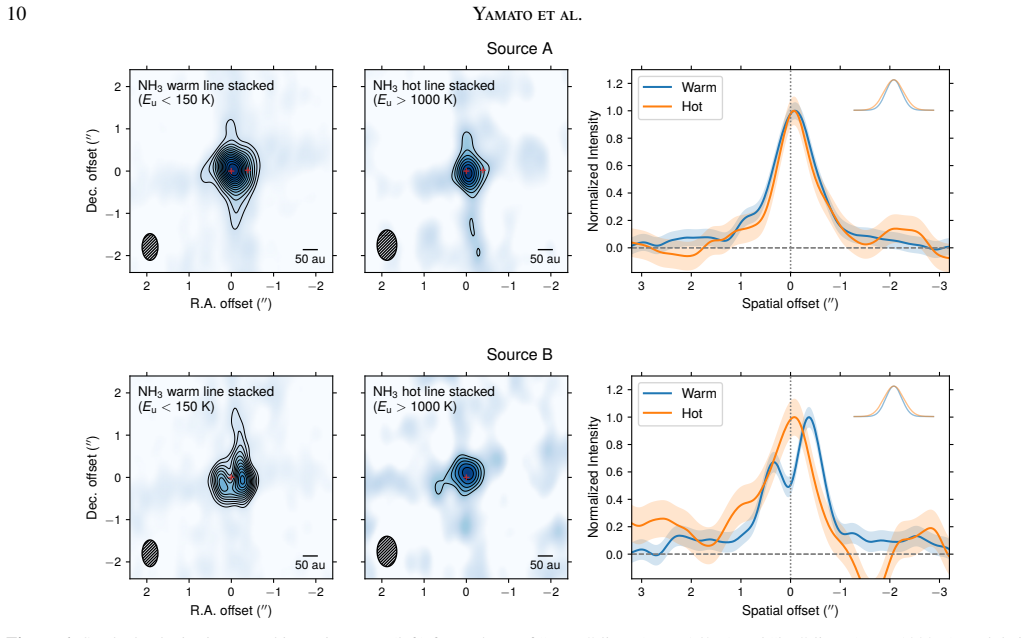
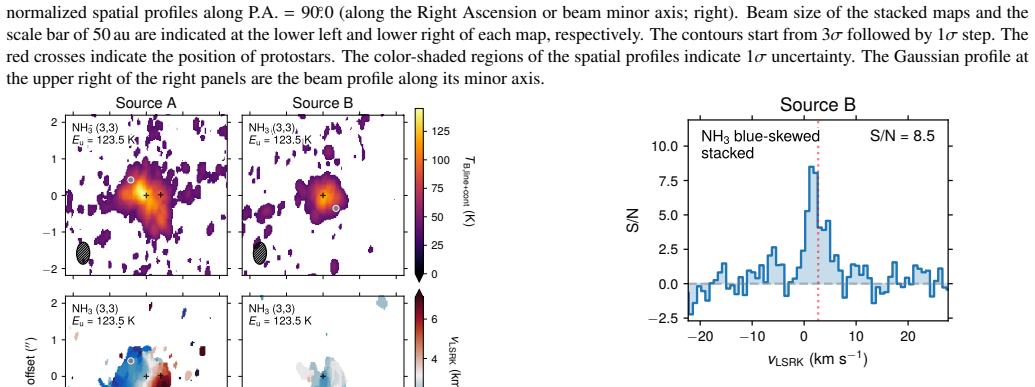
Multi-transition NH3 observations at ~0.5 arcsecond resolution show that lines with upper-state energies above 1000 K selectively trace compact, warm gas with rotation temperatures of 200-300 K around each protostar. A two-component fit separates this inner hot gas from cooler extended material, and comparison with ALMA images indicates shock heating dominates in source A while accretion heating explains the hot gas in source B.
Load-bearing premise
The two-component model captures the excitation conditions without significant optical depth effects or contributions from non-LTE processes.
Editorial extensions
If this is right
- High-Eu NH3 lines serve as selective tracers of the innermost hot envelopes around other Class 0 sources.
- Binary protostars can exhibit distinct heating processes in each component despite similar overall conditions.
- Abundance ratios of NH3 to other ice-derived molecules constrain desorption and gas-phase chemistry in hot regions.
Reading between the lines
- The contrast between shock and accretion heating may reflect differences in outflow activity or disk accretion rates between the two sources.
- Similar multi-line observations in other binaries could test whether shock heating correlates with observed outflow asymmetries.
- The derived temperatures suggest that NH3 survives or reforms in regions hot enough to sublimate water ice.
Editorial analysis
A structured set of objections, weighed in public.
Referee Report
Summary. The paper reports subarcsecond (~0.5") VLA observations of 17 NH3 inversion transitions (Eu ~23–1580 K) toward the Class 0 system IRAS 16293-2422. Spatially resolved emission shows high-Eu lines compact near the protostars and low-Eu lines more extended. A two-component LTE model yields rotation temperatures of ~200–300 K for the warm component in both source A and B, with NH3 column densities also constrained; the authors interpret the hot gas in A as shock-heated and in B as accretion-heated via comparison to prior ALMA data.
Significance. The dataset is the most comprehensive NH3 line set yet obtained toward a protostellar source. If the excitation modeling holds, the work supplies direct constraints on inner-region temperatures and offers a concrete test of competing heating mechanisms (shock vs. accretion) at subarcsecond scales, strengthening the link between NH3 excitation and nitrogen chemistry during the Class 0 phase.
major comments (1)
- [modeling approach (abstract and implied analysis section)] The two-component LTE fit to the 17 lines (abstract) is presented without reported checks for optical-depth corrections or non-LTE effects across the Eu range up to 1580 K. Because the warm-component T_rot ~200–300 K and the subsequent shock/accretion interpretation rest directly on this assumption, the lack of supporting diagnostics (e.g., line-ratio tests or RADEX comparisons) is load-bearing for the central claim.
minor comments (2)
- The abstract states that high-Eu lines are “selectively trace the inner hot region” but does not quantify beam-filling factors or report formal uncertainties on the derived T_rot values.
- Literature values for icy-molecule abundances are invoked for the chemistry discussion; the specific references and any assumptions about beam dilution should be stated explicitly.
Simulated Author's Rebuttal
We thank the referee for their constructive review and for acknowledging the value of our NH3 dataset. We address the single major comment below.
read point-by-point responses
-
Referee: The two-component LTE fit to the 17 lines (abstract) is presented without reported checks for optical-depth corrections or non-LTE effects across the Eu range up to 1580 K. Because the warm-component T_rot ~200–300 K and the subsequent shock/accretion interpretation rest directly on this assumption, the lack of supporting diagnostics (e.g., line-ratio tests or RADEX comparisons) is load-bearing for the central claim.
Authors: We appreciate the referee drawing attention to the need for explicit validation of the LTE assumption. The two-component LTE model follows the standard approach used in prior NH3 studies of protostars, where the high densities (typically >10^6 cm^{-3}) near the sources support thermalization of the inversion transitions. The derived T_rot values are also consistent with independent temperature estimates from other species in the literature. That said, we agree that reporting supporting diagnostics would strengthen the manuscript. In the revised version we will add (i) estimates of line optical depths derived from the fitted column densities and (ii) a line-ratio consistency check between pairs of transitions with comparable Eu values. We will also briefly discuss why non-LTE effects are expected to be small for the warm component given the source densities. Full non-LTE modeling with RADEX lies outside the scope of this primarily observational work but is not required to support the reported temperatures. These additions will not change the main scientific conclusions. revision: yes
Circularity Check
No circularity; results derive from new VLA data and standard two-component LTE modeling
full rationale
The derivation chain consists of new subarcsecond VLA observations of 17 NH3 inversion lines (Eu 23-1580 K), detection of spatially resolved emission, and application of a standard two-component model to extract T_rot and column density. The warm-component T_rot ~200-300 K and heating-origin suggestions follow directly from these data plus comparison to independent prior ALMA maps. No self-definitional relations, fitted inputs renamed as predictions, load-bearing self-citations, or ansatz smuggling appear; the central results remain independent of the paper's own prior outputs.
Assumptions & free parameters
free parameters (2)
- warmer component rotation temperature =
~200-300 K
- NH3 column density
assumptions (1)
- domain assumption The molecular emission can be modeled with two discrete temperature components in LTE
Cite this review
Pith. "Pith review of Subarcsecond Multi-line Observations of NH$_3$ with VLA toward the Class 0 Source IRAS 16293-2422." pith.science (2026). https://pith.science/paper/H755S7ZW
@misc{pith2026260600212,
  author       = {Pith},
  title        = {Pith review of: Subarcsecond Multi-line Observations of NH$_3$ with VLA toward the Class 0 Source IRAS 16293-2422},
  year         = {2026},
  howpublished = {\url{https://pith.science/paper/H755S7ZW}},
  note         = {Machine review of arXiv:2606.00212}
}
abstract
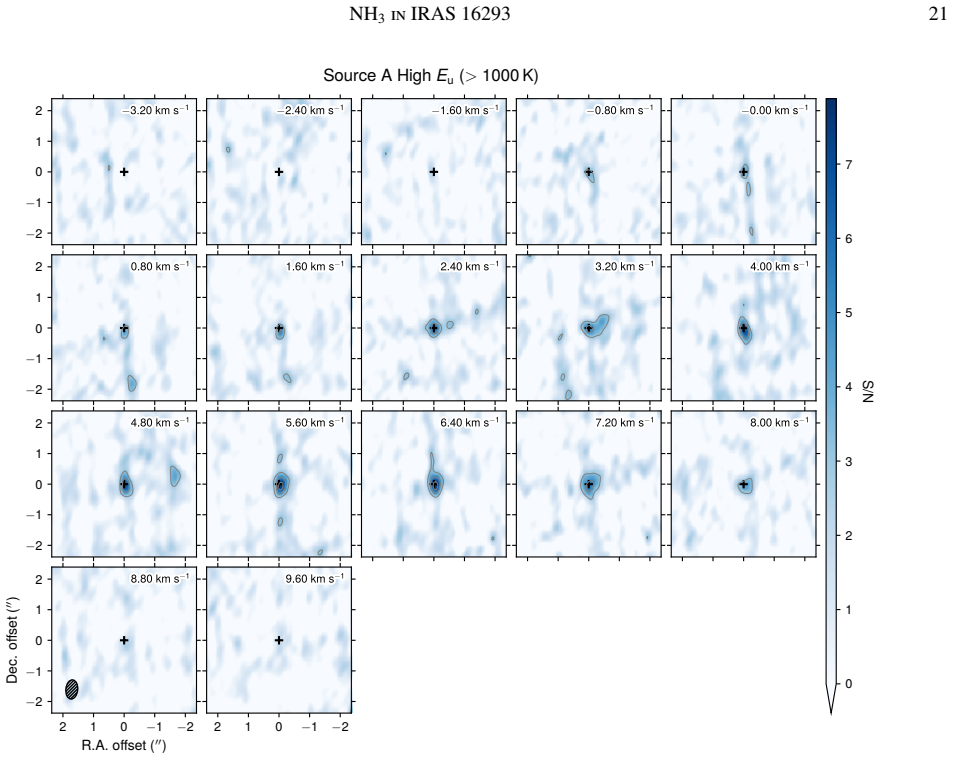
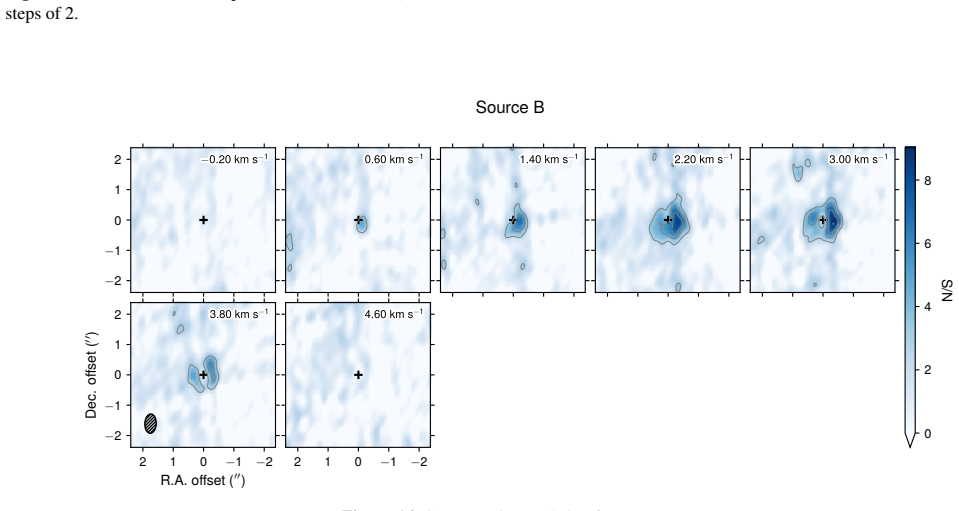
Ammonia (NH$_3$) is one of the key volatiles that plays a central role in nitrogen chemistry and its evolution during the epoch of star and planet formation. We present subarcsecond ($\sim0.\!\!^{\prime\prime}5$) resolution observations of NH$_3$ molecular emission lines with Karl G. Jansky Very Large Array (VLA) toward the Class 0 multiple system IRAS 16293-2422 including source A and source B as major components. This comprises the most comprehensive set of NH$_3$ line observations in protostellar sources to date, which includes 17 inversion transitions with a wide range of upper state energies ($E_\mathrm{u}$) spanning from $\sim$23 K to $\sim$1,580 K. We detect spatially resolved emission of a number of transitions, and find that the high-$E_\mathrm{u}$ ($\gtrsim$1,000 K) lines show compact distributions in the vicinity of protostars while low-$E_\mathrm{u}$ ($\lesssim$150 K) lines exhibit more extended emission. Utilizing a two-component model, we constrain the rotation temperature and NH$_3$ column density for both source A and source B. The rotation temperature of the warmer component reaches $\sim$200-300 K, indicating that the high-$E_\mathrm{u}$ lines selectively trace the inner hot region. We suggest that this hot NH$_3$ gas in source A is originated from the local shock heating based on the comparison with the previous high-resolution ALMA observations, while that in source B could be explained by the mass accretion heating in the innermost hot region. We also briefly discuss the chemistry related to NH$_3$ based on the abundance ratios relative to major icy molecules derived using literature values.
Figures

Figures from the paper (12 more)




Reference graph
Works this paper leans on
-
[1]
On the Nature of the Compact Sources in IRAS 16293-2422 Seen at Centimeter to Submillimeter Wavelengths. , keywords =. doi:10.3847/1538-4357/ab0c97 , archivePrefix =. 1903.02202 , primaryClass =
work page Pith review arXiv doi:10.3847/1538-4357/ab0c97 1903
-
[2]
Orbital and Mass Constraints of the Young Binary System IRAS 16293-2422 A. , keywords =. doi:10.3847/1538-4357/ab960b , archivePrefix =. 2005.11954 , primaryClass =
-
[3]
Substructures in the Disk-forming Region of the Class 0 Low-mass Protostellar Source IRAS 16293-2422 Source A on a 10 au Scale. , keywords =. doi:10.3847/1538-4357/abbe14 , archivePrefix =. 2010.01273 , primaryClass =
-
[4]
Research Notes of the American Astronomical Society , year = 2018, month = Sep, volume =
A Robust Method to Measure Centroids of Spectral Lines. Research Notes of the American Astronomical Society , year = 2018, month = Sep, volume =. doi:10.3847/2515-5172/aae265 , adsurl =
-
[5]
Chemical and Physical Picture of IRAS 16293-2422 Source B at a Sub-arcsecond Scale Studied with ALMA
Chemical and Physical Picture of IRAS 16293-2422 Source B at a Sub-arcsecond Scale Studied with ALMA. , keywords =. doi:10.3847/1538-4357/aaa6c7 , archivePrefix =. 1801.04174 , primaryClass =
-
[6]
Infalling-Rotating Motion and Associated Chemical Change in the Envelope of IRAS 16293-2422 Source A Studied with ALMA. , keywords =. doi:10.3847/0004-637X/824/2/88 , archivePrefix =. 1605.00340 , primaryClass =
-
[7]
The ALMA-PILS survey: isotopic composition of oxygen-containing complex organic molecules toward IRAS 16293-2422B. , keywords =. doi:10.1051/0004-6361/201731667 , archivePrefix =. 1808.08753 , primaryClass =
-
[8]
The ALMA-PILS survey: inventory of complex organic molecules towards IRAS 16293-2422 A. , keywords =. doi:10.1051/0004-6361/201936299 , archivePrefix =. 2001.06400 , primaryClass =
Show all 100 references
- [9]
-
[10]
Direct detection of infall onto source B and high-resolution kinematics of source A
The first ALMA view of IRAS 16293-2422. Direct detection of infall onto source B and high-resolution kinematics of source A. , keywords =. doi:10.1051/0004-6361/201219589 , archivePrefix =. 1206.5215 , primaryClass =
- [11]
- [12]
- [13]
-
[14]
, keywords =
A Chemical View of Protostellar-disk Formation in L1527. , keywords =. doi:10.1088/2041-8205/791/2/L38 , adsurl =
- [15]
-
[16]
, keywords =
Which molecule traces what: Chemical diagnostics of protostellar sources. , keywords =. doi:10.1051/0004-6361/202140692 , archivePrefix =. 2107.03696 , primaryClass =
-
[17]
, year = 2014, month = mar, volume =
Change in the chemical composition of infalling gas forming a disk around a protostar. , year = 2014, month = mar, volume =. doi:10.1038/nature13000 , adsurl =
2014 doi
-
[18]
Early Planet Formation in Embedded Disks (eDisk). III. A First High-resolution View of Submillimeter Continuum and Molecular Line Emission toward the Class 0 Protostar L1527 IRS. , keywords =. doi:10.3847/1538-4357/accf87 , archivePrefix =. 2306.15407 , primaryClass =
- [19]
- [20]
- [21]
- [22]
- [23]
-
[24]
, keywords =
The First Interferometric Measurements of NH _ 2 D/NH _ 3 Ratio in Hot Corinos. , keywords =. doi:10.3847/1538-4357/ac9ea5 , archivePrefix =. 2210.16336 , primaryClass =
-
[25]
, keywords =
Tracking the Ice Mantle History in the Solar-type Protostars of NGC 1333 IRAS 4. , keywords =. doi:10.3847/2041-8213/ac85af , archivePrefix =. 2208.00247 , primaryClass =
- [26]
-
[27]
, keywords =
Hot Corinos Chemical Diversity: Myth or Reality?. , keywords =. doi:10.3847/2041-8213/ab8d41 , archivePrefix =. 2006.04484 , primaryClass =
- [28]
-
[29]
First results from an unbiased submillimeter wavelength line survey of the Class 0 protostellar binary IRAS 16293-2422 with ALMA
The ALMA Protostellar Interferometric Line Survey (PILS). First results from an unbiased submillimeter wavelength line survey of the Class 0 protostellar binary IRAS 16293-2422 with ALMA. , keywords =. doi:10.1051/0004-6361/201628648 , archivePrefix =. 1607.08733 , primaryClass =
-
[30]
, keywords =
The Duplicity of IRAS 16293-2422: A Protobinary Star?. , keywords =. doi:10.1086/167156 , adsurl =
-
[31]
, keywords =
Large Proper Motions in the Young Low-Mass Protostellar System IRAS 16293-2422. , keywords =
- [32]
- [33]
- [34]
-
[35]
The case of IRAS 16293A
Temperature profiles of young disk-like structures. The case of IRAS 16293A. , keywords =. doi:10.1051/0004-6361/201936839 , archivePrefix =. 1911.03495 , primaryClass =
1911 doi
-
[36]
, keywords =
Dust Hot Spots at 10 au Scales around the Class 0 Binary IRAS 16293-2422 A: A Departure from the Passive Irradiation Model. , keywords =. doi:10.3847/2041-8213/aca53a , archivePrefix =. 2212.08436 , primaryClass =
-
[37]
, keywords =
A Simple Model of Spectral-Line Profiles from Contracting Clouds. , keywords =. doi:10.1086/310146 , adsurl =
- [38]
-
[39]
, keywords =
Exploring the dust grain size and polarization mechanism in the hot and massive Class 0 disk IRAS 16293-2422 B. , keywords =. doi:10.1051/0004-6361/202244628 , archivePrefix =. 2311.02521 , primaryClass =
-
[40]
ACS Earth and Space Chemistry , keywords =
Thermal Desorption of Interstellar Ices: A Review on the Controlling Parameters and Their Implications from Snowlines to Chemical Complexity. ACS Earth and Space Chemistry , keywords =. doi:10.1021/acsearthspacechem.1c00357 , archivePrefix =. 2201.07512 , primaryClass =
- [41]
-
[42]
FAUST. VII. Detection of a Hot Corino in the Prototypical Warm Carbon-chain Chemistry Source IRAS 15398-3359. , keywords =. doi:10.3847/1538-4357/acc1e5 , archivePrefix =. 2303.03564 , primaryClass =
-
[43]
, keywords =
Chemical and Physical Characterization of the Isolated Protostellar Source CB68: FAUST IV. , keywords =. doi:10.3847/1538-4357/ac77e7 , archivePrefix =. 2206.06603 , primaryClass =
- [44]
-
[45]
, keywords =
Chemical Differentiation and Temperature Distribution on a Few au Scale around the Protostellar Source B335. , keywords =. doi:10.3847/1538-4357/ac7ff4 , archivePrefix =. 2207.06721 , primaryClass =
-
[46]
Early Planet Formation in Embedded Disks (eDisk). VII. Keplerian Disk, Disk Substructure, and Accretion Streamers in the Class 0 Protostar IRAS 16544-1604 in CB 68. , keywords =. doi:10.3847/1538-4357/acdd7a , archivePrefix =. 2306.15443 , primaryClass =
-
[47]
Early Planet Formation in Embedded Disks (eDisk). IV. The Ringed and Warped Structure of the Disk around the Class I Protostar L1489 IRS. , keywords =. doi:10.3847/1538-4357/accd71 , archivePrefix =. 2306.15408 , primaryClass =
-
[48]
, keywords =
Comprehensive Study of Thermal Desorption of Grain-surface Species by Accretion Shocks around Protostars. , keywords =. doi:10.3847/1538-4357/aa67df , adsurl =
- [49]
-
[50]
Sulfur chemistry
Modeling accretion shocks at the disk-envelope interface. Sulfur chemistry. , keywords =. doi:10.1051/0004-6361/202141591 , archivePrefix =. 2107.09750 , primaryClass =
- [51]
-
[52]
, keywords =
The young protostellar disc in IRAS 16293-2422 B is hot and shows signatures of gravitational instability. , keywords =. doi:10.1093/mnras/stab2657 , archivePrefix =. 2109.06497 , primaryClass =
- [53]
-
[54]
Nature Astronomy , keywords =
Evidence of ammonium salts in comet 67P as explanation for the nitrogen depletion in cometary comae. Nature Astronomy , keywords =. doi:10.1038/s41550-019-0991-9 , archivePrefix =. 1911.13005 , primaryClass =
1911 doi
-
[55]
Science , keywords =
Ammonium salts are a reservoir of nitrogen on a cometary nucleus and possibly on some asteroids. Science , keywords =. doi:10.1126/science.aaw7462 , archivePrefix =. 2003.06034 , primaryClass =
2003 doi
-
[56]
, keywords =
Abundant ammonium hydrosulphide embedded in cometary dust grains. , keywords =. doi:10.1093/mnras/stac2440 , archivePrefix =. 2208.11396 , primaryClass =
-
[57]
arXiv e-prints , keywords =
Ammonium hydrosulfide (NH4SH) as a potentially significant sulfur sink in interstellar ices. arXiv e-prints , keywords =. doi:10.48550/arXiv.2410.02860 , archivePrefix =. 2410.02860 , primaryClass =
- [58]
-
[59]
, keywords =
Carbamic acid and carbamate formation in NH\ 3\ :CO\ 2\ ices - UV irradiation versus thermal processes. , keywords =. doi:10.1051/0004-6361:200810536 , adsurl =
-
[60]
, keywords =
Experimental investigation of aminoacetonitrile formation through the Strecker synthesis in astrophysical-like conditions: reactivity of methanimine (CH _ 2 NH), ammonia (NH _ 3 ), and hydrogen cyanide (HCN). , keywords =. doi:10.1051/0004-6361/201117602 , adsurl =
-
[61]
, year = 2024, month = sep, volume =
Sulphur storage in cold molecular clouds: the case of the NH _ 4 ^ + SH ^ - salt on interstellar dust grains. , year = 2024, month = sep, volume =. doi:10.1093/mnras/stae1747 , adsurl =
2024 doi
- [62]
-
[63]
Nature Astronomy , keywords =
An Ice Age JWST inventory of dense molecular cloud ices. Nature Astronomy , keywords =. doi:10.1038/s41550-022-01875-w , archivePrefix =. 2301.09140 , primaryClass =
-
[64]
, keywords =
A deep search for large complex organic species toward IRAS16293-2422 B at 3 mm with ALMA. , keywords =. doi:10.1051/0004-6361/202347832 , archivePrefix =. 2401.04760 , primaryClass =
-
[65]
, keywords =
The Herschel view of the dense core population in the Ophiuchus molecular cloud. , keywords =. doi:10.1051/0004-6361/201936442 , archivePrefix =. 2001.11036 , primaryClass =
2001 doi
-
[66]
, keywords =
Linelists for NH\_3, NH\_2D, ND\_2H, and ND _ 3 with quadrupole coupling hyperfine components. , keywords =. doi:10.1051/0004-6361:20054136 , adsurl =
-
[67]
doi:10.1051/0004-6361/20054136e , adsurl =
Erratum: Linelists for NH3, NH2D, ND2H, and ND3 with quadrupole coupling hyperfine components. doi:10.1051/0004-6361/20054136e , adsurl =
- [68]
-
[69]
, keywords =
Submillimeter, millimeter and microwave spectral line catalog. , keywords =. doi:10.1016/S0022-4073(98)00091-0 , adsurl =
-
[70]
, keywords =
Submillimeter-wave and far-infrared spectroscopy of high-J transitions of the ground and _ 2 =1 states of ammonia. , keywords =. doi:10.1063/1.3499911 , adsurl =
-
[71]
A multilevel study of ammonia in star-forming regions. III. Orion-KL. , keywords =
-
[72]
, keywords =
Hot ammonia emission : kinetic temperature gradients in Orion-KL. , keywords =
- [73]
-
[74]
A multilevel study of ammonia in star forming regions. V. The SGR B2 region. , keywords =
- [75]
-
[76]
Molecules with ALMA at Planet-forming Scales (MAPS). IV. Emission Surfaces and Vertical Distribution of Molecules. , keywords =. doi:10.3847/1538-4365/ac1439 , archiveprefix =. 2109.06217 , primaryclass =
- [77]
- [78]
-
[79]
The Perseus ALMA Chemistry Survey (PEACHES). I. The Complex Organic Molecules in Perseus Embedded Protostars. , keywords =. doi:10.3847/1538-4357/abdfd6 , archivePrefix =. 2101.11009 , primaryClass =
-
[80]
, keywords =
The Chemical Nature of Orion Protostars: Are ORANGES Different from PEACHES? ORANGES II. , keywords =. doi:10.3847/1538-4357/ac5904 , archivePrefix =. 2202.13835 , primaryClass =
-
[81]
, keywords =
Questioning the spatial origin of complex organic molecules in young protostars with the CALYPSO survey. , keywords =. doi:10.1051/0004-6361/201937352 , archivePrefix =. 2002.00592 , primaryClass =
2002 doi
-
[82]
Complex organic molecules in low-mass protostars on Solar System scales. II. Nitrogen-bearing species. , keywords =. doi:10.1051/0004-6361/202039996 , archivePrefix =. 2104.03326 , primaryClass =
-
[83]
, keywords =
The Circumstellar Structure of IRAS 16293-2422: C 18O, NH 3, and CO Observations. , keywords =. doi:10.1086/168523 , adsurl =
- [84]
-
[85]
, keywords =
Experimental study of the binding energy of NH _ 3 on different types of ice and its impact on the snow line of NH _ 3 and H _ 2 O. , keywords =. doi:10.1051/0004-6361/202245775 , archivePrefix =. 2311.18619 , primaryClass =
-
[86]
, keywords =
Ingredients for solar-like systems: protostar IRAS 16293-2422 B versus comet 67P/Churyumov-Gerasimenko. , keywords =. doi:10.1093/mnras/stz2430 , archivePrefix =. 1908.11290 , primaryClass =
1908 doi
-
[87]
Constraining the chemical tracers of young protostellar sources
Early Planet Formation in Embedded Disks (eDisk): XX. Constraining the chemical tracers of young protostellar sources. , keywords =. doi:10.1051/0004-6361/202553721 , archivePrefix =. 2509.19158 , primaryClass =
-
[88]
, keywords =
Sulfur oxides tracing streamers and shocks at low-mass protostellar disk─envelope interfaces. , keywords =. doi:10.1051/0004-6361/202554186 , archivePrefix =. 2507.22870 , primaryClass =
-
[89]
, keywords =
HOPS-288: A Laboratory for Complex Organics in Proto-binary/Proto-multiple Systems. , keywords =. doi:10.3847/1538-4357/ae38e1 , archivePrefix =. 2601.08948 , primaryClass =
-
[90]
, keywords =
Hot Corino Chemistry in the Class I Binary Source Ser-emb 11. , keywords =. doi:10.3847/1538-4357/ac26b9 , archivePrefix =. 2109.11512 , primaryClass =
-
[91]
The hot corino at the heart of the prototypical Class I protostar L1551 IRS5
FAUST I. The hot corino at the heart of the prototypical Class I protostar L1551 IRS5. , keywords =. doi:10.1093/mnrasl/slaa130 , archivePrefix =. 2007.10275 , primaryClass =
2007 doi
- [92]
- [93]
-
[94]
, keywords =
Efficient Formation of Formaldehyde and Methanol by the Addition of Hydrogen Atoms to CO in H _ 2 O-CO Ice at 10 K. , keywords =. doi:10.1086/341412 , adsurl =
-
[95]
Physical Chemistry Chemical Physics (Incorporating Faraday Transactions) , year = 2011, month = jan, volume =
FTIR study of ammonia formation via the successive hydrogenation of N atoms trapped in a solid N2 matrix at low temperatures. Physical Chemistry Chemical Physics (Incorporating Faraday Transactions) , year = 2011, month = jan, volume =. doi:10.1039/C1CP20645A , adsurl =
2011 doi
- [96]
-
[97]
, keywords =
Ice inventory towards the protostar Ced 110 IRS4 observed with the James Webb Space Telescope: Results from the Early Release Science Ice Age program. , keywords =. doi:10.1051/0004-6361/202451505 , archivePrefix =. 2411.19651 , primaryClass =
- [98]
-
[99]
, keywords =
Expanding the Ice Inventory of NGC 1333 IRAS 2A with INDRA Using JWST Observations: Tracing Organic Refractories and Beyond. , keywords =. doi:10.3847/1538-4365/ae112f , archivePrefix =. 2506.15358 , primaryClass =
-
[100]
, keywords =
Elemental and molecular abundances in comet 67P/Churyumov-Gerasimenko. , keywords =. doi:10.1093/mnras/stz2086 , archivePrefix =. 1907.11044 , primaryClass =
1907 doi
Reviewed June 28, 2026 · model on record in the stance chip above.
Discussion (0). Sign in to comment.