GNN-based Online Beamforming Design for HAPS-Assisted NTN
Pith reviewed 2026-06-28 19:37 UTC · model grok-4.3
The pith
A HAPS relay with GNN-optimized beamforming increases 5th-percentile energy efficiency for cell-edge users.
A machine-rendered reading of the paper's core claim, the machinery that carries it, and where it could break.
Core claim
Integrating a HAPS into terrestrial networks and using a GNN-based online optimization framework to jointly design beamforming vectors at the BS and HAPS improves network performance by increasing the 5th-percentile energy efficiency for cell-edge users.
What carries the argument
The graph neural network that captures network topology to solve the non-convex joint beamforming problem in an online manner.
If this is right
- The HAPS provides line-of-sight links that reduce the impact of inter-cell interference and path loss on cell-edge users.
- Joint beamforming at the terrestrial base stations and HAPS is required to maximize the energy-efficiency objective.
- Gains appear most clearly in the lower tail of the energy-efficiency distribution rather than in average performance.
Where Pith is reading between the lines
- The online GNN approach may adapt to time-varying user locations or channel conditions without retraining from scratch.
- Similar graph-based solvers could be tested for beamforming problems that include additional non-terrestrial nodes or power constraints.
Load-bearing premise
The GNN-based framework can effectively capture the network topology and solve the non-convex joint beamforming problem in an online manner to deliver the claimed EE gains.
What would settle it
Numerical experiments in which the GNN solution produces no increase in 5th-percentile EE relative to a baseline terrestrial network without HAPS would falsify the performance claim.
Figures

read the original abstract
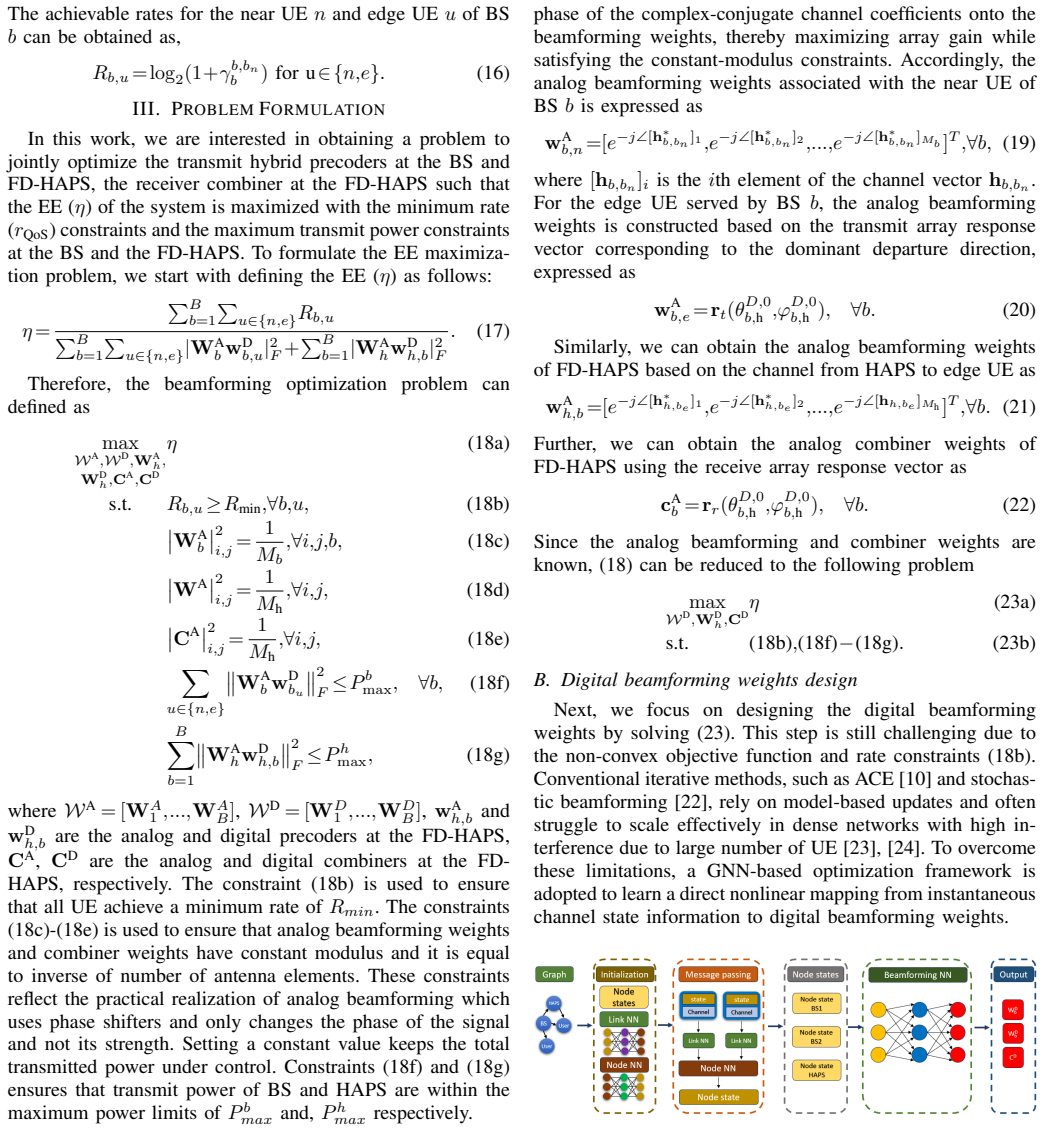
In terrestrial networks, especially in urban areas, cell-edge users often face significant capacity limitations due to high path loss, shadowing, and inter-cell interference (ICI). This paper proposes integrating a high-altitude platform station (HAPS) into terrestrial networks, where terrestrial base stations (BS) can alleviate these issues by relaying data intended for cell-edge users via HAPS, thereby leveraging line-of-sight (LoS) links. We formulate an energy-efficiency (EE) maximization problem to jointly design beamforming vectors at the BS and HAPS with the goal of improving cell-edge user performance. Since the resulting problem is non-convex, we develop an online optimization framework based on a graph neural networks (GNN), which effectively captures the network topology. Numerical results show that the proposed HAPS-assisted architecture improves network performance, particularly by increasing the 5th-percentile EE, thereby enhancing service for cell-edge users.
Editorial analysis
A structured set of objections, weighed in public.
Referee Report
Summary. The paper proposes integrating a high-altitude platform station (HAPS) into terrestrial networks to relay data for cell-edge users via LoS links, alleviating path loss, shadowing, and ICI. It formulates a non-convex energy-efficiency (EE) maximization problem for joint beamforming at terrestrial BSs and the HAPS, and develops a GNN-based online optimization framework to solve it by capturing network topology. Numerical results are claimed to demonstrate that the HAPS-assisted architecture improves network performance, especially the 5th-percentile EE for cell-edge users.
Significance. If the numerical results hold with appropriate baselines and verification, the work could contribute to NTN beamforming by showing how GNNs enable topology-aware online solutions to non-convex joint optimization problems, with potential benefits for edge-user EE in integrated terrestrial-NTN setups.
major comments (2)
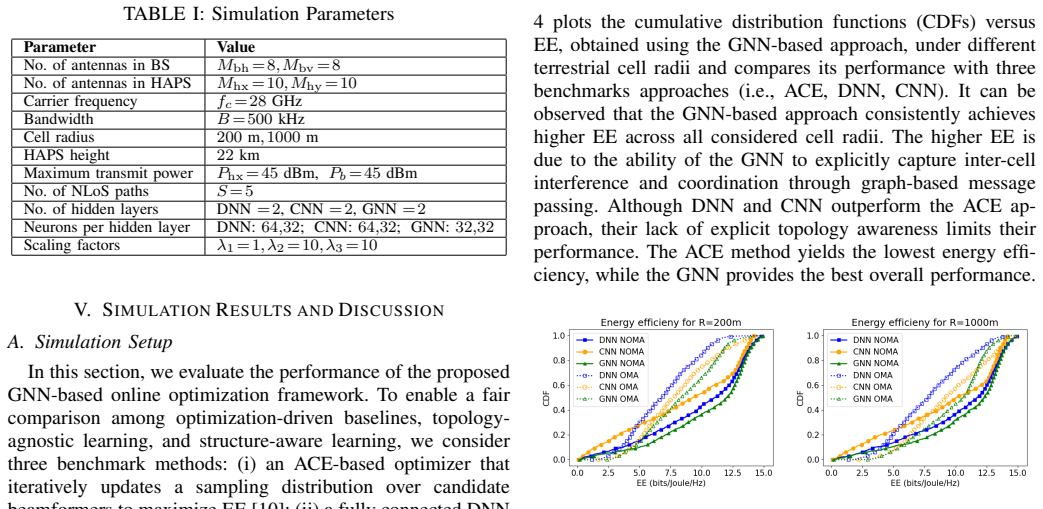
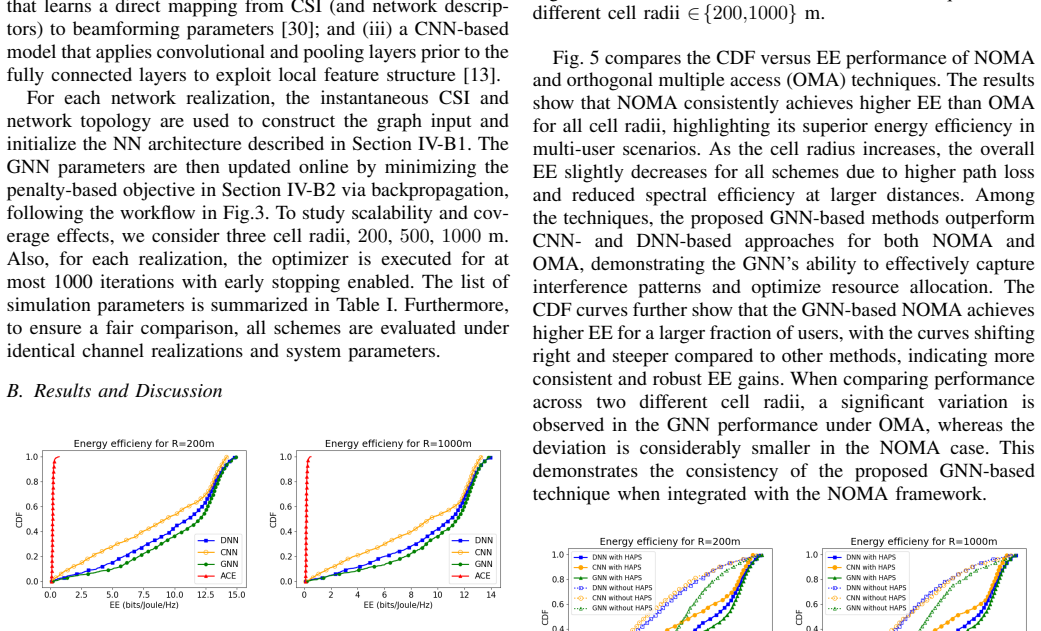
- [Abstract] Abstract: The central claim rests on 'numerical results' showing 5th-percentile EE gains, but the text provides no details on baselines, simulation parameters, error bars, convergence, or how the GNN addresses non-convexity; this is load-bearing for the performance improvement assertion and prevents verification.
- [Problem Formulation / GNN Framework] Problem formulation and GNN framework: The non-convex EE maximization is stated to be solved via GNN online optimization, but without equations, architecture details, or proof of topology capture, it is impossible to assess whether the framework delivers the claimed gains or reduces to standard methods.
minor comments (1)
- [Abstract] Abstract: Consider expanding the abstract with one sentence on key simulation parameters or baseline comparisons to better support the numerical claims.
Simulated Author's Rebuttal
We thank the referee for the constructive comments. We agree that additional details are needed to support the claims and will revise the manuscript accordingly to improve verifiability while preserving the core contributions.
read point-by-point responses
-
Referee: [Abstract] Abstract: The central claim rests on 'numerical results' showing 5th-percentile EE gains, but the text provides no details on baselines, simulation parameters, error bars, convergence, or how the GNN addresses non-convexity; this is load-bearing for the performance improvement assertion and prevents verification.
Authors: We agree the abstract is overly concise and will revise it to include brief references to the baselines (e.g., no-HAPS ZF and WMMSE), key parameters (HAPS altitude, user density, power budgets), and the GNN's unsupervised training approach for the non-convex EE problem. Due to length limits, error bars and convergence curves will be explicitly cross-referenced to Section IV rather than duplicated in the abstract. revision: yes
-
Referee: [Problem Formulation / GNN Framework] Problem formulation and GNN framework: The non-convex EE maximization is stated to be solved via GNN online optimization, but without equations, architecture details, or proof of topology capture, it is impossible to assess whether the framework delivers the claimed gains or reduces to standard methods.
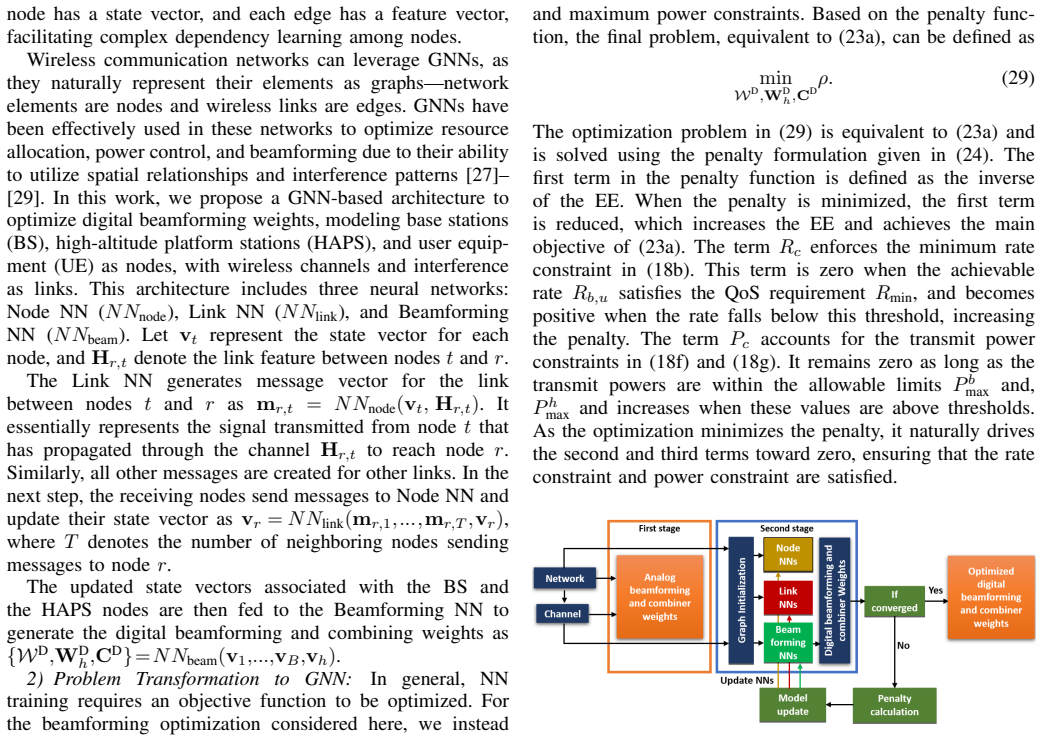
Authors: The manuscript contains a formulation section with the EE objective (sum-rate over total power) and power constraints, plus a GNN section describing the graph (nodes as BS/HAPS, edges as interference/LoS links) and message-passing layers. To address the concern, we will insert the explicit loss function, layer update equations, and a short paragraph explaining topology capture via permutation-equivariant aggregation; we will also add a table comparing GNN output to WMMSE to demonstrate it does not reduce to standard methods. revision: yes
Circularity Check
No significant circularity identified
full rationale
The manuscript abstract and context present a problem formulation for EE maximization followed by a GNN-based solver and numerical validation, but contain no equations, derivations, or self-citations that reduce any claimed prediction or result to its own inputs by construction. The central performance claim is supported by simulation outcomes rather than any self-definitional mapping, fitted-input renaming, or load-bearing self-citation chain, rendering the approach self-contained against external benchmarks.
Axiom & Free-Parameter Ledger
Reference graph
Works this paper leans on
-
[1]
What will 5G be?
J. G. Andrews, S. Buzzi, W. Choi, S. V . Hanly, A. Lozano, A. C. K. Soong, and J. C. Zhang, “What will 5G be?”IEEE J. Sel. Areas Commun., vol. 32, no. 6, pp. 1065–1082, Jun. 2014
2014
-
[2]
Multi-cell MIMO cooperative networks: A new look at interference,
D. Gesbert, S. Hanly, H. Huang, S. Shamai, O. Simeone, and W. Yu, “Multi-cell MIMO cooperative networks: A new look at interference,” IEEE J. Sel. Areas Commun., vol. 28, no. 9, pp. 1380–1408, Dec. 2010
2010
-
[3]
HAPS-ISAC: Enhancing sensing and communication in 6G networks with advanced MIMO beamforming,
P. Kanani, M. J. Omidi, M. Modarres-Hashemi, and H. Yanikomeroglu, “HAPS-ISAC: Enhancing sensing and communication in 6G networks with advanced MIMO beamforming,”IEEE Open J. Commun. Soc., vol. 6, pp. 5988 – 6004, Jul. 2025
2025
-
[4]
Millimeter wave mobile communications for 5G cellular: It will work!
T. S. Rappaportet al., “Millimeter wave mobile communications for 5G cellular: It will work!”IEEE Access, vol. 1, pp. 335–349, May 2013
2013
-
[5]
Hybrid beamforming for massive MIMO: A survey,
A. F. Molisch, V . V . Ratnam, S. Han, Z. Li, S. L. H. Nguyen, L. Li, and K. Haneda, “Hybrid beamforming for massive MIMO: A survey,” IEEE Commun. Mag., vol. 55, no. 9, pp. 134–141, Sept. 2017
2017
-
[6]
Hybrid beamforming for 5G millimeter-wave multi-cell networks,
S. Sun, T. S. Rappaport, and M. Shaft, “Hybrid beamforming for 5G millimeter-wave multi-cell networks,” inProc. IEEE Infocom. Conf., Honolulu, HI, USA, 15-18, Apr. 2018
2018
-
[7]
Spatially sparse precoding in millimeter wave MIMO systems,
O. E. Ayach, S. Rajagopal, S. Abu-Surra, Z. Pi, and R. W. H. Jr., “Spatially sparse precoding in millimeter wave MIMO systems,”IEEE Trans. Wireless Commun., vol. 13, no. 3, pp. 1499–1513, Jan. 2014
2014
-
[8]
Alternating minimization algorithms for hybrid precoding in millimeter wave MIMO systems,
X. Yu, J.-C. Shen, J. Zhang, and K. B. Letaief, “Alternating minimization algorithms for hybrid precoding in millimeter wave MIMO systems,” IEEE J. Sel. Topics Signal Process., vol. 10, no. 3, pp. 485–500, Apr. 2016
2016
-
[9]
Alternating optimization based hybrid precoding strategies for millimeter wave MIMO systems,
X. Qiao, Y . Zhang, M. Zhou, and L. Yang, “Alternating optimization based hybrid precoding strategies for millimeter wave MIMO systems,” IEEE Access, vol. 8, pp. 113 078–113 089, 2020
2020
-
[10]
Machine learning-inspired hybrid precoding for HAP massive MIMO systems with limited RF chains,
S. u. Hassan, T. Mir, S. Alamri, N. A. Khan, and U. Mir, “Machine learning-inspired hybrid precoding for HAP massive MIMO systems with limited RF chains,”MDPI Electronics, vol. 12, no. 4, Feb. 2023
2023
-
[11]
Outage minimization for intelligent reflecting surface aided MISO communication systems via stochastic beamforming,
W. Fang, M. Fu, Y . Shi, and Y . Zhou, “Outage minimization for intelligent reflecting surface aided MISO communication systems via stochastic beamforming,” inProc. 2020 IEEE 11th Sensor Array. Multichannel. Signal Process. Workshop (SAM Wkshps), Hangzhou, China, 08-11 Jun. 2020
2020
-
[12]
Multi-user hybrid beamforming system based on deep neural network in millimeter-wave communication,
L. Sung and D.-H. Cho, “Multi-user hybrid beamforming system based on deep neural network in millimeter-wave communication,”IEEE Access, vol. 8, pp. 91 616–91 623, Apr. 2020
2020
-
[13]
Convolutional neural network-based hybrid beamforming design based on energy efficiency for mmwave M-MIMO systems,
H. Ayad, M. Y . Bendimerad, and F. T. Bendimerad, “Convolutional neural network-based hybrid beamforming design based on energy efficiency for mmwave M-MIMO systems,”Int. J. Elect. Comp. Eng., no. 6, pp. 5443–5452, Dec. 2025
2025
-
[14]
Hybrid beamforming for MISO system via convolutional neural network,
T. Zhang, A. Dong, C. Zhang, J. Yu, J. Qiu, S. Li, and Y . Zhou, “Hybrid beamforming for MISO system via convolutional neural network,” Electronics, vol. 11, Jul. 2022
2022
-
[15]
Deep learning-based joint CSI feedback and hybrid precoding in FDD mmwave massive MIMO systems,
Q. Sun, H. Zhao, J. Wang, and W. Chen, “Deep learning-based joint CSI feedback and hybrid precoding in FDD mmwave massive MIMO systems,”Entropy, Mar. 2022
2022
-
[16]
Online adaptive real-time beamforming design for dynamic environments in cell- free systems,
G. Chen, Z. Wang, H. Lin, P. Du, and Y . Huang, “Online adaptive real-time beamforming design for dynamic environments in cell- free systems,”IEEE Trans. Wireless Commun., vol. 24, no. 11, pp. 8925–8938, Nov. 2025
2025
-
[17]
Graph neural networks for wireless communications: From theory to practice,
Y . Shen, J. Zhang, S. H. Song, and K. B. Letaief, “Graph neural networks for wireless communications: From theory to practice,”IEEE Trans. Wireless Commun., vol. 22, no. 5, pp. 3554–3569, Nov. 2022
2022
-
[18]
Multi- connectivity in 5G mmwave cellular networks,
M. Giordani, M. Mezzavilla, S. Rangan, and M. Zorzi, “Multi- connectivity in 5G mmwave cellular networks,” inProc. 2016 Mediterranean Ad. Hoc. Netw. Workshop (Med-Hoc-Net Wkshps), Vilanova i la Geltru, Spain, 20-22 Jun. 2016
2016
-
[19]
Multi-antenna capacity of sparse multipath channels,
V . Raghavan and A. M. Sayeed, “Multi-antenna capacity of sparse multipath channels,”IEEE Trans. Inf. Theory, vol. 1, no. 1, pp. 156–166, Jun. 2008
2008
-
[20]
Millimeter wave wireless communications: New results for rural connectivity,
G. R. MacCartney, S. Sun, T. S. Rappaport, Y . Xing, H. Yan, J. Koka, R. Wang, and D. Yu, “Millimeter wave wireless communications: New results for rural connectivity,” inProc. ACM MobiCom, New York, NY , USA, Oct. 2016
2016
-
[21]
LLM4CP: Adapting large language models for channel prediction,
B. Liu, X. Liu, S. Gao, X. Cheng, and L. Yang, “LLM4CP: Adapting large language models for channel prediction,”J. Commun. Inf. Net., vol. 9, no. 2, pp. 113–125, Jun. 2024
2024
-
[22]
Opportunistic beamforming using dumb antennas,
P. Viswanath and D. N. C. Tse, “Opportunistic beamforming using dumb antennas,”IEEE Trans. Inf. Theory, vol. 48, no. 6, pp. 1277–1294, Jun. 2002
2002
-
[23]
A deep learning framework for optimization of MISO downlink beamform- ing,
W. Xia, G. Zheng, Y . Zhu, J. Zhang, J. Wang, and A. P. Petropulu, “A deep learning framework for optimization of MISO downlink beamform- ing,”IEEE Trans. Commun., vol. 68, no. 3, pp. 1866 – 1880, Dec. 2019
2019
-
[24]
Learning-based massive beamforming,
S. Lu, S. Zhao, and Q. Shi, “Learning-based massive beamforming,” in Proc. IEEE Global Commun. Conf., Taipei, Taiwan, 07-11 Dec. 2020
2020
-
[25]
The graph neural network model,
F. Scarselli, M. Gori, A. C. Tsoi, M. Hagenbuchner, and G. Monfardini, “The graph neural network model,”IEEE Trans. Neu. Nets., vol. 20, no. 1, pp. 61–80, Jan. 2009
2009
-
[26]
A comprehensive survey on graph neural networks,
Z. Wu, S. Pan, F. Chen, G. Long, C. Zhang, and P. S. Yu, “A comprehensive survey on graph neural networks,”IEEE Trans. Neu. Nets. Learn. Systs, vol. 32, no. 1, pp. 4–24, Jan. 2021
2021
-
[27]
Graph-based deep learning for communication networks: A survey,
W. Jiang, “Graph-based deep learning for communication networks: A survey,”Computer Commun., vol. 185, pp. 40–54, Jan. 2022
2022
-
[28]
Graph neural network based beamforming and RIS reflection design in a multi-RIS assisted wireless network,
B. Lim and M. Vu, “Graph neural network based beamforming and RIS reflection design in a multi-RIS assisted wireless network,” in Proc. IEEE Stat. Sig. Proc. Workshops (SSP Wkshps), Aug. 2023
2023
-
[29]
Graph-based resource allocation for integrated space and terrestrial communications,
A. Ivanov, K. Tonchev, V . Poulkov, A. Manolova, and N. N. Neshov, “Graph-based resource allocation for integrated space and terrestrial communications,”Sensors, vol. 22, no. 15, Aug. 2022
2022
-
[30]
Hybrid beamforming with deep learning for large-scale antenna arrays,
R. Hu, L. Jiang, and P. Li, “Hybrid beamforming with deep learning for large-scale antenna arrays,”IEEE Access, vol. 9, pp. 54 690–54 699, 2021
2021
discussion (0)
Sign in with ORCID, Apple, or X to comment. Anyone can read and Pith papers without signing in.