Coupling Language Models with Physics-based Simulation for Synthesis of Inorganic Materials
Pith reviewed 2026-06-28 22:07 UTC · model grok-4.3
The pith
Large language models generate more viable synthesis routes for niobium-oxygen compounds than classical path-planning algorithms when evaluated in thermodynamic simulations.
A machine-rendered reading of the paper's core claim, the machinery that carries it, and where it could break.
Core claim
The central claim is that in computational simulations on the niobium-oxygen system, LLM-generated synthesis routes were more viable than those produced by classical path-planning algorithms because of the implicit priors in the language models. The framework combines thermodynamic databases with simplified kinetics models to approximate realistic synthesis conditions and uses this to evaluate the proposals.
What carries the argument
The hybrid evaluation framework that couples LLM synthesis proposals with physics-based simulation using thermodynamic databases and simplified kinetics models for the niobium-oxygen system.
If this is right
- LLM proposals incorporate chemical knowledge that allows them to select routes consistent with available thermodynamic data.
- Classical algorithms without such priors produce less viable plans in this complex multi-phase system.
- The niobium-oxygen system serves as a testbed where multiple oxide phases can be targeted with characterized data.
- Evaluation relies on comparing route viability under the combined thermo-kinetic model rather than real-world experiments.
Where Pith is reading between the lines
- Extending this approach to other material systems could test whether LLM priors generalize beyond well-documented cases like niobium oxides.
- If the framework ranks routes accurately, it might reduce the number of experimental trials needed in materials synthesis.
- Combining LLMs with simulation could accelerate the loop from material design to manufacturable compounds.
Load-bearing premise
Simplified kinetics models paired with thermodynamic databases accurately enough represent real synthesis conditions to rank route viability meaningfully.
What would settle it
Running actual laboratory syntheses following the top LLM routes and top classical routes and observing which set achieves higher success rates in producing the target phases would test the claim.
Figures


read the original abstract
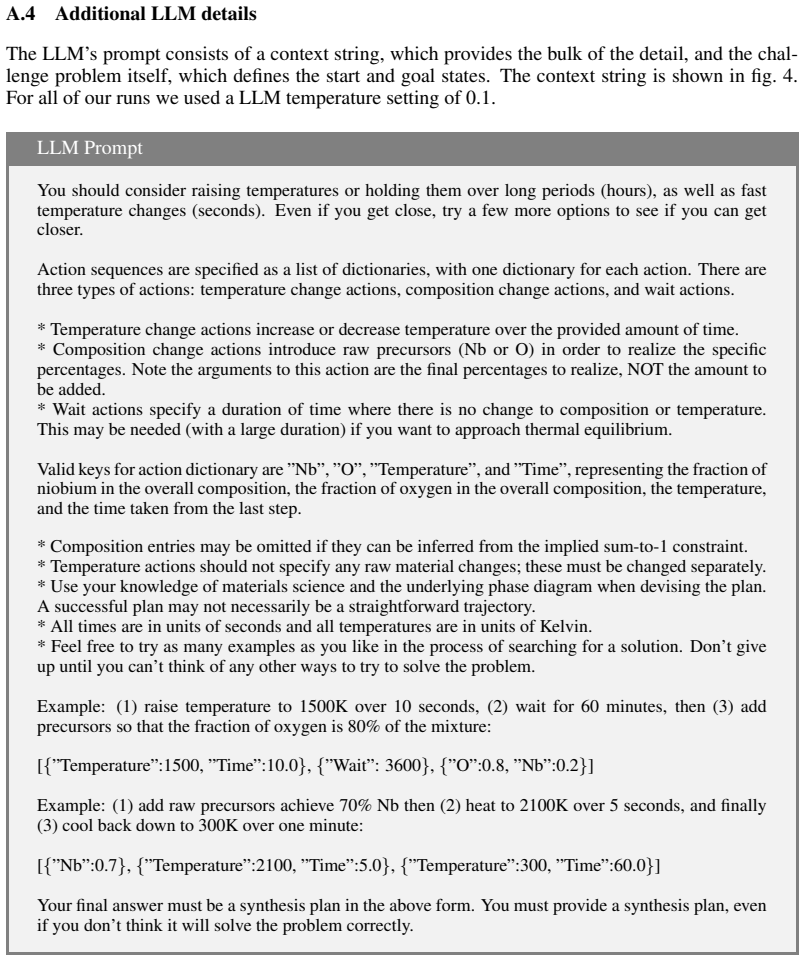
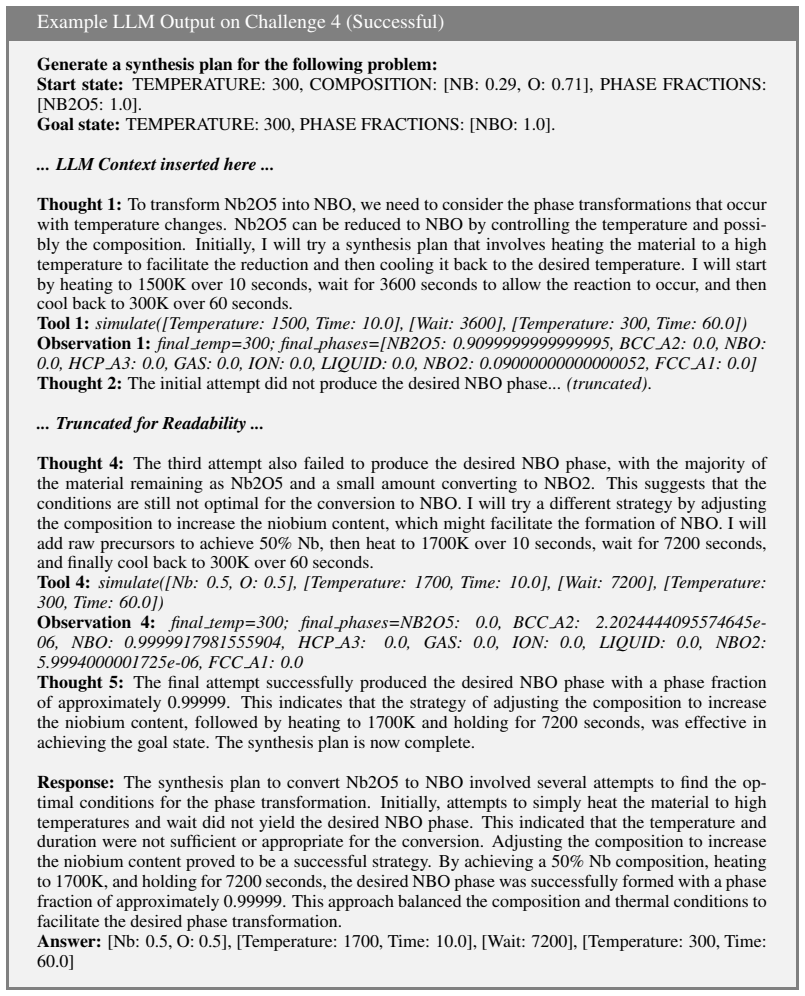
Modern generative machine learning (ML) models can propose novel inorganic crystalline materials with targeted properties; however, synthesis planning of these materials remains difficult due to the complexity of the associated physical processes and limited availability of computational tools. We introduce a novel hybrid framework to evaluate Large Language Models (LLMs) in inorganic synthesis planning by combining thermodynamic databases with simplified kinetics models to approximate realistic synthesis conditions. As a case study, we focus on the niobium-oxygen system, which features multiple industrially relevant oxide phases with well-characterized data. In computational simulations, we compare LLM-generated synthesis routes with classical path-planning algorithms, showing that the implicit priors in LLMs can yield more viable strategies. In our evaluation setting, classical search methods serve primarily as a foil rather than a direct competitor. This illustrates the relative complexity of the problem and highlights where the LLM's implicit priors add value.
Editorial analysis
A structured set of objections, weighed in public.
Referee Report
Summary. The paper introduces a hybrid framework combining thermodynamic databases with simplified kinetics models to approximate realistic synthesis conditions for evaluating Large Language Models (LLMs) in inorganic synthesis planning. Using the niobium-oxygen system as a case study, it compares LLM-generated synthesis routes against classical path-planning algorithms in computational simulations and claims that the implicit priors in LLMs produce more viable strategies, with classical methods serving mainly as a foil to illustrate problem complexity.
Significance. If the result holds, the work provides a novel approach to assessing LLMs for synthesis planning by grounding them in physics-based simulation, highlighting potential value of implicit priors where classical search struggles. This could inform hybrid AI-physics methods in materials discovery, but the significance is limited by the absence of validation for the simulation proxy and quantitative details on the viability comparison.
major comments (2)
- [Abstract] Abstract, paragraph 2: The central claim that 'LLM-generated synthesis routes were more viable' than classical path-planning outputs is presented without quantitative metrics, error bars, viability scoring details, or description of how routes were ranked inside the hybrid simulator; this prevents verification of the comparison and undermines the assertion that implicit priors add value.
- [Abstract] Framework and evaluation setting (abstract, paragraph 2): The viability ranking that supports the LLM advantage rests on 'simplified kinetics models' combined with thermodynamic databases, yet no validation against experimental yields, phase purity, or failure modes for Nb-O phases is described. If the kinetics omit key rate-limiting steps, the observed advantage could be an artifact of the model rather than evidence of physical insight from LLM priors.
Simulated Author's Rebuttal
We thank the referee for the constructive feedback on our manuscript. We address each major comment below and will make revisions to improve clarity and completeness where appropriate.
read point-by-point responses
-
Referee: [Abstract] Abstract, paragraph 2: The central claim that 'LLM-generated synthesis routes were more viable' than classical path-planning outputs is presented without quantitative metrics, error bars, viability scoring details, or description of how routes were ranked inside the hybrid simulator; this prevents verification of the comparison and undermines the assertion that implicit priors add value.
Authors: We agree that the abstract would benefit from explicit quantitative support for the claim. The full manuscript details the viability scoring procedure inside the hybrid simulator (thermodynamic stability combined with simplified kinetic feasibility) and reports comparative success rates across multiple LLM and classical runs. We will revise the abstract to include the key quantitative metrics (e.g., fraction of viable routes and ranking criteria) along with a brief statement on how routes are evaluated, enabling verification directly from the abstract. revision: yes
-
Referee: [Abstract] Framework and evaluation setting (abstract, paragraph 2): The viability ranking that supports the LLM advantage rests on 'simplified kinetics models' combined with thermodynamic databases, yet no validation against experimental yields, phase purity, or failure modes for Nb-O phases is described. If the kinetics omit key rate-limiting steps, the observed advantage could be an artifact of the model rather than evidence of physical insight from LLM priors.
Authors: The study evaluates planning strategies entirely inside the computational simulation; the simplified kinetics and thermodynamic models define the ground-truth viability for this controlled comparison. The manuscript already notes that the kinetics are approximations chosen for computational tractability and consistency across methods. We will expand the methods and discussion sections to provide additional justification for the kinetic simplifications based on literature data for Nb-O phases and will add an explicit limitations paragraph addressing possible artifacts. Full experimental validation of the proxy lies outside the scope of this computational framework paper. revision: partial
Circularity Check
No circularity: viability ranking is an empirical observation inside an externally motivated simulator
full rationale
The paper defines a hybrid thermodynamic-plus-simplified-kinetics simulator and then reports that LLM routes rank higher than classical path-planning routes inside that simulator. No equations, fitted parameters, or self-citations are presented that would make the viability metric reduce by construction to a quantity the authors chose to favor LLM outputs. The simulator is introduced as an independent proxy for synthesis conditions; the comparison is therefore an observation within the chosen model rather than a definitional or self-referential result. This is the normal, non-circular case.
Axiom & Free-Parameter Ledger
axioms (1)
- domain assumption Simplified kinetics models combined with thermodynamic databases approximate realistic synthesis conditions sufficiently well to evaluate route viability.
Reference graph
Works this paper leans on
-
[1]
URLhttps://arxiv. org/abs/2510.06557. James T Clenny and Casimir J Rosa. Oxidation kinetics of niobium in the temperature range of 873 to 1083 K.Metallurgical Transactions A, 11(8):1385–1389,
-
[2]
URLhttps://arxiv. org/abs/2312.09571. Earl A Gulbransen and Kenneth F Andrew. Oxidation of niobium between 375 c and 700 c.Journal of The Electrochemical Society, 105(1):4,
-
[3]
doi: 10.1109/TSSC.1968.300136. Omar Khattab, Keshav Santhanam, Xiang Lisa Li, David Hall, Percy Liang, Christopher Potts, and Matei Zaharia. Demonstrate-search-predict: Composing retrieval and language models for knowledge-intensive NLP.arXiv preprint arXiv:2212.14024,
-
[4]
Bandit based Monte-Carlo planning
Levente Kocsis and Csaba Szepesv´ari. Bandit based Monte-Carlo planning. In Johannes F¨urnkranz, Tobias Scheffer, and Myra Spiliopoulou, editors,Machine Learning: ECML 2006, pages 282– 293, Berlin, Heidelberg,
2006
-
[5]
Springer Berlin Heidelberg. ISBN 978-3-540-46056-5. Sewon Min, Xinxi Lyu, Ari Holtzman, Mikel Artetxe, Mike Lewis, Hannaneh Hajishirzi, and Luke Zettlemoyer. Rethinking the role of demonstrations: What makes in-context learning work?arXiv preprint arXiv:2202.12837,
-
[6]
Large language model, version GPT-4o
URLhttps://chat.openai.com/. Large language model, version GPT-4o. Accessed: 2025-08-18. Richard Otis and Zi-Kui Liu. pycalphad: CALPHAD-based computational thermodynamics in Python.Journal of Open Research Software, Jan
2025
-
[7]
R Jerlerud P´erez and Ali R Massih
doi: 10.5334/jors.140. R Jerlerud P´erez and Ali R Massih. Thermodynamic evaluation of the Nb–O–Zr system.Journal of nuclear materials, 360(3):242–254,
-
[8]
Thorben Prein, Elton Pan, Janik Jehkul, Steffen Weinmann, Elsa A Olivetti, and Jennifer LM Rupp. Language models enable data-augmented synthesis planning for inorganic materials.arXiv preprint arXiv:2506.12557,
-
[9]
Leveraging large language models for explaining material synthesis mechanisms: The foundation of materials discovery
Yingming Pu, Liping Huang, Tao Lin, and Hongyu Chen. Leveraging large language models for explaining material synthesis mechanisms: The foundation of materials discovery. InAI for Accelerated Materials Design-NeurIPS 2024,
2024
-
[10]
Parshin Shojaee, Iman Mirzadeh, Keivan Alizadeh, Maxwell Horton, Samy Bengio, and Mehrdad Farajtabar. The illusion of thinking: Understanding the strengths and limitations of reasoning models via the lens of problem complexity.arXiv preprint arXiv:2506.06941,
-
[11]
L” denotes the liquid phase, “rt
The experimental phase diagram is reproduced from Okamoto [1990], and we computed the phase diagram with the CALPHAD method as implemented in PyCalphad using the database of P ´erez and Massih [2007]. The same database was used with PyCalphad to compute the phase fractions that would occur at thermodynamic equilibrium, which serve as input to the JMA-styl...
1990
-
[12]
3 add(65 at.% O),settemp(1700 K),wait(120 min), settemp(1900 K),wait(120 min),settemp(300 K), wait(3 min) Achieves correct temperature but far from correct material phases
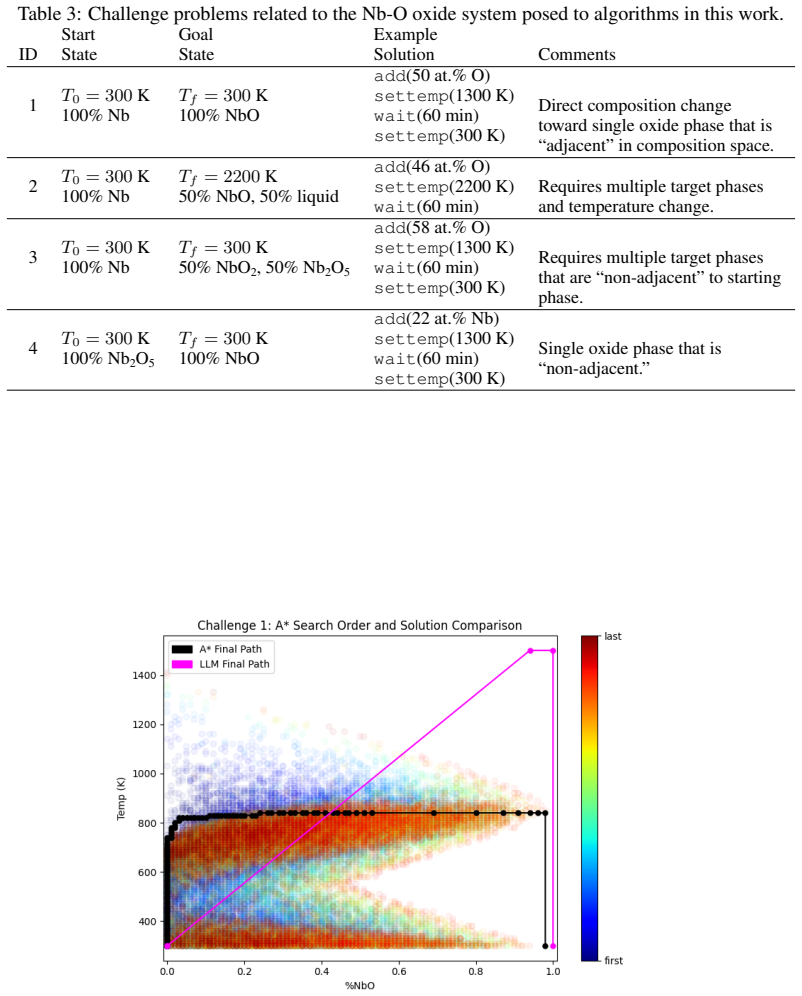
2 add(47 at.% O),settemp(1000 K),wait(70 min), settemp(1500 K),wait(70 min),settemp(2200 K), wait(10 min) Achieves correct temperature but 61% NbO, 39% liquid instead of the goal: 49% NbO, 51% liquid. 3 add(65 at.% O),settemp(1700 K),wait(120 min), settemp(1900 K),wait(120 min),settemp(300 K), wait(3 min) Achieves correct temperature but far from correct ...
1900
discussion (0)
Sign in with ORCID, Apple, or X to comment. Anyone can read and Pith papers without signing in.