Structure-Aware Consistency Priors for Shape from Polarization in Complex Media
Pith reviewed 2026-06-28 18:55 UTC · model grok-4.3
The pith
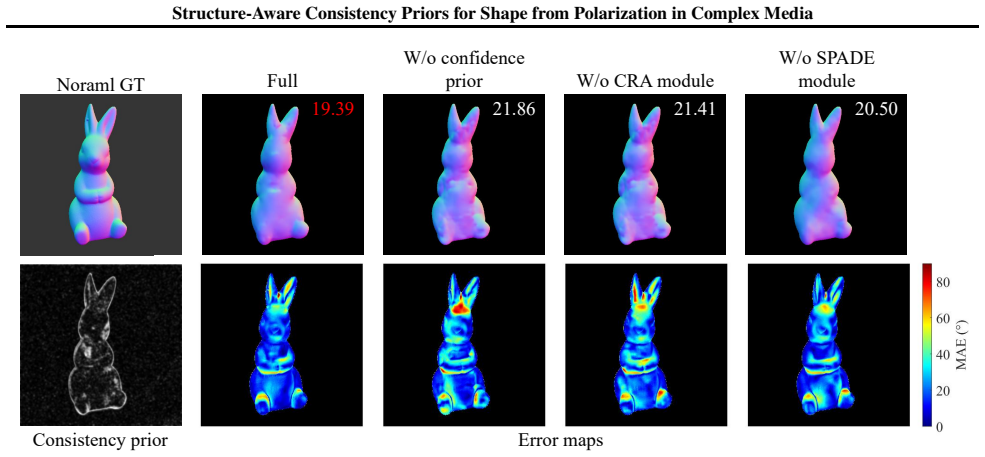
A structure-aware prior from autocorrelation of polarization angles allows a dual-branch network to recover surface normals in ice more accurately than prior methods.
A machine-rendered reading of the paper's core claim, the machinery that carries it, and where it could break.
Core claim
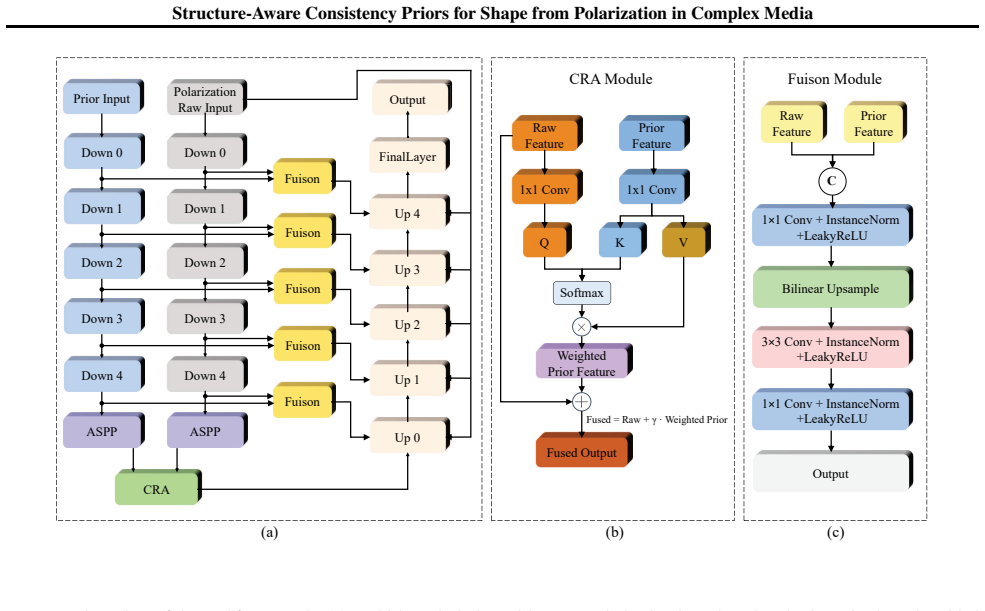
The structure-aware polarization prior based on autocorrelation functions of AoLP captures local spatial consistency of polarization angles and thereby mitigates the nonlinear mapping between polarization observations and surface normals in ice. When this prior is integrated with raw polarization features inside the IceSfP dual-branch network through cross-modal attention and multi-scale feature fusion, the network produces accurate surface normal estimates, as shown by its performance on the newly constructed real-world ice SfP dataset.
What carries the argument
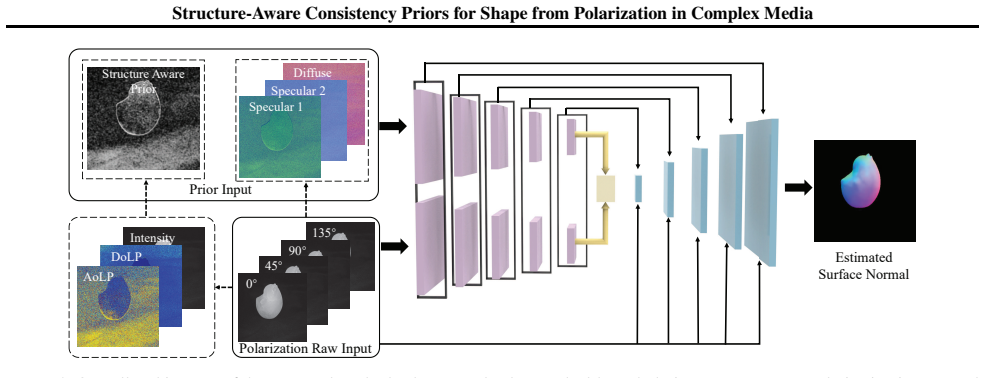
The structure-aware polarization prior derived from autocorrelation functions of the angle of linear polarization (AoLP), which supplies spatial consistency cues that are fused into the IceSfP network via cross-modal attention.
If this is right
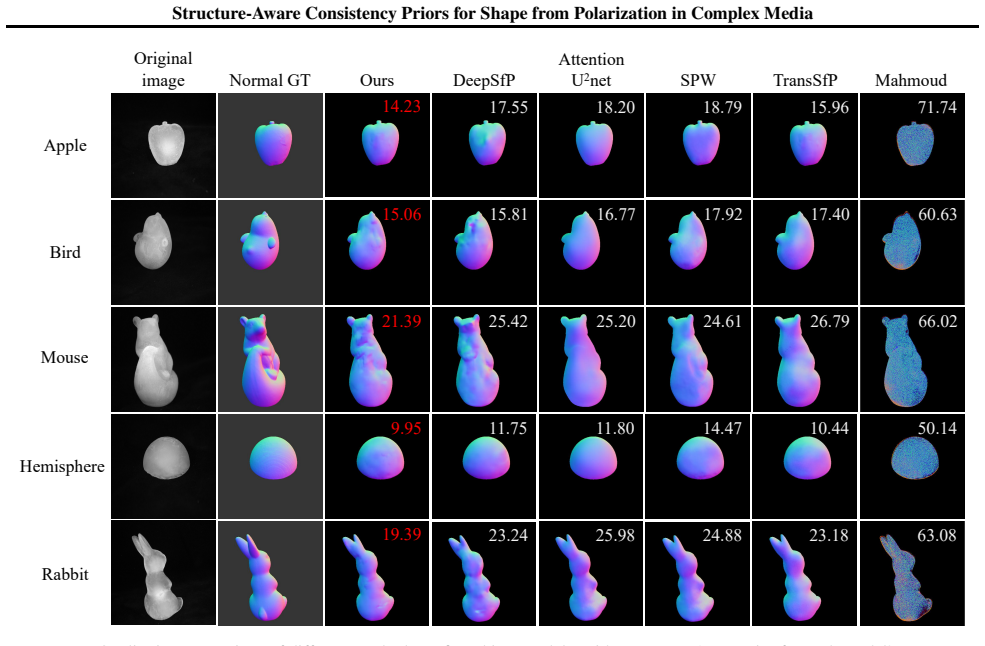
- The method achieves a mean angular error of 16.01 degrees, 2.74 degrees lower than the second-best approach on ice data.
- The first real-world ice SfP dataset enables quantitative evaluation of polarization-based shape recovery in complex media.
- The dual-branch fusion strategy generalizes to other complex media where direct polarization-to-normal mapping is unreliable.
Where Pith is reading between the lines
- The autocorrelation prior could be adapted to other scattering media such as water or fog by recomputing the same consistency measure on their polarization images.
- Single-view normal maps from this pipeline could support real-time 3D reconstruction for robots operating on ice or in turbid environments.
- Removing the prior from the network and measuring the resulting error increase on the released dataset would isolate how much the spatial consistency term contributes.
Load-bearing premise
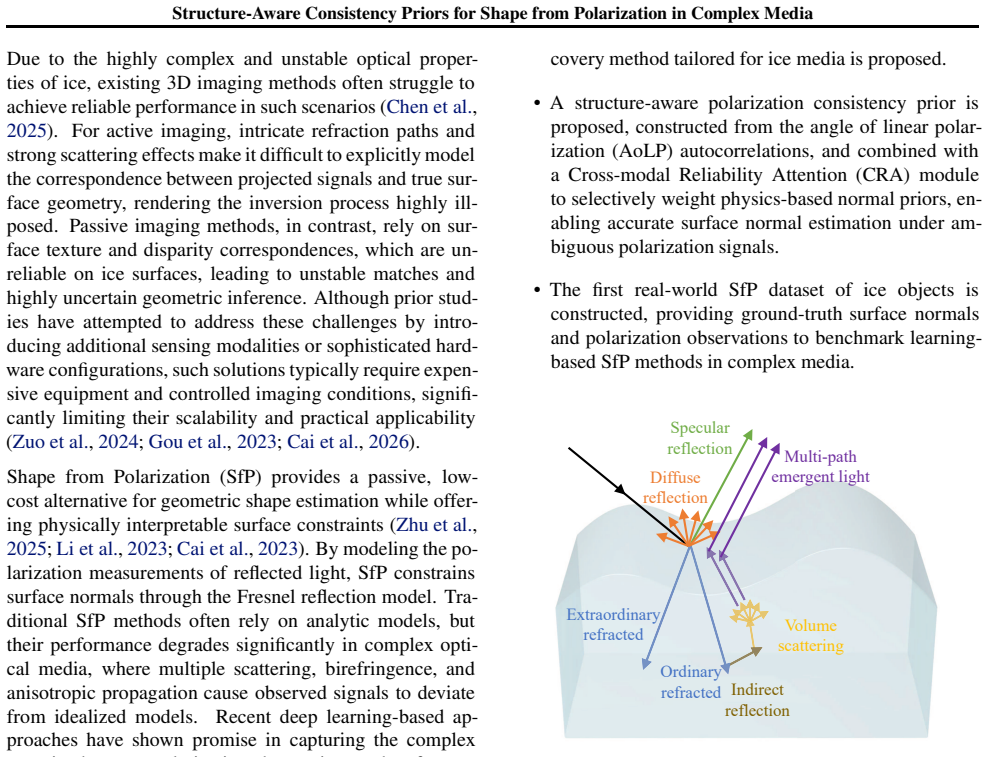
Autocorrelation functions of AoLP angles can capture the local spatial consistency needed to compensate for the nonlinear polarization-to-normal mapping in ice without additional unstated modeling of light scattering.
What would settle it
An independent ground-truth measurement of surface normals on the same ice scenes (for example via laser scanning) that shows the network error rises above the reported 16.01 deg MAE when the autocorrelation prior is ablated.
Figures





read the original abstract
Recovering surface normals from single view polarization images in complex media remains challenging. This paper focuses on ice as a representative complex medium, where intricate light matter interactions lead to a nonlinear mapping between polarization observations and surface normals. To address this, a structure-aware polarization prior based on autocorrelation functions is proposed to capture the local spatial consistency of AoLP. Building on this, a dual-branch network (IceSfP) is designed to integrate raw polarization features with priors via cross modal attention and multi-scale feature fusion, enabling accurate surface normal estimation under complex media conditions. To evaluate the method, the first real-world ice SfP dataset is constructed. Experimental results show that the method outperforms existing approaches across all metrics, achieving a MAE of 16.01 deg, which is 2.74 deg lower than the second-best method. The framework provides a generalizable solution for high-precision geometric perception in complex media.
Editorial analysis
A structured set of objections, weighed in public.
Referee Report
Summary. The paper claims to address surface normal recovery from single-view polarization images in complex media (ice as exemplar) by introducing a structure-aware prior based on autocorrelation functions of the angle of linear polarization (AoLP) to encode local spatial consistency. It proposes the IceSfP dual-branch network that fuses raw polarization features with these priors through cross-modal attention and multi-scale fusion. A new real-world ice SfP dataset is constructed, and experiments report that the method achieves MAE of 16.01 deg, outperforming prior approaches by 2.74 deg and providing a generalizable framework for high-precision geometric perception.
Significance. If the empirical gains and dataset are robustly validated, the work would supply a practical prior and network architecture for SfP under nonlinear light-matter interactions, potentially extending to other complex media. Construction of the first real-world ice dataset is a concrete contribution that could support future benchmarking.
major comments (2)
- [Abstract] Abstract: the central claim of outperformance (MAE 16.01 deg, 2.74 deg better than second-best) is presented without any description of the baselines, dataset size/composition, train/test split, error analysis, or validation protocol, rendering it impossible to verify support for the claim.
- [Abstract] Abstract: the structure-aware prior is asserted to capture local spatial consistency and mitigate the nonlinear mapping without additional modeling assumptions, but no derivation, explicit functional form of the autocorrelation, or ablation isolating its contribution is referenced, leaving the weakest assumption untested in the provided description.
Simulated Author's Rebuttal
We thank the referee for the detailed comments. We address each major comment below, noting that the abstract is a high-level summary while the full manuscript contains the requested details. We propose targeted revisions to the abstract for improved clarity.
read point-by-point responses
-
Referee: [Abstract] Abstract: the central claim of outperformance (MAE 16.01 deg, 2.74 deg better than second-best) is presented without any description of the baselines, dataset size/composition, train/test split, error analysis, or validation protocol, rendering it impossible to verify support for the claim.
Authors: We agree that the abstract, constrained by length, omits these specifics. The full manuscript describes the baselines, the composition of the new real-world ice SfP dataset, train/test splits, error analysis (including MAE), and validation protocol in Section 4. To improve verifiability at the abstract level, we will revise the abstract to briefly reference the real-world dataset and standard evaluation protocol used. revision: yes
-
Referee: [Abstract] Abstract: the structure-aware prior is asserted to capture local spatial consistency and mitigate the nonlinear mapping without additional modeling assumptions, but no derivation, explicit functional form of the autocorrelation, or ablation isolating its contribution is referenced, leaving the weakest assumption untested in the provided description.
Authors: The abstract provides a concise summary. The derivation of the structure-aware prior, including the explicit functional form of the autocorrelation of AoLP, appears in Section 3.1, with justification that it encodes local spatial consistency without further assumptions. Ablation studies isolating the prior's contribution are in Section 4. We will revise the abstract to include a reference to Section 3.1 for the prior details. revision: yes
Circularity Check
No significant circularity; empirical network with new dataset and explicit prior
full rationale
The paper introduces an autocorrelation-based structure-aware prior on AoLP, integrates it into a dual-branch IceSfP network via cross-modal attention, constructs a new real-world ice SfP dataset, and reports empirical MAE improvements. No derivation, uniqueness theorem, fitted parameter renamed as prediction, or self-citation chain is described that would reduce any claimed result to its own inputs by construction. The approach is self-contained as standard supervised learning on held-out data with an independently motivated prior.
Axiom & Free-Parameter Ledger
Reference graph
Works this paper leans on
-
[1]
Chen, L.-C., Zhu, Y ., Papandreou, G., Schroff, F., and Adam, H
doi: 10.1364/OE.505074. Chen, L.-C., Zhu, Y ., Papandreou, G., Schroff, F., and Adam, H. Encoder-Decoder with Atrous Separable Con- volution for Semantic Image Segmentation. In Fer- rari, V ., Hebert, M., Sminchisescu, C., and Weiss, Y . (eds.), Computer Vision – ECCV 2018 , volume 11211, pp. 833–851. Springer International Publishing, Cham,
-
[2]
In: Computer Vision – ECCV 2018, pp
ISBN 978-3-030-01233-5 978-3-030-01234-2. doi: 10.1007/978-3-030-01234-2 49. Chen, Y ., Zhu, P ., Yin, Y ., Wu, M., Y u, K., Feng, L., and Chen, W . Objective assessment of IPM denoising qual- ity of ϕ -OTDR signal. Measurement, 214:112775, June
-
[3]
ISSN 02632241. doi: 10.1016/j.measurement. 2023.112775. Chen, Y ., Wu, J., Lin, D., Y an, P ., Ji, Z., Zhao, J., and Cheng, J. Improving water/ice/snow depth accuracy on runway pavement with ultrasonic echo signal analysis. Cold Regions Science and T echnology, 235:104492, July
-
[4]
doi: 10.1016/j.coldregions.2025
ISSN 0165232X. doi: 10.1016/j.coldregions.2025. 104492. Feng, C., Wang, C., Zhang, L., Gong, W ., Liu, L., Peng, B., and Feng, C. Underwater 3D measurement using sheet of light system with multi-layer refractive inter- face. Measurement, 244:116514, February 2025. ISSN 02632241. doi: 10.1016/j.measurement.2024.116514. Gou, Y ., Li, Q., Y ao, R., Chen, J.,...
-
[5]
ISBN 978-3-031-72854-9 978-3-031-72855-6
Springer Nature Switzerland, Cham, 2025a. ISBN 978-3-031-72854-9 978-3-031-72855-6. doi: 10.1007/ 978-3-031-72855-6 4. Li, K., Liang, J., Wan, Z., and Liu, Y . SfP-underwater: Attention-based shape from polarization for underwater scattering environments. Optics & Laser T echnology , 192:113545, December 2025b. ISSN 00303992. doi: 10.1016/j.optlastec.2025...
-
[6]
doi: 10.1146/ annurev-vision-102122-094213
ISSN 2374-4642, 2374-4650. doi: 10.1146/ annurev-vision-102122-094213. M¨ uller, F., B¨ ohm, A., Herrnring, H., V on Bock Und Po- lach, F., and Ehlers, S. Influence of the ice shape on ice-structure impact loads. Cold Regions Science and T echnology, 221:104175, May 2024. ISSN 0165232X. doi: 10.1016/j.coldregions.2024.104175. Peng, Y ., Liu, R., Zhang, Z.,...
-
[7]
Shao, M., Xia, C., Y ang, Z., Huang, J., and Wang, X
doi: 10.1007/s11432-024-4212-2. Shao, M., Xia, C., Y ang, Z., Huang, J., and Wang, X. Transparent shape from a single view polarization im- age. In 2023 IEEE/CVF International Conference on Computer Vision (ICCV) , pp. 9243–9252, 2023. doi: 10.1109/ICCV51070.2023.00851. Shin, B. G., Park, J.-H., Kong, J., and Jung, S. J. Characterizing critical behavior a...
-
[8]
Wang, B., Zhou, C., Meng, Y ., and Huang, J
doi: 10.1109/TP AMI.2025.3552408. Wang, B., Zhou, C., Meng, Y ., and Huang, J. Shape from polarization via a physical prior-based deep fusion network with ambiguous surface normals. Optics Ex- press, 33(14):29255, July 2025a. ISSN 1094-4087. doi: 10.1364/OE.562136. Wang, H., Wang, Z., Long, X., Lin, C., Hancke, G., and Lau, R. W . MAGE : Single Image to M...
work page doi:10.1109/tp 2025
-
[9]
Probabilistic shaping for nonlinearity tolerance
ISSN 0733-8724, 1558-2213. doi: 10.1109/JLT. 2022.3186830. Wu, X., Chen, J., Li, P ., Wang, X., Wu, J., and Huang, F. Deep learning-based polarization 3D imaging method for underwater targets. Optics Express, 33(2):2068, Jan- uary 2025. ISSN 1094-4087. doi: 10.1364/OE.541298. Xu, G., Waitz, F., Wagner, S., Nehlert, F., Schnaiter, M., and J¨ arvinen, E. To...
work page doi:10.1109/jlt 2022
-
[10]
Y ang, Y ., Long, X.-X., Dou, Z., Lin, C., Liu, Y ., Y an, Q., Ma, Y ., Wang, H., Wu, Z., and Yin, W
doi: 10.1029/2022JD037604. Y ang, Y ., Long, X.-X., Dou, Z., Lin, C., Liu, Y ., Y an, Q., Ma, Y ., Wang, H., Wu, Z., and Yin, W . Won- der3D++: Cross-Domain Diffusion for High-Fidelity 3D Generation From a Single Image. IEEE Transactions on Pattern Analysis and Machine Intelligence , 48(2):1674– 1688, February 2026. ISSN 0162-8828, 2160-9292, 1939-3539. d...
-
[11]
ISBN 978-3-031-26312-5 978-3-031-26313-2
Springer Nature Switzerland, Cham, 2023. ISBN 978-3-031-26312-5 978-3-031-26313-2. doi: 10.1007/ 978-3-031-26313-2 33. Zhang, S., Y ang, Y ., Sun, Y ., Liu, N., Sun, F., and Fang, B. Artificial Skin Based on Visuo-Tactile Sensing for 3D Shape Reconstruction: Material, Method, and Eval- uation. Advanced Functional Materials , 35(1):2411686, January 2025. IS...
2023
-
[12]
doi: 10.1016/j.cja.2024.04.014
ISSN 10009361. doi: 10.1016/j.cja.2024.04.014. Zhu, J., Peng, L., Du, H., Liu, Z., Cai, Y ., Pan, C., Li, X., and Shao, X. High-quality polarization 3D reconstruc- tion of weakly textured objects by fusing multi-view im- ages. Optics Express , 33(18):38749, September 2025. ISSN 1094-4087. doi: 10.1364/OE.570825. Ziyu, L., Kang, G., Junfeng, G., and Lin, Y...
-
[13]
de- fines a non-injective mapping between ρs and θs. Conse- quently, a single ρs may correspond to two valid zenith angle solutions, leading to two ambiguous surface normal estimates: Ns, 1 = cos φ s sin θs, 1 sin φ s sin θs, 1 cos θs, 1 , Ns, 2 = cos φ s sin θs, 2 sin φ s sin θs, 2 cos θs, 2 , φ s = ϕ + π 2 . (18) 12 Structure-Aware Consis...
-
[14]
+ (I v 45 − I v 135) (I r 0 − I r
-
[15]
(22) The volumetric scattering terms, (I v 45− I v
+ (I v 0 − I v 90) ) . (22) The volumetric scattering terms, (I v 45− I v
-
[16]
As a result, these perturbations introduce abrupt and disordered variations in Eq
and (I v 0 − I v 90), exhibit spatially irregular or rapidly varying behavior du e to complex internal light transport mechanisms, including subsurface scattering, birefringence, and multipath prop a- gation. As a result, these perturbations introduce abrupt and disordered variations in Eq
-
[17]
In contrast, the surface reflection terms, (I r 45 − I r
Moreover, the non- linear nature of the arctangent operation further ampli- fies small fluctuations in the differential polarization ter ms, thereby inducing sudden variations in the AoLP . In contrast, the surface reflection terms, (I r 45 − I r
-
[18]
Consequently, these terms vary smoothly across neighboring pixels, and the corresponding AoLP preserves strong geometric consistency in the spatial domain
and (I r 0 − I r 90), are primarily governed by the Fresnel reflection mechanism, whose polarization state is determined by the local surface geometry. Consequently, these terms vary smoothly across neighboring pixels, and the corresponding AoLP preserves strong geometric consistency in the spatial domain. Based on these physical characteristics, when the ...
discussion (0)
Sign in with ORCID, Apple, or X to comment. Anyone can read and Pith papers without signing in.