Rogue waves from noise-induced modulational instability of a plane wave
Pith reviewed 2026-06-28 16:09 UTC · model grok-4.3
The pith
Rogue waves arise when a few nonlinear modes synchronize amid many others in the focusing nonlinear Schrödinger equation.
A machine-rendered reading of the paper's core claim, the machinery that carries it, and where it could break.
Core claim
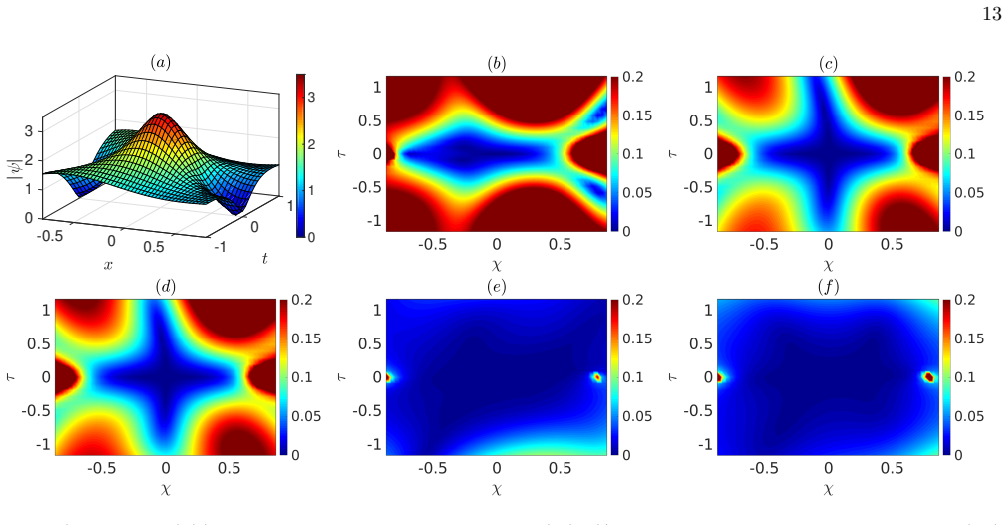
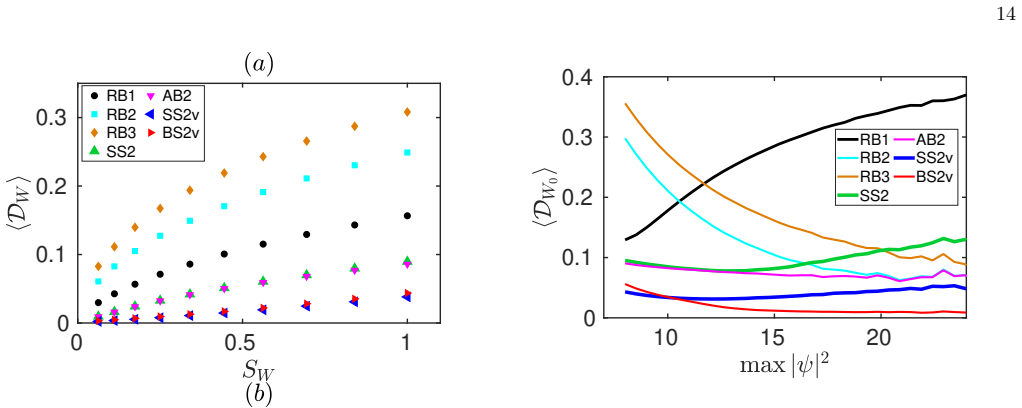
In the statistically stationary regime reached after noise-induced modulational instability, the one-dimensional focusing nonlinear Schrödinger equation produces rogue waves whose spatiotemporal shapes are reproduced by the exact solutions for a general collision of two solitons or a general collision of two Tajiri-Watanabe breathers; the parameters recovered from these fits are numerically consistent with the spectrum of the direct scattering transform applied to the full wavefield, indicating that the rogue waves originate from synchronization of a few coherent nonlinear modes within a background containing many such modes.
What carries the argument
Fitting of observed rogue-wave profiles to exact two-soliton and two-Tajiri-Watanabe-breather collision solutions, cross-checked against the direct scattering transform spectrum of the complete wavefield.
If this is right
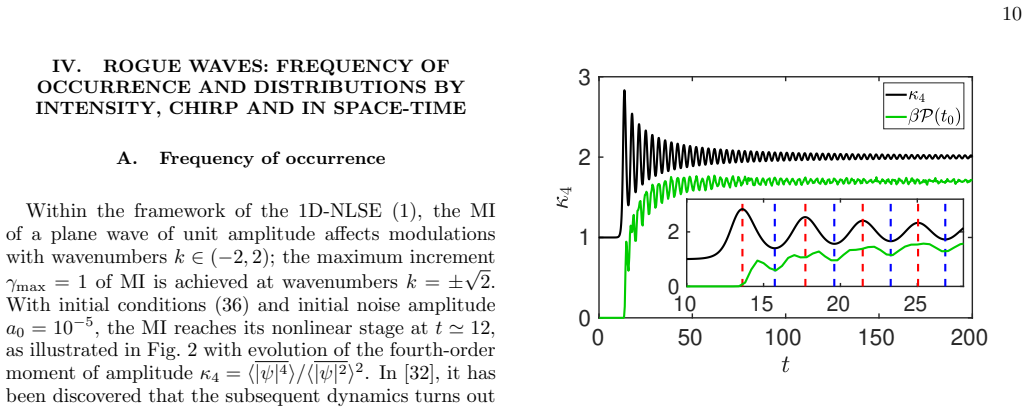
- The rate of rogue-wave occurrence begins to rise from zero precisely when the fourth-order moment of amplitude attains its first local maximum and thereafter grows in an oscillatory fashion toward a long-time limit.
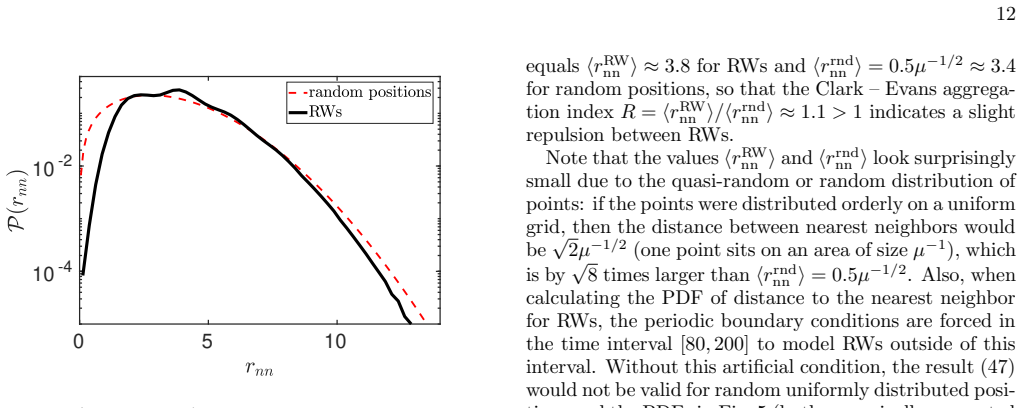
- In the stationary state the equation produces substantially more rogue waves than a linear system of comparable size, yet each rogue wave occupies a smaller average spatiotemporal area.
- The distribution of rogue-wave peak intensities follows an exponential-like form that shows no change in character across different amplitude ranges, implying a common formation mechanism.
- Because the fitted two-mode parameters align with the scattering spectrum of the whole field, the statistics of extreme events can be traced to the dynamics of a small number of interacting coherent structures.
Where Pith is reading between the lines
- The same few-mode synchronization picture may apply to rogue-wave formation in other integrable nonlinear wave equations where direct scattering transforms are available.
- If synchronization is the dominant route, then controlled perturbations that alter the relative phases of the dominant modes could be tested as a means to suppress or enhance rogue-wave probability.
- In non-integrable or higher-dimensional systems the analogous diagnostic would be whether the largest maxima continue to be captured by low-dimensional exact solutions even when the background contains a broadband spectrum.
Load-bearing premise
That a superior numerical match to two-mode collision solutions, rather than to the other seven exact solutions tested, together with agreement of the fitted parameters to the scattering spectrum, demonstrates that synchronization is the physical origin instead of an incidental result of the fitting procedure.
What would settle it
A new ensemble of simulations in which the direct scattering transform spectrum contains many modes yet the largest local maxima fail to match the two-soliton or two-breather collision profiles inside the same fitting window used in the original analysis.
Figures




read the original abstract
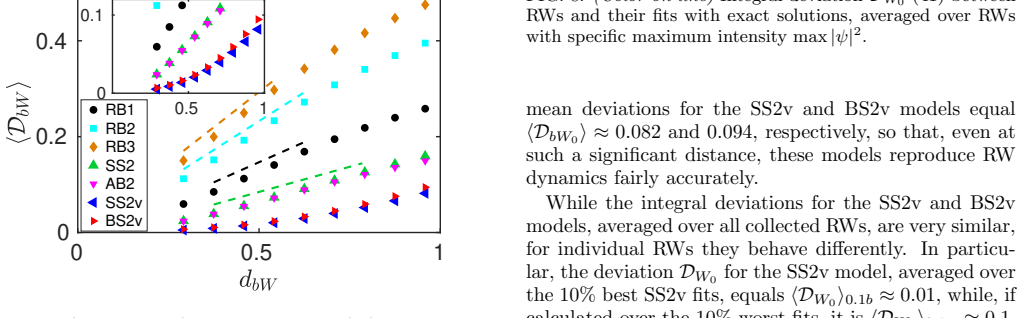
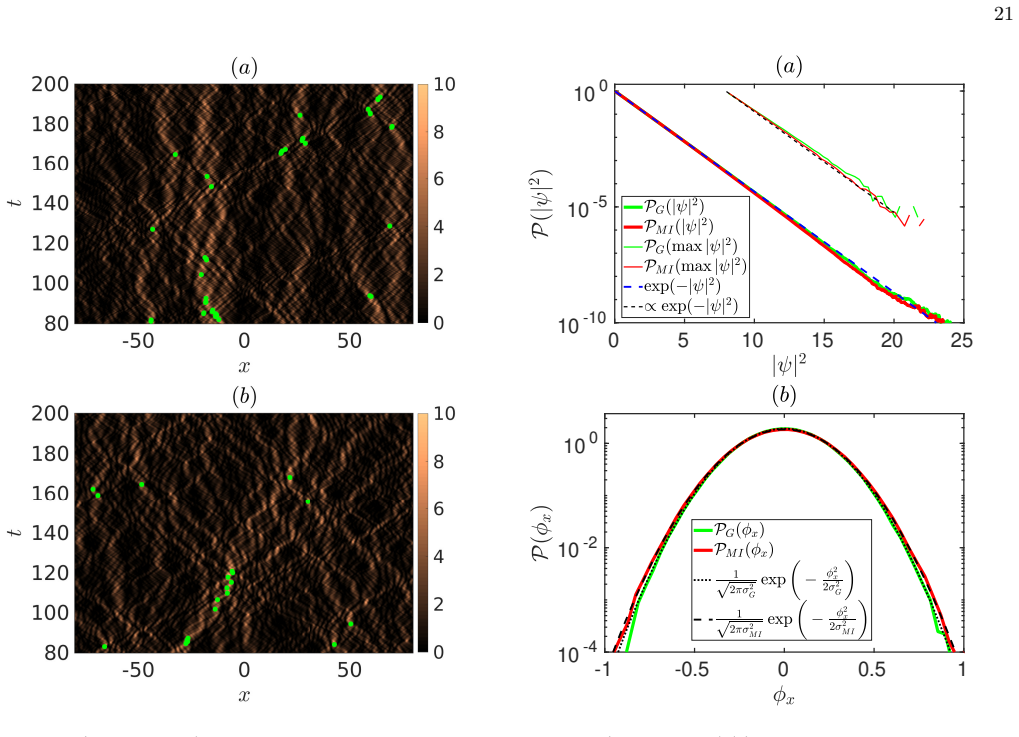
In the framework of the one-dimensional nonlinear Schrodinger equation (1D-NLSE) of the focusing type, the present paper studies numerically rogue waves (RWs) that emerge in the nonlinear stage of noise-induced modulational instability of a plane wave. For a large ensemble of simulations, all sufficiently large local maximums of the wavefield (i.e., RWs) are systematically collected and analyzed. It is shown that the frequency of occurrence of such maximums begins to increase from zero at the time, when the fourth-order moment of amplitude reaches its first (largest) local maximum, and then grows in an oscillatory manner approaching its asymptotic value at long time. Near the statistically stationary state, the 1D-NLSE generates a much larger number of RWs than a comparable linear system, but, in average, one RW affects a much smaller spatiotemporal area. The distribution of these RWs by maximum intensity represents an exponential-like function without noticeable changes in behavior, indicating a similar origin for RWs of significantly different amplitudes. The collected RWs are compared within a sufficiently large spatiotemporal window with nine exact solutions, of which two models reproduce RW dynamics much better than the others: a general collision of two solitons and a general collision of two Tajiri-Watanabe breathers; RWs are fitted with these collisions using pre-compiled databases of such solutions. The parameters of the two models turn out to be quite similar to the direct scattering transform spectrum of the whole wavefield, supporting a hypothesis that RWs may emerge due to synchronization of a few nonlinear modes (solitons or breathers) in presence of many other nonlinear modes of the wavefield.
Editorial analysis
A structured set of objections, weighed in public.
Referee Report
Summary. The manuscript numerically investigates rogue waves emerging from noise-induced modulational instability in the focusing 1D-NLSE. It collects large local maxima from an ensemble of simulations, analyzes their occurrence frequency (which increases after the fourth-order moment peaks and grows oscillatorily), intensity distribution (exponential-like), and compares their profiles in a spatiotemporal window to nine exact solutions. Two models—general two-soliton collisions and general two-Tajiri-Watanabe breather collisions—provide superior fits via pre-compiled databases; the fitted parameters are similar to the global direct scattering transform spectrum, supporting the hypothesis that RWs arise from synchronization of a few nonlinear modes amid many others. The work also contrasts RW statistics with a comparable linear system.
Significance. If substantiated, the synchronization hypothesis would provide a mechanistic account for why RWs are more frequent yet more localized in the nonlinear regime than in linear systems, with implications for extreme-event prediction in optics and hydrodynamics. Strengths include systematic collection of RWs from direct numerical simulations, systematic comparison against a database of exact solutions, and cross-validation with the direct scattering transform spectrum.
major comments (2)
- [RW profile fitting and DST comparison (as described in the abstract)] The central claim that superior fits of collected RW profiles to two-soliton and two-Tajiri-Watanabe breather collisions (versus seven other exact solutions) plus similarity of fitted parameters to the DST spectrum demonstrate synchronization of a few modes is load-bearing but not yet distinguished from the alternative that any sufficiently large local maximum in a multi-mode NLSE field can be locally approximated by a low-order exact solution regardless of synchronization. No control experiments (e.g., random multi-mode superpositions lacking MI-driven synchronization) are reported to test specificity of the fitting success.
- [Numerical methods and ensemble analysis (as referenced in the abstract)] Details on grid resolution, ensemble size, and statistical error bars for the collected rogue waves, their occurrence statistics, and the fitting procedure are not provided, which is necessary to evaluate the robustness of the reported superior fits and the synchronization hypothesis.
Simulated Author's Rebuttal
We thank the referee for the constructive and detailed review. We respond point-by-point to the major comments below, outlining planned revisions where appropriate.
read point-by-point responses
-
Referee: The central claim that superior fits of collected RW profiles to two-soliton and two-Tajiri-Watanabe breather collisions (versus seven other exact solutions) plus similarity of fitted parameters to the DST spectrum demonstrate synchronization of a few modes is load-bearing but not yet distinguished from the alternative that any sufficiently large local maximum in a multi-mode NLSE field can be locally approximated by a low-order exact solution regardless of synchronization. No control experiments (e.g., random multi-mode superpositions lacking MI-driven synchronization) are reported to test specificity of the fitting success.
Authors: We agree that dedicated control experiments with random multi-mode superpositions (lacking MI-driven synchronization) would help distinguish the synchronization hypothesis from generic local approximability by low-order solutions. At the same time, the manuscript already demonstrates that only two of the nine tested exact solutions yield superior fits, and that the fitted parameters closely match the global DST spectrum of the full wavefield. This DST linkage ties the local structures specifically to the nonlinear modes generated by the MI process. We will revise the text to make this distinction and the supporting role of the DST comparison more explicit. If feasible within the revision timeline, we will also include a brief control comparison. revision: partial
-
Referee: Details on grid resolution, ensemble size, and statistical error bars for the collected rogue waves, their occurrence statistics, and the fitting procedure are not provided, which is necessary to evaluate the robustness of the reported superior fits and the synchronization hypothesis.
Authors: We apologize for these omissions. In the revised manuscript we will add a dedicated subsection on numerical methods that specifies the spatial and temporal grid resolutions, the ensemble size (number of independent realizations), the procedures used to compute occurrence statistics and intensity distributions, and the criteria and error estimation for the database fitting of RW profiles. These additions will allow readers to assess the robustness of the reported results. revision: yes
Circularity Check
No significant circularity; results from independent simulations and external exact-solution comparisons
full rationale
The paper conducts direct numerical simulations of the focusing 1D-NLSE starting from a plane wave plus noise, identifies local maxima exceeding a threshold, and compares their profiles inside a fixed spatiotemporal window against nine pre-existing exact solutions (including two-soliton and two-Tajiri-Watanabe breather collisions) drawn from external databases. Fitted parameters are then noted to lie near eigenvalues obtained from the global direct scattering transform of the same field. None of these steps reduces by the paper's own equations to a fitted quantity renamed as a prediction, nor does any load-bearing claim rest on a self-citation chain whose content is unverified outside the present work. The central hypothesis is advanced as an interpretation of the numerical observations rather than as a mathematical identity derived from the fitting procedure itself.
Axiom & Free-Parameter Ledger
axioms (1)
- domain assumption The focusing one-dimensional nonlinear Schrödinger equation governs the evolution of the wave field under study.
Reference graph
Works this paper leans on
-
[1]
Kharif and E
C. Kharif and E. Pelinovsky, Physical mechanisms of the rogue wave phenomenon, Eur. J. Mech.-B/Fluids22, 603 (2003)
2003
-
[2]
Dysthe, H
K. Dysthe, H. E. Krogstad, and P. Muller, Oceanic rogue waves, Annu. Rev. Fluid Mech.40, 287 (2008)
2008
-
[3]
Onorato, S
M. Onorato, S. Residori, U. Bortolozzo, A. Montina, and F. T. Arecchi, Rogue waves and their generating mecha- nisms in different physical contexts, Phys. Rep.528, 47 (2013)
2013
-
[4]
J. M. Dudley, G. Genty, A. Mussot, A. Chabchoub, and F. Dias, Rogue waves and analogies in optics and oceanography, Nat. Rev. Phys.1, 675 (2019)
2019
-
[5]
K. B. Dysthe and K. Trulsen, Note on breather type so- lutions of the NLS as models for freak-waves, Phys. Scr. 1999, 48 (1999)
1999
-
[6]
A. R. Osborne, M. Onorato, and M. Serio, The nonlinear dynamics of rogue waves and holes in deep-water gravity wave trains, Phys. Lett. A275, 386 (2000)
2000
-
[7]
Osborne,Nonlinear Ocean Waves and the Inverse Scattering Transform(Academic Press, 2010)
A. Osborne,Nonlinear Ocean Waves and the Inverse Scattering Transform(Academic Press, 2010)
2010
-
[8]
V. I. Shrira and V. V. Geogjaev, What makes the pere- grine soliton so special as a prototype of freak waves?, J. Eng. Math.67, 11 (2010)
2010
-
[9]
Y. S. Kivshar and G. Agrawal,Optical solitons: from fibers to photonic crystals(Academic press, London, 2003)
2003
-
[10]
Kharif, E
C. Kharif, E. Pelinovsky, and A. Slunyaev,Rogue waves in the ocean, observation, theories and modeling(Ad- vances in Geophysical and Environmental Mechanics and Mathematics Series, Springer, Heidelberg, 2009)
2009
-
[11]
Osborne,Nonlinear ocean waves(Academic Press, 2010)
A. Osborne,Nonlinear ocean waves(Academic Press, 2010)
2010
-
[12]
D. H. Peregrine, Water waves, nonlinear Schr¨ odinger equations and their solutions, J. Aust. Math. Soc. Series B, Appl. Math.25, 16 (1983)
1983
-
[13]
Akhmediev, A
N. Akhmediev, A. Ankiewicz, and J. M. Soto-Crespo, Rogue waves and rational solutions of the nonlinear Schr¨ odinger equation, Phys. Rev. E80, 026601 (2009)
2009
-
[14]
N. N. Akhmediev and V. I. Korneev, Modulation insta- bility and periodic solutions of the nonlinear Schr¨ odinger equation, Teoret. Mat. Fiz.69, 1089 (1986)
1986
-
[15]
E. A. Kuznetsov, Solitons in a parametrically unstable 23 plasma, DoSSR236, 575 (1977)
1977
-
[16]
Kawata and H
T. Kawata and H. Inoue, Inverse scattering method for the nonlinear evolution equations under nonvanishing conditions, J. Phys. Soc. Jpn.44, 1722 (1978)
1978
-
[17]
Ma, The perturbed plane-wave solutions of the cubic Schr¨ odinger equation, Stud
Y.-C. Ma, The perturbed plane-wave solutions of the cubic Schr¨ odinger equation, Stud. Appl. Math.60, 43 (1979)
1979
-
[18]
V. E. Zakharov and A. B. Shabat, Exact theory of two-dimensional self-focusing and one-dimensional self- modulation of waves in nonlinear media, Sov. Phys. JETP34, 62 (1972)
1972
-
[19]
Novikov, S
S. Novikov, S. V. Manakov, L. P. Pitaevskii, and V. E. Zakharov,Theory of solitons: the inverse scattering method(Springer Science & Business Media, New York, 1984)
1984
-
[20]
Suret, S
P. Suret, S. Randoux, A. Gelash, D. Agafontsev, B. Doyon, and G. El, Soliton gas: Theory, numerics, and experiments, Phys. Rev. E109, 061001 (2024)
2024
-
[21]
J. M. Soto-Crespo, N. Devine, and N. Akhmediev, In- tegrable turbulence and rogue waves: breathers or soli- tons?, Phys. Rev. Lett.116, 103901 (2016)
2016
-
[22]
Akhmediev, J
N. Akhmediev, J. M. Soto-Crespo, and N. Devine, Breather turbulence versus soliton turbulence: Rogue waves, probability density functions, and spectral fea- tures, Phys. Rev. E94, 022212 (2016)
2016
-
[23]
P. G. Grinevich and P. M. Santini, The finite gap method and the analytic description of the exact rogue wave re- currence in the periodic NLS Cauchy problem. 1, Non- linearity31, 5258 (2018)
2018
-
[24]
P. G. Grinevich and P. M. Santini, The exact rogue wave recurrence in the NLS periodic setting via matched asymptotic expansions, for 1 and 2 unstable modes, Phys. Lett. A382, 973 (2018)
2018
-
[25]
P. G. Grinevich and P. M. Santini, The finite-gap method and the periodic NLS Cauchy problem of anomalous waves for a finite number of unstable modes, Russ. Math. Surv.74, 211 (2019)
2019
-
[26]
Gelash, D
A. Gelash, D. Agafontsev, V. Zakharov, G. El, S. Ran- doux, and P. Suret, Bound state soliton gas dynam- ics underlying the noise-induced modulational instability, Phys. Rev. Lett.123, 234102 (2019)
2019
-
[27]
Gelash, D
A. Gelash, D. Agafontsev, P. Suret, and S. Randoux, Solitonic model of the condensate, Phys. Rev. E104, 044213 (2021)
2021
-
[28]
Agafontsev, A
D. Agafontsev, A. Gelash, S. Randoux, and P. Suret, Multisoliton interactions approximating the dynamics of breather solutions, Stud. Appl. Math.152, 810 (2024)
2024
-
[29]
D. S. Agafontsev, A. A. Gelash, R. I. Mullyadzhanov, and V. E. Zakharov, Bound-state soliton gas as a limit of adi- abatically growing integrable turbulence, Chaos Solitons Fractals166, 112951 (2023)
2023
-
[30]
A. A. Gelash and D. S. Agafontsev, Strongly interacting soliton gas and formation of rogue waves, Phys. Rev. E 98, 042210 (2018)
2018
-
[31]
Randoux, P
S. Randoux, P. Suret, and G. El, Inverse scattering trans- form analysis of rogue waves using local periodization procedure, Sci. Rep.6(2016)
2016
-
[32]
D. S. Agafontsev and V. E. Zakharov, Integrable tur- bulence and formation of rogue waves, Nonlinearity28, 2791 (2015)
2015
-
[33]
A. E. Kraych, D. Agafontsev, S. Randoux, and P. Suret, Statistical properties of nonlinear stage of modulation instability in fiber optics, Phys. Rev. Lett.123, 093902 (2019)
2019
-
[34]
M. J. Ablowitz and H. Segur,Solitons and the inverse scattering transform, Vol. 4 (SIAM, Philadelphia, 1981)
1981
-
[35]
L. D. Landau and E. M. Lifshitz,Quantum Mechanics: Non-relativistic Theory. V. 3 of Course of Theoretical Physics(Pergamon Press, 1958)
1958
-
[36]
Lewis, Semiclassical solutions of the Zaharov-Shabat scattering problem for phase modulated potentials, Phys
Z. Lewis, Semiclassical solutions of the Zaharov-Shabat scattering problem for phase modulated potentials, Phys. Lett. A112, 99 (1985)
1985
-
[37]
Jenkins and K
R. Jenkins and K. D. T.-R. McLaughlin, Semiclassical limit of focusing NLS for a family of square barrier initial data, Commun. Pure Appl. Math.67, 246 (2014)
2014
-
[38]
V. B. Matveev and M. A. Salle,Darboux transformations and solitons(Springer-Verlag, Berlin, 1991)
1991
-
[39]
N. N. Akhmediev and N. V. Mitzkevich, Extremely high degree of N-soliton pulse compression in an optical fiber, IEEE J. Quantum Electron.27, 849 (1991)
1991
-
[40]
V. E. Zakharov and A. V. Mikhailov, Relativistically in- variant two-dimensional models of field theory which are integrable by means of the inverse scattering problem method, Sov. Phys. JETP47, 1017 (1978)
1978
-
[41]
Akhmediev, J
N. Akhmediev, J. M. Soto-Crespo, and A. Ankiewicz, Extreme waves that appear from nowhere: on the nature of rogue waves, Phys. Lett. A373, 2137 (2009)
2009
-
[42]
A. A. Gelash and V. E. Zakharov, Superregular solitonic solutions: a novel scenario for the nonlinear stage of mod- ulation instability, Nonlinearity27, R1 (2014)
2014
-
[43]
T. V. Tarasova and A. V. Slunyaev, Properties of syn- chronous collisions of solitons in the Korteweg–de Vries equation, Commun. Nonlinear Sci. Numer. Simul.118, 107048 (2023)
2023
-
[44]
A. R. Its, A. V. Rybin, and M. A. Sall, Exact integration of nonlinear Schr¨ odinger equation, Theor. Math. Phys. 74, 20 (1988)
1988
-
[45]
Tajiri and Y
M. Tajiri and Y. Watanabe, Breather solutions to the focusing nonlinear Schr¨ odinger equation, Phys. Rev. E 57, 3510 (1998)
1998
-
[46]
G. Xu, A. Gelash, A. Chabchoub, V. Zakharov, and B. Kibler, Breather wave molecules, Phys. Rev. Lett. 122, 084101 (2019)
2019
-
[47]
D. S. Agafontsev, E. A. Kuznetsov, and A. A. Mailybaev, Development of high vorticity structures in incompress- ible 3D Euler equations, Phys. Fluids27, 085102 (2015)
2015
-
[48]
S. N. Chiu, D. Stoyan, W. S. Kendall, and J. Mecke, Stochastic geometry and its applications(John Wiley & Sons, 2013)
2013
-
[49]
D. S. Agafontsev and A. A. Gelash, Rogue waves with rational profiles in unstable condensate and its solitonic model, Front. Phys.9, 610896 (2021)
2021
-
[50]
Bertola and A
M. Bertola and A. Tovbis, Maximal amplitudes of finite- gap solutions for the focusing nonlinear Schr¨ odinger equation, Commun. Math. Phys.354, 525 (2017)
2017
discussion (0)
Sign in with ORCID, Apple, or X to comment. Anyone can read and Pith papers without signing in.