Breaking-induced energy dissipation of surface gravity waves at varying scales and co-flowing wind stresses
Pith reviewed 2026-06-28 13:09 UTC · model grok-4.3
The pith
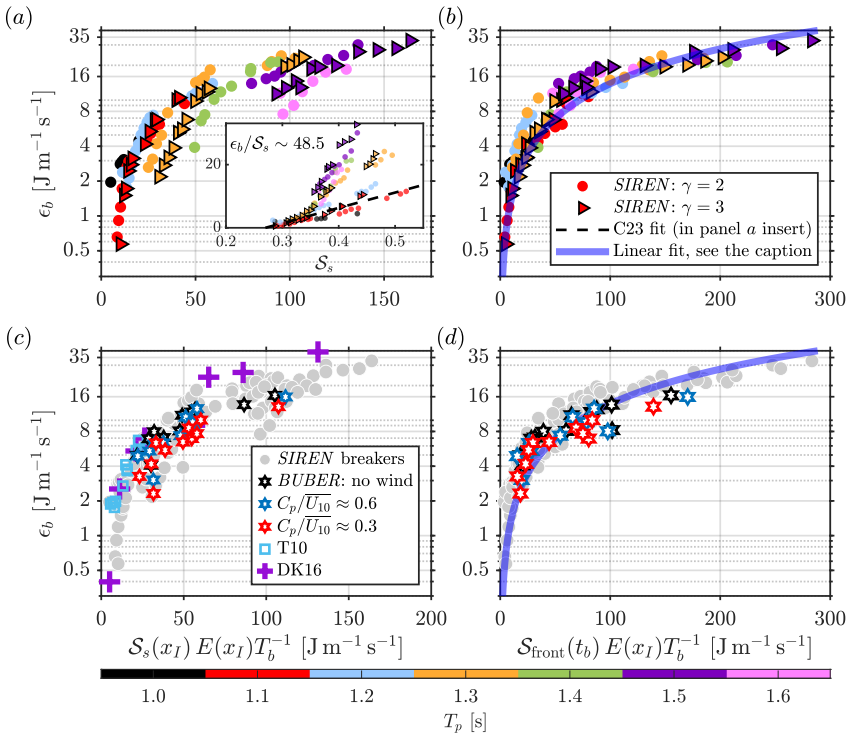
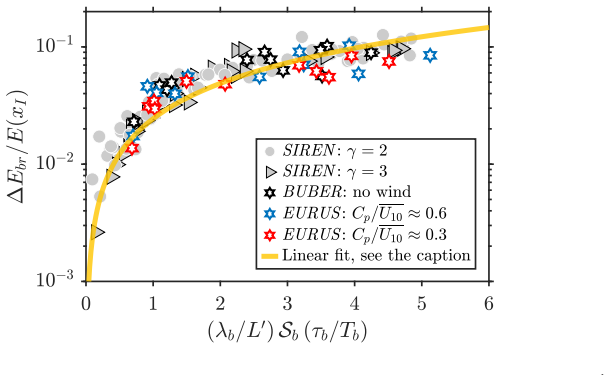
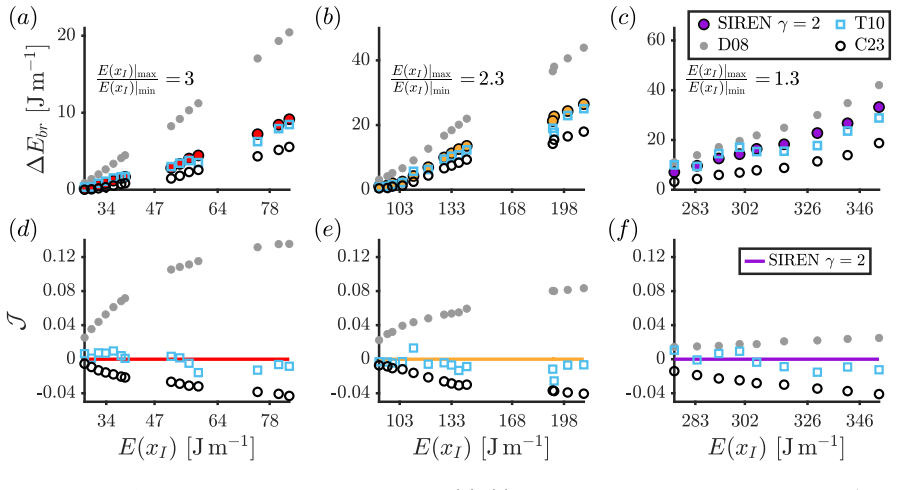
Variations in wave scale and wind primarily change breaking dissipation by shifting the onset threshold, leading to a scaling ΔE_br/E0 proportional to crest asymmetry, steepness and normalized breaking duration.
A machine-rendered reading of the paper's core claim, the machinery that carries it, and where it could break.
Core claim
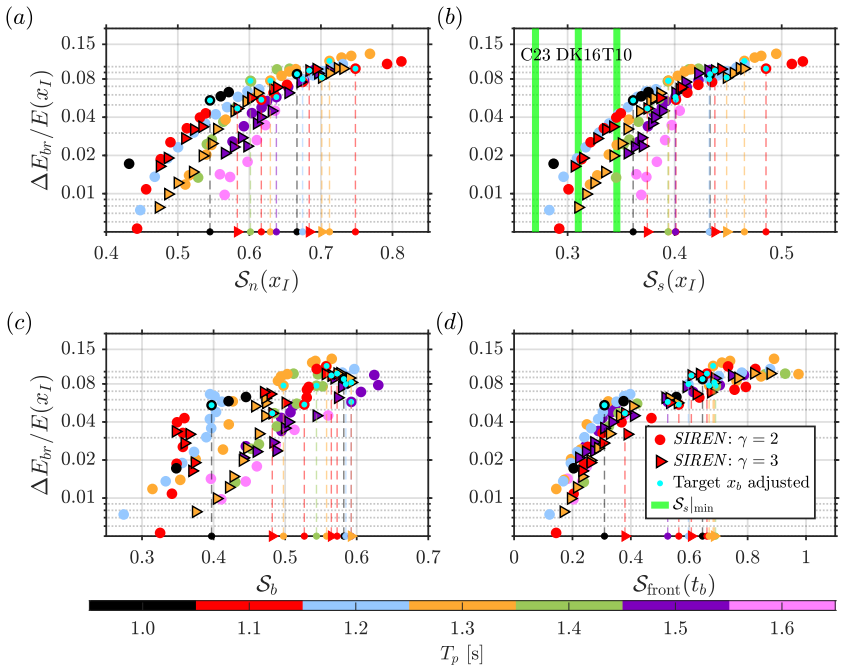
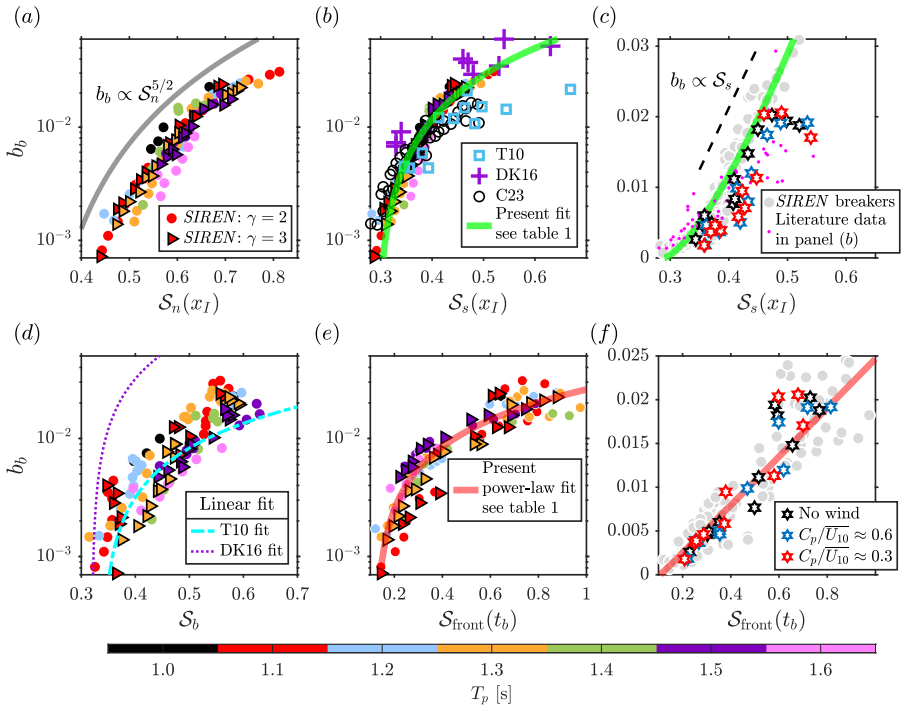
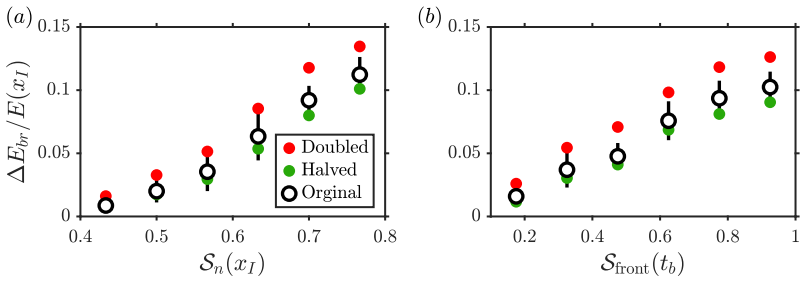
Breaking-induced energy dissipation varies with wave scale and co-flowing wind mainly through shifts in the breaking onset threshold. Characterizing onset and crest geometry by the crest-front steepness at incipient breaking yields the scaling ΔE_br/E0 ∝ β* S_b (τ_b/T_b), with β* as crest forward leaning, S_b as local steepness, and τ_b/T_b as non-dimensional breaking duration. The breaking strength parameter b relates approximately linearly to S_front(tb) once the threshold is accounted for.
What carries the argument
Crest-front steepness at incipient breaking S_front(tb), used to characterize breaking onset and local crest geometry across scales and wind conditions.
If this is right
- Wave scale variations affect fractional dissipation and rate chiefly by modifying the breaking onset threshold.
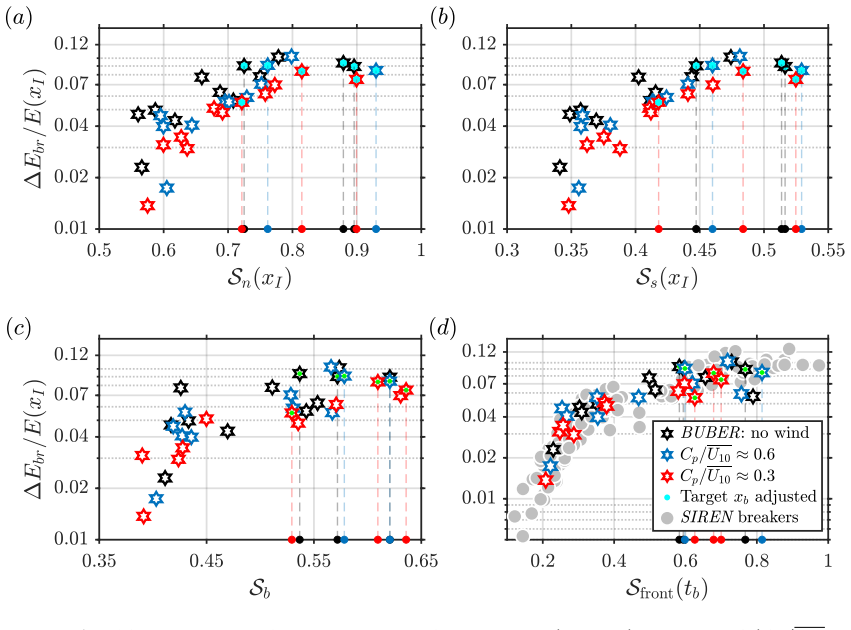
- Co-flowing wind reduces both ΔE_br/E0 and dissipation rate by causing earlier breaking with reduced crest forward lean.
- Crest asymmetry and breaking duration play key roles in setting the amount of energy dissipated.
- The breaking strength parameter b follows an approximately linear dependence on S_front(tb) after the onset threshold is considered.
Where Pith is reading between the lines
- The scaling could be tested for improving energy-loss terms in numerical wave models that include wind forcing.
- The framework for isolating breaking dissipation might extend to groups with opposing winds or broader frequency spreads.
- Field observations of crest geometry at breaking start could check whether the same threshold dependence holds outside the laboratory.
Load-bearing premise
The crest-front steepness at incipient breaking accurately characterizes breaking onset and local crest geometry across scales and wind conditions.
What would settle it
A set of measurements at a new wave scale or wind stress where the proposed scaling ΔE_br/E0 ∝ β* S_b (τ_b/T_b) fails to collapse the data once S_front(tb) is used to set the threshold.
Figures
read the original abstract
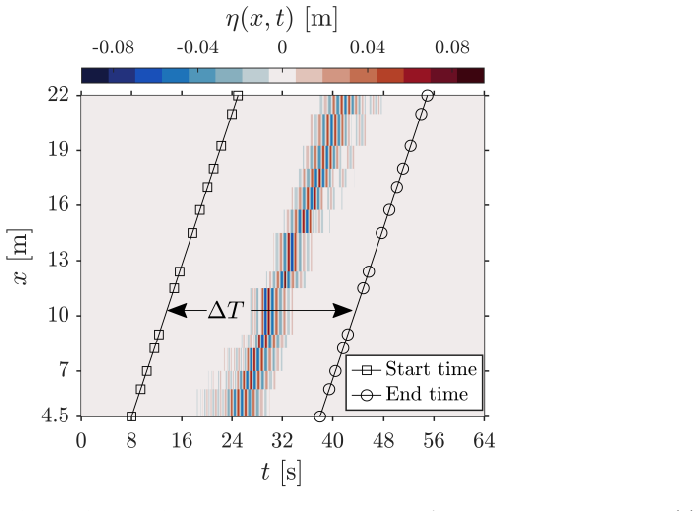
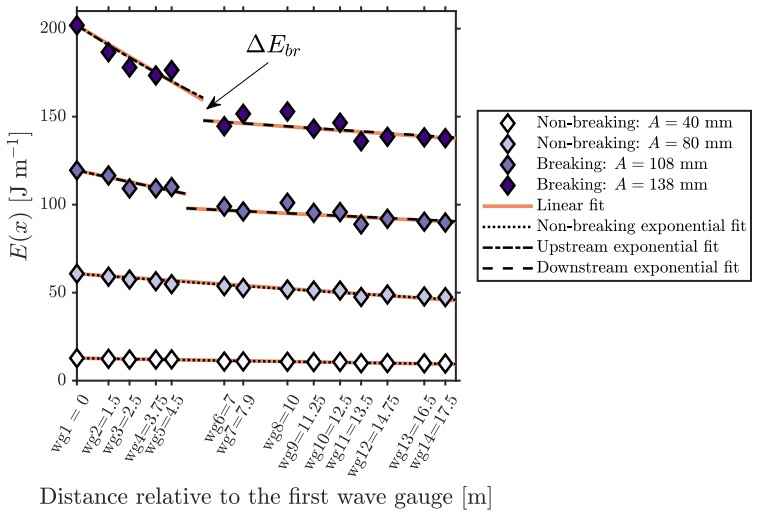
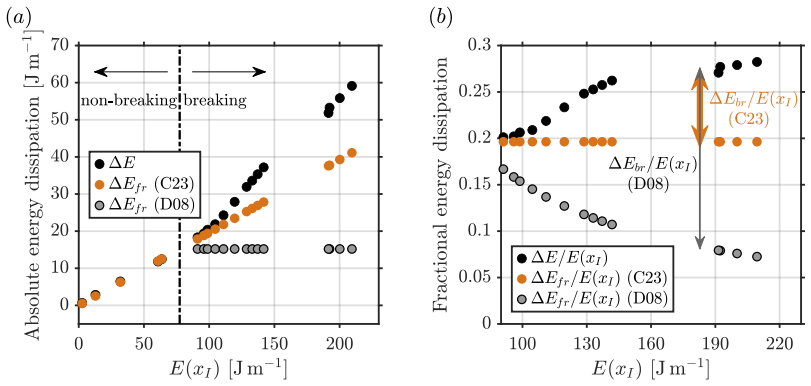
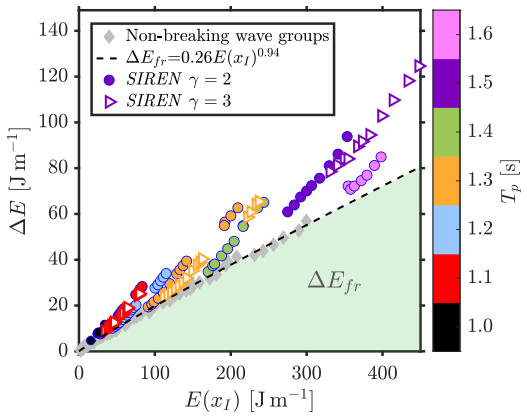
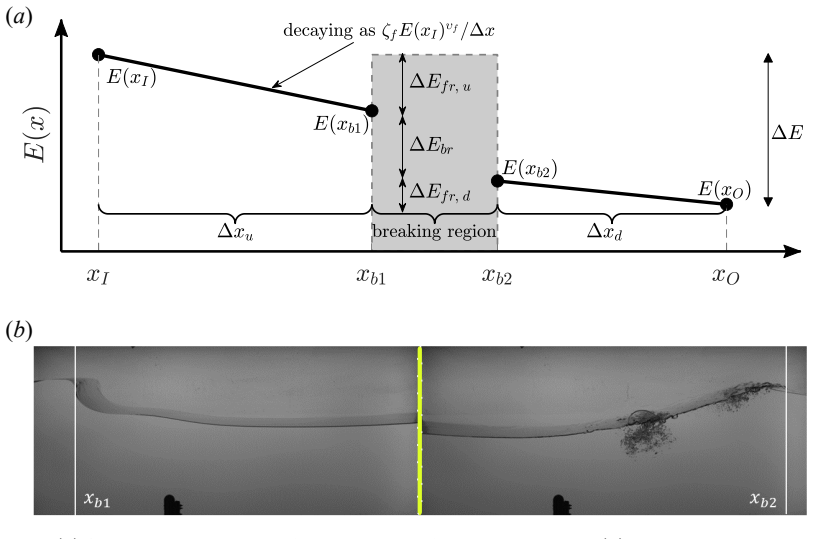
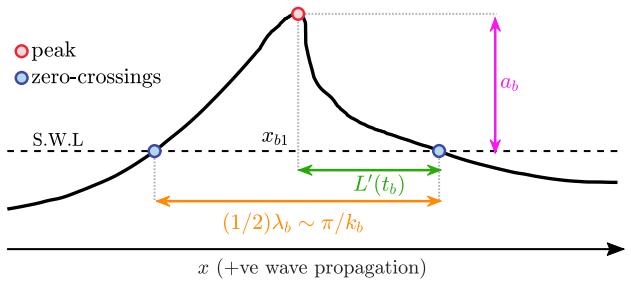
Breaking-induced energy dissipation is studied for individual unsteady breaking waves using laboratory measurements of unidirectional surface gravity wave groups across a range of wave scales and wind stresses. A refined framework to estimate breaking-induced dissipation $\Delta E_{br}$ is proposed that accounts for background dissipation from non-breaking processes. Using this framework, we show that variations in wave scale primarily influence breaking energetics, such as fractional dissipation $\Delta E_{br}/E_0$ and dissipation rate $\epsilon_b$, by modifying the breaking onset threshold. Also, co-flowing wind systematically reduces both $\Delta E_{br}/E_0$ and $\epsilon_b$ relative to unforced conditions, as wind-forced waves break earlier with reduced crest forward-leaning. Exploiting the crest-front steepness at incipient breaking $\mathcal{S}_{\text{front}}(t_b)$ to characterise breaking onset and local crest geometry, we formulate a scaling for $\epsilon_b$ based on this local measure. This then yields $\Delta E_{br}/E_0 \propto \beta^{*}\,\mathcal{S}_b\,(\tau_b/T_b)$, where $\beta^{*}$ is crest forward leaning, $\mathcal{S}_b$ local steepness, and $\tau_b/T_b$ non-dimensional breaking duration. This scaling highlights the important roles of crest asymmetry and breaking duration in setting the breaking energy dissipation. Finally, we consider the breaking strength parameter $b$ by assessing existing steepness-based scaling laws, and relate $b$ to $\mathcal{S}_{\text{front}}(t_b)$, yielding an approximately linear dependence once the breaking-onset threshold is considered.
Editorial analysis
A structured set of objections, weighed in public.
Referee Report
Summary. The manuscript reports laboratory experiments on unidirectional surface gravity wave groups across a range of scales and co-flowing wind stresses. It proposes a refined framework to isolate breaking-induced dissipation ΔE_br from background non-breaking dissipation, demonstrates that scale and wind primarily modulate fractional dissipation ΔE_br/E0 and rate ε_b via shifts in the breaking onset threshold, and introduces a scaling ΔE_br/E0 ∝ β* S_b (τ_b/T_b) based on crest-front steepness S_front(tb) at incipient breaking. It further reports an approximately linear relation between the breaking strength parameter b and S_front(tb) once the threshold is accounted for.
Significance. If the central scaling and threshold-modification narrative hold, the work supplies a physically grounded parameterization for breaking dissipation that incorporates crest asymmetry (β*), local steepness, and duration, with potential value for spectral wave models and air-sea interaction studies. The controlled variation of scale and wind in the laboratory and the attempt to refine the dissipation estimation framework constitute clear strengths.
major comments (2)
- [Abstract and results presenting the scaling] The claim that scale and wind act primarily by modifying the onset threshold characterized by S_front(tb) is load-bearing for the scaling and the narrative that other influences are captured by β*, S_b, and τ_b/T_b. The abstract presents the linear b vs. S_front(tb) relation only after threshold adjustment but does not indicate whether residual scatter or systematic dependence on peak frequency or wind stress remains; explicit tests for independent effects (e.g., data collapse at fixed S_front(tb)) are required to confirm sufficiency of this local measure.
- [Methodology and results sections] The refined framework for estimating ΔE_br is central to all quantitative claims, yet the abstract provides no quantitative details on background subtraction procedure, error bars on ΔE_br/E0 and ε_b, or validation against independent dissipation estimates. Without these, the strength of evidence supporting the scaling and the threshold-modification interpretation cannot be fully assessed.
minor comments (1)
- Notation for quantities such as β*, S_b, and τ_b/T_b should be defined explicitly at first use with reference to the relevant equations or figures.
Simulated Author's Rebuttal
We thank the referee for their thoughtful and constructive report. The comments highlight important aspects of presentation and evidence strength that we address point-by-point below. We propose targeted revisions to improve clarity without altering the core findings.
read point-by-point responses
-
Referee: [Abstract and results presenting the scaling] The claim that scale and wind act primarily by modifying the onset threshold characterized by S_front(tb) is load-bearing for the scaling and the narrative that other influences are captured by β*, S_b, and τ_b/T_b. The abstract presents the linear b vs. S_front(tb) relation only after threshold adjustment but does not indicate whether residual scatter or systematic dependence on peak frequency or wind stress remains; explicit tests for independent effects (e.g., data collapse at fixed S_front(tb)) are required to confirm sufficiency of this local measure.
Authors: We agree that explicit verification of data collapse and residual analysis strengthens the claim. The manuscript already demonstrates collapse of ΔE_br/E0 and ε_b across scales and wind conditions when plotted against the threshold-adjusted S_front(tb), with the scaling parameters β*, S_b and τ_b/T_b accounting for remaining variation. However, to directly address potential residual dependence, the revised manuscript will include (i) a supplementary figure showing fractional dissipation and b versus S_front(tb) stratified by peak frequency and wind stress, and (ii) a quantitative residual analysis confirming no systematic trends remain once the threshold is accounted for. These additions will be referenced in an updated abstract sentence. revision: yes
-
Referee: [Methodology and results sections] The refined framework for estimating ΔE_br is central to all quantitative claims, yet the abstract provides no quantitative details on background subtraction procedure, error bars on ΔE_br/E0 and ε_b, or validation against independent dissipation estimates. Without these, the strength of evidence supporting the scaling and the threshold-modification interpretation cannot be fully assessed.
Authors: The background-subtraction procedure, including the decomposition into breaking and non-breaking contributions and the associated uncertainty quantification from ensemble repeats, is fully detailed in Section 3.2, with error bars reported on all ΔE_br/E0 and ε_b values in Figures 4–7. Validation against independent spectral dissipation estimates appears in Section 4.1. We acknowledge that the abstract is necessarily concise and omits these specifics. In revision we will add one sentence to the abstract summarizing the error estimation and validation approach while respecting length limits; no changes to the underlying methodology are required. revision: partial
Circularity Check
No significant circularity; scaling derived from independent experimental measurements
full rationale
The paper's central scaling ΔE_br/E0 ∝ β* S_b (τ_b/T_b) and the relation for b are formulated from laboratory data on wave groups, using measured crest-front steepness S_front(tb) at incipient breaking to characterize onset. The framework refines dissipation estimates by subtracting background processes, and the proportionality is presented as an empirical outcome after observing how scale and wind modify the threshold. No equations reduce by construction to fitted inputs, no load-bearing self-citations are invoked, and the derivation chain remains self-contained against the reported observations without renaming or smuggling ansatzes.
Axiom & Free-Parameter Ledger
free parameters (1)
- proportionality constant in scaling
axioms (2)
- standard math Incompressible, irrotational flow assumptions for surface gravity waves prior to breaking
- domain assumption Background dissipation from non-breaking processes can be independently estimated and subtracted to isolate breaking effects
Reference graph
Works this paper leans on
-
[1]
A. H. Callaghan and G. B. Deane and M. Dale Stokes , doi =. A Comparison of Laboratory and Field Measurements of Whitecap Foam Evolution From Breaking Waves , volume =. Journal of Geophysical Research: Oceans , keywords =
-
[2]
Callaghan and Filippo Bergamasco and Mara Pistellato and Francesco Barbariol and Alvise Benetazzo , doi =
Joe Peach and Adrian H. Callaghan and Filippo Bergamasco and Mara Pistellato and Francesco Barbariol and Alvise Benetazzo , doi =. A Vision-Based Method for Spatial and Temporal Tracking of Individual Whitecaps From Breaking Ocean Waves , volume =. IEEE Transactions on Geoscience and Remote Sensing , pages =
-
[3]
Boettger and Shane R
Daniel G. Boettger and Shane R. Keating and Michael L. Banner and Russel P. Morison and Xavier Barthélémy , doi =. Energetic inception of breaking in surface gravity waves under wind forcing , volume =. Physical Review Fluids , keywords =
-
[4]
Banner , doi =
Julien Touboul and Michael L. Banner , doi =. On the breaking inception of unsteady water wave packets evolving in the presence of constant vorticity , volume =. Journal of Fluid Mechanics , keywords =
-
[5]
Numerical study of bubble rise in plunging breaking waves , volume =
Cheng Liu and Yiding Hu and Xiaobin Yang and Changhong Hu , doi =. Numerical study of bubble rise in plunging breaking waves , volume =. Physics of Fluids , month =
-
[6]
McAllister and N
M.L. McAllister and N. Pizzo and S. Draycott and T.S. van den Bremer , doi =. The influence of spectral bandwidth and shape on deep-water wave breaking onset , volume =. Journal of Fluid Mechanics , keywords =
-
[7]
Babanin and Eric Werner Schulz and Richard Manasseh and Changlong Guan , doi =
Xiaochen Zou and Alexander V. Babanin and Eric Werner Schulz and Richard Manasseh and Changlong Guan , doi =. Passive Acoustic Determination of Spectral Wave Breaking Dissipation , volume =. Journal of Physical Oceanography , keywords =
-
[8]
Deane , doi =
Qiang Gao and Lian Shen and Grant B. Deane , doi =. A numerical simulation framework for bubbly flow and sound generation in laboratory-scale breaking waves , volume =. JASA Express Letters , month =
-
[9]
Breaking bubbles across multiple time scales in turbulence , volume =
Yinghe Qi and Xu Xu and Shiyong Tan and Shijie Zhong and Qianwen Wu and Rui Ni , doi =. Breaking bubbles across multiple time scales in turbulence , volume =. Journal of Fluid Mechanics , keywords =
-
[10]
Deane and M
Grant B. Deane and M. Dale Stokes and Adrian H. Callaghan , doi =. The Saturation of Fluid Turbulence in Breaking Laboratory Waves and Implications for Whitecaps , volume =. Journal of Physical Oceanography , pages =
-
[11]
Callaghan , doi =
Adrian H. Callaghan , doi =. Estimates of the Breaking Strength Parameter for Individual Oceanic Whitecaps , volume =. Geophysical Research Letters , keywords =
-
[12]
Thomas Farrar and Bertrand Chapron and Stéphane Popinet and Luc Deike , doi =
Nicolò Scapin and Jiarong Wu and J. Thomas Farrar and Bertrand Chapron and Stéphane Popinet and Luc Deike , doi =. Growth Rate and Energy Dissipation in Wind‐Forced Breaking Waves , volume =. Geophysical Research Letters , month =
-
[13]
Deane and M
Grant B. Deane and M. Dale Stokes , doi =. Scale dependence of bubble creation mechanisms in breaking waves , volume =. Nature , month =
-
[14]
Jean-Baptiste Saulnier and Alain Clément and António F. de O. Falcão and Teresa Pontes and Marc Prevosto and Pierpaolo Ricci , doi =. Wave groupiness and spectral bandwidth as relevant parameters for the performance assessment of wave energy converters , volume =. Ocean Engineering , keywords =
-
[15]
M. L. McAllister and S. Draycott and R. Calvert and T. Davey and F. Dias and T. S. van den Bremer , doi =. Three-dimensional wave breaking , volume =. Nature , month =
-
[16]
Padilla and Yuxin Fang and Adrian H
Rui Cao and Enrique M. Padilla and Yuxin Fang and Adrian H. Callaghan , doi =. Identification of the Free Surface for Unidirectional Nonbreaking Water Waves From Side-View Digital Images , volume =. IEEE Journal of Oceanic Engineering , month =
-
[17]
Callaghan and Dongxiao Zhang , doi =
Hao Xu and Yuntian Chen and Rui Cao and Tianning Tang and Mengge Du and Jian Li and Adrian H. Callaghan and Dongxiao Zhang , doi =. Generative discovery of partial differential equations by learning from math handbooks , volume =. Nature Communications , month =
-
[18]
Padilla and Xu Chen and Adrian H
Rui Cao and Enrique M. Padilla and Xu Chen and Adrian H. Callaghan , doi =. A Representative Underlying Scale for Spectrally Resolved Energy Dissipation in Surface Breaking Waves , volume =. Journal of Geophysical Research: Oceans , month =
-
[19]
2026 , eprint=
On the limiting geometry of unsteady breaking waves subject to co-flowing wind: spectrally-informed versus locally-measured steepness , author=. 2026 , eprint=
2026
-
[20]
Iafrati and F
A. Iafrati and F. De Vita and R. Verzicco , doi =. Effects of the wind on the breaking of modulated wave trains , volume =. European Journal of Mechanics - B/Fluids , month =
-
[21]
Peirson and Hubert Branger and James W
Laurent Grare and William L. Peirson and Hubert Branger and James W. Walker and Jean-Paul Giovanangeli and Vladimir Makin , doi =. Growth and dissipation of wind-forced, deep-water waves , volume =. Journal of Fluid Mechanics , keywords =
-
[22]
Wave statistics and energy dissipation of shallow-water breaking waves in a tank with a level bottom , volume =
Shuo Liu and Hui Wang and Annie-Claude Bayeul-Lainé and Cheng Li and Joseph Katz and Olivier Coutier-Delgosha , doi =. Wave statistics and energy dissipation of shallow-water breaking waves in a tank with a level bottom , volume =. Journal of Fluid Mechanics , month =
-
[23]
Mostert and S
W. Mostert and S. Popinet and L. Deike , doi =. High-resolution direct simulation of deep water breaking waves: transition to turbulence, bubbles and droplets production , volume =. Journal of Fluid Mechanics , month =
-
[24]
Kendall Melville and Jessica M
Leonel Romero and W. Kendall Melville and Jessica M. Kleiss , doi =. Spectral Energy Dissipation due to Surface Wave Breaking , volume =. Journal of Physical Oceanography , month =
-
[25]
Wave breaking probabilities under wind forcing in open sea and laboratory , volume =
Sagi Knobler and Ewelina Winiarska and Alexander Babanin and Dan Liberzon , doi =. Wave breaking probabilities under wind forcing in open sea and laboratory , volume =. Physics of Fluids , month =
-
[26]
Herman and A
A. Herman and A. Dragan‐Górska and P. Markuszewski , doi =. Close Relationship Between Whitecapping‐Related Wave Energy Dissipation and Ambient Sound in the Open Ocean , volume =. Geophysical Research Letters , month =
-
[27]
A. H. Callaghan and J.‐R. Bidlot and G. de Leeuw and C. D. O’Dowd , doi =. Comparing Estimates of Whitecap Coverage From a Spectral Wave Model With Oceanic Observations , volume =. Geophysical Research Letters , month =
-
[28]
Mass Transfer at the Ocean–Atmosphere Interface: The Role of Wave Breaking, Droplets, and Bubbles , volume =
Luc Deike , doi =. Mass Transfer at the Ocean–Atmosphere Interface: The Role of Wave Breaking, Droplets, and Bubbles , volume =. Annual Review of Fluid Mechanics , keywords =
-
[29]
Hogan and C
L. Hogan and C. J. Zappa and A. Cifuentes‐Lorenzen and J. B. Edson and J. O’Donnell and D. S. Ullman , doi =. Observations of Breaking Wave Dissipation and Their Relationship to Atmosphere‐Ocean Energy Transfer , volume =. Journal of Geophysical Research: Oceans , month =
-
[30]
A new spectral parameter to predict dominant wave breaking based on the JONSWAP spectrum , volume =
Yuanyuan Xu and Shuxiu Liang and Zhaochen Sun and Qingren Xue , doi =. A new spectral parameter to predict dominant wave breaking based on the JONSWAP spectrum , volume =. Ocean Engineering , keywords =
-
[31]
On the non-linear energy transfer on a gravity-wave spectrum. Part 1. General Theory , author=. Journal of Fluid Mechanics , volume=
-
[32]
Journal of Fluid Mechanics , volume=
Inertial scaling of dissipation in unsteady breaking waves , author=. Journal of Fluid Mechanics , volume=
-
[33]
Rapp, R. J. and Melville, W. K. and Longuet-Higgins, Michael Selwyn , title =. Philosophical Transactions of the Royal Society of London. Series A, Mathematical and Physical Sciences , volume =
-
[34]
Annual Review of Fluid Mechanics , volume=
The Role of Surface-Wave Breaking in Air-Sea Interaction , author=. Annual Review of Fluid Mechanics , volume=
-
[35]
Annual Review of Fluid Mechanics , volume =
Perlin, Marc and Choi, Wooyoung and Tian, Zhigang , title =. Annual Review of Fluid Mechanics , volume =
-
[36]
Journal of Physical Oceanography , volume=
On the Relationship between the Energy Dissipation Rate of Surface-Breaking Waves and Oceanic Whitecap Coverage , author=. Journal of Physical Oceanography , volume=
-
[37]
Proceedings of the Royal Society of London
An Experimental Investigation of Breaking Waves Produced by a Towed Hydrofoil , volume=. Proceedings of the Royal Society of London. A. Mathematical and Physical Sciences , author=. 1981 , month=. doi:10.1098/rspa.1981.0127 , number=
-
[38]
Journal of Fluid Mechanics , volume=
The breaking and non-breaking wave resistance of a two-dimensional hydrofoil , author=. Journal of Fluid Mechanics , volume=
-
[39]
Journal of Waterway Port Coastal and Ocean Engineering , volume=
Laboratory Study of Steep and Breaking Deep Water Waves , author=. Journal of Waterway Port Coastal and Ocean Engineering , volume=
-
[40]
Ocean Engineering , volume=
Laboratory study of deep-water breaking waves , author=. Ocean Engineering , volume=
-
[41]
Journal of Fluid Mechanics , volume=
Wave breaking onset and strength for two-dimensional deep-water wave groups , author=. Journal of Fluid Mechanics , volume=
-
[42]
Tian, Zhigang and Perlin, Marc and Choi, Wooyoung , year=. Energy dissipation in two-dimensional unsteady plunging breakers and an eddy viscosity model , volume=. doi:10.1017/S0022112010000832 , journal=
-
[43]
Physics of Fluids , year=
An eddy viscosity model for two-dimensional breaking waves and its validation with laboratory experiments , author=. Physics of Fluids , year=
-
[44]
The Speed , Breaking Onset and Energy Dissipation of 3D Deep-Water Waves , year =
Allis, Michael J , keywords =. The Speed , Breaking Onset and Energy Dissipation of 3D Deep-Water Waves , year =
-
[45]
Laboratory study on the evolution of waves parameters due to wave breaking in deep water , journal =
Shuxiu Liang and Yihui Zhang and Zhaochen Sun and Yanling Chang , keywords =. Laboratory study on the evolution of waves parameters due to wave breaking in deep water , journal =. 2017 , issn =. doi:https://doi.org/10.1016/j.wavemoti.2016.08.010 , url =
-
[46]
Journal of Physical Oceanography , author=
Two Regimes of Laboratory Whitecap Foam Decay: Bubble-Plume Controlled and Surfactant Stabilized , volume=. Journal of Physical Oceanography , author=. 2013 , month=. doi:10.1175/jpo-d-12-0148.1 , number=
-
[47]
Geophysical Research Letters , author=
Laboratory air-entraining breaking waves: Imaging visible foam signatures to estimate energy dissipation , volume=. Geophysical Research Letters , author=. 2016 , month=. doi:10.1002/2016gl071226 , number=
-
[48]
China Ocean Engineering , author=
Study on Energy Spectrum Instability in the Processes of Propagating and Breaking of Focusing Waves , volume=. China Ocean Engineering , author=. 2019 , month=. doi:10.1007/s13344-019-0009-5 , number=
-
[49]
Craciunescu, Constantin Cosmin and Christou, Marios , year=. Wave breaking energy dissipation in long-crested focused wave groups based on JONSWAP spectra , volume=. doi:10.1016/j.apor.2020.102144 , journal=
-
[50]
and Grare, Laurent and Lenain, Luc and Pizzo, Nick , year=
Sinnis, James T. and Grare, Laurent and Lenain, Luc and Pizzo, Nick , year=. Laboratory studies of the role of bandwidth in surface transport and energy dissipation of deep-water breaking waves , volume=. doi:10.1017/jfm.2021.734 , journal=
-
[51]
Cao, Rui and Padilla, E.M. and Callaghan, A.H. , year=. The influence of bandwidth on the energetics of intermediate to deep water laboratory breaking waves , volume=. doi:10.1017/jfm.2023.645 , journal=
-
[52]
Iafrati, A. , doi =. Journal of Geophysical Research: Oceans , keywords =
-
[53]
Derakhti, Morteza and Kirby, James T. , year=. Bubble entrainment and liquid-bubble interaction under unsteady breaking waves , volume=. doi:10.1017/jfm.2014.637 , journal=
-
[54]
Derakhti, Morteza and Kirby, James T. , year=. Breaking-onset, energy and momentum flux in unsteady focused wave packets , volume=. doi:10.1017/jfm.2016.17 , journal=
-
[55]
Kendall and Popinet, Stéphane , year=
Deike, Luc and Melville, W. Kendall and Popinet, Stéphane , year=. Air entrainment and bubble statistics in breaking waves , volume=. doi:10.1017/jfm.2016.372 , journal=
-
[56]
Derakhti, Morteza and Banner, Michael L. and Kirby, James T. , year=. Predicting the breaking strength of gravity water waves in deep and intermediate depth , volume=. doi:10.1017/jfm.2018.352 , journal=
-
[57]
Breaking of modulated wave groups: kinematics and energy dissipation processes , volume=
De Vita, Francesco and Verzicco, Roberto and Iafrati, Alessandro , year=. Breaking of modulated wave groups: kinematics and energy dissipation processes , volume=. doi:10.1017/jfm.2018.619 , journal=
-
[58]
Distribution of breaking waves at the ocean surface , volume=. Nature , author=. 2002 , month=. doi:10.1038/417058a , number=
-
[59]
Journal of Physical Oceanography , author=
Spectrally Resolved Energy Dissipation Rate and Momentum Flux of Breaking Waves , volume=. Journal of Physical Oceanography , author=. 2008 , month=. doi:10.1175/2007jpo3762.1 , number=
-
[60]
Geophysical Research Letters , author=
Energy dissipation and the spectral distribution of whitecaps , volume=. Geophysical Research Letters , author=. 2009 , month=. doi:10.1029/2009gl038201 , number=
-
[61]
Journal of Physical Oceanography , author=
Wave Breaking Dissipation in a Young Wind Sea , volume=. Journal of Physical Oceanography , author=. 2014 , month=. doi:10.1175/jpo-d-12-0237.1 , number=
-
[62]
Geophysical Research Letters , author=
Field measurements and scaling of ocean surface wave‐breaking statistics , volume=. Geophysical Research Letters , author=. 2013 , month=. doi:10.1002/grl.50584 , number=
-
[63]
Journal of Atmospheric and Oceanic Technology , author=
Measuring Turbulent Kinetic Energy Dissipation at a Wavy Sea Surface , volume=. Journal of Atmospheric and Oceanic Technology , author=. 2015 , month=. doi:10.1175/jtech-d-14-00227.1 , number=
-
[64]
Journal of Geophysical Research , author=
Breaking criteria and energy losses for three‐dimensional wave breaking , volume=. Journal of Geophysical Research , author=. 2002 , month=. doi:10.1029/2001jc001077 , number=
-
[65]
Journal of Geophysical Research , author=
Energy and momentum dissipation through wave breaking , volume=. Journal of Geophysical Research , author=. 2005 , month=. doi:10.1029/2004jc002834 , number=
-
[66]
Journal of Physical Oceanography , author=
Influence of Wind Forcing on Modulation and Breaking of One-Dimensional Deep-Water Wave Groups , volume=. Journal of Physical Oceanography , author=. 2012 , month=. doi:10.1175/jpo-d-11-083.1 , number=
-
[67]
Journal of Geophysical Research , author=
Laboratory measurements of limiting freak waves on currents , volume=. Journal of Geophysical Research , author=. 2004 , month=. doi:10.1029/2004jc002612 , number=
-
[68]
Padilla and Rui Cao and Adrian H
Enrique M. Padilla and Rui Cao and Adrian H. Callaghan , doi =. Spatial Interpolation of Wave Fields Based on Limited Spatial Measurements , volume =. IEEE Journal of Oceanic Engineering , keywords =
-
[69]
Annual Review of Fluid Mechanics , author=
Capillary Effects on Surface Waves , volume=. Annual Review of Fluid Mechanics , author=. 2000 , month=. doi:10.1146/annurev.fluid.32.1.241 , number=
-
[70]
Deike, Luc and Popinet, Stephane and Melville, W. Kendall , year=. Capillary effects on wave breaking , volume=. doi:10.1017/jfm.2015.103 , journal=
-
[71]
In: Proceedings of the First International Offshore and Polar Engineering Conference , year=
New model for the kinematics of large ocean waves application as a design wave , author=. In: Proceedings of the First International Offshore and Polar Engineering Conference , year=
-
[72]
Loewen, M. R. and Melville, W. K. , year=. Microwave backscatter and acoustic radiation from breaking waves , volume=. doi:10.1017/s0022112091001891 , journal=
-
[73]
and Banner, Michael L
Derakhti, Morteza and Kirby, James T. and Banner, Michael L. and Grilli, Stephan T. and Thomson, Jim , doi =. Journal of Geophysical Research: Oceans , number =
-
[74]
Barratt, D. and Bingham, H. B. and Taylor, P. H. and van den Bremer, T. S. and Adcock, T. A. A. , year=. Rapid spectral evolution of steep surface wave groups with directional spreading , volume=. doi:10.1017/jfm.2020.835 , journal=
-
[75]
Saket, Arvin and Peirson, William L. and Banner, Michael L. and Barthelemy, Xavier and Allis, Michael J. , year=. On the threshold for wave breaking of two-dimensional deep water wave groups in the absence and presence of wind , volume=. doi:10.1017/jfm.2016.776 , journal=
-
[76]
Journal of Physical Oceanography , author=
Energy Dissipation by Breaking Waves , volume=. Journal of Physical Oceanography , author=. 1994 , month=. doi:10.1175/1520-0485(1994)024<2041:edbbw>2.0.co;2 , number=
-
[77]
Dtsch.Hydrogr.Z , volume=
Measurements of wind-wave growth and swell decay during the Joint North Sea Wave Project (JONSWAP) , author=. Dtsch.Hydrogr.Z , volume=
-
[78]
Evaluation of a deep-water wave breaking criterion , volume =
Zhigang Tian and Marc Perlin and Wooyoung Choi , doi =. Evaluation of a deep-water wave breaking criterion , volume =. Physics of Fluids , month =
-
[79]
Journal of Physical Oceanography , author=
Evaluation of Skewness and Kurtosis of Wind Waves Parameterized by JONSWAP Spectra , volume=. Journal of Physical Oceanography , author=. 2014 , month=. doi:10.1175/jpo-d-13-0218.1 , number=
-
[80]
Wave period group statistics for real sea waves and wave energy extraction , volume=. Proceedings of the Institution of Mechanical Engineers, Part M: Journal of Engineering for the Maritime Environment , author=. 2006 , month=. doi:10.1243/14750902jeme37 , number=
discussion (0)
Sign in with ORCID, Apple, or X to comment. Anyone can read and Pith papers without signing in.