Successes and challenges of using Semidefinite Programming for the study of Spin Chain Hamiltonians
Pith reviewed 2026-06-28 13:39 UTC · model grok-4.3
The pith
Semidefinite programming exactly recovers the ground state energy and fermion two-point functions for free-fermion spin chains.
A machine-rendered reading of the paper's core claim, the machinery that carries it, and where it could break.
Core claim
In the special case of free fermions the semidefinite program returns the exact ground state energy and the exact two-point functions. For general models the program still supplies an upper bound on the ground state energy that becomes tight with added constraints, and it produces correlators that qualitatively reproduce the true behavior even when quantitative accuracy is lost.
What carries the argument
The semidefinite programming relaxation of the Hamiltonian minimization problem, augmented by charge and integrability constraints.
If this is right
- Charge constraints enable computation of the first excited charged states.
- Integrability constraints tighten the relaxation for integrable models.
- Approximate Virasoro correlators allow extraction of the central charge and some critical exponents at criticality.
- The location of the phase transition can be identified using these methods.
- The approach encounters scaling issues as lattice volume increases.
Where Pith is reading between the lines
- The exactness result for free fermions may extend to other models where similar algebraic constraints can be imposed.
- Qualitative accuracy in interacting regimes suggests SDP could provide initial estimates in systems lacking exact solutions.
- The volume scaling problem indicates that symmetry reductions or hierarchical improvements would be needed for larger systems.
- Linking SDP outputs to conformal data might help benchmark lattice regularizations of conformal field theories.
Load-bearing premise
The semidefinite relaxation stays tight after the addition of charge constraints and any available integrability constraints.
What would settle it
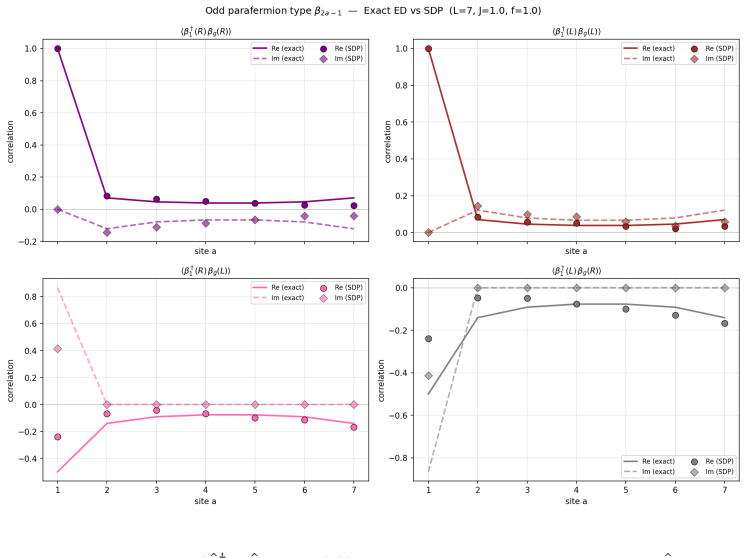
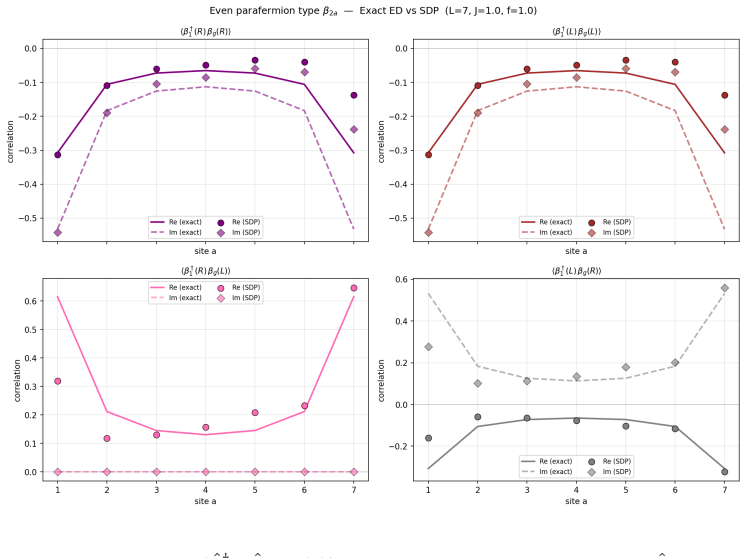
A numerical check on a small free-fermion Ising chain where the SDP energy and two-point functions are compared against exact diagonalization results.
Figures


read the original abstract
We study semidefinite programming (SDP) methods to analyze spin chain Hamiltonians. We examine the ground state energy, the first excited charged states and ground state correlators in two simple models: the Ising model in a transverse magnetic field and the closely related 3-state Potts model. Our goal is to understand precisely what the SDP program is doing and when it works well, why it does so. We focus on the following novel ingredients: using charge constraints to obtain excited states and to see if additional constraints from integrable models are effective at improving the method. At criticality we also explore to what extent we can use approximate Virasoro correlators to extract conformal data: the central charge and some critical exponents of charged states. We also use these to identify the location of the phase transition. In the special case where the system is made of free fermions we prove that the SDP finds the exact energy of the ground state and produces the correct two point functions of the fermions. Away from free fermion theories, the SDP gets progressively worse at estimating data beyond the value of the ground state energy (like correlation functions), although it qualitatively matches these. In order to be effective, the SDP seems to run into scaling issues where the amount of input needed scales poorly with the lattice volume.
Editorial analysis
A structured set of objections, weighed in public.
Referee Report
Summary. The manuscript examines semidefinite programming (SDP) relaxations for spin-chain Hamiltonians, focusing on the transverse-field Ising and 3-state Potts models. It introduces charge constraints to access excited states and integrability constraints to tighten bounds, proves that the SDP yields the exact ground-state energy and correct two-point fermion correlators in the free-fermion case, reports qualitative agreement for correlators away from free fermions, and explores extraction of central charge and critical exponents from approximate Virasoro correlators at criticality while noting that required input scales poorly with lattice volume.
Significance. The explicit proof of tightness for free fermions supplies a rigorous benchmark that clarifies when SDP relaxations become exact under charge and integrability constraints; this is a concrete strength. The demonstration that charge constraints enable access to charged excited states and that approximate Virasoro data can locate phase transitions adds practical insight, even though accuracy degrades for correlators outside the free-fermion point.
major comments (1)
- [free-fermion proof] The central claim that the SDP relaxation remains tight for free fermions once charge (and integrability) constraints are imposed is load-bearing for both the exactness proof and the qualitative claims away from that limit. The manuscript should supply the explicit algebraic steps showing that the SDP bound saturates the known free-fermion ground-state energy and two-point functions without residual gap.
minor comments (2)
- [scaling issues] The scaling discussion would be strengthened by a quantitative plot or table showing how the number of constraints or matrix size grows with chain length N.
- Notation for the charge and integrability constraints should be defined once in a dedicated subsection before their use in the SDP formulation.
Simulated Author's Rebuttal
We thank the referee for the detailed report and constructive feedback. The single major comment concerns the explicitness of the free-fermion tightness proof. We address it directly below and will revise the manuscript to incorporate the requested algebraic steps.
read point-by-point responses
-
Referee: The central claim that the SDP relaxation remains tight for free fermions once charge (and integrability) constraints are imposed is load-bearing for both the exactness proof and the qualitative claims away from that limit. The manuscript should supply the explicit algebraic steps showing that the SDP bound saturates the known free-fermion ground-state energy and two-point functions without residual gap.
Authors: We agree that the current presentation of the proof would benefit from a more expanded derivation. In the revised version we will insert a dedicated subsection that walks through the algebraic steps: starting from the free-fermion Hamiltonian expressed in Majorana operators, imposing the charge and integrability constraints on the moment matrix, and showing explicitly that the SDP objective equals the known ground-state energy while the extracted two-point functions match the exact Wick contractions with no residual gap. This addition will make the saturation argument fully self-contained. revision: yes
Circularity Check
No significant circularity
full rationale
The paper presents its strongest claim—that the SDP relaxation is tight for free-fermion spin chains, yielding exact ground-state energy and two-point functions—as a mathematical proof once charge and integrability constraints are imposed. This is not obtained by fitting parameters to data, renaming known results, or reducing via self-citation chains; the abstract explicitly distinguishes the exact free-fermion case from the qualitative degradation away from it. No load-bearing step in the provided derivation chain reduces by construction to its own inputs, and the method's scaling limitations are acknowledged rather than hidden. The central result is therefore self-contained and externally verifiable as a proof.
Axiom & Free-Parameter Ledger
Reference graph
Works this paper leans on
-
[1]
We also know thatE 1 −E 0 = α∆F E N
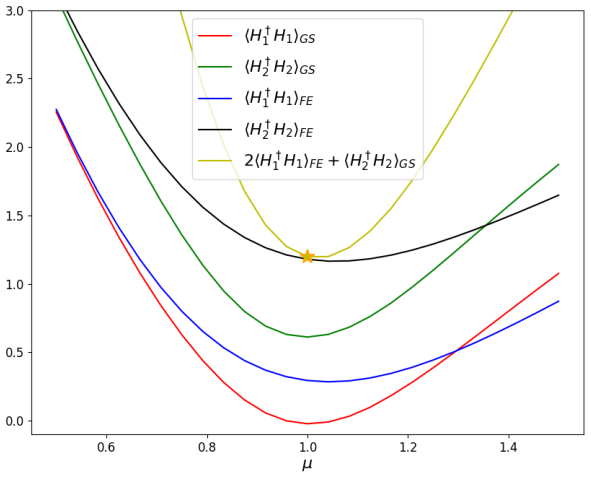
whereαis an unknown scale factor and ∆ F E is the scaling dimension of the first excited state. We also know thatE 1 −E 0 = α∆F E N . Now if the SDP approaches the correct ground state the result of this calculation is by necessity⟨I|H † 2H2|I⟩=αc/2 wherecis the central charge. Given that we already addressed the calculation of the central charge in a pre...
-
[2]
Barthel and R
T. Barthel and R. H¨ ubener, Physical review letters108, 200404 (2012)
2012
- [3]
-
[4]
Lawrence, (2021), arXiv:2111.13007 [hep-lat]
S. Lawrence, (2021), arXiv:2111.13007 [hep-lat]
-
[5]
The Conformal Bootstrap: Theory, Numerical Techniques, and Applications
D. Poland, S. Rychkov, and A. Vichi, Rev. Mod. Phys.91, 015002 (2019), arXiv:1805.04405 [hep-th]. 33
work page internal anchor Pith review Pith/arXiv arXiv 2019
-
[6]
Tavakoli, A
A. Tavakoli, A. Pozas-Kerstjens, P. Brown, and M. Ara´ ujo, Reviews of Modern Physics96, 045006 (2024)
2024
-
[7]
Solving the 3D Ising Model with the Conformal Bootstrap
S. El-Showk, M. F. Paulos, D. Poland, S. Rychkov, D. Simmons-Duffin, and A. Vichi, Phys. Rev. D86, 025022 (2012), arXiv:1203.6064 [hep-th]
work page internal anchor Pith review Pith/arXiv arXiv 2012
-
[8]
D. Berenstein and G. Hulsey, (2021), arXiv:2108.08757 [hep-th]
-
[9]
J. Bhattacharya, D. Das, S. K. Das, A. K. Jha, and M. Kundu, Phys. Lett. B823, 136785 (2021), arXiv:2108.11416 [hep-th]
-
[10]
D. Berenstein and G. Hulsey, Phys. Rev. E107, L053301 (2023), arXiv:2209.14332 [hep-th]
- [11]
-
[12]
P. D. Anderson and M. Kruczenski, Nucl. Phys. B921, 702 (2017), arXiv:1612.08140 [hep-th]
work page internal anchor Pith review Pith/arXiv arXiv 2017
-
[13]
V. Kazakov and Z. Zheng, JHEP06, 030 (2022), arXiv:2108.04830 [hep-th]
-
[14]
D. Berenstein and V. A. Rodriguez, JHEP09, 109 (2025), arXiv:2503.00104 [hep-th]
-
[15]
D. Berenstein, J. Rodrigues, and V. A. Rodriguez, (2026), arXiv:2602.18559 [hep-th]
-
[16]
Numerical exploration of the bootstrap in spin chain models,
D. Berenstein, G. Hulsey, and P. N. T. Lloyd, “Numerical exploration of the bootstrap in spin chain models,” (2024), arXiv:2406.17844 [hep-th]
- [17]
-
[18]
Koo and H
W. Koo and H. Saleur, Nuclear Physics B426, 459 (1994)
1994
-
[19]
M. G. Scheer, (2024), arXiv:2410.00810 [cond-mat.str-el]
work page internal anchor Pith review Pith/arXiv arXiv 2024
- [20]
-
[21]
D. Berenstein and P. N. T. Lloyd, Phys. Rev. D110, 054508 (2024), arXiv:2311.00057 [hep-th]
-
[22]
D. Berenstein, Phys. Rev. D108, 074509 (2023), arXiv:2303.12837 [hep-th]
-
[23]
Fradkin and L
E. Fradkin and L. P. Kadanoff, Nuclear Physics B170, 1 (1980)
1980
-
[24]
Pozsgay, SciPost Phys.8, 016 (2020)
B. Pozsgay, SciPost Phys.8, 016 (2020)
2020
-
[25]
Bargheer, N
T. Bargheer, N. Beisert, and F. Loebbert, Journal of Physics A: Mathematical and Theoretical 42, 285205 (2009)
2009
-
[26]
Pozsgay, Y
B. Pozsgay, Y. Jiang, and G. Tak´ acs, Journal of High Energy Physics2020, 92 (2020)
2020
-
[27]
Grady, Phys
M. Grady, Phys. Rev. D25, 1103 (1982)
1982
-
[28]
Fendley, Journal of Physics A: Mathematical and Theoretical47, 075001 (2014)
P. Fendley, Journal of Physics A: Mathematical and Theoretical47, 075001 (2014)
2014
-
[29]
M. A. Virasoro, Phys. Rev. D1, 2933 (1970)
1970
-
[30]
H. W. J. Bl¨ ote, J. L. Cardy, and M. P. Nightingale, Phys. Rev. Lett.56, 742 (1986). 34
1986
-
[31]
Affleck, Phys
I. Affleck, Phys. Rev. Lett.56, 746 (1986)
1986
-
[32]
Pasquier and H
V. Pasquier and H. Saleur, Nuclear Physics B330, 523 (1990)
1990
-
[33]
Y. Zou, A. Milsted, and G. Vidal, Phys. Rev. Lett.124, 040604 (2020)
2020
-
[34]
R. Wang, Y. Zou, and G. Vidal, Phys. Rev. B106, 115111 (2022)
2022
-
[35]
A. M. Gainutdinov, N. Read, and H. Saleur, Communications in Mathematical Physics341, 35 (2016)
2016
-
[36]
Milsted and G
A. Milsted and G. Vidal, Phys. Rev. B96, 245105 (2017)
2017
-
[37]
N. Seiberg, S. Seifnashri, and S.-H. Shao, SciPost Phys.16, 154 (2024), arXiv:2401.12281 [cond-mat.str-el]
-
[38]
L. P. Kadanoff and H. Ceva, Phys. Rev. B3, 3918 (1971)
1971
-
[39]
Alicea and P
J. Alicea and P. Fendley, Annual Review of Condensed Matter Physics7, 119 (2016)
2016
-
[40]
R. J. Baxter, Journal of Physics A: Mathematical and Theoretical47, 315001 (2014)
2014
-
[41]
F. C. Alcaraz and R. A. Pimenta, Phys. Rev. B102, 121101(R) (2020)
2020
-
[42]
F. C. Alcaraz and L. M. Ramos, Phys. Rev. E109, 044138 (2024)
2024
-
[43]
art form
J. Klinovaja and D. Loss, Phys. Rev. Lett.112, 246403 (2014). Appendix A: Construction of the boost operator and local conserved charges In this appendix we give a careful derivation of the lattice boost operator used in the main text, and we show how the coefficients of its local terms are fixed by demanding that the resulting commutator withHproduces a ...
2014
discussion (0)
Sign in with ORCID, Apple, or X to comment. Anyone can read and Pith papers without signing in.