From Capability Models to Automated Planning: An AAS-Native Approach for Automatic PDDL Generation
Pith reviewed 2026-06-28 14:47 UTC · model grok-4.3
The pith
AAS capability models structured with four Industry 4.0 standards contain enough information to generate complete PDDL planning problems automatically.
A machine-rendered reading of the paper's core claim, the machinery that carries it, and where it could break.
Core claim
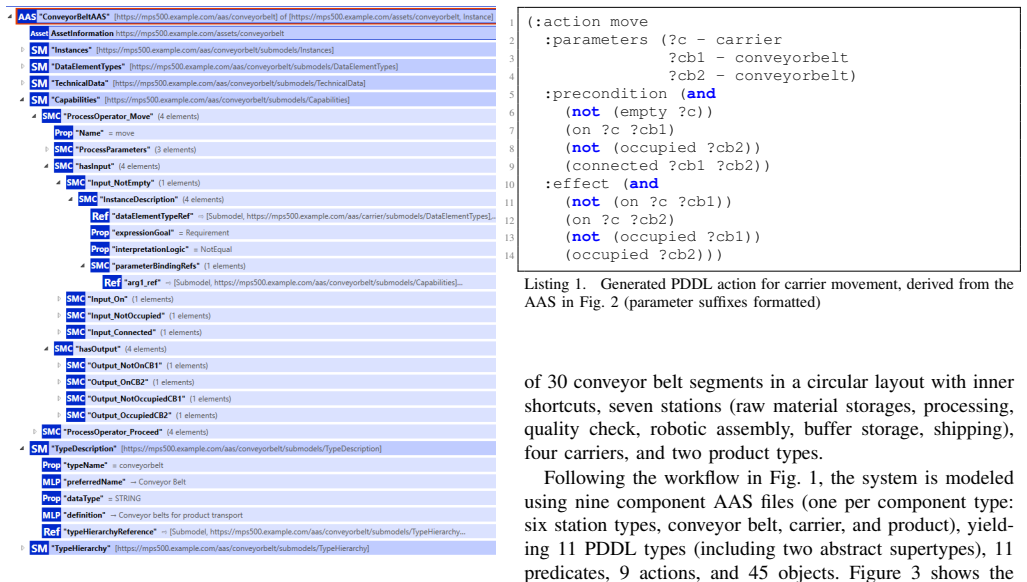
AAS capability models, structured using VDI 3682 for process descriptions, IEC 61360-1 for semantic property qualification, IDTA 02011 for type hierarchies, and IDTA 02016 for instance descriptions, contain sufficient information to generate complete PDDL problems automatically. Unlike prior work that added PDDL-specific submodels, the approach derives all planning elements directly from domain-level descriptions of resource functions called capabilities. The extraction algorithm transforms distributed Multi-AAS architectures into complete PDDL planning problems, allowing engineers to model capabilities without exposure to PDDL syntax.
What carries the argument
The extraction algorithm that pulls objects, predicates, action effects, and goals from AAS capability models of resource functions to form complete PDDL domains and problems.
If this is right
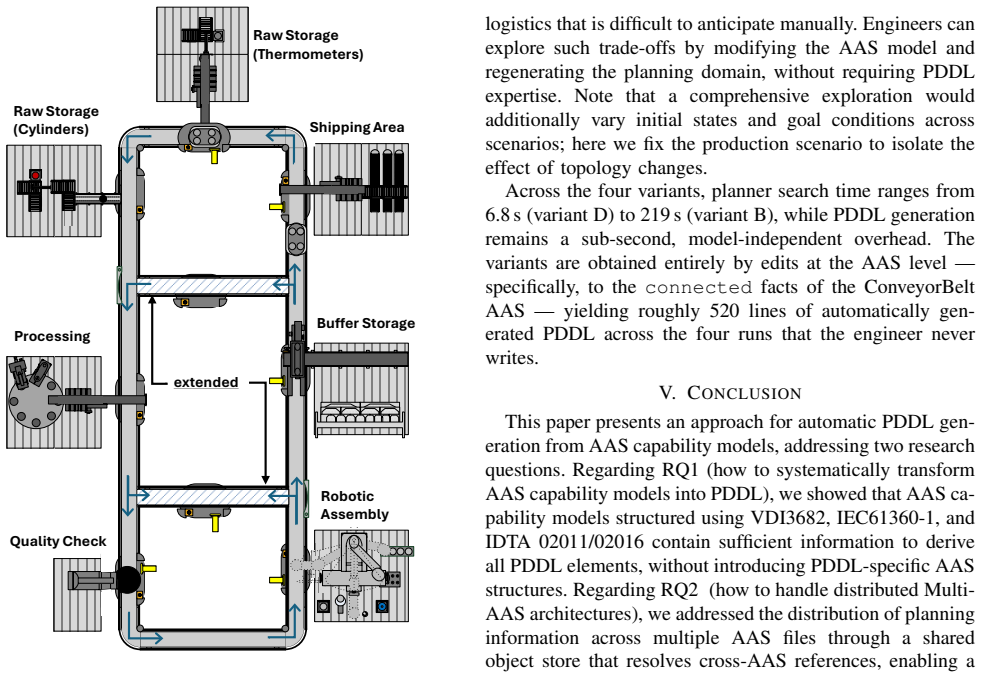
- Production engineers can explore layout variants by editing AAS capability models and regenerating PDDL problems without learning planning syntax.
- Design trade-offs become visible by comparing optimal plans across modified AAS models of the same production system.
- Distributed Multi-AAS architectures are converted into unified planning problems that treat capabilities as the sole source of domain knowledge.
- Capability modeling remains entirely at the domain level, with no requirement to insert planning-specific constructs into the AAS.
Where Pith is reading between the lines
- The same AAS files could feed other automated reasoning tools if similar extraction routines are written for their input formats.
- Planners could be invoked directly from digital-twin dashboards whenever an AAS model is updated, closing the loop between design change and verification.
- The approach may apply to other standards-based asset descriptions outside the four cited here, provided those descriptions encode process, property, and instance data at comparable granularity.
Load-bearing premise
The four cited Industry 4.0 standards already encode every fact a PDDL planner requires, so the extraction algorithm needs no additional domain knowledge or manual completion steps.
What would settle it
Apply the extraction algorithm to the laboratory AAS models and obtain PDDL files whose optimal plans differ from those produced by manually written domains for the same four layouts.
Figures

read the original abstract
Engineers designing production systems need to verify that a given layout supports all required production sequences. Automated planning techniques can answer such questions, but formulating the required planning problems in the Planning Domain Definition Language (PDDL) demands specialized expertise that production engineers typically lack. Asset Administration Shells (AAS) have emerged as the standardized Digital Twin for industrial assets in Industry 4.0. We show that AAS capability models, structured using four established Industry 4.0 standards (VDI 3682 for process descriptions, IEC 61360-1 for semantic property qualification, IDTA 02011 for type hierarchies, and IDTA 02016 for instance descriptions), contain sufficient information to generate complete PDDL problems automatically. Unlike prior work that introduced PDDL-specific submodels, our approach derives all planning elements from domain-level descriptions of resource functions, so-called capabilities, allowing engineers to model capabilities without any exposure to PDDL syntax or planning concepts. Our extraction algorithm transforms distributed Multi-AAS architectures into complete PDDL planning problems. We validate the approach on AAS models of a laboratory production system, comparing four layout variants using optimal planning to demonstrate how engineers can systematically explore design trade-offs by modifying the AAS model and regenerating the planning domain
Editorial analysis
A structured set of objections, weighed in public.
Referee Report
Summary. The paper presents an AAS-native approach to automatically generate PDDL planning problems from capability models structured according to VDI 3682, IEC 61360-1, IDTA 02011, and IDTA 02016. It asserts that these standard Industry 4.0 models contain all necessary information for complete PDDL problems (objects, predicates, actions, initial states, goals), enabling production engineers to use automated planning for layout verification without PDDL expertise. The method is validated on a laboratory production system by comparing four layout variants using optimal planning.
Significance. If the central claim holds, this work would significantly lower the barrier for applying automated planning in industrial design by leveraging existing AAS standards, allowing systematic exploration of production system designs through model modifications. The approach avoids the need for PDDL-specific extensions, which is a notable advantage over prior work.
major comments (2)
- [Abstract] The assertion that the four standards 'contain sufficient information to generate complete PDDL problems automatically' is central but unsupported by any description of the extraction algorithm, example mappings from AAS elements to PDDL constructs, or pseudocode. This makes it impossible to evaluate whether the mapping is complete without additional domain knowledge.
- [Validation] The validation on the laboratory system is described only at a high level ('comparing four layout variants using optimal planning'), with no quantitative results (e.g., planning performance metrics, success rates across variants) or details on how the generated PDDL problems were checked for correctness and completeness.
minor comments (1)
- The title and abstract could more explicitly state the contribution regarding the standards used.
Simulated Author's Rebuttal
We thank the referee for the constructive comments, which highlight areas where additional clarity will strengthen the manuscript. We address each major comment below and will revise the paper accordingly.
read point-by-point responses
-
Referee: [Abstract] The assertion that the four standards 'contain sufficient information to generate complete PDDL problems automatically' is central but unsupported by any description of the extraction algorithm, example mappings from AAS elements to PDDL constructs, or pseudocode. This makes it impossible to evaluate whether the mapping is complete without additional domain knowledge.
Authors: We agree that the abstract does not contain the requested details, as is typical for abstracts. The full manuscript describes the extraction algorithm (Section 4) and provides mappings from AAS elements (based on VDI 3682, IEC 61360-1, IDTA 02011, and IDTA 02016) to PDDL constructs (objects, predicates, actions, initial states, goals). To make the completeness of the mapping fully evaluable without domain expertise, we will add explicit example mappings and pseudocode for the extraction algorithm in the revised version. revision: yes
-
Referee: [Validation] The validation on the laboratory system is described only at a high level ('comparing four layout variants using optimal planning'), with no quantitative results (e.g., planning performance metrics, success rates across variants) or details on how the generated PDDL problems were checked for correctness and completeness.
Authors: We agree that the validation section is high-level in the current draft. The manuscript reports that four layout variants were compared via optimal planning on the generated PDDL problems, but does not include metrics or verification details. In the revision we will add quantitative results (solve times, plan quality metrics across variants), success rates, and explicit verification steps (manual cross-check of generated PDDL against AAS source data plus comparison to manually authored reference problems). revision: yes
Circularity Check
No significant circularity
full rationale
The paper presents a direct algorithmic transformation from AAS capability models (structured per VDI 3682, IEC 61360-1, IDTA 02011, IDTA 02016) into PDDL problems, without introducing fitted parameters, equations, or self-referential definitions. The central claim rests on the sufficiency of the cited external standards plus an implemented extraction procedure, validated on laboratory AAS models. No load-bearing step reduces to a self-citation chain, ansatz smuggling, or renaming of known results; the derivation is self-contained against the input standards and the explicit mapping algorithm.
Axiom & Free-Parameter Ledger
axioms (1)
- domain assumption VDI 3682, IEC 61360-1, IDTA 02011 and IDTA 02016 together encode every object, predicate, action and goal required by a PDDL planner for production sequences.
Reference graph
Works this paper leans on
-
[1]
Model-based Workflow for the Automated Generation of PDDL Descriptions,
H. Nabizada, T. Jeleniewski, F. Gehlhoff, and A. Fay, “Model-based Workflow for the Automated Generation of PDDL Descriptions,” in 2024 IEEE 29th International Conference on Emerging Technologies and Factory Automation (ETFA). IEEE, 2024, pp. 1–4
2024
-
[2]
A Research Agenda for AI Planning in the Field of Flexible Production Systems,
A. K ¨ocher, R. Heesch, N. Widulle, A. Nordhausen, J. Putzke, A. Wind- mann, and O. Niggemann, “A Research Agenda for AI Planning in the Field of Flexible Production Systems,” in2022 IEEE 5th International Conference on Industrial Cyber-Physical Systems (ICPS). IEEE, 2022, pp. 1–8
2022
-
[3]
PDDL – The Planning Domain Definition Language,
D. McDermott, M. Ghallab, A. Howe, C. Knoblock, A. Ram, M. Veloso, D. Weld, and D. Wilkins, “PDDL – The Planning Domain Definition Language,” inAIPS-98 Planning Competition Committee, 1998
1998
-
[4]
Towards robust assembly with knowledge representation for the plan- ning domain definition language (PDDL),
Z. Kootbally, C. Schlenoff, C. Lawler, T. Kramer, and S. K. Gupta, “Towards robust assembly with knowledge representation for the plan- ning domain definition language (PDDL),”Robotics and Computer- Integrated Manufacturing, vol. 33, pp. 42–55, 2015
2015
-
[5]
Bridging Engineering and AI Planning through Model- Based Knowledge Transformation for the Validation of Automated Production System Variants,
H. Nabizada, L. Beers, A. Chahine, F. Gehlhoff, O. Niggemann, and A. Fay, “Bridging Engineering and AI Planning through Model- Based Knowledge Transformation for the Validation of Automated Production System Variants,” inKEPS Workshop at ICAPS, 2025
2025
-
[6]
On Using Action Inheritance and Modularity in PDDL Domain Modelling,
A. Lindsay, “On Using Action Inheritance and Modularity in PDDL Domain Modelling,”Proceedings of the International Conference on Automated Planning and Scheduling, vol. 33, no. 1, pp. 259–267, 2023
2023
-
[7]
Evaluating PDDL for programming production cells: a case study,
C. Mayr-Dorn, A. Egyed, M. Winterer, C. Salomon, and H. F ¨urschuß, “Evaluating PDDL for programming production cells: a case study,” inIEEE/ACM 4th International Workshop on Robotics Software En- gineering (RoSE), 2022, pp. 17–24
2022
-
[8]
Asset Administration Shell Spec- ification – Part 1: Metamodel,
Industrial Digital Twin Association, “Asset Administration Shell Spec- ification – Part 1: Metamodel,” IDTA, Specification IDTA 01001-3-0, 2023
2023
-
[9]
Digitalized Automation Engineering of Industry 4.0 Production Systems and Their Tight Cooperation with Digital Twins,
P. Nov ´ak and J. Vysko ˇcil, “Digitalized Automation Engineering of Industry 4.0 Production Systems and Their Tight Cooperation with Digital Twins,”Processes, vol. 10, no. 2, p. 404, 2022, article no. 404
2022
-
[10]
Cyber-physical Production Systems: Roots, Expecta- tions and R&D Challenges,
L. Monostori, “Cyber-physical Production Systems: Roots, Expecta- tions and R&D Challenges,”Procedia CIRP, vol. 17, pp. 9–13, 2014
2014
-
[11]
A Formal Capability and Skill Model for Use in Plug and Produce Scenarios,
A. K ¨ocher, C. Hildebrandt, L. M. Vieira da Silva, and A. Fay, “A Formal Capability and Skill Model for Use in Plug and Produce Scenarios,” in2020 25th IEEE International Conference on Emerging Technologies and Factory Automation (ETFA). IEEE, 2020, pp. 1663– 1670
2020
-
[12]
Toward a Mapping of Capability and Skill Models using Asset Administration Shells and Ontologies,
L. M. Vieira da Silva, A. K ¨ocher, M. S. Gill, M. Weiss, and A. Fay, “Toward a Mapping of Capability and Skill Models using Asset Administration Shells and Ontologies,” in2023 IEEE 28th Interna- tional Conference on Emerging Technologies and Factory Automation (ETFA). IEEE, 2023, pp. 1–4
2023
-
[13]
Trans- formation eines F ¨ahigkeitsmodells in einen PDDL-Planungsansatz,
L. M. Vieira da Silva, R. Heesch, A. K ¨ocher, and A. Fay, “Trans- formation eines F ¨ahigkeitsmodells in einen PDDL-Planungsansatz,” at-Automatisierungstechnik, vol. 71, no. 2, pp. 105–115, 2023
2023
-
[14]
Leverage Asset Administration Shells to Support Artificial Intelligence Planning,
A. T. Bernhard, B. Blumhofer, M. Ruskowski, A. Wagner, A. Luxen- burger, and D. Porta, “Leverage Asset Administration Shells to Support Artificial Intelligence Planning,” in2024 IEEE 29th International Con- ference on Emerging Technologies and Factory Automation (ETFA). IEEE, 2024, pp. 1–8
2024
-
[15]
Details of the Asset Administration Shell – Part 1,
Plattform Industrie 4.0, “Details of the Asset Administration Shell – Part 1,” Federal Ministry for Economic Affairs and Climate Action, Tech. Rep., 2022
2022
-
[16]
Hierarchical Structures enabling Bills of Material,
Industrial Digital Twin Association, “Hierarchical Structures enabling Bills of Material,” IDTA, Submodel Template IDTA 02011-1-0, 2023
2023
-
[17]
Submodel for Control Component Instance,
——, “Submodel for Control Component Instance,” IDTA, Submodel Template IDTA 02016-1-0, 2023
2023
-
[18]
An Introduc- tion to the Planning Domain Definition Language,
P. Haslum, N. Lipovetzky, D. Magazzeni, and C. Muise, “An Introduc- tion to the Planning Domain Definition Language,”Synthesis Lectures on Artificial Intelligence and Machine Learning, vol. 13, no. 2, pp. 1–187, 2019
2019
-
[19]
Unified Planning: Modeling, manipulating and solving AI planning problems in Python,
A. Micheli, A. Bit-Monnot, G. R ¨oger, E. Scala, A. Valentini, L. Framba, A. Rovetta, A. Trapasso, L. Bonassi, A. E. Gereviniet al., “Unified Planning: Modeling, manipulating and solving AI planning problems in Python,”SoftwareX, vol. 29, p. 102012, 2025
2025
-
[20]
Capability-based Semantic Interop- erability of Manufacturing Resources: A BaSys 4.0 Perspective,
A. Perzylo, J. Grothoff, L. Lucio, M. Weser, S. Malakuti, P. Venet, V . Aravantinos, and T. Deppe, “Capability-based Semantic Interop- erability of Manufacturing Resources: A BaSys 4.0 Perspective,” in IFAC-PapersOnLine, vol. 52, no. 13, 2019, pp. 1590–1596, 9th IFAC Conference on Manufacturing Modelling, Management and Control
2019
-
[21]
Formal Resource and Ca- pability Descriptions Supporting Rapid Reconfiguration of Assembly Systems,
E. J ¨arvenp¨a¨a, N. Siltala, and M. Lanz, “Formal Resource and Ca- pability Descriptions Supporting Rapid Reconfiguration of Assembly Systems,” in2016 IEEE International Symposium on Assembly and Manufacturing (ISAM). IEEE, 2016, pp. 120–125
2016
-
[22]
A Reference Model for Common Understanding of Capabilities and Skills in Manufacturing,
A. K ¨ocher, A. Belyaev, J. Hermann, J. Bock, K. Meixner, M. V olk- mann, M. Winter, P. Zimmermann, S. Grimm, and C. Diedrich, “A Reference Model for Common Understanding of Capabilities and Skills in Manufacturing,”at-Automatisierungstechnik, vol. 71, no. 2, pp. 94–104, 2023
2023
-
[23]
Information Model for Capabilities, Skills & Services,
Plattform Industrie 4.0, “Information Model for Capabilities, Skills & Services,” Federal Ministry for Economic Affairs and Climate Action, Discussion Paper, 2022
2022
-
[24]
Formalized Process Descriptions,
Verein Deutscher Ingenieure, “Formalized Process Descriptions,” VDI, Tech. Rep. VDI 3682, 2015
2015
-
[25]
Standard data element types with associated classification scheme – Part 1: Definitions – Principles and methods,
International Electrotechnical Commission, “Standard data element types with associated classification scheme – Part 1: Definitions – Principles and methods,” IEC, Tech. Rep. IEC 61360-1, 2017
2017
-
[26]
Ontology based action planning and verification for agile manufacturing,
S. Balakirsky, “Ontology based action planning and verification for agile manufacturing,”Robotics and Computer-Integrated Manufactur- ing, vol. 33, pp. 21–28, 2015
2015
-
[27]
Converting semantic web services into formal planning domain descriptions to enable manufac- turing process planning and scheduling in Industry 4.0,
L. Malburg, P. Klein, and R. Bergmann, “Converting semantic web services into formal planning domain descriptions to enable manufac- turing process planning and scheduling in Industry 4.0,”Engineering Applications of Artificial Intelligence, vol. 126, p. 106727, 2023
2023
-
[28]
Flexible Production Systems: Automated Generation of Operations Plans Based on ISA-95 and PDDL,
B. Wally, J. Vysko ˇcil, P. Nov ´ak, C. Huemer, R. ˇSindel´aˇr, P. Kadera, A. Mazak, and M. Wimmer, “Flexible Production Systems: Automated Generation of Operations Plans Based on ISA-95 and PDDL,”IEEE Robotics and Automation Letters, vol. 4, no. 4, pp. 4062–4069, 2019
2019
-
[29]
Leveraging Iterative Plan Re- finement for Reactive Smart Manufacturing Systems,
B. Wally, J. Vysko ˇcil, P. Nov ´ak, C. Huemer, R. ˇSindel´aˇr, P. Kadera, A. Mazak-Huemer, and M. Wimmer, “Leveraging Iterative Plan Re- finement for Reactive Smart Manufacturing Systems,”IEEE Trans- actions on Automation Science and Engineering, vol. 18, no. 1, pp. 230–243, 2021
2021
-
[30]
Automated PDDL Domain File Generation for Enhancing Production System Development based on SysML Models,
H. Nabizada, T. Jeleniewski, L. Beers, F. Gehlhoff, and A. Fay, “Automated PDDL Domain File Generation for Enhancing Production System Development based on SysML Models,” inProceedings of the AI4CC-IPS-RCRA-SPIRIT 2024 Workshop, Bolzano, Italy, Nov. 2024
2024
-
[31]
Integrating AI Planning Semantics into SysML Sys- tem Models for Automated PDDL File Generation,
H. Nabizada, T. Jeleniewski, L. Beers, M. Weigand, F. Gehlhoff, and A. Fay, “Integrating AI Planning Semantics into SysML Sys- tem Models for Automated PDDL File Generation,” in2025 IEEE 30th International Conference on Emerging Technologies and Factory Automation (ETFA). IEEE, 2025, pp. 1–8
2025
-
[32]
Application of MBSE to model Hierarchical AI Planning problems in HDDL,
J. Rimani, C. Lesire, S. Lizy-Destrez, and N. Viola, “Application of MBSE to model Hierarchical AI Planning problems in HDDL,” in Workshop on Knowledge Engineering for Planning and Scheduling (KEPS) at ICAPS 2021, 2021
2021
-
[33]
LLMs as planning formalizers: A survey for leveraging large language models to construct automated planning models,
M. Tantakoun, C. Muise, and X. Zhu, “LLMs as planning formalizers: A survey for leveraging large language models to construct automated planning models,” inFindings of the Association for Computational Linguistics: ACL 2025, W. Che, J. Nabende, E. Shutova, and M. T. Pilehvar, Eds. Vienna, Austria: Association for Computational Linguistics, Jul. 2025, pp. ...
2025
-
[34]
Leveraging Semantic Inter- operability in Industry 4.0: An Opportunity for Automated Task Planning for Discrete Manufacturing Processes,
H. Weber, R. Gl ¨uck, and F. Krebs, “Leveraging Semantic Inter- operability in Industry 4.0: An Opportunity for Automated Task Planning for Discrete Manufacturing Processes,” inDeutscher Luft- und Raumfahrtkongress (DLRK). DGLR, 2025
2025
-
[35]
BaSyx Python SDK,
Eclipse BaSyx, “BaSyx Python SDK,” 2024. [Online]. Available: https://github.com/eclipse-basyx/basyx-python-sdk
2024
-
[36]
The Fast Downward Planning System,
M. Helmert, “The Fast Downward Planning System,”Journal of Artificial Intelligence Research, vol. 26, pp. 191–246, 2006
2006
-
[37]
PDDL2.1: An Extension to PDDL for Express- ing Temporal Planning Domains,
M. Fox and D. Long, “PDDL2.1: An Extension to PDDL for Express- ing Temporal Planning Domains,”Journal of Artificial Intelligence Research, vol. 20, pp. 61–124, 2003
2003
-
[38]
A Mapping Approach to Convert MTPs into a Capability and Skill Ontology,
A. K ¨ocher, L. Beers, and A. Fay, “A Mapping Approach to Convert MTPs into a Capability and Skill Ontology,” in2022 IEEE 27th International Conference on Emerging Technologies and Factory Au- tomation (ETFA). IEEE, 2022
2022
-
[39]
On the Use of Large Language Models to Generate Capability Ontologies,
L. M. Vieira da Silva, A. K ¨ocher, F. Gehlhoff, and A. Fay, “On the Use of Large Language Models to Generate Capability Ontologies,” in 2024 IEEE 29th International Conference on Emerging Technologies and Factory Automation (ETFA). IEEE, 2024
2024
-
[40]
A Domain-Specific Modeling Language for Production Systems in Early Engineering Phases,
L. Beers, H. Nabizada, M. Weigand, A. Chahine, F. Gehlhoff, and A. Fay, “A Domain-Specific Modeling Language for Production Systems in Early Engineering Phases,”Systems, vol. 14, no. 2, p. 150, 2026
2026
discussion (0)
Sign in with ORCID, Apple, or X to comment. Anyone can read and Pith papers without signing in.