Perturbative photonic matrix-vector multiplication with reduced phase-shift range
Pith reviewed 2026-06-28 12:49 UTC · model grok-4.3
The pith
Perturbative programming reduces phase-shift ranges in photonic matrix-vector multipliers by operating near fixed references and subtracting interferometrically.
A machine-rendered reading of the paper's core claim, the machinery that carries it, and where it could break.
Core claim
Perturbative programming in universal unitary meshes and low-depth sums-of-unitaries architectures produces phase distributions that shrink with increasing matrix dimension, with the reduced phase range compensating the subtraction overhead for sufficiently lossy phase shifters after selecting favorable references via a local conditioning criterion.
What carries the argument
perturbative programming method that operates near a fixed reference configuration and realizes targets through interferometric subtraction
If this is right
- Phase distributions obtained for random target matrices shrink as matrix size increases.
- The trade-off between reduced phase range and the intrinsic overhead of the subtraction architecture can be quantified.
- For sufficiently lossy phase shifters the reduced phase range compensates the penalty introduced by subtraction.
Where Pith is reading between the lines
- The local conditioning criterion for selecting references may allow systematic optimization beyond random targets.
- The shrinking phase statistics suggest that the method's advantage grows with scale in hardware with fixed phase-shifter loss.
Load-bearing premise
Favorable reference configurations exist that can be identified via local conditioning and that phase statistics for random matrices shrink with size while the overhead trade-off is quantifiable and favorable for lossy shifters.
What would settle it
Experimental measurement of the phase-shift distribution needed for ensembles of random target matrices of increasing dimension, comparing perturbative versus conventional programming to check whether the range shrinks and whether loss in the shifters offsets the subtraction penalty.
Figures

read the original abstract
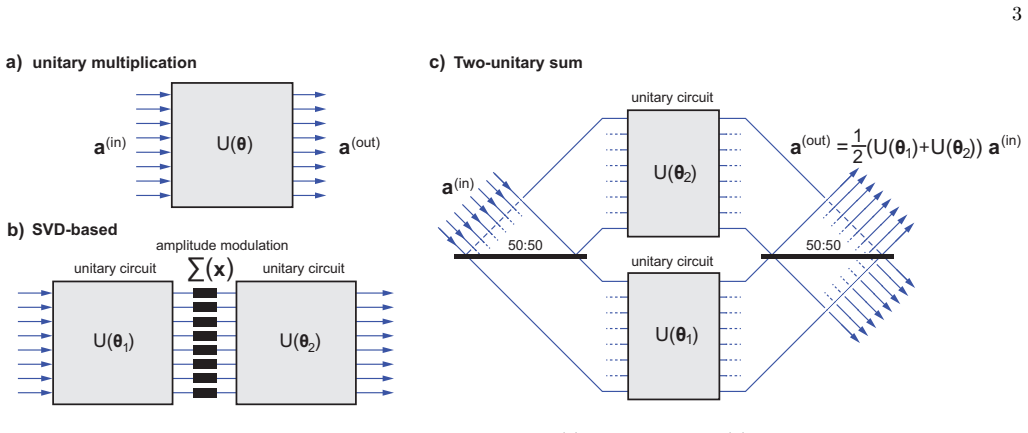
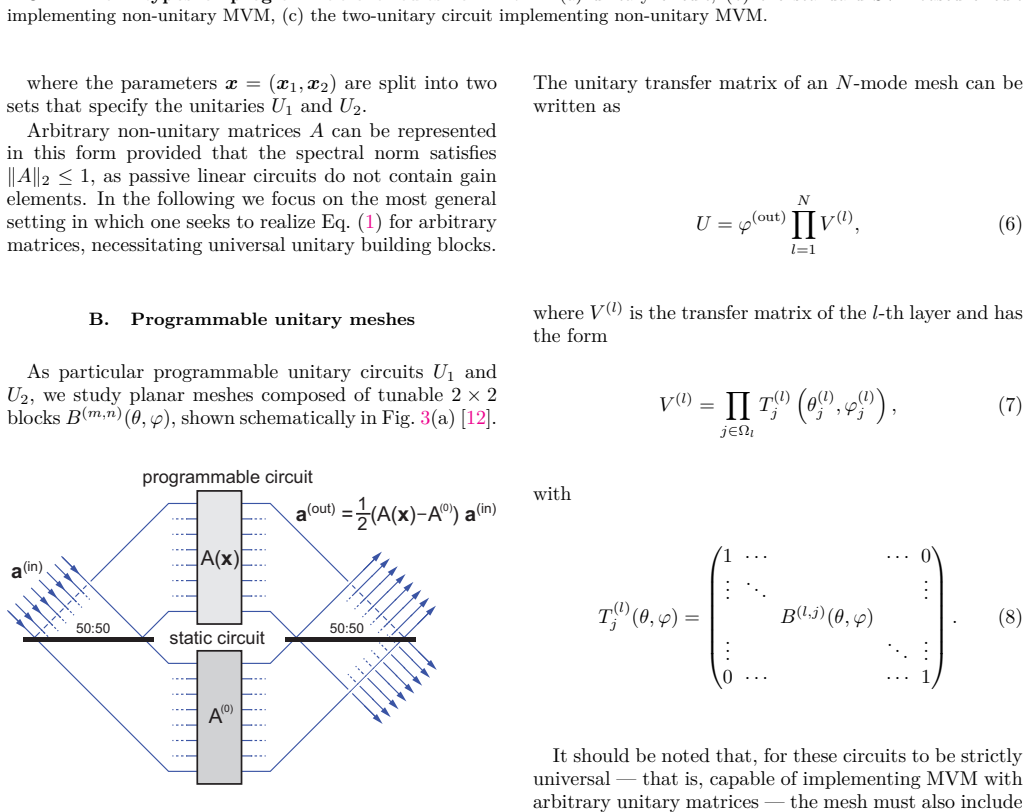
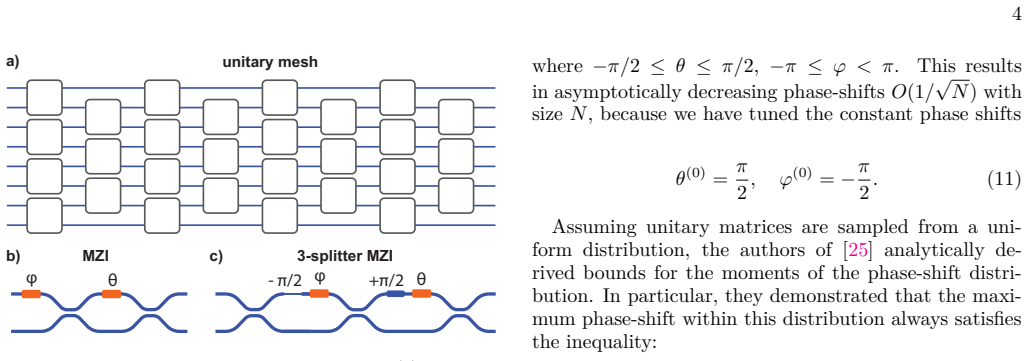
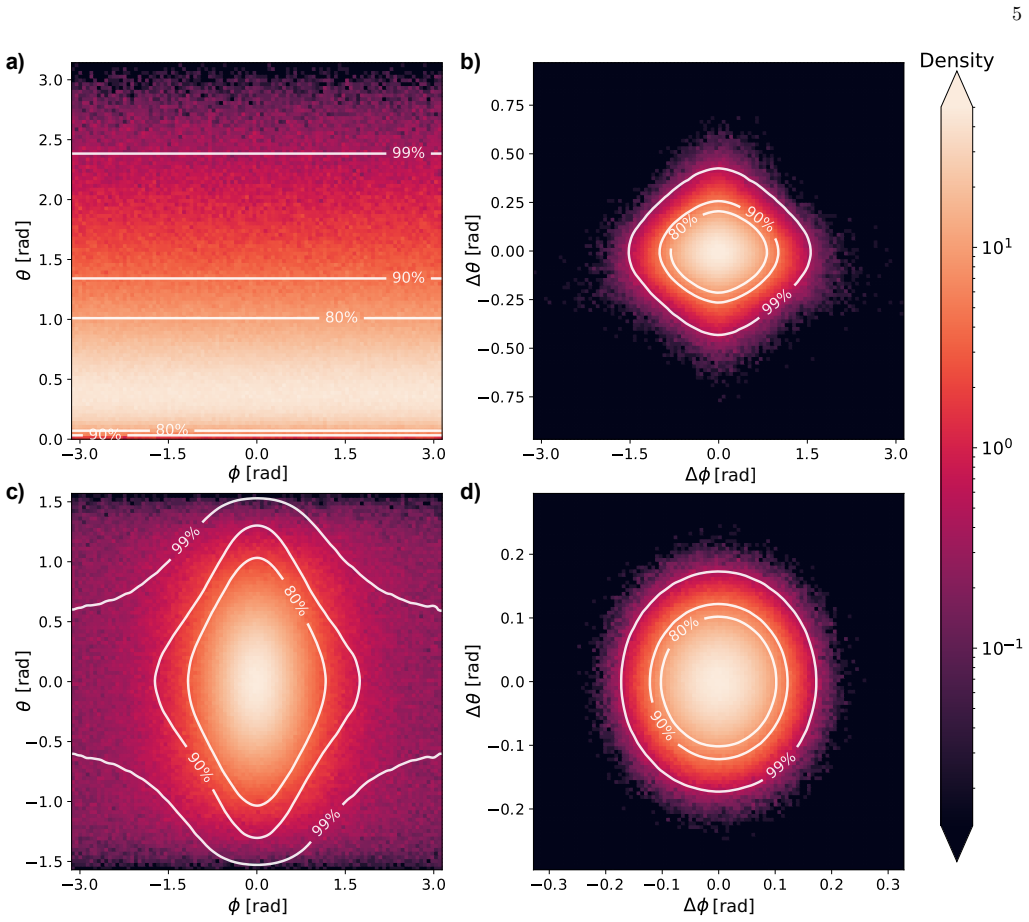
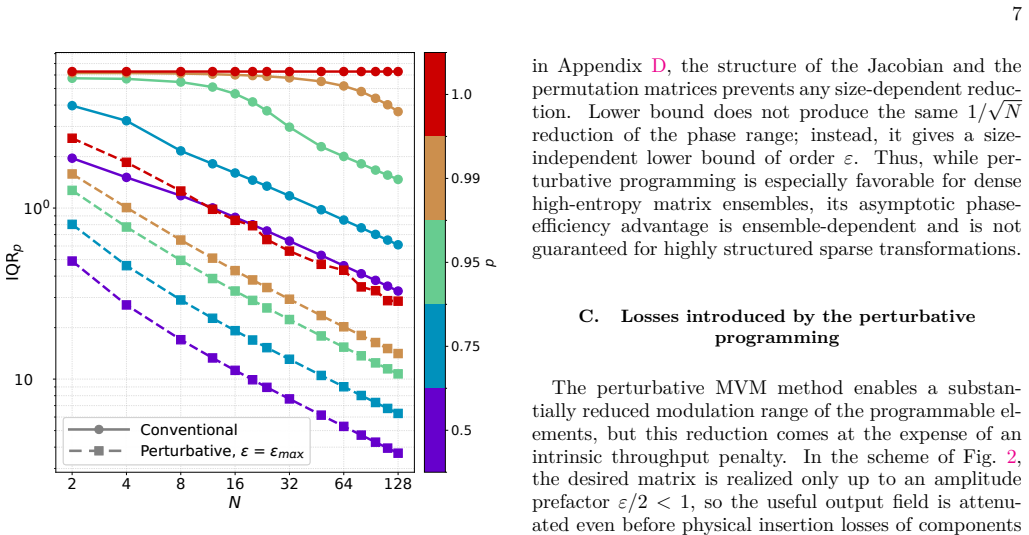
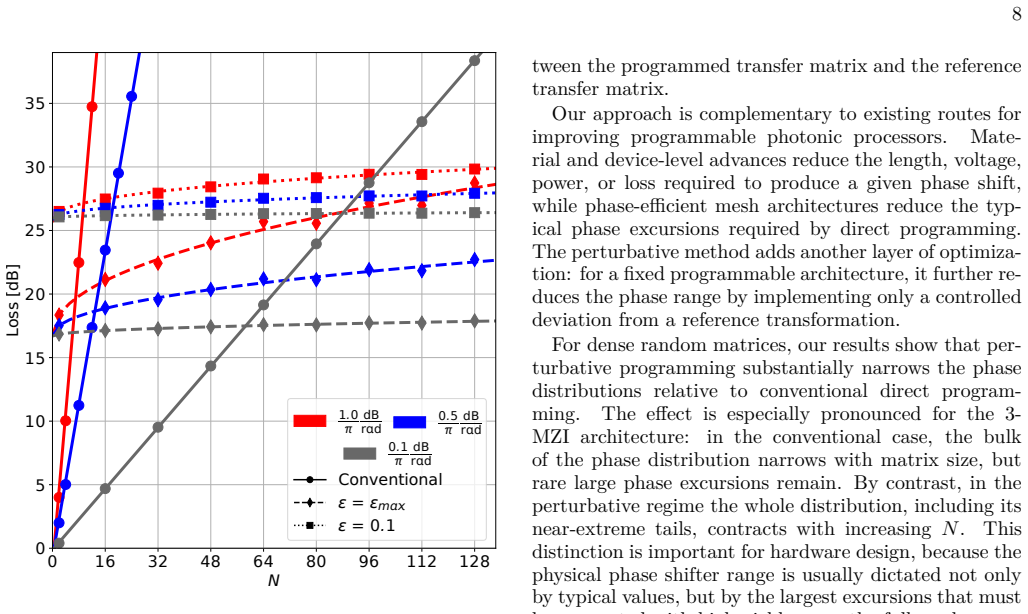
Programmable photonic meshes provide a promising platform for analog matrix-vector multiplication, but their scalability is often limited by the large phase-shift ranges required in universal interferometer circuits. We introduce a perturbative programming method that operates the circuit near a fixed reference configuration and realizes the target transformation through interferometric subtraction, thereby reducing the required programmable phase excursion. We develop this approach for photonic matrix-vector multiplication architectures based on universal unitary meshes, and low-depth non-unitary constructions based on sums of unitaries. We identify favorable reference configurations through a local conditioning criterion, analyze the phase statistics obtained for random target matrices, and show that perturbative programming produces phase distribution shrinking as the matrix size increases. We further quantify the trade-off between reduced phase range and the intrinsic overhead introduced by the subtraction architecture, and show that for sufficiently lossy phase shifters the reduced phase range can compensate for this penalty. These results identify perturbative programming as a conditional but potentially useful route toward more scalable programmable photonic matrix processors.
Editorial analysis
A structured set of objections, weighed in public.
Referee Report
Summary. The paper introduces a perturbative programming approach for photonic matrix-vector multiplication in universal unitary meshes and low-depth non-unitary constructions. By operating near a fixed reference configuration identified via a local conditioning criterion and realizing targets through interferometric subtraction, the method aims to reduce the required programmable phase excursion. It analyzes phase statistics for random target matrices, claims that the phase distribution shrinks with increasing matrix size, and quantifies the trade-off with the subtraction architecture's overhead, concluding that for sufficiently lossy phase shifters the reduced range can compensate the penalty.
Significance. If the claimed phase-range reduction and its scaling with matrix dimension hold with supporting analysis, the work could offer a practical route to improve scalability of programmable photonic processors by relaxing demands on phase-shifter hardware, particularly in lossy regimes. The approach is framed as conditional on favorable references and loss levels rather than universally applicable.
major comments (2)
- [Abstract] Abstract: the central claim that 'perturbative programming produces phase distribution shrinking as the matrix size increases' is presented without an analytical bound, asymptotic argument, or description of the numerical evidence (e.g., ensemble size, conditioning criterion details, or observed scaling for large N). This scaling is load-bearing for the scalability conclusion and the subsequent trade-off quantification.
- [Abstract] Abstract: the statement that 'for sufficiently lossy phase shifters the reduced phase range can compensate for this penalty' requires explicit quantification of the overhead (e.g., extra loss or power) versus the phase-range benefit; no such numbers, equations, or parameter regimes are supplied in the provided description, leaving the compensation claim unsupported.
minor comments (1)
- [Abstract] The abstract refers to 'analysis of phase statistics' and 'trade-off quantification' but supplies no equations, figures, or section references; adding these would clarify the method.
Simulated Author's Rebuttal
We thank the referee for their detailed review and constructive comments. We address the two major comments point-by-point below, proposing revisions to the abstract to better support the claims.
read point-by-point responses
-
Referee: [Abstract] Abstract: the central claim that 'perturbative programming produces phase distribution shrinking as the matrix size increases' is presented without an analytical bound, asymptotic argument, or description of the numerical evidence (e.g., ensemble size, conditioning criterion details, or observed scaling for large N). This scaling is load-bearing for the scalability conclusion and the subsequent trade-off quantification.
Authors: We agree that the abstract would be strengthened by including more details on the numerical evidence. The manuscript analyzes phase statistics for random target matrices using the local conditioning criterion to identify favorable references, with numerical results demonstrating the shrinking phase distribution as matrix size increases. We will revise the abstract to describe the numerical evidence, including the ensemble details and observed scaling, while noting that the support is numerical rather than analytical. revision: yes
-
Referee: [Abstract] Abstract: the statement that 'for sufficiently lossy phase shifters the reduced phase range can compensate for this penalty' requires explicit quantification of the overhead (e.g., extra loss or power) versus the phase-range benefit; no such numbers, equations, or parameter regimes are supplied in the provided description, leaving the compensation claim unsupported.
Authors: We agree that the abstract should provide more explicit details on the quantification. The manuscript quantifies the trade-off between the reduced phase range and the overhead of the subtraction architecture, identifying regimes where the benefit compensates for sufficiently lossy phase shifters. We will revise the abstract to include a brief reference to the overhead quantification and the relevant parameter regimes from the analysis. revision: yes
Circularity Check
No significant circularity; derivation is self-contained analysis of phase statistics
full rationale
The paper introduces perturbative programming via interferometric subtraction near a reference configuration identified by a local conditioning criterion, then analyzes resulting phase statistics for random target matrices to demonstrate shrinkage with matrix size N. No equations or steps reduce by construction to inputs (no self-definitional relations, no fitted parameters renamed as predictions, no load-bearing self-citations or uniqueness theorems). The shrinkage and trade-off claims are presented as outcomes of the analysis rather than tautologies, making the central result independent of its own definitions. This matches the default case of an honest non-finding.
Axiom & Free-Parameter Ledger
axioms (1)
- domain assumption Linear interferometry and phase-shift operations behave as expected near the chosen reference configuration.
Reference graph
Works this paper leans on
-
[1]
sensitivity in- dex
Optimal unitary We begin with the differential of a unitary matrix, dU . By vectorizing dU , i.e., concatenating its columns into a complex vector vec[dU ] of size N 2, we obtain vec[dU ] = ∂ vec[U (x)] ∂x dx, (A1) where x denotes a real parameterization of the unitary matrix. To maximize the scope of realizable differentials dU while minimizing dx, we seek...
-
[2]
Optimal pair of unitaries We now derive the condition on the reference matrix A(0) for the two-unitary design; see Fig. 1c. Consider the differential of A = U1 + U2 2 . (A8) 10 Realizing an arbitrary infinitesimal matrix dA ∼ W is equivalent to realizing an arbitrary infinitesimal matrix dB ∼ U † 1 W , namely 2dB = U † 1 dU1 + U † 1 U2U † 2 dU2. (A9) Since u...
-
[3]
This corre- sponds to an increase in signal intensity of approximately 1.38 dB, at the cost of requiring a less convenient split- ting ratio of roughly 59 : 41
instead of ε/2. This corre- sponds to an increase in signal intensity of approximately 1.38 dB, at the cost of requiring a less convenient split- ting ratio of roughly 59 : 41 . Appendix F: Static hardware errors The preceding analysis assumes ideal interferometric blocks. In practice, however, the constituent directional couplers are not perfectly balanc...
-
[4]
Bogaerts, D
W. Bogaerts, D. Pérez, J. Capmany, D. A. B. Miller, J. Poon, D. Englund, F. Morichetti, and A. Melloni, Pro- grammable photonic circuits, Nature 586, 207 (2020)
2020
-
[5]
N. C. Harris, J. Carolan, D. Bunandar, M. Prabhu, M. Hochberg, T. Baehr-Jones, M. L. Fanto, A. M. Smith, C. C. Tison, P. M. Alsing, and D. Englund, Linear programmable nanophotonic processors, Optica 5, 1623 (2018)
2018
-
[6]
H. Zhou, J. Dong, J. Cheng, W. Dong, C. Huang, Y. Shen, Q. Zhang, M. Gu, C. Qian, H. Chen, Z. Ruan, and X. Zhang, Photonic Matrix Multiplication Lights up Photonic Accelerator and Beyond, Light: Science & Ap- plications 11, 30 (2022)
2022
-
[7]
X. Wang, K. Liao, and X. Hu, Algorithms, architectures, and platform implementations of integrated photonic neural networks, Applied Physics Reviews 13, 011327 (2026)
2026
-
[8]
S. A. Fldzhyan, S. S. Straupe, and M. Yu. Saygin, Native QR Factorization on Programmable Photonic Meshes (2026), arXiv:2602.20701 [physics.optics]
Pith/arXiv arXiv 2026
-
[9]
X. Chen, J. Lin, and K. Wang, A Review of Silicon-Based Integrated Optical Switches, Laser & Photonics Reviews 17, 2200571 (2023)
2023
-
[10]
D. A. B. Miller, Self-configuring universal linear optical component, Photonics Research 1, 1 (2013)
2013
-
[11]
Taballione, R
C. Taballione, R. van der Meer, H. J. Snijders, P. Hooi- jschuur, J. P. Epping, M. de Goede, B. Kassenberg, P. Venderbosch, C. Toebes, H. van den Vlekkert, P. W. H. Pinkse, and J. J. Renema, A universal fully reconfig- urable 12-mode quantum photonic processor, Materials for Quantum Technology 1, 035002 (2021)
2021
-
[12]
Kondratyev, V
I. Kondratyev, V. Ivanova, S. Fldzhyan, A. Ar- genchiev, N. Kostyuchenko, S. Zhuravitskii, N. Skryabin, I. Dyakonov, M. Saygin, S. Straupe, A. Korneev, and S. Kulik, Large-scale error-tolerant programmable inter- ferometer fabricated by femtosecond laser writing, Pho- ton. Res. 12, A28 (2024)
2024
-
[13]
A. Barzaghi, M. Bénéfice, F. Ceccarelli, G. Corrielli, V. Galli, M. Gardina, V. Grimaldi, J. Kaczorowski, F. Malaspina, R. Osellame, C. Pentangelo, A. Rocchetto, and A. Rudi, A low-loss, 24-mode laser-written univer- sal photonic processor in a glass-based platform (2025), arXiv:2505.01609 [quant-ph]
arXiv 2025
-
[14]
M. Reck, A. Zeilinger, H. J. Bernstein, and P. Bertani, Experimental realization of any discrete unitary opera- tor, Physical Review Letters 73, 58 (1994)
1994
-
[15]
W. R. Clements, P. C. Humphreys, B. J. Metcalf, W. S. Kolthammer, and I. A. Walsmley, Optimal Design for Universal Multiport Interferometers, Optica 3, 1460 (2016)
2016
-
[16]
Carolan, C
J. Carolan, C. Harrold, C. Sparrow, E. Martín-López, N. J. Russell, J. W. Silverstone, P. J. Shadbolt, N. Mat- suda, M. Oguma, M. Itoh, G. D. Marshall, M. G. Thomp- son, J. C. F. Matthews, T. Hashimoto, J. L. O’Brien, and A. Laing, Universal linear optics, Science 349, 711 (2015)
2015
-
[17]
N. C. Harris, Y. Ma, J. Mower, T. Baehr-Jones, D. En- glund, M. Hochberg, and C. Galland, Efficient, compact and low loss thermo-optic phase shifter in silicon, Optics Express 22, 10487 (2014)
2014
-
[18]
H. Qiu, Y. Liu, C. Luan, D. Kong, X. Guan, Y. Ding, and H. Hu, Energy-efficient thermo-optic silicon phase shifter with well-balanced overall performance, Optics Letters 45, 4806 (2020)
2020
-
[19]
Y. Wen, H. Chen, Z. Wu, W. Li, and Y. Zhang, Fabrica- tion and photonic applications of Si-integrated LiNbO 3 and BaTiO 3 ferroelectric thin films, APL Materials 12, 020601 (2024)
2024
-
[20]
Lievens, E
E. Lievens, E. Picavet, K. De Geest, K. De Buysser, D. Van Thourhout, P. Bienstman, and J. Beeck- man, Integration of Barium Titanate Thin Films in Silicon Photonics for Electro-Optic Modulation, in 2024 IEEE Photonics Conference (IPC) (2024) pp. 1–2
2024
-
[21]
A. Raju, D. Hungund, D. Krueger, Z. Dong, Z. Sakotic, A. B. Posadas, A. A. Demkov, and D. Wasserman, High- Q Monolithic Ring Resonators in Low-Loss Barium Ti- tanate on Silicon, Laser & Photonics Reviews , 2402086 (2025)
2025
-
[22]
Ulrich, K
A. Ulrich, K. Brahim, A. Boelen, M. Debaets, A. Khalil, C. Sun, Y. Huang, S. S. Saseendran, M. Baryshnikova, P. Favia, T. Nuytten, S. Sergeant, K. Van Gasse, B. Kuyken, K. De Greve, C. Merckling, and C. Haffner, Engineering high Pockels coefficients in thin-film stron- tium titanate for cryogenic quantum electro-optic appli- cations, Science 390, 390 (2025)
2025
-
[23]
C. Li, T. Shu, Y. Zhang, C. Shi, W. Chen, J. He, F. Huang, L. Song, Z. Yu, M. Zhang, Y. Shi, and D. Dai, Versatile wavelength-selective PZT photonic chips, Op- tica 13, 83 (2026)
2026
-
[24]
C. Wang, M. Zhang, X. Chen, M. Bertrand, A. Shams- Ansari, S. Chandrasekhar, P. Winzer, and M. Lončar, Integrated lithium niobate electro-optic modulators op- erating at CMOS-compatible voltages, Nature 562, 101 (2018). 14
2018
-
[25]
Qi and Y
Y. Qi and Y. Li, Integrated lithium niobate photonics, Nanophotonics 9, 1287 (2020)
2020
-
[26]
S. R. Kari, P. Pintus, J. E. Bowers, M. Robbins, and N. Youngblood, Enabling High-Bandwidth Coherent Modulation Through Scalable Lithium Niobate Resonant Devices (2025), arXiv:2502.10846 [physics.optics]
arXiv 2025
-
[27]
M. R. Watts, J. Sun, C. DeRose, D. C. Trotter, R. W. Young, and G. N. Nielson, Adiabatic thermo-optic Mach– Zehnder switch, Optics Letters 38, 733 (2013)
2013
-
[28]
Hamerly, J
R. Hamerly, J. R. Basani, A. Sludds, S. K. Vadlamani, and D. Englund, Toward the Information-Theoretic Limit of Programmable Photonics, APL Photonics 10, 110803
-
[29]
C. Ren, R. Tanomura, K. Ichinose, K. Mizukami, Y. Taguchi, T. Fukui, Y. Nakano, and T. Tanemura, Scalable optical neural network with nonlocally coupled coherent photonic processor (2026), arXiv:2603.07174 [physics.optics]
arXiv 2026
-
[30]
S. A. Fldzhyan, M. Yu. Saygin, and S. S. Straupe, Low- Depth Two-Unitary Design of Programmable Photonic Circuits, Physical Review Research 8, 013021 (2026)
2026
-
[31]
D. A. B. Miller, Self-Configuring Universal Linear Opti- cal Component, Photonics Research 1, 1
-
[32]
S. A. Srinivasan, P. Verheyen, R. Loo, I. D. Wolf, M. Pantouvaki, G. Lepage, S. Balakrishnan, W. Van- herle, P. Absil, and J. V. Campenhout, 50Gb/s C- band GeSi Waveguide Electro-Absorption Modulator, in Optical Fiber Communication Conference (Optica Pub- lishing Group, 2016) p. Tu3D.7
2016
-
[33]
Hamerly, S
R. Hamerly, S. Bandyopadhyay, and D. Englund, Asymp- totically fault-tolerant programmable photonics, Nature Communications 13, 6831 (2022)
2022
-
[34]
Giamougiannis, A
G. Giamougiannis, A. Tsakyridis, Y. Ma, A. Totovi, M. Moralis-Pegios, D. Lazovsky, and N. Pleros, A Co- herent Photonic Crossbar for Scalable Universal Linear Optics, Journal of Lightwave Technology41, 2425 (2023)
2023
-
[35]
A. N. Tait, A. X. Wu, T. F. de Lima, E. Zhou, B. J. Shastri, M. A. Nahmias, and P. R. Prucnal, Microring Weight Banks, IEEE Journal of Selected Topics in Quan- tum Electronics 22, 312 (2016)
2016
-
[36]
S. Pai, B. Bartlett, O. Solgaard, and D. A. B. Miller, Matrix Optimization on Universal Unitary Photonic De- vices, Physical Review Applied 11 (2019)
2019
-
[37]
N. J. Russell, L. Chakhmakhchyan, J. L. O’Brien, and A. Laing, Direct Dialling of Haar Random Unitary Ma- trices, New Journal of Physics 19, 033007 (2017)
2017
-
[38]
Diaconis and P
P. Diaconis and P. J. Forrester, Hurwitz and the origins of random matrix theory in mathematics, Random Ma- trices: Theory and Applications 6, 1730001 (2017)
2017
-
[39]
A. P. Isaev and V. A. Rubakov, Theory of Groups and Symmetries (World Scientific, 2018)
2018
-
[40]
J. v. Neuman, The Uniqueness of Haar’s Measure, Re- cueil Mathématique (Nouvelle série) 1(43), 721 (1936)
1936
-
[41]
Li and R
C.-K. Li and R. Mathias, The determinant of the sum of two matrices, Bulletin of the Australian Mathematical Society 52, 425 (1995)
1995
-
[42]
E. T. Jaynes, Information Theory and Statistical Me- chanics, Physical Review 106, 620 (1957)
1957
-
[43]
V. A. Marčenko and L. A. Pastur, Distribution of Eigen- values for Some Sets of Random Matrices, Mathematics of the USSR-Sbornik 1, 457 (1967)
1967
-
[44]
Bai and J
Z. Bai and J. W. Silverstein, Spectral Analysis of Large Dimensional Random Matrices , Springer Series in Statistics (Springer New York, 2010)
2010
discussion (0)
Sign in with ORCID, Apple, or X to comment. Anyone can read and Pith papers without signing in.