When Rating Scales Fall Short: LLM-Assisted Discovery of ADHD Signals in Turkish Teacher Narratives
Pith reviewed 2026-06-28 14:13 UTC · model grok-4.3
The pith
Structured rating scales miss ADHD patterns that teachers' open-ended narratives capture, and the two sources flag largely different cases.
A machine-rendered reading of the paper's core claim, the machinery that carries it, and where it could break.
Core claim
The paper establishes that teacher narratives encode complementary signals to the Conners' Teacher Rating Scale-Revised Short Form. Structured scores do not clearly distinguish ADHD from non-ADHD students in a subset of cases, while narrative-based models capture distinct behavioral patterns in those cases; the two error sets overlap minimally. LLM-assisted theme discovery then identifies attention-related, behavioral, and family-related patterns as the content of the overlooked signals.
What carries the argument
LLM-assisted theme discovery pipeline applied to the subset of narratives where structured scores fail but narrative models succeed.
If this is right
- Combining narrative text with rating scales can improve separation of ADHD from non-ADHD cases where either source alone is insufficient.
- The minimal overlap in missed cases implies that narrative data supplies information absent from the structured instrument.
- Attention, behavioral, and family-related patterns extracted from narratives constitute candidate signals for refining ADHD screening tools.
- Natural language processing of teacher reports can be used to surface clinically relevant details that standardized scales do not quantify.
Where Pith is reading between the lines
- The same narrative-analysis approach could be applied to parent reports or clinician notes to test whether complementary signals appear across other information sources.
- If the discovered themes prove stable across languages, the method might support cross-cultural ADHD assessment tools that reduce reliance on translated rating scales alone.
- Clinics could pilot a workflow that routes ambiguous rating-scale results to an automated narrative review before final diagnosis decisions.
Load-bearing premise
The LLM-assisted theme discovery pipeline produces clinically meaningful and unbiased themes from the narratives that genuinely reflect overlooked ADHD signals rather than artifacts of the model or data processing.
What would settle it
If a fresh sample of teacher narratives is processed through the same LLM pipeline and the resulting themes do not align with clinician-verified behavioral differences between the ADHD and non-ADHD groups in that sample, the claim that narratives supply overlooked signals would not hold.
Figures

read the original abstract
Attention Deficit Hyperactivity Disorder (ADHD) is one of the most common neurodevelopmental disorders in childhood, and its diagnosis relies on assessments combining clinician judgment with standardized rating scales and reports from parents and teachers. While structured instruments such as the Conners' Teacher Rating Scale-Revised Short Form (CTRS-R:S) quantify ADHD-related behaviors, teachers also provide open-ended narratives that may contain complementary signals not captured by structured assessments. However, it remains unclear to what extent teacher narratives encode signals overlooked by rating scales. In this study, we analyze de-identified Turkish teacher evaluation forms collected during clinical ADHD assessments, including both CTRS-R:S scores and open-ended teacher narratives. We compare predictive signals from structured scores and narrative text and identify cases where structured assessments fail to clearly distinguish ADHD from non-ADHD students while narrative-based models capture distinct behavioral patterns. Notably, these cases show minimal overlap with those missed by the narrative model, suggesting that structured and narrative information encode complementary signals. To interpret these differences, we apply a large language model (LLM)-assisted theme discovery pipeline that reveals distinct attention, behavioral, and family-related patterns, highlighting the potential of natural language processing (NLP) to uncover clinically relevant signals from teacher narratives and to complement traditional ADHD screening tools.
Editorial analysis
A structured set of objections, weighed in public.
Referee Report
Summary. The paper analyzes de-identified Turkish teacher evaluation forms collected during clinical ADHD assessments, comparing predictive signals from structured CTRS-R:S scores against open-ended teacher narratives. It reports that structured assessments fail to clearly distinguish ADHD from non-ADHD cases while narrative-based models capture distinct patterns, with minimal overlap between the missed cases, indicating complementary signals. An LLM-assisted theme discovery pipeline is then applied to interpret the differences, surfacing distinct attention, behavioral, and family-related patterns.
Significance. If the empirical comparison and theme interpretations hold after validation, the work would demonstrate that teacher narratives encode clinically relevant ADHD signals overlooked by standard rating scales, with potential to improve screening via hybrid NLP approaches. The Turkish clinical data adds value for underrepresented languages and contexts in mental health NLP. The complementarity finding, if robustly quantified, could motivate further research on integrating text and structured data in neurodevelopmental disorder assessment.
major comments (1)
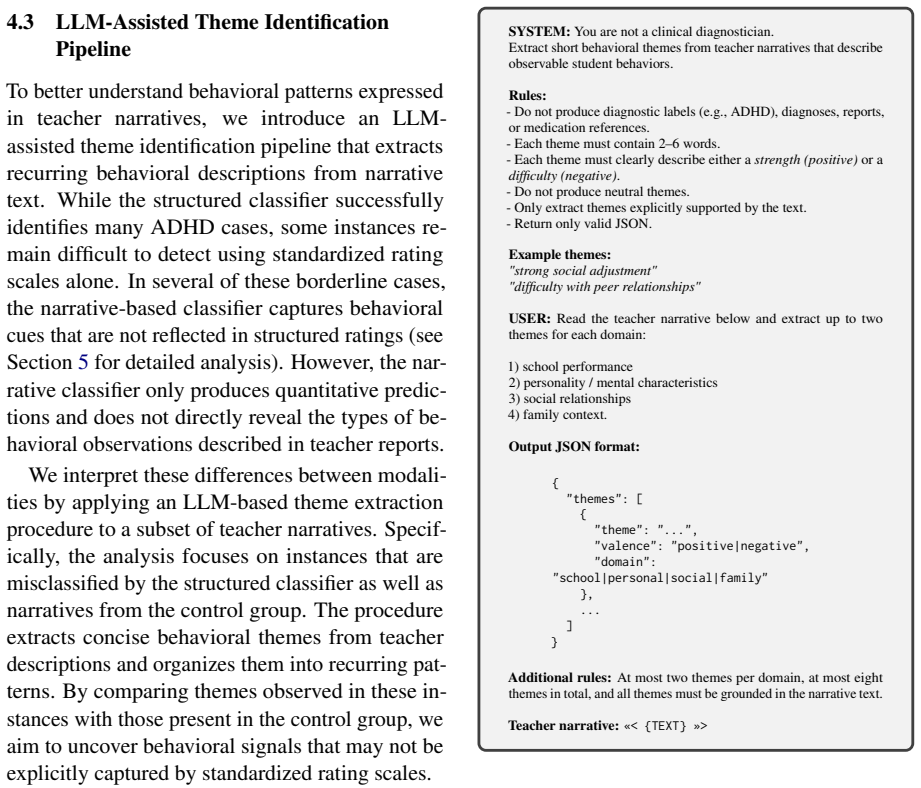
- [Methods and Results (LLM theme discovery pipeline)] The LLM-assisted theme discovery pipeline (described in the methods and results sections on interpretation of differences) provides no details on prompting strategy, model version, temperature, few-shot exemplars, deduplication, or any validation against clinical ground truth, inter-rater checks, or clinician review. This is load-bearing for the central claim because the interpretation that the surfaced 'distinct attention, behavioral, and family-related patterns' explain why narratives catch cases missed by CTRS-R:S rests on the themes being genuine signals rather than artifacts of LLM priors, translation, or narrative length.
Simulated Author's Rebuttal
We thank the referee for the thorough review and for highlighting the need for greater transparency in our LLM-assisted theme discovery pipeline. We agree this is central to the interpretability of our complementarity findings and will substantially expand the Methods and Results sections in revision.
read point-by-point responses
-
Referee: [Methods and Results (LLM theme discovery pipeline)] The LLM-assisted theme discovery pipeline (described in the methods and results sections on interpretation of differences) provides no details on prompting strategy, model version, temperature, few-shot exemplars, deduplication, or any validation against clinical ground truth, inter-rater checks, or clinician review. This is load-bearing for the central claim because the interpretation that the surfaced 'distinct attention, behavioral, and family-related patterns' explain why narratives catch cases missed by CTRS-R:S rests on the themes being genuine signals rather than artifacts of LLM priors, translation, or narrative length.
Authors: We agree that the manuscript as submitted provides insufficient methodological detail on the LLM pipeline. In the revised version we will add a dedicated subsection that specifies: (1) the exact model and version used, (2) temperature and other generation parameters, (3) the full prompting strategy including any few-shot exemplars or chain-of-thought instructions, (4) post-processing steps such as deduplication and theme merging criteria, and (5) any human validation performed (clinician review, inter-rater agreement on a subset of themes). We will also report whether themes were cross-checked against the original Turkish text to mitigate translation artifacts. Where formal validation against clinical ground truth was not conducted, we will state this limitation explicitly and describe the qualitative safeguards we applied instead. revision: yes
Circularity Check
No circularity: empirical comparison of data sources with no self-referential derivations
full rationale
The paper conducts an empirical analysis comparing predictive performance of CTRS-R:S scores versus teacher narratives on de-identified Turkish data, then applies an LLM pipeline for post-hoc theme interpretation. No equations, parameters fitted to subsets and renamed as predictions, or self-citations are present in the provided text. The central claim of complementary signals rests on the observed minimal overlap in missed cases, which is a direct data observation rather than a reduction to inputs by definition or citation chain. This matches the default expectation for non-circular empirical work.
Axiom & Free-Parameter Ledger
Reference graph
Works this paper leans on
-
[1]
Neuropediatrics , volume=
ADHD: Current concepts and treatments in children and adolescents , author=. Neuropediatrics , volume=. 2020 , publisher=
2020
-
[2]
Child and adolescent psychiatry and mental health , volume=
Prevalence and diagnostic stability of ADHD and ODD in Turkish children: a 4-year longitudinal study , author=. Child and adolescent psychiatry and mental health , volume=. 2013 , publisher=
2013
-
[3]
2022 , publisher=
Diagnostic and statistical manual of mental disorders , author=. 2022 , publisher=
2022
-
[4]
European journal of pediatrics , volume=
Variations in prevalence of attention deficit hyperactivity disorder worldwide , author=. European journal of pediatrics , volume=. 2007 , publisher=
2007
-
[5]
BMC medicine , volume=
A systematic review and analysis of long-term outcomes in attention deficit hyperactivity disorder: effects of treatment and non-treatment , author=. BMC medicine , volume=. 2012 , publisher=
2012
-
[6]
European child & adolescent psychiatry , volume=
The clinical utility of the continuous performance test and objective measures of activity for diagnosing and monitoring ADHD in children: A systematic review , author=. European child & adolescent psychiatry , volume=. 2016 , publisher=
2016
-
[7]
Pediatrics , volume=
Tools for the diagnosis of ADHD in children and adolescents: a systematic review , author=. Pediatrics , volume=. 2024 , publisher=
2024
-
[8]
Child and Adolescent Mental Health , volume=
Five years on: public sector service use related to mental health in young people with ADHD or hyperkinetic disorder five years after diagnosis , author=. Child and Adolescent Mental Health , volume=. 2008 , publisher=
2008
-
[9]
El manual diagn
Malpica, Carlos Rojas and Salas, Miguel. El manual diagn. Gac M
-
[10]
Journal of abnormal child psychology , volume=
Revision and restandardization of the Conners Teacher Rating Scale (CTRS-R): factor structure, reliability, and criterion validity , author=. Journal of abnormal child psychology , volume=. 1998 , publisher=
1998
-
[11]
EGITIM VE BILIM-EDUCATION AND SCIENCE , volume=
Conners teacher rating scale-revised short: Turkish adaptation study , author=. EGITIM VE BILIM-EDUCATION AND SCIENCE , volume=
-
[12]
Proceedings of the workshop on computational linguistics and clinical psychology: From linguistic signal to clinical reality , pages=
Quantifying mental health signals in Twitter , author=. Proceedings of the workshop on computational linguistics and clinical psychology: From linguistic signal to clinical reality , pages=
-
[13]
Translational psychiatry , volume=
Predicting early psychiatric readmission with natural language processing of narrative discharge summaries , author=. Translational psychiatry , volume=. 2016 , publisher=
2016
-
[14]
npj Schizophrenia , volume=
Automated analysis of free speech predicts psychosis onset in high-risk youths , author=. npj Schizophrenia , volume=. 2015 , publisher=
2015
-
[15]
Proceedings of the 2024 Joint International Conference on Computational Linguistics, Language Resources and Evaluation (LREC-COLING 2024) , pages=
Towards comprehensive language analysis for clinically enriched spontaneous dialogue , author=. Proceedings of the 2024 Joint International Conference on Computational Linguistics, Language Resources and Evaluation (LREC-COLING 2024) , pages=
2024
-
[16]
2023 , publisher =
Korkmaz, Nezahat , title =. 2023 , publisher =
2023
-
[17]
Information processing & management , volume=
Term-weighting approaches in automatic text retrieval , author=. Information processing & management , volume=. 1988 , publisher=
1988
-
[18]
NPJ digital medicine , volume=
Benchmarking the diagnostic performance of open source LLMs in 1933 Eurorad case reports , author=. NPJ digital medicine , volume=. 2025 , publisher=
1933
-
[19]
arXiv preprint arXiv:2407.21783 , year=
The llama 3 herd of models , author=. arXiv preprint arXiv:2407.21783 , year=
-
[20]
Introduction to nonparametric statistics for the biological sciences using R , pages=
Mann--whitney u test , author=. Introduction to nonparametric statistics for the biological sciences using R , pages=. 2016 , publisher=
2016
-
[21]
Journal of Machine Learning Research , volume=
Scikit-learn: Machine learning in Python , author=. Journal of Machine Learning Research , volume=. 2011 , publisher=
2011
-
[22]
Applied Neuropsychology: Child , volume=
Quantitative electroencephalography in children with attention deficit hyperactivity disorder and healthy children: behavioral and age correlates , author=. Applied Neuropsychology: Child , volume=. 2025 , publisher=
2025
-
[23]
Cells , volume=
From aberrant brainwaves to altered plasticity: A review of QEEG biomarkers and neurofeedback in the neurobiological landscape of ADHD , author=. Cells , volume=. 2025 , publisher=
2025
-
[24]
PLoS One , volume=
A novel quantitative electroencephalography subtype with high alpha power in ADHD: ADHD or misdiagnosed ADHD? , author=. PLoS One , volume=. 2020 , publisher=
2020
discussion (0)
Sign in with ORCID, Apple, or X to comment. Anyone can read and Pith papers without signing in.