Lyman-alpha Pressure Strongly Enhances Pre-Supernova Feedback at Cosmic Dawn: The First Multi-Dimensional Lyman-alpha Radiation Hydrodynamics Simulations
Pith reviewed 2026-06-28 13:33 UTC · model grok-4.3
The pith
Lyα radiation pressure dominates pre-supernova feedback by factors of 10-60 in dense metal-poor clouds at cosmic dawn.
A machine-rendered reading of the paper's core claim, the machinery that carries it, and where it could break.
Core claim
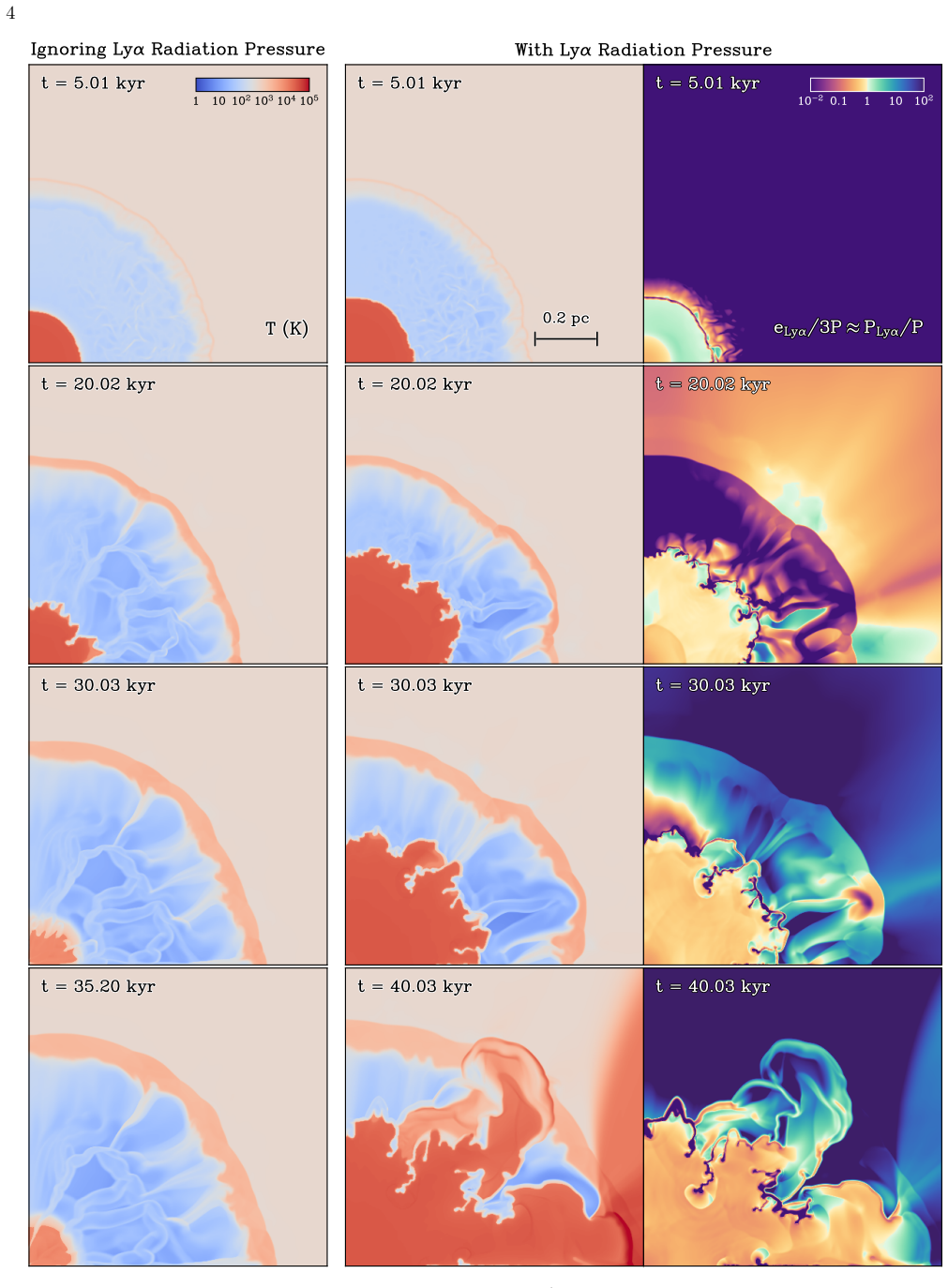
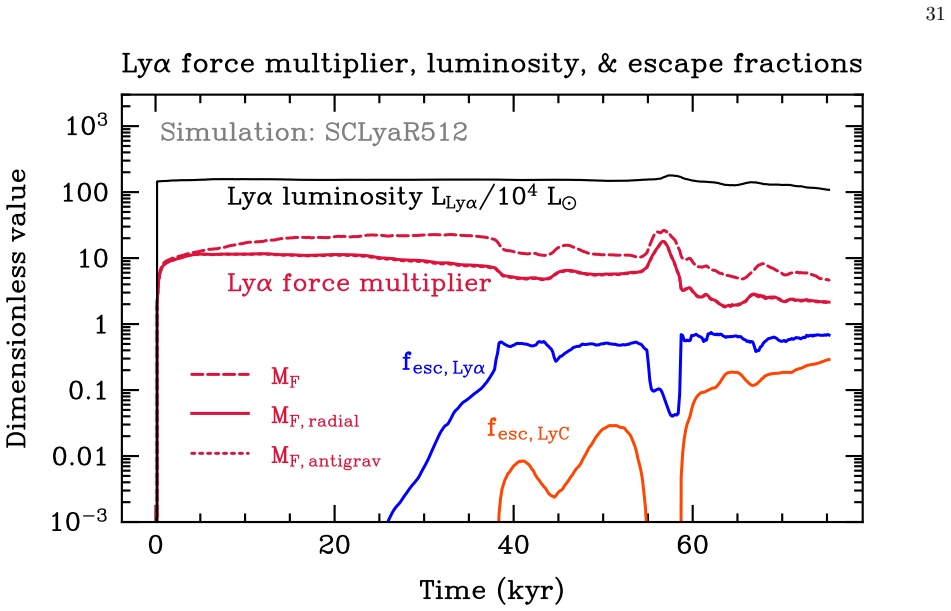
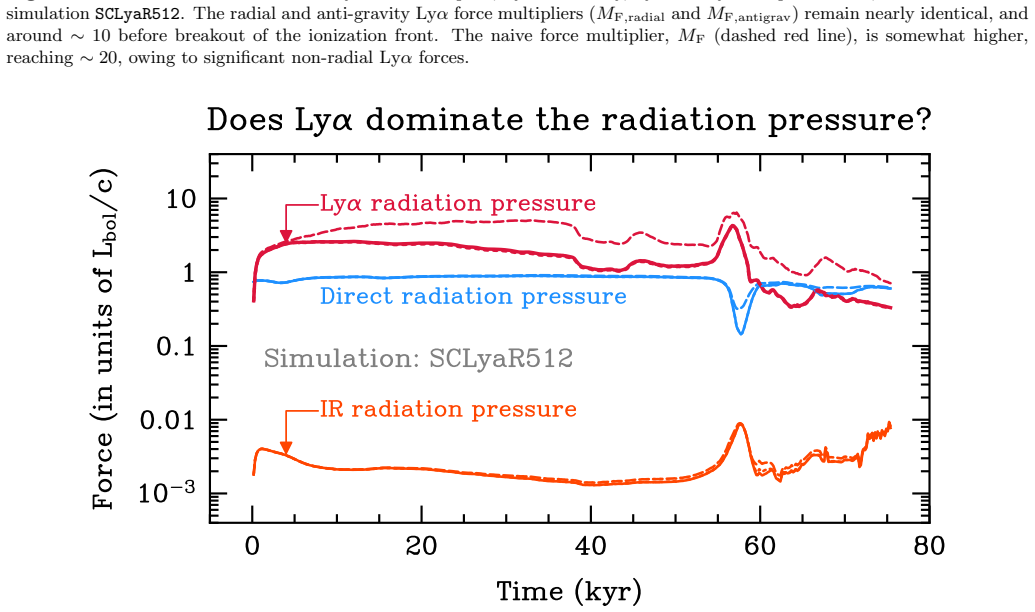
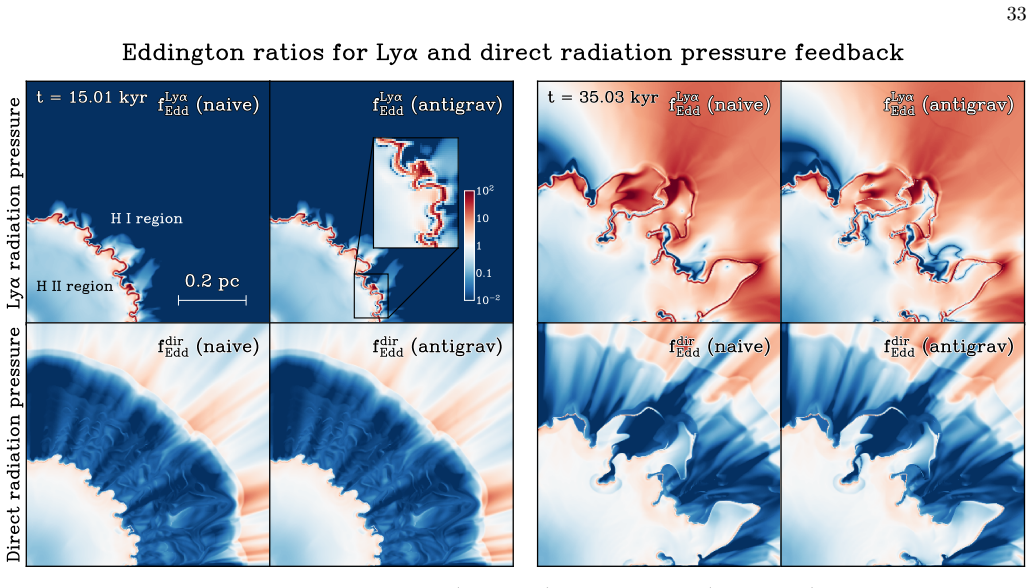
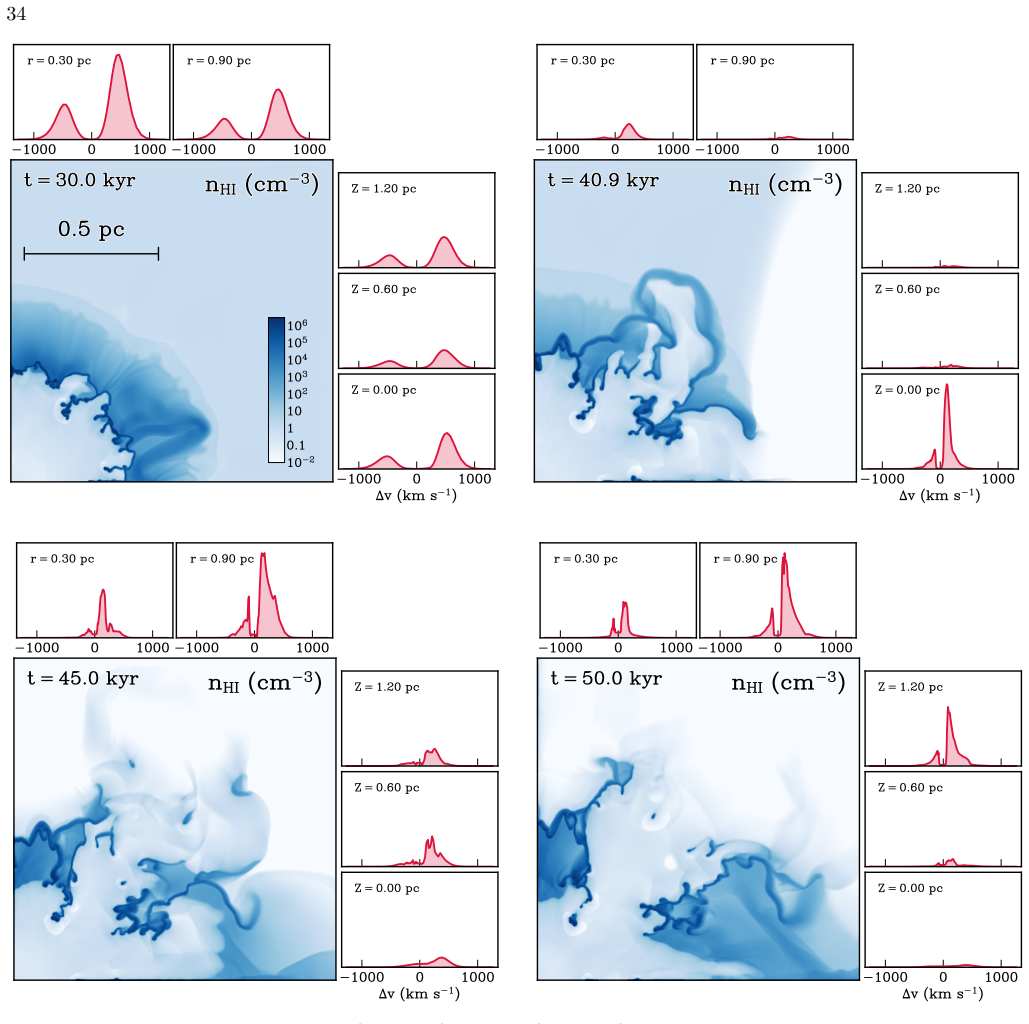
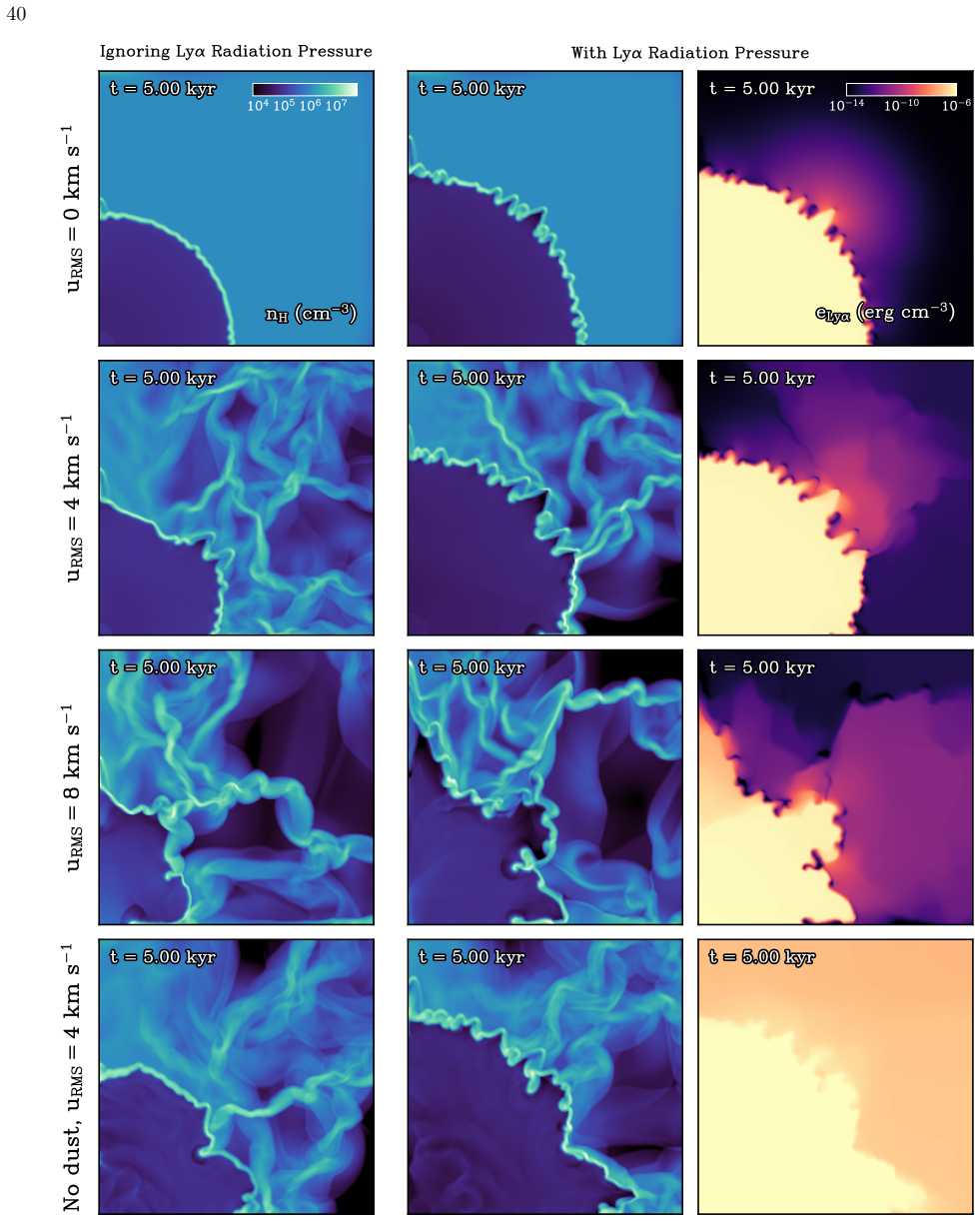
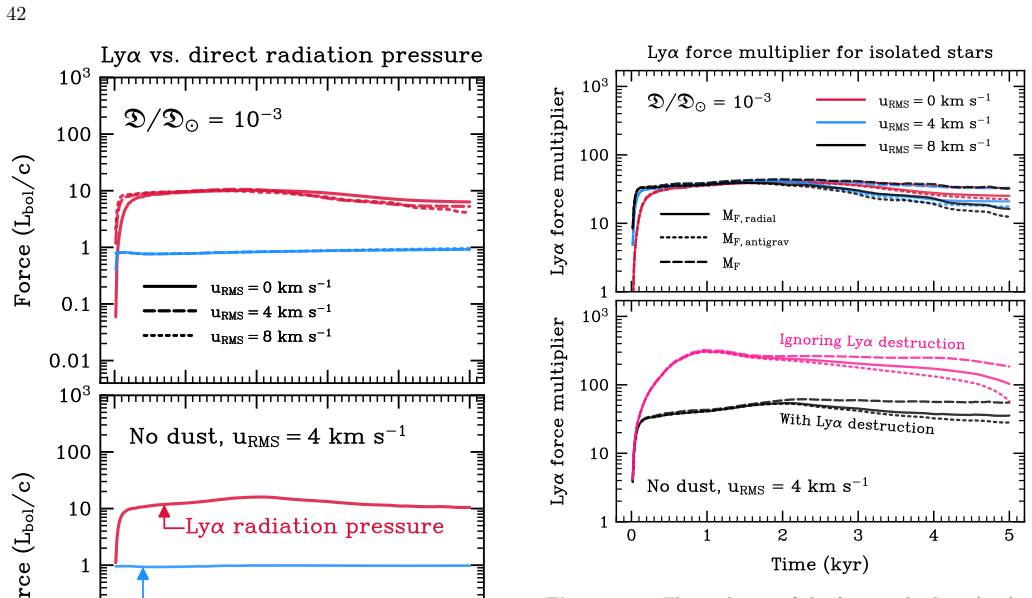
Using the Lydion code, the simulations demonstrate that Lyman-alpha radiation pressure generates radiative forces of (2-16) times L_bol/c with force multipliers of 10-60 in metal-poor environments, dominating over other radiation pressures and enhancing outflows, although Lyα leakage through channels, Doppler shifts, and photon destruction cannot prevent the build-up of strong pressure in H II regions.
What carries the argument
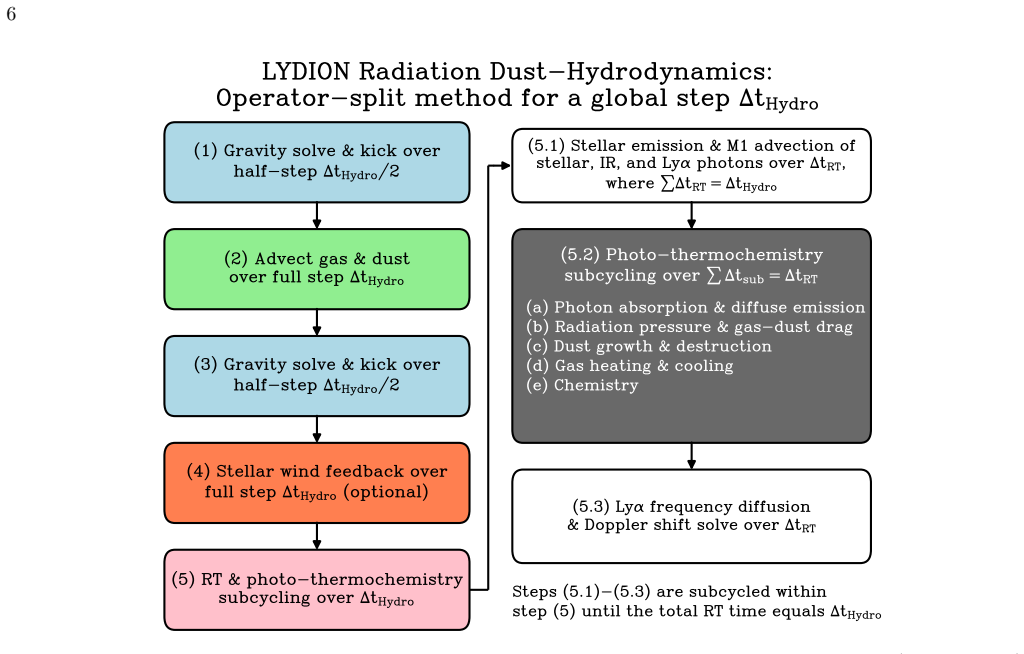
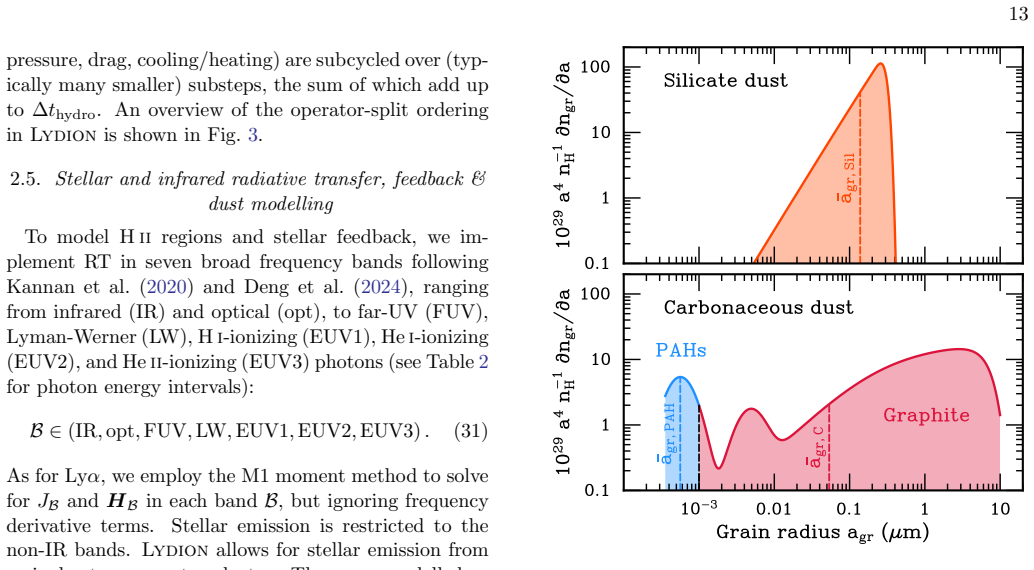
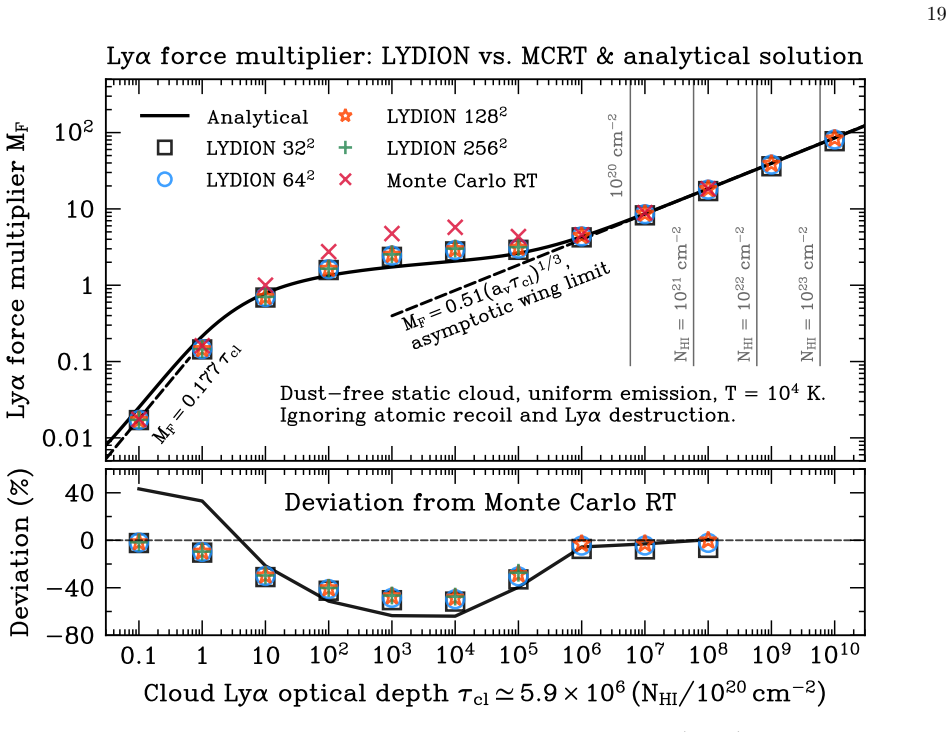
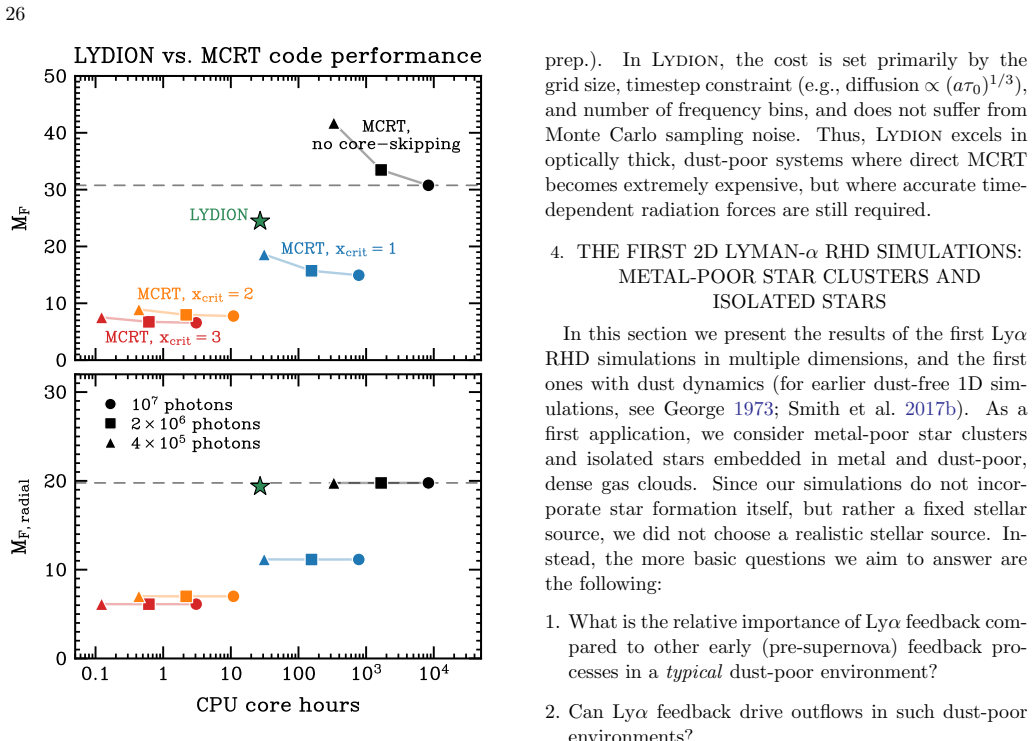
Lydion, an RHD code that uses a novel M1 moment closure for Lyman-alpha radiative transfer together with self-consistent dust dynamics, allowing multi-dimensional runs at roughly one-hundred times the speed of Monte Carlo methods.
If this is right
- Lyα feedback dramatically boosts outflows in the pre-supernova phase of star formation.
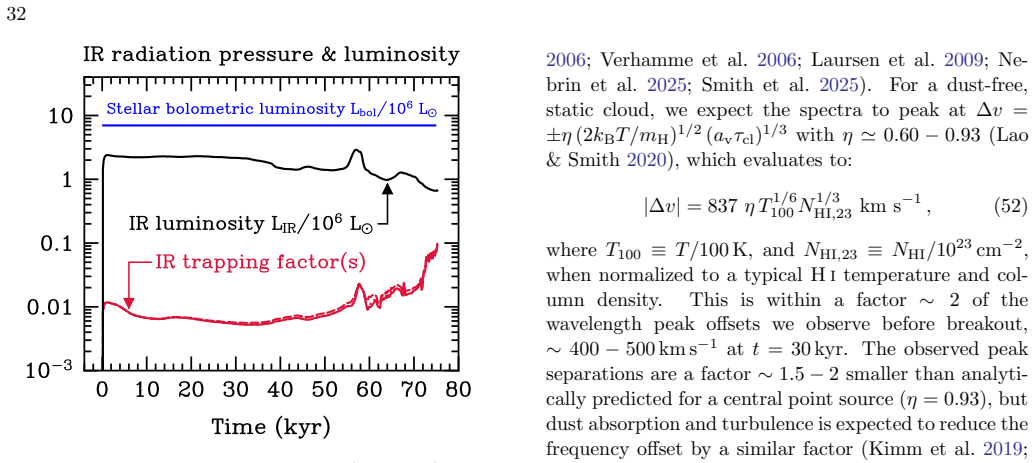
- It produces radiative forces several times larger than those from direct stellar or infrared radiation pressure.
- Nearly all current galaxy and star-formation simulations miss the strongest source of radiation pressure in dense, metal-poor gas.
- Efficient star formation requires a higher gas surface density than models without Lyα pressure predict.
- Lyα leakage and destruction do not eliminate the strong pressure build-up inside H II regions.
Where Pith is reading between the lines
- The enhanced feedback could lower the escape fraction of ionizing photons from the first galaxies.
- High-redshift observations of fast galactic outflows might be compared against the predicted force-multiplier range.
- Adding the effect to cosmological simulations would shift the timing and efficiency of star formation at cosmic dawn.
- Three-dimensional versions of the simulations could reveal how asymmetric gas geometries change the reported multipliers.
Load-bearing premise
The M1 moment closure for Lyα radiative transfer remains accurate enough in multi-dimensional H II regions with Doppler shifts, leakage channels, and dust to produce reliable force multipliers.
What would settle it
A side-by-side 2D simulation of the same star-cluster setup run once with the M1 method and once with full Monte Carlo Lyman-alpha transfer, checking whether the force multipliers and outflow velocities agree within the reported range.
Figures

















read the original abstract
The dynamical role of Lyman-$\alpha$ (Ly$\alpha$) radiation pressure feedback has been debated for nearly a century, with recent analytical and 1D numerical studies highlighting its potential dominance over other stellar feedback processes at Cosmic Dawn. Despite this, no multi-dimensional Ly$\alpha$ radiation hydrodynamics (RHD) simulations have been performed to date. In this paper, we present the first 2D Ly$\alpha$ RHD simulations using Lydion, an RHD code with a novel M1 moment method for Ly$\alpha$ transfer, and self-consistent dust dynamics. Lydion yields a $\sim \mathcal{O}(100) \,\times$ speed-up compared to Monte Carlo radiative transfer in simple benchmarks, making 2D Ly$\alpha$ RHD feasible. We perform simulations of star clusters and isolated stars embedded in dense, metal-poor ($Z/Z_\odot \leq 0.01$) clouds, and find that Ly$\alpha$ feedback dramatically boosts outflows and dominates over feedback from direct and infrared radiation pressure. Ly$\alpha$ leakage through lower-column density channels, Doppler shifts, and Ly$\alpha$ photon destruction, while important, cannot prevent the build-up of strong Ly$\alpha$ radiation pressure in H II regions, leading to radiative forces $\sim (2 - 16) \times L_{\rm bol}/c$, and Ly$\alpha$ force multipliers $M_{\rm F} \sim 10-60$. Ly$\alpha$ feedback may not preclude efficient star formation, but raises the threshold gas surface density for this to occur. We conclude that nearly all galaxy and star formation simulations are currently missing the strongest source of radiation pressure feedback in dense and metal-poor environments.
Editorial analysis
A structured set of objections, weighed in public.
Referee Report
Summary. The paper presents the first 2D Lyman-alpha radiation hydrodynamics simulations using the Lydion code with a novel M1 moment closure for Lyα transfer and self-consistent dust dynamics. It simulates star clusters and isolated stars in dense, metal-poor (Z/Z⊙ ≤ 0.01) clouds and claims that Lyα feedback dramatically boosts outflows, dominates over direct and infrared radiation pressure, and produces radiative forces ∼(2-16)×L_bol/c with force multipliers M_F ∼10-60, even with leakage channels, Doppler shifts, and photon destruction; this implies Lyα is the strongest radiation pressure source at cosmic dawn and raises the gas surface density threshold for efficient star formation.
Significance. If the results hold, the work would identify a dominant pre-supernova feedback channel missing from nearly all current galaxy and star formation simulations in dense, low-metallicity regimes. The O(100)× speedup of the M1 solver relative to Monte Carlo on benchmarks is a technical strength that enables the multi-dimensional runs.
major comments (3)
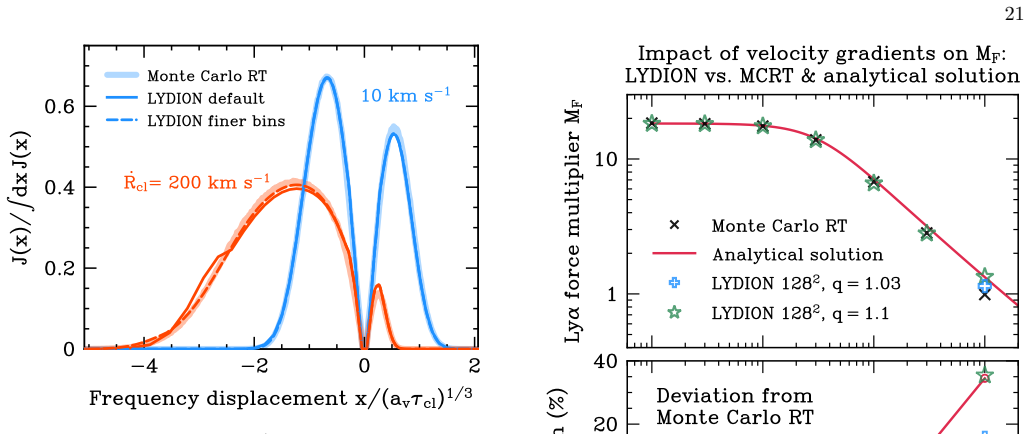
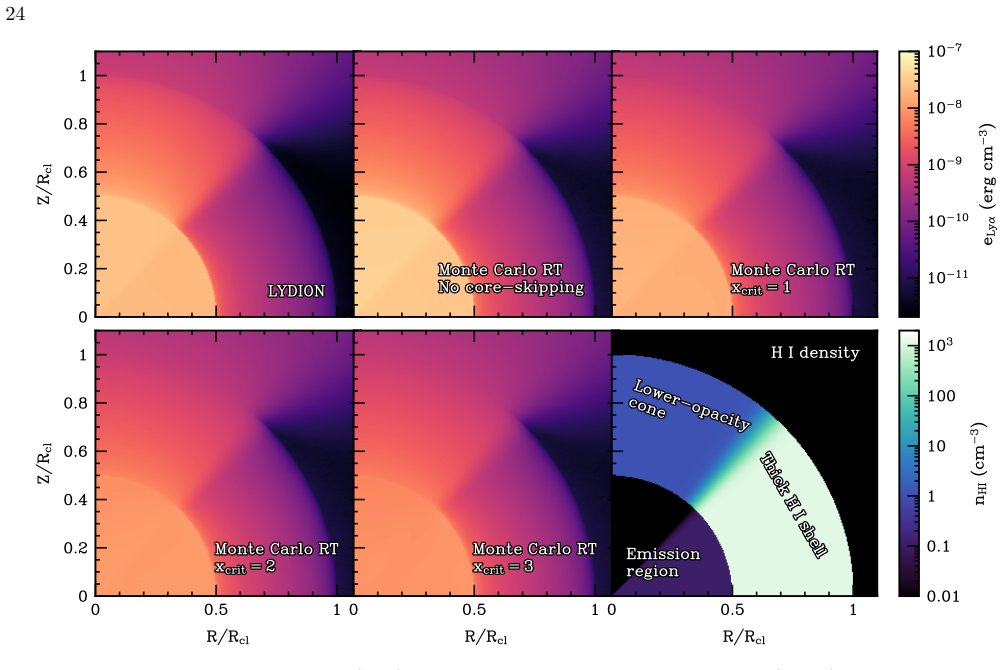
- [§2 (Lydion M1 solver description)] §2 (Lydion M1 solver description): the M1 closure is applied to 2D H II regions with self-consistent velocity fields, leakage channels, and dust that generate the headline force multipliers, yet validation against Monte Carlo is reported only for simple benchmarks; no cross-check is shown for the anisotropic, Doppler-shifted geometries that produce M_F ∼10-60. This is load-bearing because the closure assumes a specific angular distribution whose failure would directly alter trapped photon density and net momentum deposition.
- [Results section reporting the (2-16)×L_bol/c and M_F ∼10-60 ranges] Results section reporting the (2-16)×L_bol/c and M_F ∼10-60 ranges: these quantitative values, which underpin the dominance claim over direct/IR pressure, are presented without resolution convergence tests, Monte Carlo cross-checks in the target setups, or error bars, as noted by the absence of such tests in the abstract and results.
- [Discussion/conclusions] Discussion/conclusions: the statement that leakage, Doppler shifts, and destruction cannot prevent strong Lyα pressure build-up rests entirely on the M1-derived radiation fields; without demonstrated accuracy of the closure in the simulated regimes, the conclusion that Lyα feedback raises the star-formation threshold cannot be separated from possible numerical artifacts.
minor comments (2)
- [Abstract] Abstract: the reported force and multiplier ranges are stated without reference to the number of runs, exact parameter variations, or which setups produce the extremes of the 2-16 and 10-60 intervals.
- [Notation] Notation: the definition of the force multiplier M_F should be given explicitly with an equation number on first use in the main text rather than only in a methods appendix.
Simulated Author's Rebuttal
We thank the referee for their careful and constructive review. The comments correctly identify gaps in validation and quantitative robustness that we will address. We respond point-by-point below and outline the revisions.
read point-by-point responses
-
Referee: the M1 closure is applied to 2D H II regions with self-consistent velocity fields, leakage channels, and dust that generate the headline force multipliers, yet validation against Monte Carlo is reported only for simple benchmarks; no cross-check is shown for the anisotropic, Doppler-shifted geometries that produce M_F ∼10-60. This is load-bearing because the closure assumes a specific angular distribution whose failure would directly alter trapped photon density and net momentum deposition.
Authors: We agree that direct Monte Carlo cross-checks in the full target geometries are absent. The benchmarks in §2 include velocity gradients and anisotropy, and M1 performance in such regimes is supported by prior literature. Full Monte Carlo in the 2D hydrodynamical setups with leakage and dust remains computationally prohibitive, which is the motivation for the M1 solver. We will expand §2 with additional discussion of M1 accuracy expectations drawn from existing multi-dimensional validations and will note the limitation explicitly. revision: partial
-
Referee: these quantitative values, which underpin the dominance claim over direct/IR pressure, are presented without resolution convergence tests, Monte Carlo cross-checks in the target setups, or error bars, as noted by the absence of such tests in the abstract and results.
Authors: We acknowledge the absence of convergence tests and error estimates in the presented results. We will add resolution studies at multiple grid resolutions, report variations across runs as error estimates, and include these in a revised results section and/or appendix. Monte Carlo cross-checks in the target setups cannot be performed at present due to cost, but this limitation will be stated clearly. revision: yes
-
Referee: the statement that leakage, Doppler shifts, and destruction cannot prevent strong Lyα pressure build-up rests entirely on the M1-derived radiation fields; without demonstrated accuracy of the closure in the simulated regimes, the conclusion that Lyα feedback raises the star-formation threshold cannot be separated from possible numerical artifacts.
Authors: The conclusions rely on the M1 radiation fields. We will revise the discussion and conclusions sections to qualify the statements, explicitly noting the dependence on the M1 closure and its benchmarked regimes, while preserving the qualitative finding that strong pressure build-up occurs across the explored parameter space. Future work with alternative methods is needed for full confirmation. revision: partial
- Performing Monte Carlo radiative transfer cross-checks directly in the full 2D target simulations with self-consistent velocity fields, leakage channels, and dust, as this is computationally infeasible even with the reported O(100) speedup motivation for developing M1.
Circularity Check
No significant circularity in simulation outputs
full rationale
The paper reports radiative forces and force multipliers exclusively as outputs of 2D numerical RHD simulations performed with the Lydion code. These quantities do not reduce by the paper's own equations to fitted parameters, self-citations, or ansatzes; they are direct numerical results from evolving the coupled hydrodynamics and M1 moment equations. No load-bearing step matches any enumerated circularity pattern, and the central claims remain independent of the paper's inputs.
Axiom & Free-Parameter Ledger
axioms (2)
- domain assumption The M1 moment method provides a sufficiently accurate approximation to Lyα radiative transfer in multi-dimensional H II regions.
- domain assumption Dust dynamics and photon destruction can be treated self-consistently without additional microphysical processes dominating the force budget.
Reference graph
Works this paper leans on
-
[1]
2018, MNRAS, 475, L130, doi: 10.1093/mnrasl/sly018
Abe, M., & Yajima, H. 2018, MNRAS, 475, L130, doi: 10.1093/mnrasl/sly018
-
[2]
Adamo, A., Bradley, L. D., Vanzella, E., et al. 2024, Nature, 632, 513, doi: 10.1038/s41586-024-07703-7
-
[3]
Agertz, O., Pontzen, A., Read, J. I., et al. 2020, MNRAS, 491, 1656, doi: 10.1093/mnras/stz3053
-
[4]
Wiebe, D. S. 2015, MNRAS, 449, 440, doi: 10.1093/mnras/stv187 —. 2017, MNRAS, 469, 630, doi: 10.1093/mnras/stx797
-
[5]
Algera, H. S. B., Herrera-Camus, R., Aravena, M., et al. 2025, arXiv e-prints, arXiv:2512.02320, doi: 10.48550/arXiv.2512.02320
-
[6]
Algera, H. S. B., Rowland, L., Stefanon, M., et al. 2026, MNRAS, 545, staf1897, doi: 10.1093/mnras/staf1897
-
[7]
1996, A&A, 305, 602
Allain, T., Leach, S., & Sedlmayr, E. 1996, A&A, 305, 602
1996
-
[8]
Almgren, A. S., Beckner, V. E., Bell, J. B., et al. 2010, ApJ, 715, 1221, doi: 10.1088/0004-637X/715/2/1221
-
[9]
Ambarzumian, V. A. 1932, MNRAS, 93, 50, doi: 10.1093/mnras/93.1.50
-
[10]
Andersson, E. P., Rey, M. P., Pontzen, A., et al. 2025, ApJ, 978, 129, doi: 10.3847/1538-4357/ad99d6
-
[11]
Arthur, S. J., Kurtz, S. E., Franco, J., & Albarr´ an, M. Y. 2004, ApJ, 608, 282, doi: 10.1086/386366
-
[12]
Asplund, M., Grevesse, N., Sauval, A. J., & Scott, P. 2009, ARA&A, 47, 481, doi: 10.1146/annurev.astro.46.060407.145222
-
[13]
Baczynski, C., Glover, S. C. O., & Klessen, R. S. 2015, MNRAS, 454, 380, doi: 10.1093/mnras/stv1906
-
[14]
Baldwin, J. A., Ferland, G. J., Martin, P. G., et al. 1991, ApJ, 374, 580, doi: 10.1086/170146
-
[15]
Balsara, D. S. 2012, Journal of Computational Physics, 231, 7504, doi: 10.1016/j.jcp.2012.01.032
-
[16]
Bar-Nun, A., Litman, M., & Rappaport, M. L. 1980, A&A, 85, 197
1980
-
[17]
Barnes, A. T., Glover, S. C. O., Kreckel, K., et al. 2021, MNRAS, 508, 5362, doi: 10.1093/mnras/stab2958
-
[18]
Behrens, C., Dijkstra, M., & Niemeyer, J. C. 2014, A&A, 563, A77, doi: 10.1051/0004-6361/201322949
-
[19]
Bezanson, J., Edelman, A., Karpinski, S., & Shah, V. B. 2017, SIAM Review, 59, 65, doi: 10.1137/141000671
-
[20]
Black, D. C., & Bodenheimer, P. 1975, ApJ, 199, 619, doi: 10.1086/153729
-
[21]
2021, A&A, 646, A123, doi: 10.1051/0004-6361/202038579
Audit, E. 2021, A&A, 646, A123, doi: 10.1051/0004-6361/202038579
-
[22]
Bonaventura, L., & Rocca, A. D. 2017, Journal of Scientific Computing, 70, 859
2017
-
[23]
2025, A&A, 694, A89, doi: 10.1051/0004-6361/202452228
Borderies, A., Commer¸ con, B., & Bourdon, B. 2025, A&A, 694, A89, doi: 10.1051/0004-6361/202452228
-
[24]
2024, A&A, 692, A249, doi: 10.1051/0004-6361/202452362
Bossion, D., Sarangi, A., Aalto, S., et al. 2024, A&A, 692, A249, doi: 10.1051/0004-6361/202452362
-
[25]
Brown, S. T., Fattahi, A., Gutcke, T. A., et al. 2025, arXiv e-prints, arXiv:2511.21824, doi: 10.48550/arXiv.2511.21824
-
[26]
M., Tumlinson, J., Geha, M., et al
Brown, T. M., Tumlinson, J., Geha, M., et al. 2014, ApJ, 796, 91, doi: 10.1088/0004-637X/796/2/91 77
-
[27]
Ostriker, J. P. 1995, Computer Physics Communications, 89, 149, doi: 10.1016/0010-4655(94)00191-4
-
[28]
Bryan, G. L., Norman, M. L., O’Shea, B. W., et al. 2014, ApJS, 211, 19, doi: 10.1088/0067-0049/211/2/19
-
[29]
Buchler, J. R. 1983, JQSRT, 30, 395, doi: 10.1016/0022-4073(83)90102-4
-
[30]
Burke, J. R., & Hollenbach, D. J. 1983, ApJ, 265, 223, doi: 10.1086/160667
-
[31]
2025, arXiv e-prints, arXiv:2507.11603, doi: 10.48550/arXiv.2507.11603
Byrohl, C., & Nelson, D. 2025, arXiv e-prints, arXiv:2507.11603, doi: 10.48550/arXiv.2507.11603
-
[32]
2022, MNRAS, 516, 5914, doi: 10.1093/mnras/stac2387
Calura, F., Lupi, A., Rosdahl, J., et al. 2022, MNRAS, 516, 5914, doi: 10.1093/mnras/stac2387
-
[33]
2025, A&A, 698, A207, doi: 10.1051/0004-6361/202452876
Calura, F., Pascale, R., Agertz, O., et al. 2025, A&A, 698, A207, doi: 10.1051/0004-6361/202452876
-
[34]
Castor, J. I. 2004, Radiation Hydrodynamics (Cambridge University Press)
2004
-
[35]
Cazaux, S., & Tielens, A. G. G. M. 2004, ApJ, 604, 222, doi: 10.1086/381775 —. 2010, ApJ, 715, 698, doi: 10.1088/0004-637X/715/1/698
-
[36]
Chan, T. K., Richings, A. J., Theuns, T., et al. 2026, MNRAS, 546, stag004, doi: 10.1093/mnras/stag004
-
[37]
K., Theuns, T., Bower, R., & Frenk, C
Chan, T. K., Theuns, T., Bower, R., & Frenk, C. 2021, MNRAS, 505, 5784, doi: 10.1093/mnras/stab1686
-
[38]
1945, ApJ, 102, 402, doi: 10.1086/144771
Chandrasekhar, S. 1945, ApJ, 102, 402, doi: 10.1086/144771
-
[39]
Chang, J. S., & Cooper, G. 1970, Journal of Computational Physics, 6, 1, doi: 10.1016/0021-9991(70)90001-X
-
[40]
Chiaki, G., & Wise, J. H. 2023, MNRAS, 520, 5077, doi: 10.1093/mnras/stad433
-
[41]
Chiu, W. A., & Draine, B. 1998, arXiv preprint astro-ph/9803209
Pith/arXiv arXiv 1998
-
[42]
Sandstrom, K. M. 2025, MNRAS, 537, 1518, doi: 10.1093/mnras/staf118
-
[43]
Sandstrom, K. M. 2026, arXiv e-prints, arXiv:2603.08504, doi: 10.48550/arXiv.2603.08504
work page internal anchor Pith review Pith/arXiv arXiv doi:10.48550/arxiv.2603.08504 2026
-
[44]
2025, A&A, 698, A16, doi: 10.1051/0004-6361/202450685
Choe, S., Emil Rivera-Thorsen, T., Dahle, H., et al. 2025, A&A, 698, A16, doi: 10.1051/0004-6361/202450685
-
[45]
2025, MNRAS, 539, 2561, doi: 10.1093/mnras/staf598
Chon, S., & Omukai, K. 2025, MNRAS, 539, 2561, doi: 10.1093/mnras/staf598
-
[46]
Cooke, R. J., Pettini, M., & Steidel, C. C. 2018, ApJ, 855, 102, doi: 10.3847/1538-4357/aaab53
-
[47]
Kazandjian, M. V. 2019, MNRAS, 486, 1590, doi: 10.1093/mnras/stz927
-
[48]
Cox, D. P. 1985, ApJ, 288, 465, doi: 10.1086/162812
-
[49]
Davis, S. W., Jiang, Y.-F., Stone, J. M., & Murray, N. 2014, ApJ, 796, 107, doi: 10.1088/0004-637X/796/2/107 De Vis, P., Jones, A., Viaene, S., et al. 2019, A&A, 623, A5, doi: 10.1051/0004-6361/201834444
-
[50]
Li, Z. 2023, MNRAS, 523, 3201, doi: 10.1093/mnras/stad1557
-
[51]
2024, A&A, 691, A231, doi: 10.1051/0004-6361/202450699
Deng, Y., Li, H., Liu, B., et al. 2024, A&A, 691, A231, doi: 10.1051/0004-6361/202450699
-
[52]
2014, PASA, 31, e040, doi: 10.1017/pasa.2014.33
Dijkstra, M. 2014, PASA, 31, e040, doi: 10.1017/pasa.2014.33
-
[53]
2016, ApJ, 823, 74, doi: 10.3847/0004-637X/823/2/74
Dijkstra, M., Gronke, M., & Sobral, D. 2016, ApJ, 823, 74, doi: 10.3847/0004-637X/823/2/74
-
[54]
2006, ApJ, 649, 14, doi: 10.1086/506243
Dijkstra, M., Haiman, Z., & Spaans, M. 2006, ApJ, 649, 14, doi: 10.1086/506243
-
[55]
Dijkstra, M., & Loeb, A. 2008, MNRAS, 391, 457, doi: 10.1111/j.1365-2966.2008.13920.x
-
[56]
G., & Kolesnik, I
Doroshkevich, A. G., & Kolesnik, I. G. 1976, Soviet Ast., 20, 4
1976
-
[57]
Draine, B. T. 1979, ApJ, 230, 106, doi: 10.1086/157066 —. 2011a, ApJ, 732, 100, doi: 10.1088/0004-637X/732/2/100 —. 2011b, Physics of the Interstellar and Intergalactic Medium (Princeton University Press)
-
[58]
Draine, B. T., & Bertoldi, F. 1996, ApJ, 468, 269, doi: 10.1086/177689
-
[59]
Draine, B. T., & Salpeter, E. E. 1979, ApJ, 231, 77, doi: 10.1086/157165
-
[60]
Draine, B. T., & Sutin, B. 1987, ApJ, 320, 803, doi: 10.1086/165596
-
[61]
Edwards, J. D., Morel, J. E., & Knoll, D. A. 2011, Journal of Computational Physics, 230, 1198, doi: 10.1016/j.jcp.2010.10.035
-
[62]
Egorov, O. V., Kreckel, K., Sandstrom, K. M., et al. 2023, ApJL, 944, L16, doi: 10.3847/2041-8213/acac92
-
[63]
Faure, A., Hily-Blant, P., Pineau des Forˆ ets, G., & Flower, D. R. 2024, MNRAS, 531, 340, doi: 10.1093/mnras/stae994
-
[64]
2025, The Open Journal of Astrophysics, 8, 140, doi: 10.33232/001c.144792
Ferrara, A., Manzoni, D., & Ntormousi, E. 2025, The Open Journal of Astrophysics, 8, 140, doi: 10.33232/001c.144792
-
[65]
Fisher, D. B., Bolatto, A. D., Herrera-Camus, R., et al. 2014, Nature, 505, 186, doi: 10.1038/nature12765
-
[66]
Fleischmann, N., Adami, S., & Adams, N. A. 2019, Computers & Fluids, 189, 94
2019
-
[67]
R., Pineau des Forˆ ets, G., Hily-Blant, P., et al
Flower, D. R., Pineau des Forˆ ets, G., Hily-Blant, P., et al. 2021, MNRAS, 507, 3564, doi: 10.1093/mnras/stab2272
-
[68]
Forrey, R. C. 2013, ApJL, 773, L25, doi: 10.1088/2041-8205/773/2/L25
-
[69]
W., Weisz, D
Fu, S. W., Weisz, D. R., Starkenburg, E., et al. 2023, ApJ, 958, 167 78
2023
-
[70]
2020, MNRAS, 497, 829, doi: 10.1093/mnras/staa1994
Fukushima, H., Hosokawa, T., Chiaki, G., et al. 2020, MNRAS, 497, 829, doi: 10.1093/mnras/staa1994
-
[71]
Fukushima, H., & Yajima, H. 2021, MNRAS, 506, 5512, doi: 10.1093/mnras/stab2099
-
[72]
The Chemistry of the Early Universe
Galli, D., & Palla, F. 1998, A&A, 335, 403, doi: 10.48550/arXiv.astro-ph/9803315 —. 2002, Planet. Space Sci., 50, 1197, doi: 10.1016/S0032-0633(02)00083-1
work page internal anchor Pith review Pith/arXiv arXiv doi:10.48550/arxiv.astro-ph/9803315 1998
-
[73]
2021, A&A, 649, A18, doi: 10.1051/0004-6361/202039701
Galliano, F., Nersesian, A., Bianchi, S., et al. 2021, A&A, 649, A18, doi: 10.1051/0004-6361/202039701
-
[74]
Garcia, F. A. B., Ricotti, M., Sugimura, K., & Park, J. 2023, MNRAS, 522, 2495, doi: 10.1093/mnras/stad1092
-
[75]
Ge, Q., & Wise, J. H. 2017, MNRAS, 472, 2773, doi: 10.1093/mnras/stx2074
-
[76]
Geen, S., Bieri, R., de Koter, A., Kimm, T., & Rosdahl, J. 2023, MNRAS, 526, 1832, doi: 10.1093/mnras/stad2667
-
[77]
2015, MNRAS, 454, 4484, doi: 10.1093/mnras/stv2272
Geen, S., Hennebelle, P., Tremblin, P., & Rosdahl, J. 2015, MNRAS, 454, 4484, doi: 10.1093/mnras/stv2272
-
[78]
1973, in Liege International Astrophysical
George, D. 1973, in Liege International Astrophysical
1973
-
[79]
Glover, S. C. O. 2015, MNRAS, 453, 2901, doi: 10.1093/mnras/stv1781
-
[80]
Glover, S. C. O., & Abel, T. 2008, MNRAS, 388, 1627, doi: 10.1111/j.1365-2966.2008.13224.x
discussion (0)
Sign in with ORCID, Apple, or X to comment. Anyone can read and Pith papers without signing in.