Special Lagrangian submanifolds and circle collapse on K3
Pith reviewed 2026-06-28 12:23 UTC · model grok-4.3
The pith
Affine lines on the base of a collapsing K3 lift to special Lagrangian two-spheres and tori.
A machine-rendered reading of the paper's core claim, the machinery that carries it, and where it could break.
Core claim
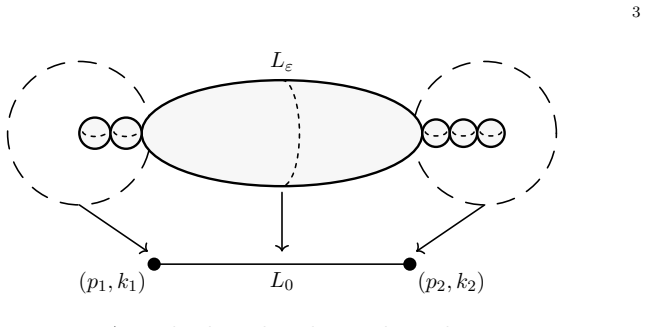
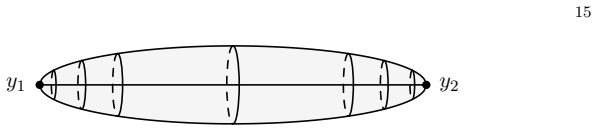
We consider K3 surfaces collapsing to a three-dimensional affine base. We show that certain affine lines on the base lift to degenerating sequences of special Lagrangian two-spheres and tori in the collapsing K3 surface. In particular, we construct special Lagrangian two-spheres connecting pairs of Taub-NUT bubbles. These examples fit into the broader program of reconstructing special submanifolds from graphs and combinatorial data on a collapsed affine limit.
What carries the argument
The lifting of affine lines on the three-dimensional affine base to sequences of special Lagrangian submanifolds that remain calibrated throughout the K3 collapse.
If this is right
- Certain affine lines on the base lift to degenerating sequences of special Lagrangian two-spheres.
- Certain affine lines on the base lift to degenerating sequences of special Lagrangian tori.
- Special Lagrangian two-spheres exist that connect pairs of Taub-NUT bubbles in the collapsing K3.
- The examples advance the reconstruction of special submanifolds from graphs and combinatorial data on the affine limit.
Where Pith is reading between the lines
- The same lifting construction may produce special Lagrangian cycles in other hyperkähler manifolds that admit affine collapses.
- Combinatorial data on the base could be used more systematically to predict the existence of calibrated cycles in degenerating families.
Load-bearing premise
The K3 surfaces admit a collapsing sequence to a three-dimensional affine base such that affine lines on the base lift to submanifolds that stay special Lagrangian during the entire degeneration.
What would settle it
An explicit collapsing family of K3 surfaces together with an affine line on the base for which no sequence of special Lagrangian submanifolds exists that satisfies the calibration condition at every stage of the collapse.
Figures
read the original abstract
We consider $K3$ surfaces collapsing to a three-dimensional affine base. We show that certain affine lines on the base lift to degenerating sequences of special Lagrangian two-spheres and tori in the collapsing $K3$ surface. In particular, we construct special Lagrangian two-spheres connecting pairs of Taub-NUT bubbles. These examples fit into the broader program of reconstructing special submanifolds from graphs and combinatorial data on a collapsed affine limit.
Editorial analysis
A structured set of objections, weighed in public.
Referee Report
Summary. The paper considers K3 surfaces collapsing to a three-dimensional affine base. It shows that certain affine lines on the base lift to degenerating sequences of special Lagrangian two-spheres and tori in the collapsing K3 surface. In particular, it constructs special Lagrangian two-spheres connecting pairs of Taub-NUT bubbles. These examples fit into the broader program of reconstructing special submanifolds from graphs and combinatorial data on a collapsed affine limit.
Significance. If the lifting construction is rigorously justified, the work supplies explicit examples of special Lagrangian submanifolds arising from affine data in circle-collapsing K3 surfaces. This advances the combinatorial reconstruction program for calibrated cycles in degenerating Calabi-Yau manifolds and may supply test cases for the SYZ conjecture in the K3 setting.
minor comments (2)
- [Abstract / §1] The abstract states the main result directly; the introduction or §1 should include a numbered statement of the principal theorem together with its precise hypotheses on the collapsing sequence.
- Notation for the affine base, the circle-collapse parameter, and the Taub-NUT bubbles should be introduced uniformly before the lifting argument begins.
Simulated Author's Rebuttal
We thank the referee for the positive summary, significance assessment, and recommendation of minor revision. The report correctly identifies the core contribution: the lifting of affine lines on the collapsed base to degenerating special Lagrangian 2-spheres and tori, including connections between Taub-NUT bubbles. No major comments are listed in the report, so we have no specific points requiring point-by-point rebuttal or revision.
Circularity Check
No significant circularity detected
full rationale
The provided abstract and context describe a construction result: affine lines on a collapsed affine base lift to degenerating special Lagrangian submanifolds (spheres and tori) in K3 surfaces, including connections between Taub-NUT bubbles. No equations, fitted parameters, self-citations as load-bearing premises, ansatzes, or renamings of known results appear in the visible text. The claim is presented as a direct mathematical construction fitting into a broader program, with no reduction of outputs to inputs by definition or statistical forcing. This is the expected honest non-finding for a construction paper whose central result does not rely on self-referential fitting or imported uniqueness theorems.
Axiom & Free-Parameter Ledger
Reference graph
Works this paper leans on
-
[1]
M. F. Atiyah and N. J. Hitchin,The Geometry and Dynamics of Mag- netic Monopoles, M. B. Porter Lectures, Princeton University Press, Princeton, NJ, 1988
1988
-
[2]
K. Becker, M. Becker, and A. Strominger,Fivebranes, membranes and non-perturbative string theory, Nuclear Phys. B456(1995), 130–152. [arXiv:hep-th/9507158]
Pith/arXiv arXiv 1995
-
[3]
O. Biquard and V. Minerbe,A Kummer construction for gravita- tional instantons, Comm. Math. Phys.308(2011), no. 3, 773–794. [arXiv:1005.5133]
Pith/arXiv arXiv 2011
-
[4]
S.-K. Chiu and Y.-S. Lin,Special Lagrangian submanifolds in K3-fibered Calabi–Yau 3-folds, preprint. [arXiv:2410.17662]
-
[5]
S.-K. Chiu, Y. Li, and Y.-S. Lin,From tropical curves to special La- grangians, preprint. [arXiv:2509.04843]
-
[6]
T.C. Collins, S. Gukov, S. Picard and S.-T. Yau,Special Lagrangian Cycles and Calabi-Yau Transitions, Commun. Math. Phys.401(2023), 769-–802. [arXiv:2111.10355]
arXiv 2023
-
[7]
Demailly,Complex Analytic and Differential Geometry, book available on the author’s website
J.-P. Demailly,Complex Analytic and Differential Geometry, book available on the author’s website. [link] 71
-
[8]
S. K. Donaldson,Two-forms on four-manifolds and elliptic equations, Nankai Tracts Math.11(2006), 153–172. [arXiv:math/0607083]
Pith/arXiv arXiv 2006
-
[9]
Donaldson,Calabi–Yau metrics on Kummer surfaces as a model glu- ing problem, Adv
S. Donaldson,Calabi–Yau metrics on Kummer surfaces as a model glu- ing problem, Adv. Geom. Anal., Adv. Lect. Math. (ALM), vol. 21, Int. Press, Somerville, MA, 2012, pp. 109–118. [arXiv:1007.4218]
Pith/arXiv arXiv 2012
-
[10]
S. K. Donaldson and C. Scaduto,Associative submanifolds and gradient cycles, inSurveys in Differential Geometry 2019: Differential geometry, Calabi–Yau theory, and general relativity. Part 2, Surv. Differ. Geom., vol. 24, Int. Press, Somerville, MA, 2022, pp. 39–65. [arXiv:2004.07314]
arXiv 2019
-
[11]
S. Habibi Esfahani and Y. Li,On the Donaldson–Scaduto conjecture, Geom. Topol.30(2026), no. 3, 959–981. [arXiv:2401.15432]
Pith/arXiv arXiv 2026
-
[12]
J. Fine and C. Yao,A report on the hypersymplectic flow, Pure Appl. Math. Q.15(2019), no. 4, 1219–1260. [arXiv:2001.11755]
arXiv 2019
-
[13]
Foscolo,ALF gravitational instantons and the collapsing Ricci-flat metrics on the K3 surface, J
L. Foscolo,ALF gravitational instantons and the collapsing Ricci-flat metrics on the K3 surface, J. Differential Geom.112(2019), 79–120. [arXiv:1603.06315]
Pith/arXiv arXiv 2019
-
[14]
L. Foscolo and F. Trinca,Unstable minimal spheres with degree-1Gauss lift in hyperk¨ ahler4-manifolds, preprint. [arXiv:2410.20396]
-
[15]
Gibbons and S
G. Gibbons and S. Hawking,Gravitational multi-instantons, Phys. Lett. 78B(1978), no. 4, 430-432
1978
-
[16]
M. Gross and B. Siebert,From real affine geometry to com- plex geometry, Annals of Mathematics174(2011), 1301-–1428. [arXiv:math/0703822]
Pith/arXiv arXiv 2011
-
[17]
M. Gross,Mirror symmetry and the Strominger–Yau–Zaslow con- jecture, in:Current Developments in Mathematics(2012), 133–191. [arXiv:1212.4220]
Pith/arXiv arXiv 2012
-
[18]
M. Gross and P. M. H. Wilson,Large complex structure limits of K3 surfaces, J. Differential Geom.55(2000), no. 3, 475–546. [arXiv:math/0008018]
Pith/arXiv arXiv 2000
-
[19]
Han and F
Q. Han and F. H. Lin,Elliptic Partial Differential Equations, Courant Lect. Notes Math.,1, New York Univ., Courant Inst. Math. Sci., New York; Amer. Math. Soc., Providence, RI, 2000
2000
-
[20]
K. Hattori,The energy of maps accompanying the collapsing of the K3 surface to a flat 3-dimensional orbifold, J. Geom. Anal.35(2025), 122. [arXiv:2410.15545]
arXiv 2025
-
[21]
Harvey and B
R. Harvey and B. Lawson,Calibrated geometries, Acta Math.148 (1982), 47–157
1982
-
[22]
H.-J. Hein, S. Sun, J. Viaclovsky, and R. Zhang,Nilpotent structures and collapsing Ricci-flat metrics on the K3 surface, J. Amer. Math. Soc.35(2022), 123–209. [arXiv:1807.09367] 72 S. PICARD AND F. TRINCA
Pith/arXiv arXiv 2022
-
[23]
H.-J. Hein and V. Tosatti,Smooth asymptotics for collapsing Calabi- Yau metrics, Comm. Pure Appl. Math.78(2025), no. 2, 382—499. [arXiv:2102.03978]
arXiv 2025
-
[24]
Joyce,Special Lagrangian submanifolds with isolated conical singu- larities
D. Joyce,Special Lagrangian submanifolds with isolated conical singu- larities. V. Survey and applications, J. Differential Geom.63(2003), 279–347. [arXiv:math/0303272]
Pith/arXiv arXiv 2003
-
[25]
M. Kontsevich and Y. Soibelman,Affine structures and non- Archimedean analytic spaces, Progr. Math.244(2006), 321-385. [arXiv:math/0406564]
Pith/arXiv arXiv 2006
-
[26]
J. Lotay and G. Oliveira,Special Lagrangians, Lagrangian mean cur- vature flow and the Gibbons-Hawking ansatz, J. Differential Geom.126 (2024), 1121–1184. [arXiv:2002.10391]
arXiv 2024
-
[27]
Marshall,Deformations of special Lagrangian submanifolds, Ph.D
S. Marshall,Deformations of special Lagrangian submanifolds, Ph.D. thesis, University of Oxford, 2002
2002
-
[28]
Mikhalkin,Enumerative tropical algebraic geometry inR 2, J
G. Mikhalkin,Enumerative tropical algebraic geometry inR 2, J. Amer. Math. Soc.18(2005), no. 2, 313–377. [arXiv:math/0312530]
Pith/arXiv arXiv 2005
-
[29]
Morrey,Second Order Elliptic Systems of Differential Equations, Proceedings of the National Academy of Sciences of the United States of America , Mar
C. Morrey,Second Order Elliptic Systems of Differential Equations, Proceedings of the National Academy of Sciences of the United States of America , Mar. 15, 1953, Vol. 39, No. 3 (Mar. 15, 1953), pp. 201-206
1953
-
[30]
Y. Odaka and Y. Oshima,Collapsing K3 Surfaces, Tropical Geom- etry and Moduli Compactifications of Satake, Morgan–Shalen Type, MSJ Memoirs, vol. 40, Mathematical Society of Japan, Tokyo, 2021. [arXiv:1810.07685]
arXiv 2021
-
[31]
Oliveira,Electrostatics and geodesics on K3 surfaces, preprint
G. Oliveira,Electrostatics and geodesics on K3 surfaces, preprint. [arXiv:2302.08354]
-
[32]
Parker,Holomorphic curves in Lagrangian torus fibrations, Ph.D
B. Parker,Holomorphic curves in Lagrangian torus fibrations, Ph.D. thesis, Stanford University, 2005
2005
-
[33]
A. Strominger, S.-T. Yau, and E. Zaslow,Mirror symmetry is T-duality, Nuclear Phys. B479(1996), no. 1–2, 243–259. [arXiv:hep-th/9606040]
Pith/arXiv arXiv 1996
-
[34]
W. A. Salm,Construction of gravitational instantons with non-maximal volume growth via codimension-1 collapse, preprint. [arXiv:2406.16318]
-
[35]
D. K. Schroers and M. A. Singer,Gravitational instantons as superpo- sitions of Atiyah–Hitchin and Taub–NUT geometries, Q. J. Math.72 (2021), no. 1–2, 277–337. [arXiv:2004.02759]
arXiv 2021
-
[36]
J. Song, G. Tian and Z. Zhang,Collapsing behavior of Ricci-flat Kahler metrics and long time solutions of the Kahler-Ricci flow, preprint. [arXiv:1904.08345]
Pith/arXiv arXiv 1904
- [37]
-
[38]
Sz´ ekelyhidi,Gromov-Hausdorff limits of collapsing Calabi-Yau fibra- tions, preprint
G. Sz´ ekelyhidi,Gromov-Hausdorff limits of collapsing Calabi-Yau fibra- tions, preprint. [arXiv:2505.14939]
-
[39]
Tosatti,Adiabatic limits of Ricci-flat Kahler metrics, J
V. Tosatti,Adiabatic limits of Ricci-flat Kahler metrics, J. Differential Geom.84(2010), no.2, 427-–453. [arXiv:0905.4718]
Pith/arXiv arXiv 2010
-
[40]
Tosatti,Ricci-flat metrics on Calabi-Yau manifolds, to appear in the Proceedings of the ICM 2026
V. Tosatti,Ricci-flat metrics on Calabi-Yau manifolds, to appear in the Proceedings of the ICM 2026. [arXiv:2509.25607]
arXiv 2026
-
[41]
F. Trinca,Barrier methods for minimal submanifolds in the Gibbons- Hawking ansatz, New York Journal of Mathematics28(2022), 835-867. [arXiv:2010.01322]
arXiv 2022
-
[42]
White,The space of minimal submanifolds for varying Riemannian metrics, Indiana Univ
B. White,The space of minimal submanifolds for varying Riemannian metrics, Indiana Univ. Math. J.40(1991), no. 1, 161–200
1991
-
[43]
X. Zhu,A gluing construction of Dk ALF gravitational instantons and existence of non-holomorphic minimal spheres, Proc. Amer. Math. Soc. 154(2026), 2175–2187. [arXiv:2407.20149] Department of Mathematics, University of British Columbia, V ancouver, Canada Email address:spicard@math.ubc.ca Email address:f.trincamath@gmail.com
arXiv 2026
discussion (0)
Sign in with ORCID, Apple, or X to comment. Anyone can read and Pith papers without signing in.