On the multi-frequency electromagnetic emission from a rotating charged dielectric disk made of isotropic media
Pith reviewed 2026-06-28 07:51 UTC · model grok-4.3
The pith
A rotating charged dielectric disk emits electromagnetic signals at multiple harmonics of its rotation frequency.
A machine-rendered reading of the paper's core claim, the machinery that carries it, and where it could break.
Core claim
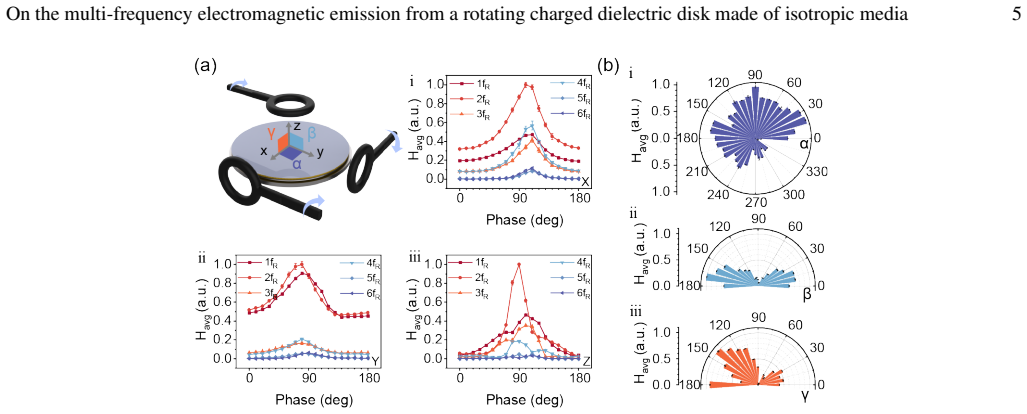
The near-field EM emission from a rotating charged dielectric disk shows discrete multi-harmonics at frequencies of nf_R with n=1 to 6, which may not be consistent with Minkowski's theory but the data can be well explained using the Maxwell's equations for a mechano-driven media system (MEs-f-MDMS). This study provides a solid proof to MEs-f-MDMS and establishes the theory for describing the near-field EM emission from accelerated medium motion, with engineering applications.
What carries the argument
The Maxwell's equations for a mechano-driven media system (MEs-f-MDMS), which incorporates mechanical driving of the medium to produce the observed multi-harmonic near-field emissions.
If this is right
- Emission frequencies occur at nf_R for n ranging from 1 to 6.
- Reversing the disk's rotation direction produces a phase shift of π for odd harmonics and zero for even harmonics.
- The framework describes near-field emissions arising from accelerated motion in isotropic media.
- The approach applies to engineering systems that involve rotating dielectric components.
Where Pith is reading between the lines
- Similar harmonic structure could appear in other forms of accelerated dielectric motion, such as linear oscillation or vibration.
- The results may guide design of rotation-based electromagnetic sensors or signal generators.
- Tests at higher speeds or with varied dielectric constants would map the limits of the MEs-f-MDMS description.
Load-bearing premise
The measured multi-harmonic signals originate from the mechano-driven electromagnetic response of the rotating isotropic medium itself rather than from experimental artifacts, electrode effects, or unmodeled mechanical vibrations.
What would settle it
A controlled measurement on the same rotating charged disk that records only a single frequency equal to the rotation rate, with all higher harmonics absent.
Figures



read the original abstract
The electromagnetic behavior of a uniformly moving medium has been traditionally described by the Minkowski's theory, based on which the electromagnetic (EM) emission from a rotating isotropic medium should be linear, which means that the frequency of the EM emission should be the same as that of the excitation source. However, we experimentally observed that the near-field EM emission from a rotating charged dielectric disk shows discrete multi-harmonics at frequencies of nf_R, with n= 1 to 6, where f_R is the rotation frequency of the disk. By reversing the rotating direction of the disk, the phase shift for the observed magnetic field is {\pi} for odd harmonics, but it is zero for the even harmonics. The experimental results may not be consistent with the Minkowski's theory, but the data can be well explained using the Maxwell's equations for a mechano-driven media system (MEs-f-MDMS). This study not only provides a solid proof to MEs-f-MDMS, but also establishes the theory for describing the near-field EM emission from accelerated medium motion, which has many engineering applications.
Editorial analysis
A structured set of objections, weighed in public.
Referee Report
Summary. The manuscript claims that near-field EM emission from a rotating charged dielectric disk of isotropic media exhibits discrete multi-harmonics at frequencies n f_R (n=1 to 6), with magnetic-field phase shifts of π for odd n and 0 for even n upon rotation reversal. These observations are asserted to be inconsistent with Minkowski theory but well explained by Maxwell's equations for a mechano-driven media system (MEs-f-MDMS), thereby providing experimental proof of the latter and a new framework for accelerated media.
Significance. If the central experimental claim is substantiated with reproducible data and controls, the result would supply a concrete test of constitutive relations in rotating media and support an alternative formulation for mechano-driven EM systems, with stated engineering relevance.
major comments (3)
- [Abstract] Abstract: the central claim of experimental observation of nf_R harmonics and their phase behavior is presented without any data, error bars, statistical analysis, or description of how the signals were isolated from the excitation source; this prevents verification that the reported multi-harmonics are load-bearing evidence rather than post-hoc interpretation.
- [Abstract] Abstract: no electrode geometry, contact details, vibration isolation, or control runs (uncharged disk, stationary disk with modulated voltage, different electrode materials) are described, leaving open the possibility that the observed harmonics and odd/even phase signature arise from time-varying capacitance or triboelectric contact effects rather than the bulk isotropic medium response.
- [Abstract] Abstract: the statement that 'the data can be well explained' by MEs-f-MDMS does not indicate whether the explanation is an independent, parameter-free derivation from the mechano-driven Maxwell equations or a fit that incorporates adjustable parameters; without this, it is impossible to assess whether the theory is falsifiably tested.
minor comments (1)
- The abstract refers to 'the experimental results' and 'the data' but supplies none; a methods or results section must include raw time traces, spectra, and quantitative comparison to both Minkowski and MEs-f-MDMS predictions.
Simulated Author's Rebuttal
We thank the referee for the careful reading and constructive comments. We respond to each major comment below.
read point-by-point responses
-
Referee: [Abstract] Abstract: the central claim of experimental observation of nf_R harmonics and their phase behavior is presented without any data, error bars, statistical analysis, or description of how the signals were isolated from the excitation source; this prevents verification that the reported multi-harmonics are load-bearing evidence rather than post-hoc interpretation.
Authors: The abstract is a concise summary. The full manuscript presents the experimental data with error bars, statistical analysis, and explicit description of signal isolation in the Results section and associated figures. We will revise the abstract to indicate that these supporting data and analyses are provided in the paper. revision: yes
-
Referee: [Abstract] Abstract: no electrode geometry, contact details, vibration isolation, or control runs (uncharged disk, stationary disk with modulated voltage, different electrode materials) are described, leaving open the possibility that the observed harmonics and odd/even phase signature arise from time-varying capacitance or triboelectric contact effects rather than the bulk isotropic medium response.
Authors: The full manuscript describes the electrode geometry, contacts, vibration isolation, and control experiments (uncharged disk, stationary disk with modulated voltage, and varied electrode materials) in the Methods and Results sections; these controls establish that the harmonics and phase signature originate from the bulk isotropic medium. We will add a brief reference to the controls in the revised abstract. revision: yes
-
Referee: [Abstract] Abstract: the statement that 'the data can be well explained' by MEs-f-MDMS does not indicate whether the explanation is an independent, parameter-free derivation from the mechano-driven Maxwell equations or a fit that incorporates adjustable parameters; without this, it is impossible to assess whether the theory is falsifiably tested.
Authors: The agreement is obtained from a direct, parameter-free solution of the mechano-driven Maxwell equations for the rotating charged disk; the nf_R harmonics and the odd/even phase shifts upon rotation reversal are predicted without adjustable parameters. We will revise the abstract to state explicitly that the comparison is parameter-free. revision: yes
Circularity Check
No significant circularity in derivation chain
full rationale
The paper reports experimental observation of discrete multi-harmonics at nf_R from a rotating charged dielectric disk, notes inconsistency with Minkowski theory, and states that the results can be explained via Maxwell's equations adapted for a mechano-driven media system (MEs-f-MDMS). The abstract frames this as an application of the adapted equations to the rotating isotropic medium, with the phase-reversal behavior (π for odd n, 0 for even) presented as a distinguishing signature. No quoted step shows a parameter fitted to the target harmonics then renamed as a prediction, nor does any load-bearing claim reduce by construction to a self-citation whose content is unverified or to a definition that presupposes the observed nf_R spectrum. The central claim therefore remains an independent application of the stated equations rather than a tautological restatement of inputs.
Axiom & Free-Parameter Ledger
Reference graph
Works this paper leans on
-
[1]
Beschreibung des Apparates, mit welchem die Versuche
R. Beschreibung des Apparates, mit welchem die Versuche. Annalen der Physik , volume=. 1890 , publisher=
-
[2]
1903 , publisher=
Eichenwald, A , journal=. 1903 , publisher=
1903
-
[3]
1904 , publisher=
Eichenwald, A , journal=. 1904 , publisher=
1904
-
[4]
Proceedings of the Royal Society of London
On the electric effect of rotating a magnetic insulator in a magnetic field , author=. Proceedings of the Royal Society of London. Series A, Containing Papers of a Mathematical and Physical Character , volume=. 1913 , publisher=
1913
-
[5]
American Journal of Physics , volume=
Measurement of the relativistic potential difference across a rotating magnetic dielectric cylinder , author=. American Journal of Physics , volume=. 2001 , publisher=
2001
-
[6]
anti-flux
Dynamics of electromagnetic waves generation by a rotating dielectric disk in a constant magnetic field—A revisit to Feynman’s “anti-flux” examples , author=. AIP Advances , volume=. 2025 , publisher=
2025
-
[7]
Die Grundgleichungen f
Minkowski, Hermann , journal=. Die Grundgleichungen f
-
[8]
1920 , publisher=
The principle of relativity: original papers , author=. 1920 , publisher=
1920
-
[9]
Das relativit
Minkowski, Hermann , journal=. Das relativit. 1915 , publisher=
1915
-
[10]
The European Physical Journal C , volume=
Electrodynamics in noninertial frames , author=. The European Physical Journal C , volume=. 2021 , publisher=
2021
-
[11]
The electrodynamics of inhomogeneous rotating media and the Abraham and Minkowski tensors. I. General theory , author=. Proceedings of the Royal Society A: Mathematical, Physical and Engineering Sciences , volume=. 2011 , publisher=
2011
-
[12]
American Journal of Physics , volume=
Applying relativistic electrodynamics to a rotating material medium , author=. American Journal of Physics , volume=. 1998 , publisher=
1998
-
[13]
The European Physical Journal Plus , volume=
Forty years of Galilean electromagnetism (1973--2013) , author=. The European Physical Journal Plus , volume=. 2013 , publisher=
1973
-
[14]
International Journal of Modern Physics B , volume=
The expanded Maxwell’s equations for a mechano-driven media system that moves with acceleration , author=. International Journal of Modern Physics B , volume=. 2023 , publisher=
2023
-
[15]
Advances in Physics: X , volume=
The Maxwell’s equations for a mechano-driven media system (MEs-f-MDMS) , author=. Advances in Physics: X , volume=. 2024 , publisher=
2024
-
[16]
Journal of Physics Communications , volume=
General solutions of the Maxwell’s equations for a mechano-driven media system (MEs-f-MDMS) , author=. Journal of Physics Communications , volume=. 2024 , publisher=
2024
-
[17]
Electromagnetic Science , volume=
Effective Fields Approach for the Maxwell’s Equations for a Mechano-Driven Media System Toward Engineering Applications , author=. Electromagnetic Science , volume=. 2025 , publisher=
2025
discussion (0)
Sign in with ORCID, Apple, or X to comment. Anyone can read and Pith papers without signing in.