Wide-field mid-infrared single-photon upconversion imaging
Pith reviewed 2026-06-28 09:06 UTC · model grok-4.3
The pith
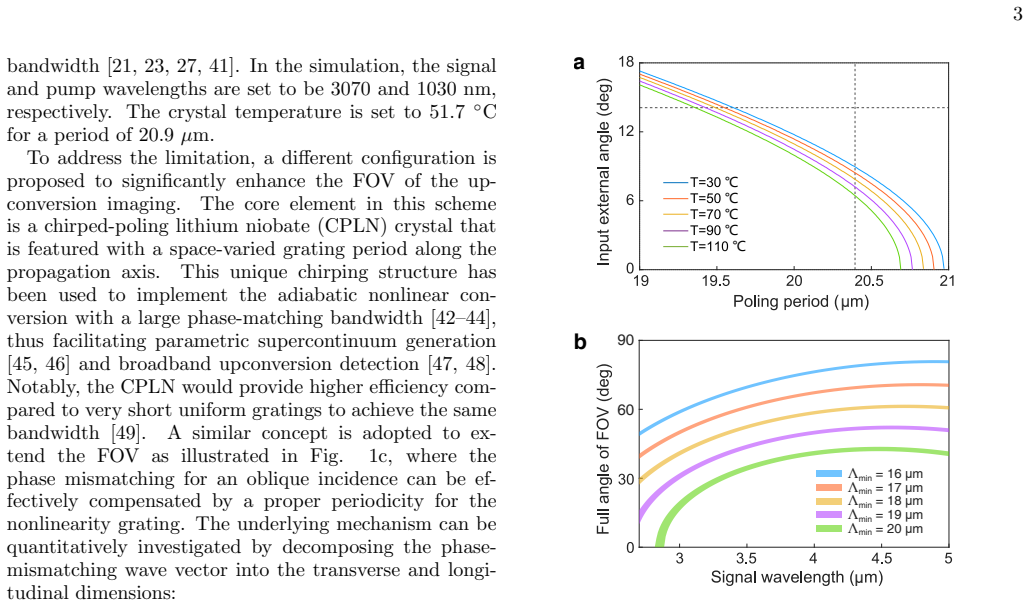
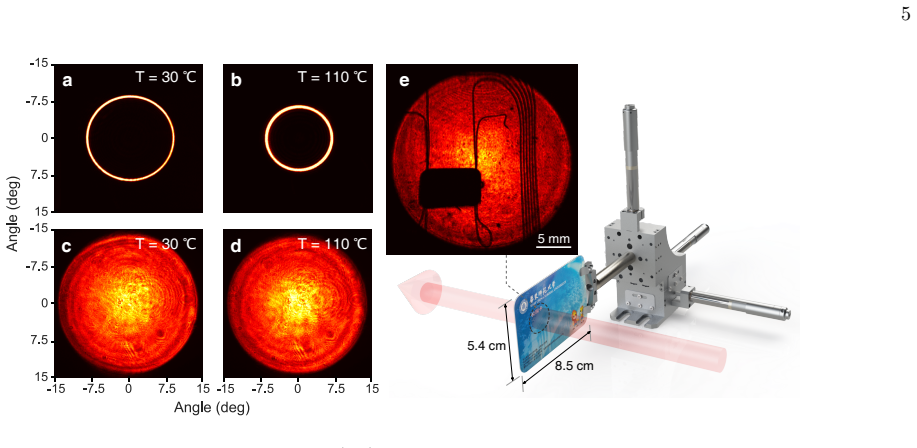
An aperiodic quasi-phase-matching crystal expands the acceptance angle for mid-infrared upconversion imaging to about 30 degrees in a single shot.
A machine-rendered reading of the paper's core claim, the machinery that carries it, and where it could break.
Core claim
By using an aperiodic quasi-phase-matching configuration, the acceptance angle for mid-infrared upconversion is expanded to approximately 30 degrees, more than ten times larger than the angle obtained with a periodically poled crystal, and the wide field is captured in one exposure without parameter scanning or post-processing, thereby supporting frame rates up to 216 kHz, room-temperature single-photon imaging through background suppression, and high-resolution time-of-flight three-dimensional imaging with picosecond gating.
What carries the argument
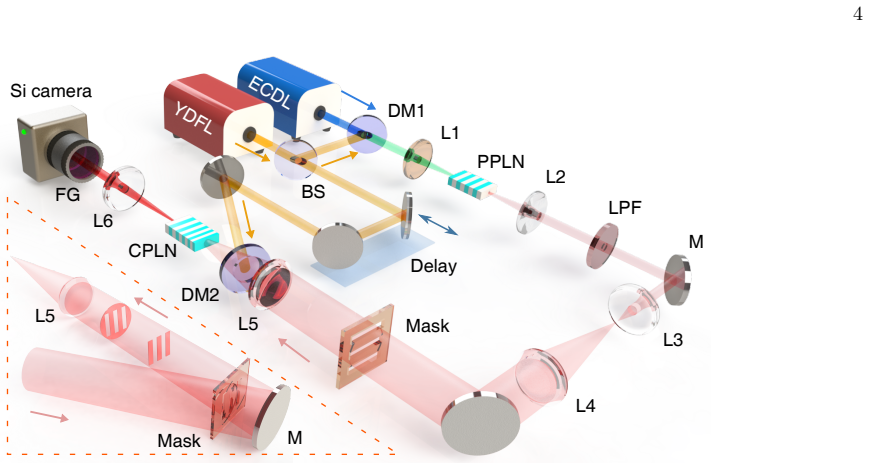
Aperiodic quasi-phase-matching crystal that broadens the angular range over which efficient nonlinear frequency conversion occurs.
If this is right
- Snapshot imaging becomes possible at frame rates reaching 216 kHz.
- Single-photon mid-infrared detection operates at room temperature because background noise is suppressed by spectro-temporal filtering.
- High-resolution three-dimensional imaging is obtained through picosecond optical gating and time-of-flight measurement.
- The wide-field capability removes the requirement for mechanical scanning or computational stitching in each frame.
Where Pith is reading between the lines
- The same aperiodic design principle could be applied to upconversion at other infrared wavelengths where phase-matching bandwidth is currently limiting.
- Integration with standard silicon focal-plane arrays may allow compact, non-scanning mid-infrared cameras for inspection tasks.
- Real-time volumetric imaging without moving parts becomes feasible once the acceptance angle and gating are combined in a single instrument.
Load-bearing premise
The fabricated aperiodic crystal, once aligned, maintains the full claimed acceptance angle uniformly across the imaging field without substantial efficiency loss or geometric distortion.
What would settle it
A direct measurement of upconversion efficiency versus input angle over a 30-degree span that shows either a significantly smaller uniform range or large spatial variations in efficiency or image quality.
Figures

read the original abstract
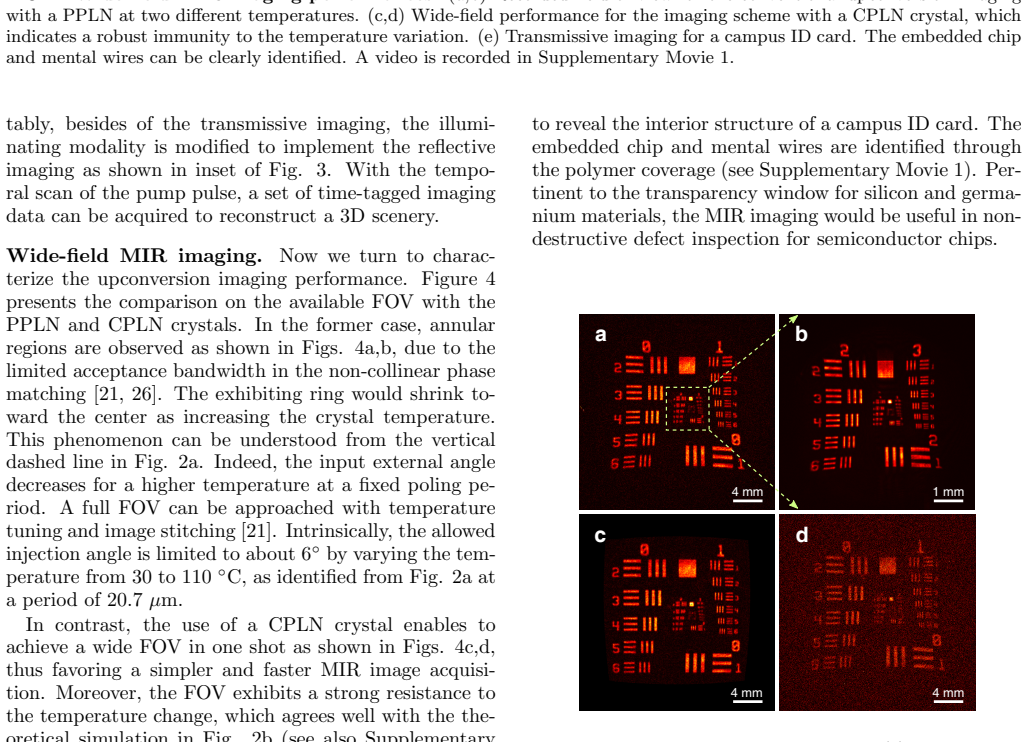
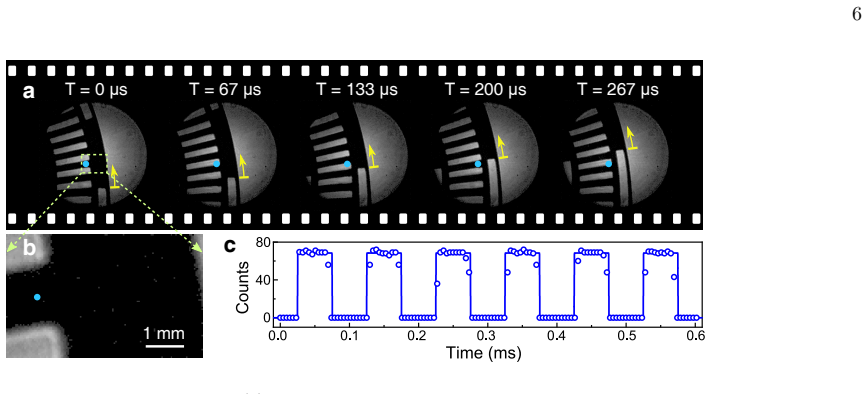
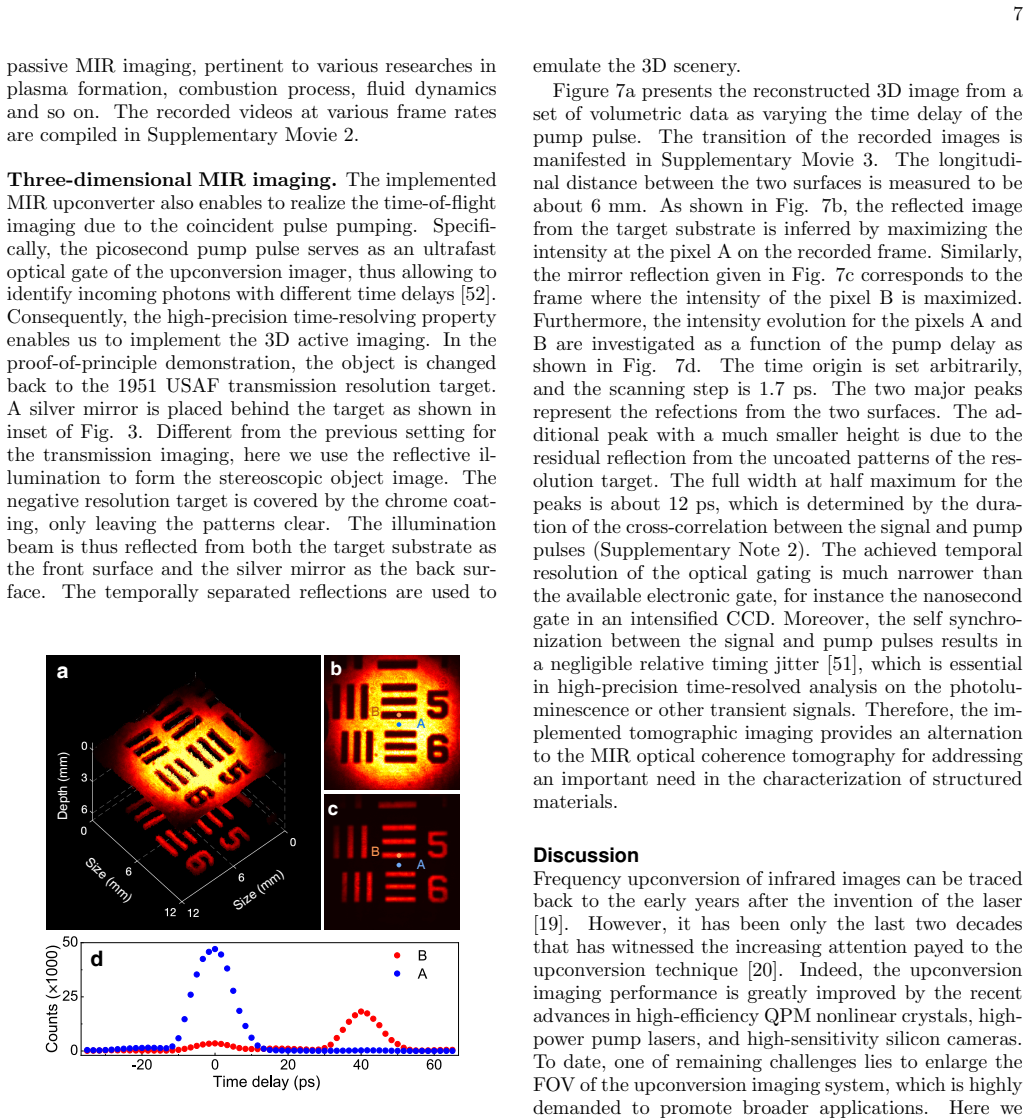
Frequency upconversion technique, where the infrared signal is nonlinearly translated into the visible band to leverage the silicon sensors, offers a promising alternation for the mid-infrared (MIR) imaging. However, the intrinsic field of view (FOV) is typically limited by the phase-matching condition, thus imposing a remaining challenge to promote subsequent applications. Here, we demonstrate a wide-field upconversion imaging based on the aperiodic quasi-phase-matching configuration. The acceptance angle is significantly expanded to about 30$^\circ$, over tenfold larger than that with the periodical poling crystal. The extended FOV is realized in one shot without the need of parameter scanning or post-processing. Consequently, a fast snapshot allows to facilitate high-speed imaging at a frame rate up to 216 kHz. Alternatively, single-photon imaging at room temperature is permitted due to the substantially suppressed background noise by the spectro-temporal filtering. Furthermore, we have implemented high-resolution time-of-flight 3D imaging based on the picosecond optical gating. These presented MIR imaging features with wide field, fast speed, and high sensitivity might stimulate immediate applications, such as non-destructive defect inspection, in-vivo biomedical examination, and high-speed volumetric tomography.
Editorial analysis
A structured set of objections, weighed in public.
Referee Report
Summary. The manuscript reports an experimental demonstration of wide-field mid-infrared single-photon upconversion imaging using an aperiodic quasi-phase-matching crystal. It claims an acceptance angle expanded to ~30° (over tenfold larger than periodic poling), realized in a single shot without scanning or post-processing, enabling snapshot imaging at up to 216 kHz frame rate, room-temperature single-photon sensitivity via spectro-temporal filtering, and picosecond time-of-flight 3D imaging.
Significance. If the central experimental claims hold with supporting characterization data, the work would offer a meaningful advance in mid-IR imaging by addressing the phase-matching-limited FOV without added complexity, potentially enabling new applications in high-speed and sensitive imaging. The aperiodic QPM approach to achieve this in one exposure is a notable technical choice.
major comments (1)
- [Abstract] Abstract: The headline claim of a uniform ~30° acceptance angle across the imaging field without substantial efficiency loss or distortion is load-bearing for the entire result, yet the text supplies no design equations for the aperiodic poling pattern, no simulated or measured efficiency curves versus angle and transverse position, and no fabrication/alignment tolerances. This directly matches the stress-test concern and prevents assessment of whether the aperiodic crystal satisfies the required flat response.
minor comments (1)
- [Abstract] Abstract: 'alternation' should read 'alternative'.
Simulated Author's Rebuttal
We thank the referee for their careful review and for highlighting the need for additional supporting details on the aperiodic QPM design. We address the major comment below.
read point-by-point responses
-
Referee: [Abstract] Abstract: The headline claim of a uniform ~30° acceptance angle across the imaging field without substantial efficiency loss or distortion is load-bearing for the entire result, yet the text supplies no design equations for the aperiodic poling pattern, no simulated or measured efficiency curves versus angle and transverse position, and no fabrication/alignment tolerances. This directly matches the stress-test concern and prevents assessment of whether the aperiodic crystal satisfies the required flat response.
Authors: We agree that the current manuscript text does not include explicit design equations for the aperiodic poling pattern, simulated or measured efficiency curves versus angle and transverse position, or fabrication/alignment tolerances. These elements are necessary to fully substantiate the uniformity of the ~30° acceptance angle. In the revised version we will add the design equations used to generate the aperiodic pattern, corresponding simulated efficiency maps, measured efficiency data across angle and field position, and a discussion of fabrication tolerances. The experimental demonstration of single-shot wide-field imaging at 216 kHz and single-photon sensitivity provides empirical evidence for the expanded FOV, but we recognize that the requested characterization data will allow a more rigorous assessment. revision: yes
Circularity Check
No circularity: experimental demonstration with no derivation chain
full rationale
The paper reports an experimental realization of wide-field upconversion imaging via an aperiodic QPM crystal, with measured acceptance angle ~30° and high-speed/single-photon capabilities. No equations, fitted parameters, predictions, or uniqueness theorems appear in the provided text. Central claims rest on direct experimental outcomes rather than any reduction to self-defined inputs or self-citation chains. This matches the default expectation for non-circular experimental work.
Axiom & Free-Parameter Ledger
axioms (1)
- standard math Quasi-phase-matching theory governs the acceptance angle in nonlinear frequency conversion.
Reference graph
Works this paper leans on
-
[1]
& Mollmann, K.-P.Infrared Thermal Imag- ing: Fundamentals, Research and Applications(Wiley- VCH, 2010)
Vollmer, M. & Mollmann, K.-P.Infrared Thermal Imag- ing: Fundamentals, Research and Applications(Wiley- VCH, 2010)
2010
-
[2]
B., Huot, L., Meng, L., Junaid, S., Tomko, J., Lloyd, G
Hermes, M., Morrish, R. B., Huot, L., Meng, L., Junaid, S., Tomko, J., Lloyd, G. R., Masselink, W. T., Tidemand- Lichtenberg, P., Pedersen, C., Palombo, F. & Stone, N. Mid-IR hyperspectral imaging for label-free histopathol- ogy and cytology.Journal of Optics.20, 023002 (2018)
2018
-
[3]
HgCdTe infrared detector material: his- tory, status and outlook.Rep
Rogalski, A. HgCdTe infrared detector material: his- tory, status and outlook.Rep. Prog. Phys.68, 2267-2336 (2005)
2005
-
[4]
& Nguyen, B.-M
Razeghi, M. & Nguyen, B.-M. Advances in mid-infrared detection and imaging: a key issues review.Rep. Prog. Phys.77, 082401 (2014)
2014
-
[5]
Wang, P., Xia, H., Li, Q., Wang, F., Zhang, L., Li, T., Martyniuk, P., Rogalski, A. & Hu, W. Sensing infrared photons at room temperature: from bulk materials to atomic layers.Small.15, 1904396 (2019)
2019
-
[6]
& Dai, D
Liu, C., Guo, J., Yu, L., Li, J., Zhang, M., Li, H., Shi, Y. & Dai, D. Silicon/2D-material photodetectors: from near-infrared to mid-infrared.Light Sci. Appl.10, 123 (2021)
2021
-
[7]
& Guyot- Sionnest, V
Keuleyan, S., Lhuillier, E., Brajuskovic, V. & Guyot- Sionnest, V. Mid-infrared HgTe colloidal quantum dot photodetectors.Nat. Photon.5, 489-493 (2011)
2011
-
[8]
H., Adinolfi, V., Shrestha, V
Bullock, J., Amani, M., Cho, J., Chen, Y.-Z., Ahn, G. H., Adinolfi, V., Shrestha, V. R., Gao, Y., Crozier, K. B., Chueh, Y.-L. & Javey, A. Polarization-resolved black phosphorus/molybdenum disulfide midwave in- frared photodiodes with high detectivity at room tem- perature,Nat. Photon.12, 601-607 (2018)
2018
-
[9]
& Miao, F
Long, M., Gao, A., Wang, P., Xia, H., Ott, C., Pan, C., Fu, Y., Liu, E., Chen, X., Lu, W., Nilges, T., Xu, J., Wang, X., Hu, W. & Miao, F. Room temperature high- detectivity mid-infrared photodetectors based on black arsenic phosphorus.Sci. Adv.3, e1700589 (2017)
2017
-
[10]
& Xia, F
Guo, Q., Yu, R., Li, C., Yuan, S., Deng, B., Javier Garca de Abajo, F. & Xia, F. Efficient electrical detection of mid-infrared graphene plasmons at room temperature, Nat. Mater.17, 986-992 (2018)
2018
-
[11]
Tong, L., Huang, X., Wang, P., Ye, L., Peng, M., An, L., Sun, Q., Zhang, Y., Yang, G., Li, Z., Zhong, F., Wang, F., Wang, Y., Motlag, M., Wu, W., Cheng, G. J. & Hu, W. Stable mid-infrared polarization imaging based on quasi-2D tellurium at room temperature.Nat. Comm.11, 2308 (2020)
2020
-
[12]
Peng, M., Xie, R., Wang, Z., Wang, P., Wang, F., Ge, H., Wang, Y., Zhong, F., Wu, P., Ye, J., Li, Q., Zhang, L., Ge, X., Ye, Y., Lei, Y., Jiang, W., Hu, Z., Wu, F., Zhou, X., Miao, J., Wang, J., Yan, H., Shan, C., Dai, J., Chen, C., Chen, X., Lu, W. & Hu, W. Blackbody-sensitive room-temperature infrared photodetectors based on low- dimensional tellurium g...
2021
-
[13]
Wang, Z., Wang, Y., He, T., Wu, P., Peng, M., Wang, H., Xu, T., Wang, F., Wang, P., Miao, J
Zhong, F., Wang, H,. Wang, Z., Wang, Y., He, T., Wu, P., Peng, M., Wang, H., Xu, T., Wang, F., Wang, P., Miao, J. & Hu, W. Recent progress and challenges on two-dimensional material photodetectors from the per- spective of advanced characterization technologies.Nano Res.14, 1840-1862 (2021)
2021
-
[14]
Hadfield, R. H. Single-photon detectors for optical quan- tum information applications,Nat. Photon.3, 696-705 (2009)
2009
-
[15]
M., Burri, S
Bruschini, C., Homulle, H., Antolovic, I. M., Burri, S. & Charbon, E. Single-photon avalanche diode imagers in biophotonics: Review and outlook.Light Sci. Appl.8, 87 (2019)
2019
-
[16]
R., Buller, G
Gariepy, G., Krstaji, N., Henderson, R., Li, C., Thomson, R. R., Buller, G. S., Heshmat, B., Raskar, R., Leach, J. & Faccio, D. Single-photon sensitive light-in-fight imaging. Nat. Commun.6, 6021 (2015)
2015
-
[17]
B., Borish, V., Cole, G
Lemos, G. B., Borish, V., Cole, G. D., Ramelow, S., Lap- 10 kiewicz, R. & Zeilinger, A. Quantum imaging with unde- tected photons.Nature.512, 409-412 (2014)
2014
-
[18]
& Zeng, H
Huang, K., Gu, X., Pan, H., Wu, E. & Zeng, H. Few- photon-level two-dimensional infrared imaging by coin- cidence frequency upconversion.Appl. Phys. Lett.100, 151102 (2012)
2012
-
[19]
Midwinter, J. E. Image conversion from 1.6µto the visi- ble in lithium niobate.Appl. Phys. Lett.12, 68-70 (1968)
1968
-
[20]
J., Meng, L., Pedersen, C
Barh, A., Rodrigo, P. J., Meng, L., Pedersen, C. & Tidemand-Lichtenberg, P. Parametric upconversion imaging and its applications.Adv. Opt. Photon.11, 952- 1019 (2019)
2019
-
[21]
S., Tidemand-Lichtenberg, P
Dam, J. S., Tidemand-Lichtenberg, P. & Pedersen, C. Room-temperature mid-infrared single-photon spectral imaging.Nat. Photon.6, 788-793 (2012)
2012
-
[22]
& Zeng, H
Zhou, Q., Huang, K., Pan, H., Wu, E. & Zeng, H. Ul- trasensitive mid-infrared up-conversion imaging at few- photon level.Appl. Phys. Lett.102, 241110 (2013)
2013
-
[23]
& Zeng, H
Wang, Y., Fang, J., Zheng, T., Liang, Y., Hao, Q., Wu, E., Yan, M., Huang, K. & Zeng, H. Mid-infrared single- photon edge enhanced imaging based on nonlinear vortex filtering.Laser Photon. Rev., 2100189 (2021)
2021
-
[24]
V., Maniam, S
Paterova, A. V., Maniam, S. M., Yang, H., Grenci, G. & Krivitsky, L. A. Hyperspectral infrared microscopy with visible light.Sci. Adv.6, eabd0460 (2020)
2020
-
[25]
M., Avery, E
Kviatkovsky, I., Chrzanowski, H. M., Avery, E. G., Bartolomaeus, H. & Ramelow, S. Microscopy with undetected photons in the mid-infrared.Sci. Adv.6, eabd0264, (2020)
2020
-
[26]
M., Tidemand-Lichtenberg, P., Dam, J
Kehlet, L. M., Tidemand-Lichtenberg, P., Dam, J. S. & Pedersen, C. Infrared upconversion hyperspectral imag- ing.Opt. Lett.40, 938-941 (2015)
2015
-
[27]
H., Xu, Z
Liu, S., Yang, C., Liu, S., Zhou, Z., Li, Y., Li, Y. H., Xu, Z. H., Guo, G. & Shi, B. Up-conversion imaging process- ing with field-of-view and edge enhancement.Phys. Rev. Appl.11, 044013 (2019)
2019
-
[28]
M., Sanders, N., Tidemand-Lichtenberg, P., Dam, J
Kehlet, L. M., Sanders, N., Tidemand-Lichtenberg, P., Dam, J. S. & Pedersen, C. Infrared hyperspectral up- conversion imaging using spatial object translation.Opt. Express23, 34023-34028 (2015)
2015
-
[29]
P., Kischkat, J., Mas- selink, W
Junaid, S., Tomko, J., Semtsiv, M. P., Kischkat, J., Mas- selink, W. T., Pedersen, C. & Tidemand-Lichtenberg, P. Mid-infrared upconversion based hyperspectral imaging. Opt. Express26, 2203-2211 (2018)
2018
-
[30]
J., Fernndez-Pousa, C
Maestre, H., Torregrosa, A. J., Fernndez-Pousa, C. R. & Capmany, J. IR-to-visible image upconverter under non- linear crystal thermal gradient operation.Opt. Express 26, 1133-1144 (2018)
2018
-
[31]
& Fabre, C
Demur, R., Garioud, R., Grisard, A., Lallier, E., Le- viandier, L., Morvan, L., Treps, N. & Fabre, C. Near- infrared to visible upconversion imaging using a broad- band pump laser.Opt. Express26, 13252-13263 (2018)
2018
-
[32]
M., Tidemand-Lichtenberg, P., Leick, L
Huot, L., Moselund, P. M., Tidemand-Lichtenberg, P., Leick, L. & Pedersen, C. Upconversion imaging using an all-fiber supercontinuum source.Opt. Lett.41, 2466-2469 (2016)
2016
-
[33]
& Rodrigo, P
Junaid, S., Tidemand-Lichtenberg, P., Pedersen, C. & Rodrigo, P. J. Upconversion dark-field imaging with ex- tended field of view at video frame rate.Appl. Opt.59, 2157-2164 (2020)
2020
-
[34]
J., Maestre, H
Torregrosa, A. J., Maestre, H. & Capmany, J. Intra- cavity upconversion to 631 nm of images illuminated by an eye-safe ASE source at 1550 nm.Opt. Lett.40, 5315- 5318 (2015)
2015
-
[35]
& Pedersen, C
Junaid, S., Chaitanya Kumar, S., Mathez, M., Her- mes, M., Stone, N., Shepherd, N., Ebrahim-Zadeh, M., Tidemand-Lichtenberg, P. & Pedersen, C. Video-rate, mid-infrared hyperspectral upconversion imaging.Optica 6, 702-708 (2019)
2019
-
[36]
M., Prince, R
Knez, D., Hanninen, A. M., Prince, R. C., Potma, E. O. & Fishman, D. A. Infrared chemical imaging through non-degenerate two-photon absorption in silicon-based cameras.Light Sci. Appl.9, 125 (2020)
2020
-
[37]
A., Cirloganu, C
Fishman, D. A., Cirloganu, C. M., Webster, S., Padilha, L. A., Monroe, M., Hagan, D. J. & Stryland, E. W. V. Sensitive mid-infrared detection in wide-bandgap semi- conductors using extreme non-degenerate two-photon ab- sorption.Nat. Photon.5, 561-565 (2011)
2011
-
[38]
M., Magel, G
Fejer, M. M., Magel, G. A., Jundt, D. H. & Byer, R. L. Quasi-phase-matched second harmonic generation: tun- ing and tolerances.IEEE J. Quantum Electron.28, 2631- 2654 (1992)
1992
-
[39]
& Kapteyn, H
Bahabad, A., Murnane, M. & Kapteyn, H. Quasi-phase- matching of momentum and energy in nonlinear optical processes.Nat. Photon.4, 570-575 (2010)
2010
-
[40]
Hu, X., Wei, D., Fang, X., Zhang, Y., Wu, D., Hu, Y., Li, J., Zhu, S
Wei, D., Wang, C., Wang, H. Hu, X., Wei, D., Fang, X., Zhang, Y., Wu, D., Hu, Y., Li, J., Zhu, S. & Xiao, M. Experimental demonstration of a three-dimensional lithium niobate nonlinear photonic crystal.Nat. Photon. 12, 596-600 (2018)
2018
-
[41]
& Guo, G
Zhou, Z., Li, Y., Ding, D., Zhang, W., Shi, S., Shi, B. & Guo, G. Orbital angular momentum photonic quantum interface.Light Sci. Appl.5, e16019 (2016)
2016
-
[42]
& Sil- berberg, Y
Suchowski, H., Prabhudesai, V., Oron, D., Arie, A. & Sil- berberg, Y. Robust adiabatic sum frequency conversion. Opt. Express17, 12731-12740 (2009)
2009
-
[43]
& Arie, A
Suchowski, H., Porat, G. & Arie, A. Adiabatic processes in frequency conversion.Laser Photon. Rev.8, 333-367 (2014)
2014
-
[44]
& Suchowski, H
Mrejen, M., Erlich, Y., Levanon, A. & Suchowski, H. Multicolor time-resolved upconversion imaging by adia- batic sum frequency conversion.Laser Photon. Rev.14, 2000040 (2020)
2020
-
[45]
Q., Ren, M
Chen, B. Q., Ren, M. L., Liu, R. J., Zhang, C., Sheng, Y., Ma, B. Q. & Li, Z. Y. Simultaneous broadband gen- eration of second and third harmonics from chirped non- linear photonic crystals.Light Sci. Appl.3, e189-e189 (2014)
2014
-
[46]
& Zhang, Z
Liu, P., Heng, J. & Zhang, Z. Chirped-pulse genera- tion from optical parametric oscillators with an aperiodic quasi-phase-matching crystal.Opt. Lett.45, 2568-2571 (2020)
2020
-
[47]
W., Nugent-Glandorf, L., Adler, F
Neely, T. W., Nugent-Glandorf, L., Adler, F. & Diddams, S. A. Broadband mid-infrared frequency upconversion and spectroscopy with an aperiodically poled LiNbO3 waveguide.Opt. Lett.37, 4332-4334 (2012)
2012
-
[48]
Friis S. M. M. & Hgstedt, L. Upconversion-based mid- infrared spectrometer using intra-cavity LiNbO3 crystals with chirped poling structure.Opt. Lett.44, 4231-4234 (2019)
2019
-
[49]
& Kashyap, R
Bostani, A., Tehranchi, A. & Kashyap, R. Super-tunable, broadband up-conversion of a high-power CW laser in an engineered nonlinear crystal.Sci. Rep.7, 883 (2017)
2017
-
[50]
& Shi, B.-S
Yang, C., Liu, S.-L., Zhou, Z.-Y., Li, Y., Li, Y.-H., Liu, S.-K., Xu, Z.-H., Guo, G.-C. & Shi, B.-S. Frequency up- conversion of an infrared image via a flat-top pump beam. Opt. Comm.460, 125143 (2020)
2020
-
[51]
& Zeng, H
Huang, K., Wang, Y., Fang, J., Kang, W., Sun, Y., 11 Liang, Y., Hao, Q., Yan, M. & Zeng, H. Mid-infrared photon counting and resolving via efficient frequency up- conversion.Photonics Res.9, 259-265 (2021)
2021
-
[52]
Y., Han, J
Wang, B., Zheng, M. Y., Han, J. J., Huang, X., Xie, X. P., Xu, F., Zhang, Q. & Pan, J. W. Non-Line-of-Sight imaging with picosecond temporal resolution.Phys. Rev. Lett.127, 053602 (2021)
2021
-
[53]
& Fabre, C
Demur, R., Grisard, A., Morvan, L., Lallier, E., Treps, N. & Fabre, C. High sensitivity narrowband wavelength mid-infrared detection at room temperature.Opt. Lett. 42, 2006-2009 (2017)
2006
-
[54]
& Pet- rich, W
Haase, K., Krger-Lui, N., Pucci, A., Schnhals, A. & Pet- rich, W. Real-time mid-infrared imaging of living mi- croorganisms.J. Biophoton.9, 61-66 (2016)
2016
discussion (0)
Sign in with ORCID, Apple, or X to comment. Anyone can read and Pith papers without signing in.