Multi-Modal Graph Neural Network with Transformer-Guided Adaptive Diffusion for Preclinical Alzheimer Classification
Pith reviewed 2026-06-28 11:27 UTC · model grok-4.3
The pith
A transformer guides per-node diffusion in a multi-modal GNN to improve preclinical Alzheimer's classification from brain graphs.
A machine-rendered reading of the paper's core claim, the machinery that carries it, and where it could break.
Core claim
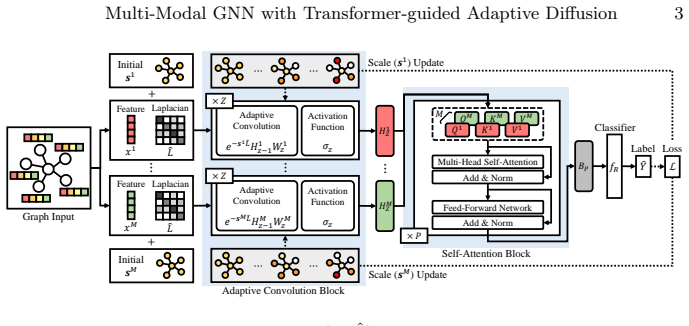
Guiding the diffusion process at each node by a downstream transformer aggregates both short- and long-range properties of graphs via diffusion-kernel and multi-head attention respectively, which improves performance of pre-clinical Alzheimer's disease classification with various modalities and identifies key ROIs that are closely associated with the preclinical stages of AD.
What carries the argument
Transformer-guided adaptive diffusion at each node, which directs diffusion-kernel aggregation for short-range properties and multi-head attention for long-range properties.
If this is right
- Higher classification accuracy for preclinical AD using multiple imaging modalities than prior GNN or attention approaches.
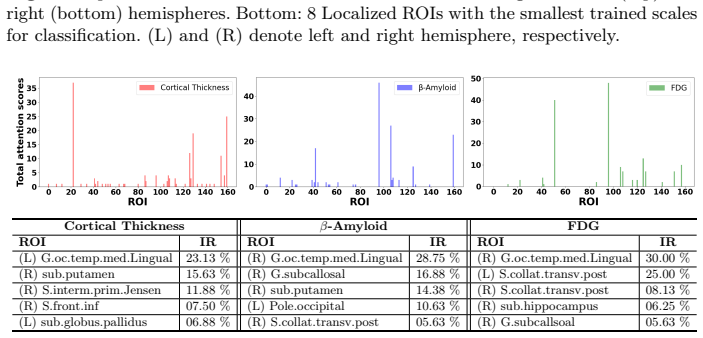
- Consistent identification of key ROIs linked to preclinical disease stages.
- Effective capture of both local diffusion and global attention signals within the same graph model.
- Support for earlier diagnosis and intervention planning in Alzheimer's disease.
Where Pith is reading between the lines
- The same node-guided diffusion pattern could be tested on graphs from other neurodegenerative conditions such as Parkinson's or frontotemporal dementia.
- If the transformer guidance proves stable across sites, the model may reduce the need for heavy modality-specific preprocessing in multi-modal studies.
- Longitudinal scans could be used to check whether the highlighted ROIs predict conversion from preclinical to clinical stages.
Load-bearing premise
The transformer can reliably guide the per-node diffusion process to aggregate both short- and long-range graph properties without overfitting to the specific multi-modal AD datasets or losing critical node-centric information.
What would settle it
Running the model on a held-out multi-modal brain imaging dataset from a different cohort of preclinical AD subjects and healthy controls and finding no accuracy improvement over standard GNN baselines or inconsistent ROI identification.
Figures
read the original abstract
The graphical representation of the brain offers critical insights into diagnosing and prognosing neurodegenerative disease via relationships between regions of interest (ROIs). Despite recent emergence of various Graph Neural Networks (GNNs) to effectively capture the relational information, there remain inherent limitations in interpreting the brain networks. Specifically, convolutional approaches ineffectively aggregate information from distant neighborhoods, while attention-based methods exhibit deficiencies in capturing node-centric information, particularly in retaining critical characteristics from pivotal nodes. These shortcomings reveal challenges for identifying disease-specific variation from diverse features from different modalities. In this regard, we propose an integrated framework guiding diffusion process at each node by a downstream transformer where both short- and long-range properties of graphs are aggregated via diffusion-kernel and multi-head attention respectively. We demonstrate the superiority of our model by improving performance of pre-clinical Alzheimer's disease (AD) classification with various modalities. Also, our model adeptly identifies key ROIs that are closely associated with the preclinical stages of AD, marking a significant potential for early diagnosis and prevision of the disease.
Editorial analysis
A structured set of objections, weighed in public.
Referee Report
Summary. The paper proposes a multi-modal graph neural network framework in which a downstream transformer guides per-node adaptive diffusion on brain ROI graphs constructed from multiple imaging modalities. Diffusion kernels aggregate short-range properties while multi-head attention captures long-range dependencies, addressing limitations of standard convolutional GNNs and pure attention mechanisms. The central empirical claim is that the resulting model improves preclinical AD classification performance relative to baselines and identifies disease-relevant ROIs.
Significance. If the reported gains and ROI findings are reproducible, the architecture offers a concrete mechanism for balancing local and global graph information in multi-modal brain networks, which could support earlier and more interpretable detection of preclinical Alzheimer's disease.
minor comments (3)
- [Abstract] The abstract states performance superiority and ROI identification but contains no numerical results, baseline names, dataset sizes, or validation protocol; these details appear only in the experimental section and should be summarized quantitatively in the abstract for clarity.
- [Method] Notation for the per-node diffusion guidance (e.g., how transformer outputs modulate the diffusion kernel parameters) is introduced without an explicit equation or pseudocode block; adding a compact algorithmic description would improve reproducibility.
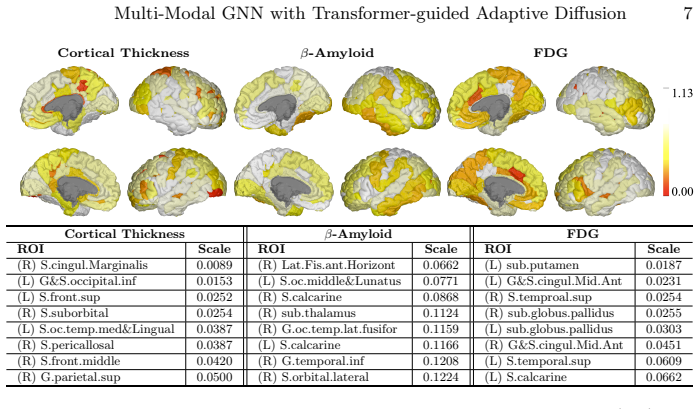
- [Experiments] Figure captions for the ROI saliency maps do not state the exact thresholding or statistical test used to declare a region 'key'; this should be specified to allow readers to assess the biological plausibility of the identified regions.
Simulated Author's Rebuttal
We thank the referee for the positive summary of our work, the assessment of its potential significance, and the recommendation for minor revision. The description accurately captures the proposed transformer-guided adaptive diffusion mechanism and its application to multi-modal brain graphs for preclinical AD classification.
Circularity Check
No significant circularity detected
full rationale
The manuscript proposes a multi-modal GNN architecture with transformer-guided adaptive diffusion for preclinical AD classification and reports empirical performance gains plus ROI identification. No equations, derivations, or parameter-fitting steps are described in the provided text that could reduce a claimed prediction or result to an input by construction. Claims rest on experimental outcomes rather than self-definitional mappings, fitted-input renamings, or load-bearing self-citations. The central result is therefore an independent empirical demonstration, not a tautology.
Axiom & Free-Parameter Ledger
Reference graph
Works this paper leans on
-
[1]
Advances in Neural In- formation Processing Systems (2016)
Ba, J.L., Kiros, J.R., Hinton, G.E.: Layer normalization. Advances in Neural In- formation Processing Systems (2016)
2016
-
[2]
Chung, F.R.: Spectral graph theory, vol. 92. American Mathematical Soc. (1997)
1997
-
[3]
Neuroimage53(1), 1–15 (2010)
Destrieux, C., Fischl, B., Dale, A., Halgren, E.: Automatic parcellation of human cortical gyri and sulci using standard anatomical nomenclature. Neuroimage53(1), 1–15 (2010)
2010
-
[4]
Molecular neurodegeneration14(1), 1–18 (2019)
DeTure, M.A., Dickson, D.W.: The neuropathological diagnosis of Alzheimer’s dis- ease. Molecular neurodegeneration14(1), 1–18 (2019)
2019
-
[5]
Annual Meeting of the Association for Computational Linguistics (2019)
Devlin,J.,Chang,M.W.,Lee,K.,Toutanova,K.:Bert:Pre-trainingofdeepbidirec- tional transformers for language understanding. Annual Meeting of the Association for Computational Linguistics (2019)
2019
-
[6]
International Conference on Learning Representations (2021)
Dosovitskiy, A., Beyer, L., Kolesnikov, A., Weissenborn, D., Zhai, X., Unterthiner, T., Dehghani, M., Minderer, M., Heigold, G., Gelly, S., et al.: An image is worth 16x16 words: Transformers for image recognition at scale. International Conference on Learning Representations (2021)
2021
-
[7]
Advances in Neural Information Processing Systems32(2019)
Gasteiger, J., Weißenberger, S., Günnemann, S.: Diffusion improves graph learning. Advances in Neural Information Processing Systems32(2019)
2019
-
[8]
In: Computer Vision and Pattern Recognition
He, K., Zhang, X., Ren, S., Sun, J.: Deep residual learning for image recognition. In: Computer Vision and Pattern Recognition. pp. 770–778 (2016)
2016
-
[9]
Brain131(12), 3277–3285 (2008)
de Jong, L.W., van der Hiele, K., Veer, I.M., Houwing, J., Westendorp, R., Bollen, E.,deBruin,P.W.,Middelkoop,H.,vanBuchem,M.A.,vanderGrond,J.:Strongly reduced volumes of putamen and thalamus in Alzheimer’s disease: an MRI study. Brain131(12), 3277–3285 (2008)
2008
-
[10]
Clinical Neuro- physiology126(11), 2132–2141 (2015)
Khazaee, A., Ebrahimzadeh, A., Babajani-Feremi, A.: Identifying patients with Alzheimer’s disease using resting-state fMRI and graph theory. Clinical Neuro- physiology126(11), 2132–2141 (2015)
2015
-
[11]
NeuroImage118, 103–117 (2015)
Kim, W.H., Adluru, N., Chung, M.K., Okonkwo, O.C., Johnson, S.C., Bendlin, B.B., Singh, V.: Multi-resolution statistical analysis of brain connectivity graphs in preclinical Alzheimer’s disease. NeuroImage118, 103–117 (2015)
2015
-
[12]
International Conference on Learning Representations (2017)
Kipf, T.N., Welling, M.: Semi-supervised classification with graph convolutional networks. International Conference on Learning Representations (2017)
2017
-
[13]
Behavioural brain research 326, 132–138 (2017)
Liu,X.,Chen,W.,Hou,H.,Chen,X.,Zhang,J.,Liu,J.,Guo,Z.,Bai,G.:Decreased functional connectivity between the dorsal anterior cingulate cortex and lingual gyrus in Alzheimer’s disease patients with depression. Behavioural brain research 326, 132–138 (2017)
2017
-
[14]
Oppenheim, A.V., Willsky, A.S., Nawab, S.H., Ding, J.J.: Signals and systems, vol. 2. Prentice hall Upper Saddle River, NJ (1997) 10 J. Sim et al
1997
-
[15]
In: Interna- tional Conference on Medical Image Computing and Computer-Assisted Interven- tion
Park, J., Hwang, Y., Kim, M., Chung, M.K., Wu, G., Kim, W.H.: Convolving directed graph edges via Hodge Laplacian for brain network analysis. In: Interna- tional Conference on Medical Image Computing and Computer-Assisted Interven- tion. pp. 789–799. Springer (2023)
2023
-
[16]
3 Biotech 12(2), 55 (2022)
Rao, Y.L., Ganaraja, B., Murlimanju, B., Joy, T., Krishnamurthy, A., Agrawal, A.: Hippocampus and its involvement in Alzheimer’s disease: a review. 3 Biotech 12(2), 55 (2022)
2022
-
[17]
Network Neuroscience 2(4), 513–535 (2018)
Ryyppö, E., Glerean, E., Brattico, E., Saramäki, J., Korhonen, O.: Regions of interest as nodes of dynamic functional brain networks. Network Neuroscience 2(4), 513–535 (2018)
2018
-
[18]
In: Proceedings of the AAAI Conference on Artificial Intelligence
Sim, J., Jeon, S., Choi, I., Wu, G., Kim, W.H.: Learning to approximate adaptive kernel convolution on graphs. In: Proceedings of the AAAI Conference on Artificial Intelligence. vol. 38, pp. 4882–4890 (2024)
2024
-
[19]
Brain132(1), 213–224 (2009)
Stam, C.J., De Haan, W., Daffertshofer, A., Jones, B., Manshanden, I., van Cap- pellen van Walsum, A.M., Montez, T., Verbunt, J., De Munck, J.C., Van Dijk, B.W., et al.: Graph theoretical analysis of magnetoencephalographic functional connectivity in Alzheimer’s disease. Brain132(1), 213–224 (2009)
2009
-
[20]
Journal of Nuclear Medicine45(9), 1431–1434 (2004)
Thie, J.A.: Understanding the standardized uptake value, its methods, and impli- cations for usage. Journal of Nuclear Medicine45(9), 1431–1434 (2004)
2004
-
[21]
Advances in Neural Information Pro- cessing Systems30(2017)
Vaswani,A.,Shazeer,N.,Parmar,N.,Uszkoreit,J.,Jones,L.,Gomez,A.N.,Kaiser, Ł., Polosukhin, I.: Attention is all you need. Advances in Neural Information Pro- cessing Systems30(2017)
2017
-
[22]
International Conference on Learning Representations (2018)
Veličković, P., Cucurull, G., Casanova, A., Romero, A., Lio, P., Bengio, Y.: Graph attention networks. International Conference on Learning Representations (2018)
2018
-
[23]
International Conference on Learning Representations (2023)
Wu, Q., Yang, C., Zhao, W., He, Y., Wipf, D., Yan, J.: Difformer: Scalable (graph) transformers induced by energy constrained diffusion. International Conference on Learning Representations (2023)
2023
-
[24]
Advances in Neural Information Processing Systems35, 27387–27401 (2022)
Wu, Q., Zhao, W., Li, Z., Wipf, D.P., Yan, J.: Nodeformer: A scalable graph struc- ture learning transformer for node classification. Advances in Neural Information Processing Systems35, 27387–27401 (2022)
2022
-
[25]
Advances in Neural Information Processing Systems36(2024)
Wu, Q., Zhao, W., Yang, C., Zhang, H., Nie, F., Jiang, H., Bian, Y., Yan, J.: Sim- plifying and empowering transformers for large-graph representations. Advances in Neural Information Processing Systems36(2024)
2024
-
[26]
International Joint Conference on Artificial Intelligence (2019)
Xu, B., Shen, H., Cao, Q., Cen, K., Cheng, X.: Graph convolutional networks using heat kernel for semi-supervised learning. International Joint Conference on Artificial Intelligence (2019)
2019
-
[27]
Advances in Neural Information Processing Systems34, 23321– 23333 (2021)
Zhao, J., Dong, Y., Ding, M., Kharlamov, E., Tang, J.: Adaptive diffusion in graph neural networks. Advances in Neural Information Processing Systems34, 23321– 23333 (2021)
2021
discussion (0)
Sign in with ORCID, Apple, or X to comment. Anyone can read and Pith papers without signing in.