Privacy-Preserving High-Resolution Image Gradient Computation Based on Fully Homomorphic Encryption
Pith reviewed 2026-06-28 09:36 UTC · model grok-4.3
The pith
Dividing high-resolution images into sub-images keeps homomorphic encryption parameters small for privacy-preserving Sobel gradient computation.
A machine-rendered reading of the paper's core claim, the machinery that carries it, and where it could break.
Core claim
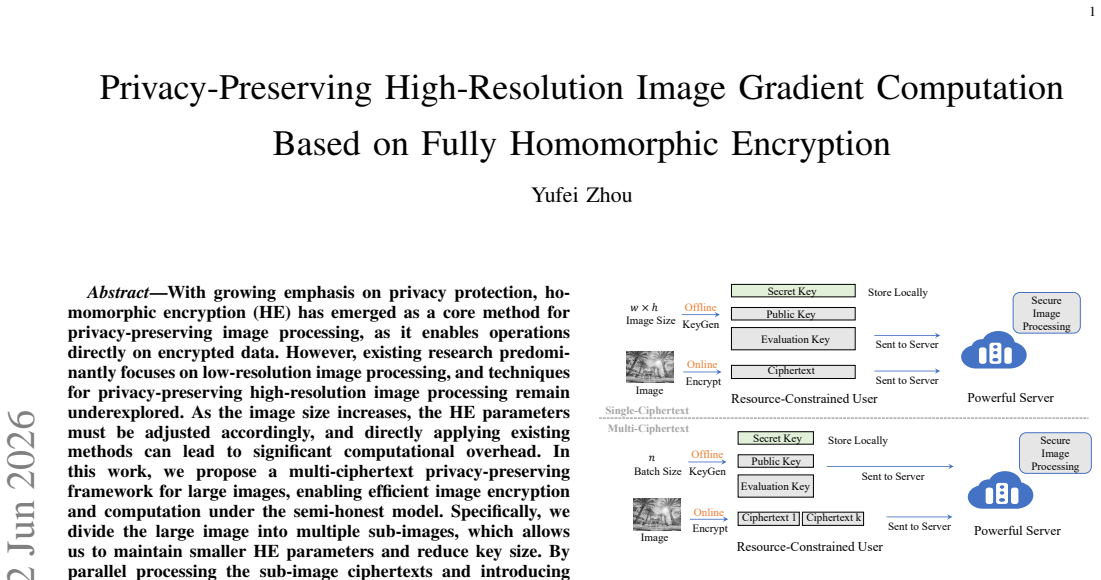
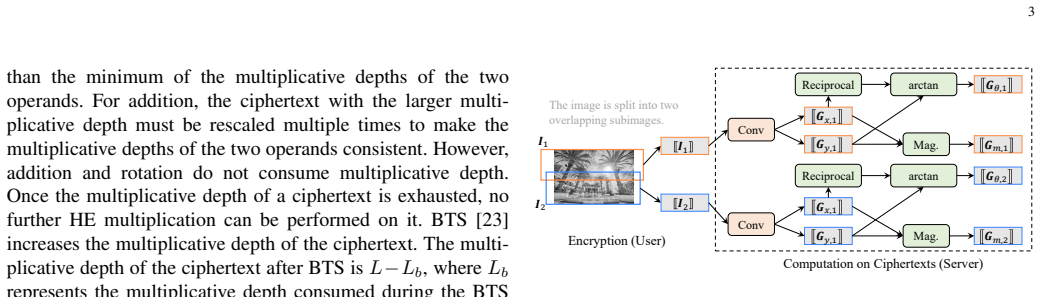
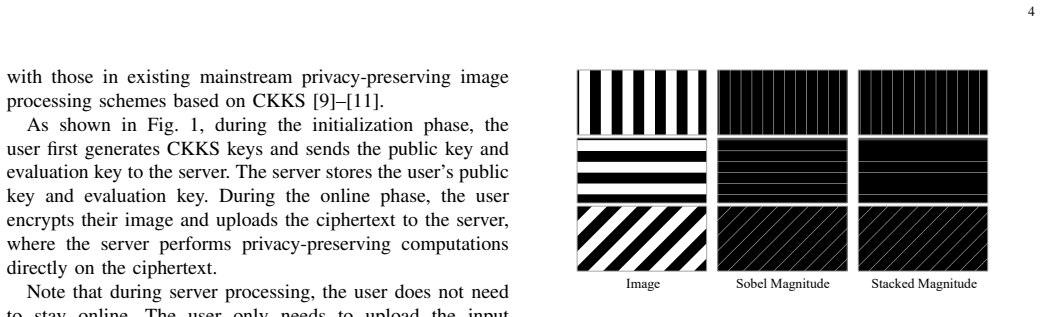
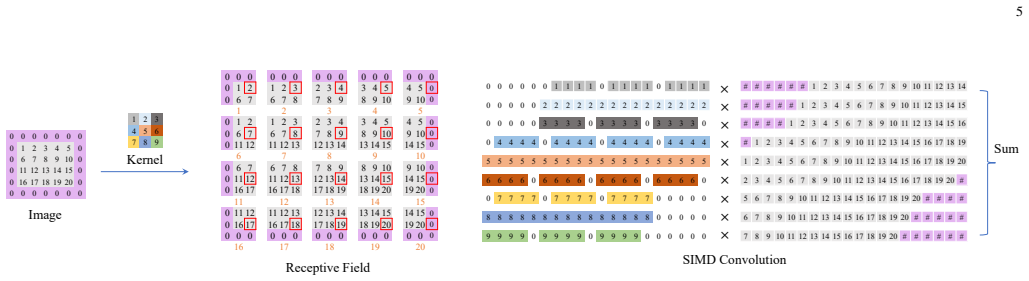
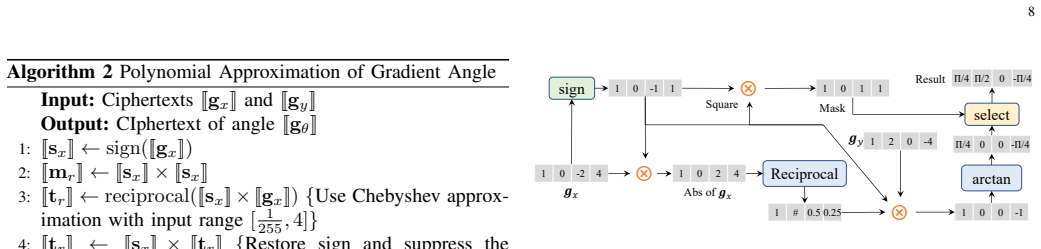
A multi-ciphertext privacy-preserving framework is obtained by partitioning a large image into independent sub-images; this permits smaller HE parameters while the sub-image ciphertexts are processed in parallel and later recombined. Convolution is optimized by repeated packing, and the Sobel gradient direction is computed via a new polynomial approximation of the reciprocal that is constructed from the sign function. The resulting protocol computes encrypted image gradients without revealing the plaintext image.
What carries the argument
Multi-ciphertext framework that partitions the input image into sub-images together with a sign-function-based polynomial approximation of the reciprocal.
If this is right
- Smaller HE parameters reduce both key size and encryption time for the client.
- Parallel sub-image processing and the new bootstrapping placement lower overall latency.
- Repeated packing reduces the number of homomorphic multiplications needed for convolution.
- The sign-based reciprocal approximation can be reused in other HE protocols that require division or normalization.
Where Pith is reading between the lines
- The same sub-image partitioning may apply to other local operators such as edge detection or filtering kernels beyond Sobel.
- Error introduced at sub-image boundaries could be measured by comparing against a non-partitioned baseline on images of varying sizes.
- The approximation technique might be tuned further for different noise budgets or security levels without changing the overall framework.
- Integration with existing HE libraries could be tested by measuring wall-clock time on standard hardware for megapixel-scale inputs.
Load-bearing premise
Splitting the image into sub-images and recombining the encrypted gradient results produces the same output as running the Sobel operator on the intact image.
What would settle it
Encrypt a known high-resolution test image, run the full pipeline, decrypt the gradient fields, and check whether every pixel matches (within the scheme's noise bound) the gradients obtained by applying the plaintext Sobel operator directly to the original image.
Figures
read the original abstract
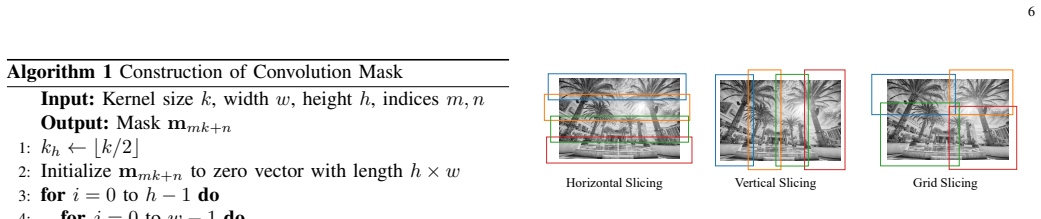
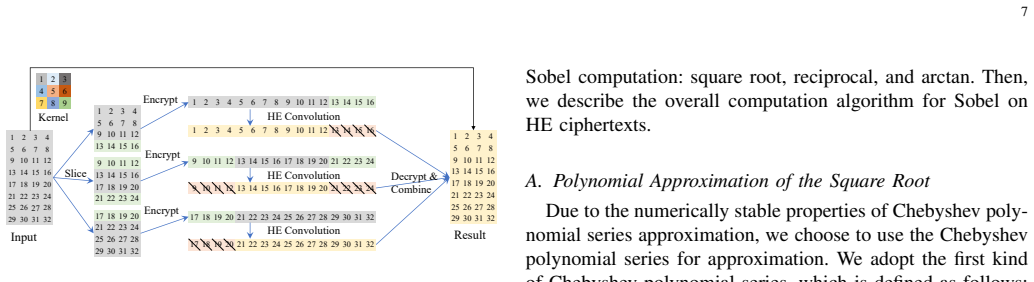
With growing emphasis on privacy protection, homomorphic encryption (HE) has emerged as a core method for privacy-preserving image processing, as it enables operations directly on encrypted data. However, existing research predominantly focuses on low-resolution image processing, and techniques for privacy-preserving high-resolution image processing remain underexplored. As the image size increases, the HE parameters must be adjusted accordingly, and directly applying existing methods can lead to significant computational overhead. In this work, we propose a multi-ciphertext privacy-preserving framework for large images, enabling efficient image encryption and computation under the semi-honest model. Specifically, we divide the large image into multiple sub-images, which allows us to maintain smaller HE parameters and reduce key size. By parallel processing the sub-image ciphertexts and introducing a new bootstrapping placement strategy, we significantly reduce encryption overhead and enhance user experience. On the server side, we optimize the large image convolution operation through a repeated packing technique and implement the Sobel operator computation based on HE. To improve gradient direction calculation for the Sobel operator, we introduce a new polynomial approximation method for the reciprocal function based on the sign function, which can be applied to other HE-based protocols.
Editorial analysis
A structured set of objections, weighed in public.
Referee Report
Summary. The manuscript proposes a multi-ciphertext privacy-preserving framework for Sobel gradient computation on high-resolution images under fully homomorphic encryption in the semi-honest model. Large images are partitioned into sub-images to permit smaller HE parameters and reduced key sizes; sub-image ciphertexts are processed in parallel with a new bootstrapping placement strategy, repeated packing for convolution, and a polynomial approximation to the reciprocal function (derived from the sign function) to compute gradient directions.
Significance. If the sub-image recombination is shown to be equivalent to monolithic Sobel evaluation and the approximation error is bounded with concrete accuracy measurements, the framework would provide a concrete route to scaling FHE-based image processing beyond low-resolution regimes. The repeated-packing optimization and sign-based reciprocal approximation are technically interesting contributions that could be reused in other HE protocols.
major comments (2)
- [Abstract / Framework Description] Abstract and framework description: the central efficiency claim rests on dividing the image into independent sub-images, encrypting and computing each with smaller HE parameters, then recombining. Sobel operators are 3x3 and therefore require adjacent-pixel neighborhoods; without an explicit overlap, padding, or stitching protocol, gradients along sub-image seams cannot be guaranteed to match full-image results. No equivalence argument, error bound, or experimental verification (e.g., pixel-wise difference maps or PSNR between sub-image and monolithic outputs) is supplied, directly undermining the claim that the multi-ciphertext method preserves mathematical correctness.
- [Polynomial Approximation Method] Polynomial approximation section: the new sign-based polynomial for the reciprocal is presented as an improvement for gradient-direction calculation, yet the manuscript supplies neither the explicit polynomial coefficients, the approximation interval and degree, nor any error analysis (maximum absolute or relative error) or comparison against prior HE-friendly approximations. Without these, it is impossible to assess whether the method meets the accuracy requirements of the Sobel pipeline.
minor comments (2)
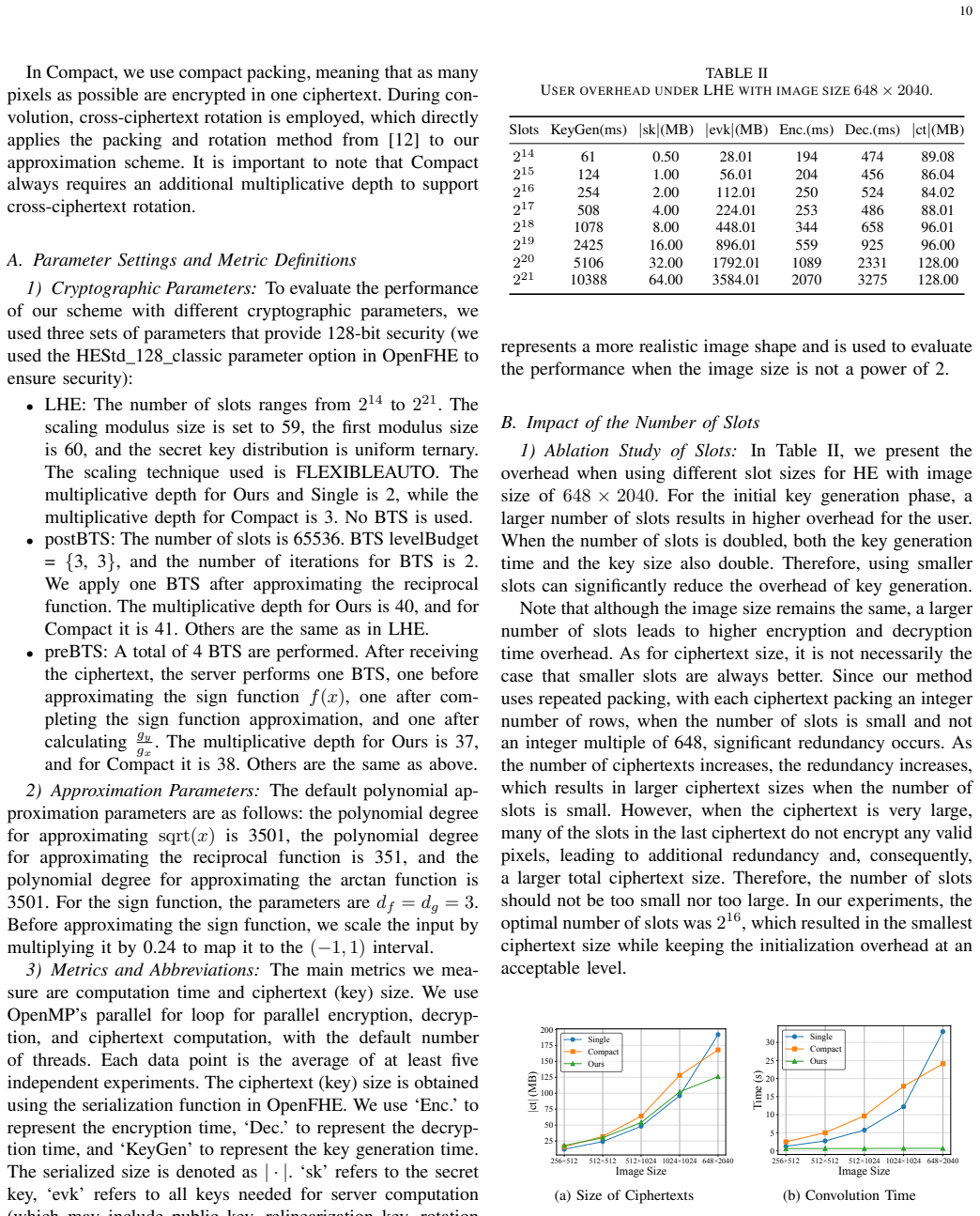
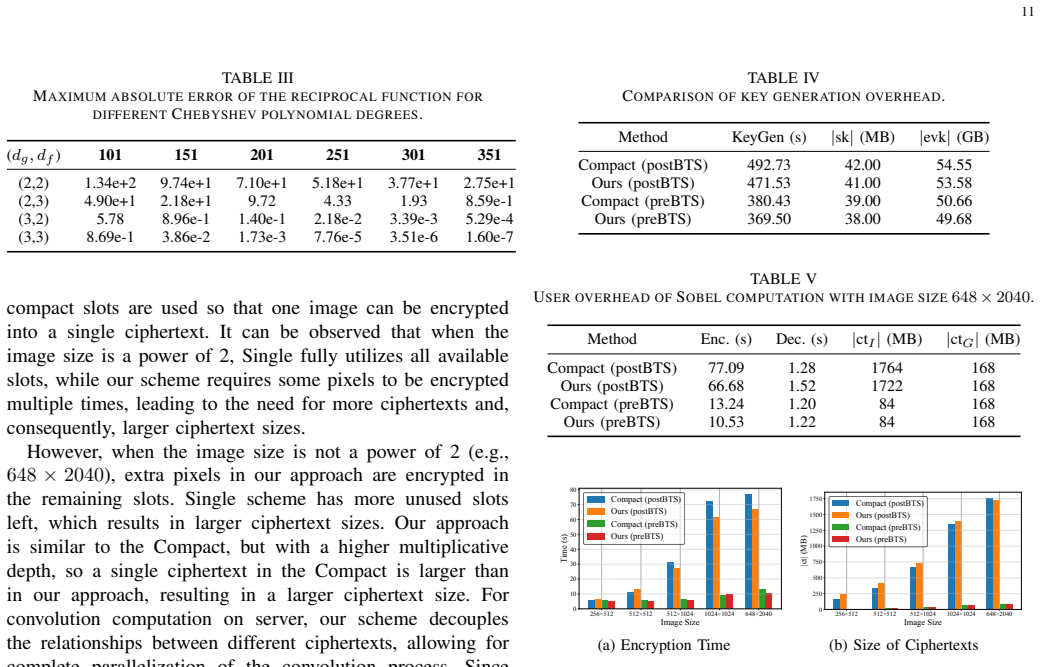
- [Abstract] The abstract states that parallel processing and the new bootstrapping placement “significantly reduce encryption overhead,” but no concrete runtime figures, parameter sets, or comparison against a single-ciphertext baseline are given even at the level of order-of-magnitude estimates.
- [Convolution Optimization] Notation for ciphertext packing and the exact form of the repeated-packing convolution should be introduced with a small worked example or diagram to clarify how the 3x3 Sobel kernels are realized under the packing scheme.
Simulated Author's Rebuttal
We thank the referee for the constructive comments, which identify important gaps in the presentation of our multi-ciphertext framework. We address each major comment below and will revise the manuscript to incorporate the requested details and verifications.
read point-by-point responses
-
Referee: [Abstract / Framework Description] Abstract and framework description: the central efficiency claim rests on dividing the image into independent sub-images, encrypting and computing each with smaller HE parameters, then recombining. Sobel operators are 3x3 and therefore require adjacent-pixel neighborhoods; without an explicit overlap, padding, or stitching protocol, gradients along sub-image seams cannot be guaranteed to match full-image results. No equivalence argument, error bound, or experimental verification (e.g., pixel-wise difference maps or PSNR between sub-image and monolithic outputs) is supplied, directly undermining the claim that the multi-ciphertext method preserves mathematical correctness.
Authors: We agree that the manuscript does not explicitly describe an overlap or stitching protocol, which is necessary for correct 3x3 Sobel neighborhoods at sub-image boundaries. In the revised version we will add a dedicated subsection detailing the sub-image division with a one-pixel overlap on each side, provide a mathematical argument establishing equivalence to monolithic Sobel evaluation under this protocol, and include experimental verification consisting of pixel-wise difference maps and PSNR values between the recombined sub-image outputs and a monolithic baseline. revision: yes
-
Referee: [Polynomial Approximation Method] Polynomial approximation section: the new sign-based polynomial for the reciprocal is presented as an improvement for gradient-direction calculation, yet the manuscript supplies neither the explicit polynomial coefficients, the approximation interval and degree, nor any error analysis (maximum absolute or relative error) or comparison against prior HE-friendly approximations. Without these, it is impossible to assess whether the method meets the accuracy requirements of the Sobel pipeline.
Authors: We acknowledge that the current manuscript does not supply the explicit coefficients, degree, interval, error bounds, or comparisons for the sign-based reciprocal approximation. The revised manuscript will expand the polynomial approximation section to include the concrete polynomial, its degree and approximation interval, a full error analysis reporting maximum absolute and relative errors, and direct comparisons against prior HE-friendly reciprocal approximations, allowing readers to evaluate its accuracy within the Sobel pipeline. revision: yes
Circularity Check
No significant circularity detected
full rationale
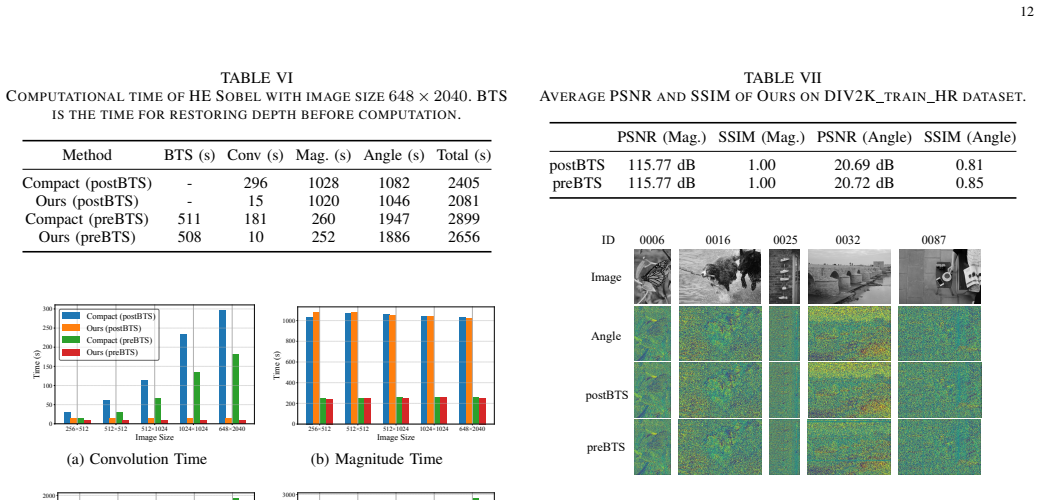
The paper is a methodological proposal for a multi-ciphertext HE framework that splits large images into sub-images for smaller parameters, uses repeated packing for convolution, and introduces a sign-function-based polynomial approximation for reciprocal in Sobel gradient direction. No load-bearing steps reduce by the paper's own equations or self-citations to fitted parameters, self-definitions, or renamed inputs; the central claims rest on independent engineering choices and a new approximation technique whose correctness is asserted separately from any fitted quantities. The sub-image recombination assumption is an unverified premise rather than a circular reduction, and no derivation chain collapses to its inputs by construction.
Axiom & Free-Parameter Ledger
axioms (1)
- domain assumption The server follows the protocol but does not deviate maliciously (semi-honest model)
Reference graph
Works this paper leans on
-
[1]
CCTV cameras at home: Temporality experience of surveillance technology in family life,
N. Liu, “CCTV cameras at home: Temporality experience of surveillance technology in family life,”New Media & Society, vol. 27, no. 6, pp. 3699–3719, 2025
2025
-
[2]
Smartphone imaging technology and its applications,
V . Blahnik and O. Schindelbeck, “Smartphone imaging technology and its applications,”Advanced Optical Technologies, vol. 10, no. 3, pp. 145–232, 2021
2021
-
[3]
Enabling simultaneous content regulation and privacy protection for cloud storage image,
G. Hu, H. Li, G. Xuet al., “Enabling simultaneous content regulation and privacy protection for cloud storage image,”IEEE Transactions on Cloud Computing, vol. 11, no. 1, pp. 111–127, 2021
2021
-
[4]
Towards practical and privacy-preserving CNN inference service for cloud-based medical imaging analysis: A homomorphic encryption-based approach,
Y . Bai, H. Zhao, X. Shiet al., “Towards practical and privacy-preserving CNN inference service for cloud-based medical imaging analysis: A homomorphic encryption-based approach,”Computer Methods and Pro- grams in Biomedicine, vol. 261, p. 108599, 2025
2025
-
[5]
Coder: Protecting privacy in image retrieval with differential privacy,
H. Yan, X. Li, W. Zhanget al., “Coder: Protecting privacy in image retrieval with differential privacy,”IEEE Transactions on Dependable and Secure Computing, vol. 21, no. 6, pp. 5420–5430, 2024
2024
-
[6]
Efficient and privacy-preserving image classification using homomorphic encryption and chunk-based convolu- tional neural network,
H. Jia, D. Cai, J. Yanget al., “Efficient and privacy-preserving image classification using homomorphic encryption and chunk-based convolu- tional neural network,”Journal of Cloud Computing, vol. 12, no. 1, p. 175, 2023
2023
-
[7]
Privacy-preserving feature extraction for medical images based on fully homomorphic encryption,
J. Zhang, X. Xiao, W. Renet al., “Privacy-preserving feature extraction for medical images based on fully homomorphic encryption,”Journal of Advanced Computing Systems, vol. 4, no. 2, pp. 15–28, 2024
2024
-
[8]
Homomorphic encryption for arithmetic of approximate numbers,
J. H. Cheon, A. Kim, M. Kimet al., “Homomorphic encryption for arithmetic of approximate numbers,” inInternational conference on the theory and application of cryptology and information security. Springer, 2017, pp. 409–437
2017
-
[9]
Low-complexity deep convolutional neural networks on fully homomorphic encryption using multiplexed parallel convolutions,
E. Lee, J.-W. Lee, J. Leeet al., “Low-complexity deep convolutional neural networks on fully homomorphic encryption using multiplexed parallel convolutions,” inInternational Conference on Machine Learn- ing. PMLR, 2022, pp. 12 403–12 422
2022
-
[10]
Neujeans: Private neural network in- ference with joint optimization of convolution and FHE bootstrapping,
J. H. Ju, J. Park, J. Kimet al., “Neujeans: Private neural network in- ference with joint optimization of convolution and FHE bootstrapping,” inProceedings of the 2024 on ACM SIGSAC Conference on Computer and Communications Security, 2024, pp. 4361–4375
2024
-
[11]
HTCNN: High-throughput batch CNN inference with homomorphic encryption,
Z. Ye, T. Wang, T. Huanget al., “HTCNN: High-throughput batch CNN inference with homomorphic encryption,”IEEE Transactions on Dependable and Secure Computing, 2025
2025
-
[12]
Privacy-preserving CNN inference for image super-resolution cross multiple ciphertexts,
P. Zheng, D. Mo, Y . Zhouet al., “Privacy-preserving CNN inference for image super-resolution cross multiple ciphertexts,”IEEE Transactions on Image Processing, vol. 34, pp. 8568–8582, 2025
2025
-
[13]
Design of an image edge detection filter using the Sobel operator,
N. Kanopoulos, N. Vasanthavada, and R. L. Baker, “Design of an image edge detection filter using the Sobel operator,”IEEE Journal of solid- state circuits, vol. 23, no. 2, pp. 358–367, 1988
1988
-
[14]
Edge detection of high-resolution remote sens- ing image based on multi-directional improved sobel operator,
L. Shi and Y . Zhao, “Edge detection of high-resolution remote sens- ing image based on multi-directional improved sobel operator,”IEEE Access, vol. 11, pp. 135 979–135 993, 2023
2023
-
[15]
A steel defect detection method based on edge feature extraction via the Sobel operator,
Y . Wang, T. Yin, X. Chenet al., “A steel defect detection method based on edge feature extraction via the Sobel operator,”Scientific Reports, vol. 14, no. 1, p. 27694, 2024
2024
-
[16]
Dual-functional fractal-fractional Sobel operator for efficient image enhancement and edge detection,
K. Gowtham, N. R. Babu, S. Harshavarthiniet al., “Dual-functional fractal-fractional Sobel operator for efficient image enhancement and edge detection,”Pattern Recognition, p. 112592, 2025
2025
-
[17]
Edge detection and image segmen- tation on encrypted image with homomorphic encryption and garbled circuit,
D. Chen, W. Chen, J. Chenet al., “Edge detection and image segmen- tation on encrypted image with homomorphic encryption and garbled circuit,” in2018 IEEE International Conference on Multimedia and Expo (ICME). IEEE, 2018, pp. 1–6
2018
-
[18]
Foundations of garbled circuits,
M. Bellare, V . T. Hoang, and P. Rogaway, “Foundations of garbled circuits,” inProceedings of the 2012 ACM conference on Computer and communications security, 2012, pp. 784–796
2012
-
[19]
Minimax approximation of sign function by composite polynomial for homomorphic comparison,
E. Lee, J.-W. Lee, J.-S. Noet al., “Minimax approximation of sign function by composite polynomial for homomorphic comparison,”IEEE Transactions on Dependable and Secure Computing, vol. 19, no. 6, pp. 3711–3727, 2021
2021
-
[20]
Optimization of homomorphic comparison algorithm on rns-ckks scheme,
E. Lee, J.-W. Lee, Y .-S. Kimet al., “Optimization of homomorphic comparison algorithm on rns-ckks scheme,”IEEE Access, vol. 10, pp. 26 163–26 176, 2022
2022
-
[21]
T. J. Rivlin,Chebyshev polynomials. Courier Dover Publications, 2020
2020
-
[22]
A survey on homomorphic encryption schemes: Theory and implementation,
A. Acar, H. Aksu, A. S. Uluagacet al., “A survey on homomorphic encryption schemes: Theory and implementation,”ACM Computing Surveys (Csur), vol. 51, no. 4, pp. 1–35, 2018
2018
-
[23]
Better bootstrapping for approximate homomorphic encryption,
K. Han and D. Ki, “Better bootstrapping for approximate homomorphic encryption,” inCryptographers’ Track at the RSA Conference. Springer, 2020, pp. 364–390
2020
-
[24]
Efficient homomorphic comparison methods with optimal complexity,
J. H. Cheon, D. Kim, and D. Kim, “Efficient homomorphic comparison methods with optimal complexity,” inInternational Conference on the Theory and Application of Cryptology and Information Security. Springer, 2020, pp. 221–256
2020
-
[25]
Szeliski,Computer vision: algorithms and applications
R. Szeliski,Computer vision: algorithms and applications. Springer Nature, 2022
2022
-
[26]
Edge detection using guided Sobel image filtering,
R. Ranjan and V . Avasthi, “Edge detection using guided Sobel image filtering,”Wireless Personal Communications, vol. 132, no. 1, pp. 651– 677, 2023
2023
-
[27]
Feature extraction and classification of retinal images using Sobel segmentation and linear SVC,
F. T. A. S. Laily, “Feature extraction and classification of retinal images using Sobel segmentation and linear SVC,”International Journal of Artificial Intelligence in Medical Issues, vol. 2, no. 2, pp. 136–149, 2024
2024
-
[28]
A survey on X. 509 public-key infrastructure, certificate revocation, and their modern implementation on blockchain and ledger technologies,
S. Khan, F. Luo, Z. Zhanget al., “A survey on X. 509 public-key infrastructure, certificate revocation, and their modern implementation on blockchain and ledger technologies,”IEEE Communications Surveys & Tutorials, vol. 25, no. 4, pp. 2529–2568, 2023
2023
-
[29]
On the concrete security of TLS 1.3 PSK mode,
H. Davis, D. Diemert, F. G ¨untheret al., “On the concrete security of TLS 1.3 PSK mode,” inAnnual International Conference on the Theory and Applications of Cryptographic Techniques. Springer, 2022, pp. 876–906
2022
-
[30]
On the security of homomorphic encryption on approximate numbers,
B. Li and D. Micciancio, “On the security of homomorphic encryption on approximate numbers,” inAnnual International Conference on the Theory and Applications of Cryptographic Techniques. Springer, 2021, pp. 648–677
2021
-
[31]
L. N. Trefethen,Approximation theory and approximation practice, extended edition. SIAM, 2019
2019
-
[32]
Secure human action recognition by encrypted neural network inference,
M. Kim, X. Jiang, K. Lauteret al., “Secure human action recognition by encrypted neural network inference,”Nature communications, vol. 13, no. 1, p. 4799, 2022
2022
-
[33]
Faster homomorphic linear transformations in HElib,
S. Halevi and V . Shoup, “Faster homomorphic linear transformations in HElib,” inAnnual International Cryptology Conference. Springer, 2018, pp. 93–120
2018
-
[34]
Homomorphic encryption se- curity standard,
M. Albrecht, M. Chase, H. Chenet al., “Homomorphic encryption se- curity standard,” HomomorphicEncryption.org, Toronto, Canada, Tech. Rep., November 2018
2018
-
[35]
OpenFHE: Open-source fully homomorphic encryption library,
A. A. Badawi, A. Alexandru, J. Bateset al., “OpenFHE: Open-source fully homomorphic encryption library,” Cryptology ePrint Archive, Paper 2022/915, 2022, https://eprint.iacr.org/2022/915. [Online]. Available: https://eprint.iacr.org/2022/915
2022
-
[36]
Ntire 2017 challenge on single image super-resolution: Dataset and study,
E. Agustsson and R. Timofte, “Ntire 2017 challenge on single image super-resolution: Dataset and study,” inIEEE Conference on Computer Vision and Pattern Recognition Workshops, 2017
2017
-
[37]
Cheddar: A swift fully homomorphic encryption library designed for gpu architectures,
W. Choi, J. Kim, and J. H. Ahn, “Cheddar: A swift fully homomorphic encryption library designed for gpu architectures,” inProceedings of the 31st ACM International Conference on Architectural Support for Programming Languages and Operating Systems, Volume 1, 2026, pp. 35–49
2026
discussion (0)
Sign in with ORCID, Apple, or X to comment. Anyone can read and Pith papers without signing in.