Projection Diagnostics for Directional Asymmetry and Tail-Ratio Departure in Multivariate Data
Pith reviewed 2026-06-28 09:05 UTC · model grok-4.3
The pith
Projection quantile summaries classify multivariate data into four regimes of symmetry and tail behavior.
A machine-rendered reading of the paper's core claim, the machinery that carries it, and where it could break.
Core claim
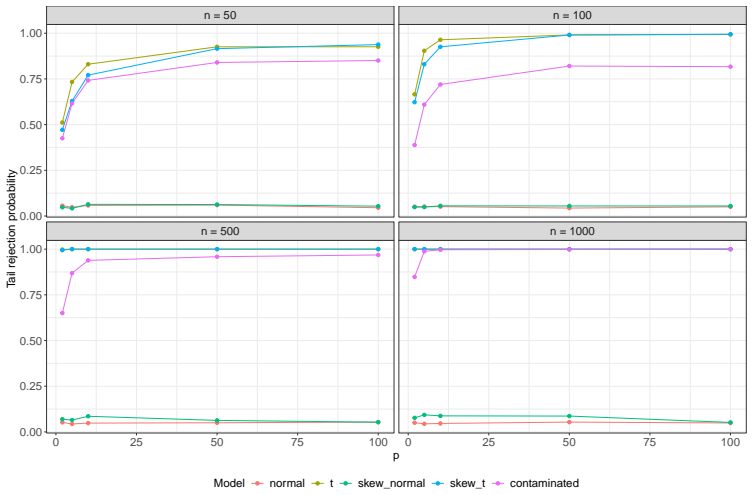
By reducing the multivariate problem to one-dimensional projections and using two quantile-based summaries—a directional skewness measure over quantile levels and an interquantile tail-ratio relative to a benchmark—the procedure yields a four-regime classification of the data: symmetric benchmark-tail, symmetric tail-departed, skewed benchmark-tail, and skewed tail-departed. Population properties are established under central symmetry and ellipticity, with uniform finite-sample bounds over searched directions and consistency of the threshold classifier under separated regimes. A sparse rank-one calculation shows why coordinate directions can complement random directions in high dimensions.
What carries the argument
Two quantile-based summaries computed on one-dimensional projections: a directional skewness measure evaluated over several quantile levels, and an interquantile tail-ratio evaluated relative to a chosen benchmark; their joint values determine the four-regime label.
If this is right
- The diagnostic can guide the choice between a symmetric model, a skewed model, a tail-adjusted model, or a model with both features.
- The method remains stable in heavy-tailed data because it uses quantiles instead of moments.
- Coordinate directions supply useful additional information in high dimensions, as shown by the sparse rank-one calculation.
- The threshold classifier is consistent once the four regimes are separated in the population.
Where Pith is reading between the lines
- The four-regime output could serve as a pre-processing step before fitting elliptical or skew-elliptical families.
- The same projection summaries might be adapted to detect changes in symmetry or tail behavior over time in sequential data.
- In very high dimensions the sparse rank-one argument suggests that a modest number of coordinate projections may suffice alongside random ones.
Load-bearing premise
The population properties and classification guarantees are derived under the assumption that the underlying distribution is centrally symmetric or elliptical.
What would settle it
Generate data from a centrally symmetric elliptical distribution with known tail behavior and check whether the empirical classification matches the known regime for a large fraction of random and coordinate directions.
Figures


read the original abstract
We study projection-based diagnostics for distinguishing directional asymmetry from tail-ratio departure in multivariate data. The procedure reduces the problem to one-dimensional projections and computes two quantile-based summaries: a directional skewness measure evaluated over several quantile levels, and an interquantile tail-ratio evaluated relative to a chosen benchmark. The two summaries lead to a four-regime classification: symmetric benchmark-tail, symmetric tail-departed, skewed benchmark-tail, and skewed tail-departed. The quantile formulation avoids relying on third and fourth moments, which can be unstable in heavy-tailed settings. We establish population properties under central symmetry and ellipticity, uniform finite-sample bounds over the searched directions, and consistency of the threshold classifier under separated regimes. A sparse rank-one calculation is also used to show why coordinate directions can complement random directions in high dimensions. The resulting diagnostic is meant to guide subsequent modelling choices, for example whether a symmetric, skewed, tail-departed, or combined multivariate model is appropriate.
Editorial analysis
A structured set of objections, weighed in public.
Referee Report
Summary. The paper proposes projection-based diagnostics that reduce multivariate asymmetry and tail-ratio questions to one-dimensional projections, using a directional skewness summary (over multiple quantile levels) and an interquantile tail-ratio summary (relative to a benchmark). These yield a four-regime classification (symmetric benchmark-tail, symmetric tail-departed, skewed benchmark-tail, skewed tail-departed). Population properties are derived under central symmetry and ellipticity; uniform finite-sample concentration bounds over directions and consistency of the threshold rule (when regimes are separated) are established. A sparse rank-one argument is supplied to motivate supplementing random projections with coordinate directions in high dimensions. The quantile approach is intended to avoid moment instability.
Significance. If the derivations hold, the work supplies a moment-robust, projection-based diagnostic that can inform subsequent model choice between symmetric, skewed, tail-adjusted, or combined multivariate specifications. The explicit use of quantiles, the uniform bounds, the consistency result under separated regimes, and the rank-one justification for coordinate directions are concrete strengths that address practical difficulties in heavy-tailed or high-dimensional settings.
minor comments (3)
- [Abstract] The abstract refers to 'several quantile levels' and 'a chosen benchmark' without naming the specific levels or selection rule; the main text should state these choices explicitly (with justification) so that the procedure is reproducible.
- [Classification rule] The four-regime classifier is defined directly from the two summaries; while this is not circular for the theoretical guarantees, the manuscript should clarify how the thresholds are calibrated in finite samples and whether they depend on dimension or sample size.
- [Finite-sample bounds] The uniform finite-sample bounds are stated to hold over the searched directions; the paper should specify the covering or discretization scheme used for the direction search and confirm that the bound remains uniform after accounting for the search.
Simulated Author's Rebuttal
We thank the referee for the positive and accurate summary of our manuscript, the recognition of its strengths (quantile-based robustness, uniform bounds, consistency under separation, and the rank-one justification), and the recommendation of minor revision. No specific major comments were provided in the report.
Circularity Check
No significant circularity; classification defined directly from quantiles
full rationale
The paper defines two quantile-based summaries (directional skewness over quantile levels and interquantile tail-ratio relative to benchmark) directly from one-dimensional projections. These feed a four-regime classification via thresholds. Population properties, uniform bounds, and consistency are derived under explicitly stated assumptions of central symmetry and ellipticity; no equations reduce the classification to a tautology or rename a fitted input as a prediction. No self-citation chains, uniqueness theorems, or smuggled ansatzes appear load-bearing in the abstract or skeptic analysis. The derivation remains self-contained against the stated conditions.
Axiom & Free-Parameter Ledger
axioms (1)
- domain assumption Central symmetry and ellipticity for population properties
Reference graph
Works this paper leans on
-
[1]
The Annals of Mathematical Statistics , volume=
Asymptotic minimax character of the sample distribution function and of the classical multinomial estimator , author=. The Annals of Mathematical Statistics , volume=
-
[2]
The tight constant in the
Massart, Pascal , journal=. The tight constant in the
-
[3]
Asymptotic Statistics , author=
-
[4]
The Concentration of Measure Phenomenon , author=
-
[5]
High-Dimensional Probability: An Introduction with Applications in Data Science , author=
-
[6]
Journal of Multivariate Analysis , volume=
On the theory of elliptically contoured distributions , author=. Journal of Multivariate Analysis , volume=
-
[7]
Journal of the American Statistical Association , volume =
On tests for multivariate normality , author =. Journal of the American Statistical Association , volume =
-
[8]
Journal of Multivariate Analysis , volume =
Limit distributions for measures of multivariate skewness and kurtosis based on projections , author =. Journal of Multivariate Analysis , volume =
-
[9]
Statistica Sinica , volume =
Quantile tomography: Using quantiles with multivariate data , author =. Statistica Sinica , volume =
-
[10]
Journal of the American Statistical Association , volume =
Robust estimation of location , author =. Journal of the American Statistical Association , volume =
-
[11]
The American Statistician , volume =
What is kurtosis? An influence function approach , author =. The American Statistician , volume =
-
[12]
The American Statistician , volume =
Skewness-invariant measures of kurtosis , author =. The American Statistician , volume =
-
[13]
Symmetric Multivariate and Related Distributions , author=
-
[14]
The Annals of Statistics , volume =
On almost linearity of low dimensional projections from high dimensional data , author =. The Annals of Statistics , volume =
-
[15]
Journal of Multivariate Analysis , volume =
A well-conditioned estimator for large-dimensional covariance matrices , author =. Journal of Multivariate Analysis , volume =
-
[16]
and Hero, Alfred O
Chen, Yilun and Wiesel, Ami and Eldar, Yonina C. and Hero, Alfred O. , journal =. Shrinkage algorithms for
-
[17]
The Annals of Statistics , volume =
Covariance regularization by thresholding , author =. The Annals of Statistics , volume =
-
[18]
Journal of the American Statistical Association , volume =
Adaptive thresholding for sparse covariance matrix estimation , author =. Journal of the American Statistical Association , volume =
-
[19]
, journal =
Maronna, Ricardo A. , journal =. Robust
-
[20]
, journal =
Tyler, David E. , journal =. A distribution-free
-
[21]
IEEE Transactions on Computers , volume =
A projection pursuit algorithm for exploratory data analysis , author =. IEEE Transactions on Computers , volume =
-
[22]
The Annals of Statistics , volume =
Asymptotics of graphical projection pursuit , author =. The Annals of Statistics , volume =
-
[23]
Technometrics , volume =
Multivariate outlier detection and robust covariance matrix estimation , author =. Technometrics , volume =
-
[24]
Independent Component Analysis , author =
-
[25]
Computational Statistics & Data Analysis , volume =
Skewness-based projection pursuit: A computational approach , author =. Computational Statistics & Data Analysis , volume =
-
[26]
Journal of Computational and Graphical Statistics , volume =
A Robust Measure of Skewness , author =. Journal of Computational and Graphical Statistics , volume =
-
[27]
Journal of the American statistical association , volume=
On a geometric notion of quantiles for multivariate data , author=. Journal of the American statistical association , volume=. 1996 , publisher=
1996
-
[28]
Biometrika , volume=
Measures of multivariate skewness and kurtosis with applications , author=. Biometrika , volume=. 1970 , publisher=
1970
-
[29]
Applications of some measures of multivariate skewness and kurtosis in testing normality and robustness studies , author=. Sankhy. 1974 , publisher=
1974
-
[30]
Communications in statistics-Theory and Methods , volume=
A class of invariant consistent tests for multivariate normality , author=. Communications in statistics-Theory and Methods , volume=. 1990 , publisher=
1990
-
[31]
Oxford bulletin of economics and statistics , volume=
An omnibus test for univariate and multivariate normality , author=. Oxford bulletin of economics and statistics , volume=. 2008 , publisher=
2008
-
[32]
Annual Review of Statistics and Its Application , volume=
The energy of data , author=. Annual Review of Statistics and Its Application , volume=. 2017 , publisher=
2017
-
[33]
Journal of statistical planning and inference , volume=
Energy statistics: A class of statistics based on distances , author=. Journal of statistical planning and inference , volume=. 2013 , publisher=
2013
-
[34]
Journal of Multivariate Analysis , volume=
Sub-dimensional Mardia measures of multivariate skewness and kurtosis , author=. Journal of Multivariate Analysis , volume=. 2022 , publisher=
2022
-
[35]
, author =
MVN: An R Package for Assessing Multivariate Normality. , author =. The R Journal , year =
-
[36]
2020 , note =
mnt: Affine Invariant Tests of Multivariate Normality , author =. 2020 , note =
2020
-
[37]
Stochastic Environmental Research and Risk Assessment , volume=
Modelling air pollution data by the skew-normal distribution , author=. Stochastic Environmental Research and Risk Assessment , volume=. 2010 , publisher=
2010
-
[38]
Environment, Development and Sustainability , volume=
A comparative study of air quality between pre and post COVID-19 periods in India , author=. Environment, Development and Sustainability , volume=. 2025 , publisher=
2025
discussion (0)
Sign in with ORCID, Apple, or X to comment. Anyone can read and Pith papers without signing in.