Implicit Fuzzification via Bounded Noise Injection for Robust Medical Image Segmentation
Pith reviewed 2026-06-28 06:42 UTC · model grok-4.3
The pith
Bounded noise injection into U-Net skip connections induces an implicit fuzzification effect for robust medical image segmentation.
A machine-rendered reading of the paper's core claim, the machinery that carries it, and where it could break.
Core claim
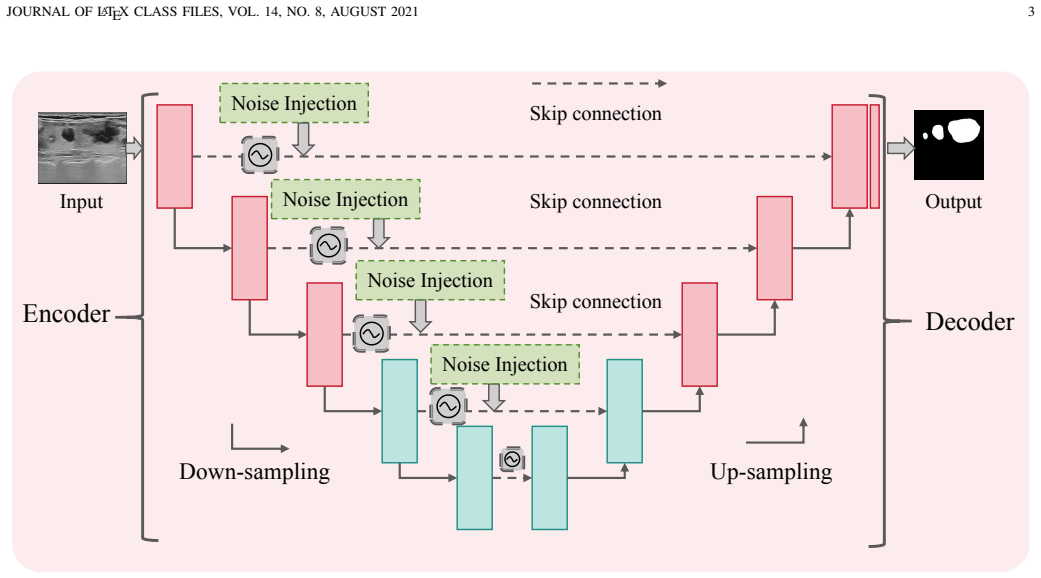
The perturbation induces an implicit fuzzification effect, yielding soft, data-driven memberships without requiring explicit fuzzy modeling. NoiseUNet injects bounded perturbations into skip connections to regularize cross-scale feature fusion, enforcing robustness to local feature variations and promoting boundary-aware representations that improve segmentation accuracy and boundary fidelity.
What carries the argument
Bounded perturbation injection into skip connections, which regularizes cross-scale feature fusion to induce implicit fuzzification.
If this is right
- Segmentation outputs become less overconfident on transition regions between classes.
- Boundary fidelity improves through data-driven soft memberships rather than explicit fuzzy layers.
- Cross-scale feature fusion gains robustness to local variations without architectural overhaul.
- The gains extend to real ambiguous medical data as shown on the introduced ThyR dataset.
Where Pith is reading between the lines
- The same bounded noise mechanism could be applied to other encoder-decoder models for tasks with label uncertainty.
- This regularization might reduce reliance on post-processing techniques for boundary refinement.
- Further tests on volumetric or multi-modal medical data would check whether the implicit fuzzification generalizes.
- The approach offers a lightweight way to incorporate uncertainty awareness into existing segmentation pipelines.
Load-bearing premise
That adding bounded perturbations to skip connections will enforce robustness to local feature variations and promote boundary-aware representations that translate into measurable gains on real ambiguous data.
What would settle it
A head-to-head test on the ThyR dataset where NoiseUNet shows no statistically significant gain over baseline U-Net on boundary metrics such as Hausdorff distance would falsify the central claim.
Figures

read the original abstract
Image segmentation remains fundamentally limited by boundary ambiguity arising from sampling-induced information loss and inherent uncertainty in pixel-wise labeling. Although encoder-decoder architectures such as U-Net achieve strong performance, they often produce overconfident predictions that fail to capture transition-region ambiguity. To address this issue, we propose \textbf{NoiseUNet}, a simple yet effective framework that injects bounded perturbations into skip connections to regularize cross-scale feature fusion. This mechanism enforces robustness to local feature variations and promotes boundary-aware representations. Theoretically, the perturbation induces an implicit fuzzification effect, yielding soft, data-driven memberships without requiring explicit fuzzy modeling. We further introduce \textbf{ThyR}, a real-world thyroid ultrasound dataset with inherently ambiguous boundaries. Experiments demonstrate that NoiseUNet consistently improves both segmentation accuracy and boundary fidelity.
Editorial analysis
A structured set of objections, weighed in public.
Referee Report
Summary. The paper introduces NoiseUNet, an encoder-decoder architecture that injects bounded perturbations into skip connections to regularize feature fusion, claiming this induces an implicit fuzzification effect that produces soft, data-driven memberships for handling boundary ambiguity in medical image segmentation without explicit fuzzy modeling. It also presents the ThyR thyroid ultrasound dataset with ambiguous boundaries and reports experimental gains in segmentation accuracy and boundary fidelity over standard U-Net variants.
Significance. If the bounded-noise mechanism can be shown to produce quantifiable soft memberships and improved boundary calibration on ambiguous data, the approach offers a lightweight, architecture-agnostic regularization strategy that avoids the overhead of explicit fuzzy sets or uncertainty modeling. The introduction of the ThyR dataset is a concrete contribution for evaluating boundary ambiguity in ultrasound. However, the absence of any derivation, ablation details, or error bars in the provided text leaves the central theoretical claim unevaluated.
major comments (2)
- [Abstract / theoretical motivation] Abstract and theoretical section: the claim that 'the perturbation induces an implicit fuzzification effect, yielding soft, data-driven memberships' is presented as a theoretical consequence, yet no equations, mapping from noise distribution to membership functions, or derivation is supplied; without this, the distinction between ordinary regularization and implicit fuzzy modeling cannot be assessed and the novelty framing rests on assertion rather than proof.
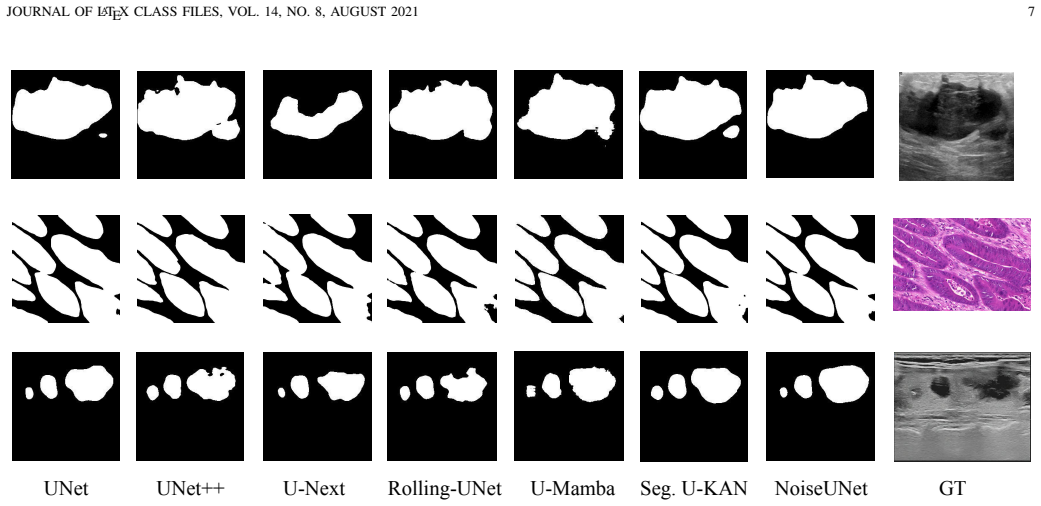
- [Experiments] Experimental section: the manuscript reports consistent improvements but supplies no ablation studies on perturbation bounds, no error bars or statistical significance tests, and no quantitative boundary-specific metrics (e.g., Hausdorff distance on transition regions); these omissions make it impossible to verify that gains arise from the claimed fuzzification rather than generic regularization.
minor comments (2)
- [Methods] Notation for the bounded perturbation (range, distribution, injection point) is not defined in the abstract and should be introduced with a clear equation in the methods.
- [Dataset] The ThyR dataset description lacks details on annotation protocol, inter-observer variability, or size; these should be added to allow reproducibility.
Simulated Author's Rebuttal
We thank the referee for the constructive comments. We address each major point below and will revise the manuscript accordingly.
read point-by-point responses
-
Referee: [Abstract / theoretical motivation] Abstract and theoretical section: the claim that 'the perturbation induces an implicit fuzzification effect, yielding soft, data-driven memberships' is presented as a theoretical consequence, yet no equations, mapping from noise distribution to membership functions, or derivation is supplied; without this, the distinction between ordinary regularization and implicit fuzzy modeling cannot be assessed and the novelty framing rests on assertion rather than proof.
Authors: We agree that a formal derivation is needed to rigorously support the implicit fuzzification claim and distinguish it from standard regularization. The revised manuscript will add a theoretical section deriving the effect of bounded noise injection on feature distributions, including equations that map the perturbation to soft, data-driven memberships via probabilistic cross-scale fusion. revision: yes
-
Referee: [Experiments] Experimental section: the manuscript reports consistent improvements but supplies no ablation studies on perturbation bounds, no error bars or statistical significance tests, and no quantitative boundary-specific metrics (e.g., Hausdorff distance on transition regions); these omissions make it impossible to verify that gains arise from the claimed fuzzification rather than generic regularization.
Authors: We acknowledge the lack of these experimental details. The revised version will include ablations on perturbation bounds, results with error bars and statistical significance tests, and boundary-specific metrics such as Hausdorff distance on transition regions to confirm the gains stem from the fuzzification mechanism. revision: yes
Circularity Check
No derivation chain or equations present to inspect; fuzzification claim is asserted without mathematical reduction
full rationale
The provided abstract and visible text contain no equations, derivations, or self-citations that could form a load-bearing chain. The central claim of 'implicit fuzzification' is stated as a theoretical consequence of bounded perturbations, but without any formal steps, parameter fitting, or uniqueness arguments shown, there are no reductions by construction to evaluate. This is the common case of a paper whose novelty framing rests on interpretation rather than a derivational structure that could be circular.
Axiom & Free-Parameter Ledger
Reference graph
Works this paper leans on
-
[1]
U-net: Convolutional networks for biomedical image segmentation,
O. Ronneberger, P. Fischer, and T. Brox, “U-net: Convolutional networks for biomedical image segmentation,” inInternational Conference on Medical image computing and computer-assisted intervention. Springer, 2015, pp. 234–241
2015
-
[2]
U-kan makes strong backbone for medical image segmentation and generation,
C. Li, X. Liu, W. Li, C. Wang, H. Liu, Y . Liu, Z. Chen, and Y . Yuan, “U-kan makes strong backbone for medical image segmentation and generation,” inProceedings of the AAAI Conference on Artificial Intel- ligence, vol. 39, no. 5, 2025, pp. 4652–4660. JOURNAL OF LATEX CLASS FILES, VOL. 14, NO. 8, AUGUST 2021 9
2025
-
[3]
A review of remote sensing image segmentation by deep learning methods,
J. Li, Y . Cai, Q. Li, M. Kou, and T. Zhang, “A review of remote sensing image segmentation by deep learning methods,”International Journal of Digital Earth, vol. 17, no. 1, p. 2328827, 2024
2024
-
[4]
Farmseg vlm: A farmland remote sensing image segmentation method considering vision- language alignment,
H. Wu, W. Mu, D. Zhong, Z. Du, H. Li, and C. Tao, “Farmseg vlm: A farmland remote sensing image segmentation method considering vision- language alignment,”ISPRS Journal of Photogrammetry and Remote Sensing, vol. 225, pp. 423–439, 2025
2025
-
[5]
Small object few-shot segmentation for vision-based industrial inspection,
Z. Zhang, C. Niu, Z. Zhao, X. Zhang, and X. Chen, “Small object few-shot segmentation for vision-based industrial inspection,”IEEE Transactions on Industrial Informatics, 2025
2025
-
[6]
An overview of industrial image segmentation using deep learning models,
G. Wang, Z. Li, G. Weng, and Y . Chen, “An overview of industrial image segmentation using deep learning models,”Intelligence & Robotics, vol. 5, no. 1, pp. 143–180, 2025
2025
-
[7]
Double integral-enhanced zeroing neural network with linear noise rejection for time-varying matrix inverse,
B. Liao, L. Han, X. Cao, S. Li, and J. Li, “Double integral-enhanced zeroing neural network with linear noise rejection for time-varying matrix inverse,”CAAI Transactions on Intelligence Technology, vol. 9, no. 1, pp. 197–210, 2024
2024
-
[8]
Prescribed- time convergence noise-tolerant zeroing neural network for multi-robot position management and coordination,
T. Wang, Y . Wang, C. Hua, X. Cao, B. Liao, and S. Li, “Prescribed- time convergence noise-tolerant zeroing neural network for multi-robot position management and coordination,”Engineering Applications of Artificial Intelligence, vol. 162, p. 112072, 2025
2025
-
[9]
Unet++: A nested u-net architecture for medical image segmentation,
Z. Zhou, M. M. Rahman Siddiquee, N. Tajbakhsh, and J. Liang, “Unet++: A nested u-net architecture for medical image segmentation,” inInternational workshop on deep learning in medical image analysis. Springer, 2018, pp. 3–11
2018
-
[10]
Unext: Mlp-based rapid medical image segmentation network,
J. M. J. Valanarasu and V . M. Patel, “Unext: Mlp-based rapid medical image segmentation network,” inInternational conference on medical image computing and computer-assisted intervention. Springer, 2022, pp. 23–33
2022
-
[11]
Rolling-unet: Re- vitalizing mlp’s ability to efficiently extract long-distance dependencies for medical image segmentation,
Y . Liu, H. Zhu, M. Liu, H. Yu, Z. Chen, and J. Gao, “Rolling-unet: Re- vitalizing mlp’s ability to efficiently extract long-distance dependencies for medical image segmentation,” inProceedings of the AAAI conference on artificial intelligence, vol. 38, no. 4, 2024, pp. 3819–3827
2024
-
[12]
U-mamba: Enhancing long-range dependency for biomedical image segmentation,
J. Ma, F. Li, and B. Wang, “U-mamba: Enhancing long-range dependency for biomedical image segmentation,”arXiv preprint arXiv:2401.04722, 2024
Pith/arXiv arXiv 2024
-
[13]
Auto-encoding variational bayes,
D. P. Kingma and M. Welling, “Auto-encoding variational bayes,”arXiv preprint arXiv:1312.6114, 2013
Pith/arXiv arXiv 2013
-
[14]
Deep residual learning for image recognition,
K. He, X. Zhang, S. Ren, and J. Sun, “Deep residual learning for image recognition,” inProceedings of the IEEE conference on computer vision and pattern recognition, 2016, pp. 770–778
2016
-
[15]
Usct-unet: Rethinking the semantic gap in u- net network from u-shaped skip connections with multichannel fusion transformer,
X. Xie and M. Yang, “Usct-unet: Rethinking the semantic gap in u- net network from u-shaped skip connections with multichannel fusion transformer,”IEEE Transactions on Neural Systems and Rehabilitation Engineering, vol. 32, pp. 3782–3793, 2024
2024
-
[16]
Atten- tion u-net: Learning where to look for the pancreas,
O. Oktay, J. Schlemper, L. L. Folgoc, M. Lee, M. Heinrich, K. Misawa, K. Mori, S. McDonagh, N. Y . Hammerla, B. Kainzet al., “Atten- tion u-net: Learning where to look for the pancreas,”arXiv preprint arXiv:1804.03999, 2018
Pith/arXiv arXiv 2018
-
[17]
Mind the gap: Learning modality-agnostic representations with a cross-modality unet,
X. Niu, E. Li, J. Liu, Y . Wang, M. Osadchy, and Y . Fang, “Mind the gap: Learning modality-agnostic representations with a cross-modality unet,”IEEE Transactions on Image Processing, vol. 33, pp. 655–670, 2024
2024
-
[18]
Boundary-aware segmen- tation network for mobile and web applications,
X. Qin, D.-P. Fan, C. Huang, C. Diagne, Z. Zhang, A. C. Sant’Anna, A. Suarez, M. Jagersand, and L. Shao, “Boundary-aware segmen- tation network for mobile and web applications,”arXiv preprint arXiv:2101.04704, 2021
arXiv 2021
-
[19]
Active boundary loss for semantic segmentation,
C. Wang, Y . Zhang, M. Cui, P. Ren, Y . Yang, X. Xie, X.-S. Hua, H. Bao, and W. Xu, “Active boundary loss for semantic segmentation,” inProceedings of the AAAI conference on artificial intelligence, vol. 36, no. 2, 2022, pp. 2397–2405
2022
-
[20]
Gated-scnn: Gated shape cnns for semantic segmentation,
T. Takikawa, D. Acuna, V . Jampani, and S. Fidler, “Gated-scnn: Gated shape cnns for semantic segmentation,” inProceedings of the IEEE/CVF international conference on computer vision, 2019, pp. 5229–5238
2019
-
[21]
Boundary iou: Improving object-centric image segmentation evaluation,
B. Cheng, R. Girshick, P. Doll ´ar, A. C. Berg, and A. Kirillov, “Boundary iou: Improving object-centric image segmentation evaluation,” inPro- ceedings of the IEEE/CVF conference on computer vision and pattern recognition, 2021, pp. 15 334–15 342
2021
-
[22]
Training data-efficient image transformers & distillation through attention,
H. Touvron, M. Cord, M. Douze, F. Massa, A. Sablayrolles, and H. J ´egou, “Training data-efficient image transformers & distillation through attention,” inInternational conference on machine learning. PMLR, 2021, pp. 10 347–10 357
2021
-
[23]
Randaugment: Practical automated data augmentation with a reduced search space,
E. D. Cubuk, B. Zoph, J. Shlens, and Q. V . Le, “Randaugment: Practical automated data augmentation with a reduced search space,” inProceedings of the IEEE/CVF conference on computer vision and pattern recognition workshops, 2020, pp. 702–703
2020
-
[24]
Semi- supervised semantic segmentation needs strong, varied perturbations,
G. French, S. Laine, T. Aila, M. Mackiewicz, and G. Finlayson, “Semi- supervised semantic segmentation needs strong, varied perturbations,” arXiv preprint arXiv:1906.01916, 2019
arXiv 1906
-
[25]
Rankmatch: Exploring the better consistency regularization for semi-supervised semantic segmentation,
H. Mai, R. Sun, T. Zhang, and F. Wu, “Rankmatch: Exploring the better consistency regularization for semi-supervised semantic segmentation,” inProceedings of the IEEE/CVF conference on computer vision and pattern recognition, 2024, pp. 3391–3401
2024
-
[26]
Towards deep learning models resistant to adversarial attacks,
A. Madry, A. Makelov, L. Schmidt, D. Tsipras, and A. Vladu, “Towards deep learning models resistant to adversarial attacks,”arXiv preprint arXiv:1706.06083, 2017
Pith/arXiv arXiv 2017
-
[27]
Fuzzy machine learning: A comprehensive framework and systematic review,
J. Lu, G. Ma, and G. Zhang, “Fuzzy machine learning: A comprehensive framework and systematic review,”IEEE Transactions on Fuzzy Systems, vol. 32, no. 7, pp. 3861–3878, 2024
2024
-
[28]
Region uncertainty estimation for medical image segmentation with noisy labels,
K. Han, S. Wang, J. Chen, C. Qian, C. Lyu, S. Ma, C. Qiu, V . S. Sheng, Q. Huang, and Z. Liu, “Region uncertainty estimation for medical image segmentation with noisy labels,”IEEE Transactions on Medical Imaging, 2025
2025
-
[29]
Uncertainty-aware segmentation quality prediction via deep learning bayesian modeling: comprehensive evaluation and interpretation on skin cancer and liver segmentation,
O. Sikha, M. Riera-Marin, A. Galdran, J. G. Lopez, J. Rodriguez-Comas, G. Piella, and M. A. G. Ballester, “Uncertainty-aware segmentation quality prediction via deep learning bayesian modeling: comprehensive evaluation and interpretation on skin cancer and liver segmentation,” Computerized Medical Imaging and Graphics, vol. 123, p. 102547, 2025
2025
-
[30]
Uncertainty-guided cross attention ensemble mean teacher for semi-supervised medical image segmentation,
M. Karri, A. S. Arya, K. Biswas, N. Gennaro, V . Cicek, G. Durak, Y . S. Velichko, and U. Bagci, “Uncertainty-guided cross attention ensemble mean teacher for semi-supervised medical image segmentation,” in Proceedings of the Winter Conference on Applications of Computer Vision, 2025, pp. 7039–7048
2025
-
[31]
Evidence-based uncertainty-aware semi- supervised medical image segmentation,
Y . Chen, Z. Yang, C. Shen, Z. Wang, Z. Zhang, Y . Qin, X. Wei, J. Lu, Y . Liu, and Y . Zhang, “Evidence-based uncertainty-aware semi- supervised medical image segmentation,”Computers in Biology and Medicine, vol. 170, p. 108004, 2024
2024
-
[32]
An evidence- based tri-branch cross-pseudo supervision method for semi-supervised medical image segmentation,
D. Li, A. Luo, S. Wang, Y . Hu, J. Pan, Y . Wang, and J. Yu, “An evidence- based tri-branch cross-pseudo supervision method for semi-supervised medical image segmentation,” in2025 IEEE/RSJ International Confer- ence on Intelligent Robots and Systems (IROS). IEEE, 2025, pp. 7733– 7738
2025
-
[33]
Evaluation of uncertainty estimation methods in medical image segmentation: Exploring the usage of uncertainty in clinical deployment,
S. Li, M. Yuan, X. Dai, and C. Zhang, “Evaluation of uncertainty estimation methods in medical image segmentation: Exploring the usage of uncertainty in clinical deployment,”Computerized Medical Imaging and Graphics, vol. 124, p. 102574, 2025
2025
-
[34]
Emuformer: Efficient multi-task uncertainties for reliable joint semantic segmentation and monocular depth estimation,
S. Landgraf, M. Hillemann, T. Kapler, and M. Ulrich, “Emuformer: Efficient multi-task uncertainties for reliable joint semantic segmentation and monocular depth estimation,”International Journal of Computer Vision, vol. 134, no. 4, p. 142, 2026
2026
-
[35]
Predictive uncertainty estimation via prior networks,
A. Malinin and M. Gales, “Predictive uncertainty estimation via prior networks,”Advances in neural information processing systems, vol. 31, 2018
2018
-
[36]
Dataset of breast ultrasound images,
W. Al-Dhabyani, M. Gomaa, H. Khaled, and A. Fahmy, “Dataset of breast ultrasound images,”Data in brief, vol. 28, p. 104863, 2020
2020
discussion (0)
Sign in with ORCID, Apple, or X to comment. Anyone can read and Pith papers without signing in.