Primordial Binary Stars, Mass segregation and Fractality Effects on the Early Evolution of Young Open Clusters
Pith reviewed 2026-06-28 05:50 UTC · model grok-4.3
The pith
Primordial mass segregation is not needed to reproduce observations of young open clusters when initial substructure is present.
A machine-rendered reading of the paper's core claim, the machinery that carries it, and where it could break.
Core claim
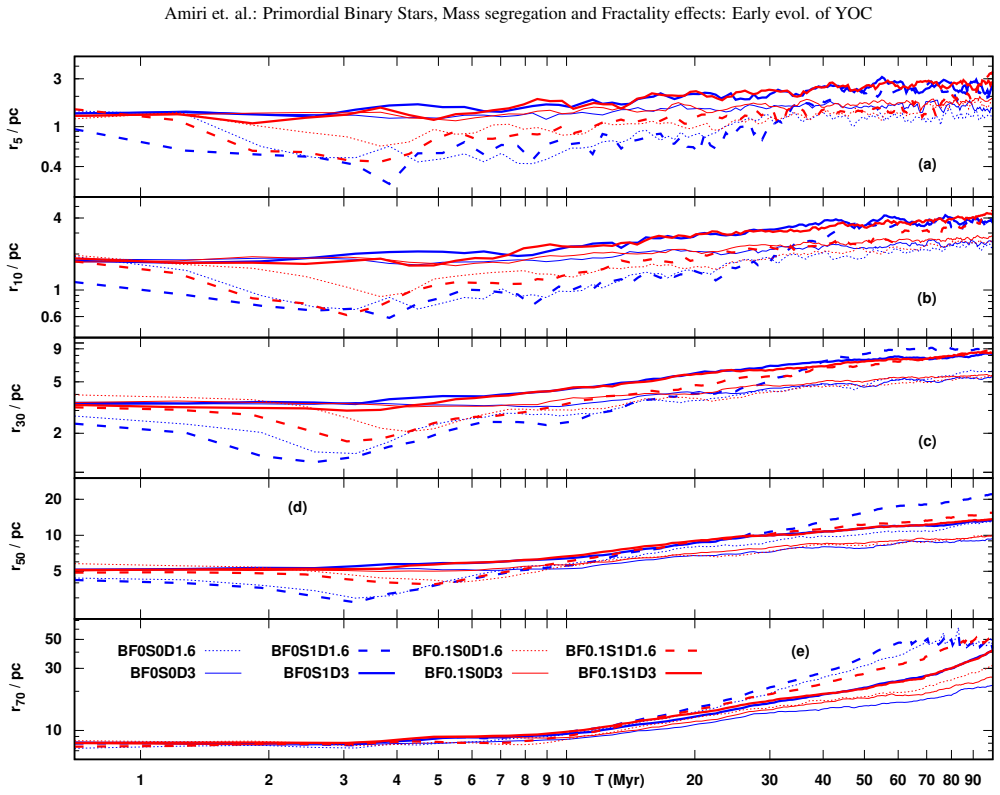
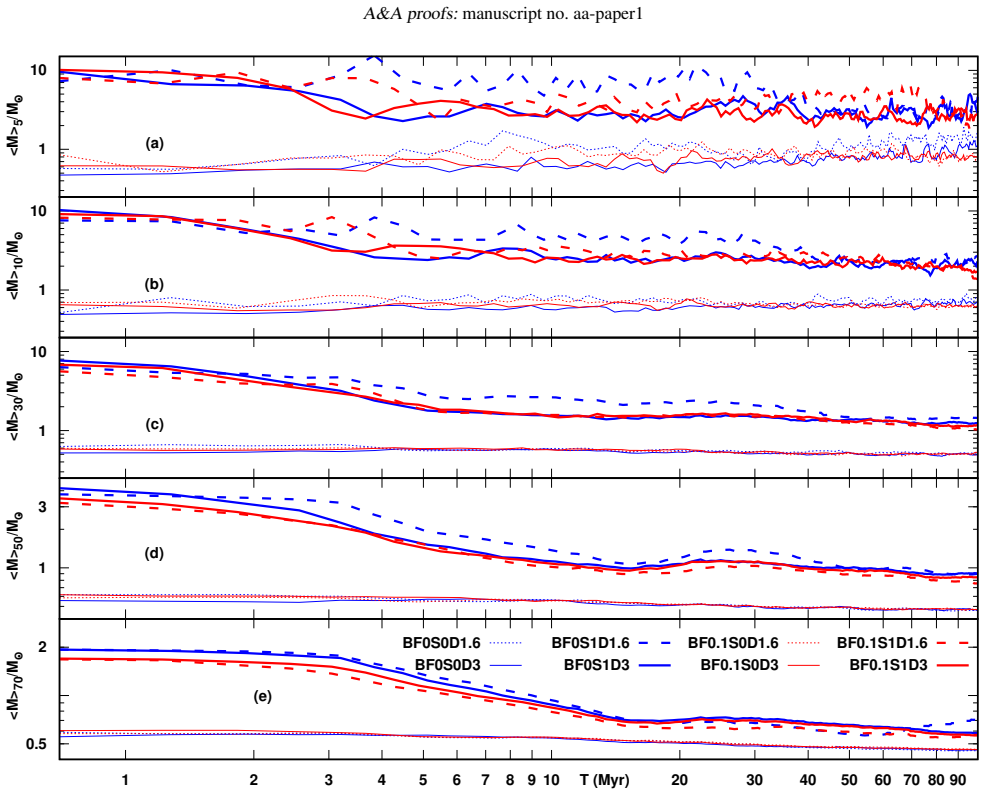
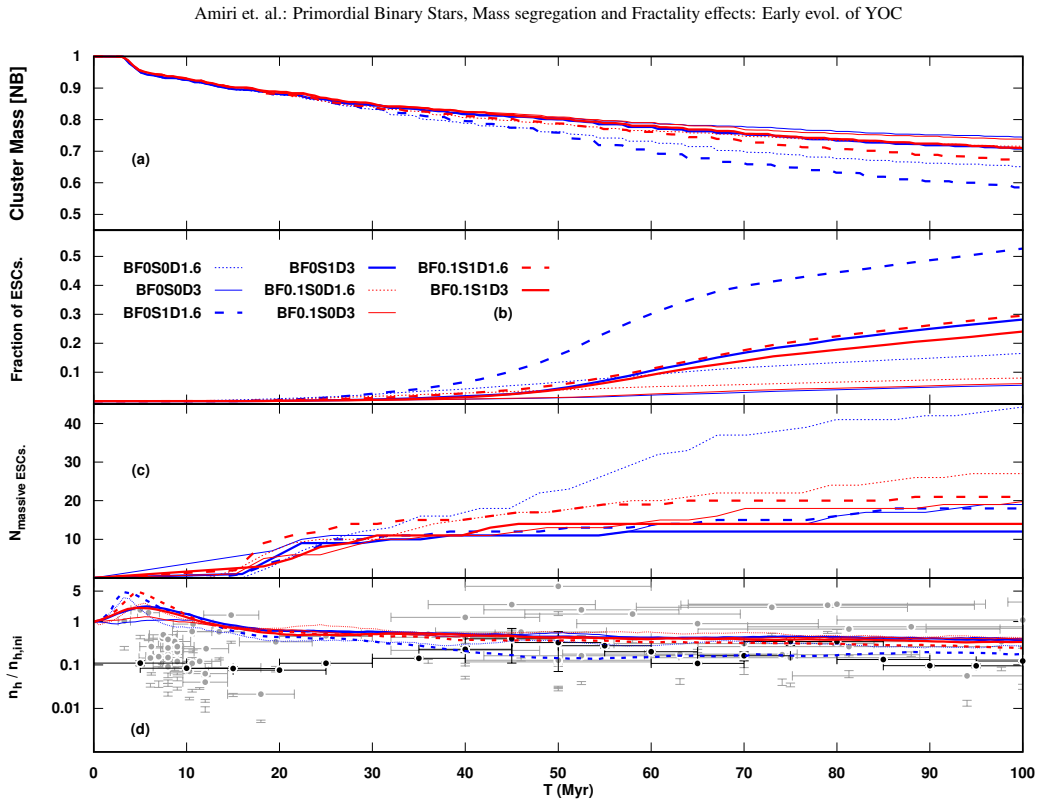
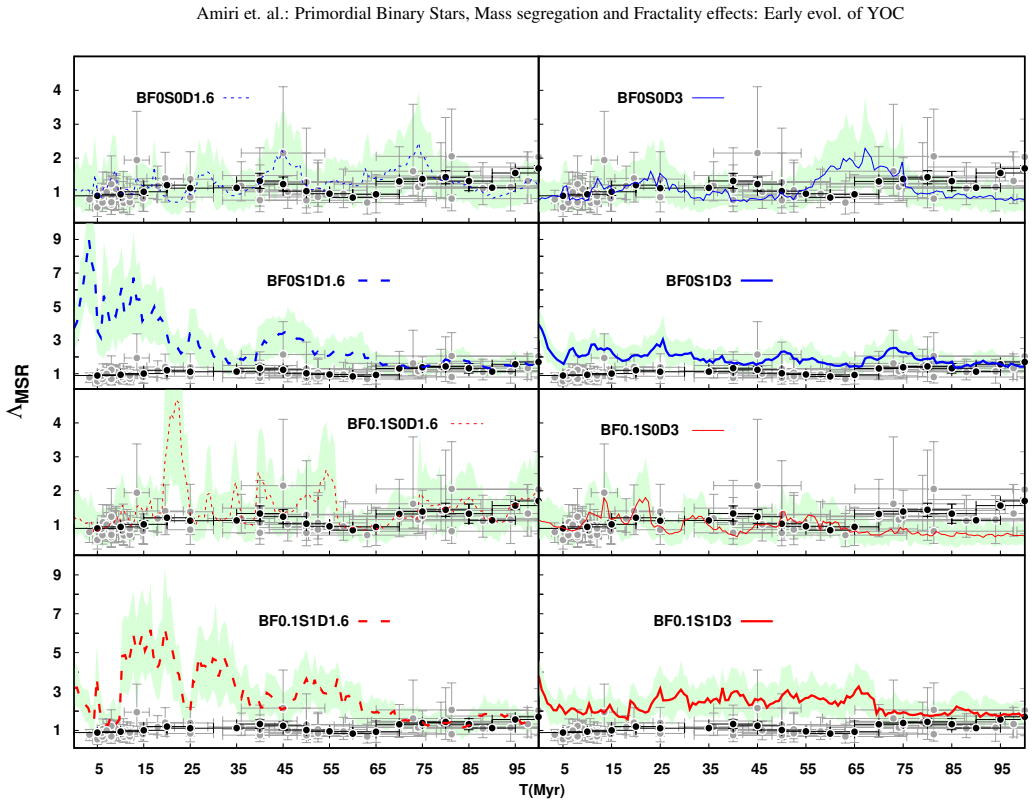
Simulations demonstrate that initial substructure postpones the core processes that drive early expansion and mass loss, and that comparison with observed young open clusters shows primordial mass segregation is not a fundamental requirement to match the data.
What carries the argument
N-body integrations of clusters initialized with fractal substructure, optional mass segregation, and primordial binaries, evolved forward and scored against observational structural metrics.
If this is right
- Substructure erases on a timescale of a few million years independent of mass segregation or binaries.
- Primordial mass segregation produces no early expansion once substructure is present.
- Loss of low-mass stars from the core is delayed when substructure is included.
- Observational properties of young clusters can be matched without primordial mass segregation.
Where Pith is reading between the lines
- Formation models may not need to imprint strong mass segregation if substructure is generic at birth.
- Age estimates for clusters a few million years old could shift if expansion is postponed by substructure.
- Targeted observations of the youngest clusters could test whether substructure alone explains the absence of mass segregation signatures.
Load-bearing premise
The specific initial conditions produced by the modified code are representative of real young clusters and the chosen metrics against the observational database are sufficient to rule out mass segregation as necessary.
What would settle it
A statistically clear sample of clusters younger than a few million years that exhibit early expansion or mass segregation signatures not reproducible by substructure alone.
Figures


read the original abstract
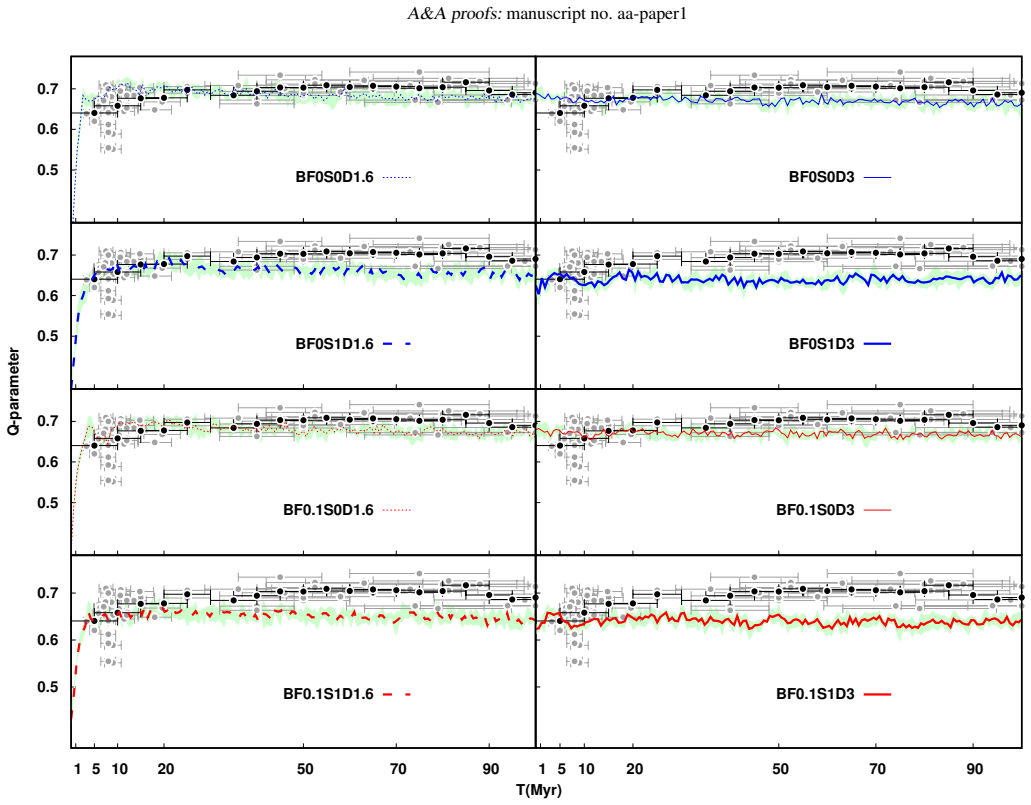
We want to understand how the combined effect of initial substructure, primordial mass segregation, and primordial binaries affects the dynamical evolution of the cluster, and which one of these features is the most important to agree with observations. Methods. We use Nbody6++GPU to simulate the dynamics of star clusters with initial substructure, primordial mass segregation, and primordial binaries, and we also study the relative importance of the processes. Initial models were generated by a modified version of McLuster, and we compared our results with observational data from Pang et al. 2022 database of open clusters. Our results show that primordial mass segregation and binaries do not change the result already obtained in previous works, as the time scale on which initial substructure disappears is of the order of few Myrs. However, we also find that in the presence of initial substructure, primordial mass segregation does not lead to an early expansion of the cluster. The processes in the core, discussed in previous works, lead to a loss of low mass stars and early expansion, are postponed in the presence of initial substructure. Finally, we find from comparison with observed clusters that primordial mass segregation is not a fundamental process to reproduce observational data.
Editorial analysis
A structured set of objections, weighed in public.
Referee Report
Summary. The paper uses N-body6++GPU simulations initialized with a modified McLuster code to explore the combined effects of initial substructure (fractality), primordial binaries, and primordial mass segregation on the early dynamical evolution of young open clusters. It compares the simulated clusters to the Pang et al. (2022) observational catalog and concludes that initial substructure erases on a few-Myr timescale, that primordial mass segregation does not produce the early expansion seen in prior work when substructure is present, and that primordial mass segregation is not a fundamental process needed to reproduce the observational data.
Significance. If the initial conditions span the plausible range and the comparison metrics have sufficient power, the result would indicate that substructure dominates early evolution and that mass segregation can be omitted from models without loss of fidelity to the Pang et al. sample. The direct N-body approach with GPU acceleration and the explicit inclusion of all three processes (fractality, binaries, segregation) in a single suite are positive features.
major comments (2)
- [Abstract, §4] Abstract and §4 (comparison with Pang et al. 2022): the central claim that 'primordial mass segregation is not a fundamental process' requires that the chosen observables (cluster radii, mass functions, segregation indicators) have sufficient dynamic range and precision to reveal a difference if mass segregation were dynamically important. No quantitative assessment of the statistical power of these metrics or of the overlap between the with/without-segregation runs is provided.
- [§2] §2 (initial conditions): the modified McLuster implementation of fractality and mass segregation is asserted to be representative of real primordial states, yet no validation against observed embedded-cluster properties (e.g., Q-parameter distributions or observed segregation levels) is shown. This assumption is load-bearing for the claim that the runs with and without primordial mass segregation are statistically indistinguishable once substructure is included.
minor comments (2)
- [§2] The description of how the fractality parameter and binary fraction are sampled across the simulation grid should be expanded for reproducibility.
- [Figures] Figure captions should explicitly state the number of realizations per model and the time at which each snapshot is shown.
Simulated Author's Rebuttal
We thank the referee for the constructive report and positive evaluation of the work's significance. We address the two major comments point by point below. Where appropriate we have revised the manuscript to strengthen the presentation of the results.
read point-by-point responses
-
Referee: [Abstract, §4] Abstract and §4 (comparison with Pang et al. 2022): the central claim that 'primordial mass segregation is not a fundamental process' requires that the chosen observables (cluster radii, mass functions, segregation indicators) have sufficient dynamic range and precision to reveal a difference if mass segregation were dynamically important. No quantitative assessment of the statistical power of these metrics or of the overlap between the with/without-segregation runs is provided.
Authors: We agree that an explicit quantitative assessment of overlap and statistical power would make the central claim more robust. In the revised manuscript we will add to §4 the results of two-sample Kolmogorov-Smirnov tests comparing the distributions of half-mass radius, present-day mass-function slope, and Λ_MSR between the primordial-mass-segregation and non-segregated runs at 1, 3 and 5 Myr (using the 10 realizations per model). We will also report the fractional overlap of the 1σ intervals for each observable. These additions will demonstrate that the differences remain statistically insignificant within the metric precision and sample size employed. revision: yes
-
Referee: [§2] §2 (initial conditions): the modified McLuster implementation of fractality and mass segregation is asserted to be representative of real primordial states, yet no validation against observed embedded-cluster properties (e.g., Q-parameter distributions or observed segregation levels) is shown. This assumption is load-bearing for the claim that the runs with and without primordial mass segregation are statistically indistinguishable once substructure is included.
Authors: The fractality (D = 1.6–2.0) and segregation (S = 0 or 0.5) parameters follow the standard McLuster prescriptions used in the literature to represent primordial conditions. To address the referee’s concern directly, the revised §2 will include a short validation subsection that computes the initial Q-parameter (Cartwright & Whitworth 2004) for our models and compares it with the observed range for embedded clusters (Q ≈ 0.3–0.8). Our D = 1.6 runs produce Q ≈ 0.5, which lies comfortably inside the observed distribution; the adopted segregation levels are likewise consistent with reported values. This addition confirms the representativeness of the initial conditions without changing the dynamical conclusions. revision: yes
Circularity Check
No circularity; simulation results compared to external observational database
full rationale
The paper generates initial conditions via a modified McLuster code, evolves them with Nbody6++GPU, and compares outputs (cluster radii, mass functions, expansion) directly to the independent Pang et al. 2022 observational database. The claim that primordial mass segregation is not fundamental follows from these external matches rather than any internal fit, self-definition, or reduction of a prediction to a fitted input. References to prior works supply context on core processes but are not load-bearing for the new conclusion, which rests on the simulation-versus-observation comparison. No equations or parameters reduce the result to the paper's own inputs by construction.
Axiom & Free-Parameter Ledger
free parameters (2)
- initial substructure parameters (fractality)
- primordial binary fraction
axioms (1)
- domain assumption N-body gravitational dynamics plus stellar evolution as implemented in Nbody6++GPU are sufficient to model the first few Myr of cluster evolution.
Reference graph
Works this paper leans on
-
[1]
Aarseth, S. J. 1999, PASP , 111, 1333
1999
-
[2]
Aarseth, S. J. 2003, Gravitational N-Body Simulations (Cambridge University Press)
2003
-
[3]
Abt, H. A. 1987, ApJ v. 317, p. 353, 317, 353
1987
-
[4]
Alfaro, E. J. & Román-Zúñiga, C. G. 2018, MNRAS, 478, L110
2018
-
[5]
J., Goodwin, S
Allison, R. J., Goodwin, S. P ., Parker, R. J., Zwart, S. F. P ., & de Grijs, R. 2010, MNRAS, 407, 1098 André, P ., Men’shchikov, A., Bontemps, S., et al. 2010, A&A, 518, L102 Arca sedda, M., Kamlah, A. W. H., Spurzem, R., et al. 2024, MNRAS, 528, 5140 Arca Sedda, M., Kamlah, A. W. H., Spurzem, R., et al. 2023, MNRAS, 526, 429
2010
-
[6]
& Wright, N
Arnold, B. & Wright, N. J. 2024, MNRAS, 531, 1191
2024
-
[7]
N., et al
Ballone, A., Mapelli, M., Di Carlo, U. N., et al. 2020, MNRAS, 496, 49
2020
-
[8]
2008, ApJ, 685, 247
Baumgardt, H., De Marchi, G., & Kroupa, P . 2008, ApJ, 685, 247
2008
-
[9]
M., & Jerabkova, T
Beccari, G., Bo ffin, H. M., & Jerabkova, T. 2020, MNRAS, 491, 2205
2020
-
[10]
2010, ApJ, 720, 1108
Beccari, G., Spezzi, L., De Marchi, G., et al. 2010, ApJ, 720, 1108
2010
-
[11]
J., & Giersz, M
Belloni, D., Kroupa, P ., Rocha-Pinto, H. J., & Giersz, M. 2018, MNRAS, 474, 3740
2018
-
[12]
& Tremaine, S
Binney, J. & Tremaine, S. 2011, Galactic dynamics, V ol. 13 (Princeton university press) Article number, page 11 of 12 A&A proofs: manuscript no. aa-paper1
2011
-
[13]
2026, ApJL, 1001, L33
Bissekenov, A., Pang, X., Spurzem, R., et al. 2026, ApJL, 1001, L33
2026
-
[14]
Bonnell, I. A. & Bate, M. R. 2006, MNRAS, 370, 488
2006
-
[15]
Bonnell, I. A. & Davies, M. B. 1998, MNRAS, 295, 691
1998
-
[16]
2012, MNRAS, 427, 127
Bressan, A., Marigo, P ., Girardi, L., et al. 2012, MNRAS, 427, 127
2012
-
[17]
G., V allenari, A., Prusti, T., et al
Brown, A. G., V allenari, A., Prusti, T., et al. 2021, A&A, 649, A1
2021
-
[18]
& Whitworth, A
Cartwright, A. & Whitworth, A. P . 2004, MNRAS, 348, 589
2004
-
[19]
Chevance, M., Kruijssen, J. M. D., Hygate, A. P . S., et al. 2020, MNRAS, 493, 2872
2020
-
[20]
P ., Marino, A
Cordoni, G., Milone, A. P ., Marino, A. F., et al. 2023, Astronomy & Astro- physics, 672, A29
2023
-
[21]
E., et al
Cournoyer-Cloutier, C., Sills, A., Harris, W. E., et al. 2024, AJ, 977, 203
2024
-
[22]
2021, MNRAS, 501, 4464 Daffern-Powell, E
Cournoyer-Cloutier, C., Tran, A., Lewis, S., et al. 2021, MNRAS, 501, 4464 Daffern-Powell, E. C. & Parker, R. J. 2020, MNRAS, 493, 4925 De Grijs, R., Johnson, R., Gilmore, G., & Frayn, C. 2002, MNRAS, 331, 228
2021
-
[23]
2017, MNRAS, 465, 2198
Dorval, J., Boily, C., Moraux, E., & Roos, O. 2017, MNRAS, 465, 2198
2017
-
[24]
& Mayor, M
Duquennoy, A. & Mayor, M. 1991, A&A, 248, 485
1991
-
[25]
S., Wang, L., Hirai, Y ., et al
Fujii, M. S., Wang, L., Hirai, Y ., et al. 2022, MNRAS, 514, 2513
2022
-
[26]
Fujii, M. S. & Zwart, S. P . 2011, Science, 334, 1380
2011
-
[27]
2017, MNRAS, 472, 4155
Gavagnin, E., Bleuler, A., Rosdahl, J., & Teyssier, R. 2017, MNRAS, 472, 4155
2017
-
[28]
Goodwin, S. P . & Whitworth, A. P . 2004, A&A, 413, 929
2004
-
[29]
2004, A&A, 416, 137
Gouliermis, D., Keller, S., Kontizas, M., Kontizas, E., & Bellas-V elidis, I. 2004, A&A, 416, 137
2004
-
[30]
& Hetem, A
Gregorio-Hetem, J. & Hetem, A. 2024, MNRAS, 533, 1782
2024
-
[31]
M., Zonoozi, A
Haghi, H., Hoseini-Rad, S. M., Zonoozi, A. H., & Küpper, A. H. W. 2014, MN- RAS, 444, 3699
2014
-
[32]
& Gregorio-Hetem, J
Hetem, A. & Gregorio-Hetem, J. 2019, MNRAS, 490, 2521
2019
-
[33]
2024, ApJ, 971, 71
Jiang, Y ., Zhong, J., Qin, S., et al. 2024, ApJ, 971, 71
2024
-
[34]
2011, A&A, 528, A144
Kaczmarek, T., Olczak, C., & Pfalzner, S. 2011, A&A, 528, A144
2011
-
[35]
Kamlah, A. W. H., Leveque, A., Spurzem, R., et al. 2022, MNRAS, 511, 4060
2022
-
[36]
& Sills, A
Karam, J. & Sills, A. 2023, MNRAS, 521, 5557
2023
-
[37]
1962, AJ, V ol
King, I. 1962, AJ, V ol. 67, p. 471 (1962), 67, 471
1962
-
[38]
G., Offner, S
Krause, M. G., Offner, S. S., Charbonnel, C., et al. 2020, Space Science Reviews, 216, 1
2020
-
[39]
1995, MNRAS, 277, 1491
Kroupa, P . 1995, MNRAS, 277, 1491
1995
-
[40]
2001, MNRAS, 322, 231
Kroupa, P . 2001, MNRAS, 322, 231
2001
-
[41]
2008, The Cambridge N-Body Lectures, 181
Kroupa, P . 2008, The Cambridge N-Body Lectures, 181
2008
-
[42]
2001, MNRAS, 321, 699
Kroupa, P ., Aarseth, S., & Hurley, J. 2001, MNRAS, 321, 699
2001
-
[43]
G., & McCaughrean, M
Kroupa, P ., Petr, M. G., & McCaughrean, M. J. 1999, New Astronomy, 4, 495
1999
-
[44]
Kruijssen, J. D. 2014, Class. Quantum Grav., 31, 244006
2014
-
[45]
R., Klein, R
Krumholz, M. R., Klein, R. I., & McKee, C. F. 2007, ApJ, 656, 959
2007
-
[46]
2012, ApJ, 750, L44
Kudryavtseva, N., Brandner, W., Gennaro, M., et al. 2012, ApJ, 750, L44
2012
-
[47]
A., Feigelson, E
Kuhn, M. A., Feigelson, E. D., Getman, K. V ., et al. 2015, ApJ, 812, 131 Küpper, A. H., Maschberger, T., Kroupa, P ., & Baumgardt, H. 2011, MNRAS, 417, 2300
2015
-
[48]
Lada, C. J. & Lada, E. A. 2003, Annu. Rev. Astron. Astrophys., 41, 57
2003
-
[49]
2025, ApJ, 989, 22
Laverde-Villarreal, E., Sills, A., Cournoyer-Cloutier, C., & Arias Callejas, V . 2025, ApJ, 989, 22
2025
-
[50]
1993, A&A, 278, 129
Leinert, C., Zinnecker, H., Weitzel, N., et al. 1993, A&A, 278, 129
1993
-
[51]
2021, MNRAS, 501, 5212
Leveque, A., Giersz, M., & Paolillo, M. 2021, MNRAS, 501, 5212
2021
-
[52]
2013, MNRAS, 436, 1497
Li, C., De Grijs, R., & Deng, L. 2013, MNRAS, 436, 1497
2013
-
[53]
Lomax, O., Bates, M., & Whitworth, A. P . 2018, MNRAS, 480, 371
2018
-
[54]
N., Kruijssen, J
Longmore, S. N., Kruijssen, J. M. D., Bastian, N., et al. 2014, in Protostars and Planets VI, 291–314
2014
-
[55]
& Kroupa, P
Marks, M. & Kroupa, P . 2012, A&A, 543, A8
2012
-
[56]
L., V esperini, E., & Zwart, S
McMillan, S. L., V esperini, E., & Zwart, S. F. P . 2007, AJ, 655, L45
2007
-
[57]
P ., Piotto, G., Bedin, L
Milone, A. P ., Piotto, G., Bedin, L. R., et al. 2012, A&A, 540, A16
2012
-
[58]
Nitadori, K. & Aarseth, S. J. 2012, MNRAS, 424, 545 Offner, S. S., Moe, M., Kratter, K. M., et al. 2022, arXiv preprint arXiv:2203.10066
Pith/arXiv arXiv 2012
-
[59]
2015, ApJ, 805, 92
Oh, S., Kroupa, P ., & Pflamm-Altenburg, J. 2015, ApJ, 805, 92
2015
-
[60]
K., Allison, R
Pang, X., Grebel, E. K., Allison, R. J., et al. 2013, ApJ, 764, 73
2013
-
[61]
2024, ApJ, 966, 169
Pang, X., Liao, S., Li, J., et al. 2024, ApJ, 966, 169
2024
-
[62]
2022, ApJ, 931, 156
Pang, X., Tang, S.-Y ., Li, Y ., et al. 2022, ApJ, 931, 156
2022
-
[63]
2023, AJ, 166, 110
Pang, X., Wang, Y ., Tang, S.-Y ., et al. 2023, AJ, 166, 110
2023
-
[64]
2021, ApJ, 923, 20
Pang, X., Y u, Z., Tang, S.-Y ., et al. 2021, ApJ, 923, 20
2021
-
[65]
J., Goodwin, S
Parker, R. J., Goodwin, S. P ., Wright, N. J., Meyer, M. R., & Quanz, S. P . 2016, MNRAS, 459, L119
2016
-
[66]
Parker, R. J. & Schoettler, C. 2022, MNRAS, 510, 1136
2022
-
[67]
J., Wright, N
Parker, R. J., Wright, N. J., Goodwin, S. P ., & Meyer, M. R. 2014, MNRAS, 438, 620 Pavlík, V . 2020, A&A, 638, A155
2014
-
[68]
Perets, H. B. & Šubr, L. 2012, ApJ, 751, 133
2012
-
[69]
S., et al
Polak, B., Mac Low, M.-M., Klessen, R. S., et al. 2025, A&A, 695, A188 Portegies Zwart, S. F., McMillan, S. L., & Gieles, M. 2010, Annu. Rev. Astron. Astrophys., 48, 431 Ramírez-Tannus, M. C., Derkink, A. R., Backs, F., et al. 2024, A&A, 690, A178
2025
-
[70]
2020, ApJ, 896, 152
Rastello, S., Carraro, G., & Capuzzo-Dolcetta, R. 2020, ApJ, 896, 152
2020
-
[71]
M., Connelley, M
Reipurth, B., Guimaraes, M. M., Connelley, M. S., & Bally, J. 2007, AJ, 134, 2272
2007
-
[72]
J., Hurley, J
Rossi, L. J., Hurley, J. R., & Bekki, K. 2017, MNRAS, 468, 4441
2017
-
[73]
2012, Science, 337, 444
Sana, H., De Mink, S., de Koter, A., et al. 2012, Science, 337, 444
2012
-
[74]
2018, MNRAS, 477, 1903
Sills, A., Rieder, S., Scora, J., McCloskey, J., & Ja ffa, S. 2018, MNRAS, 477, 1903
2018
-
[75]
1999, JCAM, 109, 407
Spurzem, R. 1999, JCAM, 109, 407
1999
-
[76]
& Kamlah, A
Spurzem, R. & Kamlah, A. 2023, Living Reviews in Computational Astro- physics, 9, 3
2023
-
[77]
2021, MNRAS, 507, 2253 V esperini, E., McMillan, S
Torniamenti, S., Ballone, A., Mapelli, M., et al. 2021, MNRAS, 507, 2253 V esperini, E., McMillan, S. L., & Zwart, S. P . 2009, AJ, 698, 615
2021
-
[78]
2016, MNRAS, 458, 1450
Wang, L., Spurzem, R., Aarseth, S., et al. 2016, MNRAS, 458, 1450
2016
-
[79]
2015, MNRAS, 450, 4070
Wang, L., Spurzem, R., Aarseth, S., et al. 2015, MNRAS, 450, 4070
2015
-
[80]
Wang, L., Tanikawa, A., & Fujii, M. S. 2022, MNRAS, 509, 4713 Y u, J., Puzia, T. H., Lin, C., & Zhang, Y . 2017, ApJ, 840, 91
2022
discussion (0)
Sign in with ORCID, Apple, or X to comment. Anyone can read and Pith papers without signing in.